
Branch Hazards Handling Branches 1 Consider executing this
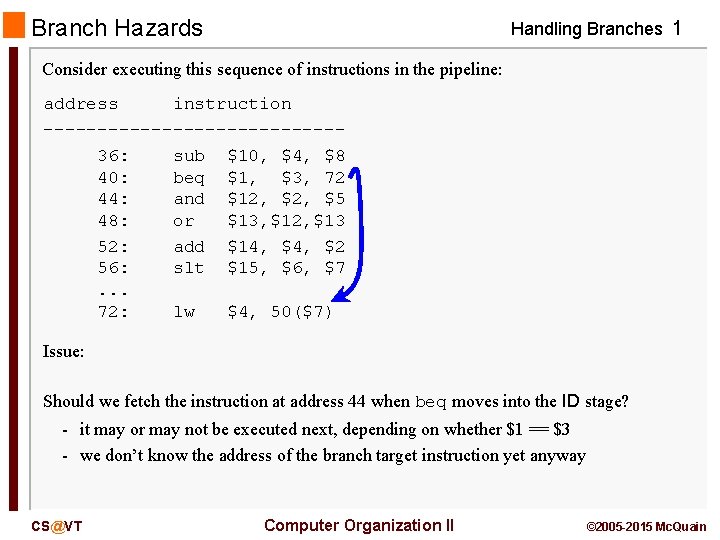
Branch Hazards Handling Branches 1 Consider executing this sequence of instructions in the pipeline: address instruction --------------36: sub $10, $4, $8 40: beq $1, $3, 72 44: and $12, $5 48: or $13, $12, $13 52: add $14, $2 56: slt $15, $6, $7. . . 72: lw $4, 50($7) Issue: Should we fetch the instruction at address 44 when beq moves into the ID stage? - it may or may not be executed next, depending on whether $1 == $3 - we don’t know the address of the branch target instruction yet anyway CS@VT Computer Organization II © 2005 -2015 Mc. Quain
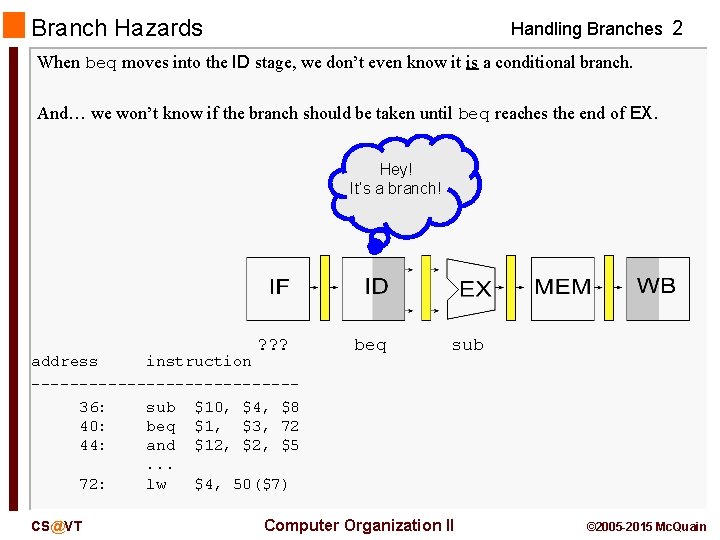
Branch Hazards Handling Branches 2 When beq moves into the ID stage, we don’t even know it is a conditional branch. And… we won’t know if the branch should be taken until beq reaches the end of EX. Hey! It’s a branch! ? ? ? address instruction --------------36: sub $10, $4, $8 40: beq $1, $3, 72 44: and $12, $5. . . 72: lw $4, 50($7) CS@VT beq sub Computer Organization II © 2005 -2015 Mc. Quain
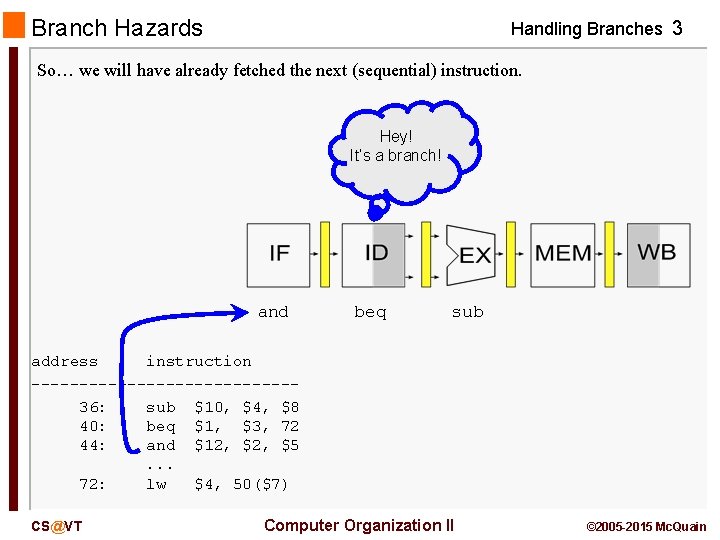
Branch Hazards Handling Branches 3 So… we will have already fetched the next (sequential) instruction. Hey! It’s a branch! and beq sub address instruction --------------36: sub $10, $4, $8 40: beq $1, $3, 72 44: and $12, $5. . . 72: lw $4, 50($7) CS@VT Computer Organization II © 2005 -2015 Mc. Quain
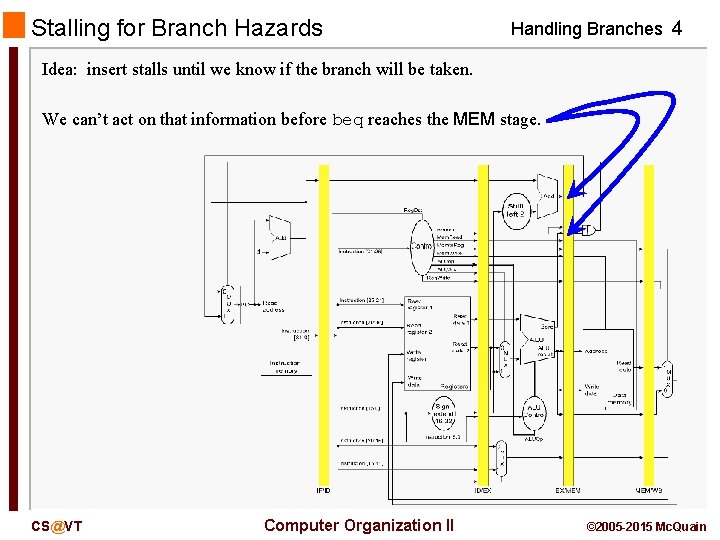
Stalling for Branch Hazards Handling Branches 4 Idea: insert stalls until we know if the branch will be taken. We can’t act on that information before beq reaches the MEM stage. CS@VT Computer Organization II © 2005 -2015 Mc. Quain
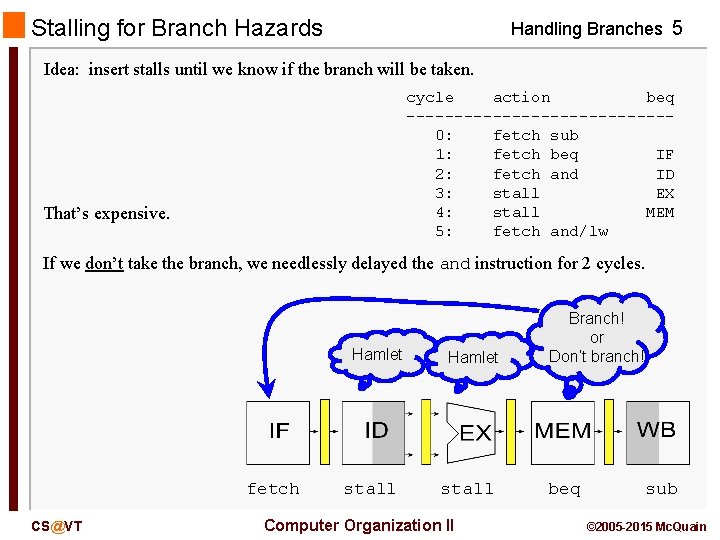
Stalling for Branch Hazards Handling Branches 5 Idea: insert stalls until we know if the branch will be taken. cycle action beq --------------0: fetch sub 1: fetch beq IF 2: fetch and ID 3: stall EX 4: stall MEM 5: fetch and/lw That’s expensive. If we don’t take the branch, we needlessly delayed the and instruction for 2 cycles. Hamlet fetch CS@VT stall Hamlet stall Computer Organization II Branch! or Don’t branch! beq sub © 2005 -2015 Mc. Quain
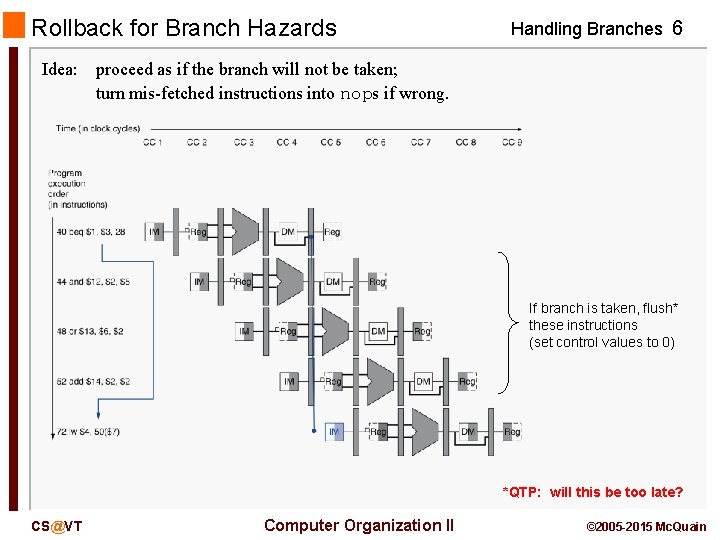
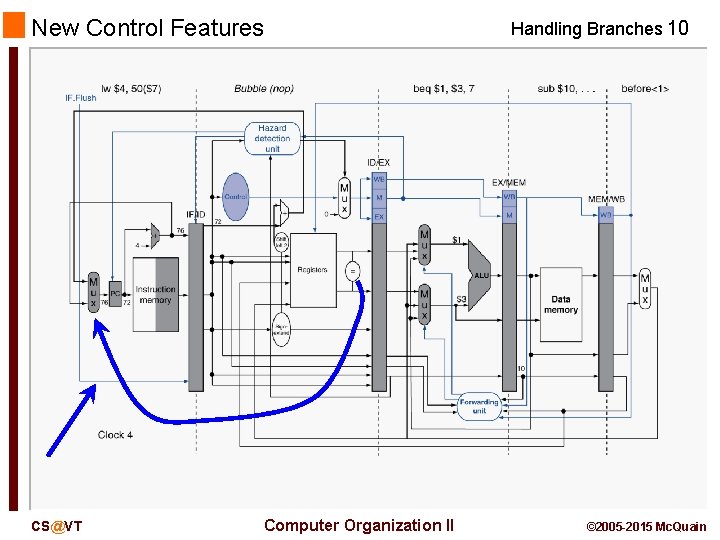
Rollback for Branch Hazards Handling Branches 6 Idea: proceed as if the branch will not be taken; turn mis-fetched instructions into nops if wrong. If branch is taken, flush* these instructions (set control values to 0) *QTP: will this be too late? CS@VT Computer Organization II © 2005 -2015 Mc. Quain
Questions Handling Branches 7 Could we rearrange the datapath so that the branch decision could be made earlier? Questions to ponder: - What about calculating the branch target address? Can that be done in the ID stage? - What about the register comparison? Can that be done in the ID stage? What about other kinds of conditional branches (e. g. , bgez, )? CS@VT Computer Organization II © 2005 -2015 Mc. Quain
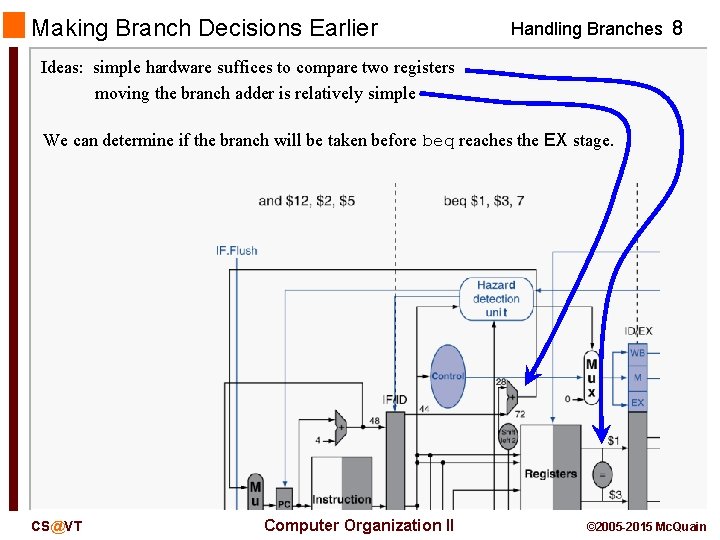
Making Branch Decisions Earlier Handling Branches 8 Ideas: simple hardware suffices to compare two registers moving the branch adder is relatively simple We can determine if the branch will be taken before beq reaches the EX stage. CS@VT Computer Organization II © 2005 -2015 Mc. Quain
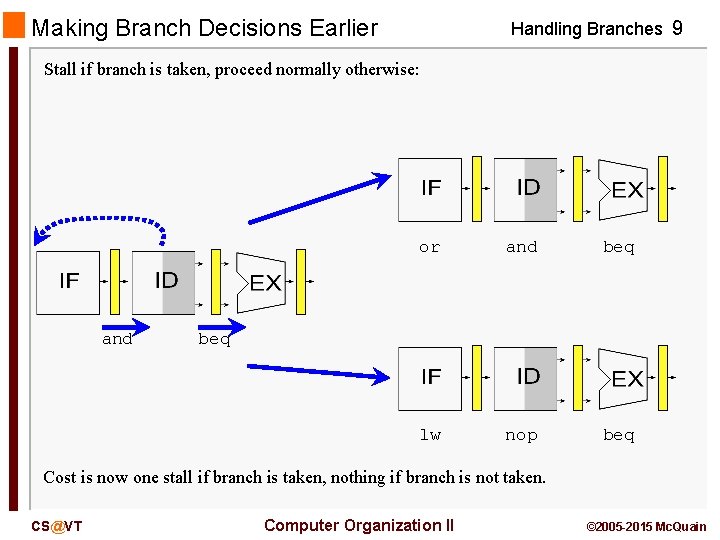
Making Branch Decisions Earlier Handling Branches 9 Stall if branch is taken, proceed normally otherwise: and or and beq lw nop beq Cost is now one stall if branch is taken, nothing if branch is not taken. CS@VT Computer Organization II © 2005 -2015 Mc. Quain
New Control Features CS@VT Computer Organization II Handling Branches 10 © 2005 -2015 Mc. Quain
The Big (but not quite final) Picture CS@VT Computer Organization II Handling Branches 11 © 2005 -2015 Mc. Quain
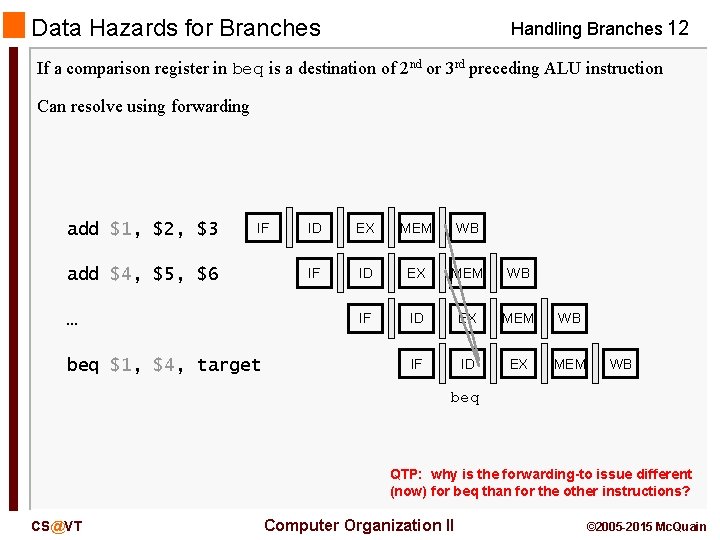
Data Hazards for Branches Handling Branches 12 If a comparison register in beq is a destination of 2 nd or 3 rd preceding ALU instruction Can resolve using forwarding add $1, $2, $3 IF add $4, $5, $6 … beq $1, $4, target ID EX MEM WB IF ID EX MEM WB beq QTP: why is the forwarding-to issue different (now) for beq than for the other instructions? CS@VT Computer Organization II © 2005 -2015 Mc. Quain
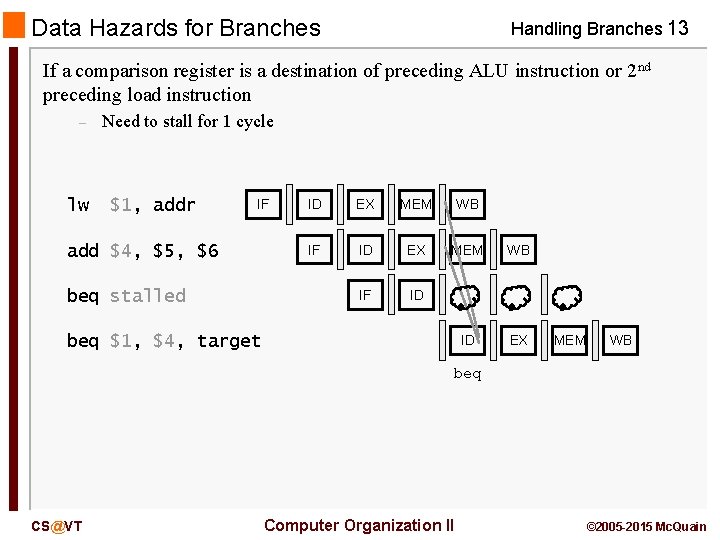
Data Hazards for Branches Handling Branches 13 If a comparison register is a destination of preceding ALU instruction or 2 nd preceding load instruction – lw Need to stall for 1 cycle $1, addr IF add $4, $5, $6 beq stalled ID EX MEM WB IF ID ID EX beq $1, $4, target MEM WB beq CS@VT Computer Organization II © 2005 -2015 Mc. Quain
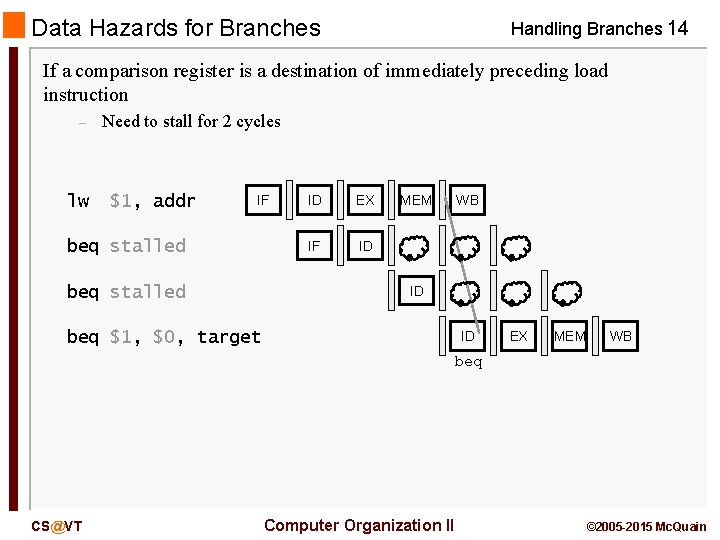
Data Hazards for Branches Handling Branches 14 If a comparison register is a destination of immediately preceding load instruction – lw Need to stall for 2 cycles $1, addr IF beq stalled ID EX IF ID MEM WB ID ID beq $1, $0, target EX MEM WB beq CS@VT Computer Organization II © 2005 -2015 Mc. Quain
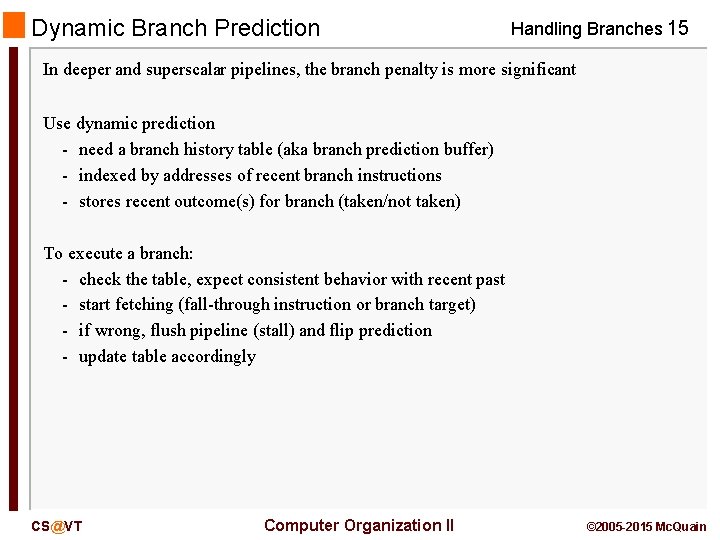
Dynamic Branch Prediction Handling Branches 15 In deeper and superscalar pipelines, the branch penalty is more significant Use dynamic prediction - need a branch history table (aka branch prediction buffer) - indexed by addresses of recent branch instructions - stores recent outcome(s) for branch (taken/not taken) To execute a branch: - check the table, expect consistent behavior with recent past - start fetching (fall-through instruction or branch target) - if wrong, flush pipeline (stall) and flip prediction - update table accordingly CS@VT Computer Organization II © 2005 -2015 Mc. Quain
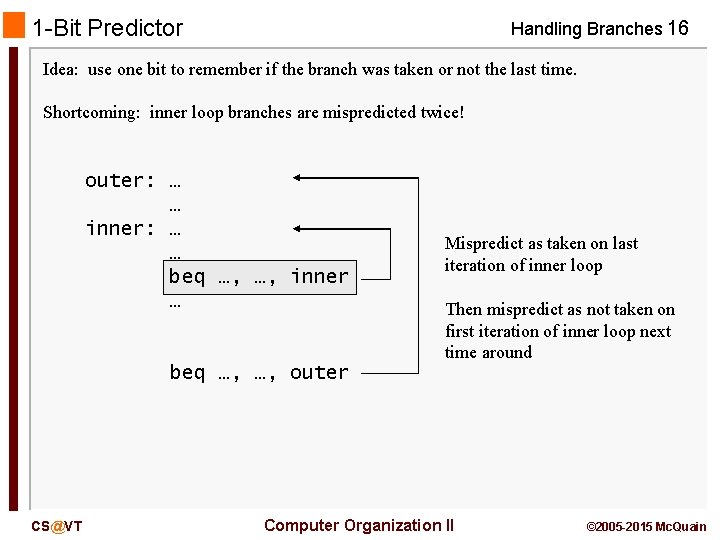
1 -Bit Predictor Handling Branches 16 Idea: use one bit to remember if the branch was taken or not the last time. Shortcoming: inner loop branches are mispredicted twice! outer: … … inner: … … beq …, …, inner … Mispredict as taken on last iteration of inner loop Then mispredict as not taken on first iteration of inner loop next time around beq …, …, outer CS@VT Computer Organization II © 2005 -2015 Mc. Quain
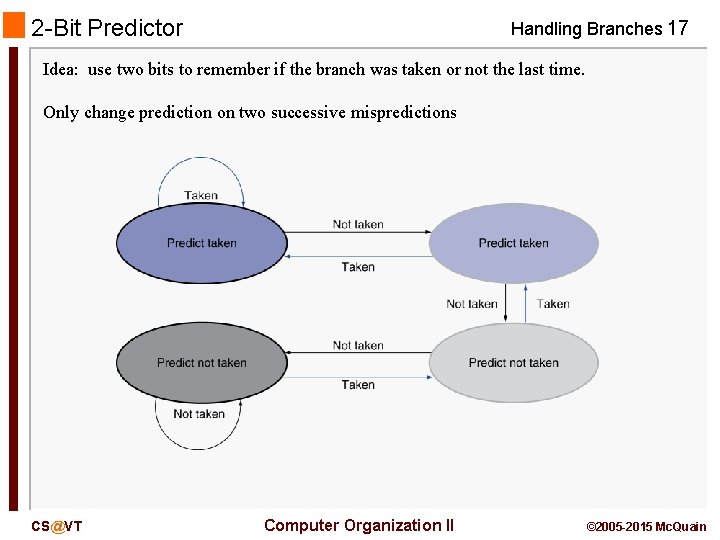
2 -Bit Predictor Handling Branches 17 Idea: use two bits to remember if the branch was taken or not the last time. Only change prediction on two successive mispredictions CS@VT Computer Organization II © 2005 -2015 Mc. Quain
Calculating the Branch Target Handling Branches 18 Even with predictor, still need to calculate the target address - 1 -cycle penalty if branch is taken Branch target buffer - Add a cache of target addresses - Indexed by PC when instruction is fetched - If hit (i. e. , target address is in cache) and instruction is branch predicted taken, can fetch target immediately CS@VT Computer Organization II © 2005 -2015 Mc. Quain
- Slides: 18