
Branch Coverage Squeezing more out of LLVM Sourcebased
Branch Coverage: Squeezing more out of LLVM Source-based Code Coverage Alan Phipps, Texas Instruments 2020 LLVM Developers’ Meeting 1
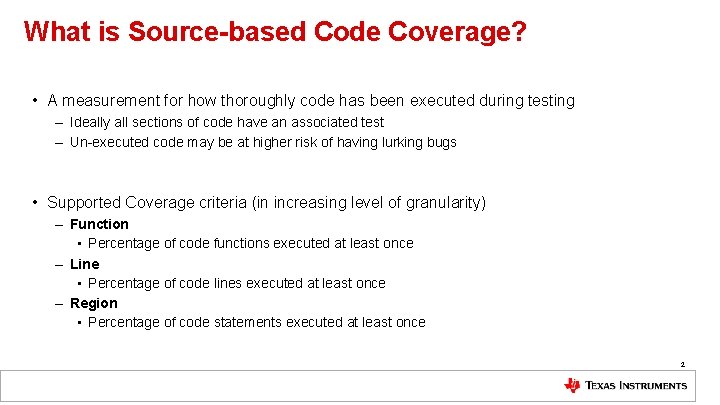
What is Source-based Code Coverage? • A measurement for how thoroughly code has been executed during testing – Ideally all sections of code have an associated test – Un-executed code may be at higher risk of having lurking bugs • Supported Coverage criteria (in increasing level of granularity) – Function • Percentage of code functions executed at least once – Line • Percentage of code lines executed at least once – Region • Percentage of code statements executed at least once 2
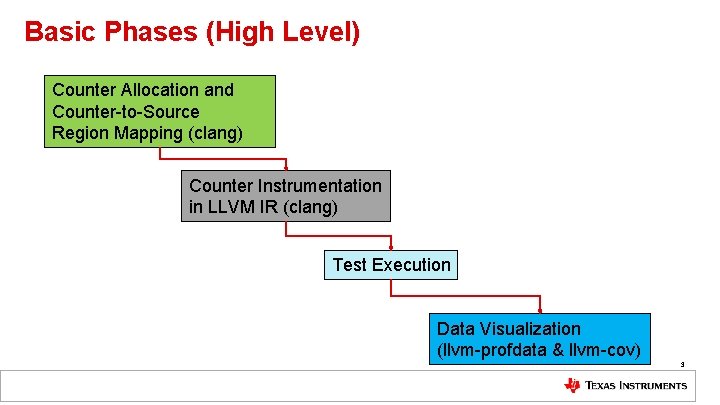
Basic Phases (High Level) Counter Allocation and Counter-to-Source Region Mapping (clang) Counter Instrumentation in LLVM IR (clang) Test Execution Data Visualization (llvm-profdata & llvm-cov) 3
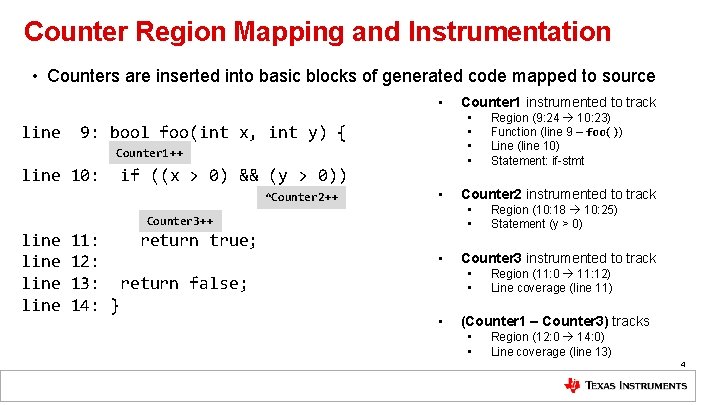
Counter Region Mapping and Instrumentation • Counters are inserted into basic blocks of generated code mapped to source • line • • 9: bool foo(int x, int y) { Counter 1++ line 10: if ((x > 0) && (y > 0)) ^Counter 2++ • 11: return true; 12: 13: return false; 14: } • Region (10: 18 10: 25) Statement (y > 0) Counter 3 instrumented to track • • • Region (9: 24 10: 23) Function (line 9 – foo()) Line (line 10) Statement: if-stmt Counter 2 instrumented to track • • Counter 3++ line Counter 1 instrumented to track Region (11: 0 11: 12) Line coverage (line 11) (Counter 1 – Counter 3) tracks • • Region (12: 0 14: 0) Line coverage (line 13) 4
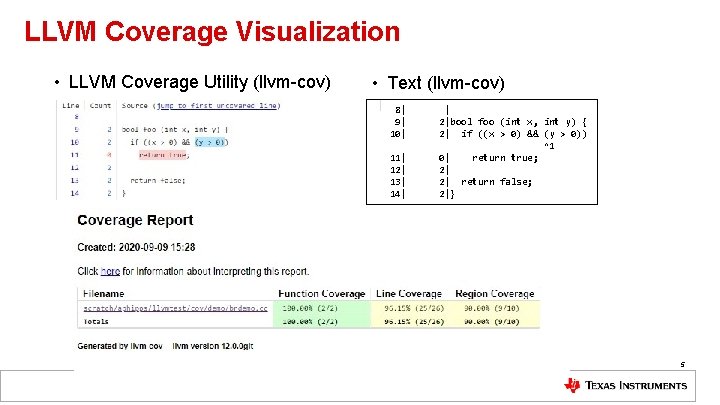
LLVM Coverage Visualization • LLVM Coverage Utility (llvm-cov) • Text (llvm-cov) 8| 9| 10| 11| 12| 13| 14| | 2|bool foo (int x, int y) { 2| if ((x > 0) && (y > 0)) ^1 0| return true; 2| 2| return false; 2|} 5
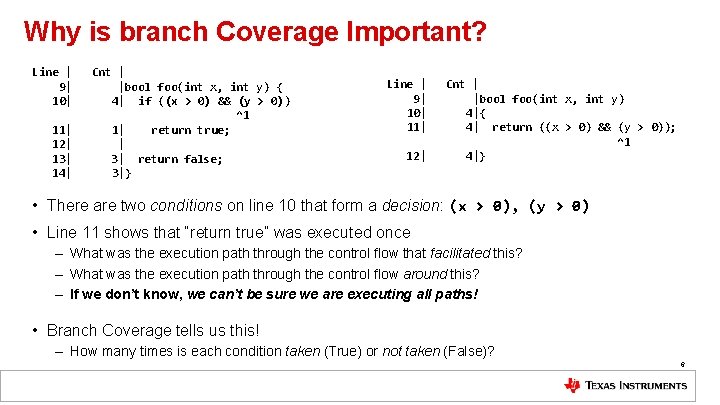
Why is branch Coverage Important? Line | 9| 10| 11| 12| 13| 14| Cnt | |bool foo(int x, int y) { 4| if ((x > 0) && (y > 0)) ^1 1| return true; | 3| return false; 3|} Line | 9| 10| 11| 12| Cnt | |bool foo(int x, int y) 4|{ 4| return ((x > 0) && (y > 0)); ^1 4|} • There are two conditions on line 10 that form a decision: (x > 0), (y > 0) • Line 11 shows that “return true” was executed once – What was the execution path through the control flow that facilitated this? – What was the execution path through the control flow around this? – If we don’t know, we can’t be sure we are executing all paths! • Branch Coverage tells us this! – How many times is each condition taken (True) or not taken (False)? 6
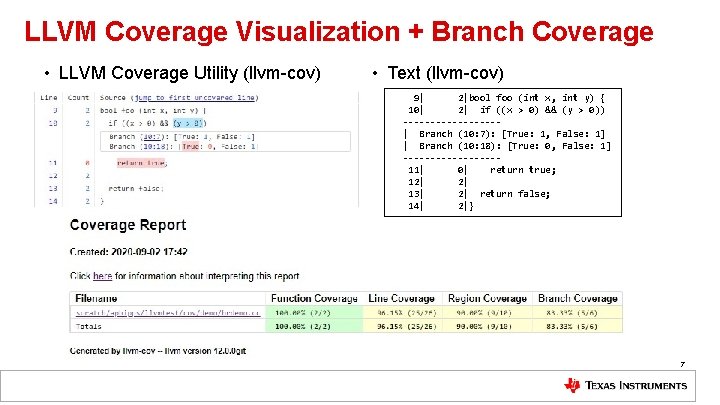
LLVM Coverage Visualization + Branch Coverage • LLVM Coverage Utility (llvm-cov) • Text (llvm-cov) 9| 2|bool foo (int x, int y) { 10| 2| if ((x > 0) && (y > 0)) ---------| Branch (10: 7): [True: 1, False: 1] | Branch (10: 18): [True: 0, False: 1] ---------11| 0| return true; 12| 2| 13| 2| return false; 14| 2|} 7

Goal: Ensure 100% Branch Coverage • C short-circuit semantics on logical operators – Testing all individual conditions also tests corresponding decisions bool foo(int x, int y) { if ((x > 0) && (y > 0)) return true; return false; } foo(1, 0): (x > 0) = true (y > 0) = false (x > 0) && (y > 0) = false foo(0, 1): (x > 0) = false (y > 0) = … not executed! (x > 0) && (y > 0) = false foo(1, 1): (x > 0) = true (y > 0) = true (x > 0) && (y > 0) = true 8
How is Branch Coverage implemented? 9
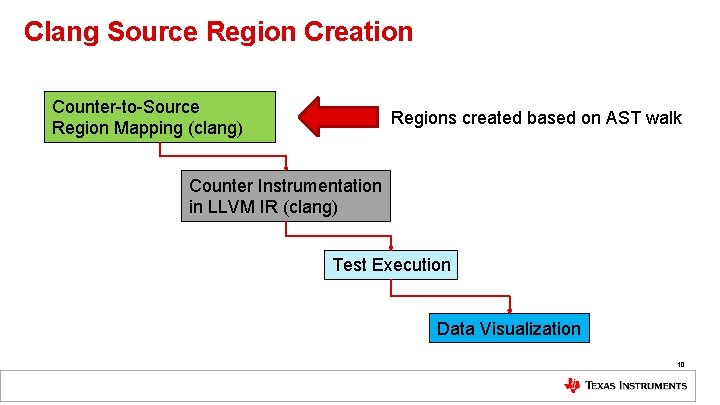
Clang Source Region Creation Counter-to-Source Region Mapping (clang) Regions created based on AST walk Counter Instrumentation in LLVM IR (clang) Test Execution Data Visualization 10
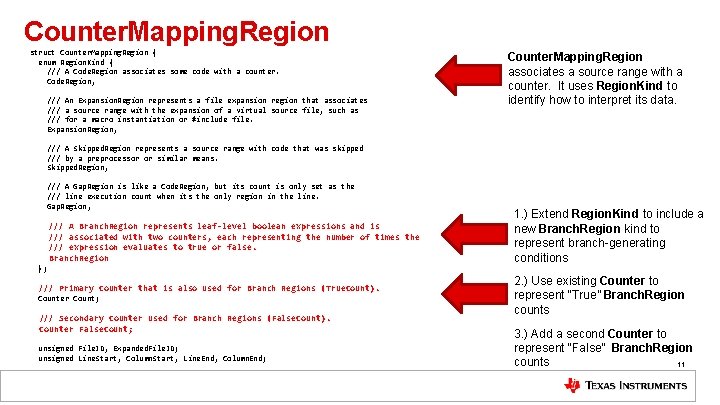
Counter. Mapping. Region struct Counter. Mapping. Region { enum Region. Kind { /// A Code. Region associates some code with a counter. Code. Region, /// An Expansion. Region represents a file expansion region that associates /// a source range with the expansion of a virtual source file, such as /// for a macro instantiation or #include file. Expansion. Region, Counter. Mapping. Region associates a source range with a counter. It uses Region. Kind to identify how to interpret its data. /// A Skipped. Region represents a source range with code that was skipped /// by a preprocessor or similar means. Skipped. Region, /// A Gap. Region is like a Code. Region, but its count is only set as the /// line execution count when its the only region in the line. Gap. Region, /// A Branch. Region represents leaf-level boolean expressions and is /// associated with two counters, each representing the number of times the /// expression evaluates to true or false. Branch. Region }; /// Primary Counter that is also used for Branch Regions (True. Count). Counter Count; /// Secondary Counter used for Branch Regions (False. Count). Counter False. Count; unsigned File. ID, Expanded. File. ID; unsigned Line. Start, Column. Start, Line. End, Column. End; 1. ) Extend Region. Kind to include a new Branch. Region kind to represent branch-generating conditions 2. ) Use existing Counter to represent “True” Branch. Region counts 3. ) Add a second Counter to represent “False” Branch. Region counts 11
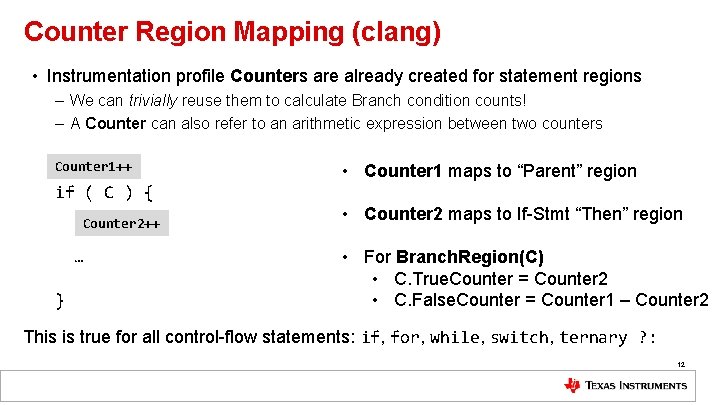
Counter Region Mapping (clang) • Instrumentation profile Counters are already created for statement regions – We can trivially reuse them to calculate Branch condition counts! – A Counter can also refer to an arithmetic expression between two counters Counter 1++ • Counter 1 maps to “Parent” region if ( C ) { Counter 2++ … } • Counter 2 maps to If-Stmt “Then” region • For Branch. Region(C) • C. True. Counter = Counter 2 • C. False. Counter = Counter 1 – Counter 2 This is true for all control-flow statements: if, for, while, switch, ternary ? : 12
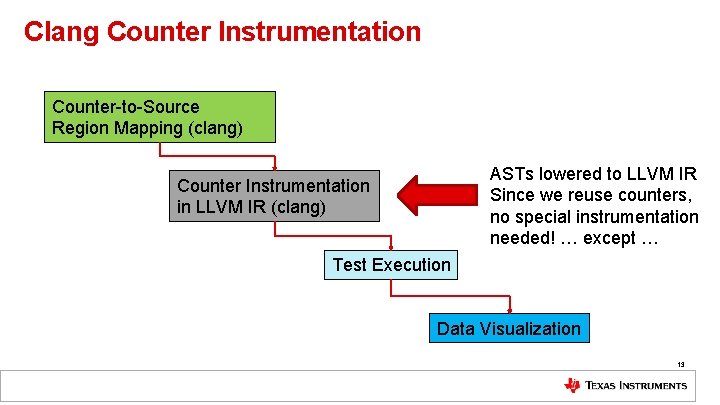
Clang Counter Instrumentation Counter-to-Source Region Mapping (clang) ASTs lowered to LLVM IR Since we reuse counters, no special instrumentation needed! … except … Counter Instrumentation in LLVM IR (clang) Test Execution Data Visualization 13
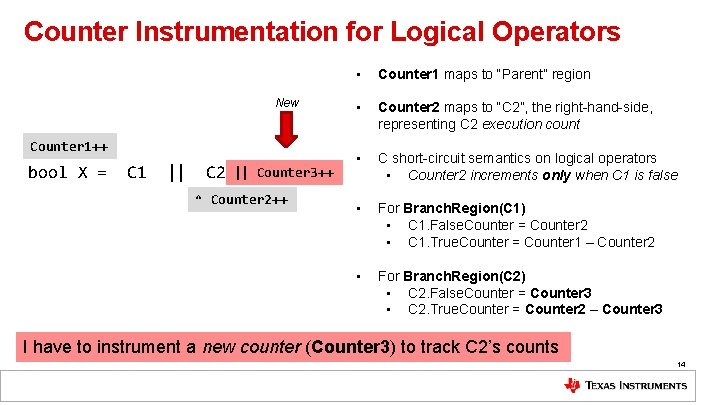
Counter Instrumentation for Logical Operators New Counter 1++ bool X = C 1 || C 2; || Counter 3++ ^ Counter 2++ • Counter 1 maps to “Parent” region • Counter 2 maps to “C 2”, the right-hand-side, representing C 2 execution count • C short-circuit semantics on logical operators • Counter 2 increments only when C 1 is false • For Branch. Region(C 1) • C 1. False. Counter = Counter 2 • C 1. True. Counter = Counter 1 – Counter 2 • For Branch. Region(C 2) • C 2. False. Counter = ? Counter 3 • C 2. True. Counter = ? Counter 2 – Counter 3 I have to instrument a new counter (Counter 3) to track C 2’s counts 14
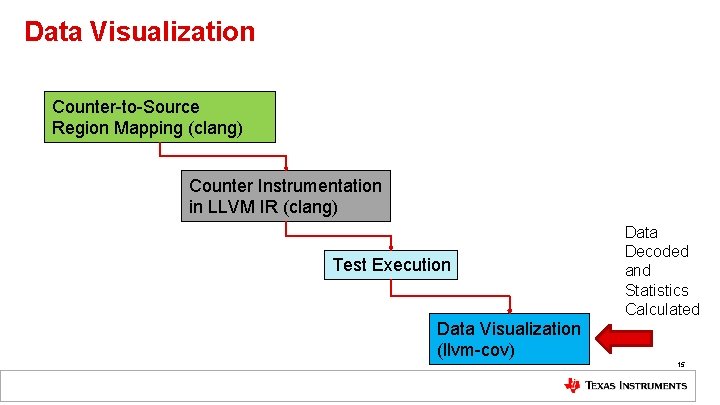
Data Visualization Counter-to-Source Region Mapping (clang) Counter Instrumentation in LLVM IR (clang) Test Execution Data Decoded and Statistics Calculated Data Visualization (llvm-cov) 15
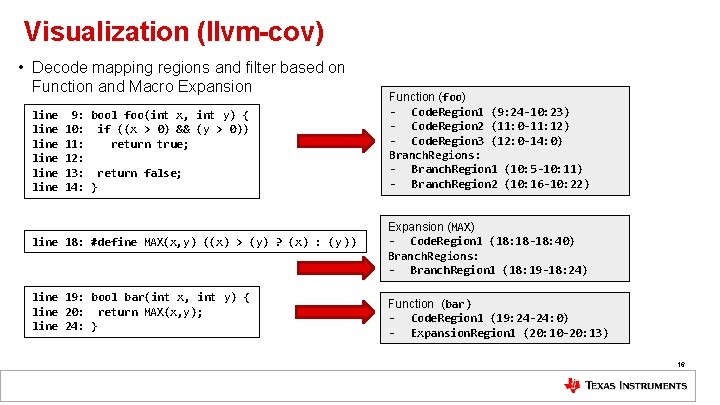
Visualization (llvm-cov) • Decode mapping regions and filter based on Function and Macro Expansion line line 9: bool foo(int x, int y) { 10: if ((x > 0) && (y > 0)) 11: return true; 12: 13: return false; 14: } line 18: #define MAX(x, y) ((x) > (y) ? (x) : (y )) line 19: bool bar(int x, int y) { line 20: return MAX(x, y); line 24: } Function (foo) - Code. Region 1 (9: 24 -10: 23) - Code. Region 2 (11: 0 -11: 12) - Code. Region 3 (12: 0 -14: 0) Branch. Regions: - Branch. Region 1 (10: 5 -10: 11) - Branch. Region 2 (10: 16 -10: 22) Expansion (MAX) - Code. Region 1 (18: 18 -18: 40) Branch. Regions: - Branch. Region 1 (18: 19 -18: 24) Function (bar) - Code. Region 1 (19: 24 -24: 0) - Expansion. Region 1 (20: 10 -20: 13) 16
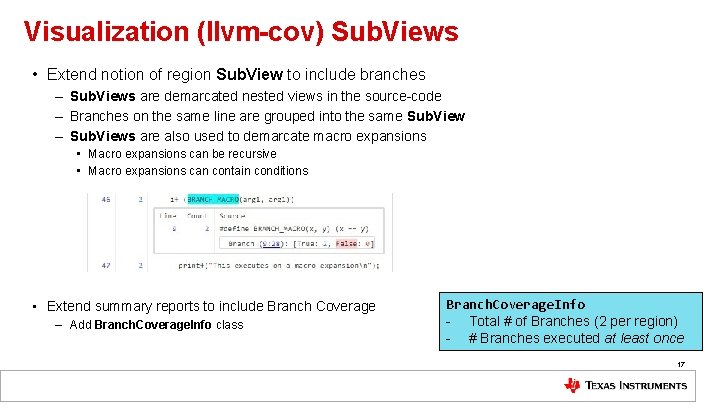
Visualization (llvm-cov) Sub. Views • Extend notion of region Sub. View to include branches – Sub. Views are demarcated nested views in the source-code – Branches on the same line are grouped into the same Sub. View – Sub. Views are also used to demarcate macro expansions • Macro expansions can be recursive • Macro expansions can contain conditions • Extend summary reports to include Branch Coverage – Add Branch. Coverage. Info class Branch. Coverage. Info - Total # of Branches (2 per region) - # Branches executed at least once 17
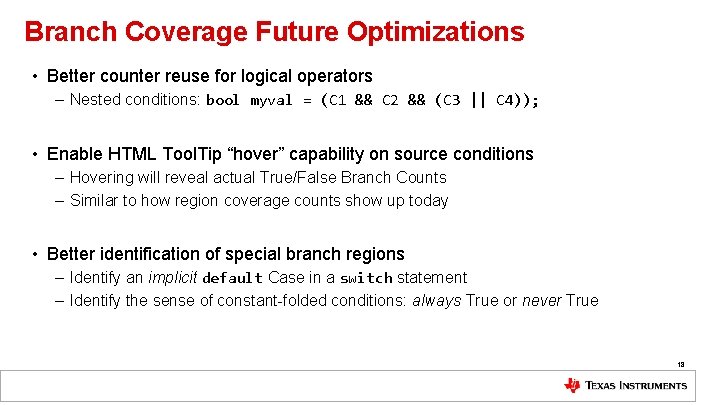
Branch Coverage Future Optimizations • Better counter reuse for logical operators – Nested conditions: bool myval = (C 1 && C 2 && (C 3 || C 4)); • Enable HTML Tool. Tip “hover” capability on source conditions – Hovering will reveal actual True/False Branch Counts – Similar to how region coverage counts show up today • Better identification of special branch regions – Identify an implicit default Case in a switch statement – Identify the sense of constant-folded conditions: always True or never True 18
What’s Next: MC/DC • Ultimate Goal: Modified Condition/Decision Coverage (MC/DC) – Percentage of all condition outcomes that independently affect a decision outcome – Built on top of branch-coverage • Usually involves emitting a truth table to confirm all possibilities 19
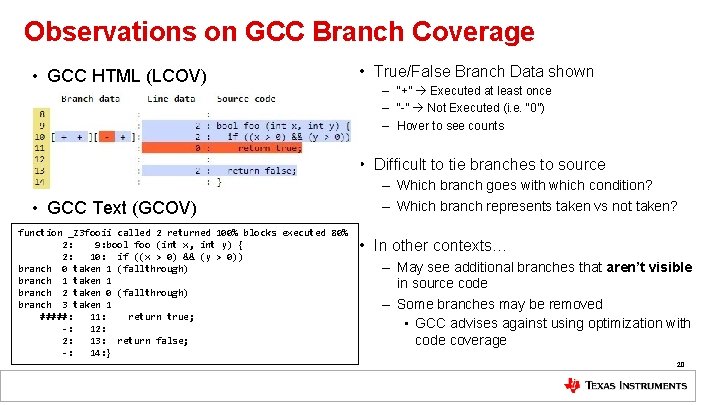
Observations on GCC Branch Coverage • GCC HTML (LCOV) • True/False Branch Data shown – “+” Executed at least once – “-” Not Executed (i. e. “ 0”) – Hover to see counts • Difficult to tie branches to source • GCC Text (GCOV) function _Z 3 fooii called 2 returned 100% blocks executed 80% 2: 9: bool foo (int x, int y) { 2: 10: if ((x > 0) && (y > 0)) branch 0 taken 1 (fallthrough) branch 1 taken 1 branch 2 taken 0 (fallthrough) branch 3 taken 1 #####: 11: return true; -: 12: 2: 13: return false; -: 14: } – Which branch goes with which condition? – Which branch represents taken vs not taken? • In other contexts… – May see additional branches that aren’t visible in source code – Some branches may be removed • GCC advises against using optimization with code coverage 20
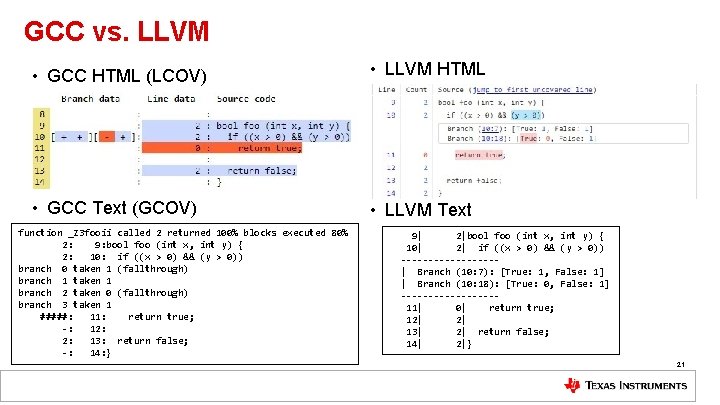
GCC vs. LLVM • GCC HTML (LCOV) • LLVM HTML • GCC Text (GCOV) • LLVM Text function _Z 3 fooii called 2 returned 100% blocks executed 80% 2: 9: bool foo (int x, int y) { 2: 10: if ((x > 0) && (y > 0)) branch 0 taken 1 (fallthrough) branch 1 taken 1 branch 2 taken 0 (fallthrough) branch 3 taken 1 #####: 11: return true; -: 12: 2: 13: return false; -: 14: } 9| 2|bool foo (int x, int y) { 10| 2| if ((x > 0) && (y > 0)) ---------| Branch (10: 7): [True: 1, False: 1] | Branch (10: 18): [True: 0, False: 1] ---------11| 0| return true; 12| 2| 13| 2| return false; 14| 2|} 21
Current State of LLVM Branch Coverage • Implementation is complete -- in the process of upstreaming the work! – Phabricator Review https: //reviews. llvm. org/D 84467 • Should be included with stock LLVM Source-based Code Coverage • A lot of ways to improve branch coverage! Want to be involved? – Contact me! a-phipps@ti. com 22
Thank you! • Acknowledgements – Vedant Kumar, Apple – Cody Addison, Nvidia – Alan Davis, Texas Instruments 23
- Slides: 23