
BrakebySteer Concept Steerbywire application with independently actuated wheels
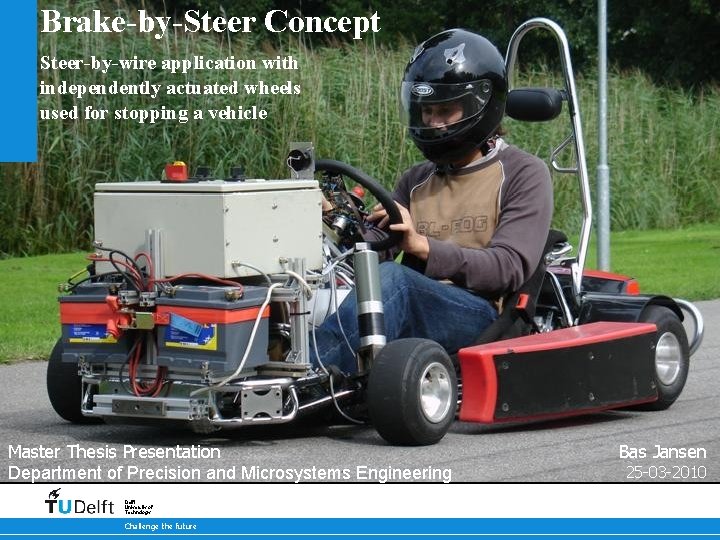
Brake-by-Steer Concept Steer-by-wire application with independently actuated wheels used for stopping a vehicle 17 -10 -2021 Master Thesis Presentation Department of Precision and Microsystems Engineering Delft University of Technology Challenge the future Brake-by-Steer Concept Bas Jansen 25 -03 -2010 1
Content 1. Introduction - SKF - Drive-by-wire - Brake-by-steer concept 2. Modeling the Brake-by-Steer system - Tire model - Vehicle model 17 -10 -2021 - Brake-by-steer cases 3. Implementation on a Go-Kart - Go-kart introduction - Design Implementations 4. Test Results - Braking performance - Lateral behavior 5. Conclusion & Recommendations Delft University of Technology Challenge the future Brake-by-Steer Concept 2
1. Introduction 17 -10 -2021 Delft University of Technology Challenge the future Brake-by-Steer Concept 3
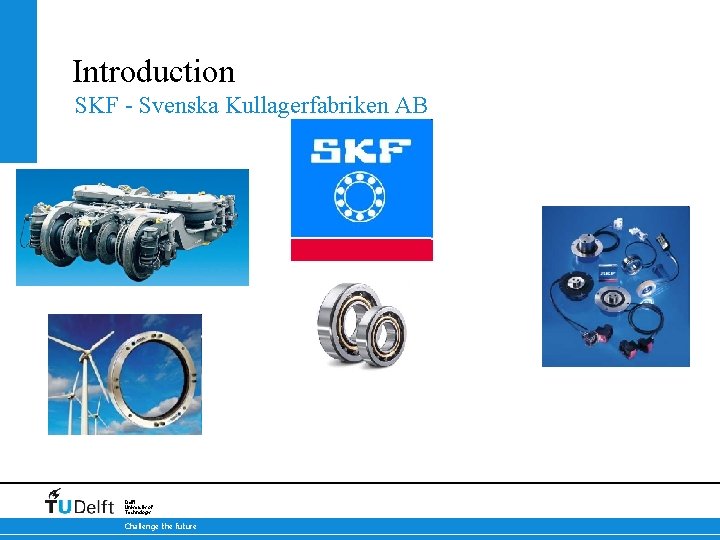
Introduction SKF - Svenska Kullagerfabriken AB 17 -10 -2021 Delft University of Technology Challenge the future Brake-by-Steer Concept 4
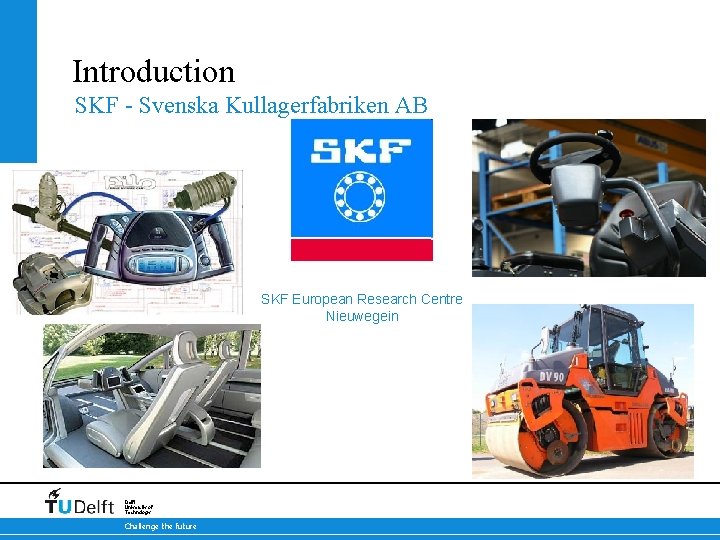
Introduction SKF - Svenska Kullagerfabriken AB 17 -10 -2021 Delft University of Technology Challenge the future SKF European Research Centre Nieuwegein Brake-by-Steer Concept 5

Introduction What is Steer-by-Wire Steering wheel Steering shaft Conventional steering system Rack & Pinion Steer-by-wire with independently 17 -10 -2021 actuated wheels Data transport Steering Controller Sensor & actuator Delft University of Technology Challenge the future Brake-by-Steer Concept 6
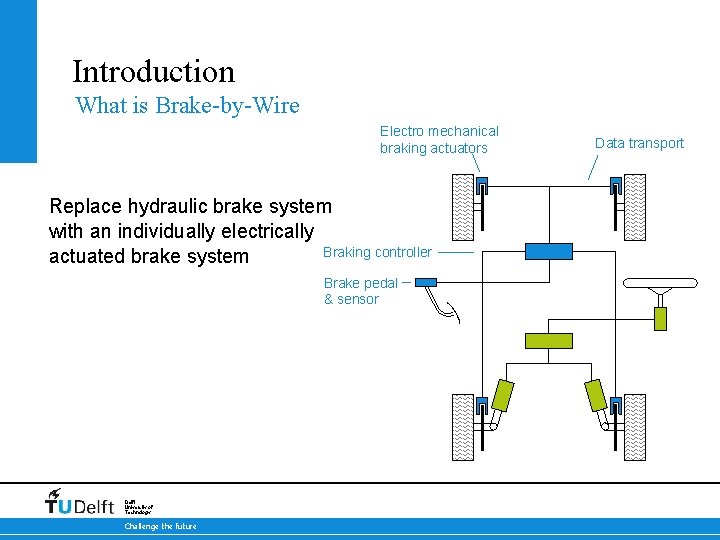
Introduction What is Brake-by-Wire Electro mechanical braking actuators Data transport Replace hydraulic brake system with an individually electrically Braking controller actuated brake system 17 -10 -2021 Delft University of Technology Challenge the future Brake pedal & sensor Brake-by-Steer Concept 7
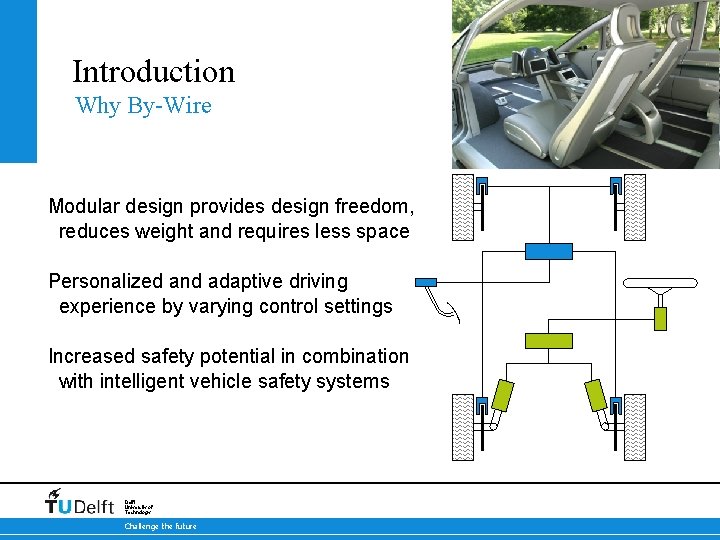
Introduction Why By-Wire Modular design provides design freedom, reduces weight and requires less space Personalized and adaptive driving 17 -10 -2021 experience by varying control settings Increased safety potential in combination with intelligent vehicle safety systems Delft University of Technology Challenge the future Brake-by-Steer Concept 8
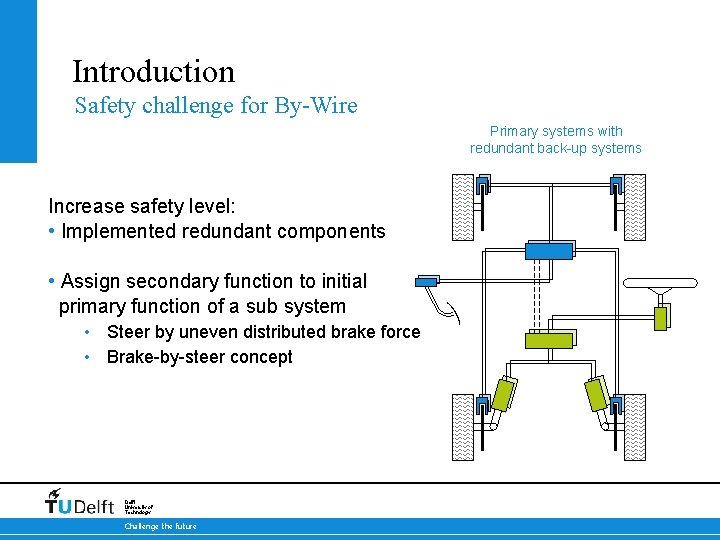
Introduction Safety challenge for By-Wire Primary systems with redundant back-up systems Increase safety level: • Implemented redundant components • Assign secondary function to initial 17 -10 -2021 primary function of a sub system • Steer by uneven distributed brake force • Brake-by-steer concept Delft University of Technology Challenge the future Brake-by-Steer Concept 9
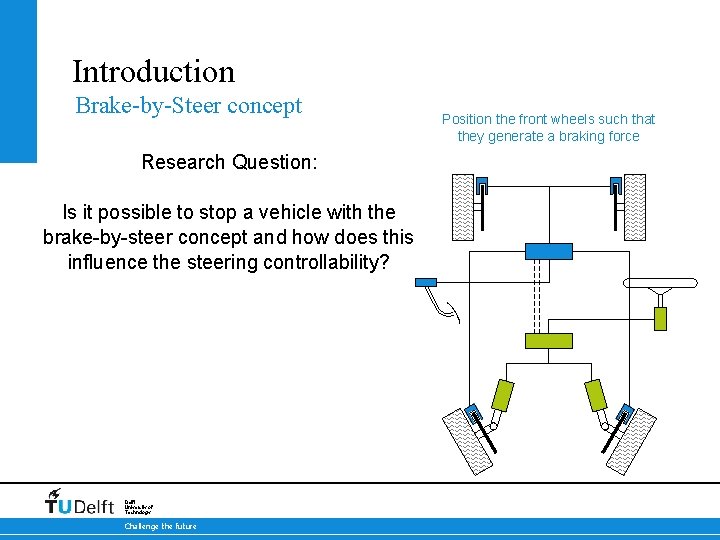
Introduction Brake-by-Steer concept Position the front wheels such that they generate a braking force Research Question: Is it possible to stop a vehicle with the brake-by-steer concept and how does this influence the steering controllability? 17 -10 -2021 Delft University of Technology Challenge the future Brake-by-Steer Concept 10
2. Modeling the Brake-by-Steer system 17 -10 -2021 Delft University of Technology Challenge the future Brake-by-Steer Concept 11
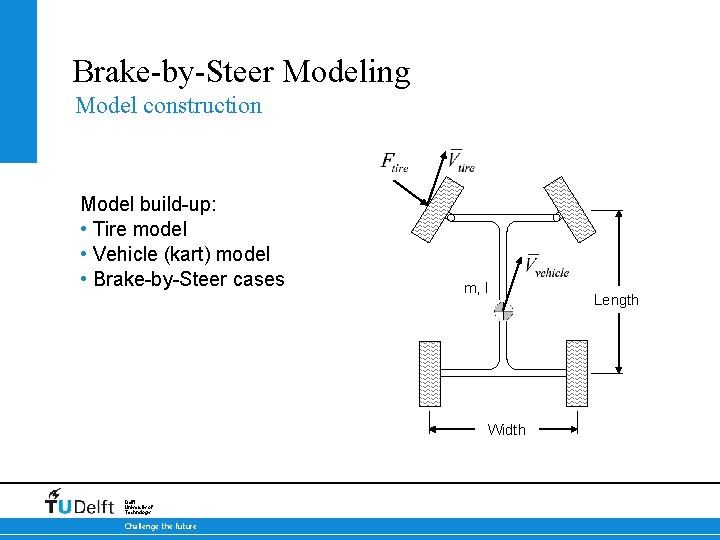
Brake-by-Steer Modeling Model construction Model build-up: • Tire model • Vehicle (kart) model • Brake-by-Steer cases 17 -10 -2021 m, I Length Width Delft University of Technology Challenge the future Brake-by-Steer Concept 12
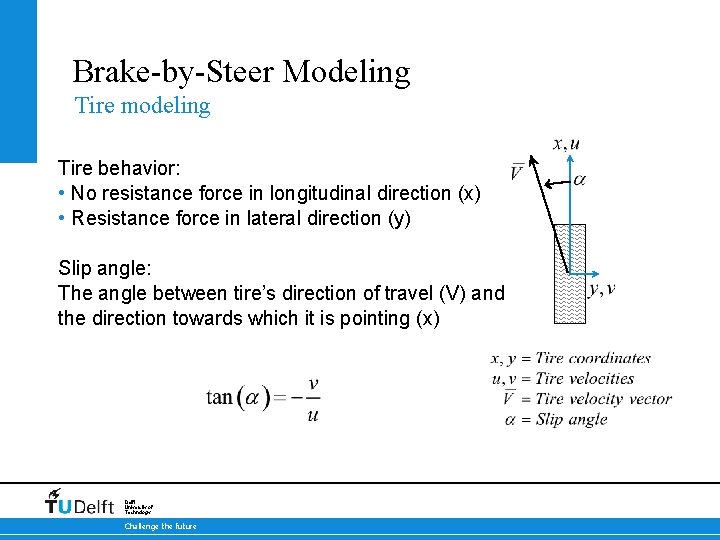
Brake-by-Steer Modeling Tire modeling Tire behavior: • No resistance force in longitudinal direction (x) • Resistance force in lateral direction (y) Slip angle: The angle between tire’s direction of travel (V) and 17 -10 -2021 the direction towards which it is pointing (x) Delft University of Technology Challenge the future Brake-by-Steer Concept 13
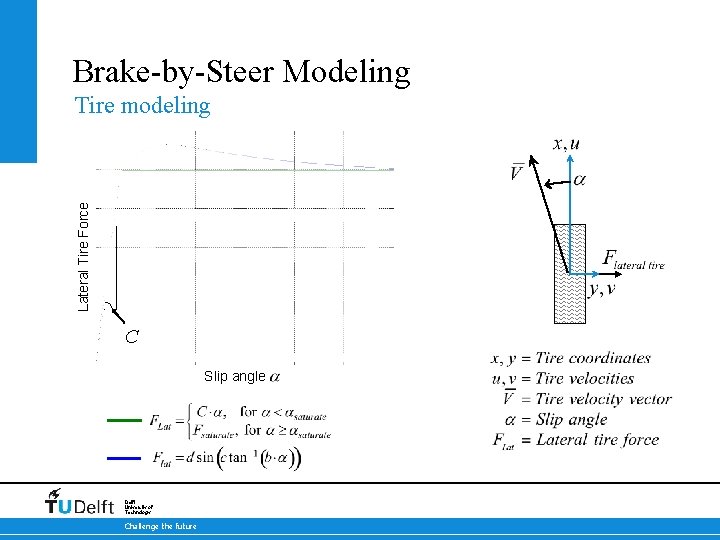
Brake-by-Steer Modeling Lateral Tire Force Tire modeling 17 -10 -2021 C Slip angle Delft University of Technology Challenge the future Brake-by-Steer Concept 14
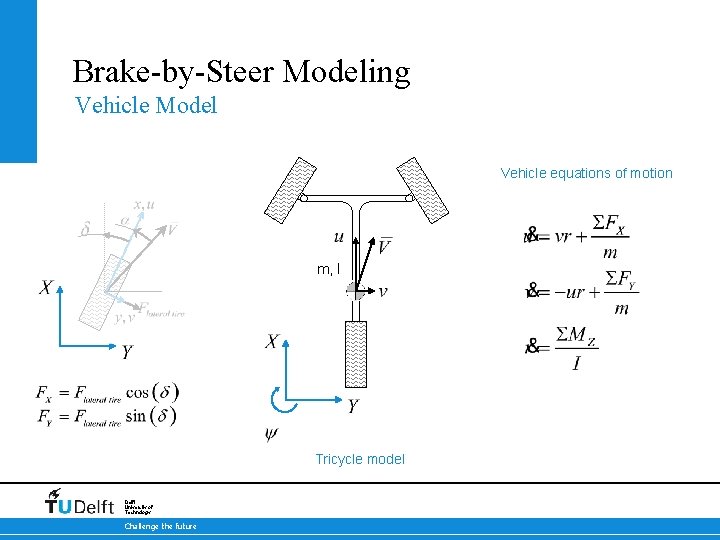
Brake-by-Steer Modeling Vehicle Model Vehicle equations of motion m, I 17 -10 -2021 Tricycle model Delft University of Technology Challenge the future Brake-by-Steer Concept 15
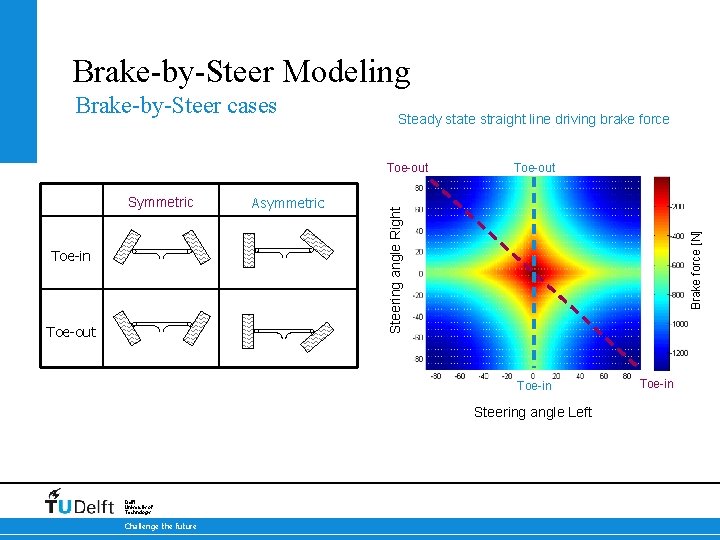
Brake-by-Steer Modeling Steady state straight line driving brake force Symmetric Toe-in 17 -10 -2021 Toe-out Asymmetric Toe-out Steering angle Right Toe-out Brake force [N] Brake-by-Steer cases Toe-in Steering angle Left Delft University of Technology Challenge the future Brake-by-Steer Concept 16
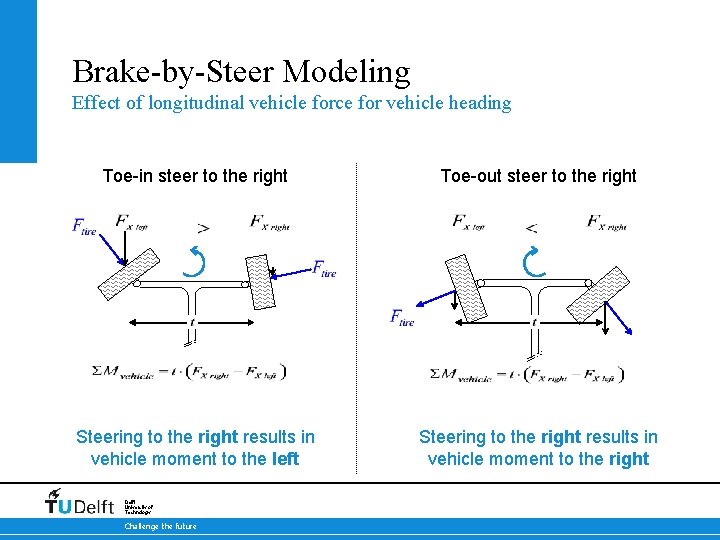
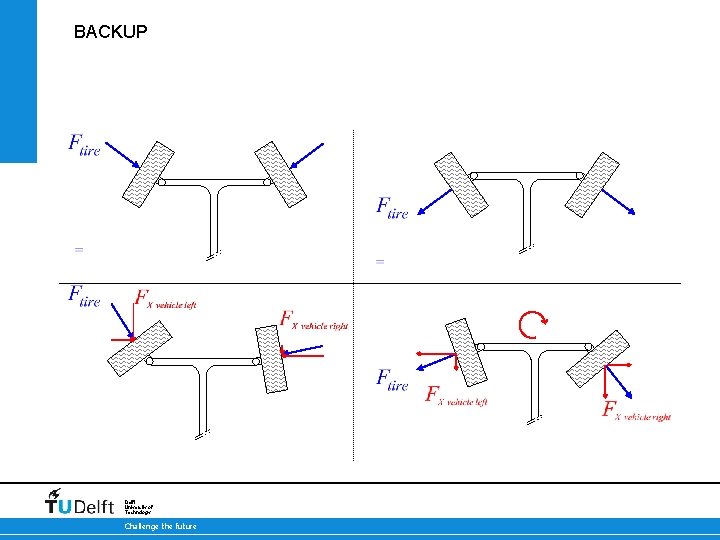
Brake-by-Steer Modeling Effect of longitudinal vehicle force for vehicle heading Toe-in steer to the right Toe-out steer to the right 17 -10 -2021 Steering to the right results in vehicle moment to the left Delft University of Technology Challenge the future Steering to the right results in vehicle moment to the right Brake-by-Steer Concept 17
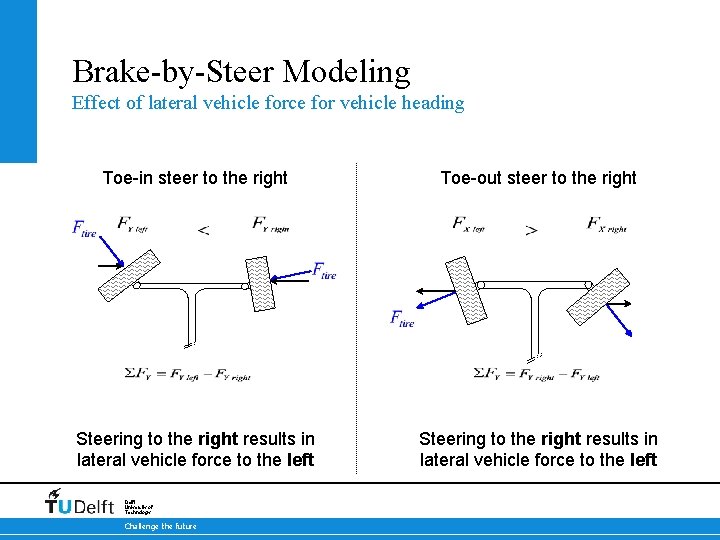
Brake-by-Steer Modeling Effect of lateral vehicle force for vehicle heading Toe-in steer to the right Toe-out steer to the right 17 -10 -2021 Steering to the right results in lateral vehicle force to the left Delft University of Technology Challenge the future Steering to the right results in lateral vehicle force to the left Brake-by-Steer Concept 18
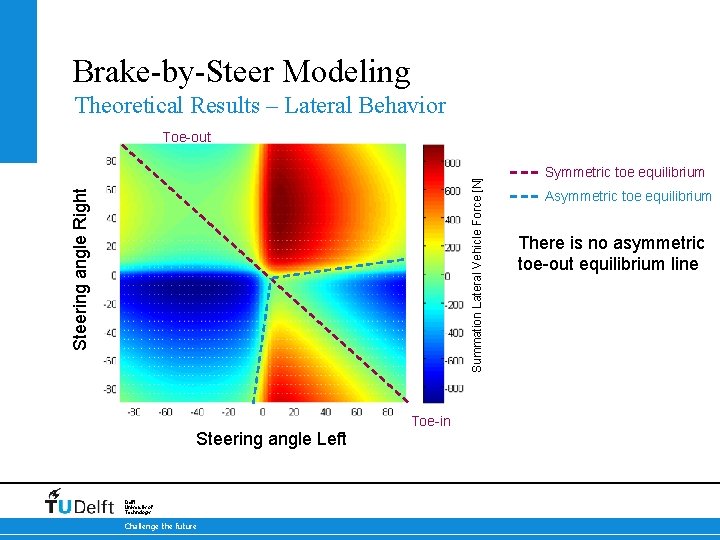
Brake-by-Steer Modeling Theoretical Results – Lateral Behavior Steering angle Right Summation Lateral Vehicle Force [N] Toe-out 17 -10 -2021 Steering angle Left Delft University of Technology Challenge the future Symmetric toe equilibrium Asymmetric toe equilibrium There is no asymmetric toe-out equilibrium line Toe-in Brake-by-Steer Concept 19
3. Implementation on a Go-Kart 17 -10 -2021 Delft University of Technology Challenge the future Brake-by-Steer Concept 20
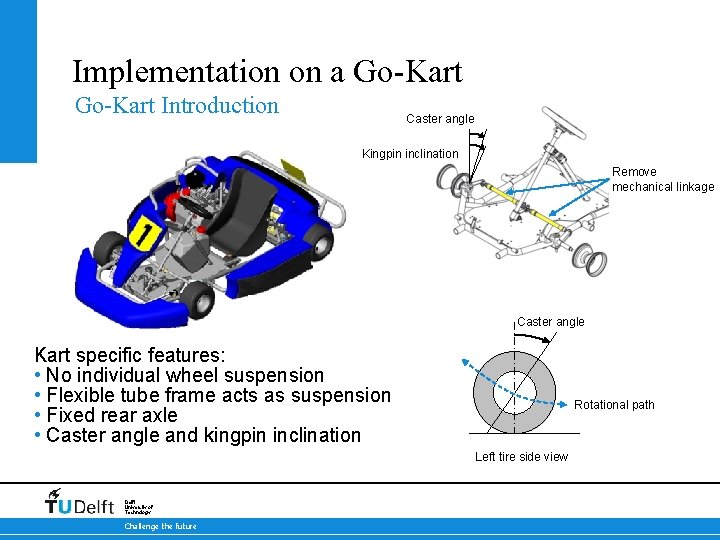
Implementation on a Go-Kart Introduction Caster angle Kingpin inclination Remove mechanical linkage 17 -10 -2021 Caster angle Kart specific features: • No individual wheel suspension • Flexible tube frame acts as suspension • Fixed rear axle • Caster angle and kingpin inclination Rotational path Left tire side view Delft University of Technology Challenge the future Brake-by-Steer Concept 21
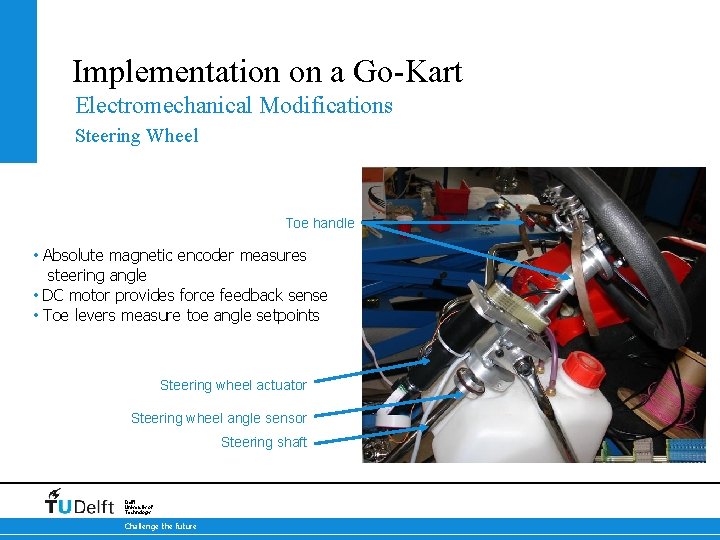
Implementation on a Go-Kart Electromechanical Modifications Steering Wheel Toe handle • Absolute magnetic encoder measures steering angle • DC motor provides force feedback sense 17 -10 -2021 • Toe levers measure toe angle setpoints Steering wheel actuator Steering wheel angle sensor Steering shaft Delft University of Technology Challenge the future Brake-by-Steer Concept 22
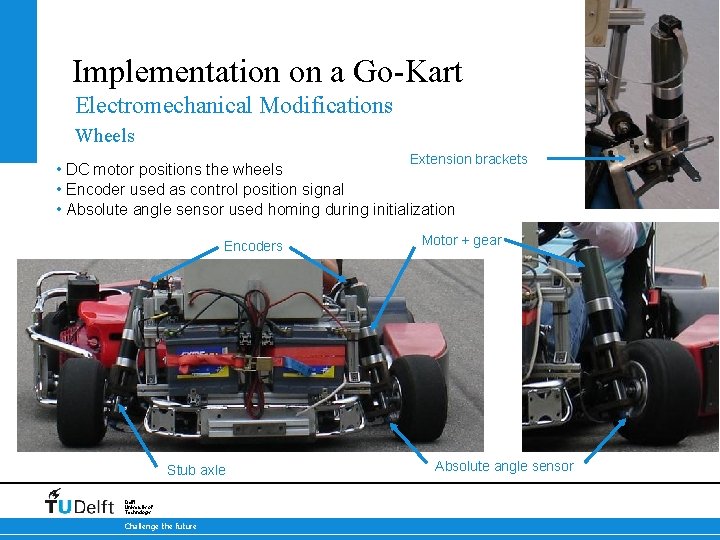
Implementation on a Go-Kart Electromechanical Modifications Wheels Extension brackets • DC motor positions the wheels • Encoder used as control position signal • Absolute angle sensor used homing during initialization Encoders Motor + gear 17 -10 -2021 Stub axle Delft University of Technology Challenge the future Absolute angle sensor Brake-by-Steer Concept 23
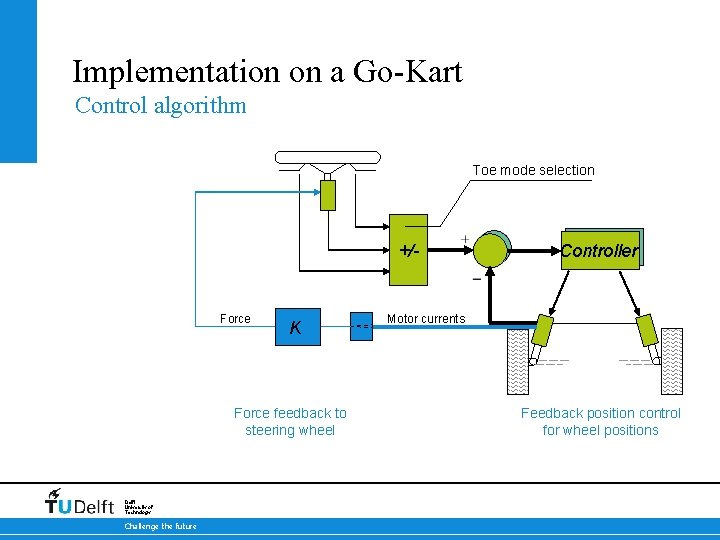
Implementation on a Go-Kart Control algorithm Toe mode selection C Controller +/17 -10 -2021 Force K Force feedback to steering wheel Delft University of Technology Challenge the future Motor currents Feedback position control for wheel positions Brake-by-Steer Concept 24
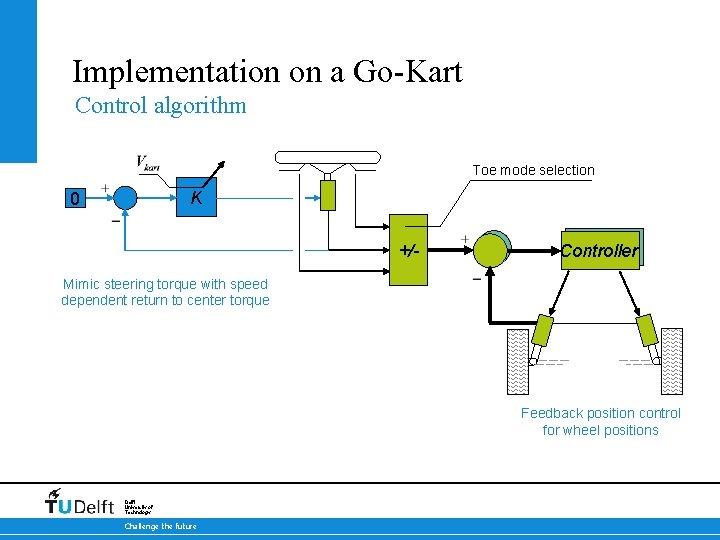
Implementation on a Go-Kart Control algorithm Toe mode selection K 0 +/- C Controller Mimic steering torque with speed 17 -10 -2021 dependent return to center torque Feedback position control for wheel positions Delft University of Technology Challenge the future Brake-by-Steer Concept 25
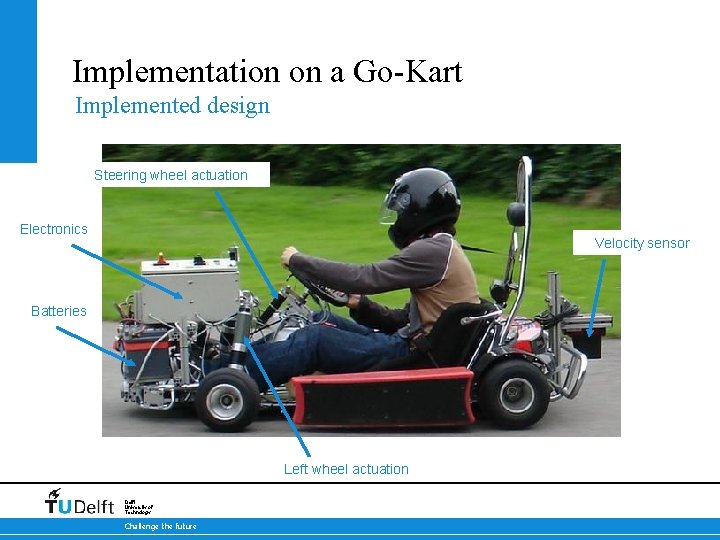
Implementation on a Go-Kart Implemented design Steering wheel actuation Electronics Velocity sensor 17 -10 -2021 Batteries Left wheel actuation Delft University of Technology Challenge the future Brake-by-Steer Concept 26
4. Test Cases and Results 17 -10 -2021 Delft University of Technology Challenge the future Brake-by-Steer Concept 27
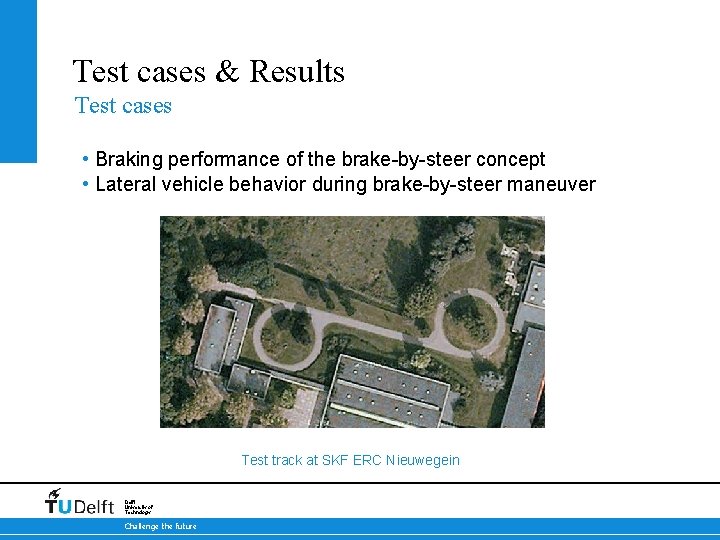
Test cases & Results Test cases • Braking performance of the brake-by-steer concept • Lateral vehicle behavior during brake-by-steer maneuver 17 -10 -2021 Test track at SKF ERC Nieuwegein Delft University of Technology Challenge the future Brake-by-Steer Concept 28
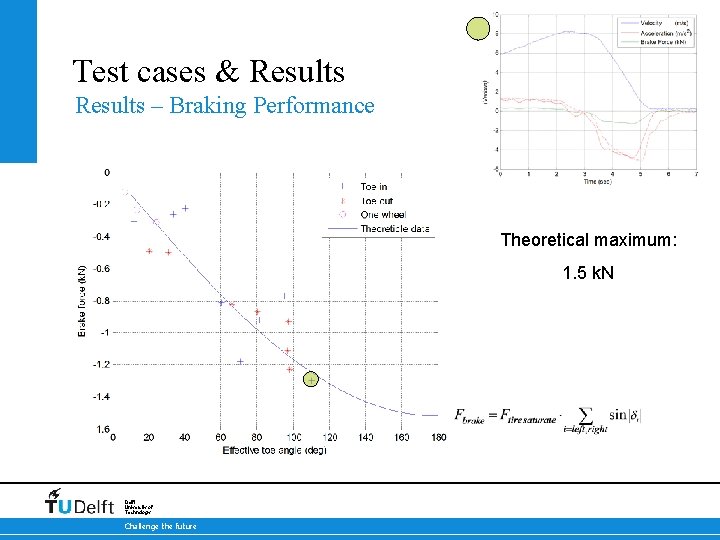
Test cases & Results – Braking Performance Theoretical maximum: 1. 5 k. N 17 -10 -2021 Delft University of Technology Challenge the future Brake-by-Steer Concept 29
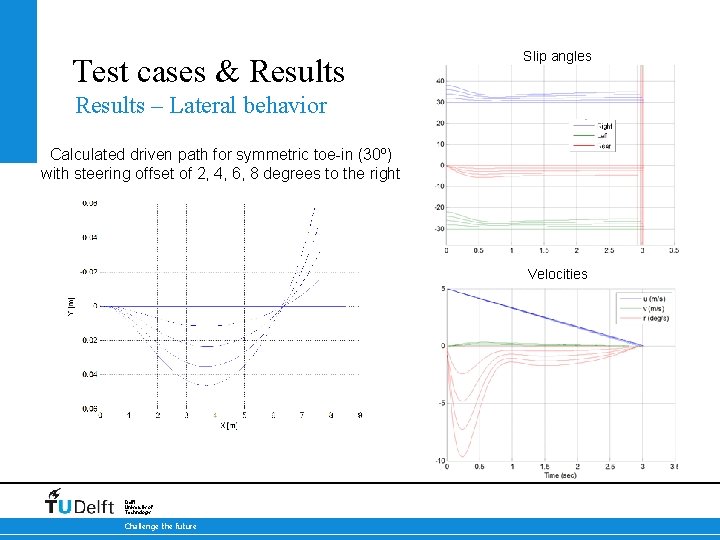
Test cases & Results Slip angles Results – Lateral behavior Calculated driven path for symmetric toe-in (30º) with steering offset of 2, 4, 6, 8 degrees to the right Velocities 17 -10 -2021 Delft University of Technology Challenge the future Brake-by-Steer Concept 30
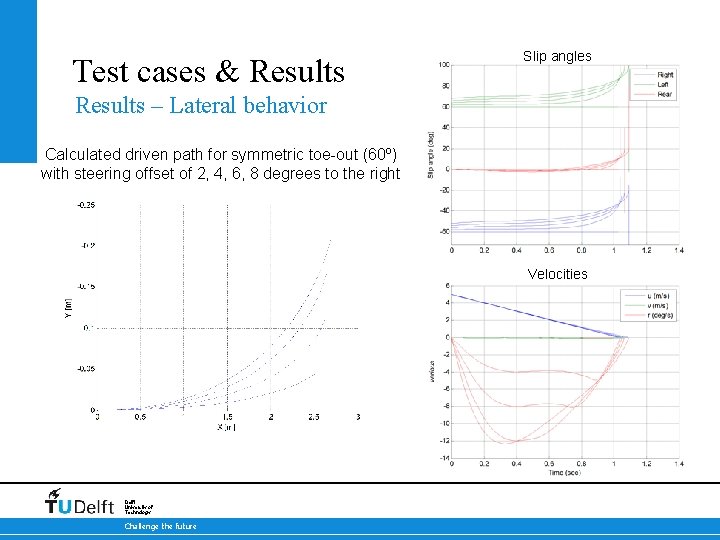
Test cases & Results Slip angles Results – Lateral behavior Calculated driven path for symmetric toe-out (60º) with steering offset of 2, 4, 6, 8 degrees to the right Velocities 17 -10 -2021 Delft University of Technology Challenge the future Brake-by-Steer Concept 31
5. Conclusions & Recommendations 17 -10 -2021 Delft University of Technology Challenge the future Brake-by-Steer Concept 32
Conclusions & Recommendations Conclusions Brake-by-Steer Concept Brake-by-steer concept can back-up failing brakes with a reduced braking performance (~50%). Lateral behavior changes drastically and ranges of inverted steering occur. These make the vehicle uncontrollable for the driver. 17 -10 -2021 Delft University of Technology Challenge the future Brake-by-Steer Concept 33
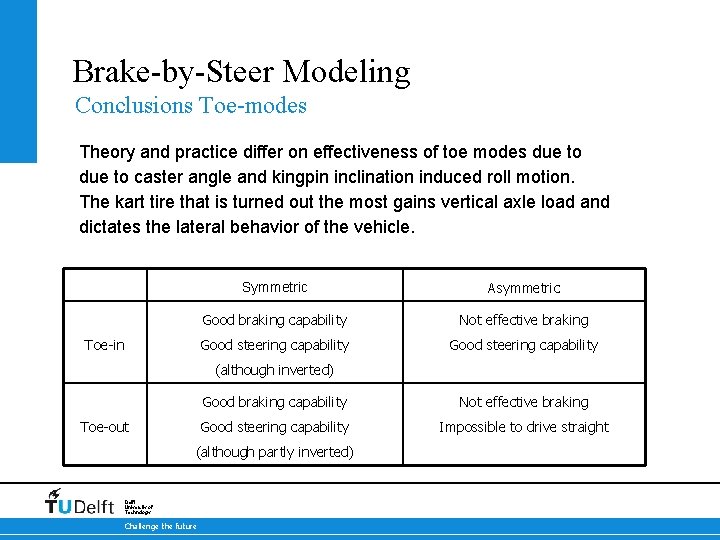
Brake-by-Steer Modeling Conclusions Toe-modes Theory and practice differ on effectiveness of toe modes due to caster angle and kingpin inclination induced roll motion. The kart tire that is turned out the most gains vertical axle load and dictates the lateral behavior of the vehicle. 17 -10 -2021 Toe-in Symmetric Asymmetric Good braking capability Not effective braking Good steering capability (although inverted) Toe-out Good braking capability Not effective braking Good steering capability Impossible to drive straight (although partly inverted) Delft University of Technology Challenge the future Brake-by-Steer Concept 34
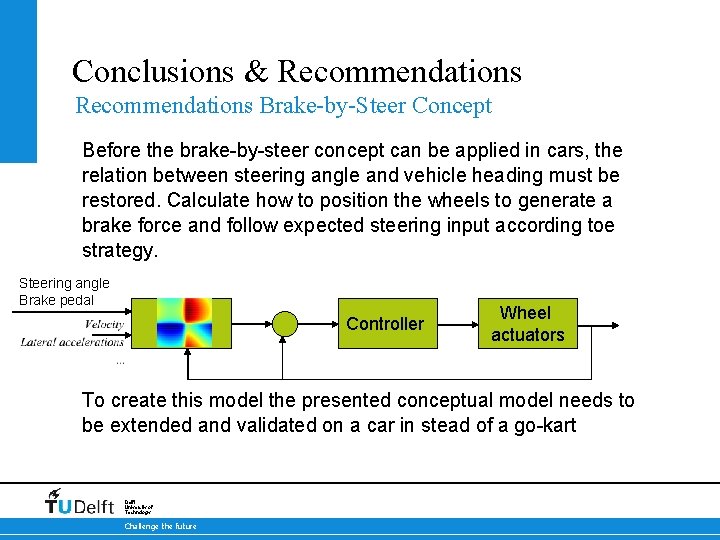
Conclusions & Recommendations Brake-by-Steer Concept Before the brake-by-steer concept can be applied in cars, the relation between steering angle and vehicle heading must be restored. Calculate how to position the wheels to generate a brake force and follow expected steering input according toe strategy. Steering angle Brake 17 -10 -2021 pedal Controller Wheel actuators To create this model the presented conceptual model needs to be extended and validated on a car in stead of a go-kart Delft University of Technology Challenge the future Brake-by-Steer Concept 35
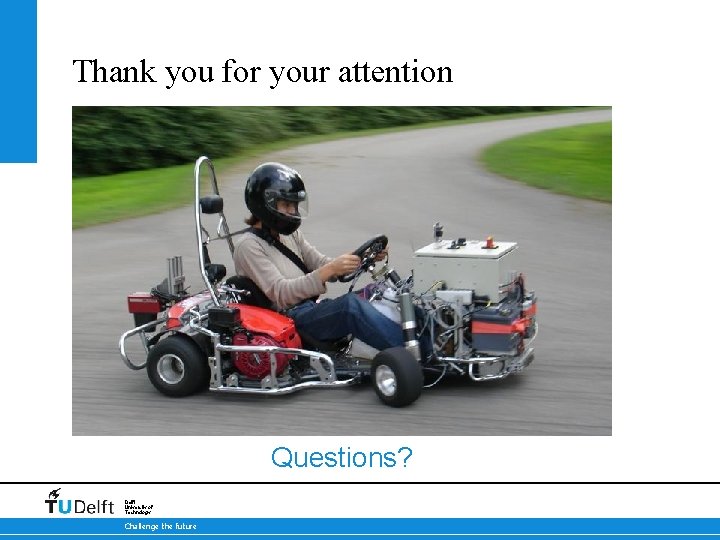
Thank you for your attention 17 -10 -2021 Questions? Delft University of Technology Challenge the future Brake-by-Steer Concept 36

17 -10 -2021 Delft University of Technology Challenge the future Brake-by-Steer Concept 37

17 -10 -2021 Delft University of Technology Challenge the future Brake-by-Steer Concept 38
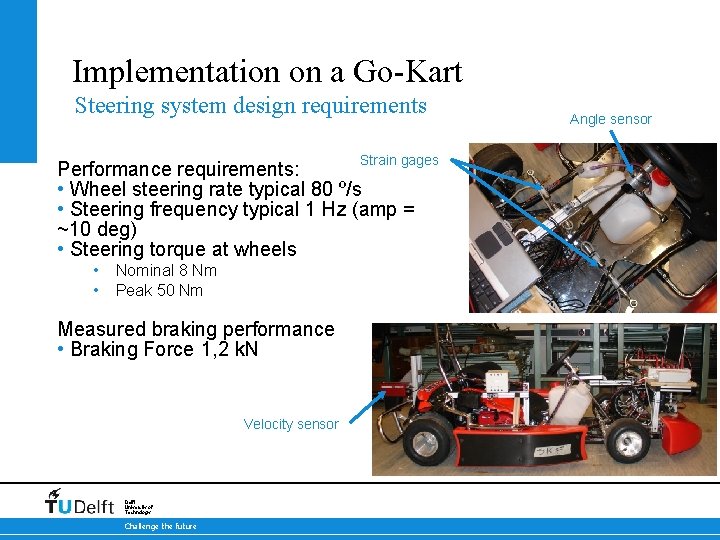
Implementation on a Go-Kart Steering system design requirements Angle sensor Strain gages Performance requirements: • Wheel steering rate typical 80 º/s • Steering frequency typical 1 Hz (amp = ~10 deg) • Steering torque at wheels • Nominal 8 Nm • Peak 50 Nm 17 -10 -2021 Measured braking performance • Braking Force 1, 2 k. N Velocity sensor Delft University of Technology Challenge the future Brake-by-Steer Concept 39
![Brake-by-Steer Modeling 17 -10 -2021 Lateral Vehicle Force [N] Brake-by-Steer cases – Vehicle controllability](http://slidetodoc.com/presentation_image_h2/cc7be13eb46b9879dc248547917a84bf/image-40.jpg "Brake-by-Steer Modeling 17 -10 -2021 Lateral Vehicle Force [N] Brake-by-Steer cases – Vehicle controllability")
Brake-by-Steer Modeling 17 -10 -2021 Lateral Vehicle Force [N] Brake-by-Steer cases – Vehicle controllability A 0 A 1 B 0 B 1 Slip angle Inverted steering occurs at symmetric toe mode for > Delft University of Technology Challenge the future Brake-by-Steer Concept 40
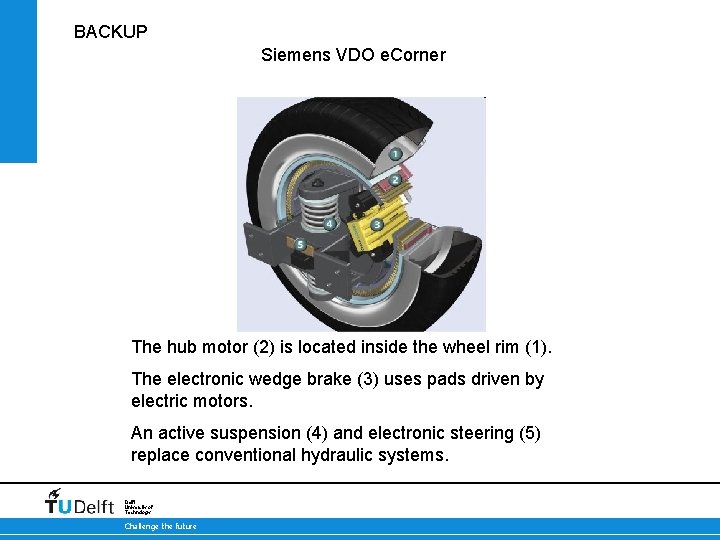
BACKUP Siemens VDO e. Corner 17 -10 -2021 The hub motor (2) is located inside the wheel rim (1). The electronic wedge brake (3) uses pads driven by electric motors. An active suspension (4) and electronic steering (5) replace conventional hydraulic systems. Delft University of Technology Challenge the future Brake-by-Steer Concept 41
BACKUP 17 -10 -2021 Delft University of Technology Challenge the future Brake-by-Steer Concept 42
- Slides: 42