
Brainstorming for Advanced Manufacturing Thrust Derek Haas Nov

Brainstorming for Advanced Manufacturing Thrust Derek Haas Nov 6, 2019

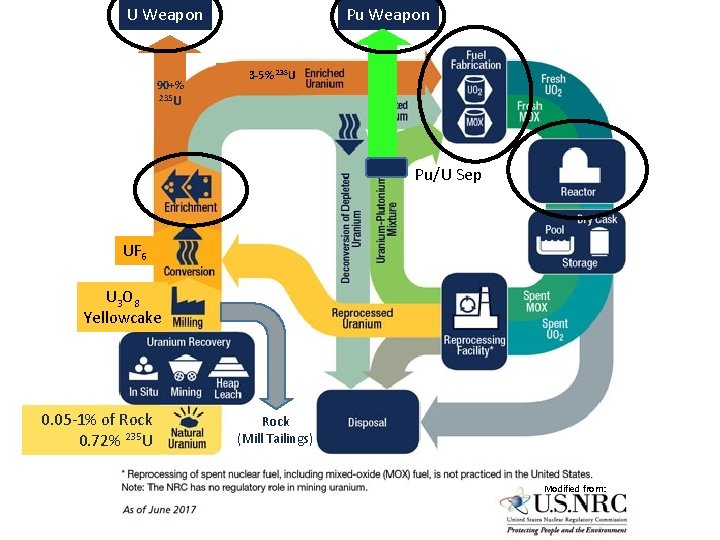
U Weapon 90+% Pu Weapon 3 -5% 235 U Pu/U Sep UF 6 U 3 O 8 Yellowcake 0. 05 -1% of Rock 0. 72% 235 U Rock (Mill Tailings) Modified from:
Process Control & In-situ Monitoring Process Controlling process variables to reduce standard deviation of finished part properties • Mechanical, Thermal, Chemical, Geometrical, etc… In laser powder bed fusion the main control variable is ensuring postsintering temperature is equal across the entire powder bed • Can be done by eliminating pre-sintering temperature gradients in the powder bed and using constant laser power (Very Difficult) • Can be done by varying laser power across the powder bed to account for the temperature gradients (less power where hotter, more power where colder)
Process Control & In-situ Monitoring Imaging/Characterization techniques to allow for layer-by-layer “inspection” of parts • Can ensure no defects are present in the part Can reduce wasted material/time if defects are present in the part • Identify the part will be scrap before the part is fully finished • Potential for in-situ defect mitigation to salvage part
Process Control & In-situ Monitoring @ UT-Austin Process Control (LAMPS, Polymers) • Utilize boresight infrared camera to measure post-sintering temperature at specific locations of the powder bed. • Data allows for in-situ laser power adjustments to achieve equal post-sintering temperatures across entire powder bed [1]. In-situ Monitoring (LAMPS, Polymers) • Utilize optical coherence tomography (OCT) to image each layer during a build (can see ~10 layers deep when melted) [2]. • Allows for real time defect detection such as pores in part or curling during the SLS process. References [1] T. Phillips, S. Fish, J. Beaman. Development of an automated laser control system for improving temperature uniformity and controlling component strength in selective laser sintering. Additive Manufacturing, 24 (2018), pp. 316322 [2] A. Lewis, et al. In-situ Process Monitoring and ex-Situ part Quality Assessment of Selective Laser Sintering Using optical Coherence Tomography. Solid Freeform Fabrication. Proceedings of the 27 th Annual International Solid Freeform Fabrication Symposium (2016), pp. 1397 -1411
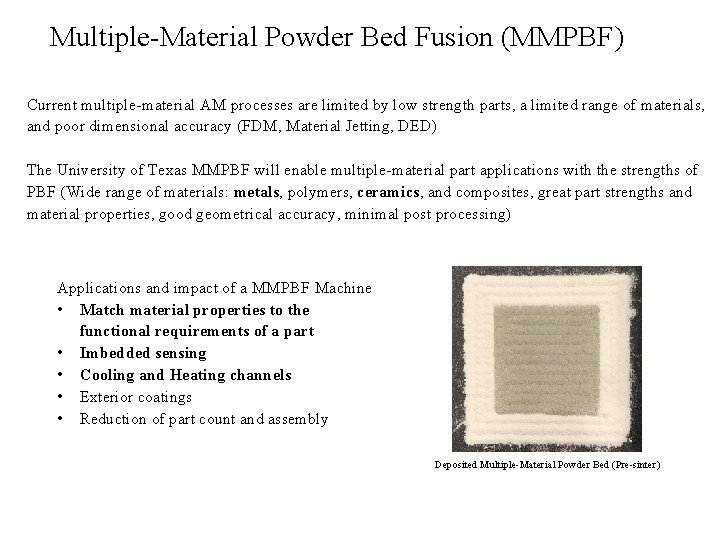
Multiple-Material Powder Bed Fusion (MMPBF) Current multiple-material AM processes are limited by low strength parts, a limited range of materials, and poor dimensional accuracy (FDM, Material Jetting, DED) The University of Texas MMPBF will enable multiple-material part applications with the strengths of PBF (Wide range of materials: metals, polymers, ceramics, and composites, great part strengths and material properties, good geometrical accuracy, minimal post processing) Applications and impact of a MMPBF Machine • Match material properties to the functional requirements of a part • Imbedded sensing • Cooling and Heating channels • Exterior coatings • Reduction of part count and assembly Deposited Multiple-Material Powder Bed (Pre-sinter)
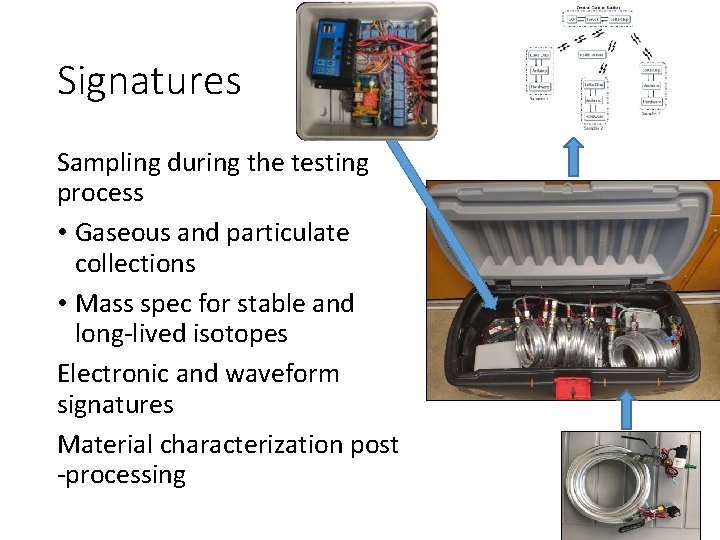
Signatures Sampling during the testing process • Gaseous and particulate collections • Mass spec for stable and long-lived isotopes Electronic and waveform signatures Material characterization post -processing
Other Research Topics Explosives (Extrusion) Embedded Sensors Structural Materials
- Slides: 9