
BrainCompatible Learning Alissa Watson EDU 417 Joanna SavareseLevine
Brain-Compatible Learning Alissa Watson EDU 417 Joanna Savarese-Levine February 23, 2014
The Purpose of This Presentation • The purpose of this presentation is to show braincompatible learning enhances the students understanding of lessons and concepts. • This presentation will compare and contrast traditional learning with brain-compatible learning. • This presentation will show different factors that students may have and how to help them with their educational experience. • This presentation will provide information on how the brain processes and retains information. • This presentation will also provide a lesson plan example of how to incorporate modifications for diverse students as well as the entire class.
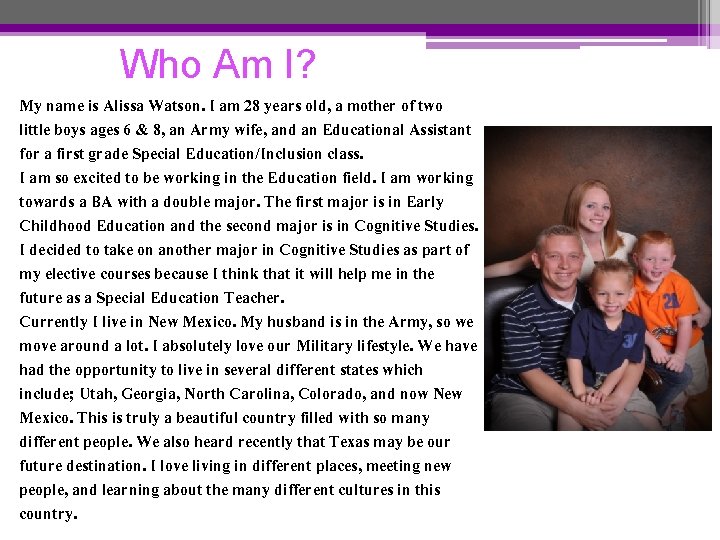
Who Am I? My name is Alissa Watson. I am 28 years old, a mother of two little boys ages 6 & 8, an Army wife, and an Educational Assistant for a first grade Special Education/Inclusion class. I am so excited to be working in the Education field. I am working towards a BA with a double major. The first major is in Early Childhood Education and the second major is in Cognitive Studies. I decided to take on another major in Cognitive Studies as part of my elective courses because I think that it will help me in the future as a Special Education Teacher. Currently I live in New Mexico. My husband is in the Army, so we move around a lot. I absolutely love our Military lifestyle. We have had the opportunity to live in several different states which include; Utah, Georgia, North Carolina, Colorado, and now New Mexico. This is truly a beautiful country filled with so many different people. We also heard recently that Texas may be our future destination. I love living in different places, meeting new people, and learning about the many different cultures in this country.
Brain-Compatible Learning Brain-compatible education is still in research mode. There have not been any set guidelines or criteria to follow in the classroom that will allow a teacher to maximize the possibilities of braincompatible education. The teacher must include other educational experiences in combination with brain-compatible education and develop a curriculum/lesson plan that will provide their students with a meaningful educational experience. The teacher must remember that all children learn differently and that one size does not fit all. This may make for a time consuming/trial and error period while developing a well-rounded lesson plan for the students.

Brain-Compatible Learning Brain-compatible education is still in research mode. There have not been any set guidelines or criteria to follow in the classroom that will allow a teacher to maximize the possibilities of brain-compatible education. The teacher must include other educational experiences in combination with braincompatible education and develop a curriculum/lesson plan that will provide their students with a meaningful educational experience. The teacher must remember that all children learn differently and that one size does not fit all. This may make for a time consuming/trial and error period while developing a well-rounded lesson plan for the students. Brain compatible education can enhance the students learning, which is the goal of most educators. Enhancing and providing meaningful lessons to the students can be done when combining brain-compatible education with tradition education. Brain-compatible education provides students with a wide variety of experiences. By providing the students with a wide variety of experiences, the teacher is building more neural pathways in the brains of the students which in turn create increased learning capabilities. “The brain “loves to learn”. The more early childhood experiences the more neural connections and the greater the learning” (Mc. Daniel, 2008). Therefore, yes brain-compatible education should be included in the classrooms.

Compare and Contrast Traditional Learning With Brain-Compatible Learning • Our brains are involved in everything that • The need and desire to develop effective learning for we do. Why would neuroscience not be young students will always be an ongoing process. Scientists included in the ongoing search for meaningful have elaborated on what previous theorists have proven and education experiences? now have created the possibility of more in depth and • “Many traditional methods that are meaningful learning through brain-compatible education. employed today have done a satisfactory job • of teaching our students. However, the newer to the traditional methods. While brain-compatible education approach called brain based learning/teaching does not provide the 100% , solid facts that it does without a takes advantage of the most recent research doubt enhance a child’s learning experience, research has that indicates the teaching methods we now been done that suggests that with the assistance of employ are fast becoming inadequate to multidisciplinary, brain-based learning increases neural accommodate all of the student in our school production which enhances a child’s learning capabilities. system” (Mc. Daniel, 2008). Brain based learning is the evolutionary learning methods
Principles of Brain Compatible Education 1. Pattern and Meaning Making. Students need to make connections with what they are learning in order for there to be a greater likelihood of them retaining the lessons. Patterns provide organization and meaning increases retention. Both of these working together enhance the students learning. 2. The Brain as a Parallel Processor. “The brain is geared toward survival and is, in actuality, poorly designed for linear, lock-step instruction” (Roberts, 2002). The brain works efficiently and effectively when it is multi-tasking. 3. Stress and Threat. “Learning is enhanced by challenge and inhibited by threat” (Roberts, 2002).
Factors • Neuroplasticity “means that the brain is shaped not only by its inherited genetic code but also by its environment” (Wolfe, 2010, p. 72). Everyone has their own unique genetic code that helps shape who they are and how they think. They also have their own unique experiences throughout their live that also helps shape who they are and how they think.
Connections The relationship between psychology, neuroscience, and education is that they work hand in hand to understand how children think and how to teach children curriculum. Psychology provides teachers with the ability to understand the student’s emotions and how to help them cope with the things they are going through. Psychology also provides teachers with vital information on how to effectively encourage students and excite them about education. Neuroscience provides teachers with the ability to understand how their students think. It also shows teachers that children are all different learners and that they need to tap into each child’s learning style and intelligences in order to provide them each with the best possible educational experience. Finally, education is a basis of concepts and learning patterns that are taught through curriculum. In order for teachers to educate students, they must understand their students on a higher level. Teaching is not just explaining how to read, add, and subtract, it is understanding the psychology and neuroscience of each of their students and presenting curriculum in a way that encompasses psychological and neurological abilities.
Factors Neuroplasticity tells us that environment and genetics plays a major role in the way a child’s brain develops. With that said, a child needs adequate sleep and nutrition in order for their memory to work and store information. Children who experience lack of sleep and nutrition are unable to focus and learn new concepts which leaves their memory in a stand still. The memory will not be able to store the lessons learned during the day if they are tired or hungry. Technology is the same. If the student is working with technology they must be focused and ready to use it. All of these factors are important to know, understand, an incorporate daily in order for the students to learn and grow.
Behavior Factors All children learn and grow at different rates. “All children need to be challenged and nurtured in order to profit from instruction. Instruction that is above or below the maturity level of a child’s brain is not only inappropriate; it can lead to behavior problems” (Clikeman, n. d. ). Dopamine, Serotonin, and Acetylcholine all play major roles in a child’s behavior. If their levels are too high, the children may experience behaviors that are disruptive and if their levels are too low, the children my experience behaviors such as lack of motivation, unwillingness to follow directions, and difficulty listening. As long as the classroom is flowing in a cohesive manner, the students behaviors will be limited. Too much excitement will cause chaos, and too little excitement will cause boredom.
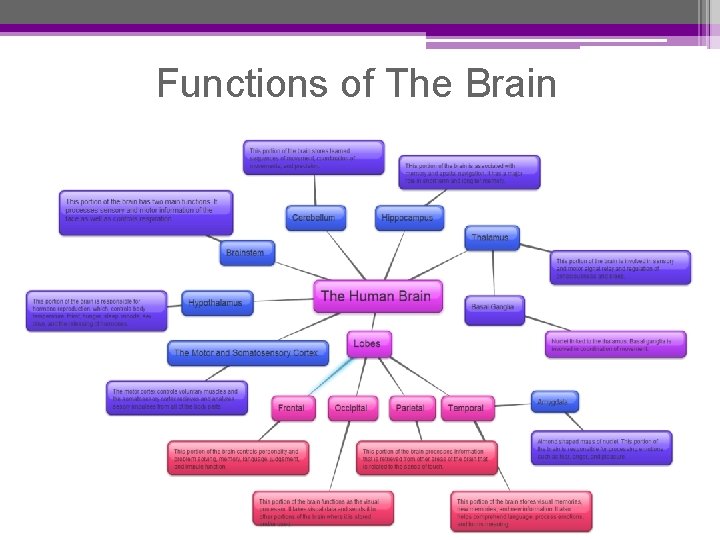
Functions of The Brain
Information Processing Model The following video http: //www. youtube. com/watch? v=uxr 29 NWQx. EA (yuecl, 2013) shows how information is processed through the brain and stored for later use in memory. This video explains how the brain saves certain information and disregards other information and where it is stored and why some information is more difficult to remember. This video is a great tool to utilize when developing lesson plans for the classroom because it shows how the students process the information being taught to them and how they are most likely going to store it in their brain. With this knowledge, the teacher can provide more meaningful lessons for their students.
Learning to Read There are several parts of the brain that are involved in a person’s reading process. The process of reading starts with sight. When a person looks at printed text, their brain begins to decipher the letters and meaning. “Visual information is contained in the light that is reflected from objects. After the visual recognition process has occurred, the information is then sent to the angular gyrus. The angular gyrus is “located at the junction of the occipital, parietal, and temporal lobes” (Fischer, 2008, p. 259) and acts as a connector of the visual word and the rest of the process. The angular gyrus is where the text that is being seen is translated into the sounds of the spoken language. As light rays enter the eyes, they are transduced, or changed into electrical impulses, and are sent from the eyes through the optic nerves to the thalamus” (Fischer, 2008, p. 259). The thalamus is located above of the brain stem and located in between the cerebral cortex and the midbrain. “The job of the thalamus is to relay this information to the primary visual cortex located in the occipital lobe” (Fischer, 2008, p. 259). This process begins the visual recognition of the letters and their meaning. The information is then sent to the Wernicke’s area located in the junction of the parietal and temporal lobes and the function is the comprehension of words. After this, the information is sent to the Broca’s area is located in the back of the frontal lobe and its function is “processing syntax, or assembling words into sensible phrases that are grammatically correct. This ability to organize words is essential for meaning” (Fischer, 2008, p. 256)
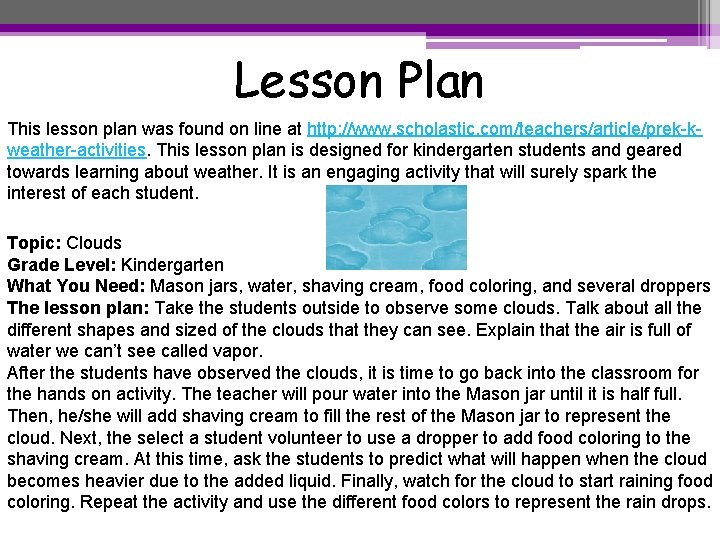
Lesson Plan This lesson plan was found on line at http: //www. scholastic. com/teachers/article/prek-kweather-activities. This lesson plan is designed for kindergarten students and geared towards learning about weather. It is an engaging activity that will surely spark the interest of each student. Topic: Clouds Grade Level: Kindergarten What You Need: Mason jars, water, shaving cream, food coloring, and several droppers The lesson plan: Take the students outside to observe some clouds. Talk about all the different shapes and sized of the clouds that they can see. Explain that the air is full of water we can’t see called vapor. After the students have observed the clouds, it is time to go back into the classroom for the hands on activity. The teacher will pour water into the Mason jar until it is half full. Then, he/she will add shaving cream to fill the rest of the Mason jar to represent the cloud. Next, the select a student volunteer to use a dropper to add food coloring to the shaving cream. At this time, ask the students to predict what will happen when the cloud becomes heavier due to the added liquid. Finally, watch for the cloud to start raining food coloring. Repeat the activity and use the different food colors to represent the rain drops.
Modifications • While the previous lesson plan is a great lesson on teaching students about how rain is formed, there are modifications that can be made in order for this lesson plan to be more meaningful and brain-compatible. It is important for the teacher to know and understand all the different learners in the classroom and develop a lesson plan that will reach learner. The modifications that will be made to this lesson plan will enhance the students understanding of rain.
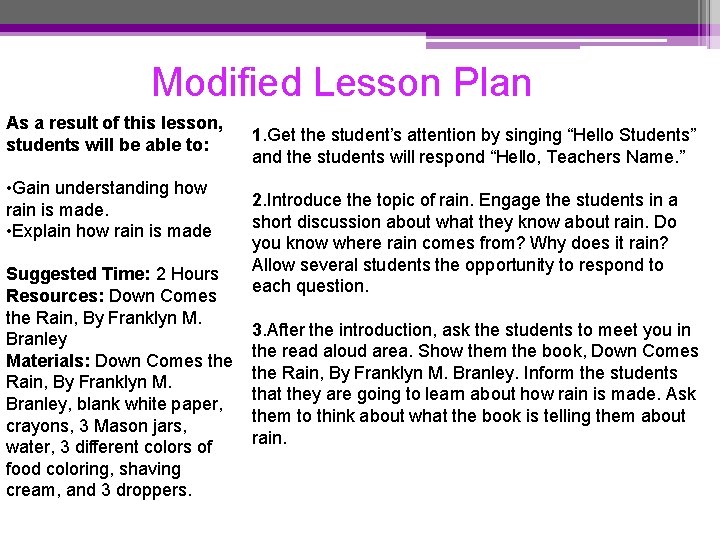
Modified Lesson Plan As a result of this lesson, students will be able to: • Gain understanding how rain is made. • Explain how rain is made Suggested Time: 2 Hours Resources: Down Comes the Rain, By Franklyn M. Branley Materials: Down Comes the Rain, By Franklyn M. Branley, blank white paper, crayons, 3 Mason jars, water, 3 different colors of food coloring, shaving cream, and 3 droppers. 1. Get the student’s attention by singing “Hello Students” and the students will respond “Hello, Teachers Name. ” 2. Introduce the topic of rain. Engage the students in a short discussion about what they know about rain. Do you know where rain comes from? Why does it rain? Allow several students the opportunity to respond to each question. 3. After the introduction, ask the students to meet you in the read aloud area. Show them the book, Down Comes the Rain, By Franklyn M. Branley. Inform the students that they are going to learn about how rain is made. Ask them to think about what the book is telling them about rain.
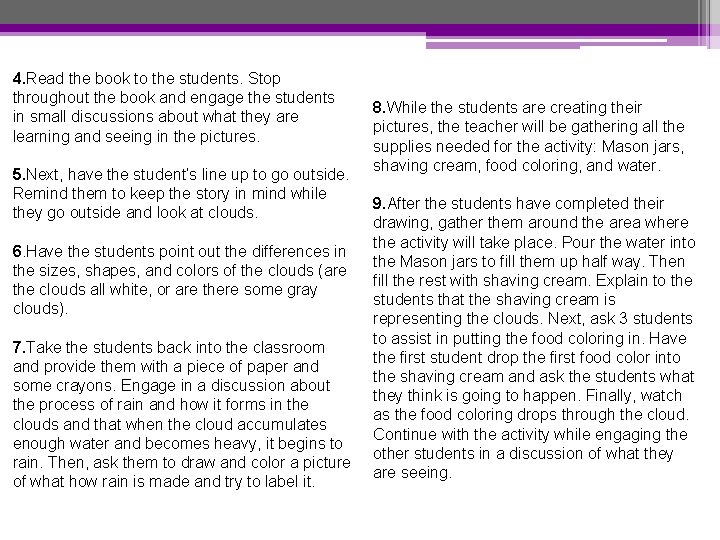
4. Read the book to the students. Stop throughout the book and engage the students in small discussions about what they are learning and seeing in the pictures. 5. Next, have the student’s line up to go outside. Remind them to keep the story in mind while they go outside and look at clouds. 6. Have the students point out the differences in the sizes, shapes, and colors of the clouds (are the clouds all white, or are there some gray clouds). 7. Take the students back into the classroom and provide them with a piece of paper and some crayons. Engage in a discussion about the process of rain and how it forms in the clouds and that when the cloud accumulates enough water and becomes heavy, it begins to rain. Then, ask them to draw and color a picture of what how rain is made and try to label it. 8. While the students are creating their pictures, the teacher will be gathering all the supplies needed for the activity: Mason jars, shaving cream, food coloring, and water. 9. After the students have completed their drawing, gather them around the area where the activity will take place. Pour the water into the Mason jars to fill them up half way. Then fill the rest with shaving cream. Explain to the students that the shaving cream is representing the clouds. Next, ask 3 students to assist in putting the food coloring in. Have the first student drop the first food color into the shaving cream and ask the students what they think is going to happen. Finally, watch as the food coloring drops through the cloud. Continue with the activity while engaging the other students in a discussion of what they are seeing.
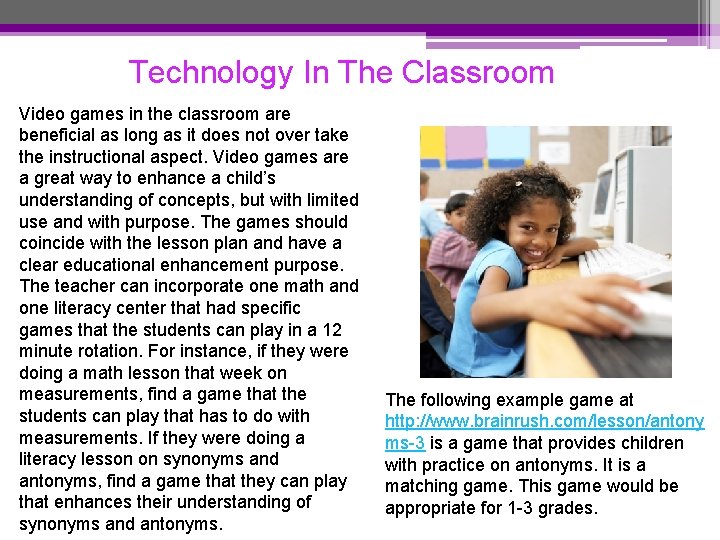
Technology In The Classroom Video games in the classroom are beneficial as long as it does not over take the instructional aspect. Video games are a great way to enhance a child’s understanding of concepts, but with limited use and with purpose. The games should coincide with the lesson plan and have a clear educational enhancement purpose. The teacher can incorporate one math and one literacy center that had specific games that the students can play in a 12 minute rotation. For instance, if they were doing a math lesson that week on measurements, find a game that the students can play that has to do with measurements. If they were doing a literacy lesson on synonyms and antonyms, find a game that they can play that enhances their understanding of synonyms and antonyms. The following example game at http: //www. brainrush. com/lesson/antony ms-3 is a game that provides children with practice on antonyms. It is a matching game. This game would be appropriate for 1 -3 grades.
Conclusion In conclusion, although brain-compatible learning is still in its infancy stage, teachers and students can benefit from its capabilities. This presentation has shown that brain-compatible learning, in combination with traditional learning, provides students with meaningful and enhanced learning experiences. Brain -compatible learning shows teachers how to combine brain functions, information processing, and lessons together to give students an educational experience that is interactive, informative, and meaningful.
References Mc. Daniel, R. (2008). Brain based learning vs. traditional learning. Yahoo Voices. Retrieved January 22, 2014, from http: //voices. yahoo. com/brain-based-learning-vs-traditional-learning-1717969. html Roberts, J. W. (2002). Beyond Learning By Doing: The Brain Compatible Approach. Journal of Experiential Education, 25(2), 281. Retrieved January 22, 2014, from Ashford Library. Wofle, P. (2010). Brain matters: Translating research into classroom practice. (2 nd ed. ). Alexandria, VA: Association for Supervision & Curriculum Development. Clikeman, M. (n. d. ). Research in brain function and learning: The importance of matching instruction to a child’s maturity level. American Psychological Association. Retrieved from http: //www. apa. org/education/k 12/brain-function. aspx yuecl. (2013, July 18). Information processing model: Sensory, working, and long term memory [Video File]. Retrieved from http: //www. youtube. com/watch? v=uxr 29 NWQx. EA Fischer, K. W. , & Immordino-Yang, M. H. (2008). The Jossey-Bass reader on the brain and learning. (1 st ed. ). San Francisco, CA: Jossey-Bass. Scholastic. (n. d. ). Lesson plans. Retrieved from http: //www. scholastic. com/teachers/lesson-plans/free-lesson-plans
- Slides: 21