
Brain theory and artificial intelligence Lecture 23 Scene
Brain theory and artificial intelligence Lecture 23. Scene Perception Reading Assignments: None Laurent Itti: CS 564 – Brain theory and artificial intelligence. Scene Perception 1

Laurent Itti: CS 564 – Brain theory and artificial intelligence. Scene Perception 2
How much can we remember? Incompleteness of memory: how many windows in the Taj Mahal? despite conscious experience of picture-perfect, iconic memorization. Laurent Itti: CS 564 – Brain theory and artificial intelligence. Scene Perception 3
Laurent Itti: CS 564 – Brain theory and artificial intelligence. Scene Perception 4
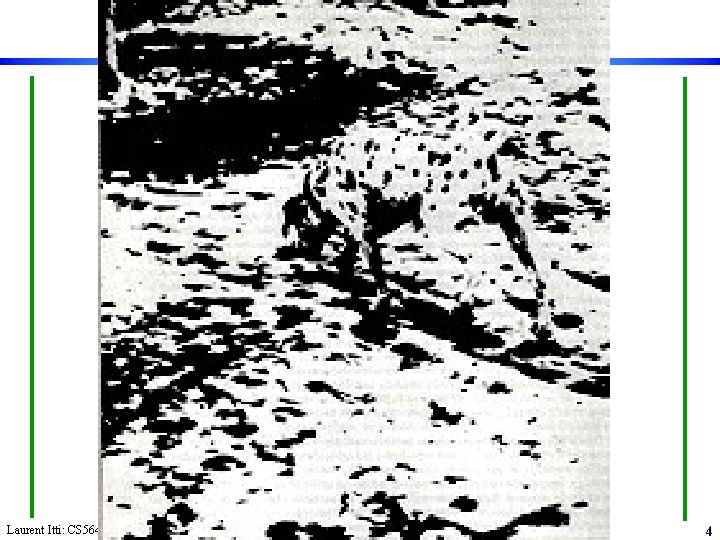
But… We can recognize complex scenes which we have seen before. So, we do have some form of iconic memory. In this lecture: - examine how we can perceive scenes - what is the representation (that can be memorized) - what are the mechanisms Laurent Itti: CS 564 – Brain theory and artificial intelligence. Scene Perception 5
Extended Scene Perception Attention-based analysis: Scan scene with attention, accumulate evidence from detailed local analysis at each attended location. Main issues: - what is the internal representation? - how detailed is memory? - do we really have a detailed internal representation at all!!? Gist: Can very quickly (120 ms) classify entire scenes or do simple recognition tasks; can only shift attention twice in that much time! Laurent Itti: CS 564 – Brain theory and artificial intelligence. Scene Perception 6
Accumulating Evidence Combine information across multiple eye fixations. Build detailed representation of scene in memory. Laurent Itti: CS 564 – Brain theory and artificial intelligence. Scene Perception 7
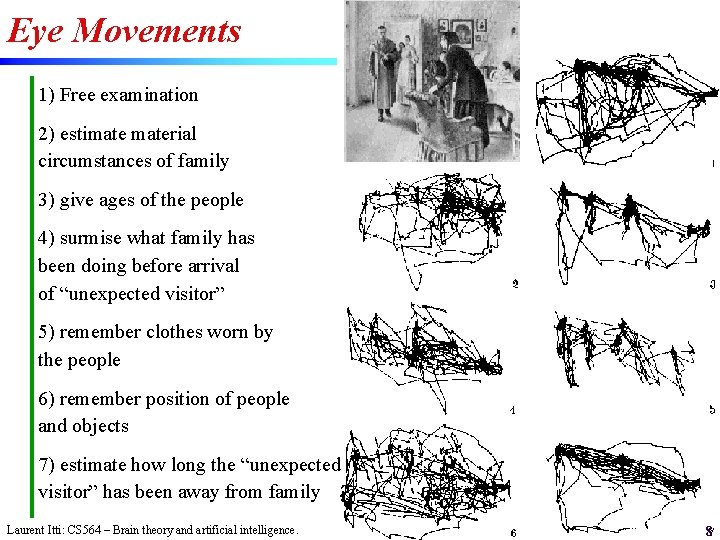
Eye Movements 1) Free examination 2) estimaterial circumstances of family 3) give ages of the people 4) surmise what family has been doing before arrival of “unexpected visitor” 5) remember clothes worn by the people 6) remember position of people and objects 7) estimate how long the “unexpected visitor” has been away from family Laurent Itti: CS 564 – Brain theory and artificial intelligence. Scene Perception 8
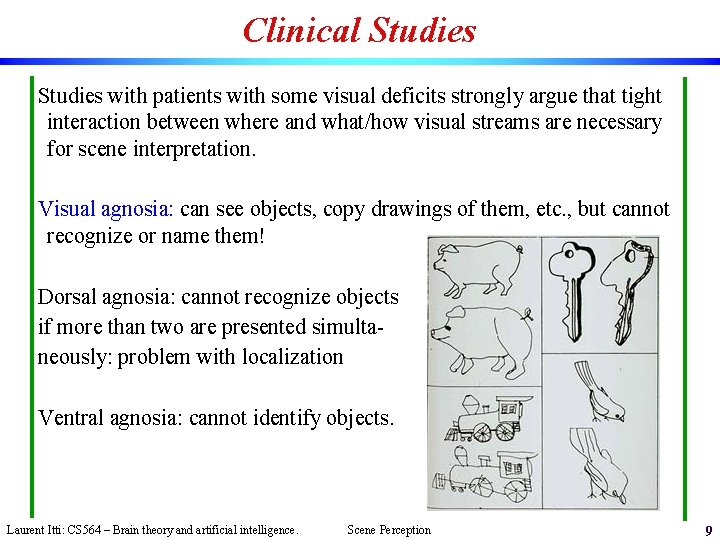
Clinical Studies with patients with some visual deficits strongly argue that tight interaction between where and what/how visual streams are necessary for scene interpretation. Visual agnosia: can see objects, copy drawings of them, etc. , but cannot recognize or name them! Dorsal agnosia: cannot recognize objects if more than two are presented simultaneously: problem with localization Ventral agnosia: cannot identify objects. Laurent Itti: CS 564 – Brain theory and artificial intelligence. Scene Perception 9
These studies suggest… We bind features of objects into objects (feature binding) We bind objects in space into some arrangement (space binding) We perceive the scene. Feature binding = what stream Space binding = where/how stream Laurent Itti: CS 564 – Brain theory and artificial intelligence. Scene Perception 10
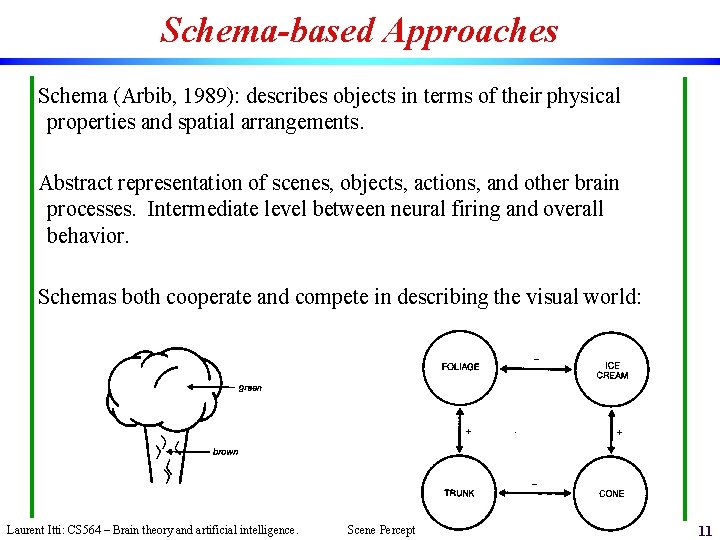
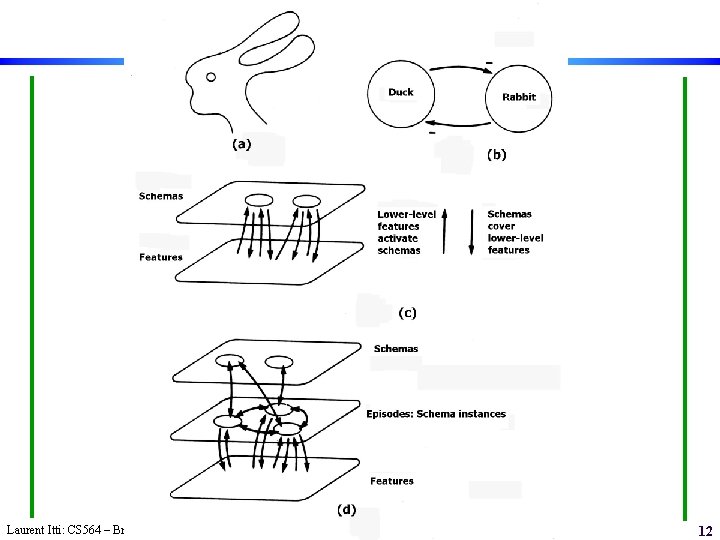
Schema-based Approaches Schema (Arbib, 1989): describes objects in terms of their physical properties and spatial arrangements. Abstract representation of scenes, objects, actions, and other brain processes. Intermediate level between neural firing and overall behavior. Schemas both cooperate and compete in describing the visual world: Laurent Itti: CS 564 – Brain theory and artificial intelligence. Scene Perception 11
Laurent Itti: CS 564 – Brain theory and artificial intelligence. Scene Perception 12
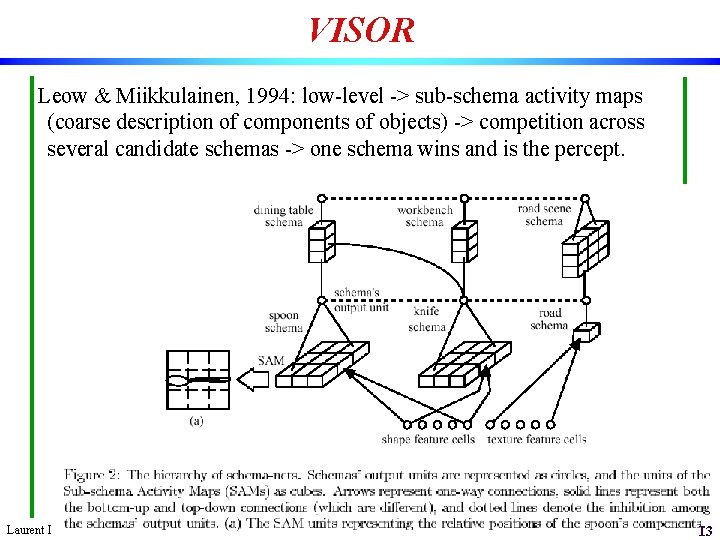
VISOR Leow & Miikkulainen, 1994: low-level -> sub-schema activity maps (coarse description of components of objects) -> competition across several candidate schemas -> one schema wins and is the percept. Laurent Itti: CS 564 – Brain theory and artificial intelligence. Scene Perception 13
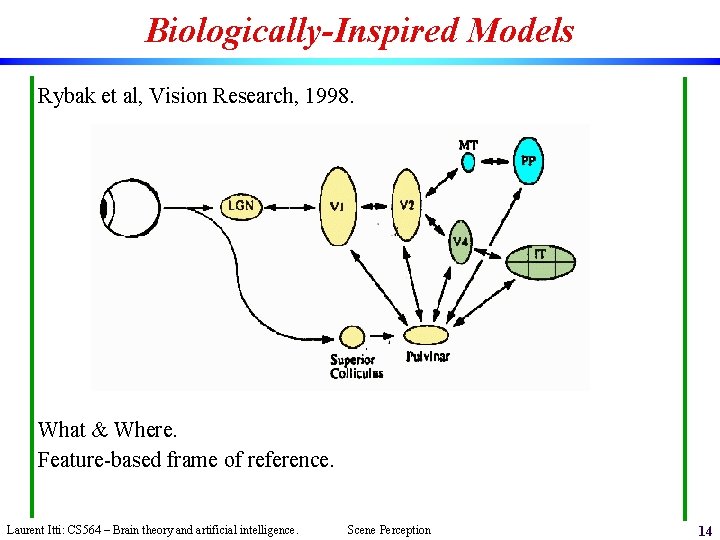
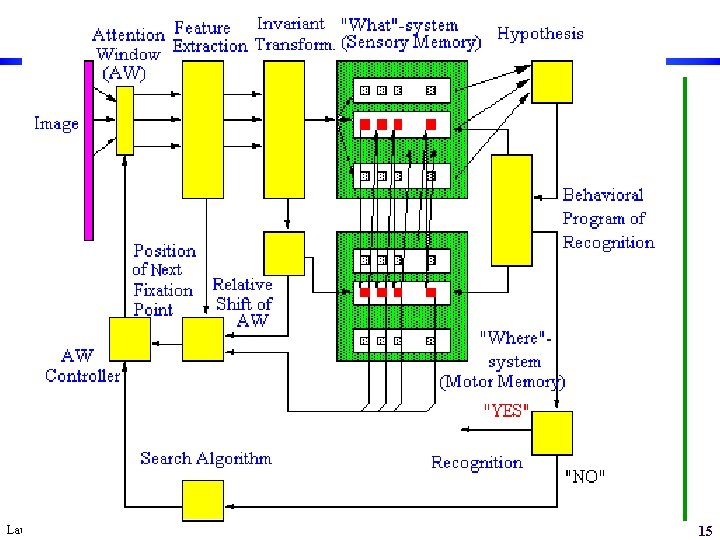
Biologically-Inspired Models Rybak et al, Vision Research, 1998. What & Where. Feature-based frame of reference. Laurent Itti: CS 564 – Brain theory and artificial intelligence. Scene Perception 14
Laurent Itti: CS 564 – Brain theory and artificial intelligence. Scene Perception 15
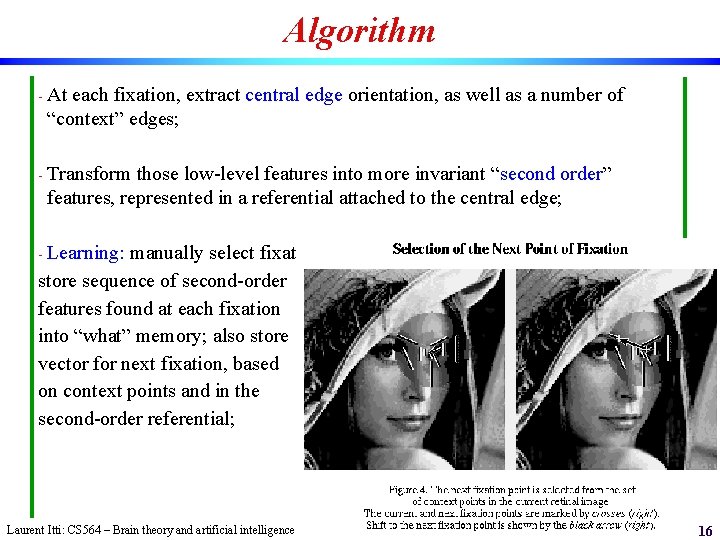
Algorithm - At each fixation, extract central edge orientation, as well as a number of “context” edges; - Transform those low-level features into more invariant “second order” features, represented in a referential attached to the central edge; - Learning: manually select fixation points; store sequence of second-order features found at each fixation into “what” memory; also store vector for next fixation, based on context points and in the second-order referential; Laurent Itti: CS 564 – Brain theory and artificial intelligence. Scene Perception 16
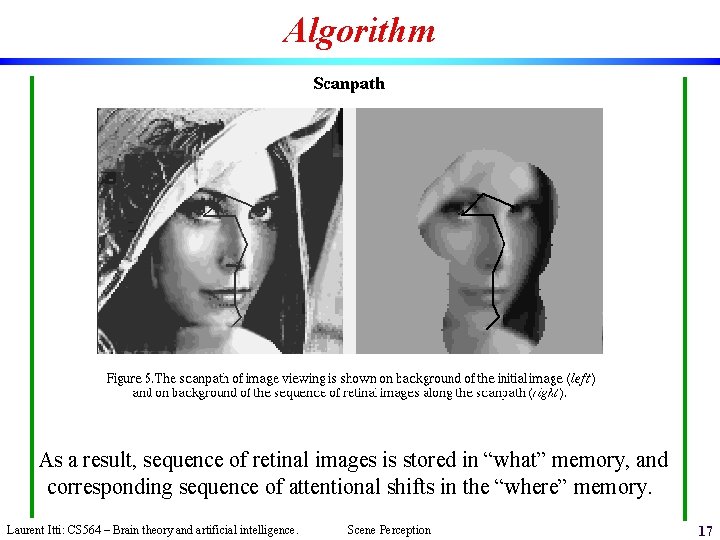
Algorithm As a result, sequence of retinal images is stored in “what” memory, and corresponding sequence of attentional shifts in the “where” memory. Laurent Itti: CS 564 – Brain theory and artificial intelligence. Scene Perception 17
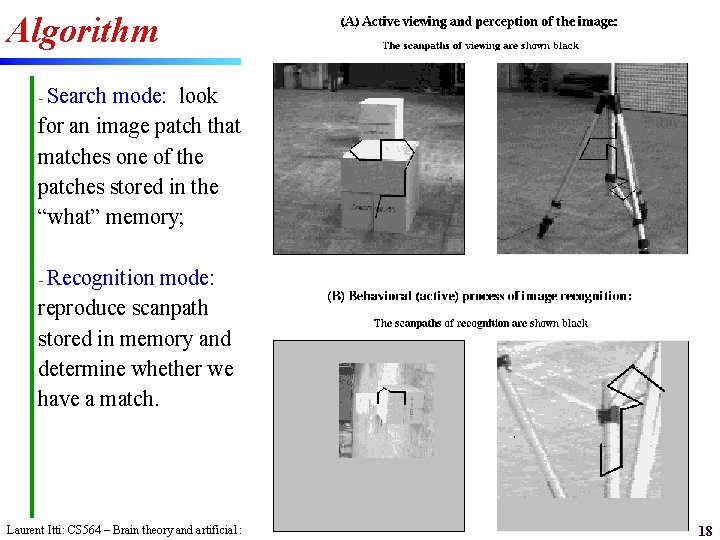
Algorithm - Search mode: look for an image patch that matches one of the patches stored in the “what” memory; - Recognition mode: reproduce scanpath stored in memory and determine whether we have a match. Laurent Itti: CS 564 – Brain theory and artificial intelligence. Scene Perception 18
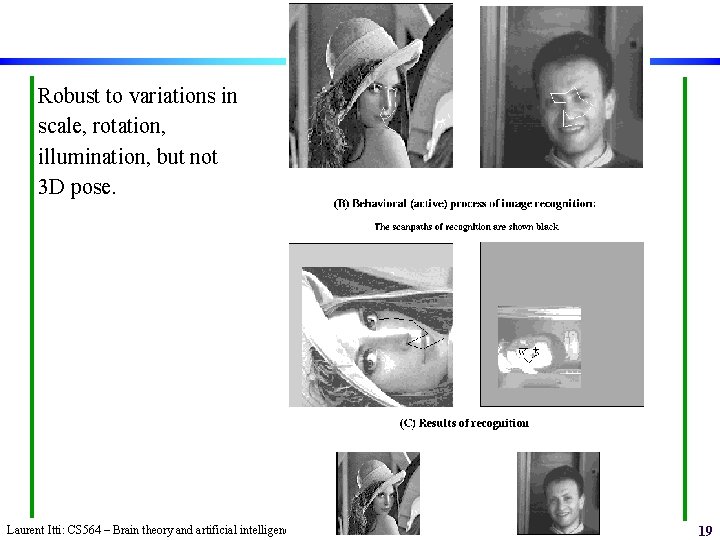
Robust to variations in scale, rotation, illumination, but not 3 D pose. Laurent Itti: CS 564 – Brain theory and artificial intelligence. Scene Perception 19
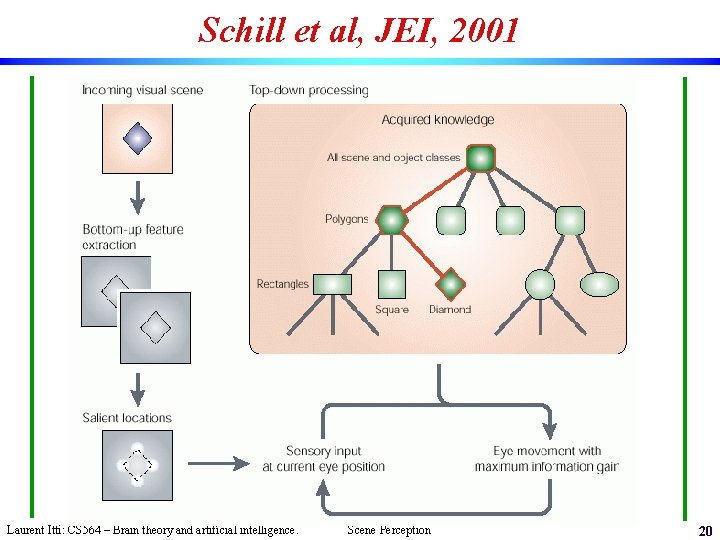
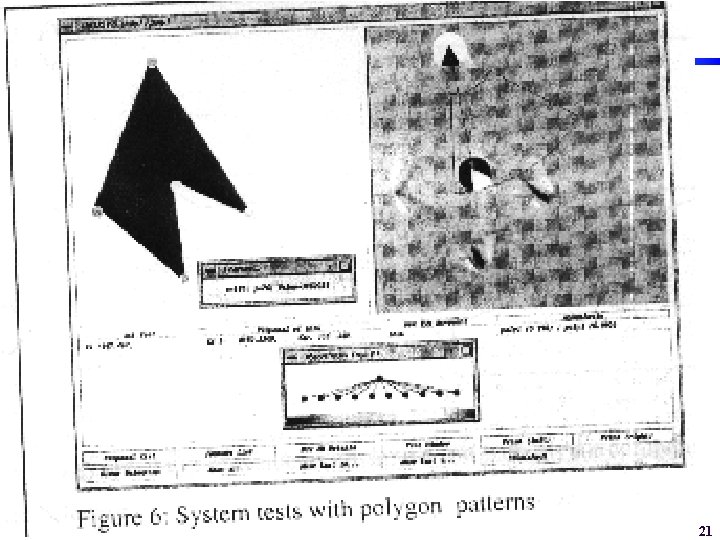
Schill et al, JEI, 2001 Laurent Itti: CS 564 – Brain theory and artificial intelligence. Scene Perception 20
Laurent Itti: CS 564 – Brain theory and artificial intelligence. Scene Perception 21
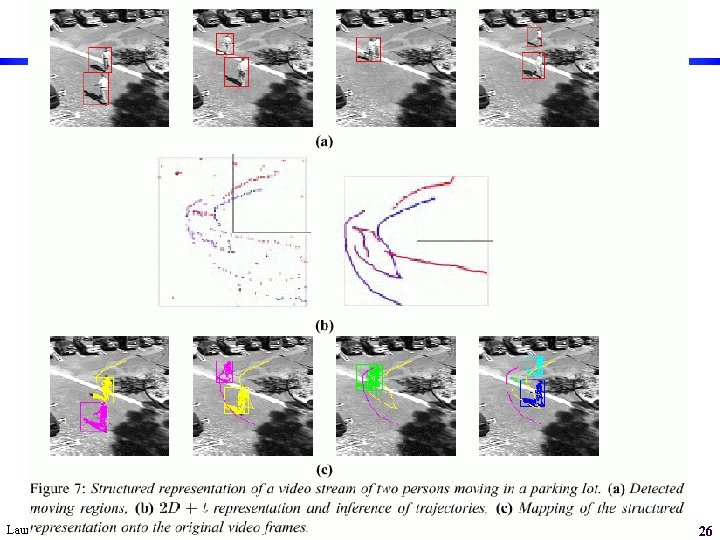
Dynamic Scenes Extension to moving objects and dynamic environment. Rizzolatti: mirror neurons in monkey area F 5 respond when monkey observes an action (e. g. , grasping an object) as well as when he executes the same action. Computer vision models: decompose complex actions using grammars of elementary actions and precise composition rules. Resembles temporal extension of schema-based systems. Is this what the brain does? Laurent Itti: CS 564 – Brain theory and artificial intelligence. Scene Perception 22
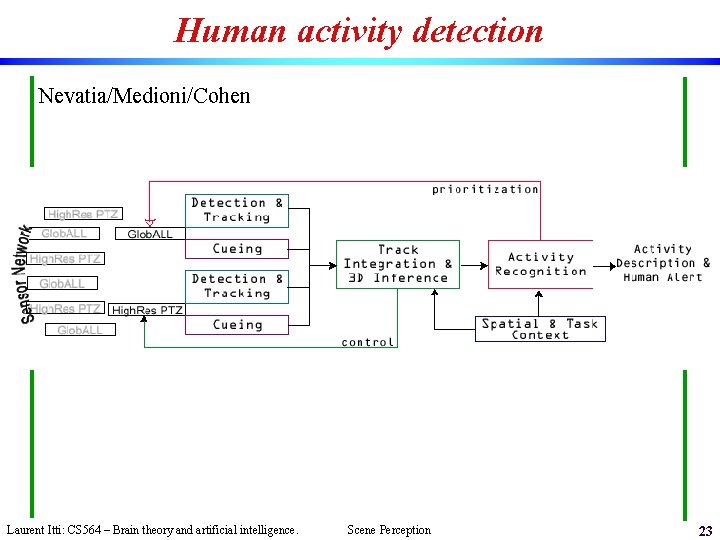
Human activity detection Nevatia/Medioni/Cohen Laurent Itti: CS 564 – Brain theory and artificial intelligence. Scene Perception 23
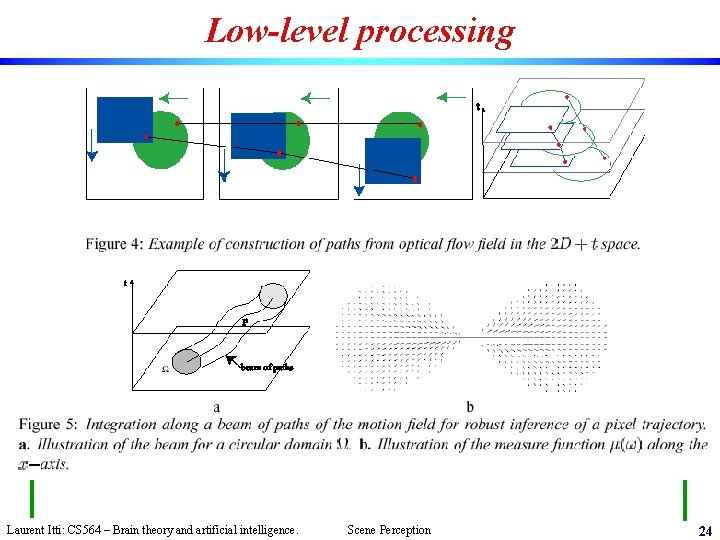
Low-level processing Laurent Itti: CS 564 – Brain theory and artificial intelligence. Scene Perception 24
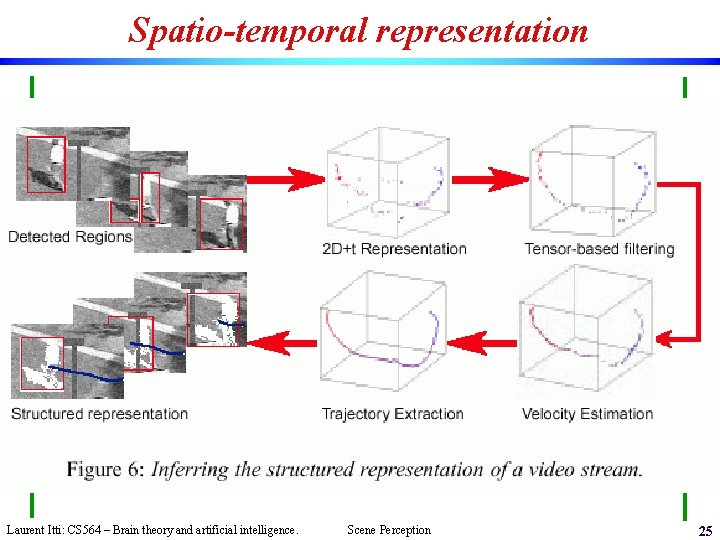
Spatio-temporal representation Laurent Itti: CS 564 – Brain theory and artificial intelligence. Scene Perception 25
Laurent Itti: CS 564 – Brain theory and artificial intelligence. Scene Perception 26
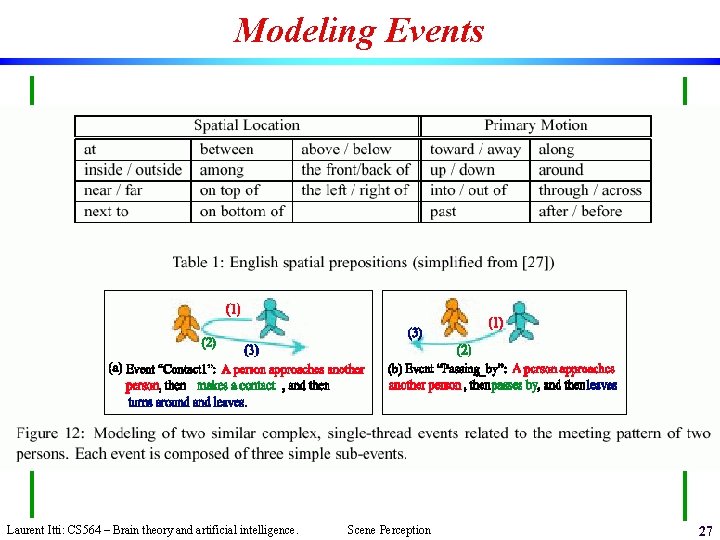
Modeling Events Laurent Itti: CS 564 – Brain theory and artificial intelligence. Scene Perception 27
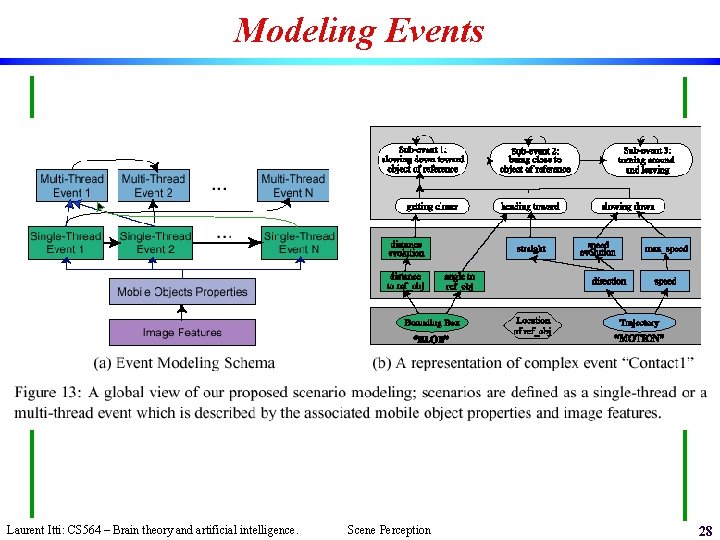
Modeling Events Laurent Itti: CS 564 – Brain theory and artificial intelligence. Scene Perception 28
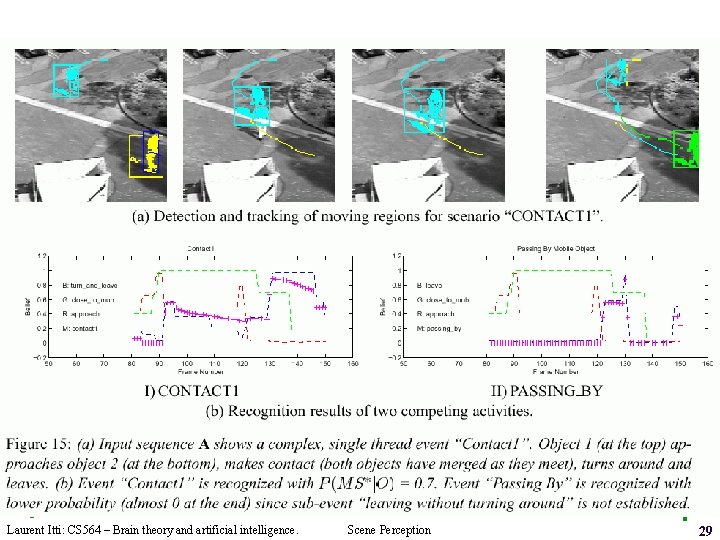
Laurent Itti: CS 564 – Brain theory and artificial intelligence. Scene Perception 29
Several Problems… with the “progressive visual buffer hypothesis: ” Change blindness: Attention seems to be required for us to perceive change in images, while these could be easily detected in a visual buffer! Amount of memory required is huge! Interpretation of buffer contents by high-level vision is very difficult if buffer contains very detailed representations (Tsotsos, 1990)! Laurent Itti: CS 564 – Brain theory and artificial intelligence. Scene Perception 30
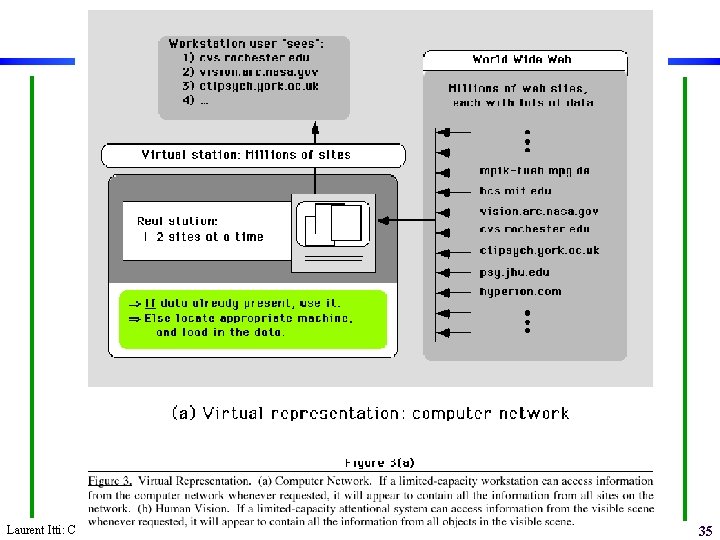
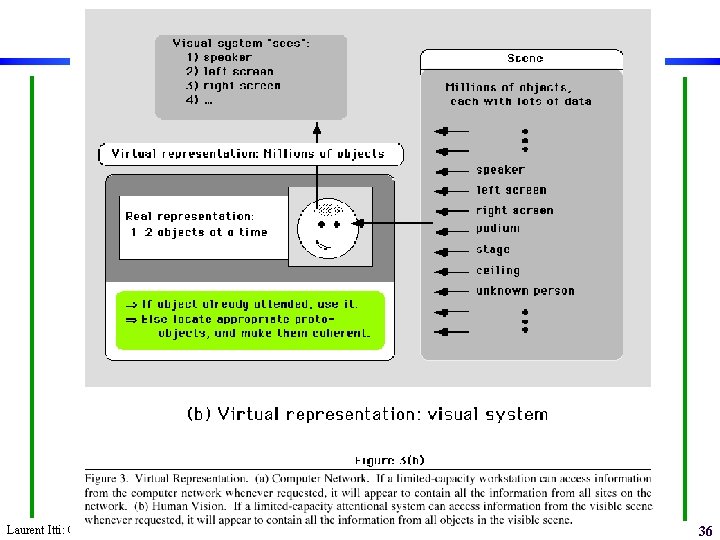
The World as an Outside Memory Kevin O’Regan, early 90 s: why build a detailed internal representation of the world? too complex… not enough memory… … and useless? The world is the memory. Attention and the eyes are a look-up tool! Laurent Itti: CS 564 – Brain theory and artificial intelligence. Scene Perception 31
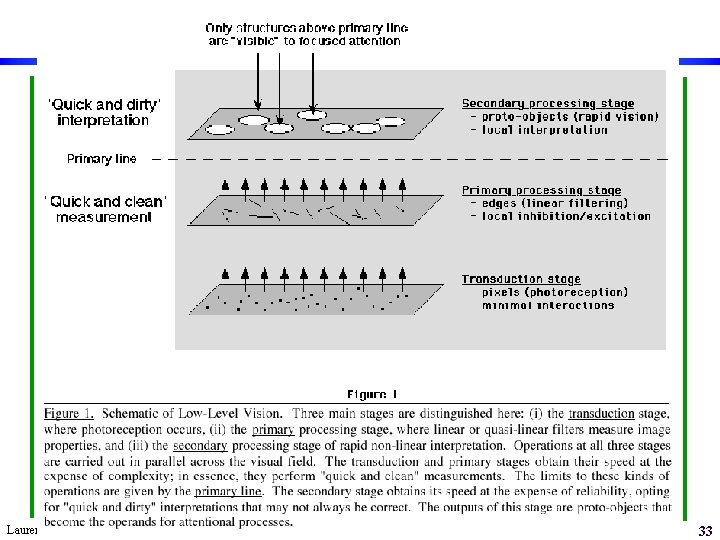
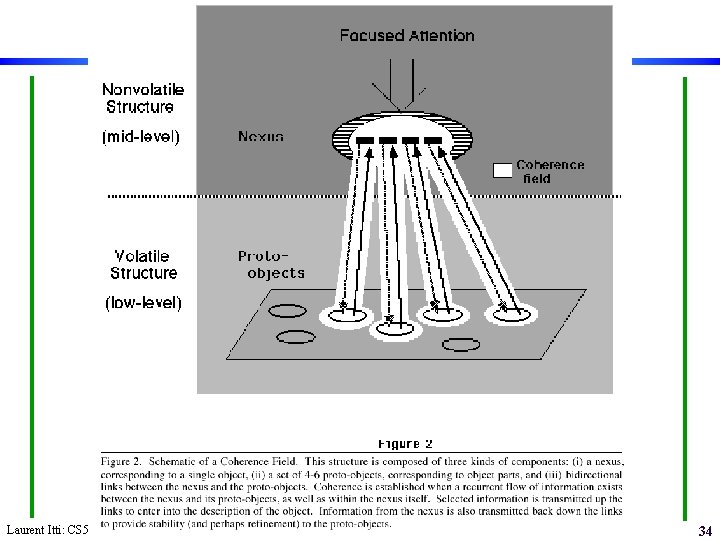
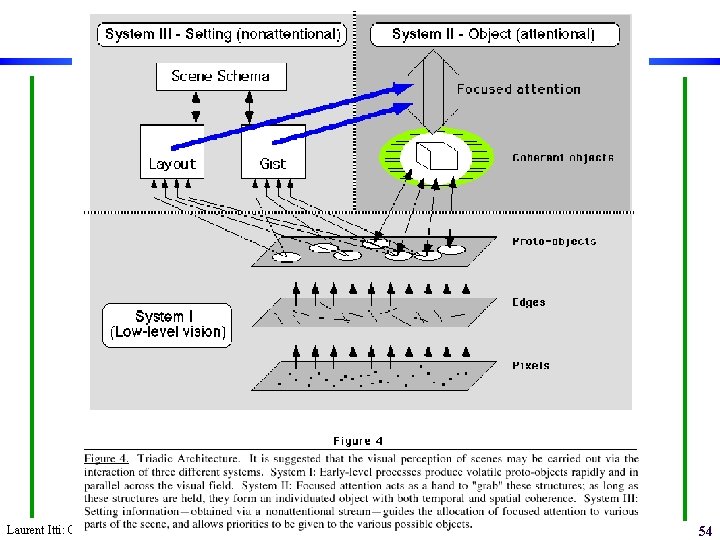
The “Attention Hypothesis” Rensink, 2000 No “integrative buffer” Early processing extracts information up to “proto-object” complexity in massively parallel manner Attention is necessary to bind the different proto-objects into complete objects, as well as to bind object and location Once attention leaves an object, the binding “dissolves. ” Not a problem, it can be formed again whenever needed, by shifting attention back to the object. Only a rather sketchy “virtual representation” is kept in memory, and attention/eye movements are used to gather details as needed Laurent Itti: CS 564 – Brain theory and artificial intelligence. Scene Perception 32
Laurent Itti: CS 564 – Brain theory and artificial intelligence. Scene Perception 33
Laurent Itti: CS 564 – Brain theory and artificial intelligence. Scene Perception 34
Laurent Itti: CS 564 – Brain theory and artificial intelligence. Scene Perception 35
Laurent Itti: CS 564 – Brain theory and artificial intelligence. Scene Perception 36
Back to accumulated evidence! Hollingworth et al, 2000 argue against the disintegration of coherent visual representations as soon as attention is withdrawn. Experiment: - line drawings of natural scenes - change one object (target) during a saccadic eye movement away from that object - instruct subjects to examine scene, and they would later be asked questions about what was in it - also instruct subjects to monitor for object changes and press a button as soon as a change detected Hypothesis: It is known that attention will precede eye movements. So the change is outside the focus of attention. If subjects can notice it, it means that some detailed memory of the object is retained. Laurent Itti: CS 564 – Brain theory and artificial intelligence. Scene Perception 37
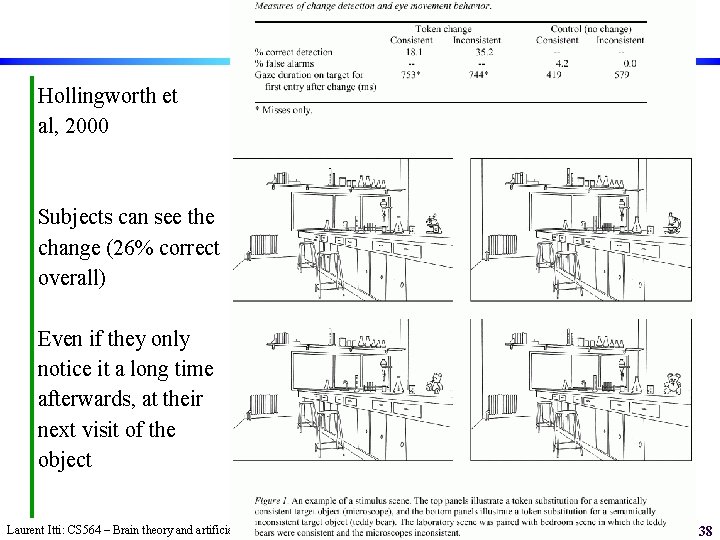
Hollingworth et al, 2000 Subjects can see the change (26% correct overall) Even if they only notice it a long time afterwards, at their next visit of the object Laurent Itti: CS 564 – Brain theory and artificial intelligence. Scene Perception 38
Hollingworth et al So, these results suggest that “the online representation of a scene can contain detailed visual information in memory from previously attended objects. Contrary to the proposal of the attention hypothesis (see Rensink, 2000), the results indicate that visual object representations do not disintegrate upon the withdrawal of attention. ” Laurent Itti: CS 564 – Brain theory and artificial intelligence. Scene Perception 39
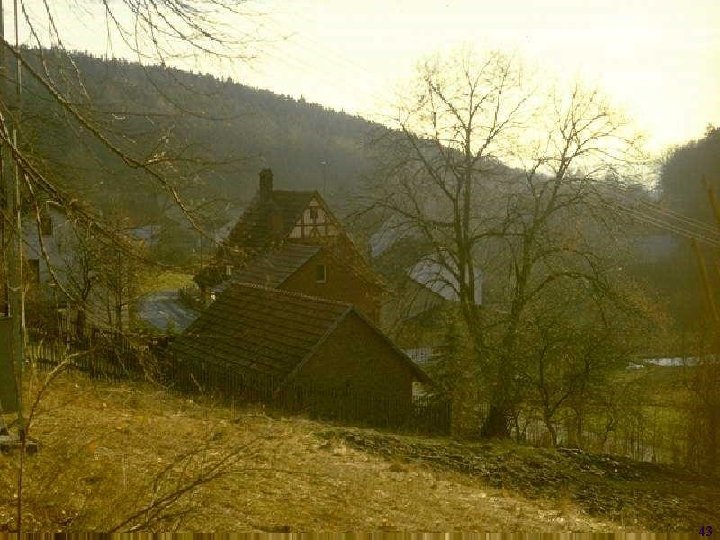
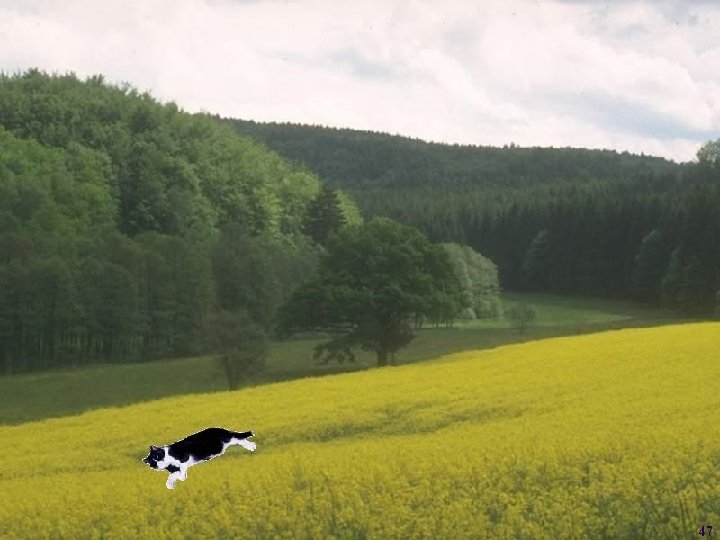
Gist of a Scene Biederman, 1981: from very brief exposure to a scene (120 ms or less), we can already extract a lot of information about its global structure, its category (indoors, outdoors, etc) and some of its components. “riding the first spike: ” 120 ms is the time it takes the first spike to travel from the retina to IT! Thorpe, van Rullen: very fast classification (down to 27 ms exposure, no mask), e. g. , for tasks such as “was there an animal in the scene? ” Laurent Itti: CS 564 – Brain theory and artificial intelligence. Scene Perception 40

Laurent Itti: CS 564 – Brain theory and artificial intelligence. Scene Perception 41
Laurent Itti: CS 564 – Brain theory and artificial intelligence. Scene Perception 42
Laurent Itti: CS 564 – Brain theory and artificial intelligence. Scene Perception 43
Laurent Itti: CS 564 – Brain theory and artificial intelligence. Scene Perception 44

Laurent Itti: CS 564 – Brain theory and artificial intelligence. Scene Perception 45
Laurent Itti: CS 564 – Brain theory and artificial intelligence. Scene Perception 46
Laurent Itti: CS 564 – Brain theory and artificial intelligence. Scene Perception 47
Laurent Itti: CS 564 – Brain theory and artificial intelligence. Scene Perception 48
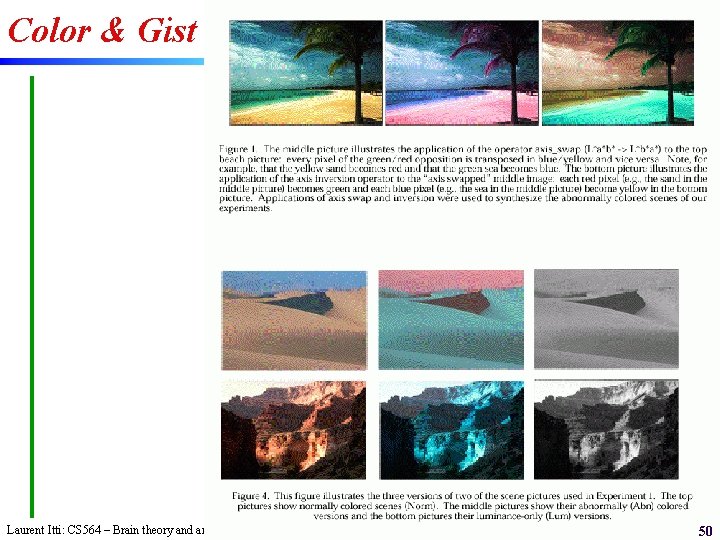
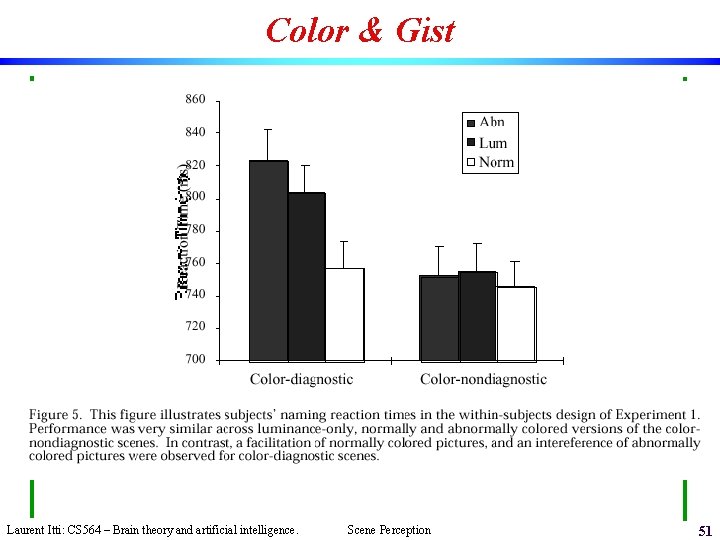
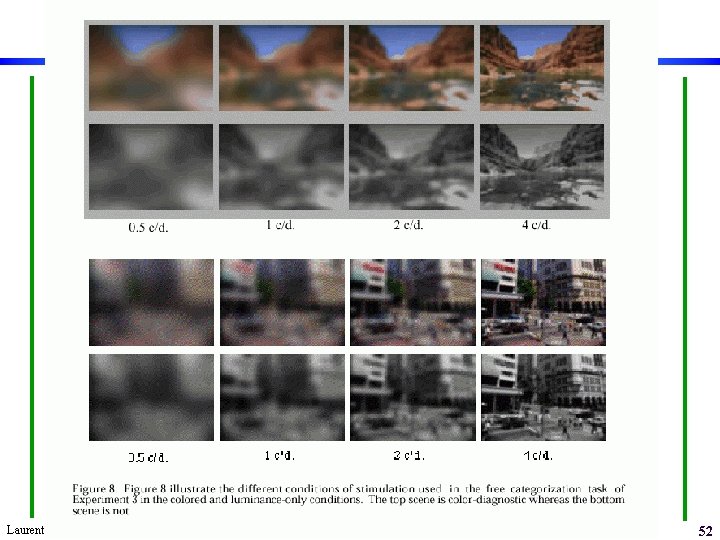
Gist of a Scene Oliva & Schyns, Cognitive Psychology, 2000 Investigate effect of color on fast scene perception. Idea: Rather than looking at the properties of the constituent objects in a given scene, look at the global effect of color on recognition. Hypothesis: diagnostic colors (predictive of scene category) will help recognition. Laurent Itti: CS 564 – Brain theory and artificial intelligence. Scene Perception 49
Color & Gist Laurent Itti: CS 564 – Brain theory and artificial intelligence. Scene Perception 50
Color & Gist Laurent Itti: CS 564 – Brain theory and artificial intelligence. Scene Perception 51
Laurent Itti: CS 564 – Brain theory and artificial intelligence. Scene Perception 52
Color & Gist Conclusion from Oliva & Schyns study: “colored blobs at a coarse spatial scale concur with luminance cues to form the relevant spatial layout that mediates express scene recognition. ” Laurent Itti: CS 564 – Brain theory and artificial intelligence. Scene Perception 53
Laurent Itti: CS 564 – Brain theory and artificial intelligence. Scene Perception 54
Outlook It seems unlikely that we perceive scenes by building a progressive buffer and accumulating detailed evidence into it. It would take to much resources and be too complex to use. Rather, we may only have an illusion of detailed representation, and the availability of our eyes/attention to get the details whenever they are needed. The world as an outside memory. In addition to attention-based scene analysis, we are able to very rapidly extract the gist of a scene – much faster than we can shift attention around. This gist may be constructed by fairly simple processes that operate in parallel. It can then be used to prime memory and attention. Laurent Itti: CS 564 – Brain theory and artificial intelligence. Scene Perception 55
- Slides: 55