
Brain Structure and Function If the human brain
Brain Structure and Function

“If the human brain were so simple that we could understand it, we would be so simple that we couldn’t” -Emerson Pugh, The Biological Origin of Human Values (1977)
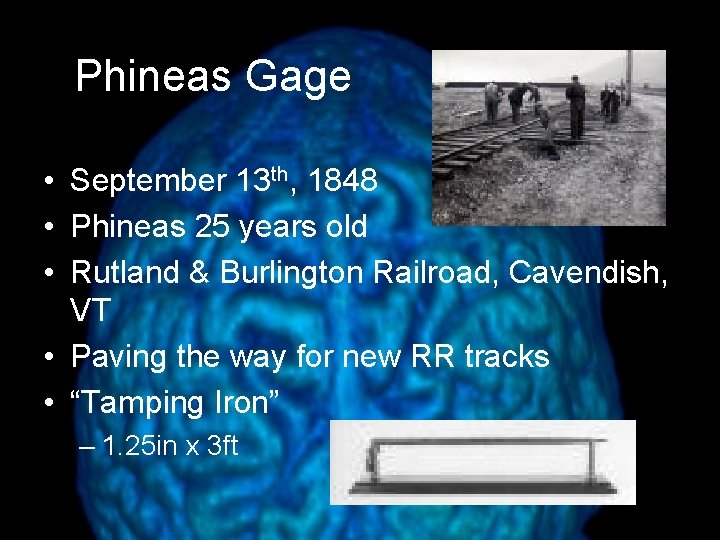
Phineas Gage • September 13 th, 1848 • Phineas 25 years old • Rutland & Burlington Railroad, Cavendish, VT • Paving the way for new RR tracks • “Tamping Iron” – 1. 25 in x 3 ft
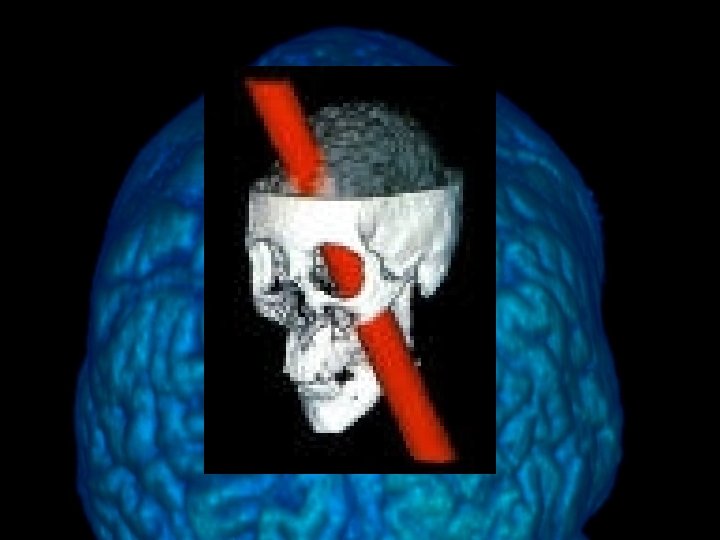

Phineas Gage • Accident – Quick Recovery • Months later: “No longer Gage” – Before: capable, efficient, best foreman, well-balanced mind – After: extravagant, anti-social, liar, grossly profane • Stint with P. T Barnum • Died 12 years later • Watch Clip
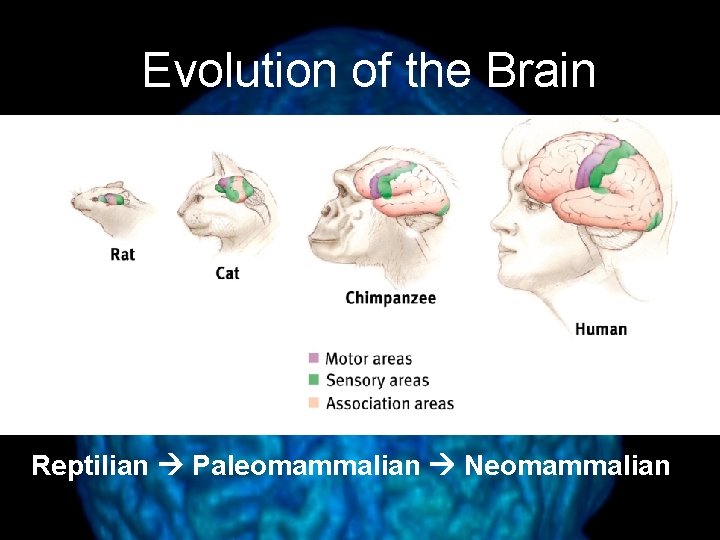
Evolution of the Brain Reptilian Paleomammalian Neomammalian
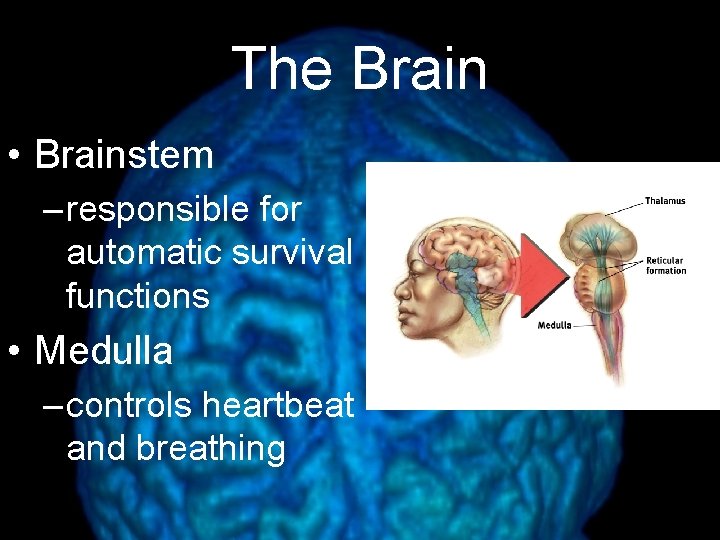
The Brain • Brainstem – responsible for automatic survival functions • Medulla – controls heartbeat and breathing
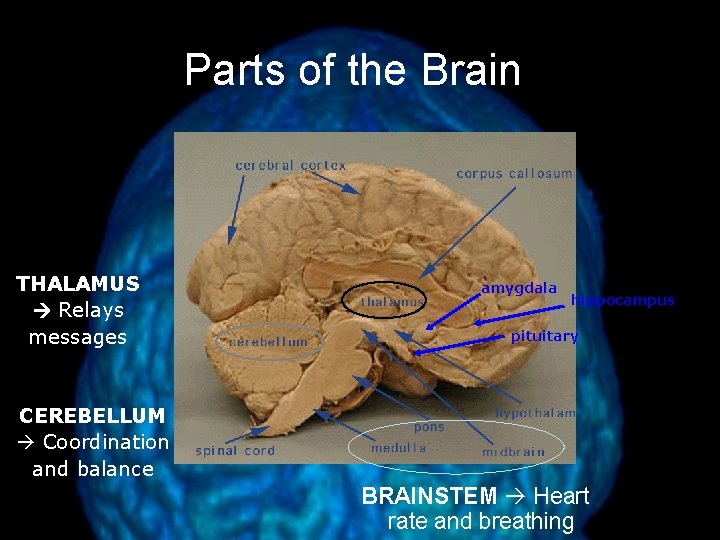
Parts of the Brain THALAMUS Relays messages amygdala hippocampus pituitary CEREBELLUM Coordination and balance BRAINSTEM Heart rate and breathing
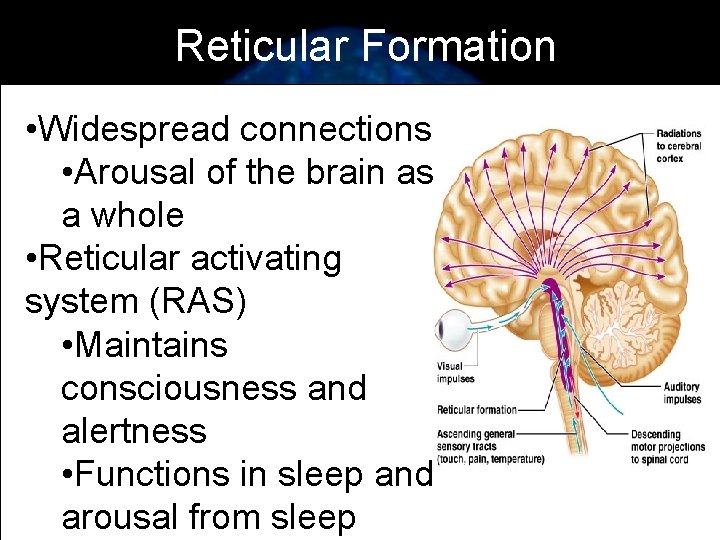
Reticular Formation • Widespread connections • Arousal of the brain as a whole • Reticular activating system (RAS) • Maintains consciousness and alertness • Functions in sleep and arousal from sleep

The Cerebellum – helps coordinate voluntary movement and balance
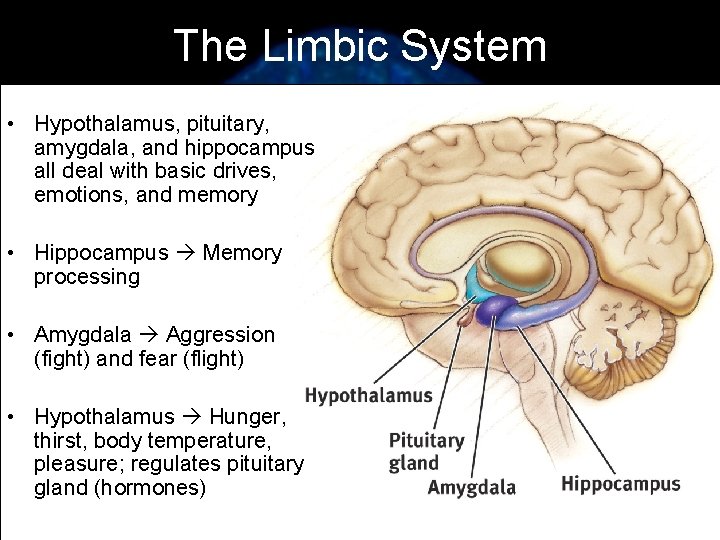
The Limbic System • Hypothalamus, pituitary, amygdala, and hippocampus all deal with basic drives, emotions, and memory • Hippocampus Memory processing • Amygdala Aggression (fight) and fear (flight) • Hypothalamus Hunger, thirst, body temperature, pleasure; regulates pituitary gland (hormones)
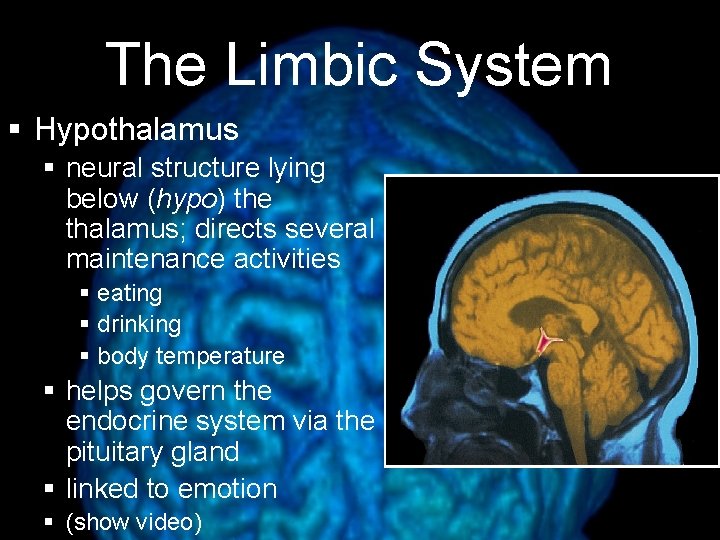
The Limbic System § Hypothalamus § neural structure lying below (hypo) the thalamus; directs several maintenance activities § eating § drinking § body temperature § helps govern the endocrine system via the pituitary gland § linked to emotion § (show video)
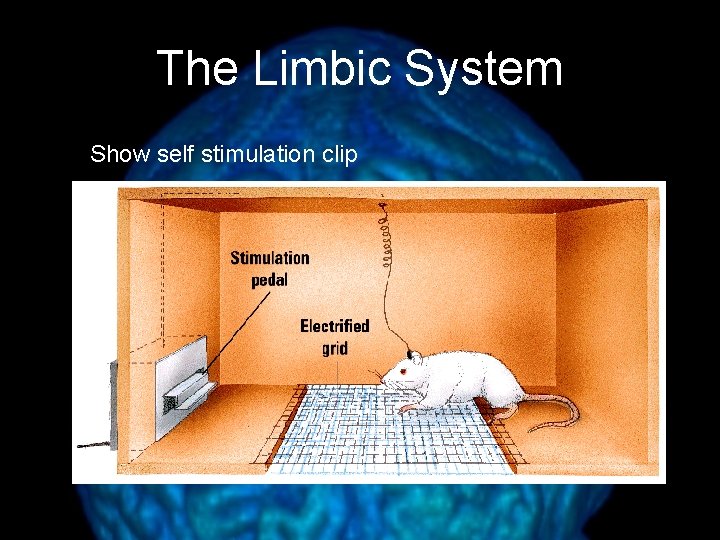
The Limbic System Show self stimulation clip
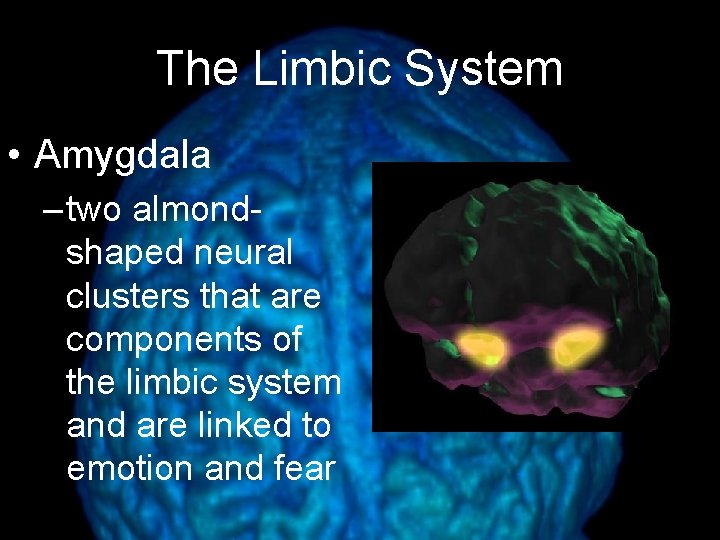
The Limbic System • Amygdala – two almondshaped neural clusters that are components of the limbic system and are linked to emotion and fear
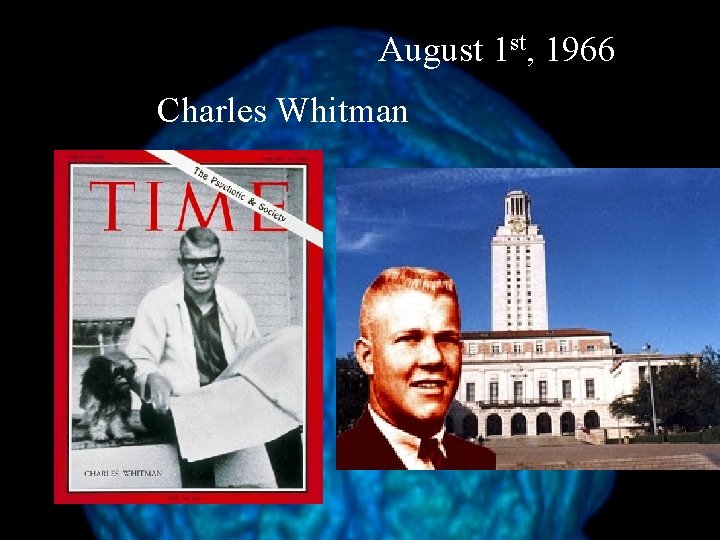
August 1 st, 1966 Charles Whitman
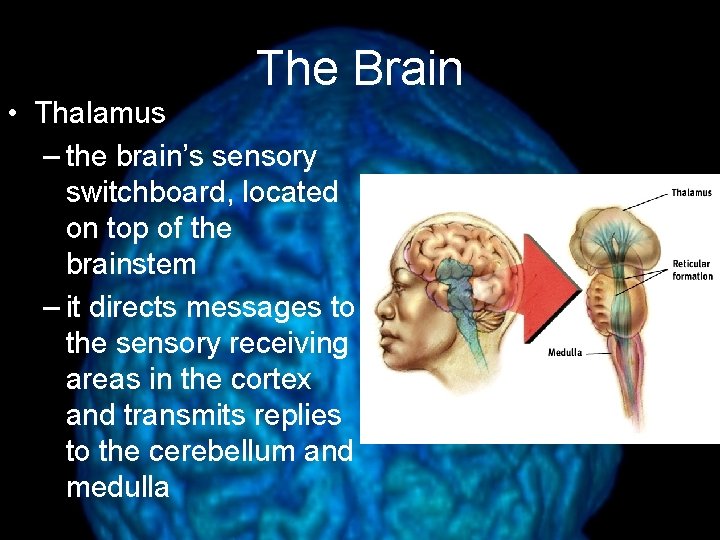
The Brain • Thalamus – the brain’s sensory switchboard, located on top of the brainstem – it directs messages to the sensory receiving areas in the cortex and transmits replies to the cerebellum and medulla
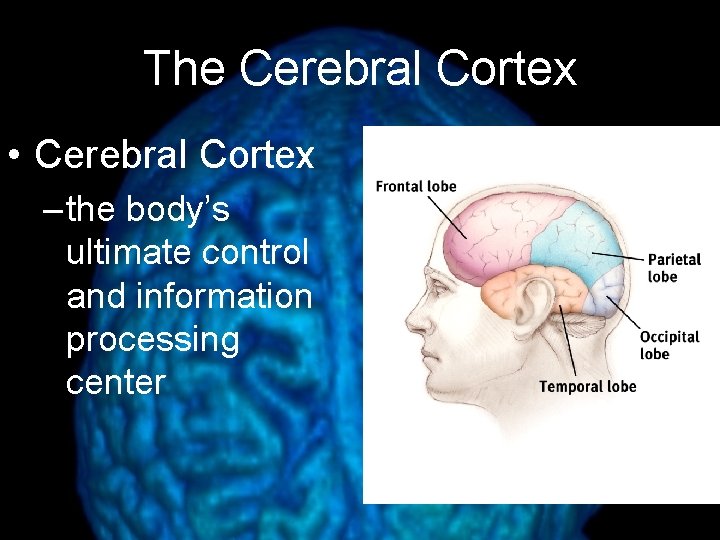
The Cerebral Cortex • Cerebral Cortex – the body’s ultimate control and information processing center
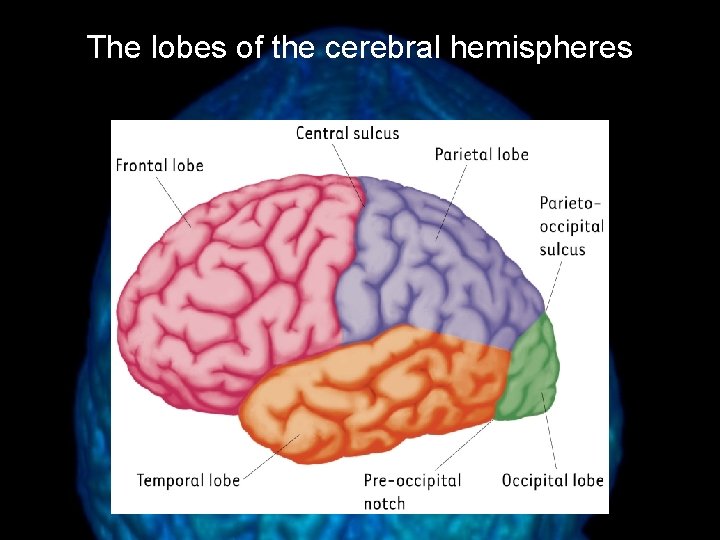
The lobes of the cerebral hemispheres
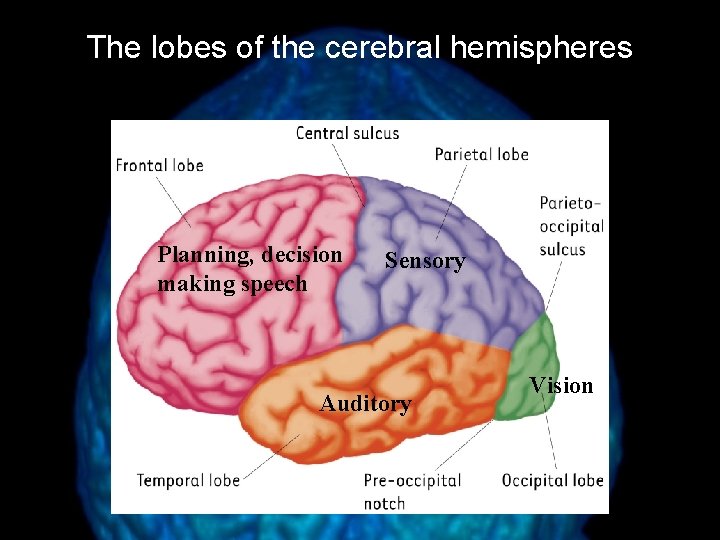
The lobes of the cerebral hemispheres Planning, decision making speech Sensory Auditory Vision
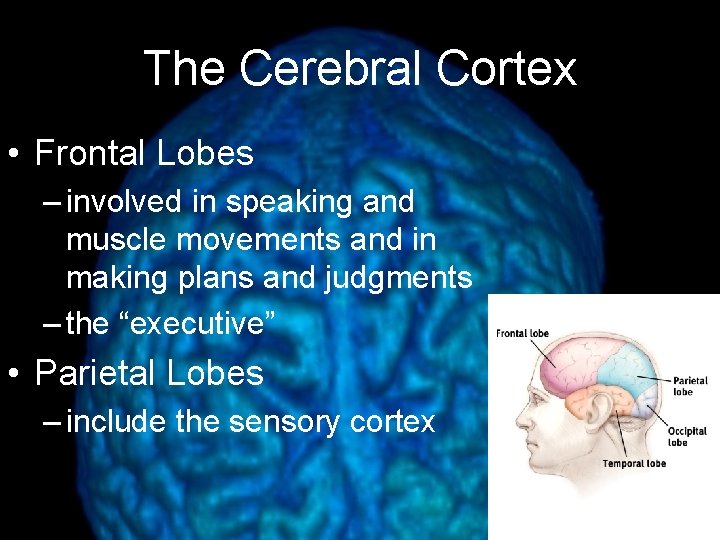
The Cerebral Cortex • Frontal Lobes – involved in speaking and muscle movements and in making plans and judgments – the “executive” • Parietal Lobes – include the sensory cortex
The Cerebral Cortex • Occipital Lobes – include the visual areas, which receive visual information from the opposite visual field • Temporal Lobes – include the auditory areas, each of which receives auditory information primarily from the opposite ear
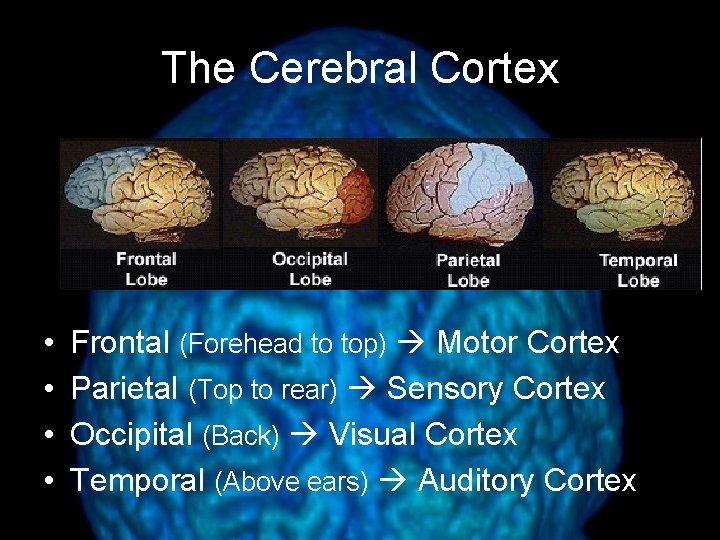
The Cerebral Cortex • • Frontal (Forehead to top) Motor Cortex Parietal (Top to rear) Sensory Cortex Occipital (Back) Visual Cortex Temporal (Above ears) Auditory Cortex
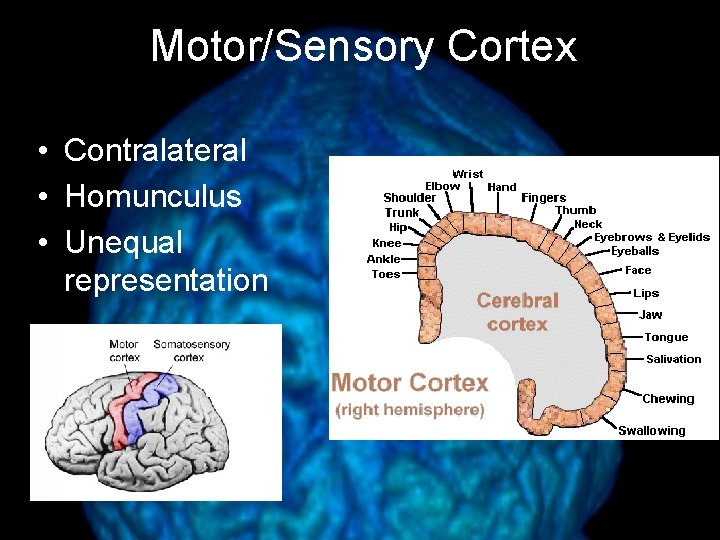
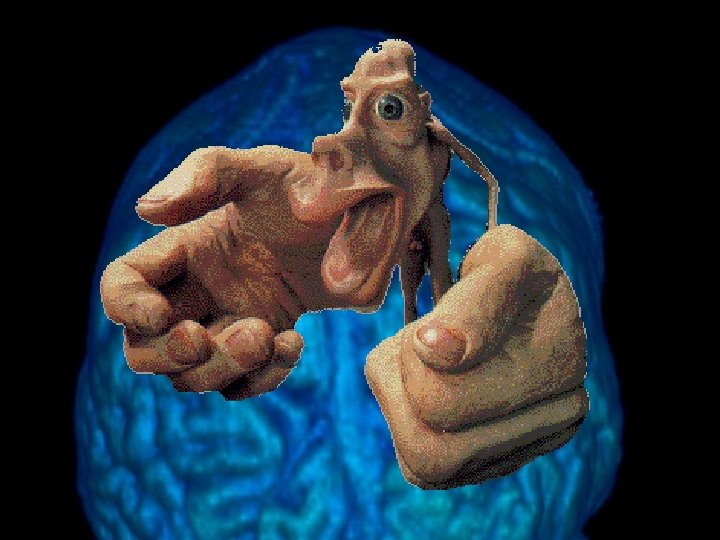
Motor/Sensory Cortex • Contralateral • Homunculus • Unequal representation
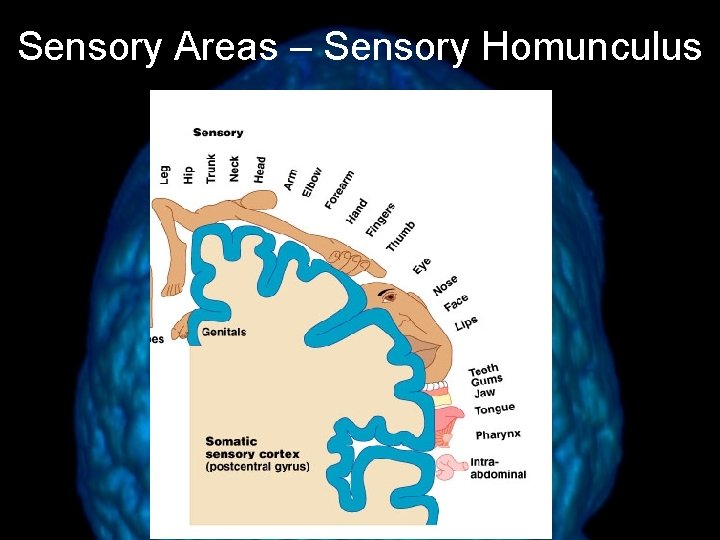
Sensory Areas – Sensory Homunculus Figure 13. 10
The Cerebral Cortex § Aphasia § impairment of language, usually caused by left hemisphere damage either to Broca’s area (impairing speaking) or to Wernicke’s area (impairing understanding) –see clips § Broca’s Area § an area of the left frontal lobe that directs the muscle movements involved in speech § Wernicke’s Area § an area of the left temporal lobe involved in language comprehension and expression
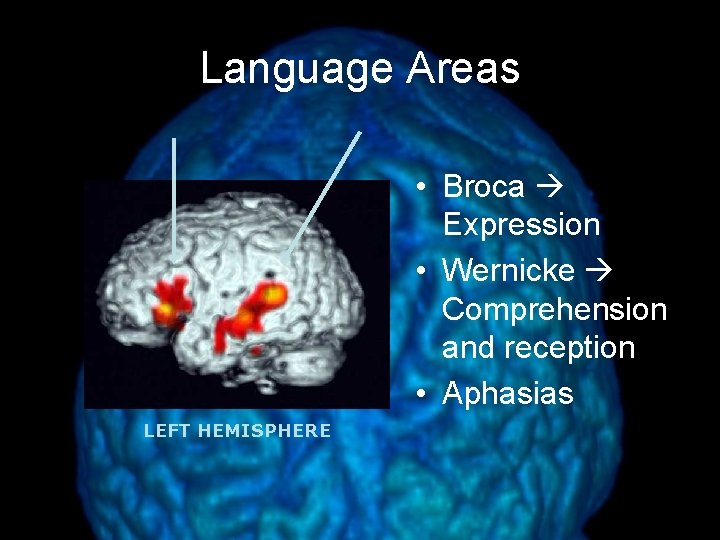
Language Areas • Broca Expression • Wernicke Comprehension and reception • Aphasias LEFT HEMISPHERE
![Paul Broca [1800 s] • Suggested localization](http://slidetodoc.com/presentation_image/192df8e65bd673b91765cd7ea65d167e/image-28.jpg "Paul Broca [1800 s] • Suggested localization")
Paul Broca [1800 s] • Suggested localization
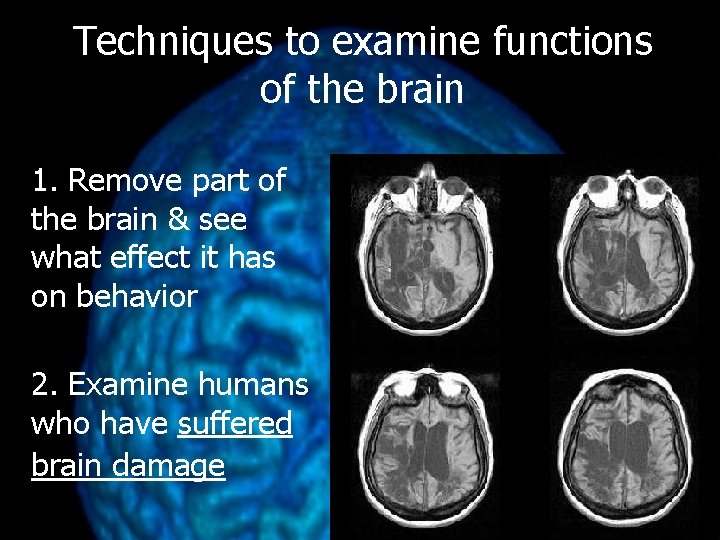
Techniques to examine functions of the brain 1. Remove part of the brain & see what effect it has on behavior 2. Examine humans who have suffered brain damage
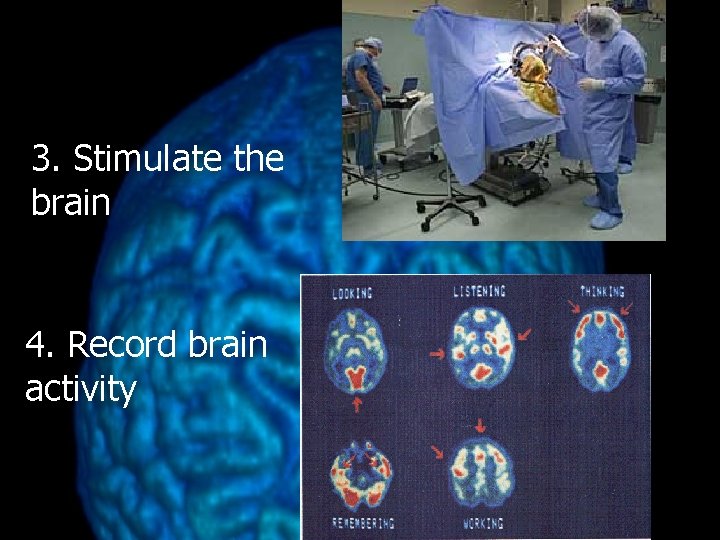
3. Stimulate the brain 4. Record brain activity
Brain Lateralization
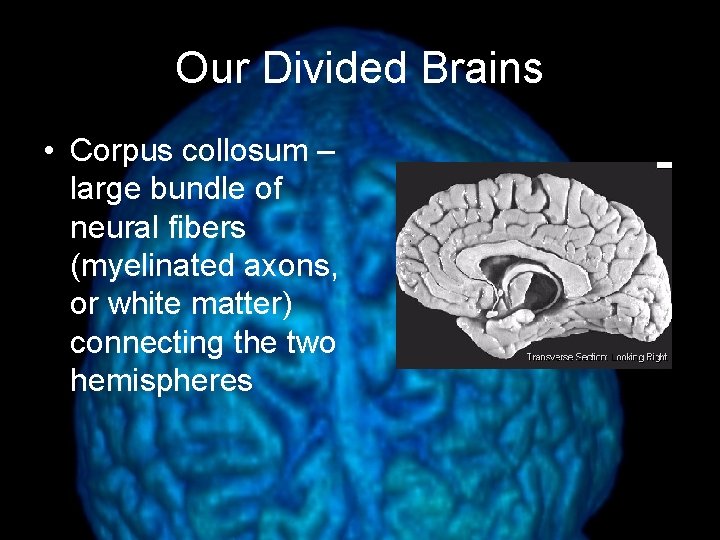
Our Divided Brains • Corpus collosum – large bundle of neural fibers (myelinated axons, or white matter) connecting the two hemispheres
Hemispheric Specialization LEFT RIGHT Symbolic thinking (Language) Detail Literal meaning Spatial perception Overall picture Context, metaphor
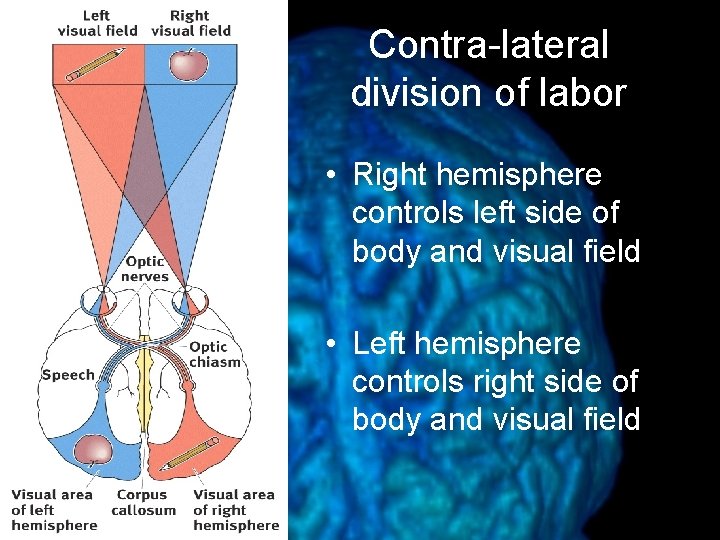
Contra-lateral division of labor • Right hemisphere controls left side of body and visual field • Left hemisphere controls right side of body and visual field
Split Brain Patients • Epileptic patients had corpus callosum cut to reduce seizures in the brain • Lives largely unaffected, seizures reduced • Affected abilities related to naming objects in the left visual field
Brain Plasticity
Brain Plasticity • The ability of the brain to reorganize neural pathways based on new experiences • Persistent functional changes in the brain represent new knowledge • Age dependent component • Brain injuries
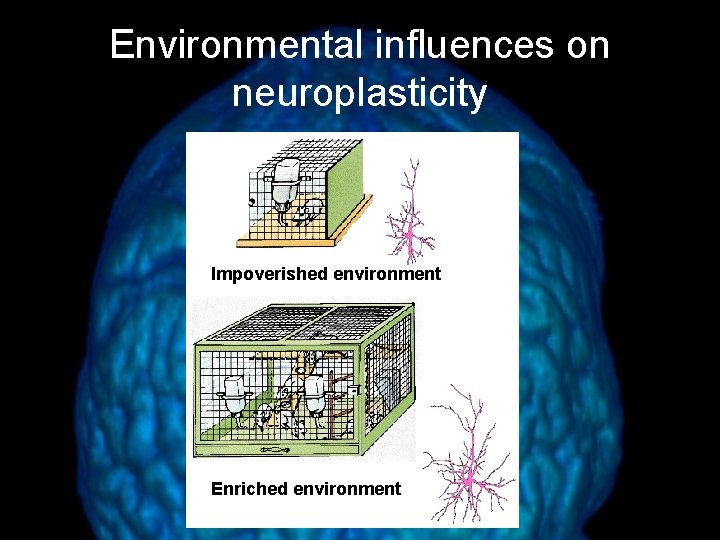
Environmental influences on neuroplasticity Impoverished environment Enriched environment
Sensation and Perception
Sensation • The process by which the central nervous system receives input from the environment via sensory neurons • Bottom up processing
Perception • The process by which the brain interprets and organizes sensory information • Top-down processing
The psychophysics of sensation • Absolute threshold the minimum stimulation needed to detect a stimulus with 50% accuracy • Subliminal stimulation below the absolute threshold for conscious awareness – May affect behavior without conscious awareness • Sensory adaptation/habituation diminished sensitivity to an unchanging stimulus
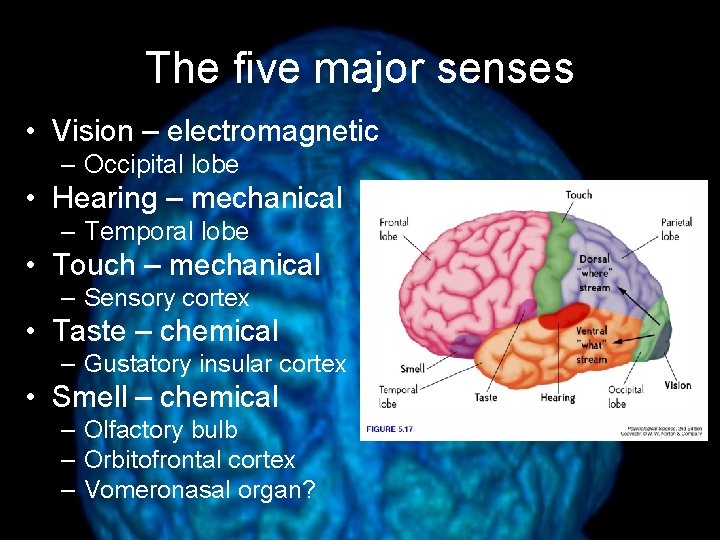
The five major senses • Vision – electromagnetic – Occipital lobe • Hearing – mechanical – Temporal lobe • Touch – mechanical – Sensory cortex • Taste – chemical – Gustatory insular cortex • Smell – chemical – Olfactory bulb – Orbitofrontal cortex – Vomeronasal organ?
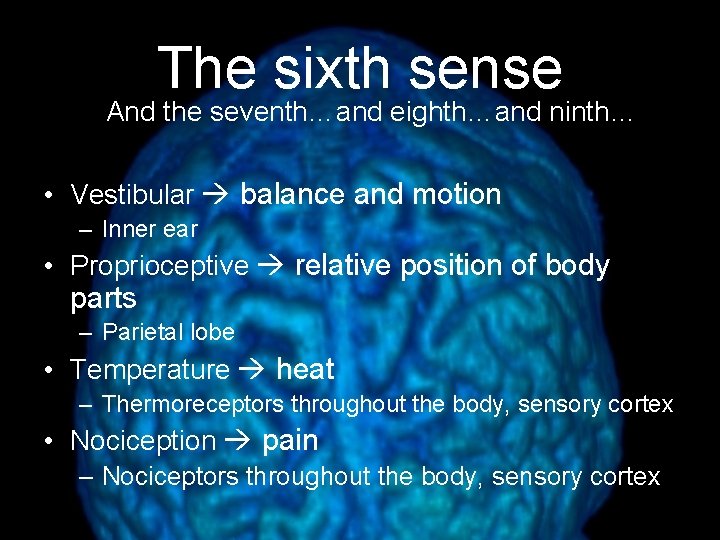
The sixth sense And the seventh…and eighth…and ninth… • Vestibular balance and motion – Inner ear • Proprioceptive relative position of body parts – Parietal lobe • Temperature heat – Thermoreceptors throughout the body, sensory cortex • Nociception pain – Nociceptors throughout the body, sensory cortex
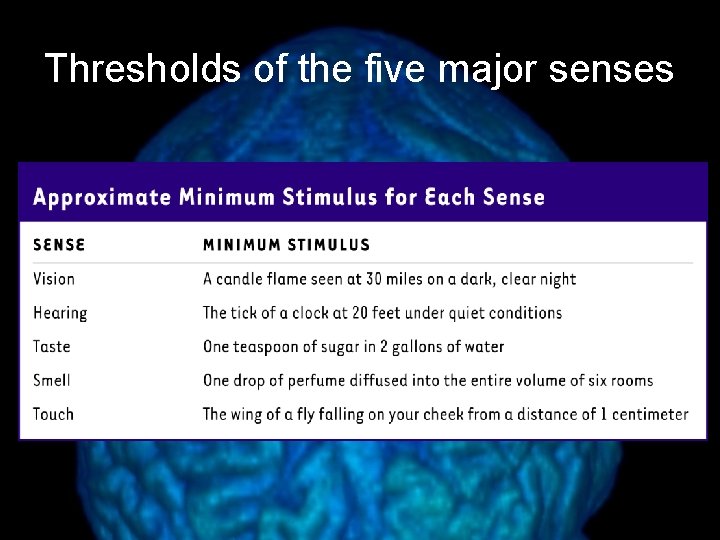
Thresholds of the five major senses
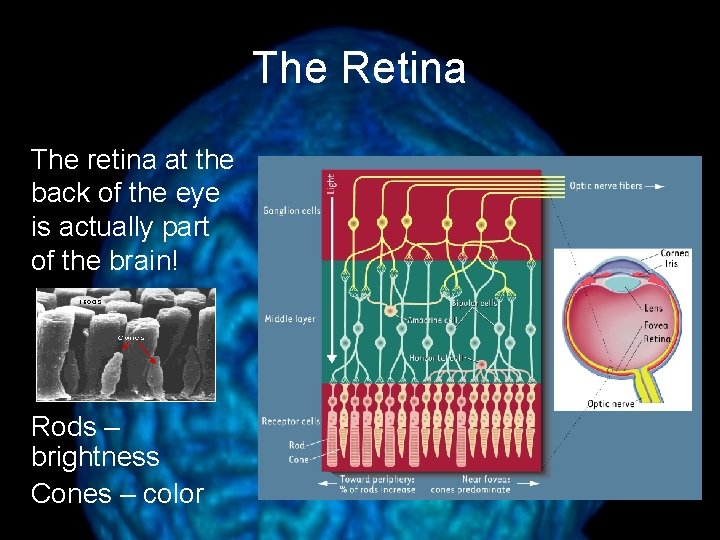
The Retina The retina at the back of the eye is actually part of the brain! Rods – brightness Cones – color
Functions of Olfaction • Many animals are macrosmatic – having a keen sense of smell that is necessary for survival • Humans are microsmatic – a less keen sense of smell that is not crucial to survive ch 15 48
Identifying Odors • Humans can discriminate among 100, 000 odors but they cannot label them accurately – This appears to be caused by an inability to retrieve the name from memory, from a lack of sensitivity ch 15 49
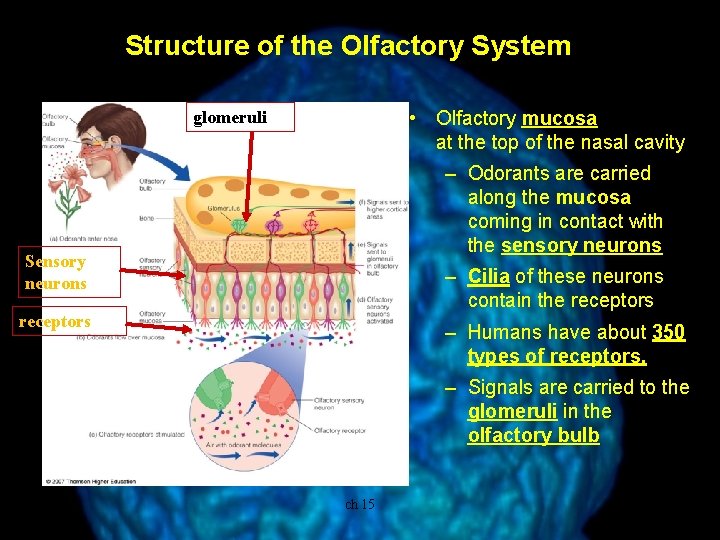
Structure of the Olfactory System • Olfactory mucosa is located at the top of the nasal cavity glomeruli – Odorants are carried along the mucosa coming in contact with the sensory neurons Sensory neurons – Cilia of these neurons contain the receptors – Humans have about 350 types of receptors. – Signals are carried to the glomeruli in the olfactory bulb ch 15 50
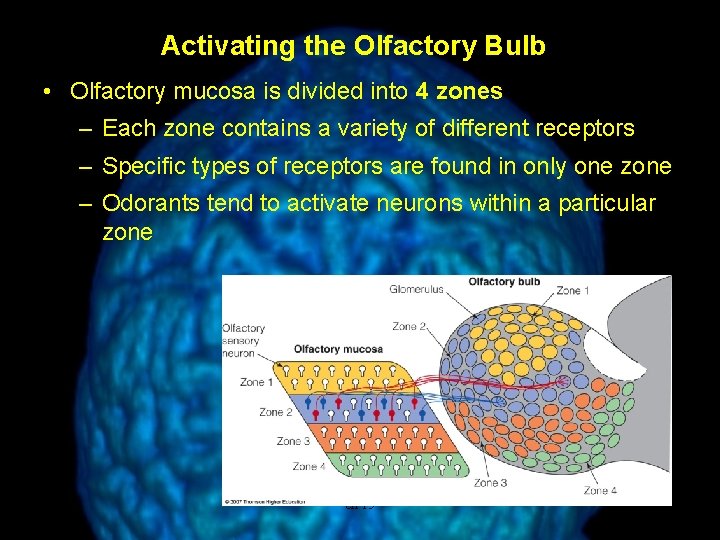
Activating the Olfactory Bulb • Olfactory mucosa is divided into 4 zones – Each zone contains a variety of different receptors – Specific types of receptors are found in only one zone – Odorants tend to activate neurons within a particular zone ch 15 51
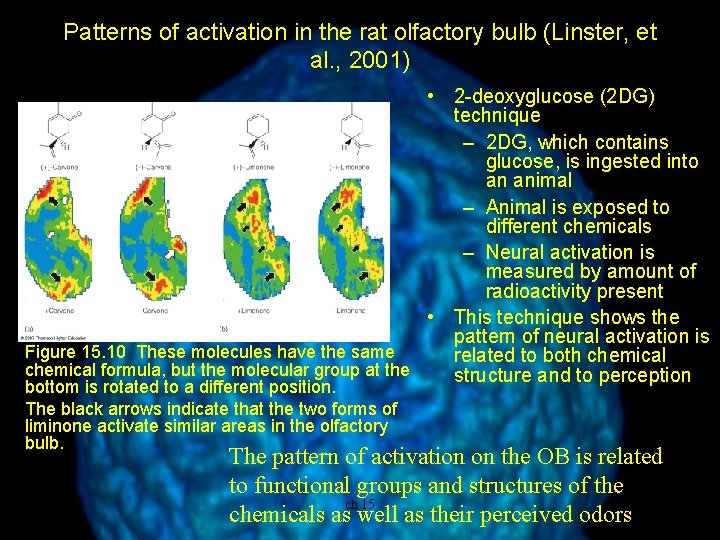
Patterns of activation in the rat olfactory bulb (Linster, et al. , 2001) • 2 -deoxyglucose (2 DG) technique – 2 DG, which contains glucose, is ingested into an animal – Animal is exposed to different chemicals – Neural activation is measured by amount of radioactivity present • This technique shows the pattern of neural activation is Figure 15. 10 These molecules have the same related to both chemical formula, but the molecular group at the structure and to perception bottom is rotated to a different position. The black arrows indicate that the two forms of liminone activate similar areas in the olfactory bulb. The pattern of activation on the OB is related to functional groups and structures of the ch 15 52 chemicals as well as their perceived odors
Pheromones • • • In many animals, the sense of smell is used for communication. For example, insects such as ants and termites and vertebrates such as dogs and cats communicate with each other by secreting and detecting odorous signals called pheromones – especially to signal sexual receptivity, danger, territorial boundaries, and food sources. We humans seem to use the sense of smell primarily in conjunction with taste to seek and sample food, but some evidence exists to suggest that people may also use sexual pheromones as well as pheromones that help us identify family members by smell. For more information: – Video on PBS called “Sweaty T-Shirts and Human Mate Choice” for an evolutionary perspective on pheromones
Functions of Taste • Sweetness is usually associated with substances that have nutritive value • Bitter is usually associated with substances that are potentially harmful • Salty taste indicates the presence of sodium • However, there is not a perfect connection between tastes and function of substances ch 15 54
Basic Taste Qualities • Five basic taste qualities: – Salty – Sour – Sweet – Bitter – Umami - described as meaty, brothy or savory and associated with MSG ch 15 55
Five Distinct Tastes: • Five Distinct Tastes: – Each of these tastes developed as survival functions, according to evolutionary psychology. • Sweet - energy source • Sour – potentially toxic acid • Bitter – potential poisons • Salty – sodium essential to physiological processes • Umami – proteins to grow and repair tissue
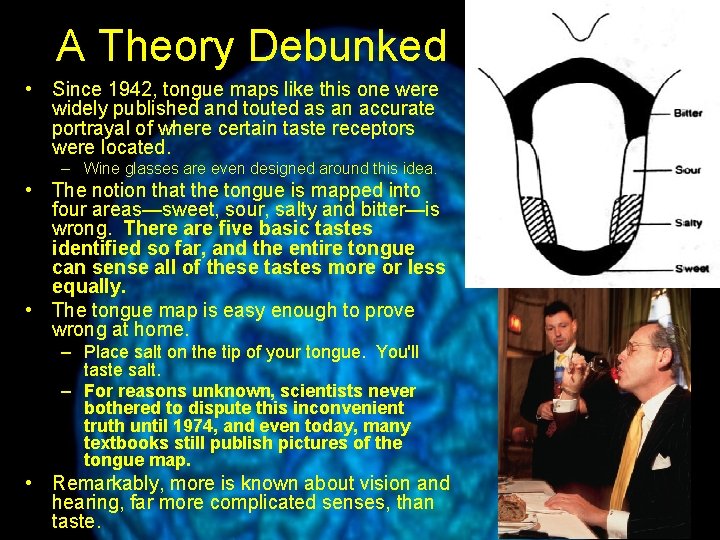
A Theory Debunked • Since 1942, tongue maps like this one were widely published and touted as an accurate portrayal of where certain taste receptors were located. – Wine glasses are even designed around this idea. • The notion that the tongue is mapped into four areas—sweet, sour, salty and bitter—is wrong. There are five basic tastes identified so far, and the entire tongue can sense all of these tastes more or less equally. • The tongue map is easy enough to prove wrong at home. – Place salt on the tip of your tongue. You'll taste salt. – For reasons unknown, scientists never bothered to dispute this inconvenient truth until 1974, and even today, many textbooks still publish pictures of the tongue map. • Remarkably, more is known about vision and hearing, far more complicated senses, than taste.
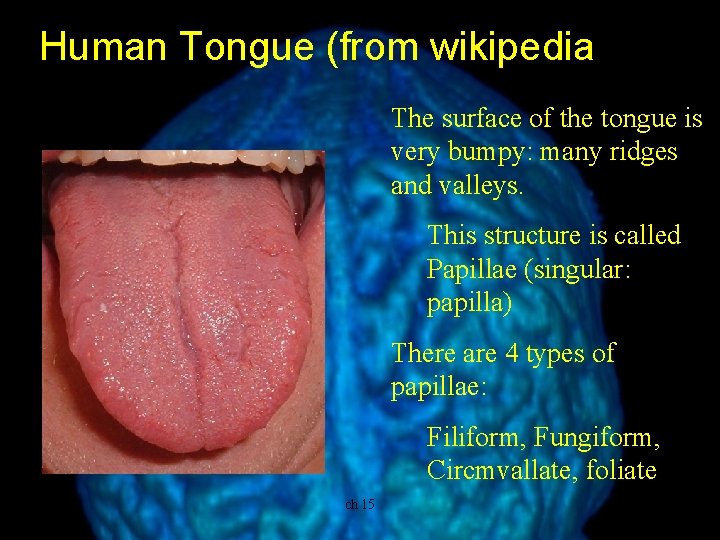
Human Tongue (from wikipedia) The surface of the tongue is very bumpy: many ridges and valleys. This structure is called Papillae (singular: papilla) There are 4 types of papillae: Filiform, Fungiform, Circmvallate, foliate ch 15 58
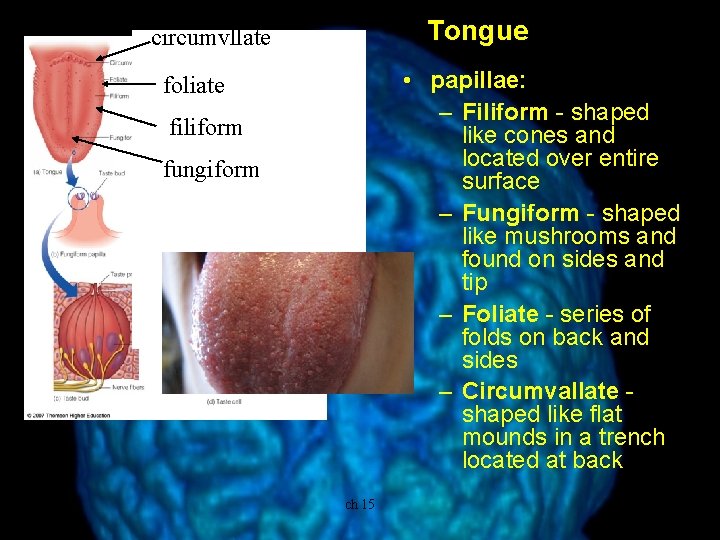
Tongue circumvllate • papillae: – Filiform - shaped like cones and located over entire surface – Fungiform - shaped like mushrooms and found on sides and tip – Foliate - series of folds on back and sides – Circumvallate - shaped like flat mounds in a trench located at back foliate filiform fungiform ch 15 59
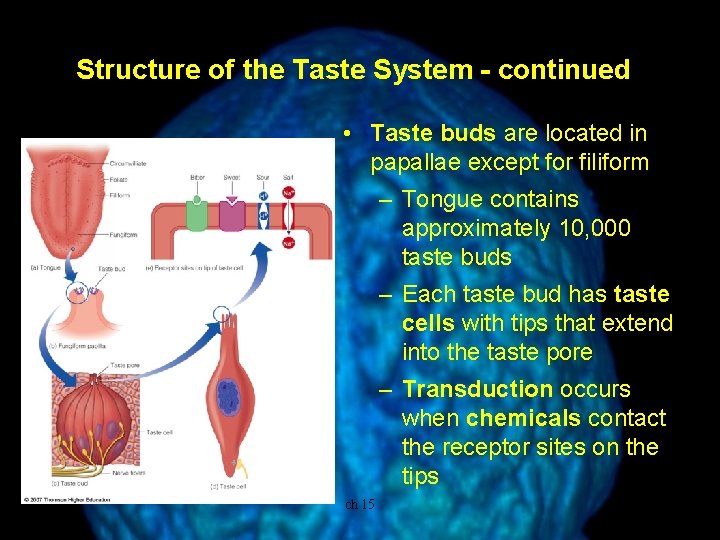
Structure of the Taste System - continued • Taste buds are located in papallae except for filiform – Tongue contains approximately 10, 000 taste buds – Each taste bud has taste cells with tips that extend into the taste pore – Transduction occurs when chemicals contact the receptor sites on the tips ch 15 60
- Slides: 60