
Brain stem components Ascending tract Descending Fiber connecting
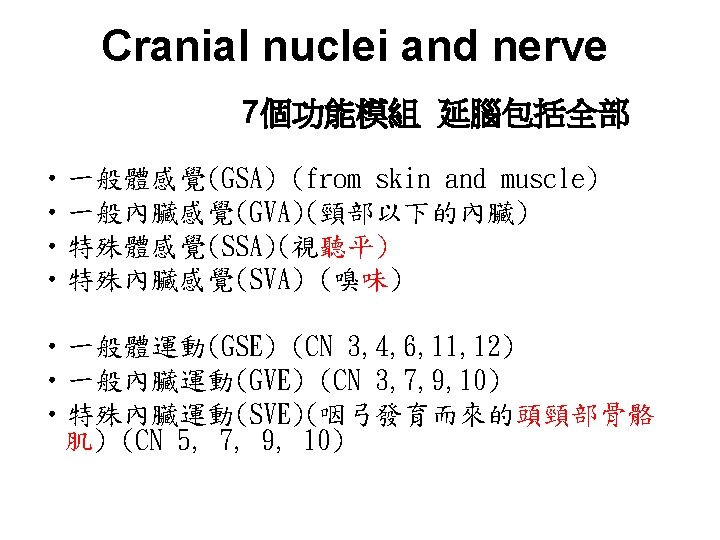
Brain stem components • • • Ascending tract Descending Fiber connecting with the cerebellum Cranial nuclei and nerve Integrative center---reticular formation (monoaminergic neuron) dopamine, catecholamine, and serotonin
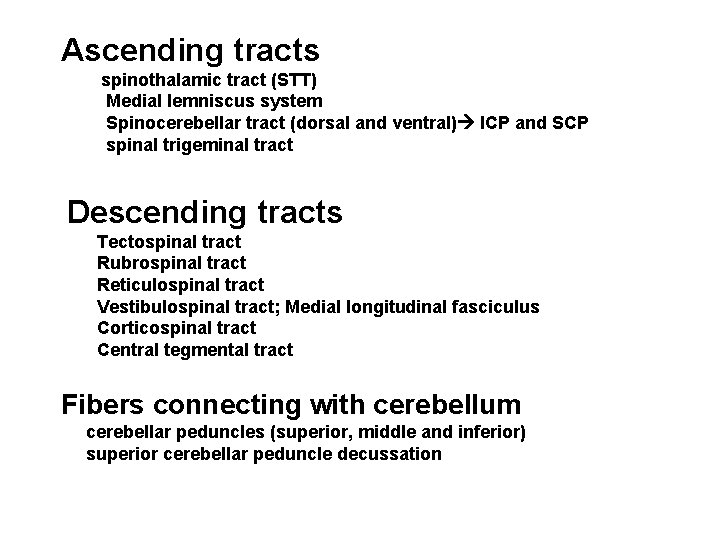
Ascending tracts spinothalamic tract (STT) Medial lemniscus system Spinocerebellar tract (dorsal and ventral) ICP and SCP spinal trigeminal tract Descending tracts Tectospinal tract Rubrospinal tract Reticulospinal tract Vestibulospinal tract; Medial longitudinal fasciculus Corticospinal tract Central tegmental tract Fibers connecting with cerebellum cerebellar peduncles (superior, middle and inferior) superior cerebellar peduncle decussation
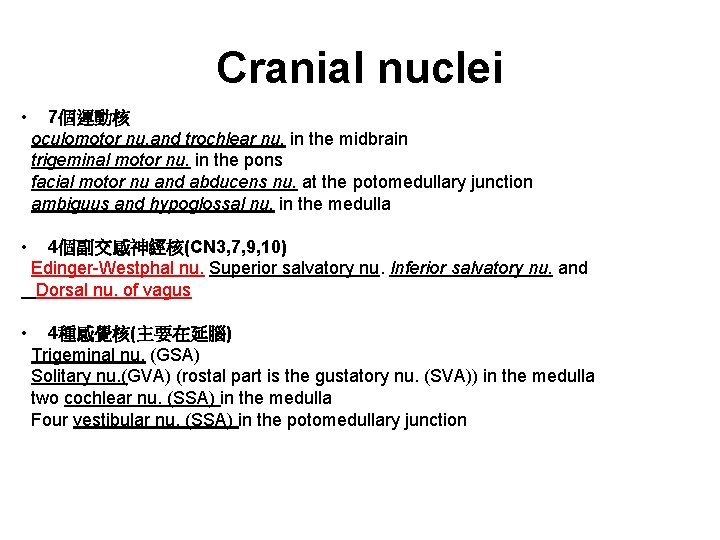
Cranial nuclei • 7個運動核 oculomotor nu. and trochlear nu. in the midbrain trigeminal motor nu. in the pons facial motor nu and abducens nu. at the potomedullary junction ambiguus and hypoglossal nu. in the medulla • 4個副交感神經核(CN 3, 7, 9, 10) Edinger-Westphal nu. Superior salvatory nu. Inferior salvatory nu. and Dorsal nu. of vagus • 4種感覺核(主要在延腦) Trigeminal nu. (GSA) Solitary nu. (GVA) (rostal part is the gustatory nu. (SVA)) in the medulla two cochlear nu. (SSA) in the medulla Four vestibular nu. (SSA) in the potomedullary junction
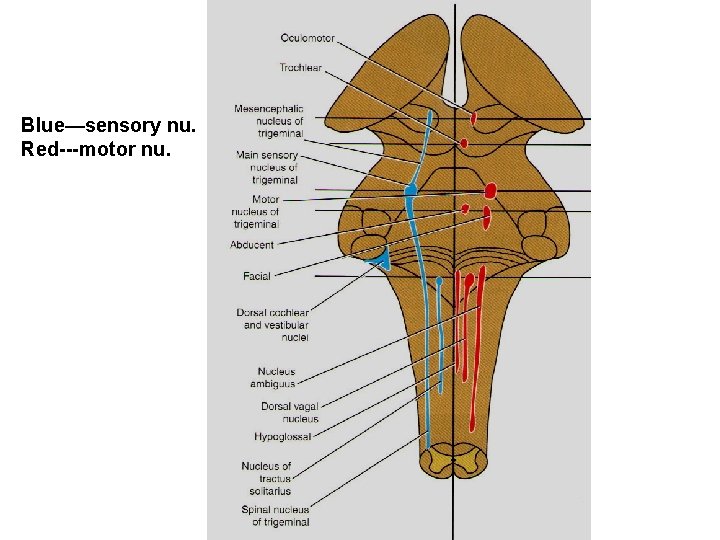
Blue—sensory nu. Red---motor nu.
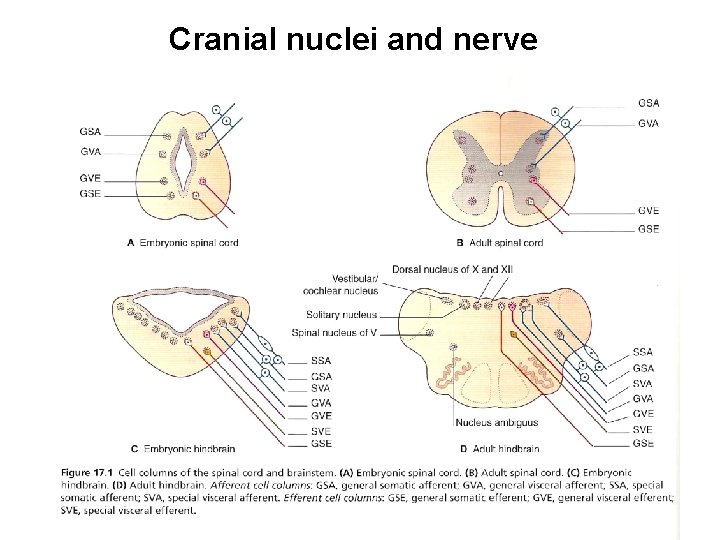
Cranial nuclei and nerve
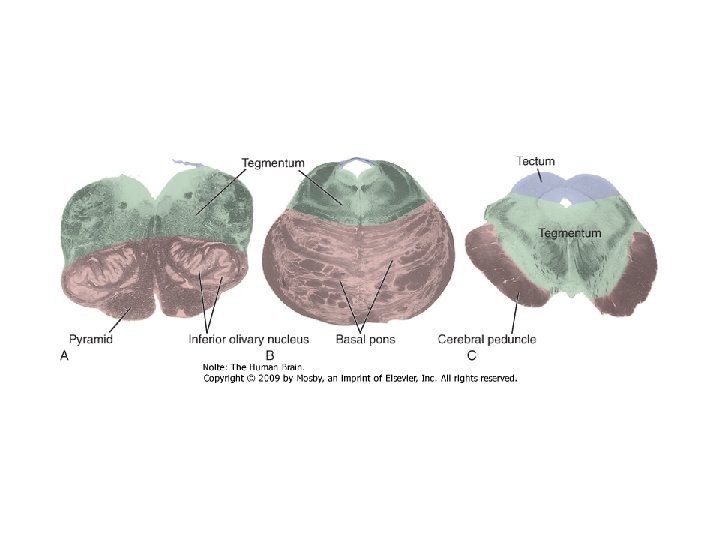
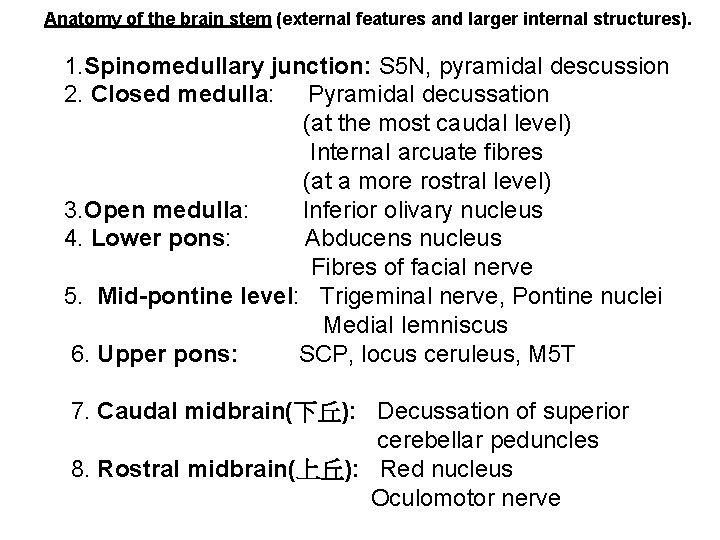
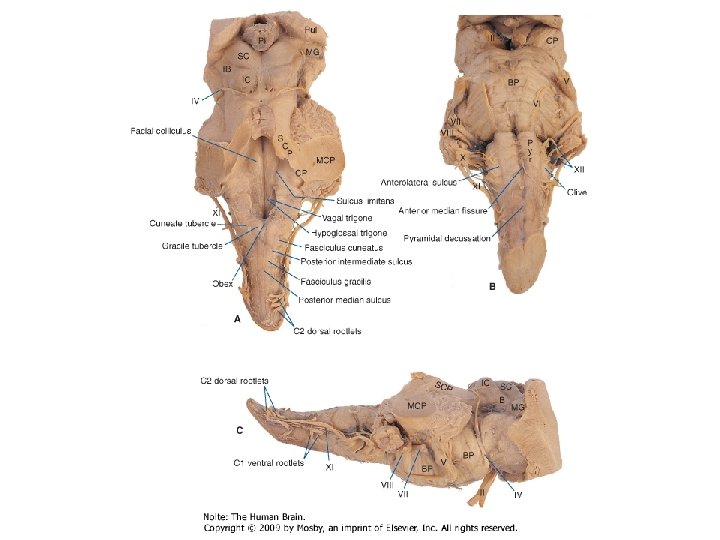
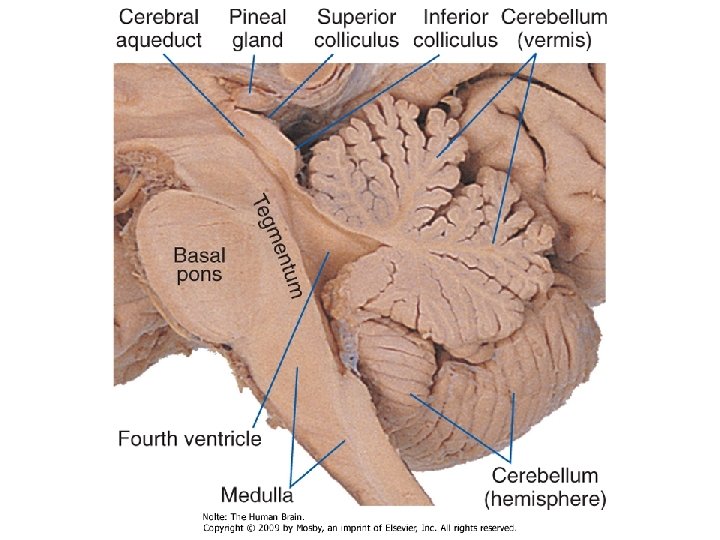
Anatomy of the brain stem (external features and larger internal structures). 1. Spinomedullary junction: S 5 N, pyramidal descussion 2. Closed medulla: Pyramidal decussation (at the most caudal level) Internal arcuate fibres (at a more rostral level) 3. Open medulla: Inferior olivary nucleus 4. Lower pons: Abducens nucleus Fibres of facial nerve 5. Mid-pontine level: Trigeminal nerve, Pontine nuclei Medial lemniscus 6. Upper pons: SCP, locus ceruleus, M 5 T 7. Caudal midbrain(下丘): Decussation of superior cerebellar peduncles 8. Rostral midbrain(上丘): Red nucleus Oculomotor nerve
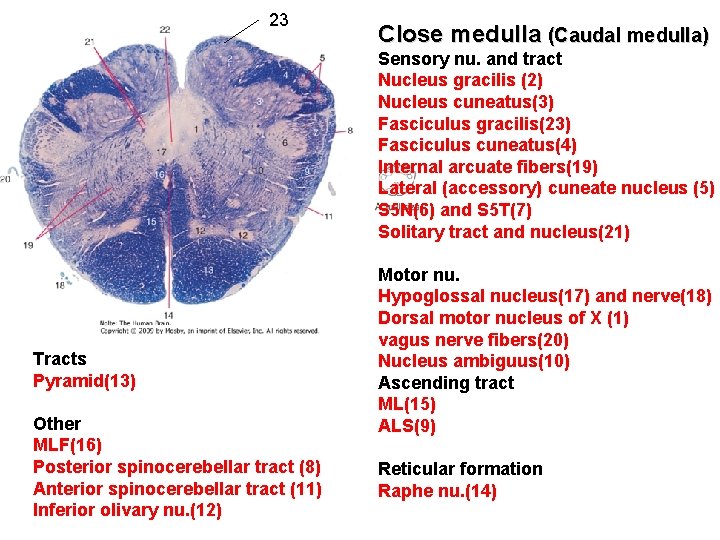
23 Close medulla (Caudal medulla) Sensory nu. and tract Nucleus gracilis (2) Nucleus cuneatus(3) Fasciculus gracilis(23) Fasciculus cuneatus(4) Internal arcuate fibers(19) Lateral (accessory) cuneate nucleus (5) S 5 N(6) and S 5 T(7) Solitary tract and nucleus(21) Tracts Pyramid(13) Other MLF(16) Posterior spinocerebellar tract (8) Anterior spinocerebellar tract (11) Inferior olivary nu. (12) Motor nu. Hypoglossal nucleus(17) and nerve(18) Dorsal motor nucleus of X (1) vagus nerve fibers(20) Nucleus ambiguus(10) Ascending tract ML(15) ALS(9) Reticular formation Raphe nu. (14)
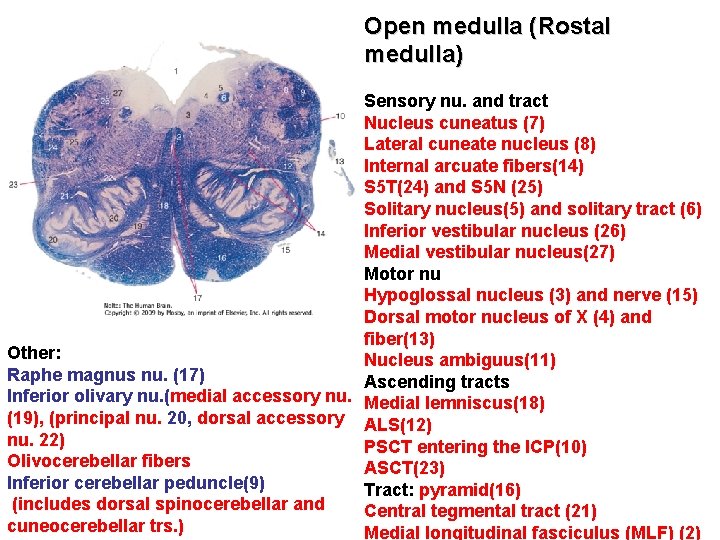
Open medulla (Rostal medulla) Sensory nu. and tract Nucleus cuneatus (7) Lateral cuneate nucleus (8) Internal arcuate fibers(14) S 5 T(24) and S 5 N (25) Solitary nucleus(5) and solitary tract (6) Inferior vestibular nucleus (26) Medial vestibular nucleus(27) Motor nu Hypoglossal nucleus (3) and nerve (15) Dorsal motor nucleus of X (4) and fiber(13) Other: Nucleus ambiguus(11) Raphe magnus nu. (17) Ascending tracts Inferior olivary nu. (medial accessory nu. Medial lemniscus(18) (19), (principal nu. 20, dorsal accessory ALS(12) nu. 22) PSCT entering the ICP(10) Olivocerebellar fibers ASCT(23) Inferior cerebellar peduncle(9) Tract: pyramid(16) (includes dorsal spinocerebellar and Central tegmental tract (21) cuneocerebellar trs. ) Medial longitudinal fasciculus (MLF) (2)
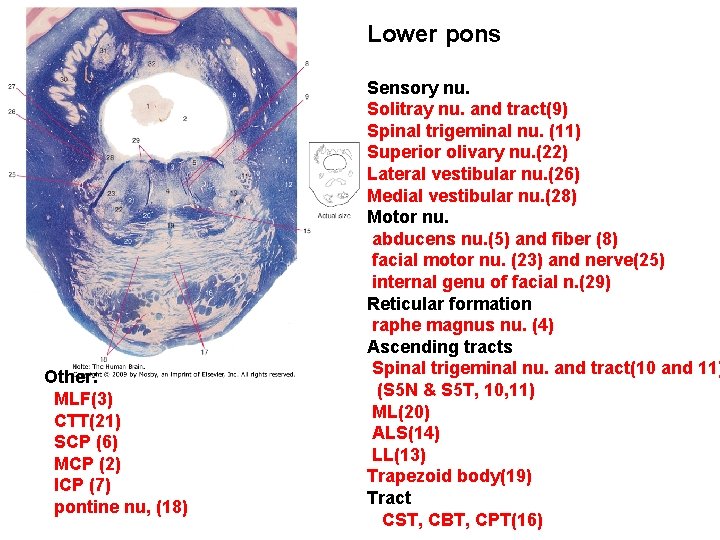
Lower pons Other: MLF(3) CTT(21) SCP (6) MCP (2) ICP (7) pontine nu, (18) Sensory nu. Solitray nu. and tract(9) Spinal trigeminal nu. (11) Superior olivary nu. (22) Lateral vestibular nu. (26) Medial vestibular nu. (28) Motor nu. abducens nu. (5) and fiber (8) facial motor nu. (23) and nerve(25) internal genu of facial n. (29) Reticular formation raphe magnus nu. (4) Ascending tracts Spinal trigeminal nu. and tract(10 and 11) (S 5 N & S 5 T, 10, 11) ML(20) ALS(14) LL(13) Trapezoid body(19) Tract CST, CBT, CPT(16)
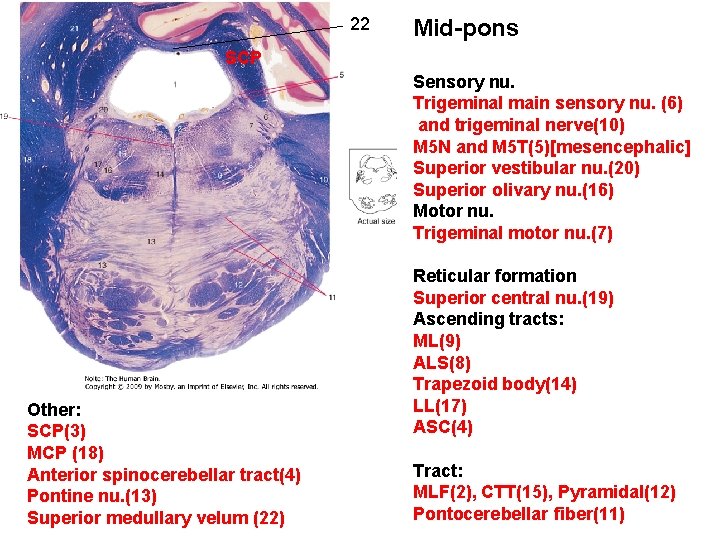
22 Mid-pons SCP Sensory nu. Trigeminal main sensory nu. (6) and trigeminal nerve(10) M 5 N and M 5 T(5)[mesencephalic] Superior vestibular nu. (20) Superior olivary nu. (16) Motor nu. Trigeminal motor nu. (7) Other: SCP(3) MCP (18) Anterior spinocerebellar tract(4) Pontine nu. (13) Superior medullary velum (22) Reticular formation Superior central nu. (19) Ascending tracts: ML(9) ALS(8) Trapezoid body(14) LL(17) ASC(4) Tract: MLF(2), CTT(15), Pyramidal(12) Pontocerebellar fiber(11)
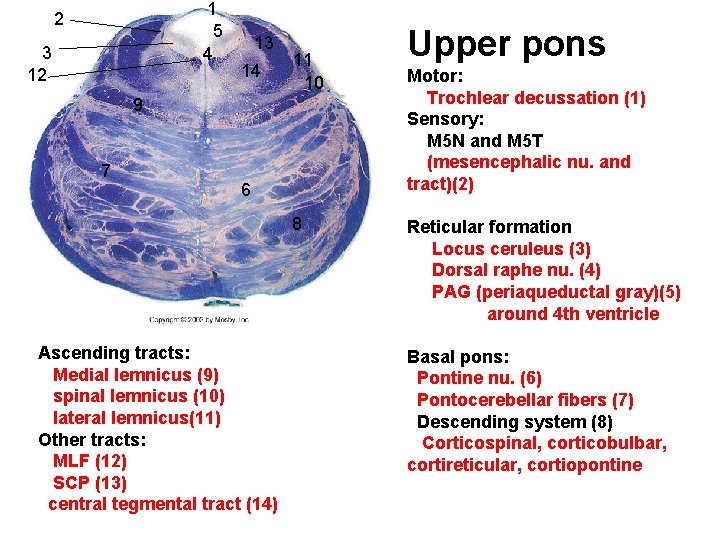
1 5 4 2 3 12 13 14 11 10 9 7 6 8 Ascending tracts: Medial lemnicus (9) spinal lemnicus (10) lateral lemnicus(11) Other tracts: MLF (12) SCP (13) central tegmental tract (14) Upper pons Motor: Trochlear decussation (1) Sensory: M 5 N and M 5 T (mesencephalic nu. and tract)(2) Reticular formation Locus ceruleus (3) Dorsal raphe nu. (4) PAG (periaqueductal gray)(5) around 4 th ventricle Basal pons: Pontine nu. (6) Pontocerebellar fibers (7) Descending system (8) Corticospinal, corticobulbar, cortireticular, cortiopontine
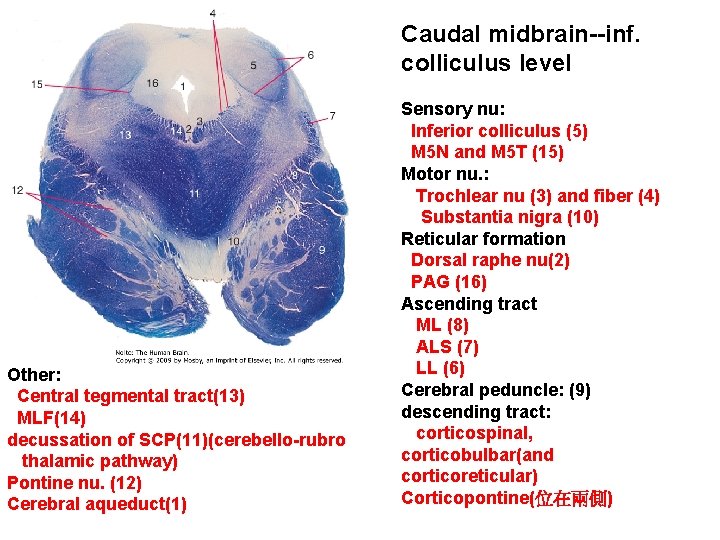
Caudal midbrain--inf. colliculus level Other: Central tegmental tract(13) MLF(14) decussation of SCP(11)(cerebello-rubro thalamic pathway) Pontine nu. (12) Cerebral aqueduct(1) Sensory nu: Inferior colliculus (5) M 5 N and M 5 T (15) Motor nu. : Trochlear nu (3) and fiber (4) Substantia nigra (10) Reticular formation Dorsal raphe nu(2) PAG (16) Ascending tract ML (8) ALS (7) LL (6) Cerebral peduncle: (9) descending tract: corticospinal, corticobulbar(and corticoreticular) Corticopontine(位在兩側)
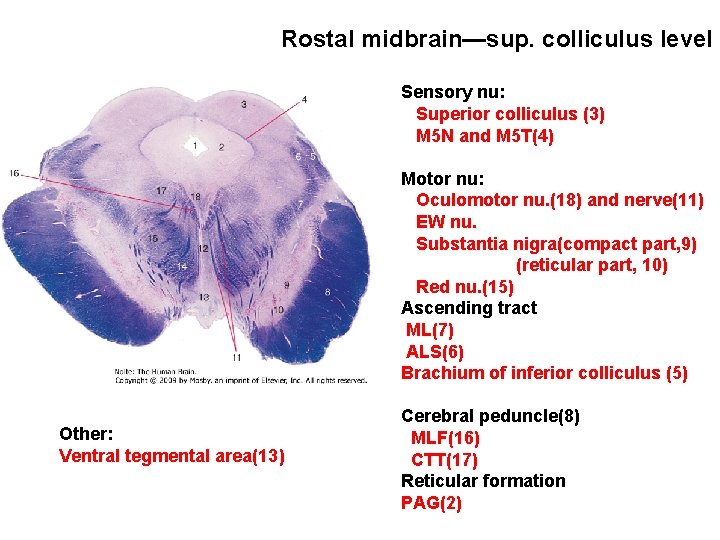
Rostal midbrain—sup. colliculus level Sensory nu: Superior colliculus (3) M 5 N and M 5 T(4) Motor nu: Oculomotor nu. (18) and nerve(11) EW nu. Substantia nigra(compact part, 9) (reticular part, 10) Red nu. (15) Ascending tract ML(7) ALS(6) Brachium of inferior colliculus (5) Other: Ventral tegmental area(13) Cerebral peduncle(8) MLF(16) CTT(17) Reticular formation PAG(2)
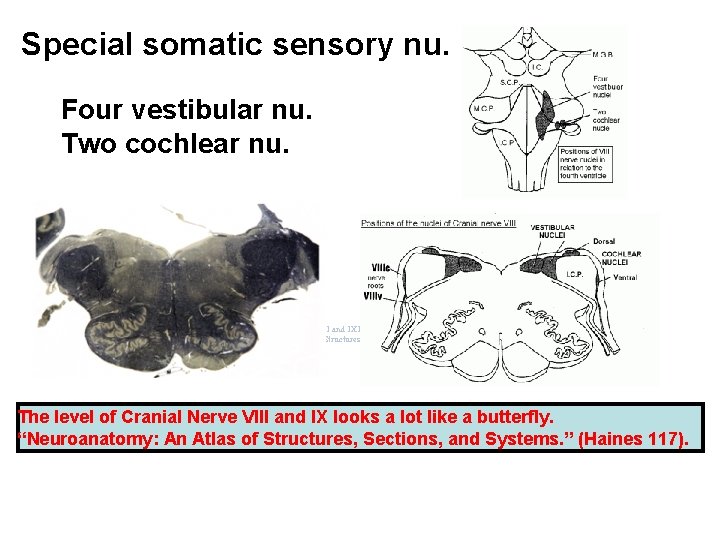
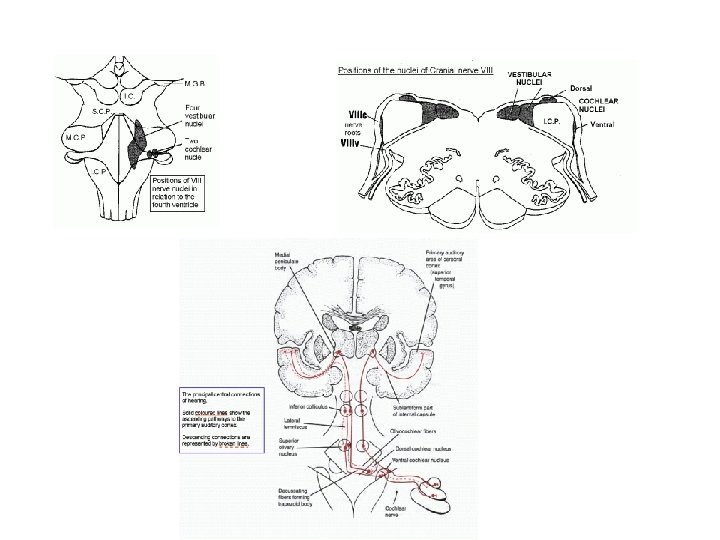
Special somatic sensory nu. Four vestibular nu. Two cochlear nu. The level of Cranial Nerve VIII and IX looks a lot like a butterfly. “Neuroanatomy: An Atlas of Structures, Sections, and Systems. ” (Haines 117).
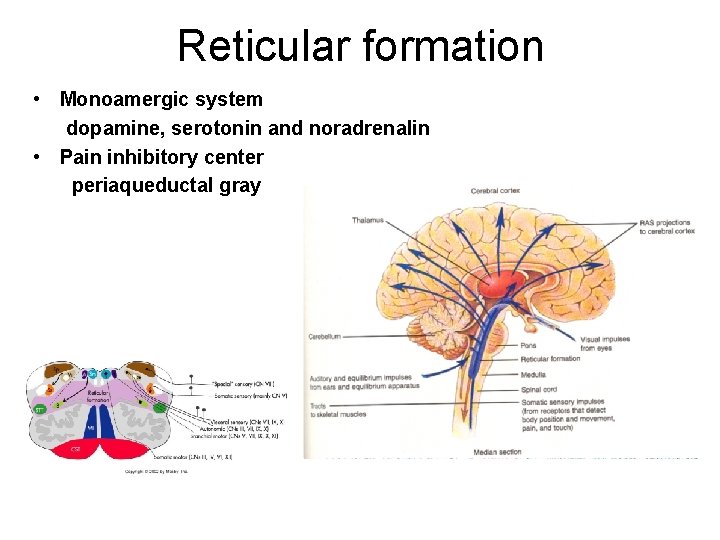
Reticular formation • Monoamergic system dopamine, serotonin and noradrenalin • Pain inhibitory center periaqueductal gray
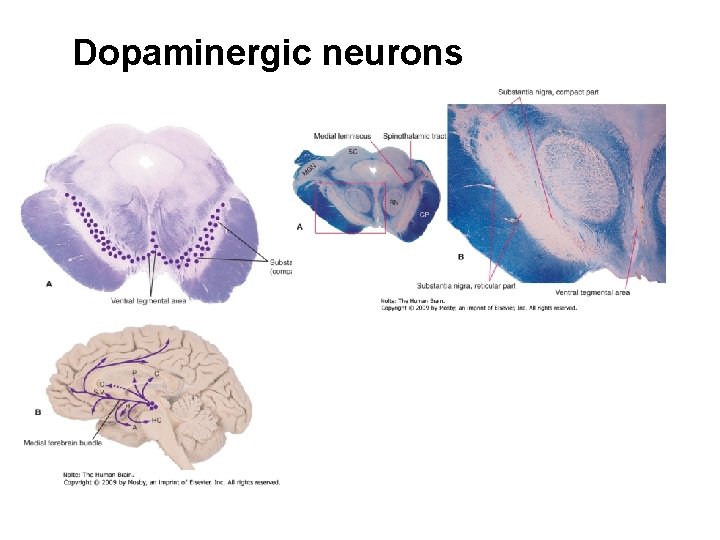
Dopaminergic neurons
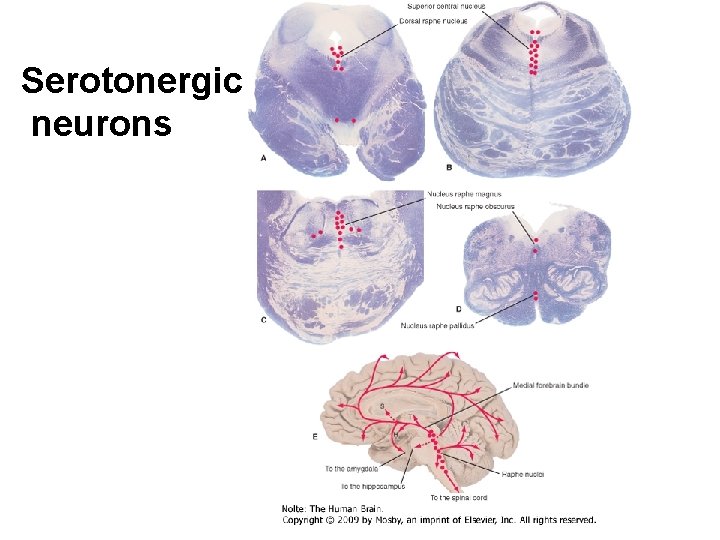
Serotonergic neurons
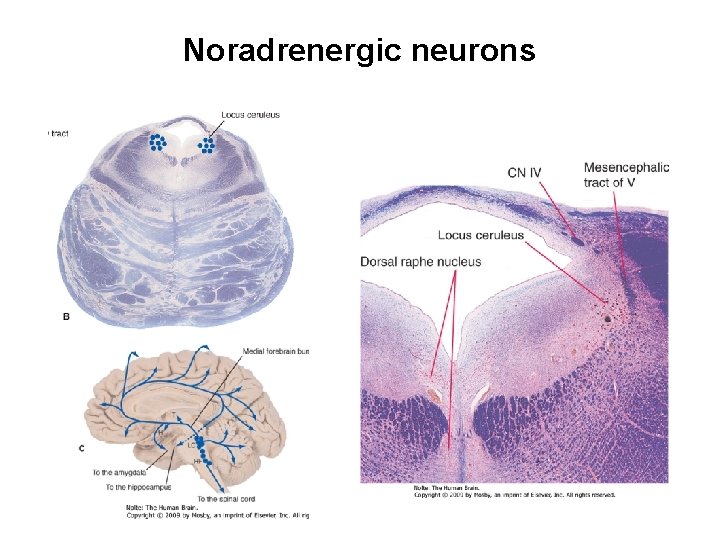
Noradrenergic neurons
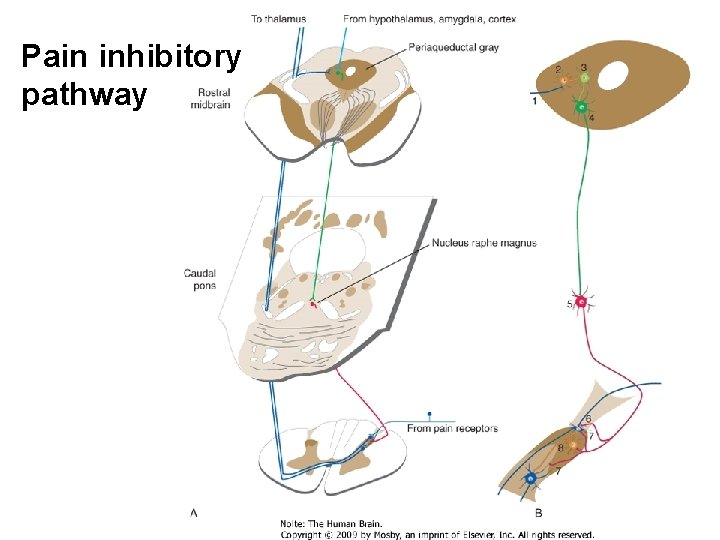
Pain inhibitory pathway
- Slides: 25