
BRAIN RESEARCH INFORMATION PROCESSING THEORIES The brain must

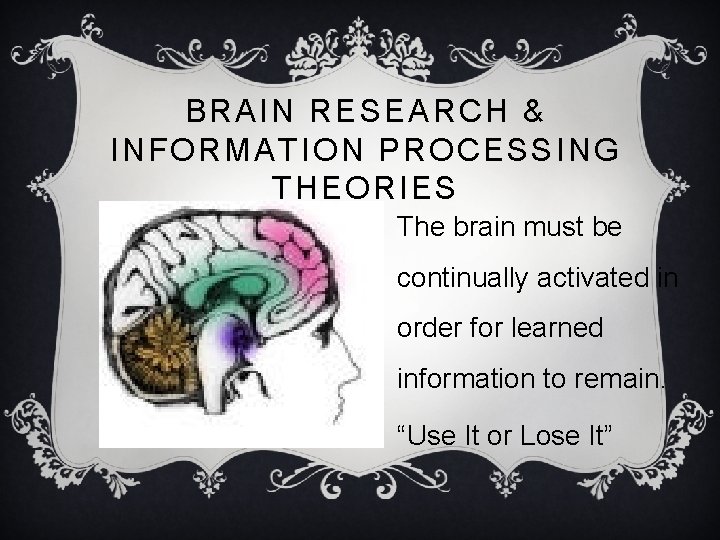
BRAIN RESEARCH & INFORMATION PROCESSING THEORIES The brain must be continually activated in order for learned information to remain. “Use It or Lose It”
INFORMATION PROCESSING THEORIES v Sensory Pathways • Concrete experience is important. {Dr. G. & A. } If we have done it, we will remember how to do it again. • Children should be provided multiple representations to achieve conceptual understanding. • CONCRETE ABSTRACT SYMBOLIC

INFORMATION PROCESSING THEORIES v Thought Processing Styles • “…the strategies used to organize and classify new information or skills to obtain order out of a confusing series of stimulus events” (p. 50). • Field-dependent learners • Field-independent learners
FIELD-DEPENDENT LEARNERS Simultaneous thought processing is preferred. Field-dependent learners like to see all information at once. “Whole to Part”
FIELD-INDEPENDENT LEARNERS Successive thought processing is preferred. Field-independent learners like to see details one at a time. “Part to Whole”
FIELD-DEPENDENT OR FIELD-INDEPENDENT? Which one are you?
TOP EXAMPLE: FIELD-INDEPENDENT BOTTOM EXAMPLE: FIELD-DEPENDENT
INFORMATION PROCESSING THEORIES v. Gardner’s Multiple Intelligences • Humans use at least eight different intelligences to process information. • • Interpersonal Intrapersonal Bodily-Kinesthetic Musical Spatial Naturalist Linguistic Logical-Mathematical
THE USE OF ASSESSMENT IN MATHEMATICS LEARNING Assessment is a systematic way to mark the differences that exist in learning rate, level, duration, and type. Assessment in student learning is here to stay!!
WHY ASSESS? The purpose of assessment is to provide useful information regarding students'’ understanding and skills. It contributes to the teacher’s ability to understand students’ needs to provide opportunities to mathematical abilities. develop students’
Assessment should provide information to: - students to get information about themselves as learners of math - teachers to make informed decisions about instruction - parents to obtain information about their children’s mathematical competencies and abilities - administrators to become informed about the effectiveness of mathematics programs.
- Slides: 12