
Brain Oxygen Optimization in Severe TBIPhase 3 Protocol
Brain Oxygen Optimization in Severe TBI--Phase 3 Protocol Introduction and Scientific Rationale Ramon Diaz-Arrastia, MD, Ph. D Professor of Neurology, University of Pennsylvania BOOST-3 Study Chair
Does BOOSTing Cerebral Oxygenation Boost TBI Outcomes? • We don’t know • The question belies the complexity of the answer • It is likely that increasing cerebral oxygenation is helpful in some cases but not in others • In some cases, increasing cerebral oxygenation may be harmful • Cerebral blood flow and cerebral oxygen utilization is highly dynamic in critically ill patients • It is critical to understand the endophenotypes of brain tissue hypoxia

Anatomy of Cerebral Microvasculature Zlokovic et al, Neurosurgery 43(4): 877 -878, 1998. Reina de la Torre, et al Anat Record 1998; 251: 87 -96 PC Blumbergs, in Reilly & Bullock, Head Injury, 2 nd Ed, 2005
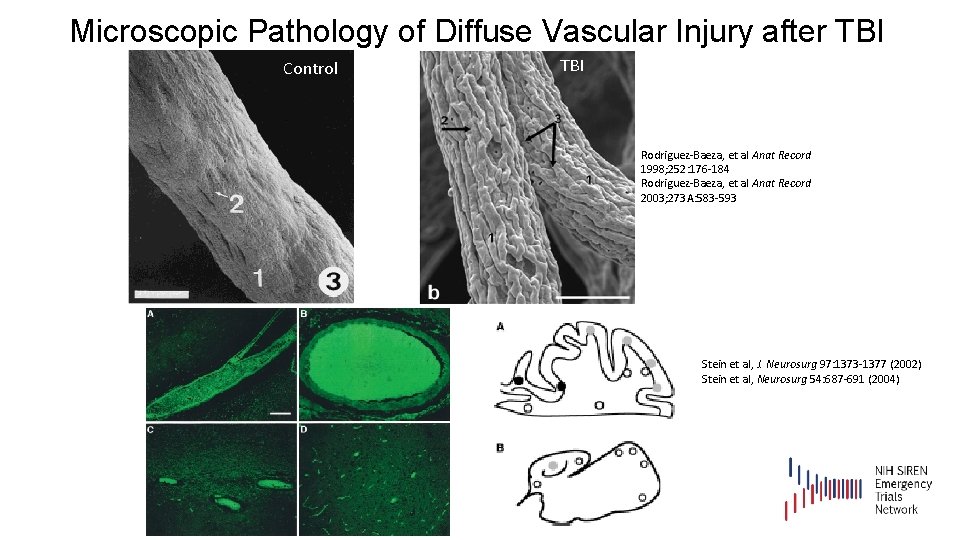
Microscopic Pathology of Diffuse Vascular Injury after TBI Control TBI Rodriguez-Baeza, et al Anat Record 1998; 252: 176 -184 Rodriguez-Baeza, et al Anat Record 2003; 273 A: 583 -593 Stein et al, J. Neurosurg 97: 1373 -1377 (2002) Stein et al, Neurosurg 54: 687 -691 (2004)
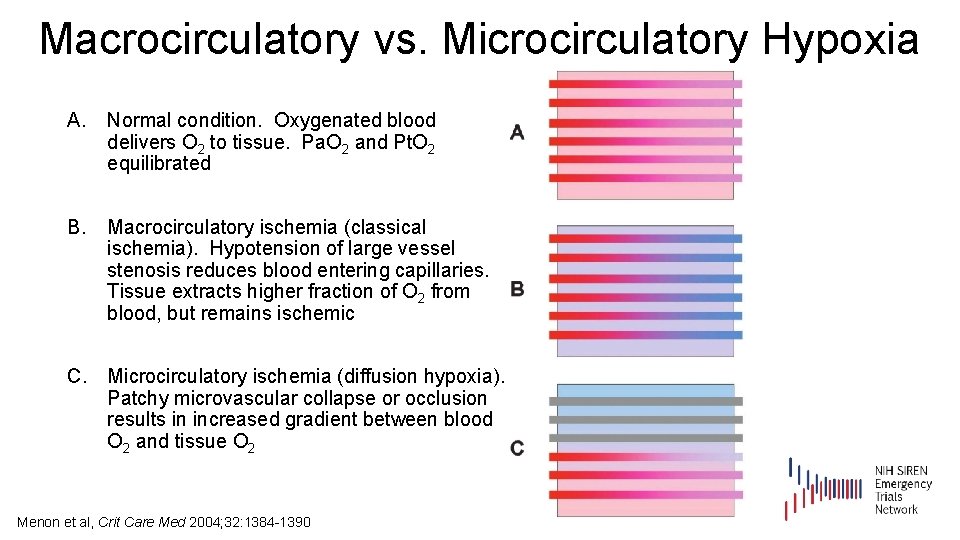
Macrocirculatory vs. Microcirculatory Hypoxia A. Normal condition. Oxygenated blood delivers O 2 to tissue. Pa. O 2 and Pt. O 2 equilibrated B. Macrocirculatory ischemia (classical ischemia). Hypotension of large vessel stenosis reduces blood entering capillaries. Tissue extracts higher fraction of O 2 from blood, but remains ischemic C. Microcirculatory ischemia (diffusion hypoxia). Patchy microvascular collapse or occlusion results in increased gradient between blood O 2 and tissue O 2 Menon et al, Crit Care Med 2004; 32: 1384 -1390
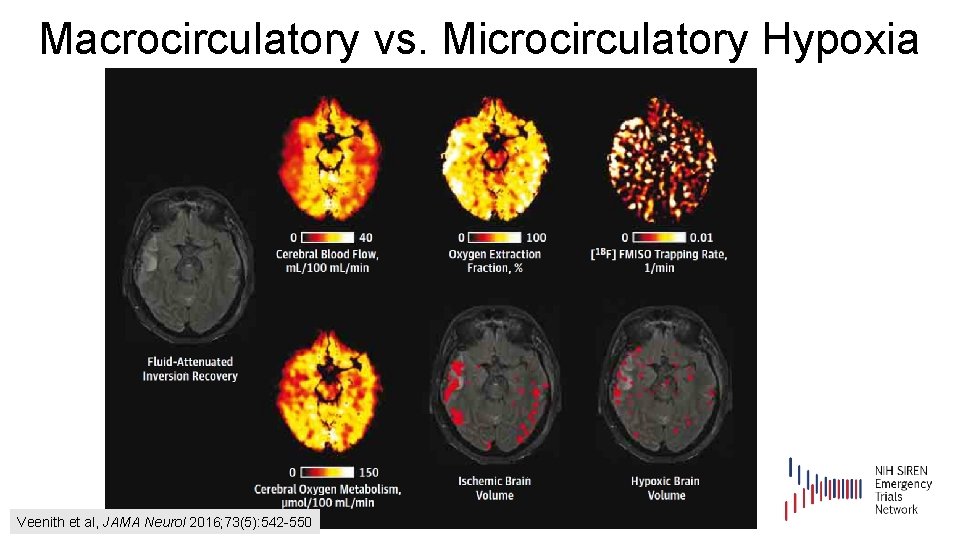
Macrocirculatory vs. Microcirculatory Hypoxia Veenith et al, JAMA Neurol 2016; 73(5): 542 -550
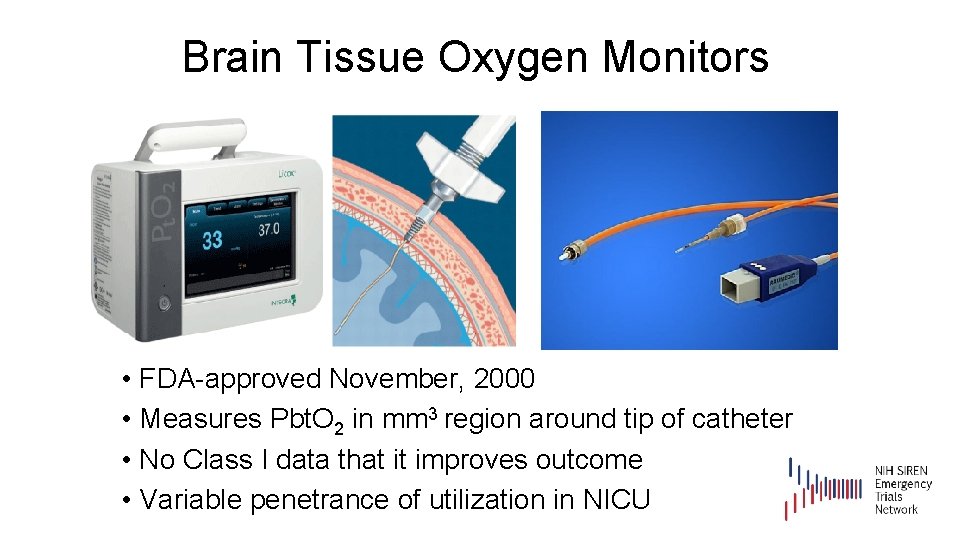
Brain Tissue Oxygen Monitors • FDA-approved November, 2000 • Measures Pbt. O 2 in mm 3 region around tip of catheter • No Class I data that it improves outcome • Variable penetrance of utilization in NICU
Rationale for Pbt. O 2 monitoring • Episodes of low Pbt. O 2 are common after TBI • Van den Brink et al 1 (2000) • 101 patients monitored average 86 hours • 57% had values < 15 mm Hg • 42% had values < 10 mm Hg • 22% had values < 5 mm Hg • Longhi et al 2 (2007) • Episodes Pbt. O 2 10 - 19 mm Hg in 23% of time • Median duration 50 minutes • Episodes Pbt. O 2 < 10 mm Hg 11% of the time • Median duration 39 minutes 1. 2. van den Brink WA, et al, Neurosurgery 2000; 46: 868 -878. Longhi L, et al, Intensive Care Med 2007; 33(12): 2136 -2142.
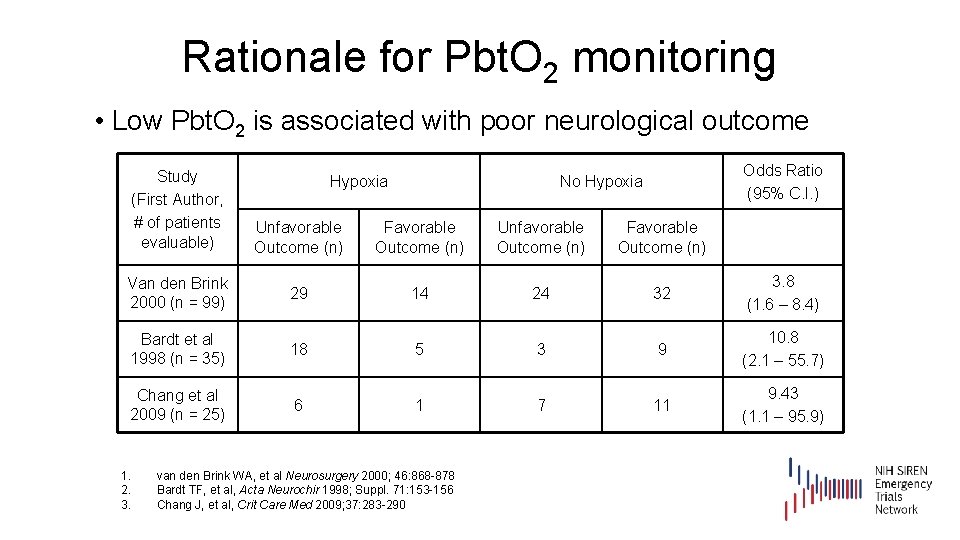
Rationale for Pbt. O 2 monitoring • Low Pbt. O 2 is associated with poor neurological outcome Study (First Author, # of patients evaluable) Hypoxia Odds Ratio (95% C. I. ) No Hypoxia Unfavorable Outcome (n) Favorable Outcome (n) Van den Brink 2000 (n = 99) 29 14 24 32 3. 8 (1. 6 – 8. 4) Bardt et al 1998 (n = 35) 18 5 3 9 10. 8 (2. 1 – 55. 7) Chang et al 2009 (n = 25) 6 1 7 11 9. 43 (1. 1 – 95. 9) 1. 2. 3. van den Brink WA, et al Neurosurgery 2000; 46: 868 -878 Bardt TF, et al, Acta Neurochir 1998; Suppl. 71: 153 -156 Chang J, et al, Crit Care Med 2009; 37: 283 -290
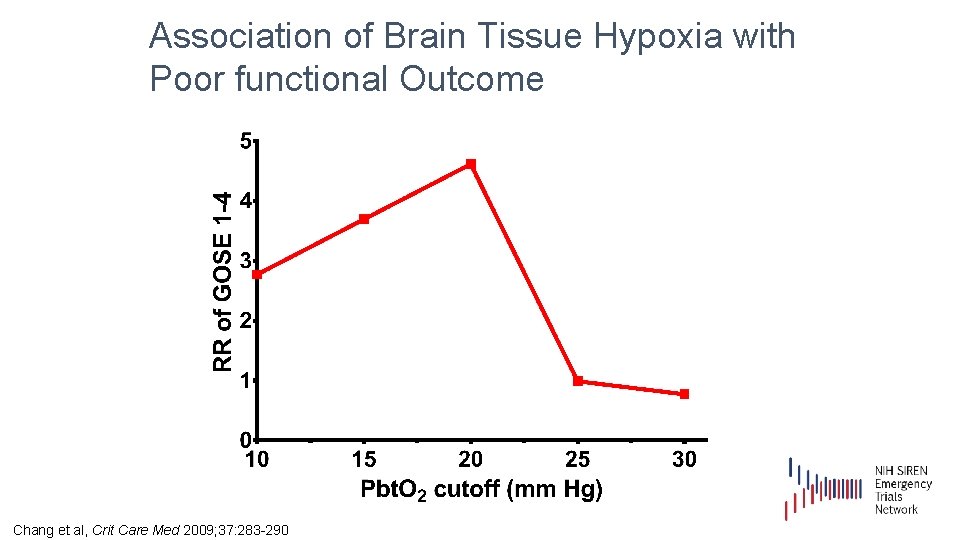
Association of Brain Tissue Hypoxia with Poor functional Outcome Chang et al, Crit Care Med 2009; 37: 283 -290

Association of Brain Tissue Hypoxia with Poor functional Outcome Chang et al, Crit Care Med 2009; 37: 283 -290
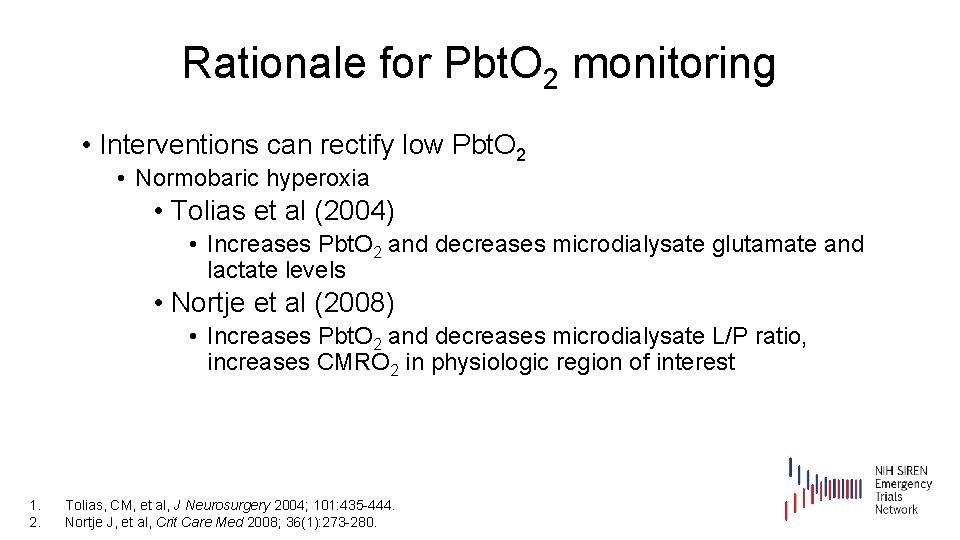
Rationale for Pbt. O 2 monitoring • Interventions can rectify low Pbt. O 2 • Normobaric hyperoxia • Tolias et al (2004) • Increases Pbt. O 2 and decreases microdialysate glutamate and lactate levels • Nortje et al (2008) • Increases Pbt. O 2 and decreases microdialysate L/P ratio, increases CMRO 2 in physiologic region of interest 1. 2. Tolias, CM, et al, J Neurosurgery 2004; 101: 435 -444. Nortje J, et al, Crit Care Med 2008; 36(1): 273 -280.
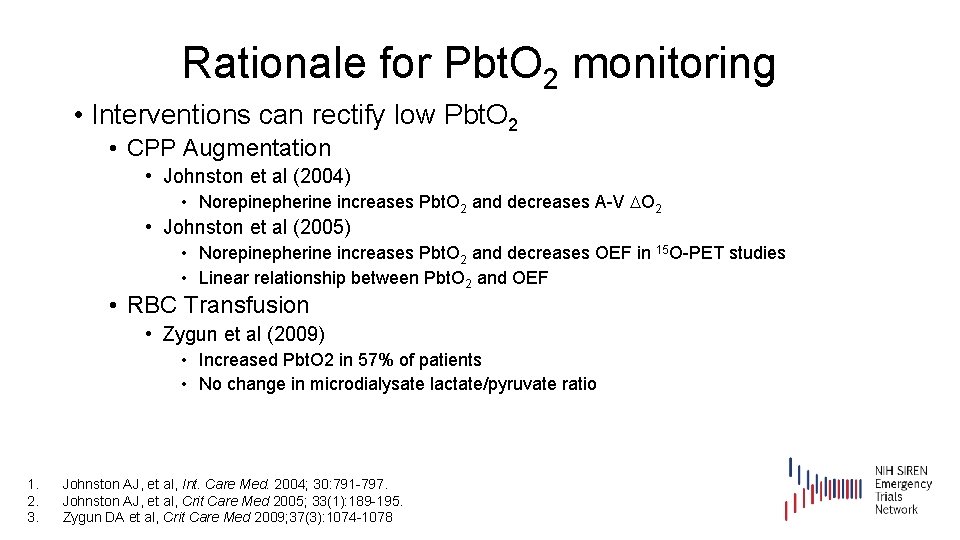
Rationale for Pbt. O 2 monitoring • Interventions can rectify low Pbt. O 2 • CPP Augmentation • Johnston et al (2004) • Norepinepherine increases Pbt. O 2 and decreases A-V DO 2 • Johnston et al (2005) • Norepinepherine increases Pbt. O 2 and decreases OEF in 15 O-PET studies • Linear relationship between Pbt. O 2 and OEF • RBC Transfusion • Zygun et al (2009) • Increased Pbt. O 2 in 57% of patients • No change in microdialysate lactate/pyruvate ratio 1. 2. 3. Johnston AJ, et al, Int. Care Med. 2004; 30: 791 -797. Johnston AJ, et al, Crit Care Med 2005; 33(1): 189 -195. Zygun DA et al, Crit Care Med 2009; 37(3): 1074 -1078
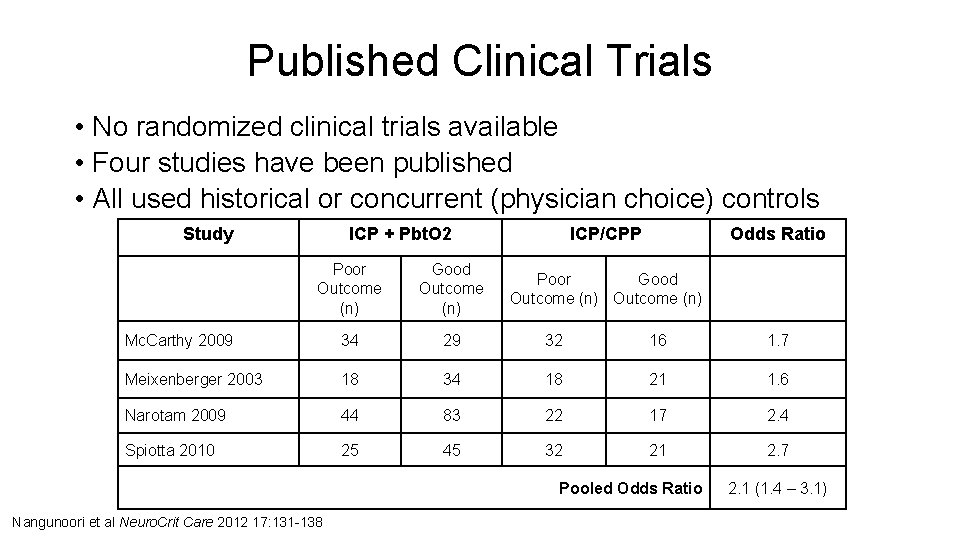
Published Clinical Trials • No randomized clinical trials available • Four studies have been published • All used historical or concurrent (physician choice) controls Study ICP + Pbt. O 2 ICP/CPP Odds Ratio Poor Good Outcome (n) (95% CI) Poor Outcome (n) Good Outcome (n) Mc. Carthy 2009 34 29 32 16 1. 7 Meixenberger 2003 18 34 18 21 1. 6 Narotam 2009 44 83 22 17 2. 4 Spiotta 2010 25 45 32 21 2. 7 Pooled Odds Ratio Nangunoori et al Neuro. Crit Care 2012 17: 131 -138 2. 1 (1. 4 – 3. 1)
BRAIN OXYGEN AND OUTCOME IN SEVERE TRAUMATIC BRAIN INJURY: PHASE 2 BOOST 2
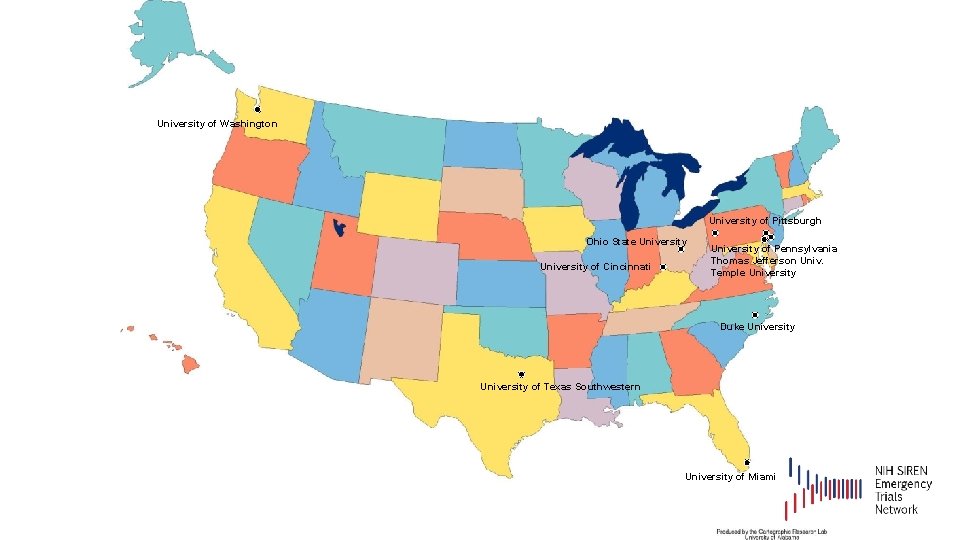
BOOST-2 Study Sites University of Washington University of Pittsburgh Ohio State University of Cincinnati University of Pennsylvania Thomas Jefferson Univ. Temple University Duke University of Texas Southwestern University of Miami
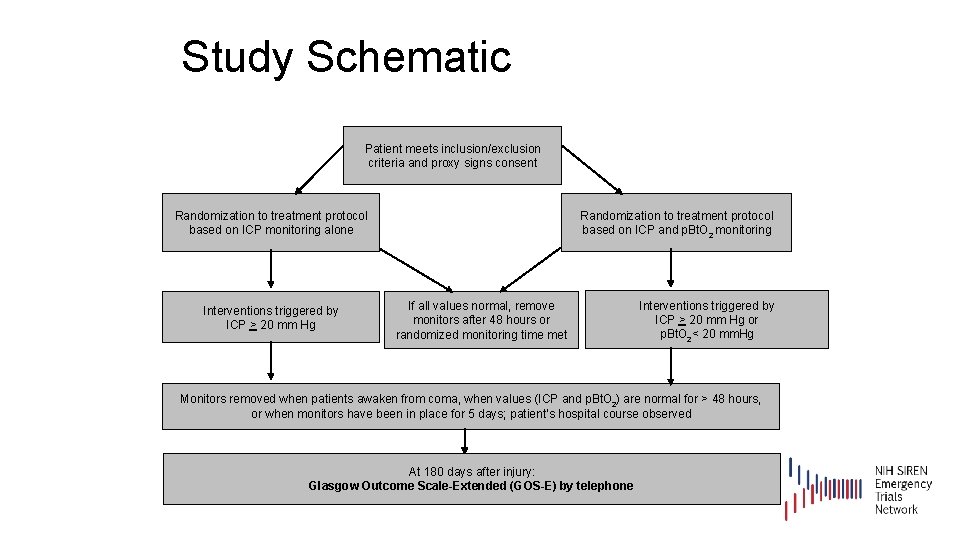
Study Schematic Patient meets inclusion/exclusion criteria and proxy signs consent Randomization to treatment protocol based on ICP monitoring alone Interventions triggered by ICP > 20 mm Hg Randomization to treatment protocol based on ICP and p. Bt. O 2 monitoring If all values normal, remove monitors after 48 hours or randomized monitoring time met Interventions triggered by ICP > 20 mm Hg or p. Bt. O 2< 20 mm. Hg Monitors removed when patients awaken from coma, when values (ICP and p. Bt. O 2) are normal for > 48 hours, or when monitors have been in place for 5 days; patient’s hospital course observed At 180 days after injury: Glasgow Outcome Scale-Extended (GOS-E) by telephone
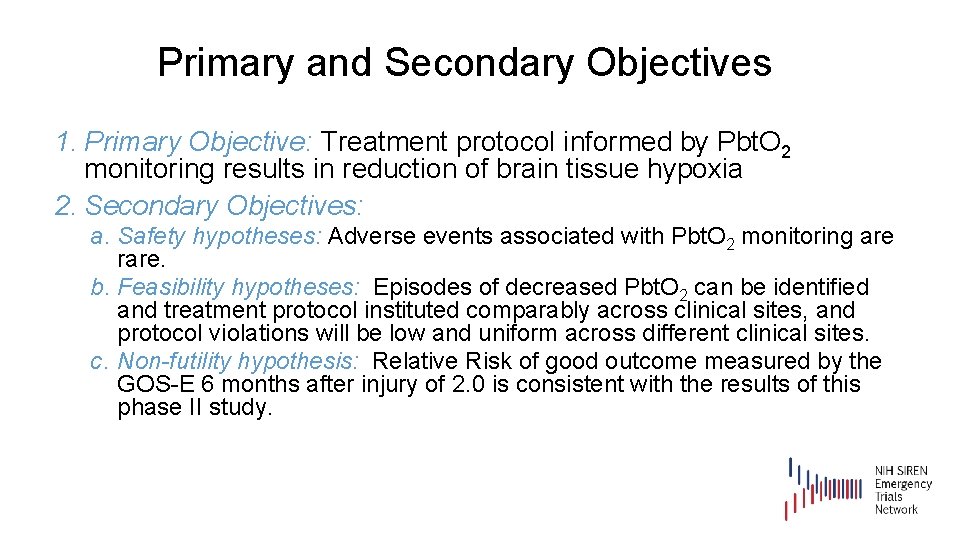
Primary and Secondary Objectives 1. Primary Objective: Treatment protocol informed by Pbt. O 2 monitoring results in reduction of brain tissue hypoxia 2. Secondary Objectives: a. Safety hypotheses: Adverse events associated with Pbt. O 2 monitoring are rare. b. Feasibility hypotheses: Episodes of decreased Pbt. O 2 can be identified and treatment protocol instituted comparably across clinical sites, and protocol violations will be low and uniform across different clinical sites. c. Non-futility hypothesis: Relative Risk of good outcome measured by the GOS-E 6 months after injury of 2. 0 is consistent with the results of this phase II study.
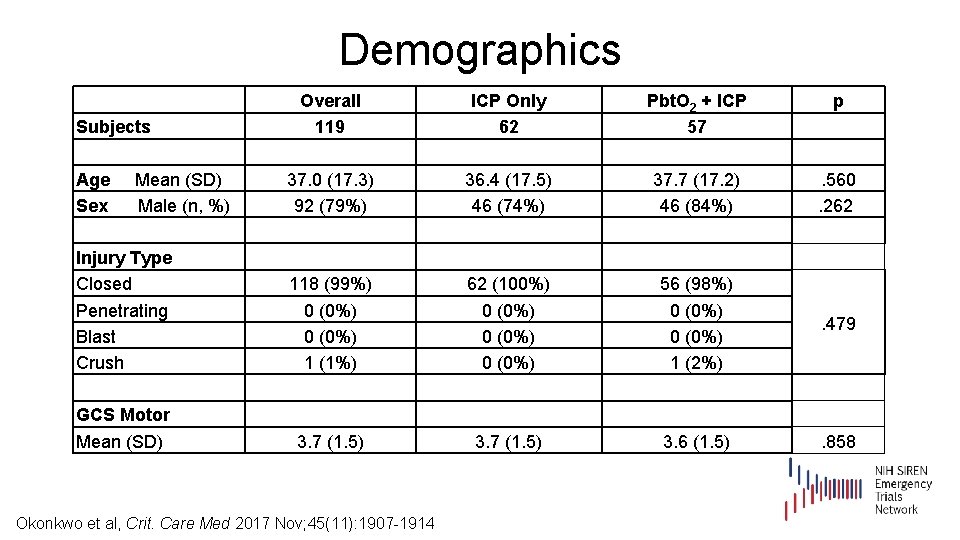
Demographics Subjects Age Mean (SD) Sex Male (n, %) Injury Type Closed Penetrating Blast Crush GCS Motor Mean (SD) Overall 119 37. 0 (17. 3) 92 (79%) ICP Only 62 36. 4 (17. 5) 46 (74%) Pbt. O 2 + ICP 57 37. 7 (17. 2) 46 (84%) p . 560. 262 118 (99%) 0 (0%) 1 (1%) 3. 7 (1. 5) Okonkwo et al, Crit. Care Med 2017 Nov; 45(11): 1907 -1914 62 (100%) 0 (0%) 3. 7 (1. 5) 56 (98%) 0 (0%) 1 (2%) 3. 6 (1. 5) . 479 . 858
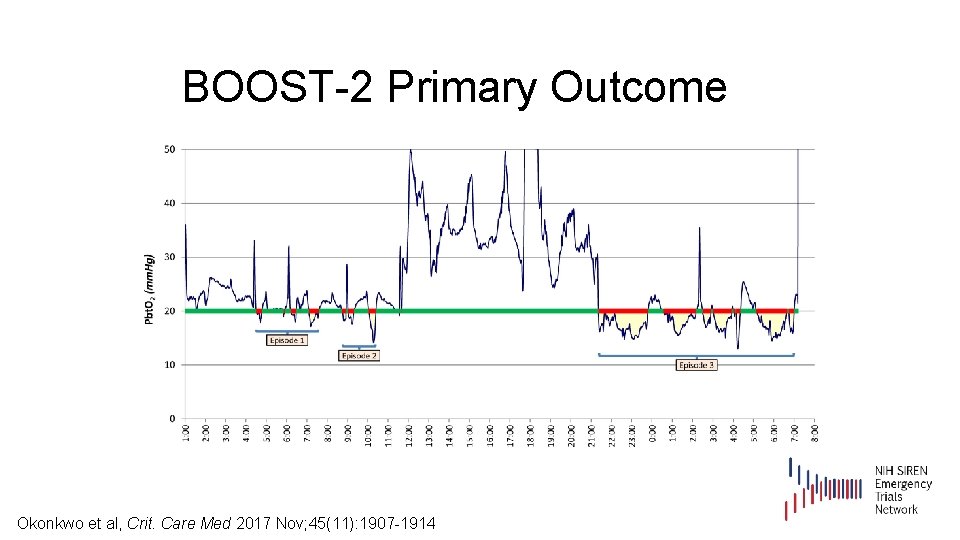
BOOST-2 Primary Outcome Okonkwo et al, Crit. Care Med 2017 Nov; 45(11): 1907 -1914
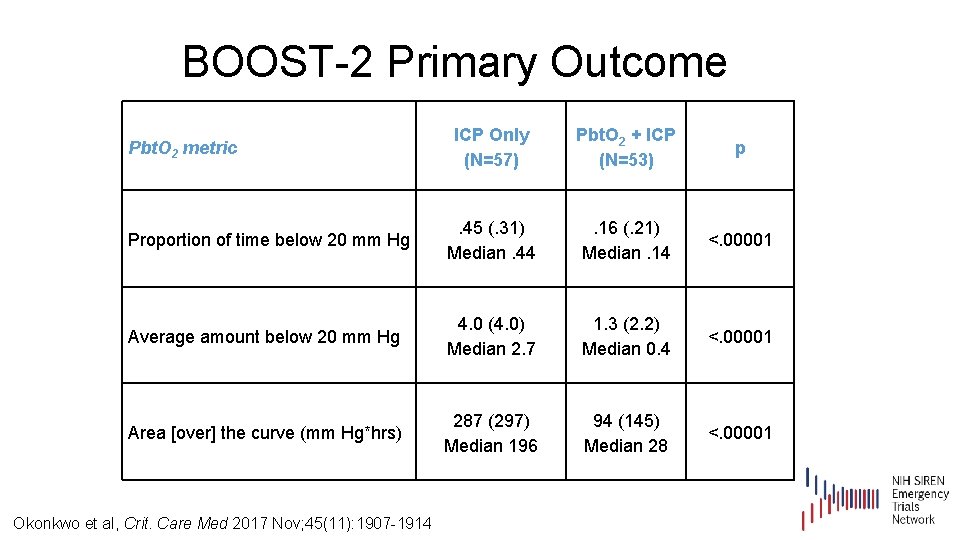
BOOST-2 Primary Outcome ICP Only (N=57) Pbt. O 2 + ICP (N=53) p Proportion of time below 20 mm Hg . 45 (. 31) Median. 44 . 16 (. 21) Median. 14 <. 00001 Average amount below 20 mm Hg 4. 0 (4. 0) Median 2. 7 1. 3 (2. 2) Median 0. 4 <. 00001 Area [over] the curve (mm Hg*hrs) 287 (297) Median 196 94 (145) Median 28 <. 00001 Pbt. O 2 metric Okonkwo et al, Crit. Care Med 2017 Nov; 45(11): 1907 -1914
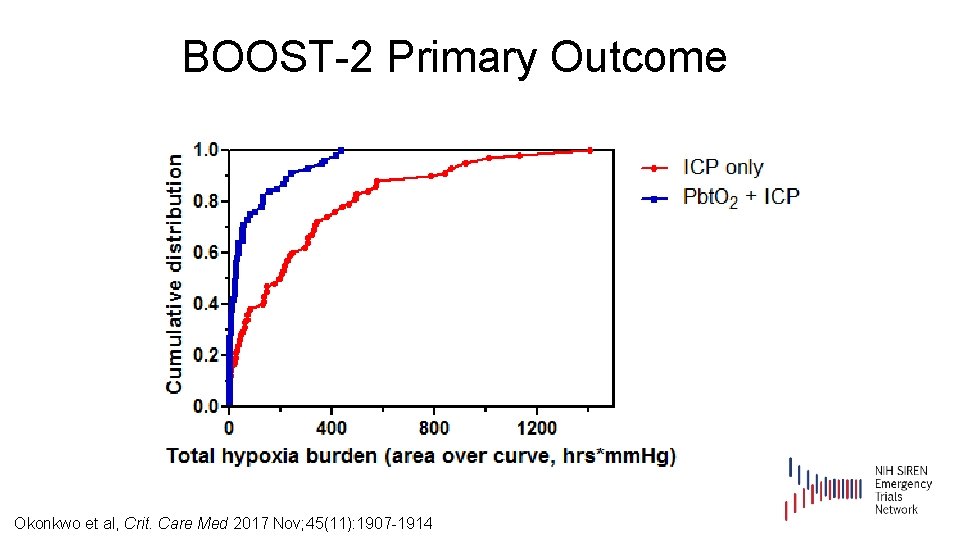
BOOST-2 Primary Outcome Okonkwo et al, Crit. Care Med 2017 Nov; 45(11): 1907 -1914
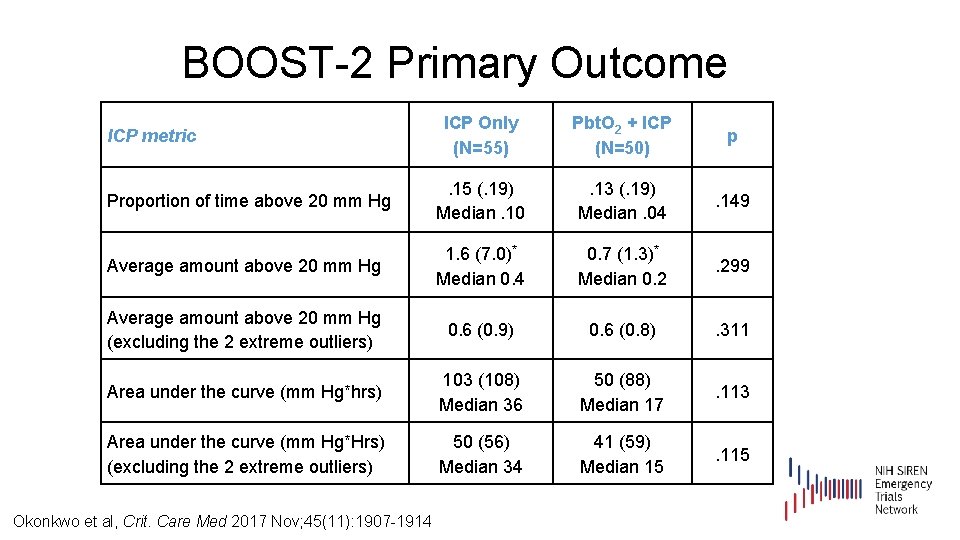
BOOST-2 Primary Outcome ICP Only (N=55) Pbt. O 2 + ICP (N=50) p Proportion of time above 20 mm Hg . 15 (. 19) Median. 10 . 13 (. 19) Median. 04 . 149 Average amount above 20 mm Hg 1. 6 (7. 0)* Median 0. 4 0. 7 (1. 3)* Median 0. 2 . 299 Average amount above 20 mm Hg (excluding the 2 extreme outliers) 0. 6 (0. 9) 0. 6 (0. 8) . 311 Area under the curve (mm Hg*hrs) 103 (108) Median 36 50 (88) Median 17 . 113 Area under the curve (mm Hg*Hrs) (excluding the 2 extreme outliers) 50 (56) Median 34 41 (59) Median 15 . 115 ICP metric Okonkwo et al, Crit. Care Med 2017 Nov; 45(11): 1907 -1914
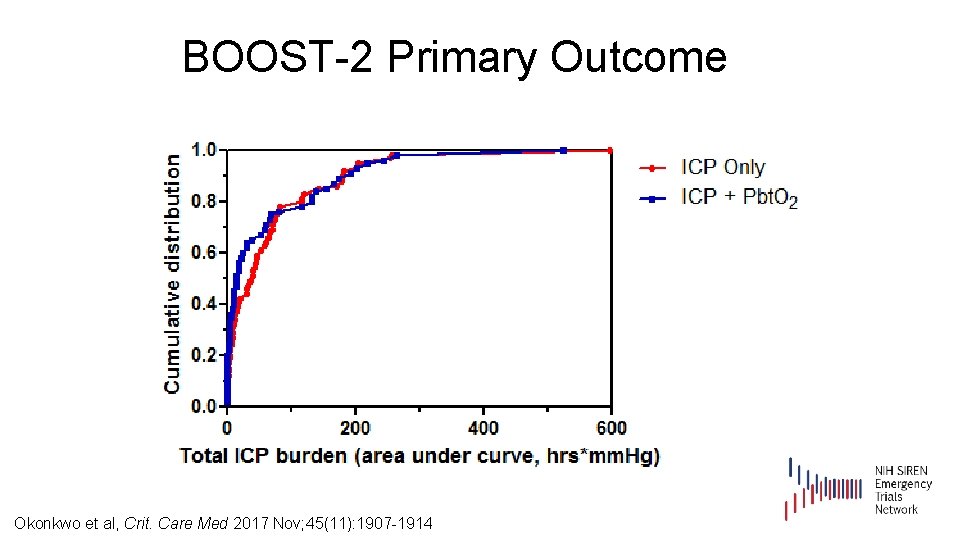
BOOST-2 Primary Outcome Okonkwo et al, Crit. Care Med 2017 Nov; 45(11): 1907 -1914

BOOST-2 Interventions Scenario Tier 1 B 2 3 Task# Task 1 2 3 4 5 6 7 1 2 3 4 5 1 2 3 4 Adjust head of bed to lower ICP Ensure temperature < 38 Adjust sedation and analgesia Adjust ventilation to obtain Pa. CO 2 between 35‐ 40 mm. Hg CSF drainage Standard dose mannitol (0. 25 – 1. 0 g/kg) Hypertonic saline Adjust ventilation to lower Pa. CO 2 to 32‐ 35 mm. Hg. High dose mannitol (>1 g/kg), or higher frequency of standard dose Repeat CT – look for increased size of intracranial mass lesions Treat surgically remediable lesions with craniotomy Adjust temperature to 35 – 37 °C Pentobarbital coma Decompressive craniectomy Adjust Temperature to 32 – 34. 5 °C Neuromuscular paralysis ICP+ Only Pbt. O 2 61 44 72 33 324 181 38 10 165 59 63 23 70 26 9 5 6 6 14 7 0 1 4 4 1 0 3 0 1 0 8 2
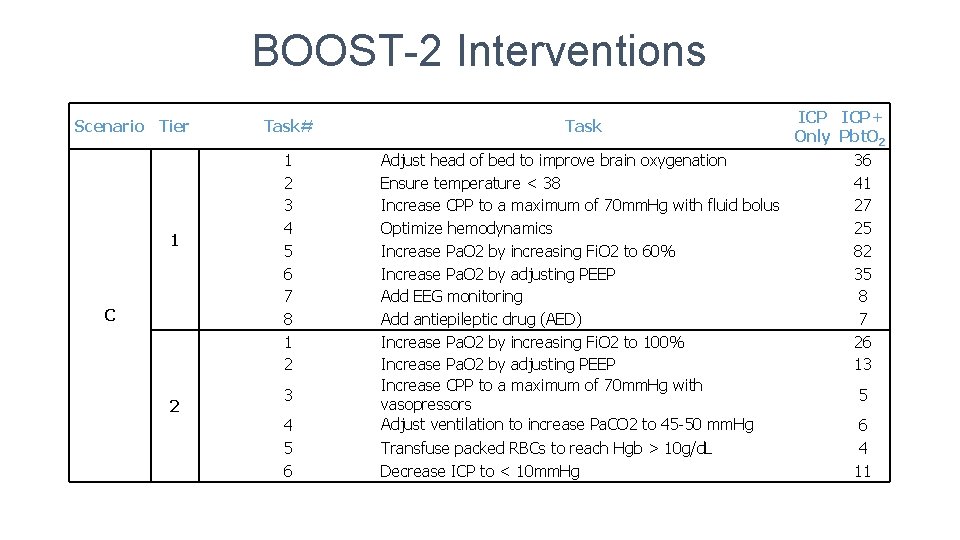
BOOST-2 Interventions Scenario Tier 1 C 2 Task# Task 1 2 3 4 5 6 7 8 1 2 Adjust head of bed to improve brain oxygenation Ensure temperature < 38 Increase CPP to a maximum of 70 mm. Hg with fluid bolus Optimize hemodynamics Increase Pa. O 2 by increasing Fi. O 2 to 60% Increase Pa. O 2 by adjusting PEEP Add EEG monitoring Add antiepileptic drug (AED) Increase Pa. O 2 by increasing Fi. O 2 to 100% Increase Pa. O 2 by adjusting PEEP Increase CPP to a maximum of 70 mm. Hg with vasopressors Adjust ventilation to increase Pa. CO 2 to 45‐ 50 mm. Hg Transfuse packed RBCs to reach Hgb > 10 g/d. L Decrease ICP to < 10 mm. Hg 3 4 5 6 ICP+ Only Pbt. O 2 36 41 27 25 82 35 8 7 26 13 5 6 4 11
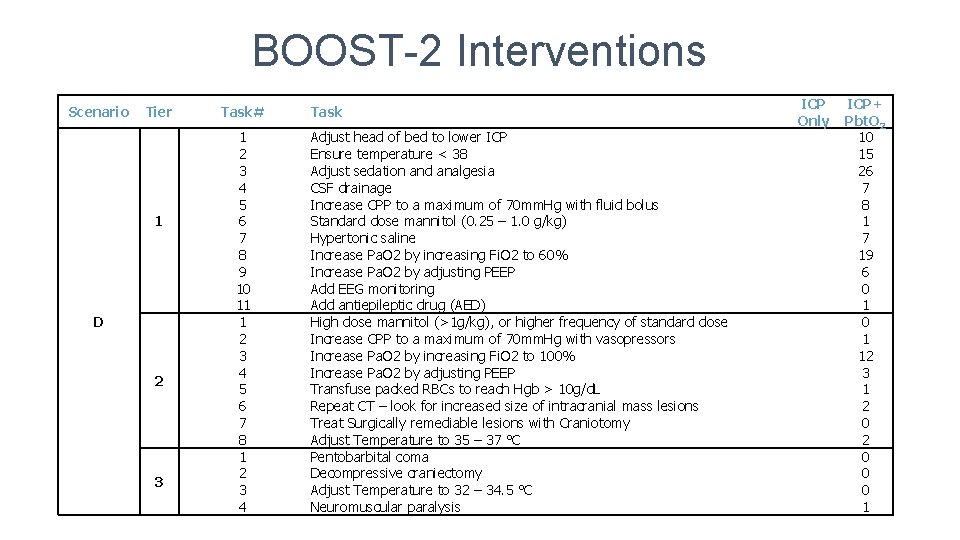
BOOST-2 Interventions Scenario Tier 1 D 2 3 Task# 1 2 3 4 5 6 7 8 9 10 11 1 2 3 4 5 6 7 8 1 2 3 4 Task Adjust head of bed to lower ICP Ensure temperature < 38 Adjust sedation and analgesia CSF drainage Increase CPP to a maximum of 70 mm. Hg with fluid bolus Standard dose mannitol (0. 25 – 1. 0 g/kg) Hypertonic saline Increase Pa. O 2 by increasing Fi. O 2 to 60% Increase Pa. O 2 by adjusting PEEP Add EEG monitoring Add antiepileptic drug (AED) High dose mannitol (>1 g/kg), or higher frequency of standard dose Increase CPP to a maximum of 70 mm. Hg with vasopressors Increase Pa. O 2 by increasing Fi. O 2 to 100% Increase Pa. O 2 by adjusting PEEP Transfuse packed RBCs to reach Hgb > 10 g/d. L Repeat CT – look for increased size of intracranial mass lesions Treat Surgically remediable lesions with Craniotomy Adjust Temperature to 35 – 37 °C Pentobarbital coma Decompressive craniectomy Adjust Temperature to 32 – 34. 5 °C Neuromuscular paralysis ICP Only ICP+ Pbt. O 2 10 15 26 7 8 1 7 19 6 0 1 12 3 1 2 0 0 0 1
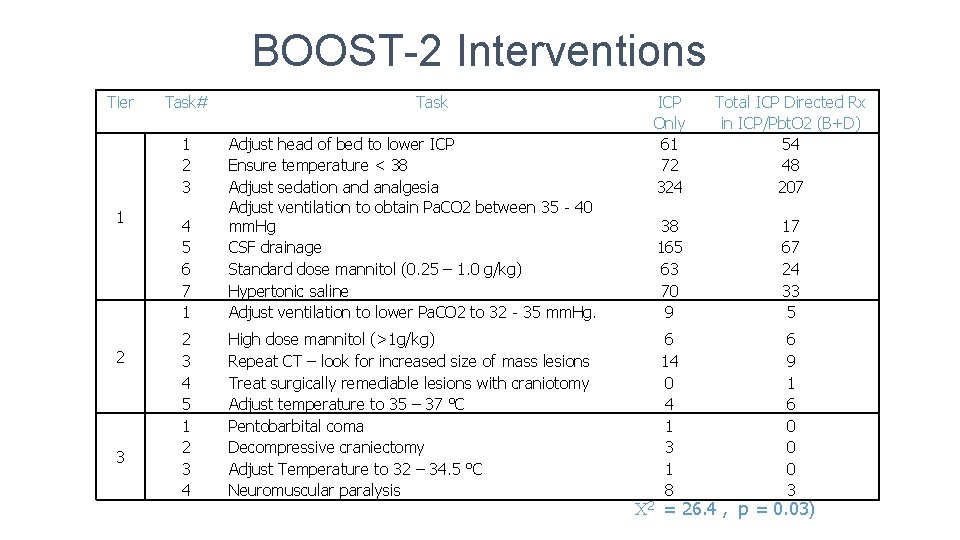
BOOST-2 Interventions Tier Task# 1 2 3 Task 4 5 6 7 1 Adjust head of bed to lower ICP Ensure temperature < 38 Adjust sedation and analgesia Adjust ventilation to obtain Pa. CO 2 between 35‐ 40 mm. Hg CSF drainage Standard dose mannitol (0. 25 – 1. 0 g/kg) Hypertonic saline Adjust ventilation to lower Pa. CO 2 to 32‐ 35 mm. Hg. 2 3 4 5 1 2 3 4 High dose mannitol (>1 g/kg) Repeat CT – look for increased size of mass lesions Treat surgically remediable lesions with craniotomy Adjust temperature to 35 – 37 °C Pentobarbital coma Decompressive craniectomy Adjust Temperature to 32 – 34. 5 °C Neuromuscular paralysis ICP Only 61 72 324 Total ICP Directed Rx in ICP/Pbt. O 2 (B+D) 54 48 207 38 165 63 70 9 17 67 24 33 5 6 14 0 4 1 3 1 8 6 9 1 6 0 0 0 3 C 2 = 26. 4 , p = 0. 03)
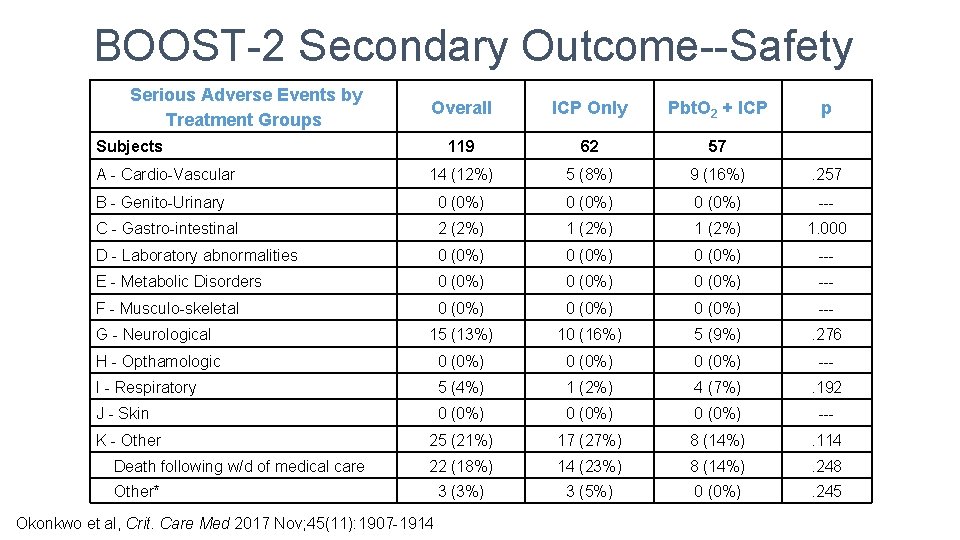
BOOST-2 Secondary Outcome--Safety Serious Adverse Events by Treatment Groups Overall ICP Only Pbt. O 2 + ICP p 119 62 57 14 (12%) 5 (8%) 9 (16%) . 257 B - Genito-Urinary 0 (0%) --- C - Gastro-intestinal 2 (2%) 1. 000 D - Laboratory abnormalities 0 (0%) --- E - Metabolic Disorders 0 (0%) --- F - Musculo-skeletal 0 (0%) --- G - Neurological 15 (13%) 10 (16%) 5 (9%) . 276 H - Opthamologic 0 (0%) --- I - Respiratory 5 (4%) 1 (2%) 4 (7%) . 192 J - Skin 0 (0%) --- K - Other 25 (21%) 17 (27%) 8 (14%) . 114 Death following w/d of medical care 22 (18%) 14 (23%) 8 (14%) . 248 3 (3%) 3 (5%) 0 (0%) . 245 Subjects A - Cardio-Vascular Other* Okonkwo et al, Crit. Care Med 2017 Nov; 45(11): 1907 -1914
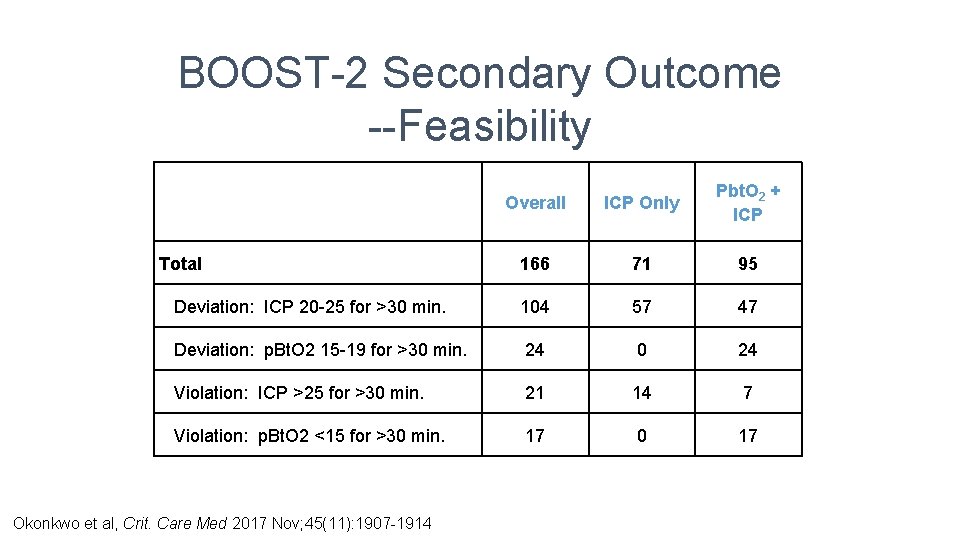
BOOST-2 Secondary Outcome --Feasibility Overall ICP Only Pbt. O 2 + ICP Total 166 71 95 Deviation: ICP 20 -25 for >30 min. 104 57 47 Deviation: p. Bt. O 2 15 -19 for >30 min. 24 0 24 Violation: ICP >25 for >30 min. 21 14 7 Violation: p. Bt. O 2 <15 for >30 min. 17 0 17 Okonkwo et al, Crit. Care Med 2017 Nov; 45(11): 1907 -1914
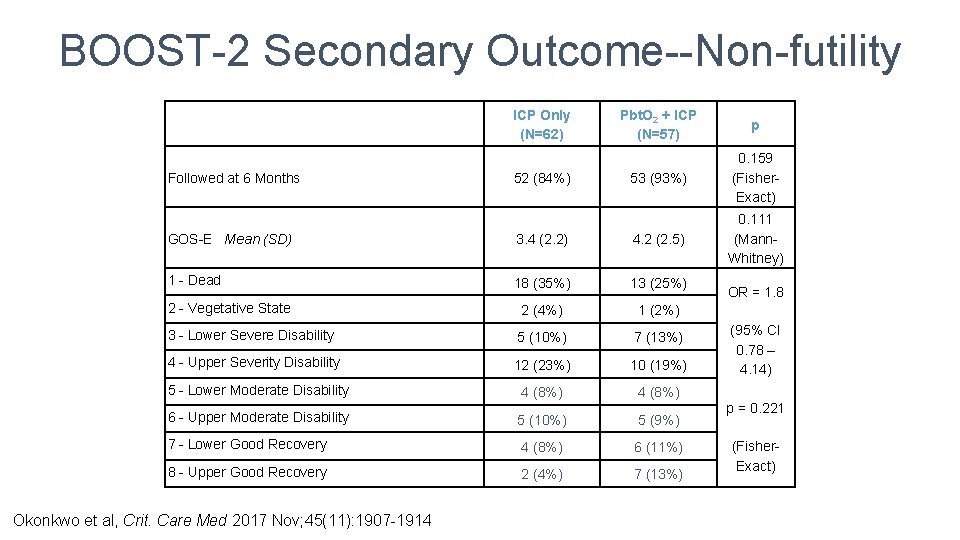
BOOST-2 Secondary Outcome--Non-futility Followed at 6 Months ICP Only (N=62) 52 (84%) Pbt. O 2 + ICP (N=57) p 53 (93%) 0. 159 (Fisher. Exact) 0. 111 (Mann. Whitney) GOS-E Mean (SD) 3. 4 (2. 2) 4. 2 (2. 5) 1 - Dead 18 (35%) 13 (25%) 2 - Vegetative State 2 (4%) 1 (2%) 3 - Lower Severe Disability 5 (10%) 7 (13%) 4 - Upper Severity Disability 12 (23%) 10 (19%) 5 - Lower Moderate Disability 4 (8%) 6 - Upper Moderate Disability 5 (10%) 5 (9%) 7 - Lower Good Recovery 4 (8%) 6 (11%) 8 - Upper Good Recovery 2 (4%) 7 (13%) Okonkwo et al, Crit. Care Med 2017 Nov; 45(11): 1907 -1914 OR = 1. 8 (95% CI 0. 78 – 4. 14) p = 0. 221 (Fisher. Exact)
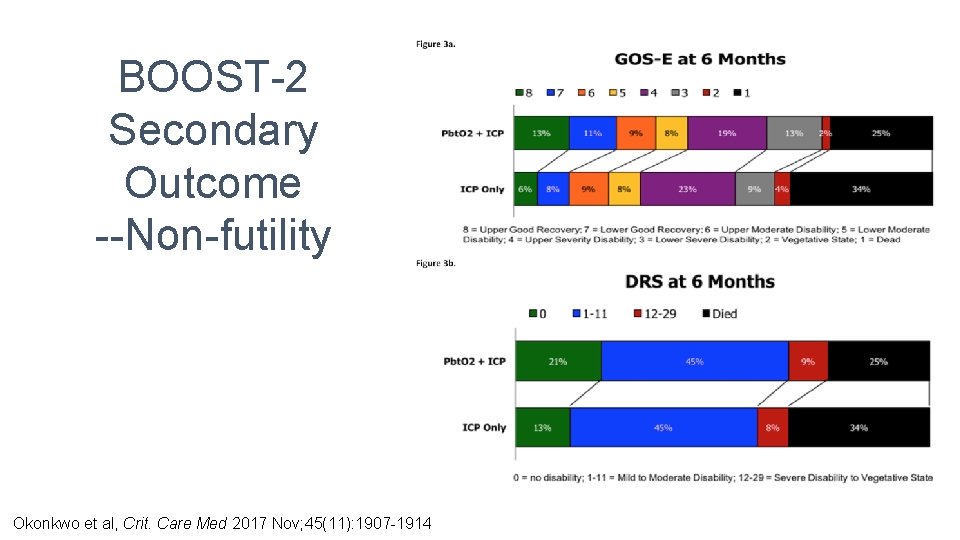
BOOST-2 Secondary Outcome --Non-futility Okonkwo et al, Crit. Care Med 2017 Nov; 45(11): 1907 -1914

Brain Oxygen Optimization in Severe TBI-Phase 3 (BOOST-3) William Barsan, MD, Contact PI, CCC SIREN Ramon Diaz-Arrastia, MD, Ph. D, Scientific PI Lori Shutter, MD, Clinical PI Sharon Yeatts, Ph. D, Statistical PI, DCC SIREN
BOOST-Phase 3 • Approved by NINDS Council 9/2017 • Target enrollment 1094 • Sufficient to detect a 10% absolute improvement in good outcome • GOS-E Sliding Dichotomy • Planned 45 sites • In collaboration with SIREN Network
Primary Objective To determine whether the prescribed treatment protocol, informed by Pbt. O 2 monitoring, results in improved neurologic outcome measured by the Glasgow Outcome Scale-Extended (GOS-E) 6 months after injury compared to treatment based on intracranial pressure (ICP) monitoring only.
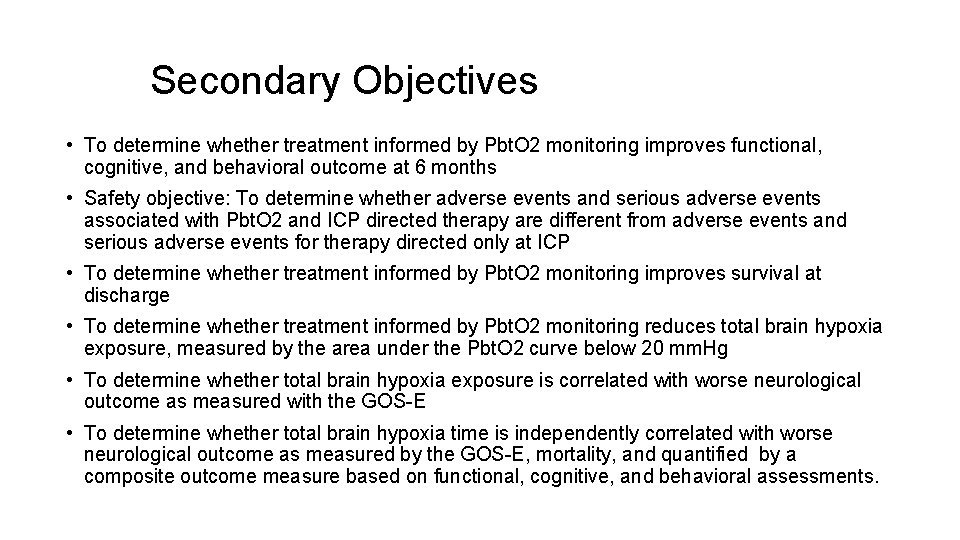
Secondary Objectives • To determine whether treatment informed by Pbt. O 2 monitoring improves functional, cognitive, and behavioral outcome at 6 months • Safety objective: To determine whether adverse events and serious adverse events associated with Pbt. O 2 and ICP directed therapy are different from adverse events and serious adverse events for therapy directed only at ICP • To determine whether treatment informed by Pbt. O 2 monitoring improves survival at discharge • To determine whether treatment informed by Pbt. O 2 monitoring reduces total brain hypoxia exposure, measured by the area under the Pbt. O 2 curve below 20 mm. Hg • To determine whether total brain hypoxia exposure is correlated with worse neurological outcome as measured with the GOS-E • To determine whether total brain hypoxia time is independently correlated with worse neurological outcome as measured by the GOS-E, mortality, and quantified by a composite outcome measure based on functional, cognitive, and behavioral assessments.
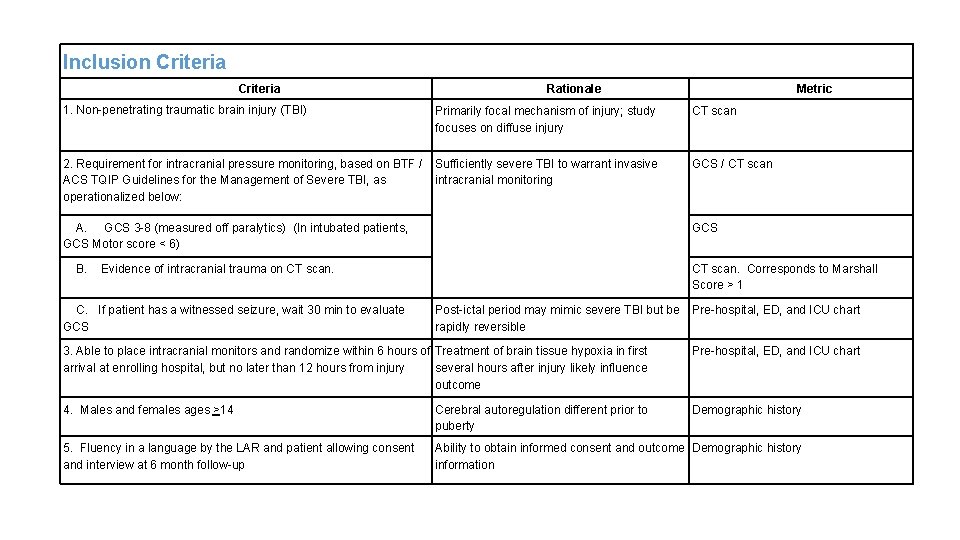
Inclusion Criteria 1. Non-penetrating traumatic brain injury (TBI) Rationale Primarily focal mechanism of injury; study focuses on diffuse injury Metric CT scan 2. Requirement for intracranial pressure monitoring, based on BTF / Sufficiently severe TBI to warrant invasive ACS TQIP Guidelines for the Management of Severe TBI, as intracranial monitoring operationalized below: GCS / CT scan A. GCS 3 -8 (measured off paralytics) (In intubated patients, GCS Motor score < 6) GCS B. Evidence of intracranial trauma on CT scan. Corresponds to Marshall Score > 1 C. If patient has a witnessed seizure, wait 30 min to evaluate GCS Post-ictal period may mimic severe TBI but be Pre-hospital, ED, and ICU chart rapidly reversible 3. Able to place intracranial monitors and randomize within 6 hours of Treatment of brain tissue hypoxia in first arrival at enrolling hospital, but no later than 12 hours from injury several hours after injury likely influence outcome Pre-hospital, ED, and ICU chart 4. Males and females ages >14 Cerebral autoregulation different prior to puberty Demographic history 5. Fluency in a language by the LAR and patient allowing consent and interview at 6 month follow-up Ability to obtain informed consent and outcome Demographic history information
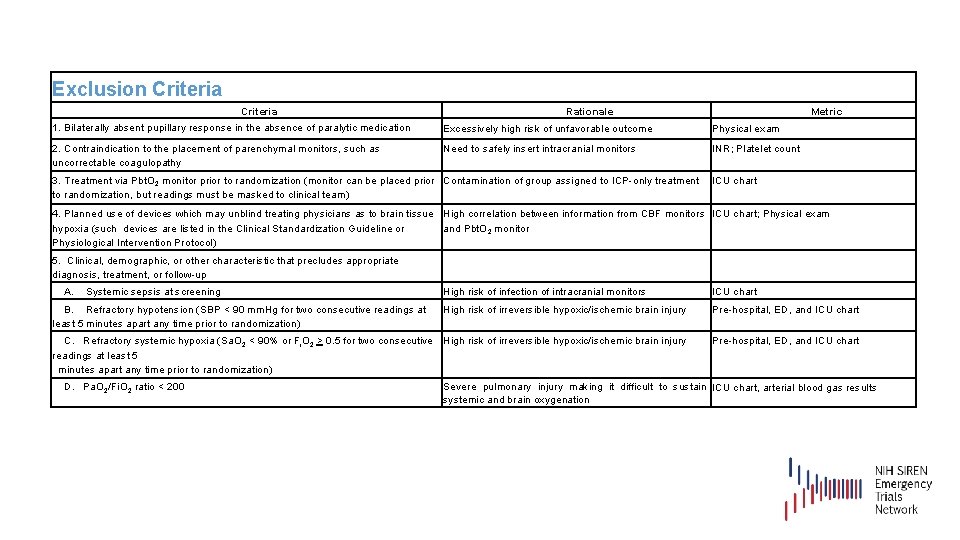
Exclusion Criteria Rationale Metric 1. Bilaterally absent pupillary response in the absence of paralytic medication Excessively high risk of unfavorable outcome Physical exam 2. Contraindication to the placement of parenchymal monitors, such as uncorrectable coagulopathy Need to safely insert intracranial monitors INR; Platelet count 3. Treatment via Pbt. O 2 monitor prior to randomization (monitor can be placed prior Contamination of group assigned to ICP-only treatment to randomization, but readings must be masked to clinical team) ICU chart 4. Planned use of devices which may unblind treating physicians as to brain tissue High correlation between information from CBF monitors ICU chart; Physical exam hypoxia (such devices are listed in the Clinical Standardization Guideline or and Pbt. O 2 monitor Physiological Intervention Protocol) 5. Clinical, demographic, or other characteristic that precludes appropriate diagnosis, treatment, or follow-up A. Systemic sepsis at screening High risk of infection of intracranial monitors ICU chart B. Refractory hypotension (SBP < 90 mm. Hg for two consecutive readings at least 5 minutes apart any time prior to randomization) High risk of irreversible hypoxic/ischemic brain injury Pre-hospital, ED, and ICU chart C. Refractory systemic hypoxia (Sa. O 2 < 90% or Fi. O 2 > 0. 5 for two consecutive High risk of irreversible hypoxic/ischemic brain injury readings at least 5 minutes apart any time prior to randomization) Pre-hospital, ED, and ICU chart D. Pa. O 2/Fi. O 2 ratio < 200 Severe pulmonary injury making it difficult to sustain ICU chart, arterial blood gas results systemic and brain oxygenation
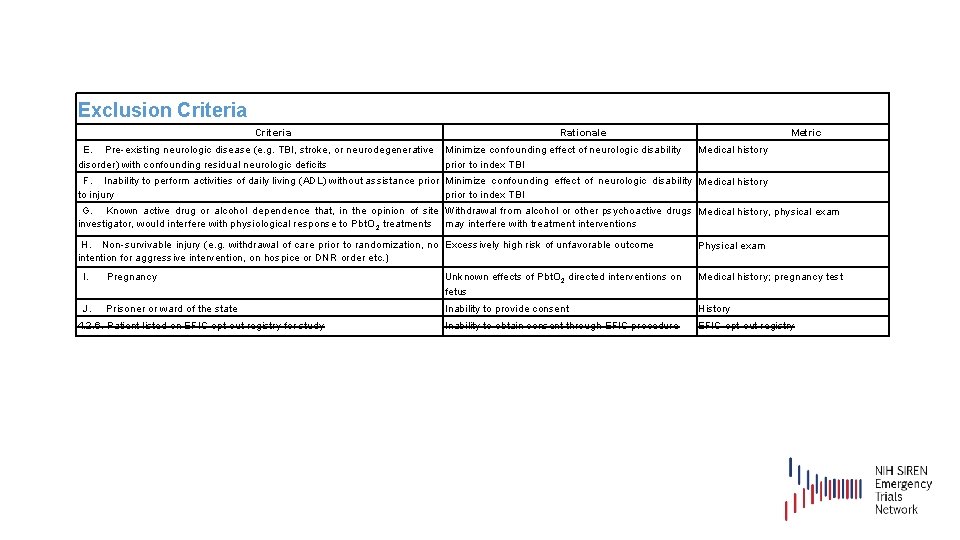
Exclusion Criteria Rationale E. Pre-existing neurologic disease (e. g. TBI, stroke, or neurodegenerative Minimize confounding effect of neurologic disability disorder) with confounding residual neurologic deficits prior to index TBI Metric Medical history F. Inability to perform activities of daily living (ADL) without assistance prior Minimize confounding effect of neurologic disability Medical history to injury prior to index TBI G. Known active drug or alcohol dependence that, in the opinion of site Withdrawal from alcohol or other psychoactive drugs Medical history, physical exam investigator, would interfere with physiological response to Pbt. O 2 treatments may interfere with treatment interventions H. Non-survivable injury (e. g. withdrawal of care prior to randomization, no Excessively high risk of unfavorable outcome intention for aggressive intervention, on hospice or DNR order etc. ) Physical exam I. Pregnancy Unknown effects of Pbt. O 2 directed interventions on fetus Medical history; pregnancy test J. Prisoner or ward of the state Inability to provide consent History 4. 2. 6. Patient listed on EFIC opt-out registry for study Inability to obtain consent through EFIC procedure EFIC opt-out registry
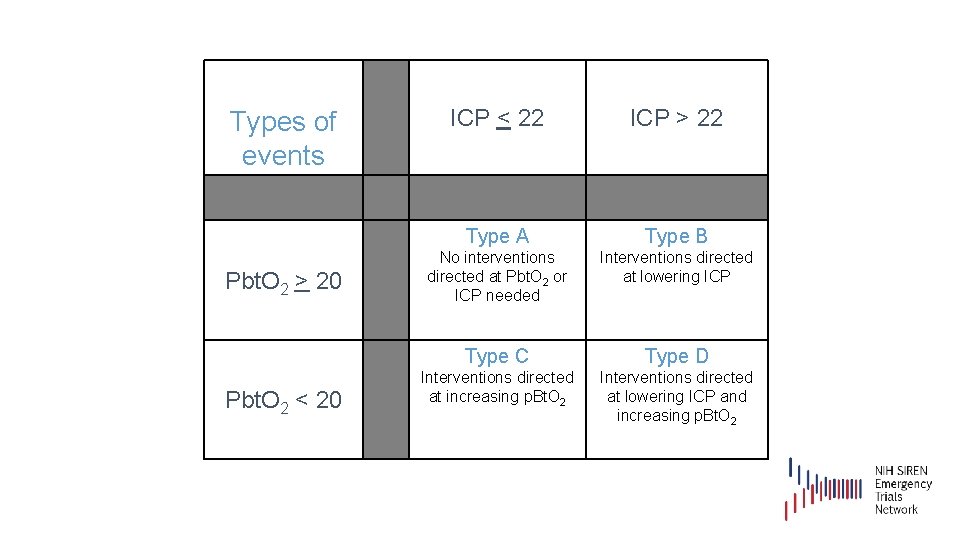
Types of events Pbt. O 2 > 20 Pbt. O 2 < 20 ICP < 22 ICP > 22 Type A Type B No interventions directed at Pbt. O 2 or ICP needed Interventions directed at lowering ICP Type C Type D Interventions directed at increasing p. Bt. O 2 Interventions directed at lowering ICP and increasing p. Bt. O 2
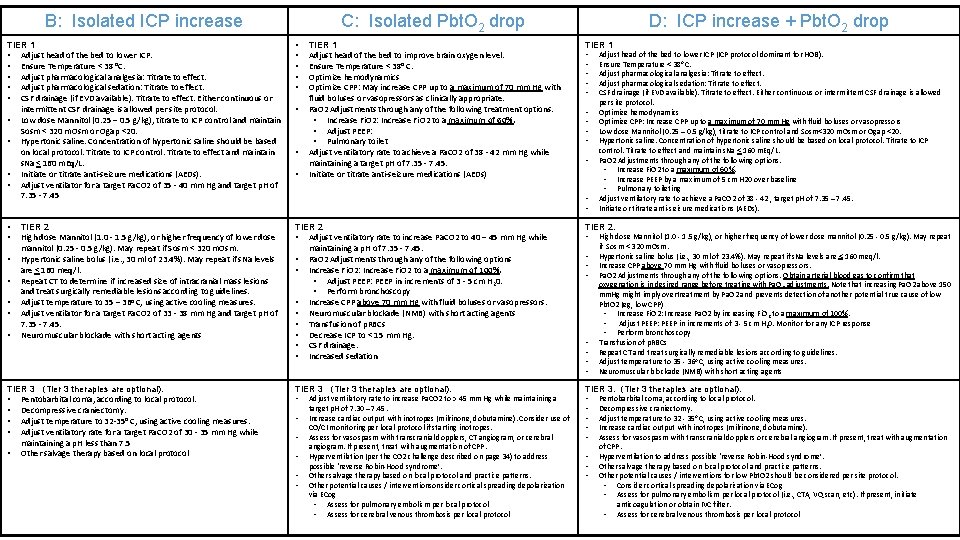
B: Isolated ICP increase C: Isolated Pbt. O 2 drop D: ICP increase + Pbt. O 2 drop TIER 1 • Adjust head of the bed to lower ICP. • Ensure Temperature < 38 o. C. • Adjust pharmacological analgesia: Titrate to effect. • Adjust pharmacological sedation: Titrate to effect. • CSF drainage (if EVD available). Titrate to effect. Either continuous or intermittent CSF drainage is allowed per site protocol. • Low dose Mannitol (0. 25 – 0. 5 g/kg), titrate to ICP control and maintain Sosm < 320 m. Osm or Ogap <20. • Hypertonic saline. Concentration of hypertonic saline should be based on local protocol. Titrate to ICP control. Titrate to effect and maintain s. Na < 160 m. Eq/L. • Initiate or titrate anti-seizure medications (AEDs). • Adjust ventilator for a target Pa. CO 2 of 35 - 40 mm Hg and target p. H of 7. 35 - 7. 45 • • TIER 2 • Adjust ventilatory rate to increase Pa. CO 2 to 40 – 45 mm Hg while maintaining a p. H of 7. 35 - 7. 45. • Pa. O 2 Adjustments through any of the following options • Increase Fi. O 2: Increase Fi. O 2 to a maximum of 100%. • Adjust PEEP: PEEP in increments of 3 - 5 cm H 20. • Perform bronchoscopy • Increase CPP above 70 mm Hg with fluid boluses or vasopressors. • Neuromuscular blockade (NMB) with short acting agents • Transfusion of p. RBCs • Decrease ICP to < 15 mm Hg. • CSF drainage. • Increased sedation TIER 2. TIER 3 (Tier 3 therapies are optional). TIER 3. (Tier 3 therapies are optional). • • • TIER 2 High dose Mannitol (1. 0 - 1. 5 g/kg), or higher frequency of lower dose mannitol (0. 25 - 0. 5 g/kg). May repeat if Sosm < 320 m. Osm. Hypertonic saline bolus (i. e. , 30 ml of 23. 4%). May repeat if s. Na levels are < 160 meq/l. Repeat CT to determine if increased size of intracranial mass lesions and treat surgically remediable lesions according to guidelines. Adjust temperature to 35 – 36 o C, using active cooling measures. Adjust ventilator for a target Pa. CO 2 of 33 - 38 mm Hg and target p. H of 7. 35 - 7. 45. Neuromuscular blockade with short acting agents TIER 3 (Tier 3 therapies are optional). • Pentobarbital coma, according to local protocol. • Decompressive craniectomy. • Adjust temperature to 32 -35 o C, using active cooling measures. • Adjust ventilatory rate for a target Pa. CO 2 of 30 - 35 mm Hg while maintaining a p. H less than 7. 5 • Other salvage therapy based on local protocol • • • TIER 1 Adjust head of the bed to improve brain oxygen level. Ensure Temperature < 38 o C. Optimize hemodynamics Optimize CPP: May increase CPP up to a maximum of 70 mm Hg with fluid boluses or vasopressors as clinically appropriate. Pa. O 2 Adjustments through any of the following treatment options. • Increase Fi. O 2: Increase Fi. O 2 to a maximum of 60%. • Adjust PEEP: • Pulmonary toilet Adjust ventilatory rate to achieve a Pa. CO 2 of 38 - 42 mm Hg while maintaining a target p. H of 7. 35 - 7. 45. Initiate or titrate anti-seizure medications (AEDs) TIER 1 • • • • • Adjust ventilatory rate to increase Pa. CO 2 to > 45 mm Hg while maintaining a target p. H of 7. 30 – 7. 45. Increase cardiac output with inotropes (milrinone, dobutamine). Consider use of CO/CI monitoring per local protocol if starting inotropes. Assess for vasospasm with transcranial dopplers, CT angiogram, or cerebral angiogram. If present, treat with augmentation of CPP. Hyperventilation (per the CO 2 challenge described on page 34) to address possible ‘reverse Robin-Hood syndrome’. Other salvage therapy based on local protocol and practice patterns. Other potential causes / interventionsonsider cortical spreading depolarization via ECog • Assess for pulmonary embolism per local protocol • Assess for cerebral venous thrombosis per local protocol • • • • Adjust head of the bed to lower ICP (ICP protocol dominant for HOB). Ensure Temperature < 38 o C. Adjust pharmacological analgesia: Titrate to effect. Adjust pharmacological sedation: Titrate to effect. CSF drainage (if EVD available). Titrate to effect. Either continuous or intermittent CSF drainage is allowed per site protocol. Optimize hemodynamics Optimize CPP: Increase CPP up to a maximum of 70 mm Hg with fluid boluses or vasopressors Low dose Mannitol (0. 25 – 0. 5 g/kg), titrate to ICP control and Sosm<320 m. Osm or Ogap <20. Hypertonic saline. Concentration of hypertonic saline should be based on local protocol. Titrate to ICP control. Titrate to effect and maintain s. Na < 160 m. Eq/L. Pa. O 2 Adjustments through any of the following options. • Increase Fi. O 2 to a maximum of 60%. • Increase PEEP by a maximum of 5 cm H 20 over baseline • Pulmonary toileting Adjust ventilatory rate to achieve a Pa. CO 2 of 38 - 42 , target p. H of 7. 35 – 7. 45. Initiate or titrate anti-seizure medications (AEDs). High dose Mannitol (1. 0 - 1. 5 g/kg), or higher frequency of lower dose mannitol (0. 25 - 0. 5 g/kg). May repeat if Sosm < 320 m. Osm. Hypertonic saline bolus (i. e. , 30 ml of 23. 4%). May repeat if s. Na levels are < 160 meq/l. Increase CPP above 70 mm Hg with fluid boluses or vasopressors. Pa. O 2 Adjustments through any of the following options. Obtain arterial blood gas to confirm that oxygenation is in desired range before treating with Pa. O 2 adjustments. Note that increasing Pa. O 2 above 150 mm. Hg might imply overtreatment by Pa. O 2 and prevents detection of another potential true cause of low Pbt. O 2 (eg, low CPP) • Increase Fi. O 2: Increase Pa. O 2 by increasing Fi. O 2 to a maximum of 100%. • Adjust PEEP: PEEP in increments of 3 - 5 cm H 20. Monitor for any ICP response • Perform bronchoscopy Transfusion of p. RBCs Repeat CT and treat surgically remediable lesions according to guidelines. Adjust temperature to 35 - 36 o C, using active cooling measures. Neuromuscular blockade (NMB) with short acting agents Pentobarbital coma, according to local protocol. Decompressive craniectomy. Adjust temperature to 32 - 35 o C, using active cooling measures. Increase cardiac output with inotropes (milrinone, dobutamine). Assess for vasospasm with transcranial dopplers or cerebral angiogram. If present, treat with augmentation of CPP. Hyperventilation to address possible ‘reverse Robin-Hood syndrome’. Other salvage therapy based on local protocol and practice patterns. Other potential causes / interventions for low Pbt. O 2 should be considered per site protocol. • Consider cortical spreading depolarization via ECog • Assess for pulmonary embolism per local protocol (i. e. , CTA, VQ scan, etc). If present, initiate anticoagulation or obtain IVC filter. • Assess for cerebral venous thrombosis per local protocol
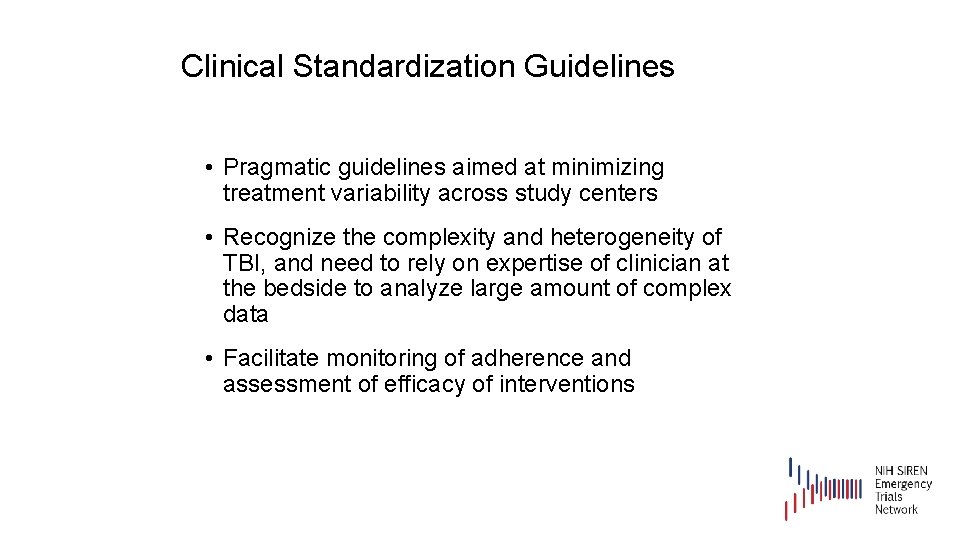
Clinical Standardization Guidelines • Pragmatic guidelines aimed at minimizing treatment variability across study centers • Recognize the complexity and heterogeneity of TBI, and need to rely on expertise of clinician at the bedside to analyze large amount of complex data • Facilitate monitoring of adherence and assessment of efficacy of interventions
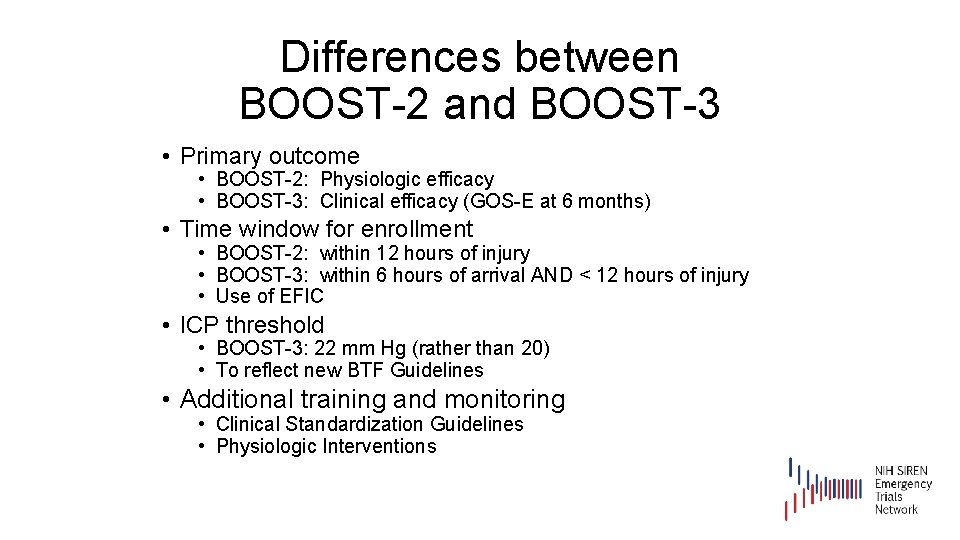
Differences between BOOST-2 and BOOST-3 • Primary outcome • BOOST-2: Physiologic efficacy • BOOST-3: Clinical efficacy (GOS-E at 6 months) • Time window for enrollment • BOOST-2: within 12 hours of injury • BOOST-3: within 6 hours of arrival AND < 12 hours of injury • Use of EFIC • ICP threshold • BOOST-3: 22 mm Hg (rather than 20) • To reflect new BTF Guidelines • Additional training and monitoring • Clinical Standardization Guidelines • Physiologic Interventions
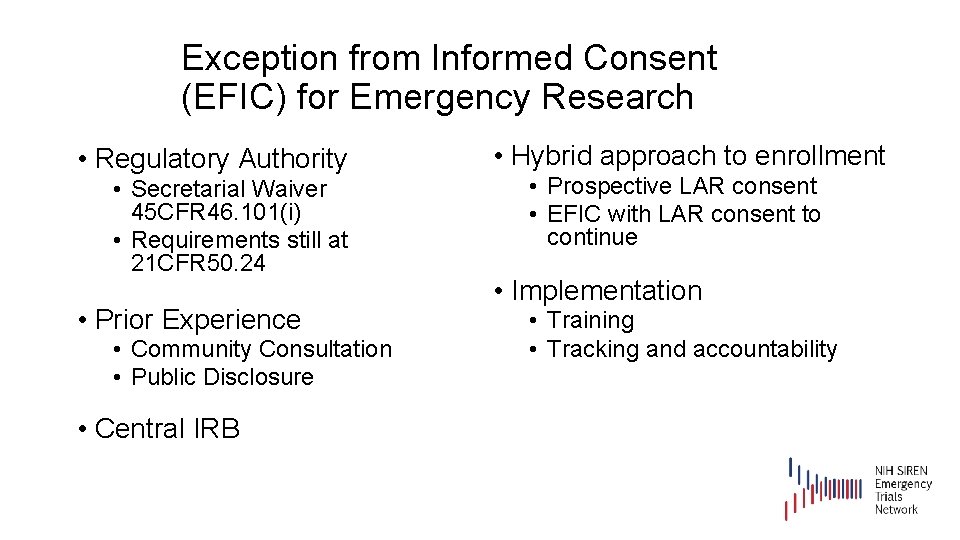
Exception from Informed Consent (EFIC) for Emergency Research • Regulatory Authority • Secretarial Waiver 45 CFR 46. 101(i) • Requirements still at 21 CFR 50. 24 • Prior Experience • Community Consultation • Public Disclosure • Central IRB • Hybrid approach to enrollment • Prospective LAR consent • EFIC with LAR consent to continue • Implementation • Training • Tracking and accountability
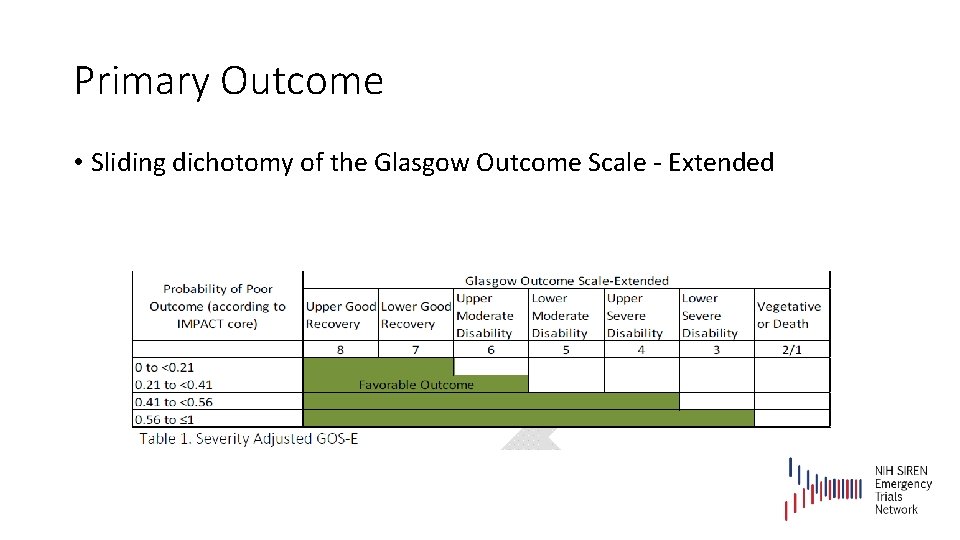
Primary Outcome • Sliding dichotomy of the Glasgow Outcome Scale - Extended
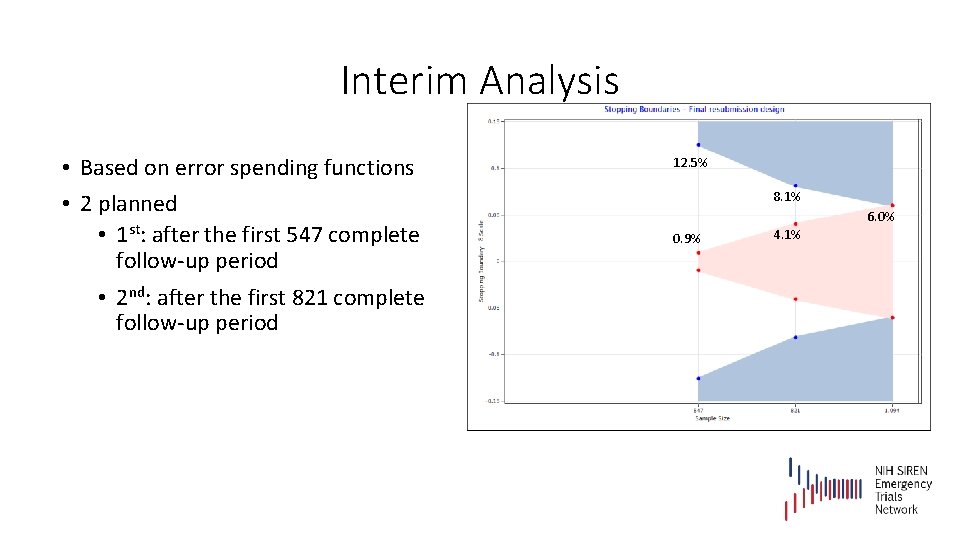
Interim Analysis • Based on error spending functions • 2 planned • 1 st: after the first 547 complete follow-up period • 2 nd: after the first 821 complete follow-up period 12. 5% 8. 1% 6. 0% 0. 9% 4. 1%
Conclusions • Treatment protocol informed by Pbt. O 2 and ICP measurements reduces duration of brain tissue hypoxia • Treatment protocol informed by Pbt. O 2 and ICP measurements is feasible, with modest number of protocol deviations and violations • Treatment protocol informed by Pbt. O 2 monitoring is consistent with reduction in mortality and increase in good recovery • Definitive Phase 3 trial will establish clinical efficacy


- Slides: 50