
Brain Injury Concussion Clinic Br ICC Supervisors Mc
Brain Injury & Concussion Clinic (Br. ICC) Supervisors: Mc. Kay Moore Sohlberg, Jennifer Meyer, Alex Ledbetter, Priya Kucheria
TODAY • Purpose of Br. ICC • Assessment • Intervention • Inter-disciplinary collaboration • Paperwork • Supervision setup
Purpose of Br. ICC • Purpose : • Evaluate clients with acquired brain injuries that are referred to the clinic (most often by physicians) • Identify the nature of persistent cognitive impairment and its impact on functional activities and participation • Provide cognitive rehabilitation and/or counseling services to such individuals experiencing some loss of functional ability or changes from pre-morbid levels impacting daily functioning • Purpose of services is to facilitate client’s return to desired activity or accomplish desired goal in desired context / setting.
Purpose of Br. ICC • Population: This term, Br. ICC will mostly be adolsecents with m. TBI. We will try to group clients in Br. ICC. We have older clients and mor severe clients and will look to add on another Br. ICC if the numbers warrant. • Impairments and functional deficits • Commonly observed cognitive impairments: attention, memory, executive function • Functional deficits: Impact on ability to attend school and manage academic demands • Somatic concerns: Headache, sensitivity to light, dizziness • Psychosocial changes: Changes in social networks (Friends), irritability, flat affect
Purpose of Br. ICC • Case management: Interdisciplinary collaboration to provide a holistic rehabilitation experience • Service delivery: Group and individual sessions to facilitate peer support and focus services on client’s area of need.
Purpose of Br. ICC • EBP • Sohlberg & Ledbetter, 2015 • m. TBI literature • e. GAS Training handout • ‘Working with families’

Assessment • Delivery format • Tests • e. GAS • Clinician role

Consultation Process • Time allotted : 2 hours • Components of assessment: • 45 mins: Interview • 1 hr 15 mins: Standardized tests • Standardized assessments • • RBANS TEA/TEA-ch—as needed and determined by interview BRIEF—as needed and determined by interview D-KEFS (selected subtests)—as needed and determined by interview
Consultation Paperwork • Report templates • Test protocols • PCSS and HIT (if appropriate)
Standardized Batteries • RBANS: • Video training webinar: http: //www. pearsonclinical. com/psychology/products/100000726/repeatable-battery-for -the-assessment-of-neuropsychological-status-update-rbans-update. html#tab-training • Refer to the presentation titled ‘RBANS Update: Repeatable Battery for the Assessment of Neuropsychological Status’ by Anne-Marie Kimbell, Ph. D • TEA / TEA-ch: • Mc. Kay Moore Sohlberg, Ph. D class • BRIEF: • Powerpoint training: http: //www 4. parinc. com/Products/Product. aspx? Product. ID=BRIEF • D-KEFS: • Video training webinar: http: //www. pearsonclinical. com/psychology/products/100000618/deliskaplan-executive-functionsystem-d-kefs. html#tab-training • Refer to training by Gloria Maccow, Ph. D
Outcome Measure: e. GAS • e. GAS : An app developed by Dr. Sohlberg and team to identify functional goals and develop an individualized outcome measure. In other words, the app allows a clinician to assist client in identifying personally relevant goals and define an objective scale to measure outcomes • Motivational interviewing: A collaborative, counseling/interviewing technique used to enhance client’s metacognitive awareness and promote client autonomy in identifying functional goas. • GAS: A set of procedures that helps create individualized outcome measure in the form of a 5 -point scale (levels ranging from most favorable to least favorable outcome)
Outcome Measure: e. GAS • The e. GAS may be completed during cognitive consult OR during the first session
Why use e. GAS? • Fills the need for patient-centered outcome measure • First app that combines motivational interviewing skills with goal attainment scaling procedure to make it easy for the clinicians and clients to collaborate and identify personally relevant goals and outcomes • Flexible design of the app – allows clinician to adapt the interview and data taking process to cater to individual client needs
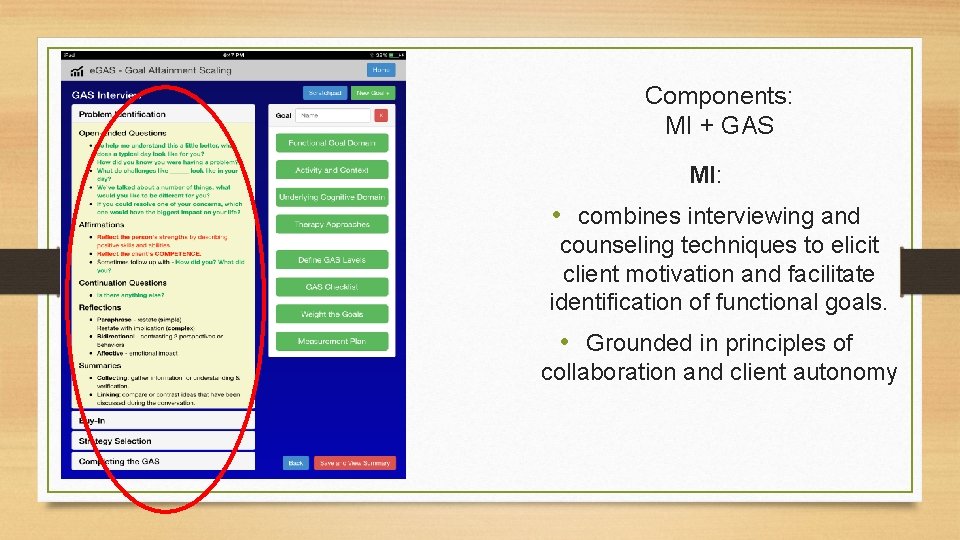
Components: MI + GAS MI: • combines interviewing and counseling techniques to elicit client motivation and facilitate identification of functional goals. • Grounded in principles of collaboration and client autonomy
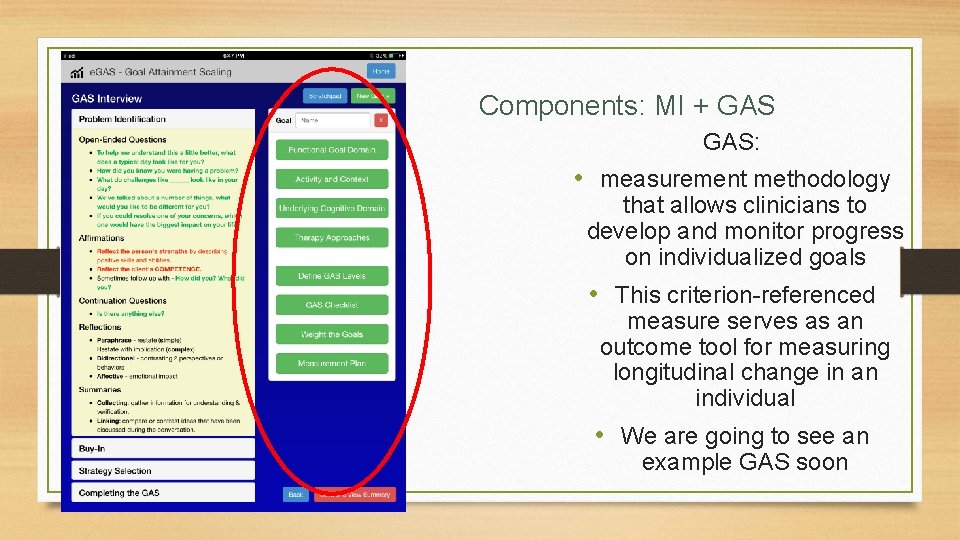
Components: MI + GAS: • measurement methodology that allows clinicians to develop and monitor progress on individualized goals • This criterion-referenced measure serves as an outcome tool for measuring longitudinal change in an individual • We are going to see an example GAS soon
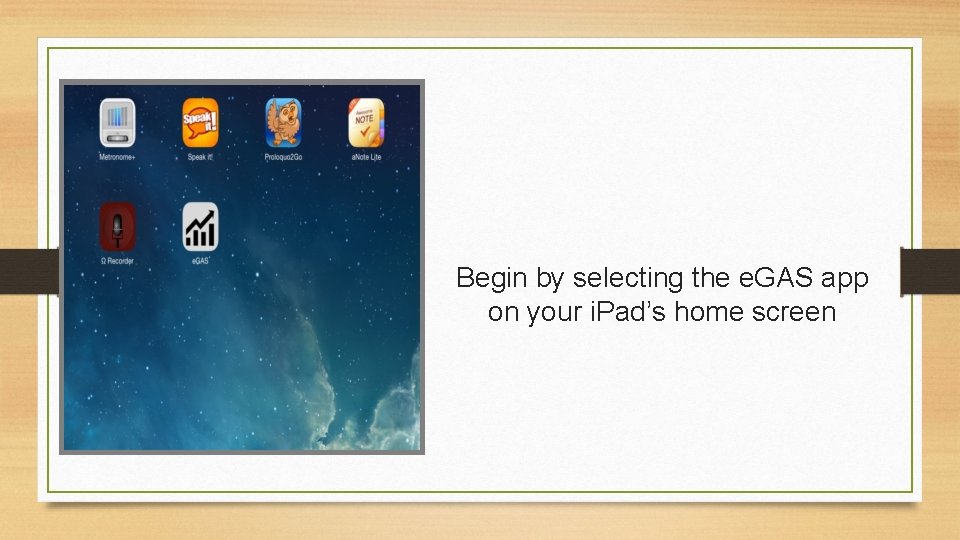
Begin by selecting the e. GAS app on your i. Pad’s home screen
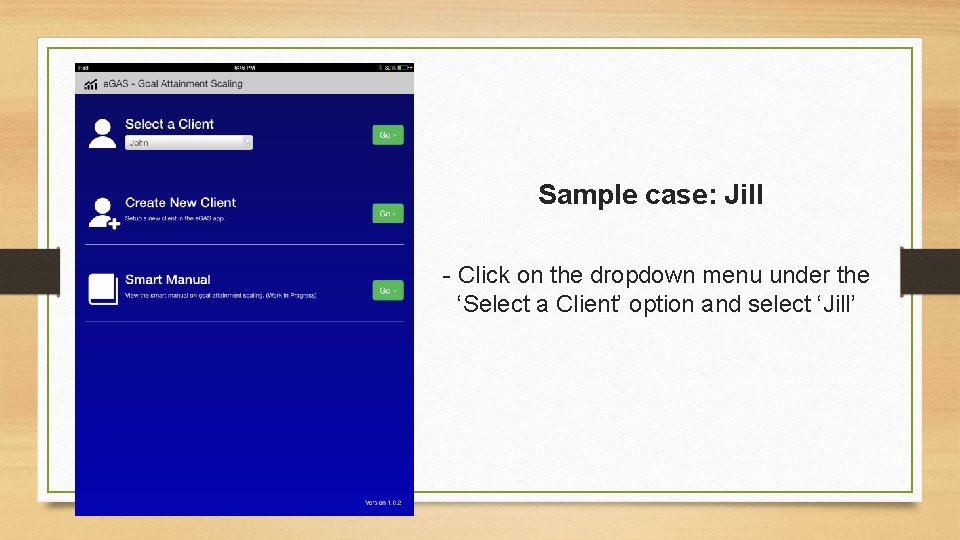
Sample case: Jill - Click on the dropdown menu under the ‘Select a Client’ option and select ‘Jill’
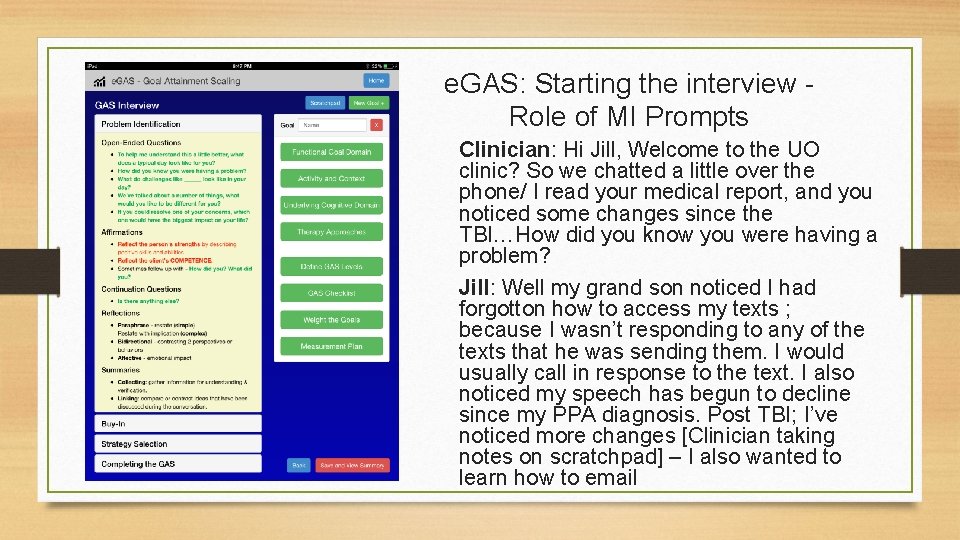
e. GAS: Starting the interview Role of MI Prompts Clinician: Hi Jill, Welcome to the UO clinic? So we chatted a little over the phone/ I read your medical report, and you noticed some changes since the TBI…How did you know you were having a problem? Jill: Well my grand son noticed I had forgotton how to access my texts ; because I wasn’t responding to any of the texts that he was sending them. I would usually call in response to the text. I also noticed my speech has begun to decline since my PPA diagnosis. Post TBI; I’ve noticed more changes [Clinician taking notes on scratchpad] – I also wanted to learn how to email
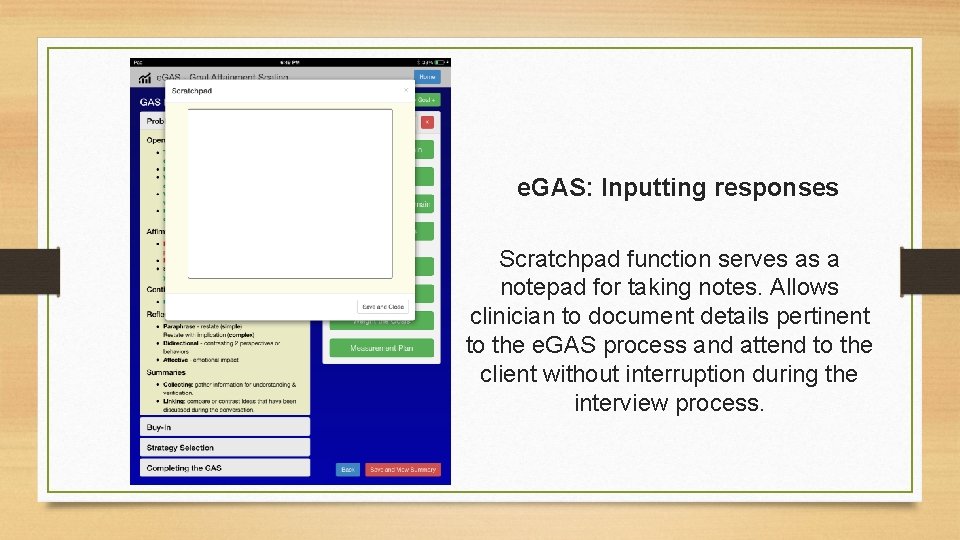
e. GAS: Inputting responses Scratchpad function serves as a notepad for taking notes. Allows clinician to document details pertinent to the e. GAS process and attend to the client without interruption during the interview process.
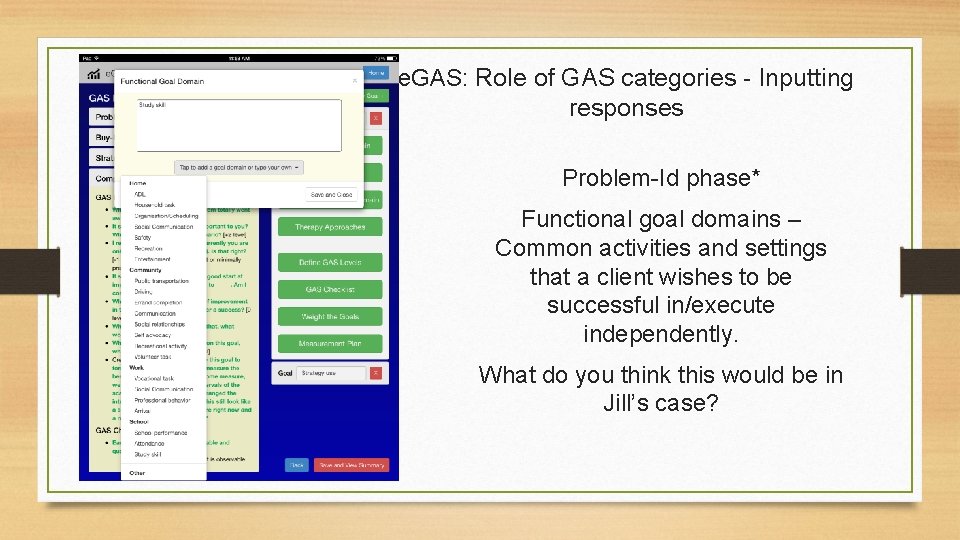
e. GAS: Role of GAS categories - Inputting responses Problem-Id phase* Functional goal domains – Common activities and settings that a client wishes to be successful in/execute independently. What do you think this would be in Jill’s case?
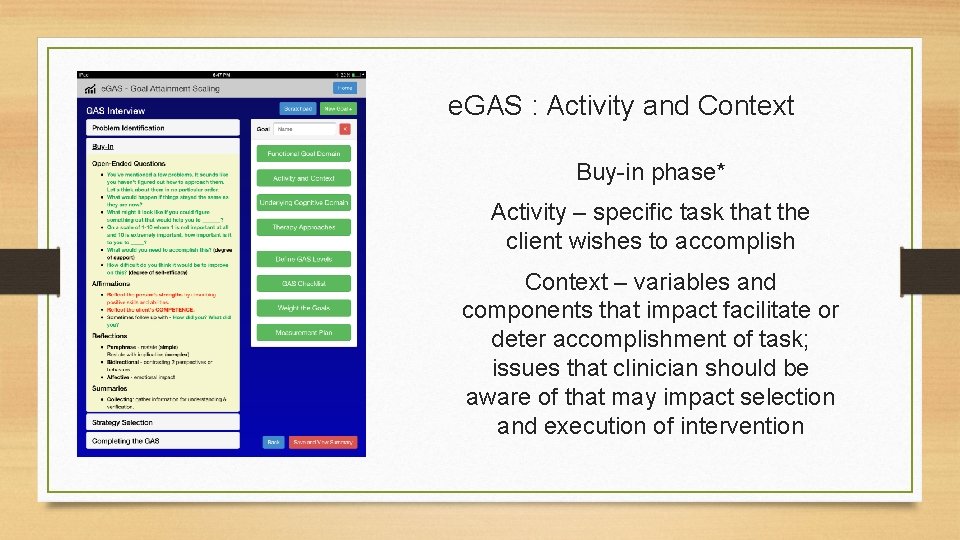
e. GAS : Activity and Context Buy-in phase* Activity – specific task that the client wishes to accomplish Context – variables and components that impact facilitate or deter accomplishment of task; issues that clinician should be aware of that may impact selection and execution of intervention
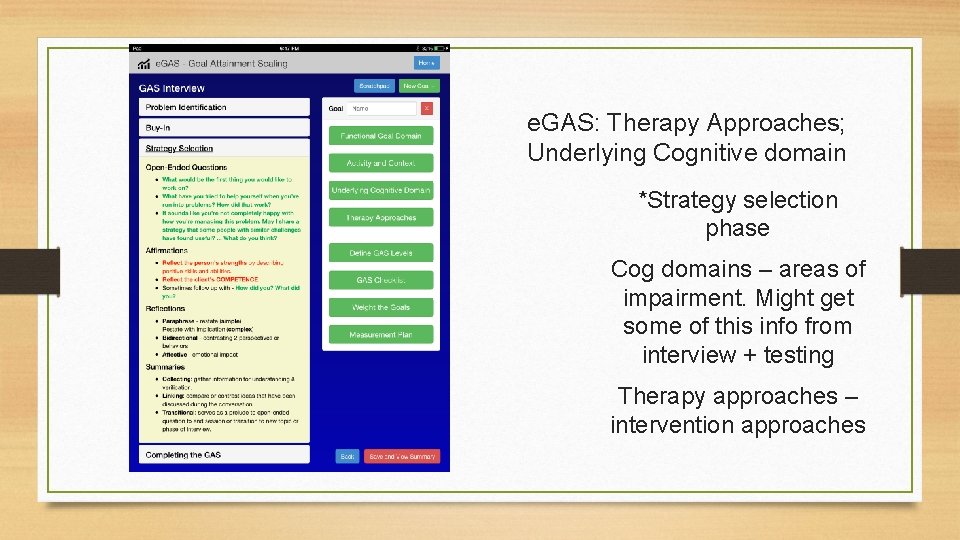
e. GAS: Therapy Approaches; Underlying Cognitive domain *Strategy selection phase Cog domains – areas of impairment. Might get some of this info from interview + testing Therapy approaches – intervention approaches
Initial interview • Your role • Before session - Be sure you are well acquainted with the green buttons on the right hand side of the screen. Make sure you’ve registered the client in Egas (will see shortly) • During the session - Be comfortable with the dropdown menus and recording information into the relevant categories • After the 2 nd session (when GAS has been generated) – integrate the information gathered into the eval templates
Sample Goal Attainment Scale • Let’s look at Jill’s scale! • Five levels ranging from -2 to +2 • Baseline is at -1
Key characteristics of a scale • Let’s look at the GAS checklist and evaluate whether Jill’s scale meets these criteria • Each level is Objective, Measurable, Quantifiable – I can observe and measure the behavior; • Roughly equidistant levels – Are units of measurement non-overlapping; are they progressing in a logical fashion • Discrete/Unidimensional – are you measuring singular aspects of a functional goal? Is there just one variable that you are measuring? • Meaningful – Did you use the MI techniques correctly • Functional domain directly related to the type of therapy approach and / or cognitive domain • Unit of measurement will also tie into the intervention approach
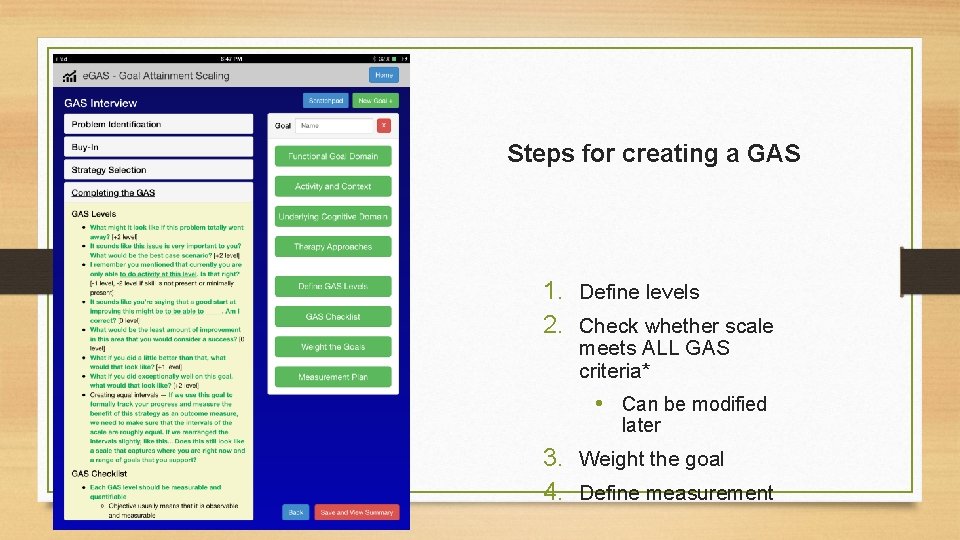
Steps for creating a GAS 1. Define levels 2. Check whether scale meets ALL GAS criteria* • Can be modified later 3. Weight the goal 4. Define measurement
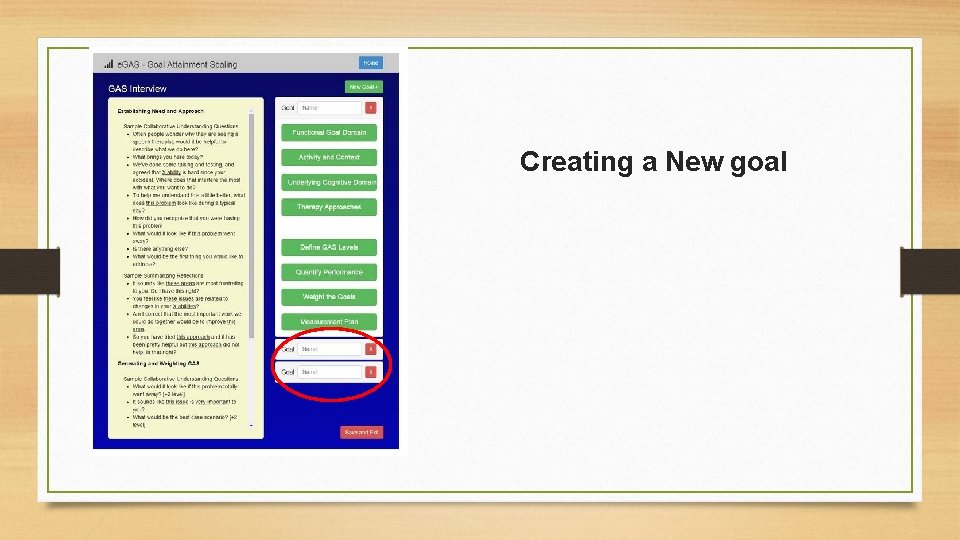
Creating a New goal
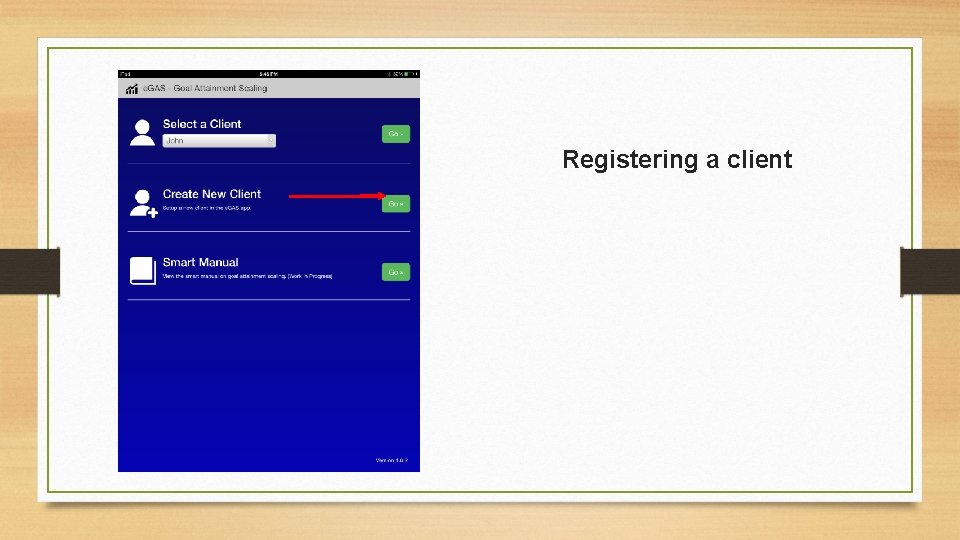
Registering a client
Your turn to create a new client! • BRTI • QUJA
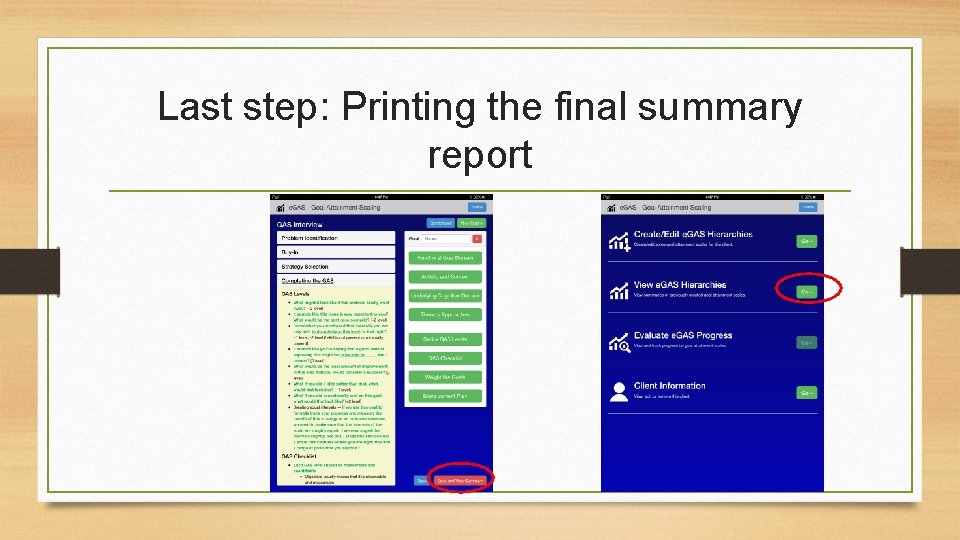
Last step: Printing the final summary report
Consult Process See handout titled Cognitive Rehabilitation Consultation Procedures located on: Info. CDS Treatment Areas Acquired Cognitive Disorders Cognitive Consultation Process See document titled ‘BRICC_Consultation Procedures’
Br. ICC: Intervention • Referrals : through BRICC assessments. Clients will be gradually added • Service delivery: • Group and individual • Group session: 3: 30 – 4: 00; Individual: 4: 00 – 5: 00* • First session: Only group session; no individual session • Interdiscliplinary collaboration • Collaborating with Counseling Couples & Family Therapy (CFT) to provide a holistic approach. Attend not just to the cognitive but also the emotional, psychological, and social aspects of recovery

Collaboration with CFT • Student Clinician – Hannah Tanakah • Attend to the psychosocial and emotional aspects of functioning that has been impacted by brain injury • Sit in on group sessions and interact with clients. She will also be present for the group supervision meetings. • Attend individual sessions per client needs / clinician requests • Students conducting assessment or intervention may report their observations to Hannah after discussing the case / client with their respective supervisors.
Intervention • Therapy approaches - restorative to compensatory • Direct attention training • Functional skills training • Metacognitive strategy instruction • External aid training • Personalized education • Environmental modifications/support
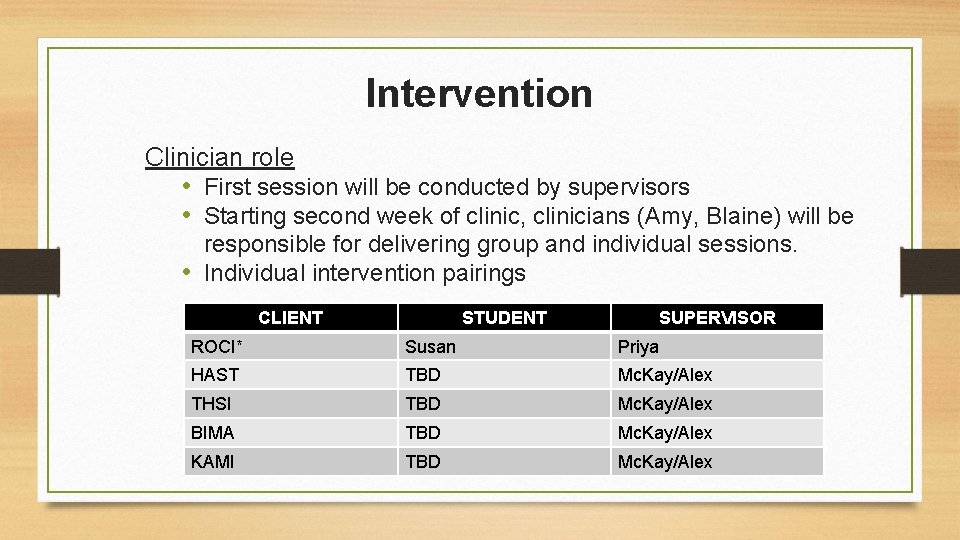
Intervention Clinician role • First session will be conducted by supervisors • Starting second week of clinic, clinicians (Amy, Blaine) will be responsible for delivering group and individual sessions. • Individual intervention pairings CLIENT STUDENT SUPERVISOR ROCI* Susan Priya HAST TBD Mc. Kay/Alex THSI TBD Mc. Kay/Alex BIMA TBD Mc. Kay/Alex KAMI TBD Mc. Kay/Alex
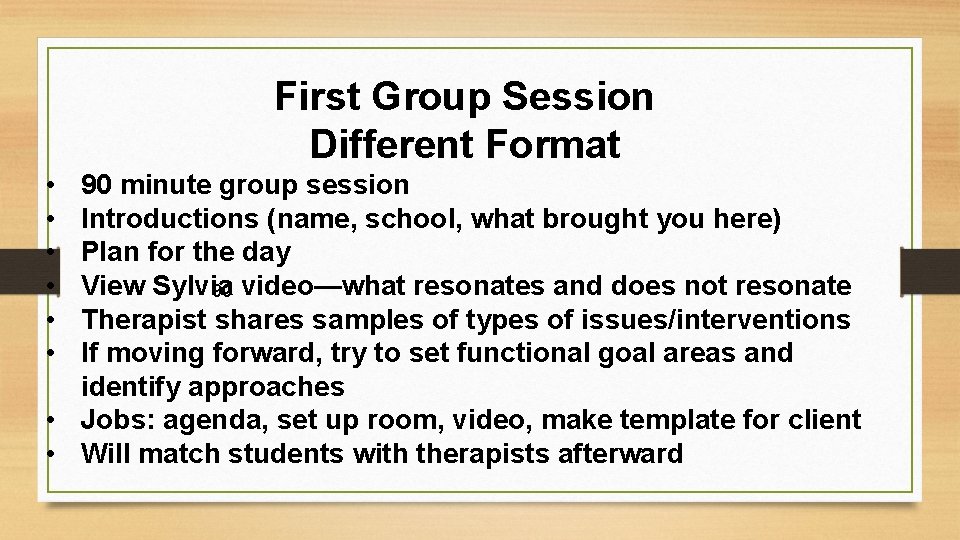
First Group Session Different Format • • • 90 minute group session Introductions (name, school, what brought you here) Plan for the day View Sylvia 90 video—what resonates and does not resonate Therapist shares samples of types of issues/interventions If moving forward, try to set functional goal areas and identify approaches • Jobs: agenda, set up room, video, make template for client • Will match students with therapists afterward
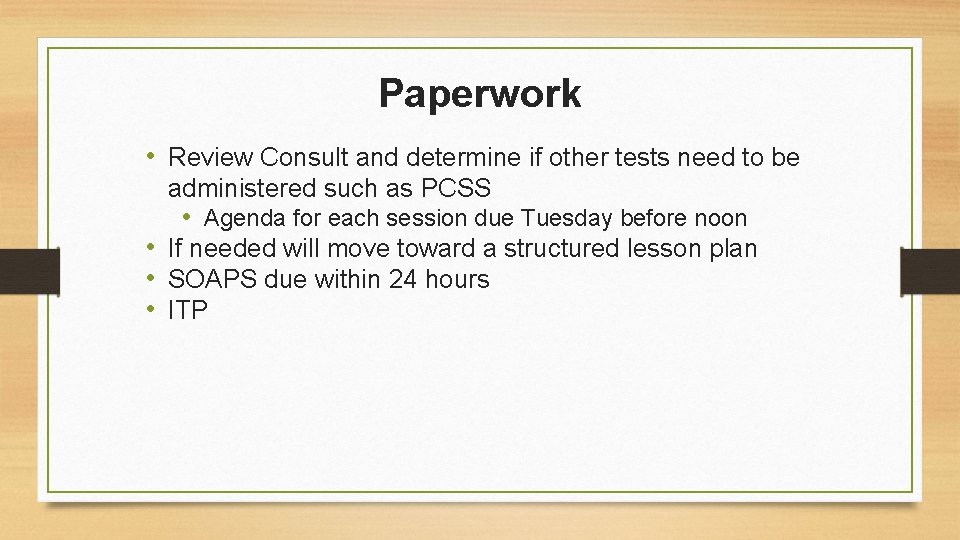
Paperwork • Review Consult and determine if other tests need to be administered such as PCSS • Agenda for each session due Tuesday before noon • If needed will move toward a structured lesson plan • SOAPS due within 24 hours • ITP
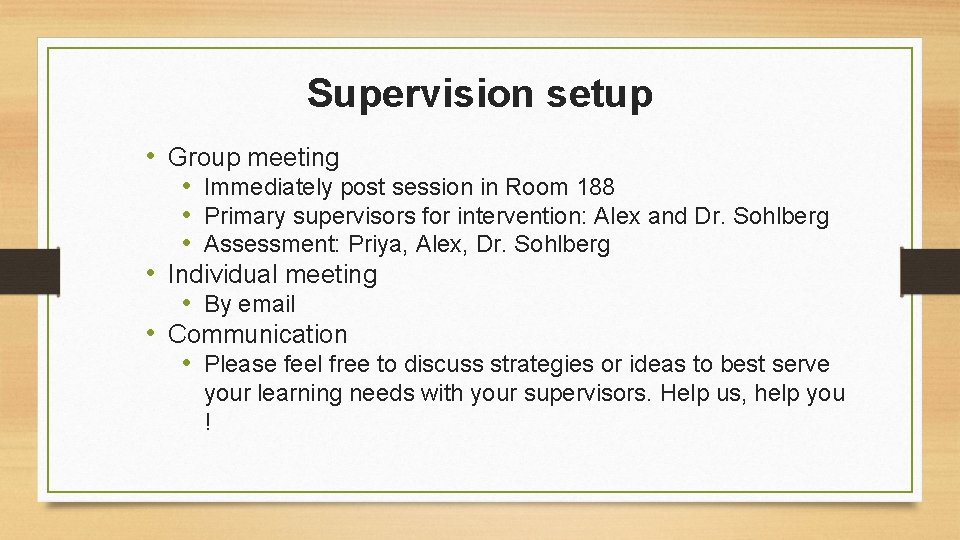
Supervision setup • Group meeting • Immediately post session in Room 188 • Primary supervisors for intervention: Alex and Dr. Sohlberg • Assessment: Priya, Alex, Dr. Sohlberg • Individual meeting • By email • Communication • Please feel free to discuss strategies or ideas to best serve your learning needs with your supervisors. Help us, help you !
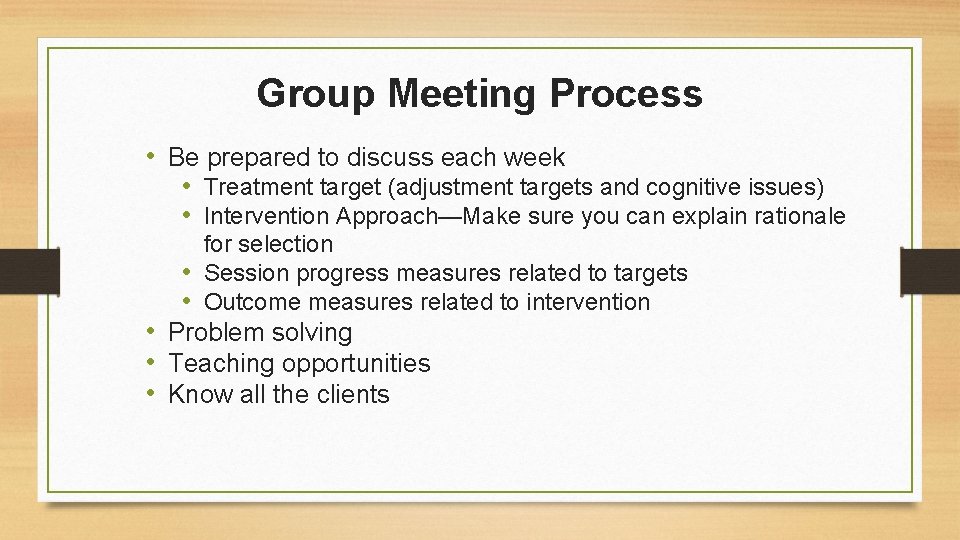
Group Meeting Process • Be prepared to discuss each week • Treatment target (adjustment targets and cognitive issues) • Intervention Approach—Make sure you can explain rationale for selection • Session progress measures related to targets • Outcome measures related to intervention • Problem solving • Teaching opportunities • Know all the clients
THANK YOU! QUESTIONS / COMMENTS / CONCERNS?
- Slides: 40