
Brain drain brain circulation balanced mobility June 27

Brain drain, brain circulation, balanced mobility June 27 th 2012 James Cemmell Education policy advisor jamespearl@hotmail. com

‘In this context, the loss of skilled labour is of vital importance for development and development potential. The loss of teachers undermines the ability of schools and education systems to function, the loss of nurses impairs efforts to deliver even basic healthcare and public health programmes and the loss of other skilled professionals acts as a barrier to institutional capacity building, the efficient utilisation of external assistance and private sector growth. The ‘Brain Drain’, as the flow of skilled professionals out of developing countries has become known, thus marks a potentially serious barrier to economic growth, development and poverty reduction. ’ The ‘Brain Drain’ Academic and Skilled Migration to the UK and its Impacts on Africa Report to the AUT and NATFHE April 2005
Summary 1. 2. 3. Migration policy to address highly skilled migration flows Response from the higher education community Post-Bucharest: developing policy and embedding sustainable practice

Definitions Brain Drain permanent or long-term international emigration of skilled people who have been the subject of considerable educational investment by their own societies. ◦ UK hiring of clinicians from S. E. Asia, S. Africa; PM Initiative, Lisbon Objective? ◦ Stimulated by highly skilled migration permits; balanced by Df. ID policy! Migration or Mobility of “highly skilled persons”, which does not imply a pre-conceived view (‘drain’) on the impact of the movement ◦ ‘Hire Lebanese’ website for hires in the MENA region. ◦ Brain waste vs remittance benefits Circulation return is a static concept while mobility and circulation are better able to capture dynamics of current migration: multilateral movements. ◦ Concept of transnational citizens ◦ Pull: active diaspora, attractiveness policy – Ireland has developed best practice; Poland EU circulation significant ◦ Push: give your citizens a positive experience; minimise all push factors under your control ILO: Policy responses to skilled migration: Retention, return and circulation Piyasiri Wickramasekara Gains form international migration: Promoting circular migration Piyasiri Wickramasekara
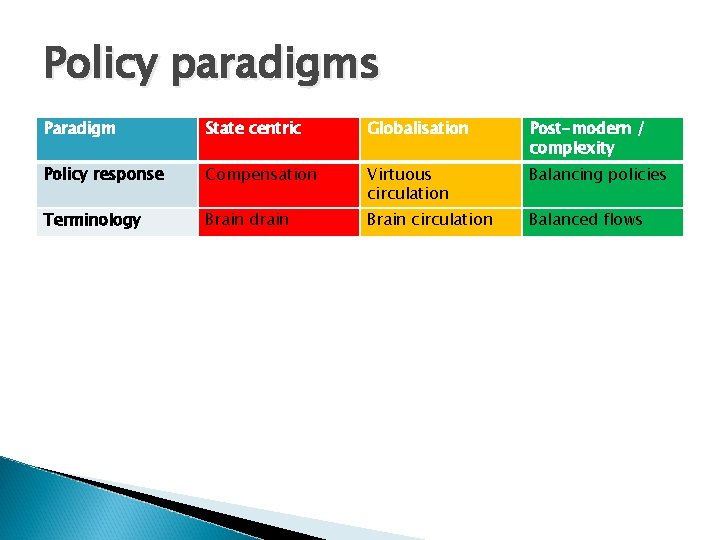
Policy paradigms Paradigm State centric Globalisation Post-modern / complexity Policy response Compensation Virtuous circulation Balancing policies Terminology Brain drain Brain circulation Balanced flows
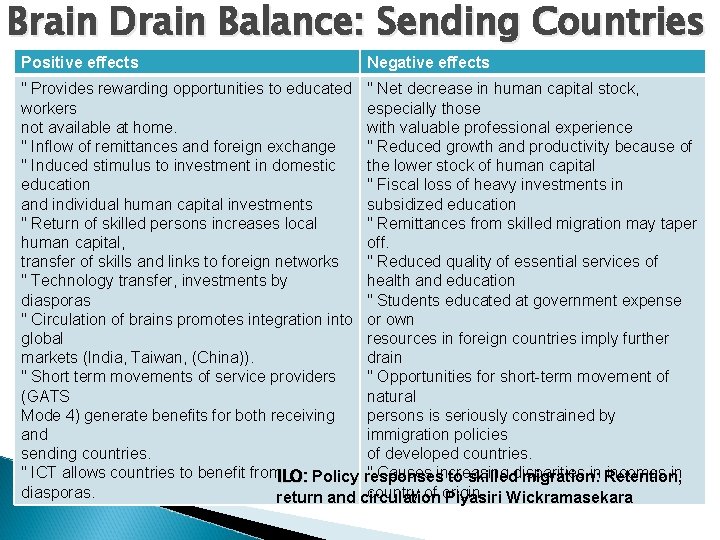
Brain Drain Balance: Sending Countries Positive effects Negative effects " Provides rewarding opportunities to educated " Net decrease in human capital stock, workers especially those not available at home. with valuable professional experience " Inflow of remittances and foreign exchange " Reduced growth and productivity because of " Induced stimulus to investment in domestic the lower stock of human capital education " Fiscal loss of heavy investments in and individual human capital investments subsidized education " Return of skilled persons increases local " Remittances from skilled migration may taper human capital, off. transfer of skills and links to foreign networks " Reduced quality of essential services of " Technology transfer, investments by health and education diasporas " Students educated at government expense " Circulation of brains promotes integration into or own global resources in foreign countries imply further markets (India, Taiwan, (China)). drain " Short term movements of service providers " Opportunities for short-term movement of (GATS natural Mode 4) generate benefits for both receiving persons is seriously constrained by and immigration policies sending countries. of developed countries. " ICT allows countries to benefit from. ILO: Policy responses " Causes increasing in Retention, incomes in to skilleddisparities migration: diasporas. country of origin. return and circulation Piyasiri Wickramasekara
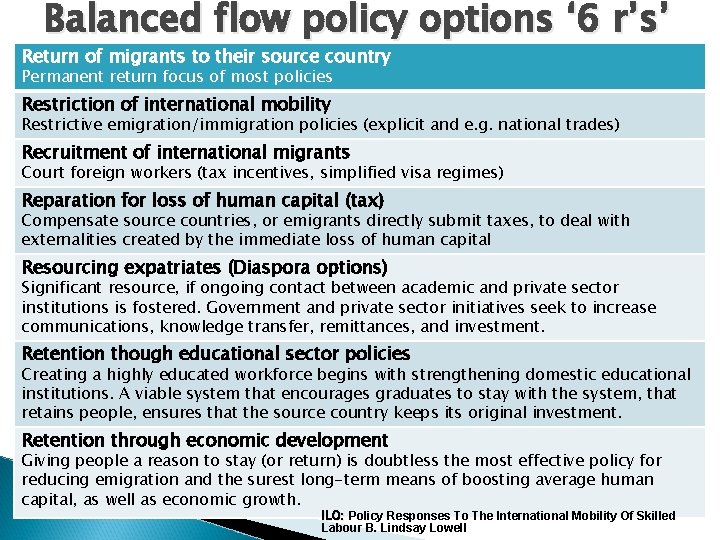
Balanced flow policy options ‘ 6 r’s’ Return of migrants to their source country Permanent return focus of most policies Restriction of international mobility Restrictive emigration/immigration policies (explicit and e. g. national trades) Recruitment of international migrants Court foreign workers (tax incentives, simplified visa regimes) Reparation for loss of human capital (tax) Compensate source countries, or emigrants directly submit taxes, to deal with externalities created by the immediate loss of human capital Resourcing expatriates (Diaspora options) Significant resource, if ongoing contact between academic and private sector institutions is fostered. Government and private sector initiatives seek to increase communications, knowledge transfer, remittances, and investment. Retention though educational sector policies Creating a highly educated workforce begins with strengthening domestic educational institutions. A viable system that encourages graduates to stay with the system, that retains people, ensures that the source country keeps its original investment. Retention through economic development Giving people a reason to stay (or return) is doubtless the most effective policy for reducing emigration and the surest long-term means of boosting average human capital, as well as economic growth. ILO: Policy Responses To The International Mobility Of Skilled Labour B. Lindsay Lowell
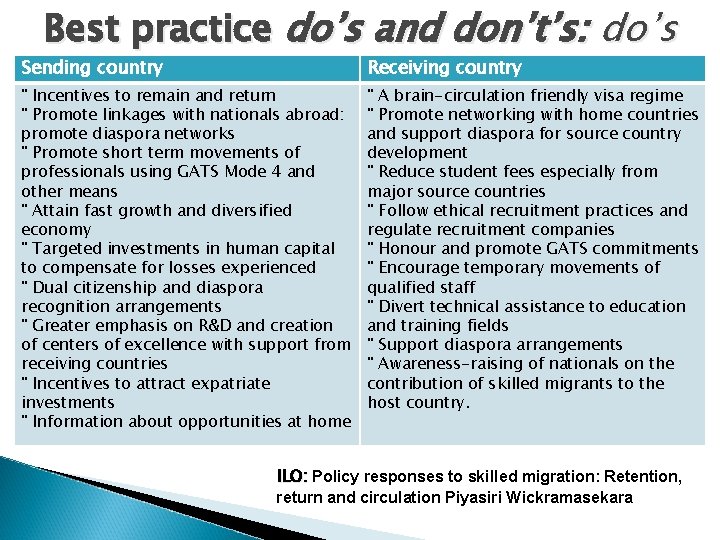
Best practice do’s and don’t’s: do’s Sending country Receiving country " Incentives to remain and return " Promote linkages with nationals abroad: promote diaspora networks " Promote short term movements of professionals using GATS Mode 4 and other means " Attain fast growth and diversified economy " Targeted investments in human capital to compensate for losses experienced " Dual citizenship and diaspora recognition arrangements " Greater emphasis on R&D and creation of centers of excellence with support from receiving countries " Incentives to attract expatriate investments " Information about opportunities at home " A brain-circulation friendly visa regime " Promote networking with home countries and support diaspora for source country development " Reduce student fees especially from major source countries " Follow ethical recruitment practices and regulate recruitment companies " Honour and promote GATS commitments " Encourage temporary movements of qualified staff " Divert technical assistance to education and training fields " Support diaspora arrangements " Awareness-raising of nationals on the contribution of skilled migrants to the host country. ILO: Policy responses to skilled migration: Retention, return and circulation Piyasiri Wickramasekara
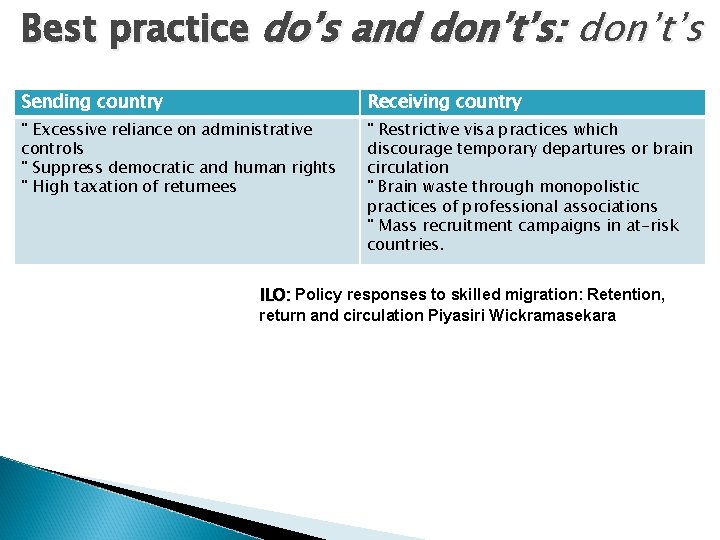
Best practice do’s and don’t’s: don’t’s Sending country Receiving country " Excessive reliance on administrative controls " Suppress democratic and human rights " High taxation of returnees " Restrictive visa practices which discourage temporary departures or brain circulation " Brain waste through monopolistic practices of professional associations " Mass recruitment campaigns in at-risk countries. ILO: Policy responses to skilled migration: Retention, return and circulation Piyasiri Wickramasekara
Brain drain within Bologna International strategy/ external dimension Leuven -> Bucharest Mobility strategy
![Looking outside – external dimension ‘ESIB [ESU] believes in the freedom of each student,](http://slidetodoc.com/presentation_image/0ca82024c750fe72d82f0a6d5e43c19c/image-11.jpg "Looking outside – external dimension ‘ESIB [ESU] believes in the freedom of each student,")
Looking outside – external dimension ‘ESIB [ESU] believes in the freedom of each student, researcher and member of teaching staff to choose their place of study, work and life, ’ but ‘Making Europe one of the most attractive higher education areas, countries have to act responsibly in relation to the problem of brain drain, both between Bologna signatory countries and outside. ’

External strategy: policy responses Address push factors: ‘Guaranteeing safe employment and working conditions for students, staff and researchers in the qualification phase can reduce the problem of brain drain and enhance the attractiveness of the EHEA. ‘ Promote employment: ‘This also means that Ph. D candidates should be employed by the universities, and enough full time jobs have to be provided for young researchers to make the academic workplace an attractive option for them. ’ Global links: ‘Promote research and innovation in third countries through appropriate links’ Support growth: ‘Financing for small high-potential companies right’ Promote brain circulation: “Brain circulation” should also be promoted for European students, teachers and researchers who have decided to spend part of their working life outside Europe ‘People undertaking a temporary assignment abroad are both an asset for the sending and/or hosting country as they constitute a reserve of professional contacts abroad, acting as bridgeheads for sharing knowledge. ’
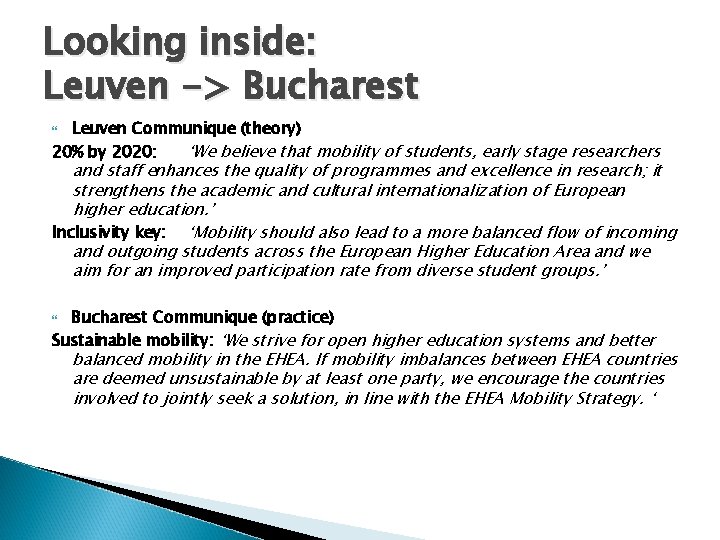
Looking inside: Leuven -> Bucharest Leuven Communique (theory) 20% by 2020: ‘We believe that mobility of students, early stage researchers and staff enhances the quality of programmes and excellence in research; it strengthens the academic and cultural internationalization of European higher education. ’ Inclusivity key: ‘Mobility should also lead to a more balanced flow of incoming and outgoing students across the European Higher Education Area and we aim for an improved participation rate from diverse student groups. ’ Bucharest Communique (practice) Sustainable mobility: ‘We strive for open higher education systems and better balanced mobility in the EHEA. If mobility imbalances between EHEA countries are deemed unsustainable by at least one party, we encourage the countries involved to jointly seek a solution, in line with the EHEA Mobility Strategy. ‘
EHEA mobility strategy Focus on the graduate ‘brain’: Our demand for more balanced mobility is directed particularly at degree mobility since it can have a sustained effect on the host and home countries, can facilitate capacity building and cooperation and may lead to brain gain on the one side and to brain drain on the other. Future monitoring – data gathering: In order to be able to better evaluate the development of degree mobility in the EHEA and react in good time to possible negative consequences for certain countries and regions, we intend in future to analyse the mobility flows systematically and regularly. Suggestion of compensatory route? If the findings show greater imbalances over longer periods of time, the governments concerned should jointly investigate the causes, consider carefully the advantages and disadvantages of the specific imbalance and seek solutions if deemed necessary. Dealing with the matter multilaterally might also be considered.
Student & faculty response to balanced migration Deliver attractive/responsive environment Environment characterised by realisation that national capture not always possible Internationalism at home – EHEA as a supranational Area Student as barometer? Faculty, Institutional, Student, Ministry roles? Opportunities moving towards Armenia 2015
Discussion Moving from an International to Area Wide higher education approach to advantage full opportunities of Bologna membership? Potential to deliver enhanced mobility under auspices of education cooperation? Identify sources of brain circulation opportunities? Identify key push factors, how to mitigate? Identify key pull factors, how to mitigate?
- Slides: 16