
Brain Computer Interfaces BCI What is a BCI
Brain Computer Interfaces (BCI)
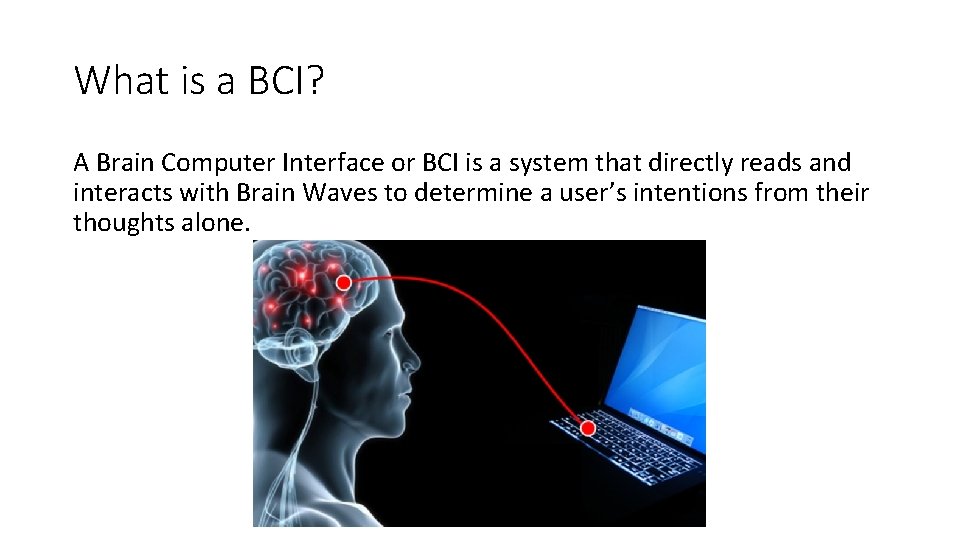
What is a BCI? A Brain Computer Interface or BCI is a system that directly reads and interacts with Brain Waves to determine a user’s intentions from their thoughts alone.
Development • During the 1970 s development of BCIs began at University of California with the intent of being used in prosthetics as treatment for disabled individuals. • Development at the time was hindered by the technology and how primitive it was in comparison to today • By 2006 the development had progressed to the point where a complete tetraplegic was able to operate a TV and prosthetic hand after receiving a microelectrode implant. • In 2011 it was demonstrated that BCIs could be used to navigate a computer and spell words out on the screen.
BCI Use • BCI is still largely an experimental technology but it has been used as intended mainly in the prosthetic field and medicine such as warning epileptic patients in advance as to seizures and rehabilitation. • Even at that BCI still isn’t too widely utilized and it is a developing technology that multiple fields are looking into integrating as it does develop. • BCI has recently also popped up as a potential way to have soldiers control drones from DARPA
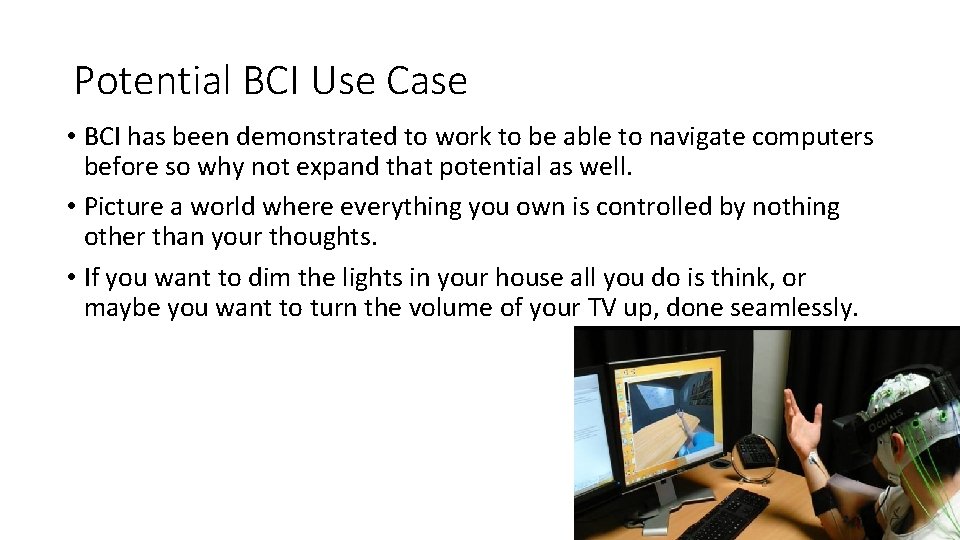
Potential BCI Use Case • BCI has been demonstrated to work to be able to navigate computers before so why not expand that potential as well. • Picture a world where everything you own is controlled by nothing other than your thoughts. • If you want to dim the lights in your house all you do is think, or maybe you want to turn the volume of your TV up, done seamlessly.
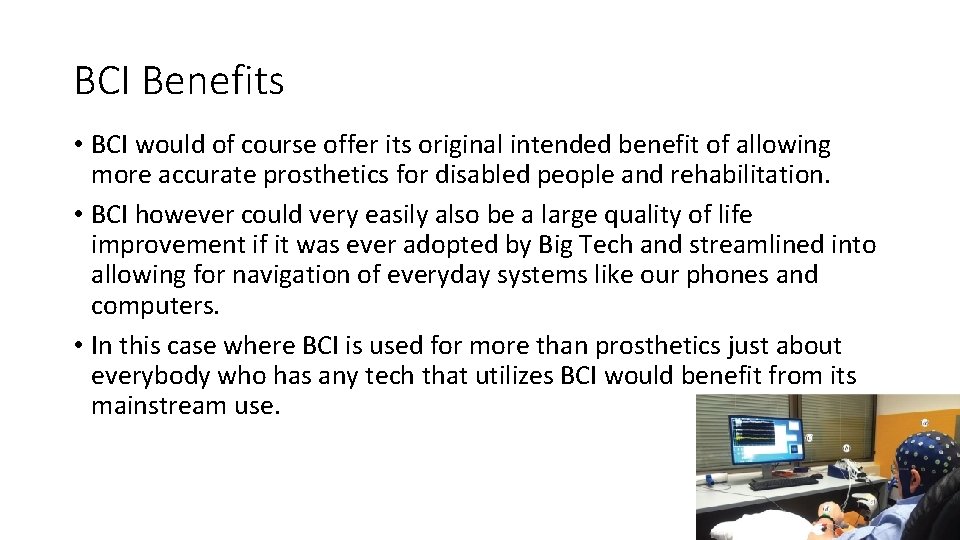
BCI Benefits • BCI would of course offer its original intended benefit of allowing more accurate prosthetics for disabled people and rehabilitation. • BCI however could very easily also be a large quality of life improvement if it was ever adopted by Big Tech and streamlined into allowing for navigation of everyday systems like our phones and computers. • In this case where BCI is used for more than prosthetics just about everybody who has any tech that utilizes BCI would benefit from its mainstream use.
Potential Issues of BCIs • BCI is still extremely experimental as of now and there is no telling as of currently as to how or if there even is any sort of long term impact on users of the tech. • There also are concerns about how to legally handle the technology in a world where consumer data is highly coveted by advertisers. A technology which literally detects what the user’s thoughts are would be a goldmine when it comes to data collection and especially so for advertising and marketing let alone privacy concerns. • Given the nature of the tech currently there also would definitely be a crowd against it. The majority of BCI either works through implants into the brain itself or a mess of wires and electrode arrays spread across the user’s head.
Sources Powers, Benjamin “Technology Melds Minds With Machines, and Raises Concerns”: undark. org 4/22/20 https: //undark. org/2020/04/22/brain-technology-interface/ Shih J Jerry, Krusienski J Dean, Wolpaw R Jonathan, “Brain-Computer Interfaces in Medicince”: Mayo Clinic Proceedings https: //www. ncbi. nlm. nih. gov/pmc/articles/PMC 3497935/ Pichiorri Floranna, Mattia Donatella “Brain-computer interfaces in neurologic rehabilitation practice” pubmed. gov https: //pubmed. ncbi. nlm. nih. gov/32164846/ Images: Pardeshi, Ganesh. “Brain Computer Interface (BCI) Market Scrutinized in New Research. ” Wha. Tech, 29 May 2019, www. whatech. com/market-research/consumer/598242 -brain-computer-interface-bci-marketcompetition-companies-analysis-2019. University of Adelaide. “Stroke Patient Improvement with a Brain-Computer Interface. ” Medical Xpress Medical Research Advances and Health News, Medical Xpress, 30 Aug. 2017, medicalxpress. com/news/2017 -08 -patient-brain-computer-interface. html. Wairagkar, Maitreyee, et al. “Movement Intention Based Brain Computer Interface for Virtual Reality and Soft Robotics Rehabilitation Using Novel Autocorrelation Analysis of EEG: Semantic Scholar. ” Semantic Scholar, 2016, www. semanticscholar. org/paper/Movement-intention-based-Brain-Computer-Interface-Wairagkar. Zoulias/046422 e 95 aee 75912 b 030 de 34 ec 2371803247 d 22
- Slides: 8