
BRAIN BEHAVIOUR LOCALIZATION IN THE BRAIN First what
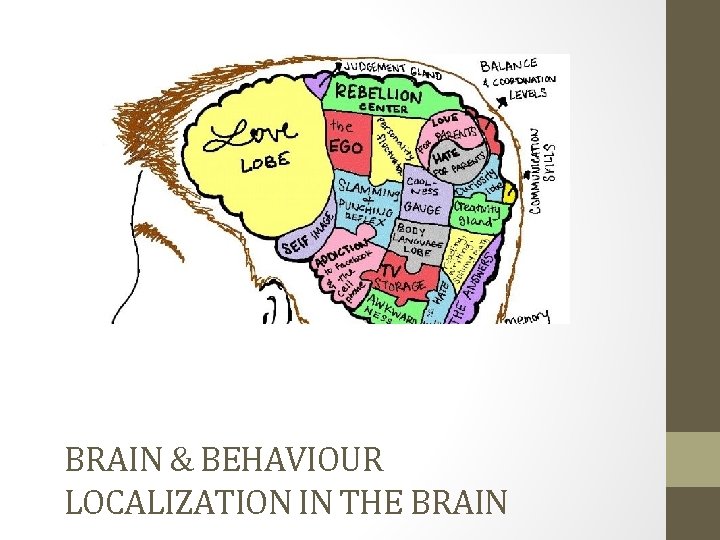
BRAIN & BEHAVIOUR LOCALIZATION IN THE BRAIN

First, what is ‘localization’? • Theory: different brain areas/structures are responsible for certain behaviours/emotions/cognitions • Remember a core principle to the Biopsychological approach is that behaviours/emotions/cognitions are rooted in aspects of physiology, precise brain areas being one of them. • There’s interesting history of how psychologists went about exploring localization, so we’ll look at some older research to get started…

Buddy warm up: • Design 2 potential SAQ questions for this topic • Design 2 potential LAQ questions for this topic

SAQs – thoughts?
LAQs – thoughts?
SAQs • Describe localization with reference to research. • Explain one study related to localization. LAQS • Evaluate localization of brain function as an explanation of behaviour. • Discuss research methods used in the investigation of brain and behaviour (you could select localization).

Why study ‘Localization’? • Crit A: Why might it matter to understand IF a certain behaviour/emotion/cognition is deeply implicated in a precise brain area? (Significance of investigation) • 5 mins What are some conditions/research methods that might allow for chance to study this? •
Early conditions/methodology localization: tech & pre tech • Autopsy study post death; cut skull – look at the brain; observe (qualitative); look for irregularities (lesion/damaged area; tumor; dead areas) • + explorative/visual – can compare w/‘normal’ dead brain • -- one point in time; non active – can’t see process; ‘dead’ – can’t see process or behavioural indicators– focus on result/outcome • Ethics: need consent (personal, or proxy ie: family provides consent) What else?

Methodology localization: tech & pre tech • Accidental damage something happens - (lesion, injury, infection) – some process impacts the brain and creates a new scenario compared with a ‘normal’ brain • + explorative/visual – can compare behavioural output w/‘normal’ live brain if sample somewhat close (age, lifestyle, gender); brain active and ‘working’ • -- no control over damage – can’t replicate; very narrow generalizability; no 2 brain damages are the same! • Ethics: consent to study; respect to individual during research – trials, order effects of research (fatigue, boredom etc)
Methodology localization: tech & pre tech • Intentional damage/surgery something happens that researcher induces- (introduces lesion, injury, infection) – some process impacts the brain and creates a new scenario compared with a ‘normal’ brain • + explorative/visual – can compare w/‘normal’ live brain if sample somewhat close (age, lifestyle, gender); brain active and ‘working’ • + researchers may have control over damage! Brain mapping potential • --Ethically compromised due to unknown outcome– last resort! When might this be considered? • Ethics: thorough consent/briefing/debriefing/monitoring, research overview

Methodology localization: tech & pre tech • Scan the brain technology supports looking at brain images (MRI, structure) and brain activity (process), and others • We’ll get more into this with brain scanning techniques
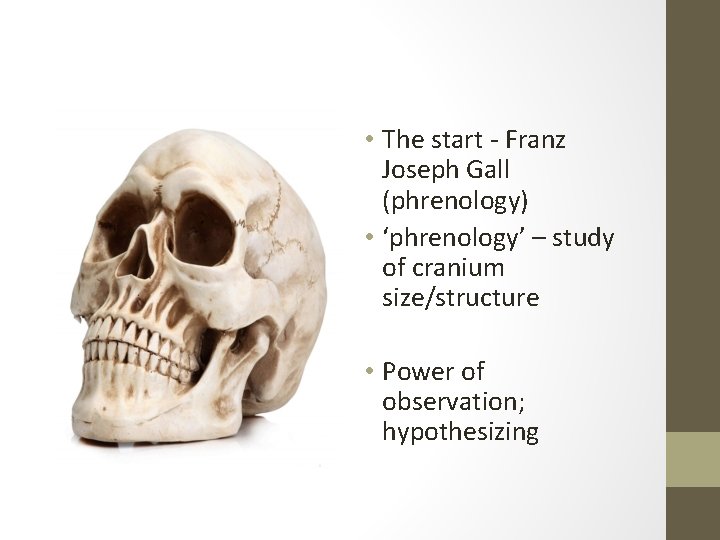
• The start - Franz Joseph Gall (phrenology) • ‘phrenology’ – study of cranium size/structure • Power of observation; hypothesizing

Localization – definition review • Tracing the origin of a behaviour, emotions, cognitive processes, to an exact location in the brain
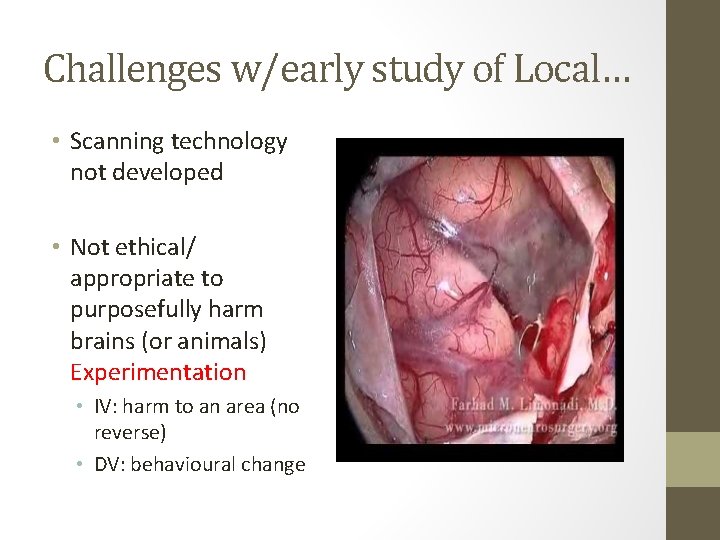
Challenges w/early study of Local… • Scanning technology not developed • Not ethical/ appropriate to purposefully harm brains (or animals) Experimentation • IV: harm to an area (no reverse) • DV: behavioural change

Early investigations based on… • Looking/observing • Listening/talking • Identifying patterns • Unique circumstances/ accidents taking place ----- • Qualitative methods, right?
Qualitative method: Case study • In depth, detailed examination of a person, group, organization or event. • Phineas Gage, ‘Tan’, ‘Genie’, ‘HM’ are all unique cases (intrinsically interesting…) • But, they could never be completely replicated
Method : Review ‘Case study’? • Examination of human/event experience • Research strategy to compile info about an occurrence, especially when something unique happens…. • Triangulating method: • Observe – overtly or covertly • Medical files/history • Interview family/friends/ bystanders • MRI/f. MRI/CT/PET results

Localization warm up tasks: 10 mins • Define localization together • Chat about general methodological challenges with investigating localization. • How would you approach an Intro? Write an intro SOLO: • LAQ: Evaluate localization as an explanation for human behaviour.
Intro practice: • LAQ: Evaluate localization as an explanation for human behaviour.

Intro practice: • Localization generally argues that behaviors, emotions and cognitions may be traceable to a precise brain areas. It is necessary to understand localization for appropriate brain mapping, particularly in brain surgery. Broca’s early work with ‘Tan’ showed elements of strict localization in that speech production could be precisely linked to the left front cortex in what is still known at ‘Broca’s Area’. However, in modern day, localization theory is simply not broad enough to explain how the brain compensates and adjusts to form new connections.

Early L of Fun. Case: Paul Broca/’Tan’ 1824 - 1880

Broca’s study: • Worked w/ stroke patients/ noticed speech impediments • Tried to find connections b/w speech problems brain injuries/damage • Tried to determine if specialization occurred in the brain, meaning areas of the brain responsible for certain tasks • Ie: occipital lobe vision

Broca’s study of “Tan” (case) • • • Tan could only say ‘Tan’ Tan lost ability to speak lesion in his temporal lobe The study of Tan’s brain autopsy Lesion caused by syphilis (infection) From this, Broca connected the lesion impaired functioning loss of speech

Broca’s Area G 2 C site; check out frontal lobe/Broca’s Area
Aphasia Broca’s Aphasia Wernicke’s Aphasia • Loss or impairment of language production • Language comprehension is decent • Speaking laboured/usually 4 words at a time • Vocab range diminished • “Non-fluent aphasia” • Production is decent/fluent • Comprehension is impaired • Understanding of words damaged • Speaking quite smooth • “Fluent aphasia”
Aphasia clips • Broca’s Aphasia • Wernicke’s Apashia

Broca’s Findings • Language production localized -- left frontal cortex (see pic) • ‘Broca’s area’ • Responsible for speech production, language processing, and language comprehension • Also controls facial neurons • Ideas of ‘strict localization’ – precise brain area (Broca’s Area) linked to precise behavior (speech production)

Critique (a practice we always wish to be in…): • Autopsy-based - no interactive testing could be done – dead brains are only so useful • No cause& effect from case study • Hard to specifically study brain while the patient awake w/o inflicting pain • Today, MRIs show functional activity of area
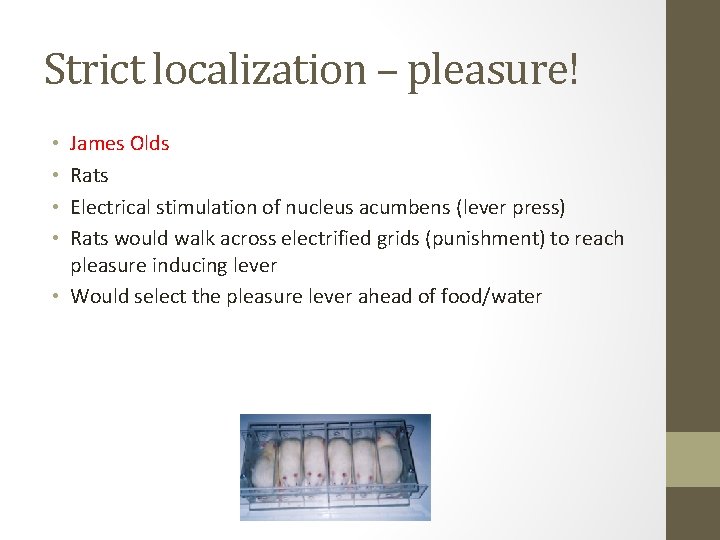
Strict localization – pleasure! James Olds Rats Electrical stimulation of nucleus acumbens (lever press) Rats would walk across electrified grids (punishment) to reach pleasure inducing lever • Would select the pleasure lever ahead of food/water • •

Background Study: Lashley, distribution of function (OUP p 51 -52) Sample: rats Method: induced brain damage/IV irreversible Aim: to test if memory was localized strictly in the brain Procedure: train rats to learn maze; cortex removal Why did he abandon hypothesis? He couldn’t find ‘one area’; amount of cortex removal mattered – not location • Key finding/Challenge to strict localization? Knowledge of memory as distributed, not localized. • What is ‘relative localization’? Some local’n for some functions (speed production) but acknowledged limits to theory • How does the case of HM show relative localization? • • •
Key Study: HM (case study; autopsy) William Scoville (surgeon); Brenda Milner, Suzanne Corkin • (Handout/article – please read) • Debilitating epilepsy; disruption - quality of life • Surgery, 1953; partial removal of both hippocampal areas (5 cms of tissue); some temporal lobe tissue • Finding: Post surgery retrograde/anterograde amnesia (30 sec memory); lived in working memory; hippocampal areas critical for memory conversion (localized function) • Could not convert episodic, semantic memories; STM LTM; could form procedural mem’s (MSM model support) • Ongoing research w/HM (interviews, brain scans/MRI, memory activities) • Death of HM 2008; final brain scan & brain dissection (over 2400 slices preserved)


Case of HM Value Limitations • Unique brain case – learning opportunity for psychologists (heuristic) • Longitudinal: data gathered over long period of time; comparative • Vast quali/quanti data; brain preserved over time • Testing yielded support for distinct memory stores (MSM) • Unique case – replication impossible (but not expected) • Lack of generalizability • Cause & effect not inferred about precise role of hipp or surrounding brain areas

Key Study: Maguire et al (2000) • Read (p 61 OUP text) Quick clip • • Aim, procedure, findings Sample characteristics Why MRI? Who was excluded? Why? Define anterior/posterior Summarize the ‘shift’ that happened in the hippocampus Explain bi-directional ambiguity (p 61 top)
Key Study: Maguire et al (2000) • Aim: investigate if hipp size differs based on spatial/nav exp • Procedure: ethical procedures/overviews; establish exclusion criteria; assess sample control/taxi drivers; conduct/analyze MRI scans • Sample characteristics: male, 32 -62 yrs; in good health; taxi experience; licensed; range of driving taxi 1. 5 -42 yrs! • Brain scanning technique (MRI)? Focus on hipp structure; size differential • Exclusion criteria? Below 32/over 62 yrs; females; left handed; health issues- control confounding variables • Which variable is not fully controlled for? Impact?
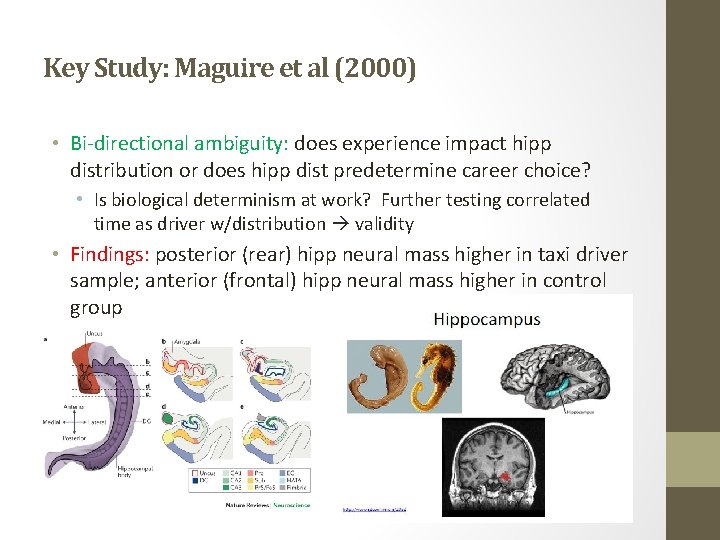
Key Study: Maguire et al (2000) • Bi-directional ambiguity: does experience impact hipp distribution or does hipp dist predetermine career choice? • Is biological determinism at work? Further testing correlated time as driver w/distribution validity • Findings: posterior (rear) hipp neural mass higher in taxi driver sample; anterior (frontal) hipp neural mass higher in control group
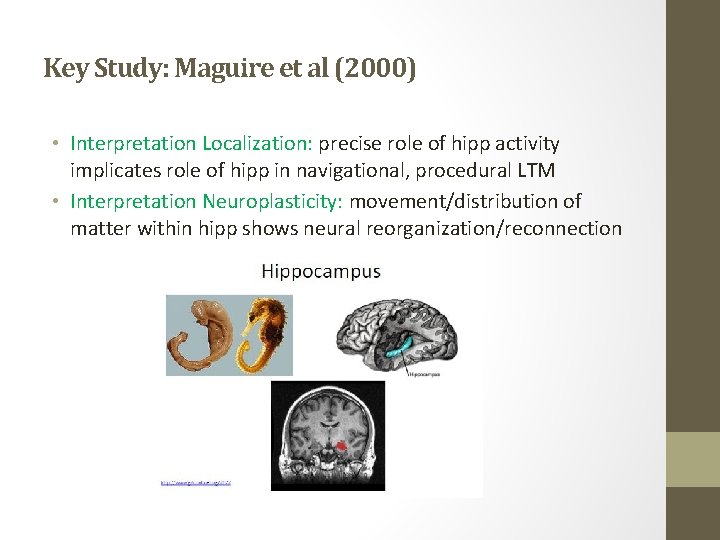
Key Study: Maguire et al (2000) • Interpretation Localization: precise role of hipp activity implicates role of hipp in navigational, procedural LTM • Interpretation Neuroplasticity: movement/distribution of matter within hipp shows neural reorganization/reconnection
At home: Read Neuroplasticity: 56 -63 Notes & CT Merzenich & Draganski et al (2006); exam study
References • • • http: //z. about. com/f/wiki/e/en/0/03/Brocas. Area. Small. png http: //www. sci. uidaho. edu/med 532/Broca. htm http: //www. wisegeek. com/what-is-brocas-area. htm http: //www. youtube. com/watch? v=Fw 6 d 54 gjuv. A&feature=related http: //www. youtube. com/watch? v=12 d. O 78 c 6 -q 8 http: //www. aphasia. org/Aphasia%20 Facts/aphasia_facts. html http: //www. whonamedit. com/doctor. cfm/1982. html http: //en. wikipedia. org/wiki/Paul_Broca http: //findarticles. com/p/articles/mi_g 2699/is_0004/ai_2699000404/? tag=content; col 1
- Slides: 41