
Brain activation in response to urinary bladder filling
Brain activation in response to urinary bladder filling in spinal cord injured patients: a f. MRI study Jaroslav Tintěra 1, Jan Krhut 2, Petr Holý 3, Karolína Bílková 4, Roman Zachoval 3 Institute for Clinical and Experimental Medicine Prague, Czech Republic 2 Department of Urology, University Hospital Ostrava, Czech Republic 3 Department of Urology, Thomayer’s Hospital, Prague, Czech Republic 4 Spinal Cord Rehabilitation Unit, Rehabilitation Center Kladruby, CR 1
Aim of the study • Our understanding of the neuroregulation of the urinary bladder is still incomplete • It has been recognized that many of diseases associated with lower urinary tract and altered bladder emptying could have their origin in the dysfunction at the level of CNS • Little is known about the extraspinal afferent pathways in human • The aim of the study was to evaluate the extraspinal sensory pathways in spinal cord injured patients using f. MRI
Methods: group of patients • Subjects: 12 right-handed men (age 24– 54 years) were enrolled. All patients experienced complete spinal cord injury (ASIA A) at level C 7 -Th 5 on average 15 months before entering the study. • General conditions • informed consent • all examinations in antibiotic profylaction (ofloxacin 2 x 200 mg) • bladder and abdominal pressure monitoring • f. MRI protocol • filling and withdrawing of the bladder with simoultaneous f. MRI and urodynamics measurement

Methods: urinary tract interventions • Filling and withdrawing of the bladder: • application of a double-lumen, soft 8 Fr bladder catheter • intravesical pressure monitored during repeated filling • intraabdominal pressure measured in the rectal ampula • pressure and filling monitored using urodynamical system MMS • Filling dynamics • filling rate 25 ml/min up to a) 50 ml and b) 100 ml • at level a) and b): cyclic filling and withdrawing of 25 ml • then the bladder was filled until uninhibited detrusor contraction has been occurred • this procedure repeated 3 x

Methods: urinary tract interventions Cyclic bladder filling and withdrawing scheme
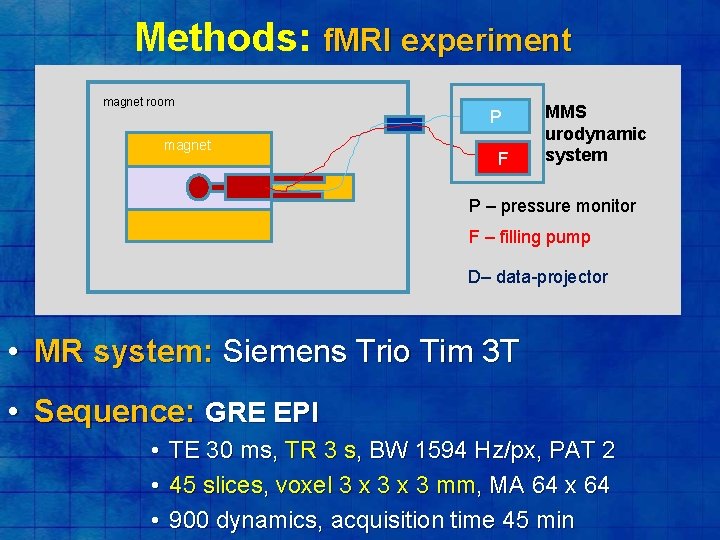
Methods: f. MRI experiment magnet room magnet P F MMS urodynamic system P – pressure monitor F – filling pump D– data-projector • MR system: Siemens Trio Tim 3 T • Sequence: GRE EPI • • • TE 30 ms, TR 3 s, BW 1594 Hz/px, PAT 2 45 slices, voxel 3 x 3 mm, MA 64 x 64 900 dynamics, acquisition time 45 min
Methods: evaluation • Software: SPM 8 • Pre-process (SPM): • • realignment slice timing smoothing: 6 x 6 mm normalization • Statistics: All blocks with bladder manipulation including the episode of detrusor contraction were defined as one condition Individual and group statistics: t-test, p=0. 001 uncorrected
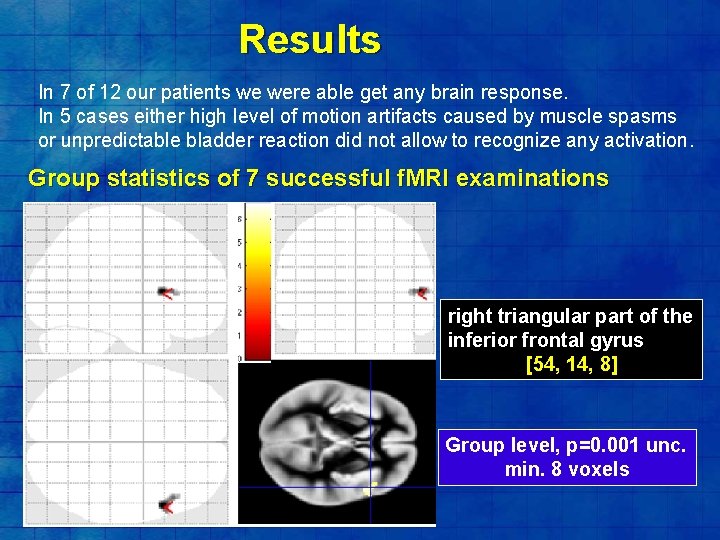
Results In 7 of 12 our patients we were able get any brain response. In 5 cases either high level of motion artifacts caused by muscle spasms or unpredictable bladder reaction did not allow to recognize any activation. Group statistics of 7 successful f. MRI examinations right triangular part of the inferior frontal gyrus [54, 14, 8] Group level, p=0. 001 unc. min. 8 voxels
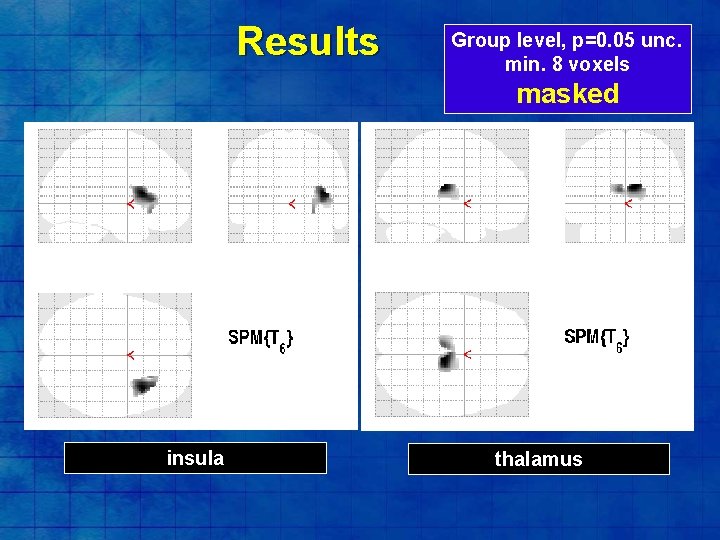
Results Group level, p=0. 05 unc. min. 8 voxels masked insula thalamus
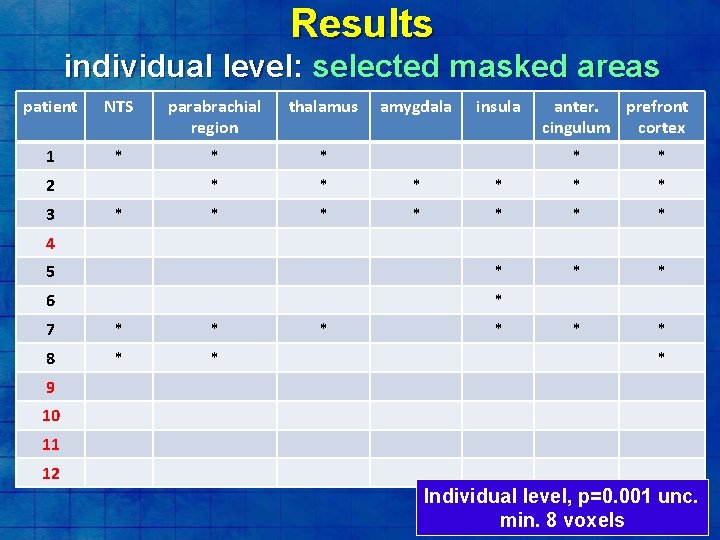
Results individual level: selected masked areas patient NTS parabrachial region thalamus amygdala 1 * * * * * insula anter. prefront cingulum cortex * * * * 5 * * * 6 * * * 2 3 * 4 7 * * 8 * * * 9 10 11 12 Individual level, p=0. 001 unc. min. 8 voxels
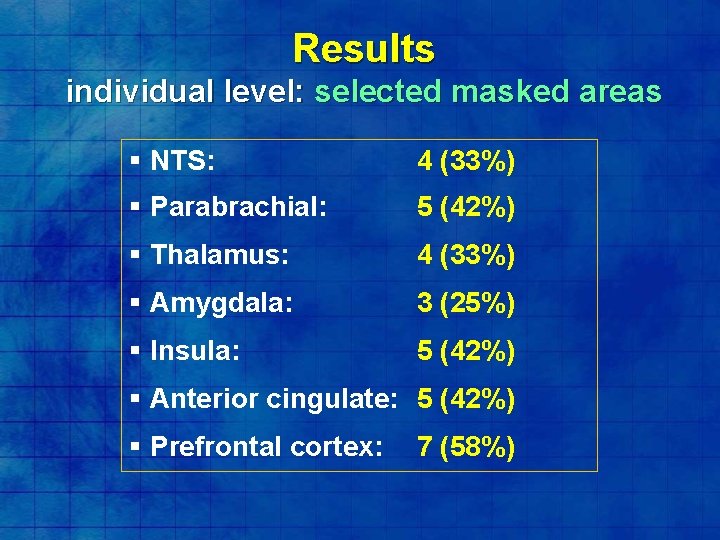
Results individual level: selected masked areas § NTS: 4 (33%) § Parabrachial: 5 (42%) § Thalamus: 4 (33%) § Amygdala: 3 (25%) § Insula: 5 (42%) § Anterior cingulate: 5 (42%) § Prefrontal cortex: 7 (58%)
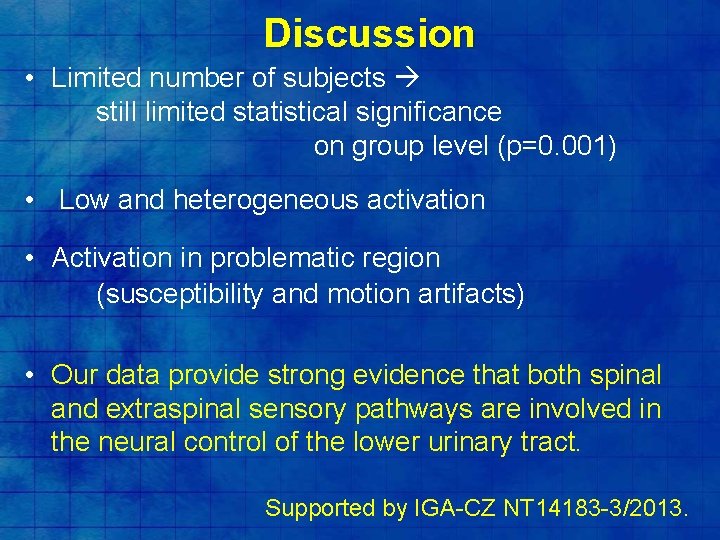
Discussion • Limited number of subjects still limited statistical significance on group level (p=0. 001) • Low and heterogeneous activation • Activation in problematic region (susceptibility and motion artifacts) • Our data provide strong evidence that both spinal and extraspinal sensory pathways are involved in the neural control of the lower urinary tract. Supported by IGA-CZ NT 14183 -3/2013.
- Slides: 12