
BPSEC Updates Edward Birrane Edward Birranejhuapl edu 443
BPSEC Updates Edward Birrane Edward. Birrane@jhuapl. edu 443 -778 -7423
Overview § § § Summary Updates Outstanding Comments Interoperability Cipher Suites Next Steps
Summary (1/3) § Motivation for this document q q In-bundle security mechanism is needed in some cases • • Different blocks may have different security needs Different nodes may impose different security policy If you do not want in-bundle security, you can secure BP by having • • Users protect their data at the application layer (e. g. secure payload) Users select secure convergence layers (if they exist) § Design decisions q q q Different blocks in a bundle can have different security Processing order must be unambiguous at a receiver New cipher suites must be able to be added at future dates
Summary (2/3) § Block Format q Two new extensions blocks defined • • • q q Both capture list of targets they act upon, key information, cipher suite configuration, and result information. Integrity (BIB) – Holds signature Confidentiality (BCB) – Indicates target(s) have had their block data replaced with crypto-text A security block can target 1 or more other blocks • Multiple targets prevents redundant info in the bundle. Mechanism provided to add new security blocks in other documents if necessary. § Block Processing Rules to Enforce Determinism q q q If a BCB target is encrypted, a BIB on that target is also encrypted. A BIB cannot target a BCB or a block protected by a BCB. • There exist BCB cipher suites that also generate integrity signatures At a receiver, BCBs must be processed before BIBs.
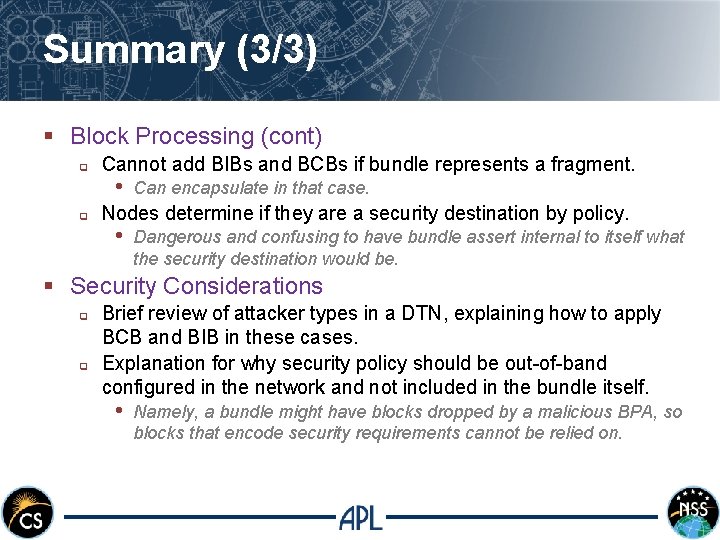
Summary (3/3) § Block Processing (cont) q q Cannot add BIBs and BCBs if bundle represents a fragment. • Can encapsulate in that case. Nodes determine if they are a security destination by policy. • Dangerous and confusing to have bundle assert internal to itself what the security destination would be. § Security Considerations q q Brief review of attacker types in a DTN, explaining how to apply BCB and BIB in these cases. Explanation for why security policy should be out-of-band configured in the network and not included in the bundle itself. • Namely, a bundle might have blocks dropped by a malicious BPA, so blocks that encode security requirements cannot be relied on.
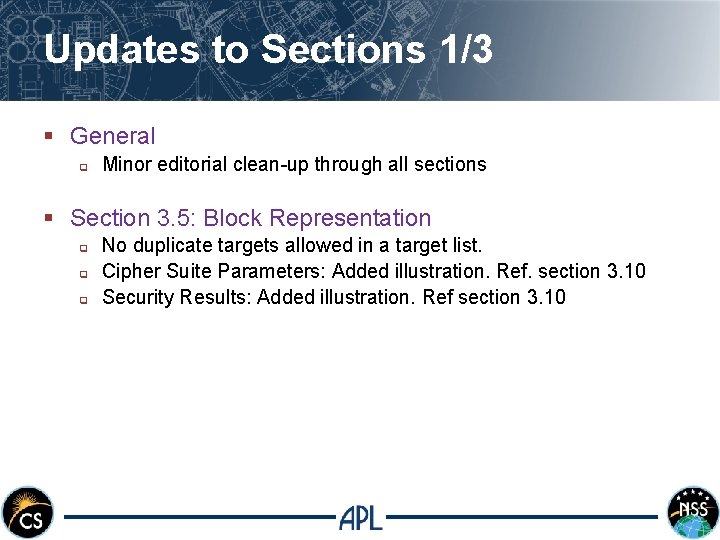
Updates to Sections 1/3 § General q Minor editorial clean-up through all sections § Section 3. 5: Block Representation q q q No duplicate targets allowed in a target list. Cipher Suite Parameters: Added illustration. Ref. section 3. 10 Security Results: Added illustration. Ref section 3. 10
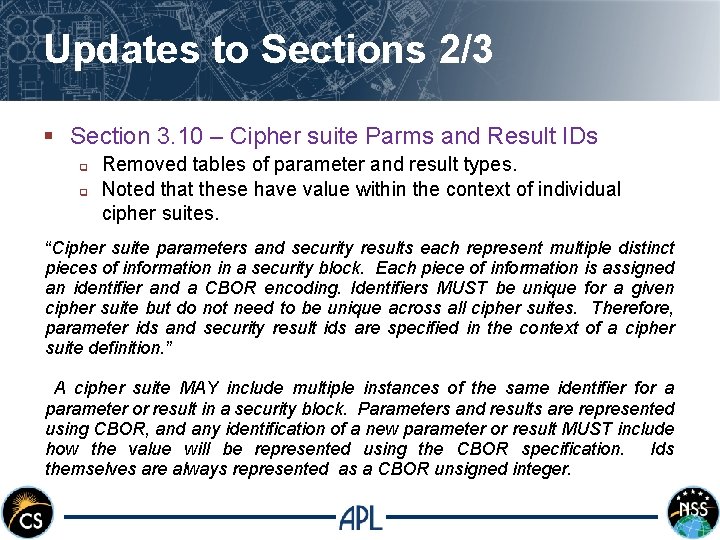
Updates to Sections 2/3 § Section 3. 10 – Cipher suite Parms and Result IDs q q Removed tables of parameter and result types. Noted that these have value within the context of individual cipher suites. “Cipher suite parameters and security results each represent multiple distinct pieces of information in a security block. Each piece of information is assigned an identifier and a CBOR encoding. Identifiers MUST be unique for a given cipher suite but do not need to be unique across all cipher suites. Therefore, parameter ids and security result ids are specified in the context of a cipher suite definition. ” A cipher suite MAY include multiple instances of the same identifier for a parameter or result in a security block. Parameters and results are represented using CBOR, and any identification of a new parameter or result MUST include how the value will be represented using the CBOR specification. Ids themselves are always represented as a CBOR unsigned integer.
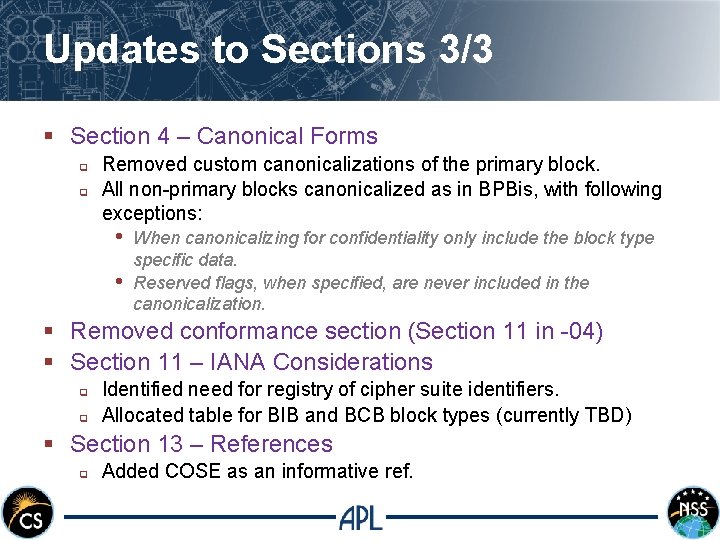
Updates to Sections 3/3 § Section 4 – Canonical Forms q q Removed custom canonicalizations of the primary block. All non-primary blocks canonicalized as in BPBis, with following exceptions: • • When canonicalizing for confidentiality only include the block type specific data. Reserved flags, when specified, are never included in the canonicalization. § Removed conformance section (Section 11 in -04) § Section 11 – IANA Considerations q q Identified need for registry of cipher suite identifiers. Allocated table for BIB and BCB block types (currently TBD) § Section 13 – References q Added COSE as an informative ref.
Current Comments § Some comments received after publish of -05. § Request that comments go to the mailing list. § Summary: q Allow cipher suites to specify how cipher suite parameters and results are stored within the security block, instead of specifying it in section 3. 10. • q q Essentially make that part of the security block “opaque” and determined by the cipher suite seelcted. Five cases where MUST is being over-used. Section 8. 2. 2 makes assertions about the security of sign+encrypt which are too strong • • (e. g. that an attacker cannot successfully modify a bundle if they cannot decrypt the bundle). Instead, in this situation require a IND-CCA 2 encryption scheme.
Interoperability Cipher Suites § Published draft of BPSec interoperability cipher suites § Integrity q BIB-HMAC 256 -SHA 256 • The integrity cipher suite provides a signed hash over the security target based on the use of the SHA-256 message digest algorithm [RFC 4634] combined with HMAC [RFC 2104] with a 256 bit truncation length. This formulation is based on the HMAC 256/256 algorithm defined in [COSE] Table 7: HMAC Algorithm Values. § Confidentiality q BCB-AES-GCM-128 • The confidentiality cipher suite provides cipher text to replace the data contents of the target block using the AES cipher operating in GCM mode [AES-GCM]. This formulation is based on the A 128 GCM algorithm defined in [COSE] Table 9: Algorithm Value for AES-GCM.
Next Steps § BPSEC q No significant problems with BPSec have been identified. • • q Section -04 to -05 addressed minor updates resulting in not overspecifying in the draft. Largest remaining issue appears to be whether BPSec requires formatting of cipher suite specified configuration parameters and results. Can we resolve this minor issues in the context of last call? § Interoperability Cipher Suites q q Need a short period of review and updates. Likely ready for a last call at next IETF.
Thank you! Questions? 12
- Slides: 12