
BPPV AND VESTIBULAR REHAB THERAPY Christopher Lambaren PT
BPPV AND VESTIBULAR REHAB THERAPY Christopher Lambaren, PT, DPT
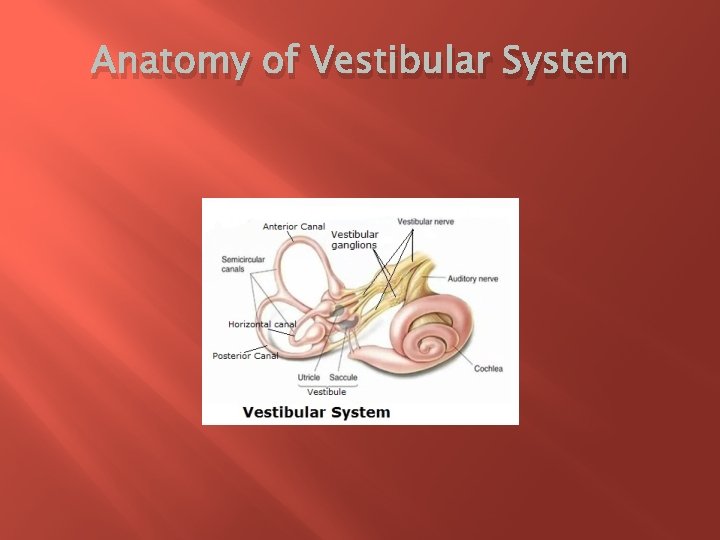
Anatomy of Vestibular System
BPPV: signs and symptoms � � Vertigo, nystagmus, nausea, and vomiting Duration generally less than 30 -40 seconds Typically described as being brought on by very specific head movements (looking up, rolling over in bed, etc) Can also cause dizziness, lightheadedness, and general imbalance
Vestibular Weakness: signs and symptoms � � � Acute onset of prolonged vertigo, spontaneous nystagmus, imbalance with tendency to fall towards affected side, and nausea/vomiting Hearing loss might be involved Usually lasts 48 -72 hrs then left with impaired balance and possible oscillopsia
BPPV: exam/special tests Dix-Hallpike test: � Patient begins in long sitting � Rotate head 45 degrees towards side being tested � Quickly bring them back onto table with head off edge of table (~20 degrees of ext) still rotated � Positive if nystagmus is upbeating and torsional towards downward ear

BPPV: exam/special tests Supine roll test � Supine, head flexed 20 degrees � Head turned to one side quickly and observed for nystagmus � Head slowly returned to neutral position. � Repeat to other side � Positive if horizontal nystagmus beating downward towards affected ear
Vestibular Weakness: exam/special tests � � Caloric testing (VNG) VOR testing Balance assessment, Fukuda Step test HINTS exam (hrs/days of vertigo and spontaneous nystagmus) � Head Impulse (abnormal is good) � Nystagmus (unidirectional-good, bidirectional-not) � Test for Skew (no vertical skew)
BPPV: interventions Epley manuever � Same start position as Dix Hallpike test � Head turned towards affected ear � Lie pt. back quickly with head into extension off table (20 degrees) keeping head rotated � Rotate head slowly to opposite side � Roll onto side opposite affected ear keeping head rotated � Sit up from sidelying with head rotated and chin tucked into shoulder
BPPV: interventions Log roll maneuver � Begin with pt. supine with head turned so affected ear is down � Slowly turn head to neutral (hold 15 -30 sec) � Slowly continue rolling head until affected ear is up (hold 15 -30 sec) � Continuing rolling head and body until their face is down (hold 15 -30 sec) � Continuing rolling same direction until back to starting position
Vestibular Weakness: interventions � � Initially vestibular suppressants and bed rest After initial onset then: � Compensation (brain) � Habituation (dizziness from movement or visual stimuli) � Adaptation (change activity/lifestyle)

Resources � � � www. dizziness-and-balance. com http: //american-hearing. org http: //vertigotreatment. org http: //bppv-treatment. com http: //vestibular. org
- Slides: 11