
BPMN Simulation with BIMP 4 Levels Supported Level
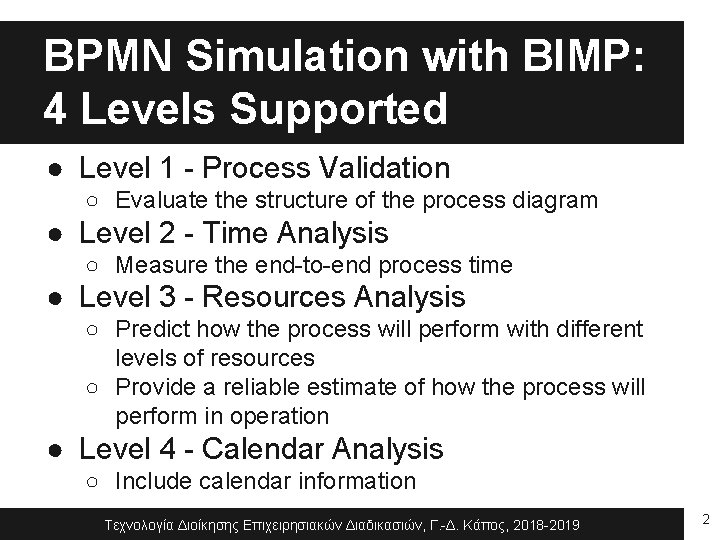
BPMN Simulation with BIMP: 4 Levels Supported ● Level 1 - Process Validation ○ Evaluate the structure of the process diagram ● Level 2 - Time Analysis ○ Measure the end-to-end process time ● Level 3 - Resources Analysis ○ Predict how the process will perform with different levels of resources ○ Provide a reliable estimate of how the process will perform in operation ● Level 4 - Calendar Analysis ○ Include calendar information Τεχνολογία Διοίκησης Επιχειρησιακών Διαδικασιών, Γ. -Δ. Κάπος, 2018 -2019 2
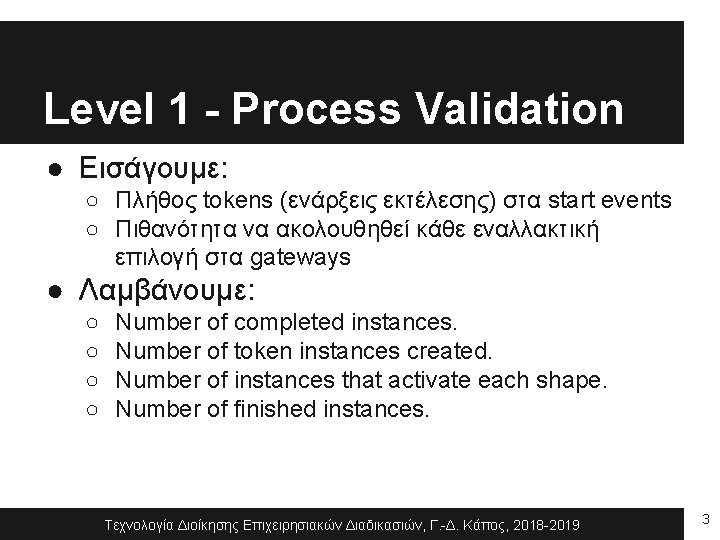
Level 1 - Process Validation ● Εισάγουμε: ○ Πλήθος tokens (ενάρξεις εκτέλεσης) στα start events ○ Πιθανότητα να ακολουθηθεί κάθε εναλλακτική επιλογή στα gateways ● Λαμβάνουμε: ○ ○ Number of completed instances. Number of token instances created. Number of instances that activate each shape. Number of finished instances. Τεχνολογία Διοίκησης Επιχειρησιακών Διαδικασιών, Γ. -Δ. Κάπος, 2018 -2019 3
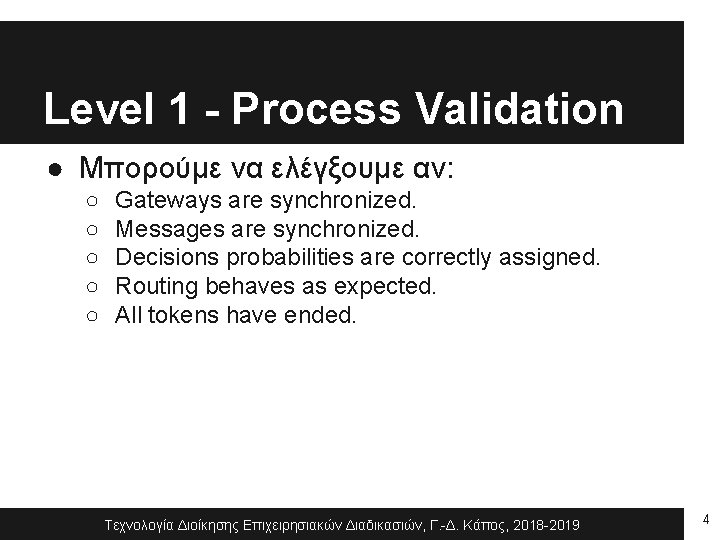
Level 1 - Process Validation ● Μπορούμε να ελέγξουμε αν: ○ ○ ○ Gateways are synchronized. Messages are synchronized. Decisions probabilities are correctly assigned. Routing behaves as expected. All tokens have ended. Τεχνολογία Διοίκησης Επιχειρησιακών Διαδικασιών, Γ. -Δ. Κάπος, 2018 -2019 4
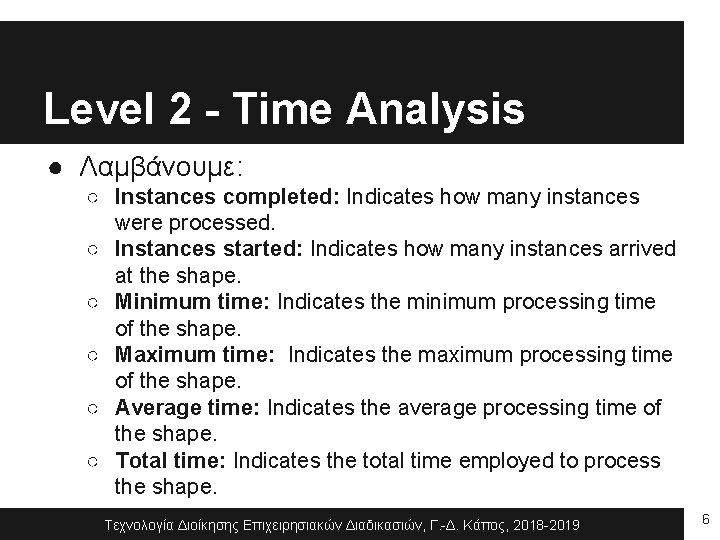
Level 2 - Time Analysis ● Λαμβάνουμε: ○ Instances completed: Indicates how many instances were processed. ○ Instances started: Indicates how many instances arrived at the shape. ○ Minimum time: Indicates the minimum processing time of the shape. ○ Maximum time: Indicates the maximum processing time of the shape. ○ Average time: Indicates the average processing time of the shape. ○ Total time: Indicates the total time employed to process the shape. Τεχνολογία Διοίκησης Επιχειρησιακών Διαδικασιών, Γ. -Δ. Κάπος, 2018 -2019 6
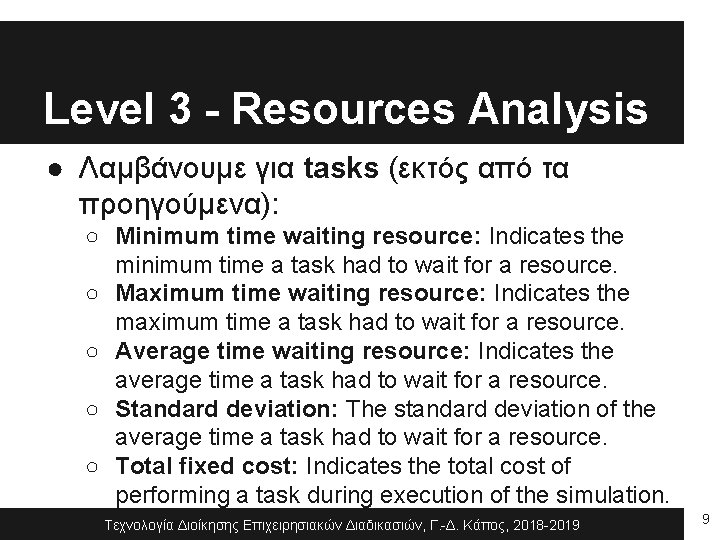
Level 3 - Resources Analysis ● Λαμβάνουμε για tasks (εκτός από τα προηγούμενα): ○ Minimum time waiting resource: Indicates the minimum time a task had to wait for a resource. ○ Maximum time waiting resource: Indicates the maximum time a task had to wait for a resource. ○ Average time waiting resource: Indicates the average time a task had to wait for a resource. ○ Standard deviation: The standard deviation of the average time a task had to wait for a resource. ○ Total fixed cost: Indicates the total cost of performing a task during execution of the simulation. Τεχνολογία Διοίκησης Επιχειρησιακών Διαδικασιών, Γ. -Δ. Κάπος, 2018 -2019 9
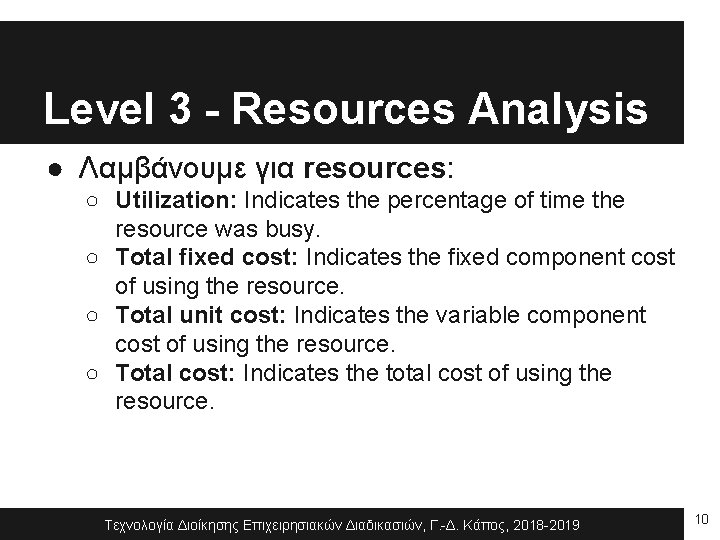
Level 3 - Resources Analysis ● Λαμβάνουμε για resources: ○ Utilization: Indicates the percentage of time the resource was busy. ○ Total fixed cost: Indicates the fixed component cost of using the resource. ○ Total unit cost: Indicates the variable component cost of using the resource. ○ Total cost: Indicates the total cost of using the resource. Τεχνολογία Διοίκησης Επιχειρησιακών Διαδικασιών, Γ. -Δ. Κάπος, 2018 -2019 10
Simulation Configuration Properties ● Γενικές παράμετροι για πιο ρεαλιστική προσαρμογή των σεναρίων ● Ορίζονται: ○ Start, Duration (check with max arrival count) ○ Base Time Unit, Base Currency Unit ○ Replication: ○ Seed: Used to generate random numbers. Τεχνολογία Διοίκησης Επιχειρησιακών Διαδικασιών, Γ. -Δ. Κάπος, 2018 -2019 14
BPMN Simulation with Bizagi Modeler: Considerations ● The following BPMN elements are not supported by the simulation engine: ○ Multiple events: Start, Intermediate and End. ○ Complex gateways. ○ Event based gateways followed by none intermediate events or tasks. ○ Multiple instance Sub-processes. Τεχνολογία Διοίκησης Επιχειρησιακών Διαδικασιών, Γ. -Δ. Κάπος, 2018 -2019 16
BPMN Simulation with Bizagi Modeler: Considerations ● The following diagrams are not supported by the simulation engine: ○ ○ BPMN Choreography diagrams. BPMN Conversation diagrams. Transactional process. Ad Hoc process. ● Reusable Sub-processes are not simulated ○ Set an overall processing time for the shape OR ○ Use Embedded Sub-processes Τεχνολογία Διοίκησης Επιχειρησιακών Διαδικασιών, Γ. -Δ. Κάπος, 2018 -2019 17
- Slides: 17