
BPM Managing Change Brett Champlin President ABPMP International
BPM: Managing Change Brett Champlin President ABPMP International Adjunct Faculty, University of Chicago Manager, Business Performance Improvement
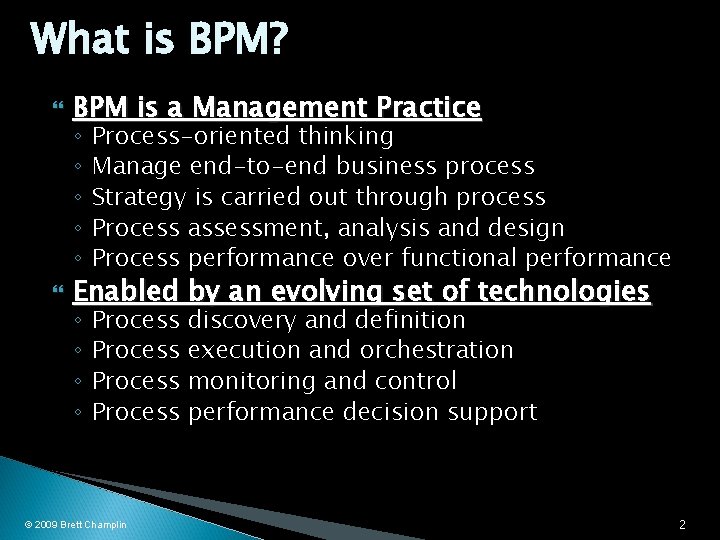
What is BPM? BPM is a Management Practice Enabled by an evolving set of technologies ◦ ◦ ◦ Process-oriented thinking Manage end-to-end business process Strategy is carried out through process Process assessment, analysis and design Process performance over functional performance ◦ ◦ Process © 2009 Brett Champlin discovery and definition execution and orchestration monitoring and control performance decision support 2

APQC BPM Benchmarking Study “BPM is the way best-practice organizations conduct business” While the APQC research participants agreed that technology, by itself, does not constitute “Business Process Management”, they concluded that much of the promise of BPM initiatives will not be realized without powerful, flexible and user-friendly IT solutions to support them. Four of the five of APQC’s best practice partners cited technology support being a key success factor for managing, aligning and integrating business processes--thus impacting profitability and their ability to compete in today’s competitive, global market. ” Source: APQC © 2009 Brett Champlin 3
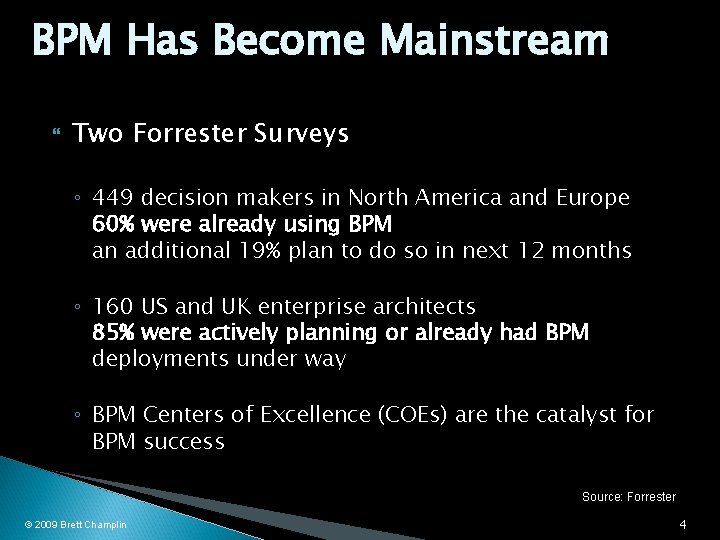
BPM Has Become Mainstream Two Forrester Surveys ◦ 449 decision makers in North America and Europe 60% were already using BPM an additional 19% plan to do so in next 12 months ◦ 160 US and UK enterprise architects 85% were actively planning or already had BPM deployments under way ◦ BPM Centers of Excellence (COEs) are the catalyst for BPM success Source: Forrester © 2009 Brett Champlin 4
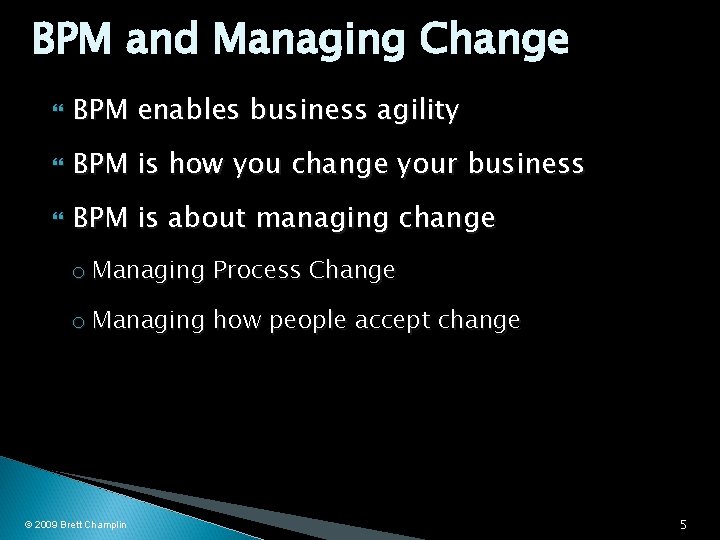
BPM and Managing Change BPM enables business agility BPM is how you change your business BPM is about managing change o Managing Process Change o Managing how people accept change © 2009 Brett Champlin 5
CHANGE MANAGEMENT Managing organizations through successful changes Being aware of a need to manage change throughout planning and implementation of change programs Understanding and influencing how people affected by change experience change © 2009 Brett Champlin 6
CHANGE MANAGEMENT Accelerate the 4 stages of natural reaction: ◦ Denial ◦ Resistance ◦ Exploration ◦ Commitment Helping People Adapt to Change ◦ Everybody has to go through this ◦ They all go through it at their own pace ◦ Some of them have to go through these stages many times before they are fully committed © 2009 Brett Champlin 7

CHANGE MANAGEMENT Communications & Activities ◦ Be honest about where you are ◦ Be honest about where you want to go ◦ Be honest about how you are going to get there ◦ Status reports, what’s new, how are we doing ◦ How this will affect “you” ◦ What can “you” do to prepare ◦ What “you” should do now ◦ How “you” can contribute to success © 2009 Brett Champlin 8
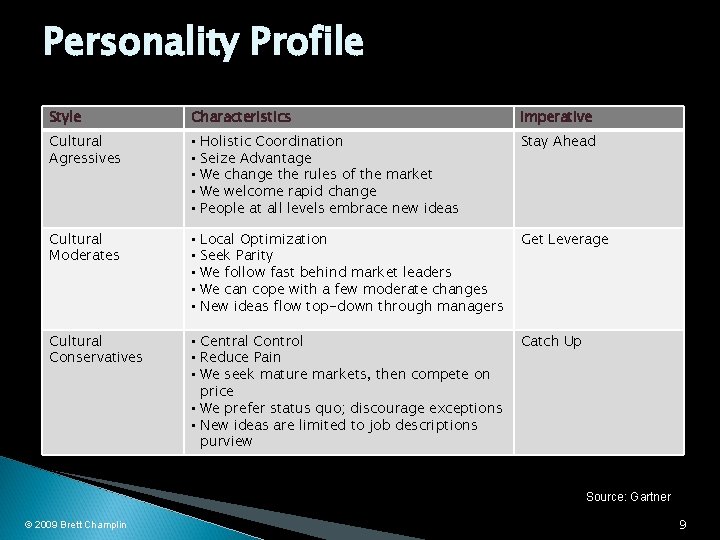
Personality Profile Style Characteristics Imperative Cultural Agressives • Holistic Coordination • Seize Advantage • We change the rules of the market • We welcome rapid change • People at all levels embrace new ideas Stay Ahead Cultural Moderates • Local Optimization • Seek Parity • We follow fast behind market leaders • We can cope with a few moderate changes • New ideas flow top-down through managers Get Leverage Cultural Conservatives • Central Control • Reduce Pain • We seek mature markets, then compete on price • We prefer status quo; discourage exceptions • New ideas are limited to job descriptions purview Catch Up Source: Gartner © 2009 Brett Champlin 9
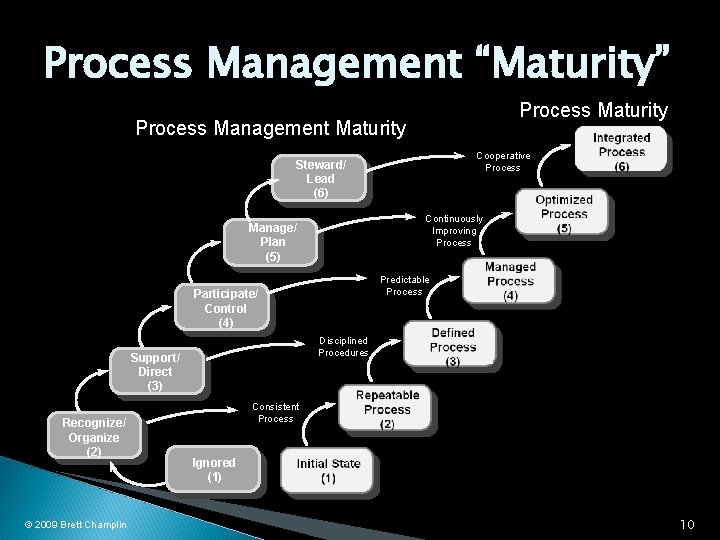
Process Management “Maturity” Process Maturity Process Management Maturity Need Enterprise Integration Need Quality Management Program Need Management Regulation © 2009 Brett Champlin Continuously Improving Process Manage/ Plan (5) Predictable Process Participate/ Control (4) Disciplined Procedures Support/ Direct (3) Recognize/ Organize (2) Cooperative Process Steward/ Lead (6) Consistent Process Ignored (1) 10

Business Process Dynamics Mission, strategy, goals, and objectives Culture, core competencies, and management systems Constrains Supports Business Process enables Workflow Design enables Information Systems • Performers • Applications • Steps & • Information decisions • Sequence and flow • Handoffs © 2009 Brett Champlin enables Motivation & Measurement • Employee assessment • “Reward and punishment” • Process performance indicators enables Policies and Rules enables Human Resources enables Facilities (or other) • Constraints • Skills • Workplace • Business rules • Matching design that the jobs to tasks • Equipment process • Selection and • Furniture… enforces placement • External & internal Source: Alec Sharp, Clariteq 11
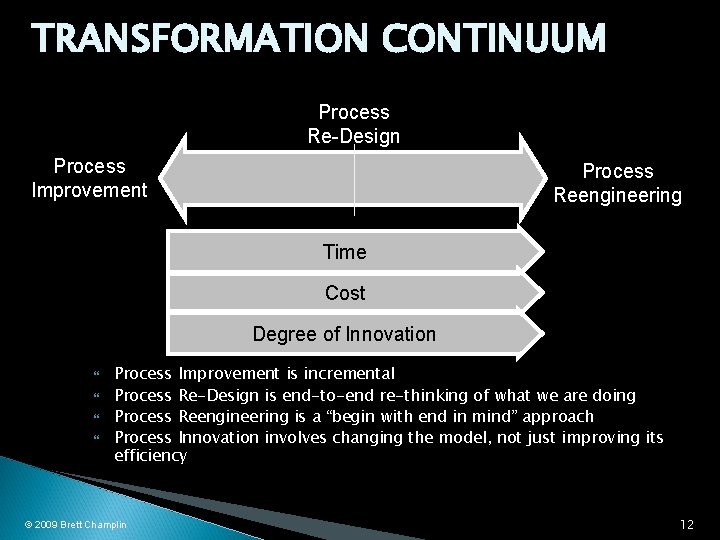
TRANSFORMATION CONTINUUM Process Re-Design Process Improvement Process Reengineering Time Cost Degree of Innovation Process Improvement is incremental Process Re-Design is end-to-end re-thinking of what we are doing Process Reengineering is a “begin with end in mind” approach Process Innovation involves changing the model, not just improving its efficiency © 2009 Brett Champlin 12

Process Reengineering End-to-End Process Activity/ Sub Process Scope of Change Business Model Managing Process Transformation Process Re-Design Process Improvement Short Long Time Source: Jeston & Nelis © 2009 Brett Champlin 13
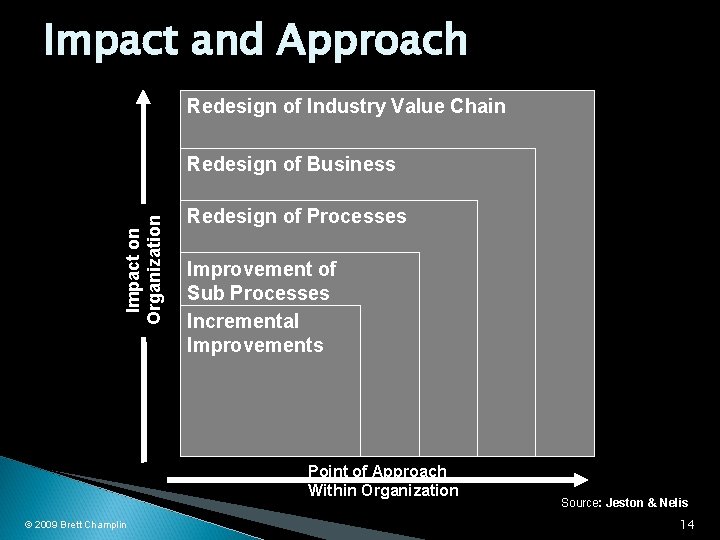
Impact and Approach Redesign of Industry Value Chain Impact on Organization Redesign of Business Redesign of Processes Improvement of Sub Processes Incremental Improvements Point of Approach Within Organization © 2009 Brett Champlin Source: Jeston & Nelis 14
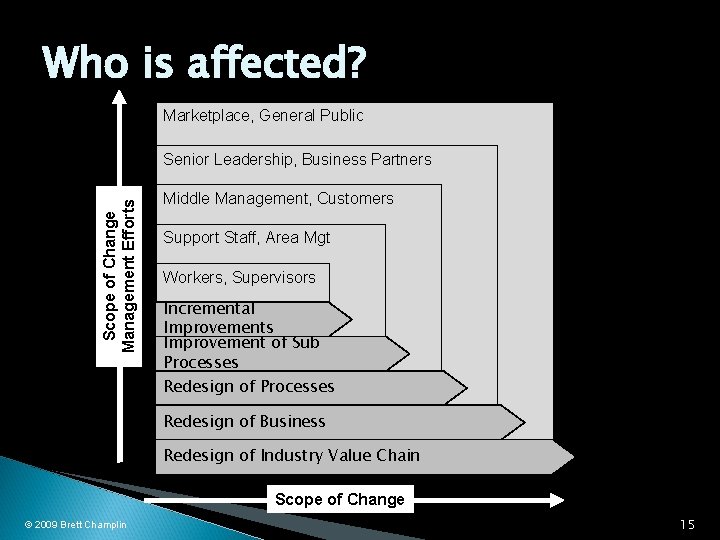
Who is affected? Marketplace, General Public Scope of Change Management Efforts Senior Leadership, Business Partners Middle Management, Customers Support Staff, Area Mgt Workers, Supervisors Incremental Improvements Improvement of Sub Processes Redesign of Business Redesign of Industry Value Chain Scope of Change © 2009 Brett Champlin 15
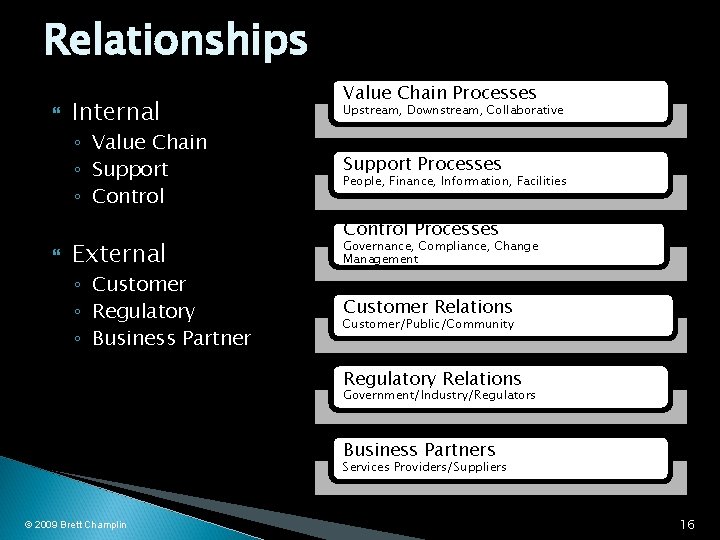
Relationships Internal ◦ Value Chain ◦ Support ◦ Control External ◦ Customer ◦ Regulatory ◦ Business Partner Value Chain Processes Upstream, Downstream, Collaborative Support Processes People, Finance, Information, Facilities Control Processes Governance, Compliance, Change Management Customer Relations Customer/Public/Community Regulatory Relations Government/Industry/Regulators Business Partners Services Providers/Suppliers © 2009 Brett Champlin 16
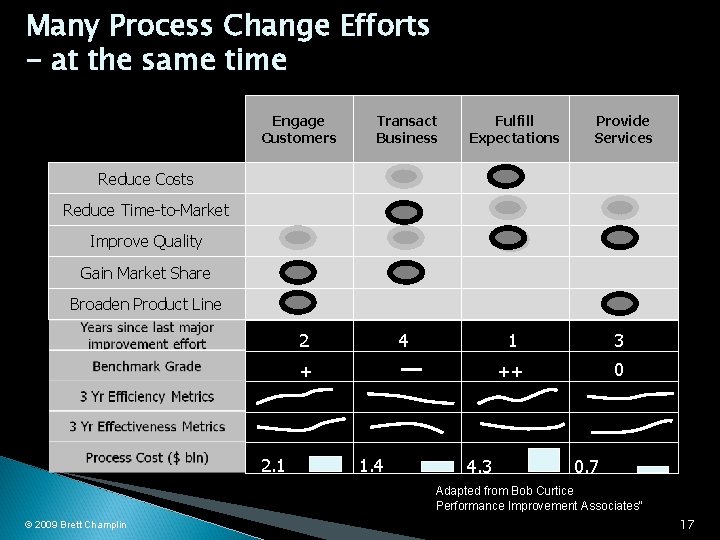
Many Process Change Efforts - at the same time Engage Customers Transact Business Fulfill Expectations Provide Services 4 1 3 ++ 0 Reduce Costs Reduce Time-to-Market Improve Quality Gain Market Share Broaden Product Line 2 + 2. 1 1. 4 4. 3 0. 7 Adapted from Bob Curtice Performance Improvement Associates" © 2009 Brett Champlin 17
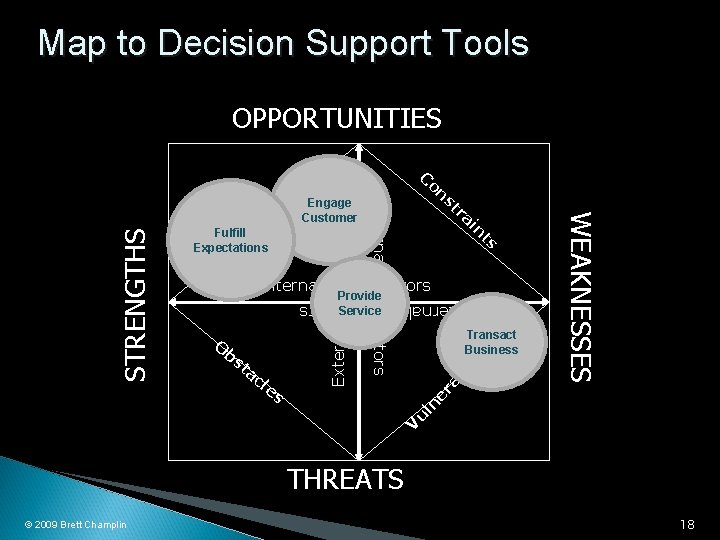
Map to Decision Support Tools OPPORTUNITIES Factors ie s lit bi V ul s ne le External ta c Transact Business ra ra g ve Le Factors O bs s Factors Provide Service Factors STRENGTHS Internal nt Internal Fulfill Expectations ai WEAKNESSES Engage Customer on st r External e C THREATS © 2009 Brett Champlin 18
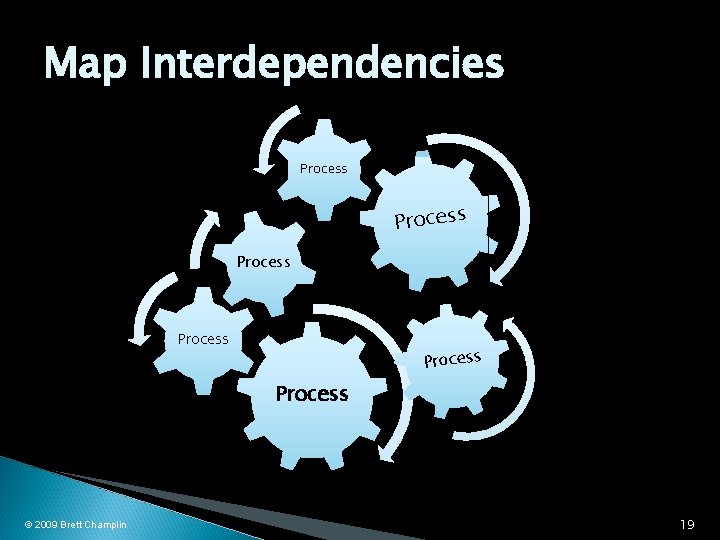
Map Interdependencies Process Process © 2009 Brett Champlin 19
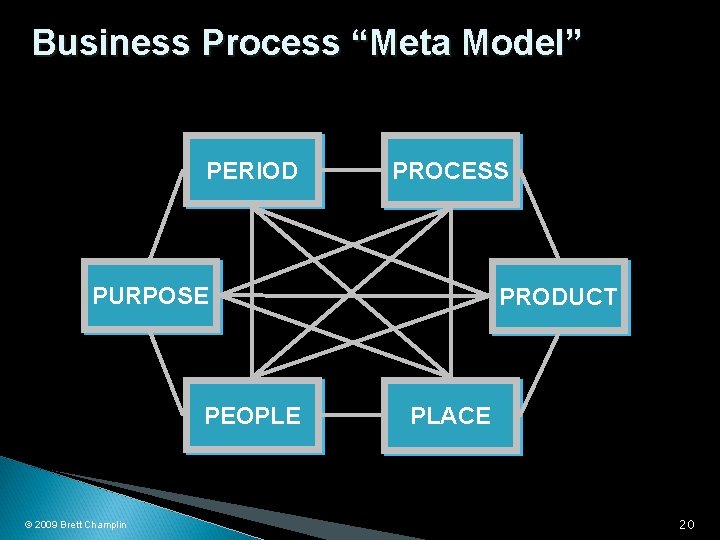
Business Process “Meta Model” PERIOD PROCESS PURPOSE PEOPLE © 2009 Brett Champlin PRODUCT PLACE 20
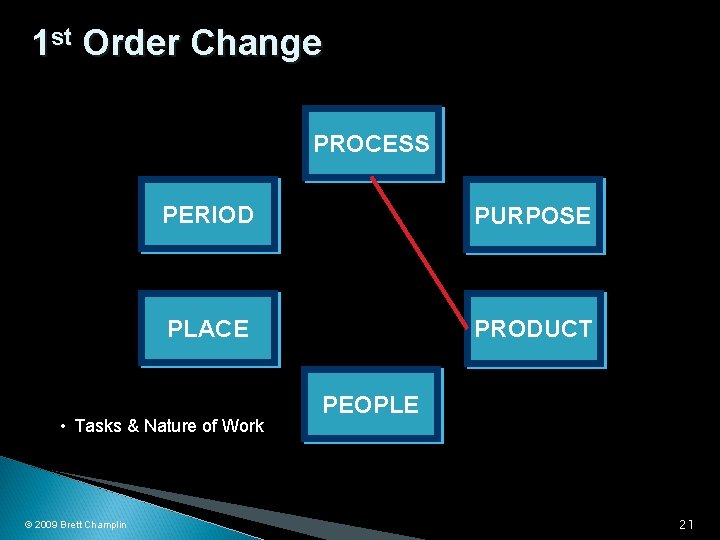
1 st Order Change PROCESS PERIOD PURPOSE PLACE PRODUCT • Tasks & Nature of Work © 2009 Brett Champlin PEOPLE 21
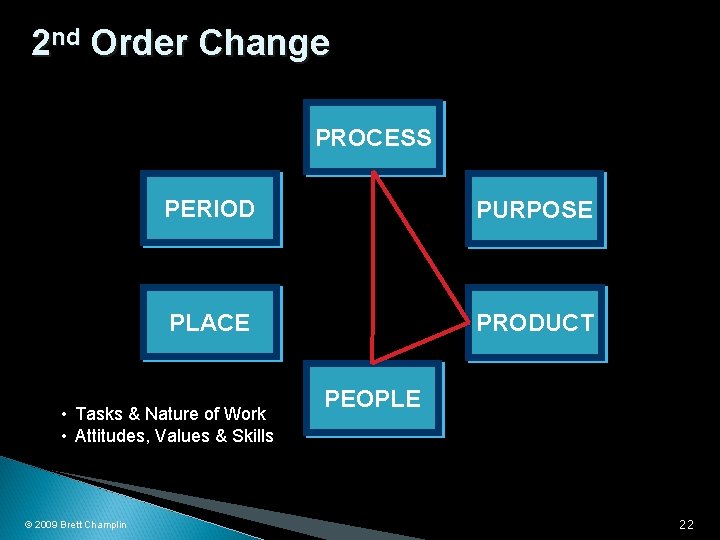
2 nd Order Change PROCESS PERIOD PURPOSE PLACE PRODUCT • Tasks & Nature of Work • Attitudes, Values & Skills © 2009 Brett Champlin PEOPLE 22
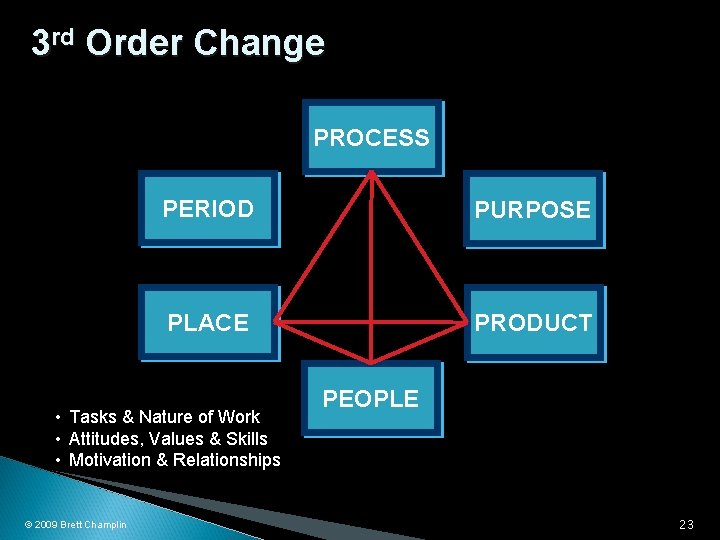
3 rd Order Change PROCESS PERIOD PURPOSE PLACE PRODUCT • Tasks & Nature of Work • Attitudes, Values & Skills • Motivation & Relationships © 2009 Brett Champlin PEOPLE 23
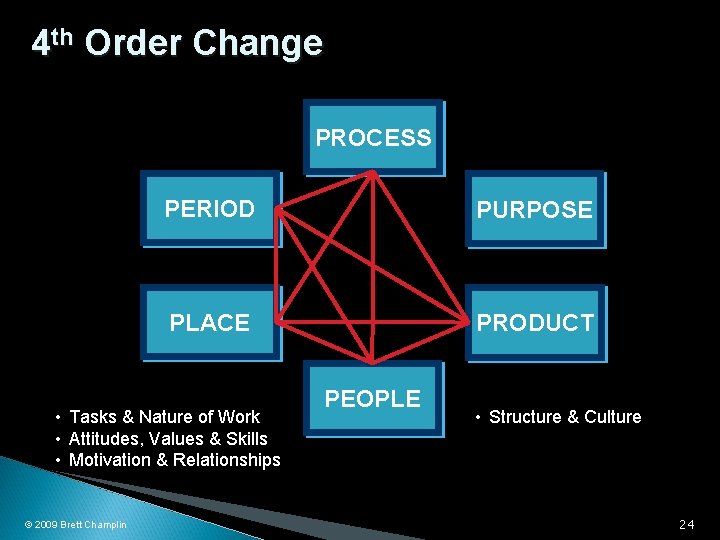
4 th Order Change PROCESS PERIOD PURPOSE PLACE PRODUCT • Tasks & Nature of Work • Attitudes, Values & Skills • Motivation & Relationships © 2009 Brett Champlin PEOPLE • Structure & Culture 24
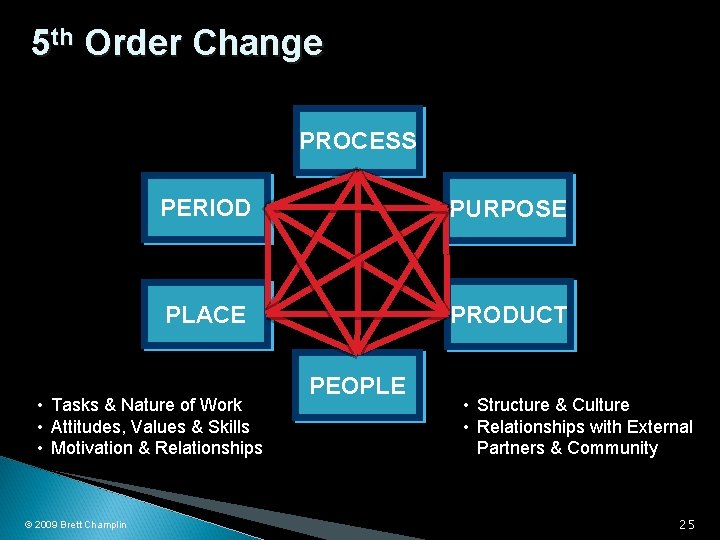
5 th Order Change PROCESS PERIOD PURPOSE PLACE PRODUCT • Tasks & Nature of Work • Attitudes, Values & Skills • Motivation & Relationships © 2009 Brett Champlin PEOPLE • Structure & Culture • Relationships with External Partners & Community 25
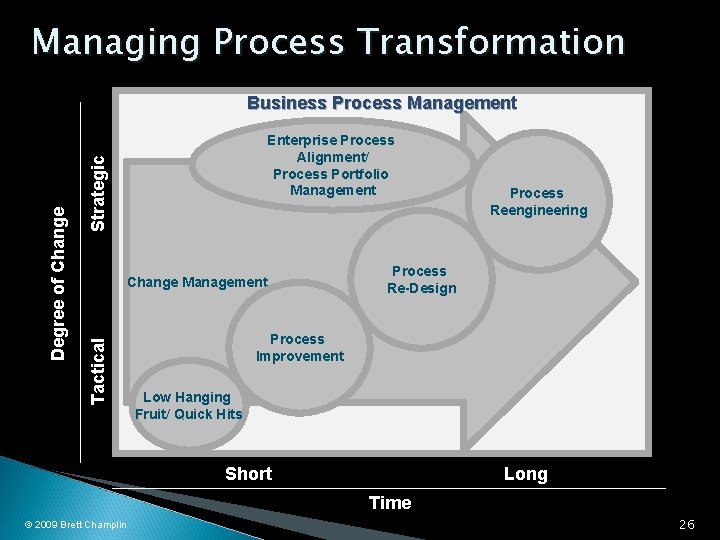
Managing Process Transformation Strategic Enterprise Process Alignment/ Process Portfolio Management Change Management Tactical Degree of Change Business Process Management Process Reengineering Process Re-Design Process Improvement Low Hanging Fruit/ Quick Hits Short Long Time © 2009 Brett Champlin 26
Roadmap for Change © 2009 Brett Champlin 27
YOU DON’T HAVE TO CHANGE. SURVIVAL ISN’T MANDATORY. -- DEMING © 2009 Brett Champlin 28
BPM: Managing Change Brett Champlin Brett@the. Champlins. com
- Slides: 29