
BPM Issue Patterns for Business Process Design Takashi
BPM Issue Patterns for Business Process Design Takashi Kobayashi Senshu University, JAPAN
Self-introduction Career § Academic - B. E & M. E. : Waseda Univ. in 1980 & 1982 - Ph. D: Osaka Univ. in 1999 § Professional - Hitachi, Ltd. (Researcher and Consultant from 1982 to 2003) - Senshu Univ. (Associate Prof. and Full Prof. from 2003 to now) All Rights Reserved, Copyright © 2013, Takashi Kobayashi 2
Self-introduction Research Interests § Business Process Design - BSC (Balanced Score Card), LAP (Language/Action Perspective), Patterns § Business Process Modeling - LAP, UML § Discrete Event Control - Petri Nets § Requirements Analysis - Volere, Use case All Rights Reserved, Copyright © 2013, Takashi Kobayashi 3
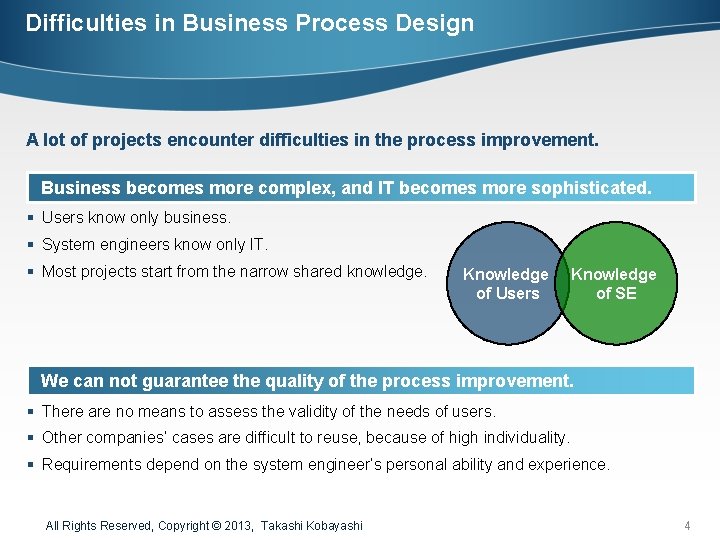
Difficulties in Business Process Design A lot of projects encounter difficulties in the process improvement. Business becomes more complex, and IT becomes more sophisticated. § Users know only business. § System engineers know only IT. § Most projects start from the narrow shared knowledge. Knowledge of Users Knowledge of SE We can not guarantee the quality of the process improvement. § There are no means to assess the validity of the needs of users. § Other companies’ cases are difficult to reuse, because of high individuality. § Requirements depend on the system engineer’s personal ability and experience. All Rights Reserved, Copyright © 2013, Takashi Kobayashi 4
Difficulties in Business Process Design To deal with these difficulties, pattern approach is powerful. § It is conventional means in the software engineering. § Architecture pattern, analysis pattern, design pattern, and implementation pattern. § We apply pattern approach to the process improvement. All Rights Reserved, Copyright © 2013, Takashi Kobayashi 5
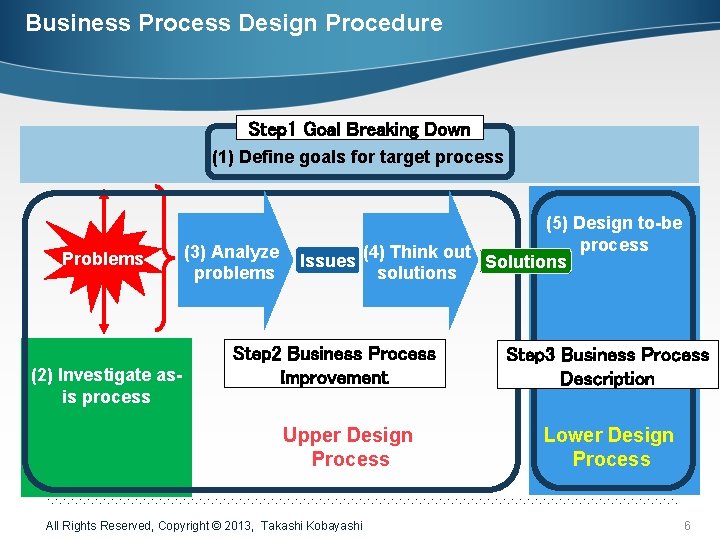
Business Process Design Procedure Step 1 Goal Breaking Down (1) Define goals for target process Problems (2) Investigate asis process (3) Analyze problems (5) Design to-be process (4) Think out Issues Solutions solutions Step 2 Business Process Improvement Upper Design Process All Rights Reserved, Copyright © 2013, Takashi Kobayashi Step 3 Business Process Description Lower Design Process 6
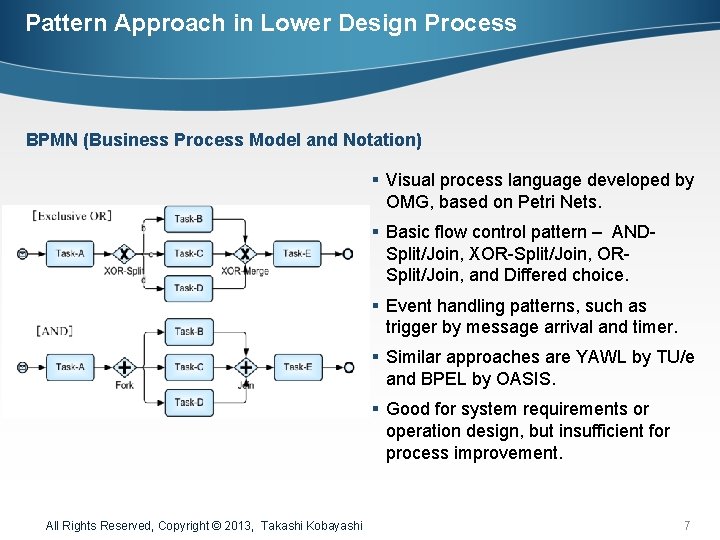
Pattern Approach in Lower Design Process BPMN (Business Process Model and Notation) § Visual process language developed by OMG, based on Petri Nets. § Basic flow control pattern – ANDSplit/Join, XOR-Split/Join, ORSplit/Join, and Differed choice. § Event handling patterns, such as trigger by message arrival and timer. § Similar approaches are YAWL by TU/e and BPEL by OASIS. § Good for system requirements or operation design, but insufficient for process improvement. All Rights Reserved, Copyright © 2013, Takashi Kobayashi 7
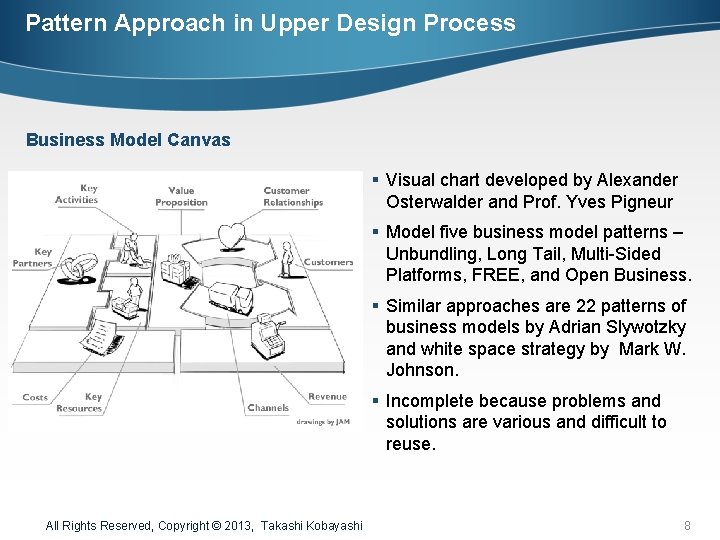
Pattern Approach in Upper Design Process Business Model Canvas § Visual chart developed by Alexander Osterwalder and Prof. Yves Pigneur § Model five business model patterns – Unbundling, Long Tail, Multi-Sided Platforms, FREE, and Open Business. § Similar approaches are 22 patterns of business models by Adrian Slywotzky and white space strategy by Mark W. Johnson. § Incomplete because problems and solutions are various and difficult to reuse. All Rights Reserved, Copyright © 2013, Takashi Kobayashi 8
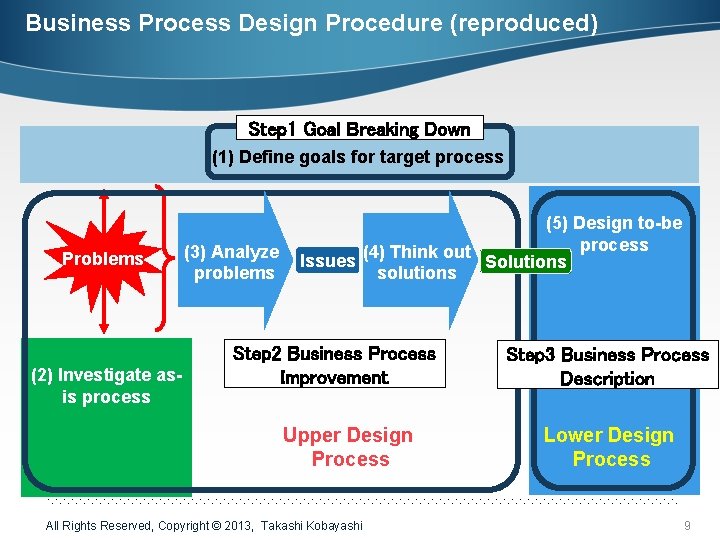
Business Process Design Procedure (reproduced) Step 1 Goal Breaking Down (1) Define goals for target process Problems (2) Investigate asis process (3) Analyze problems (5) Design to-be process (4) Think out Issues Solutions solutions Step 2 Business Process Improvement Upper Design Process All Rights Reserved, Copyright © 2013, Takashi Kobayashi Step 3 Business Process Description Lower Design Process 9
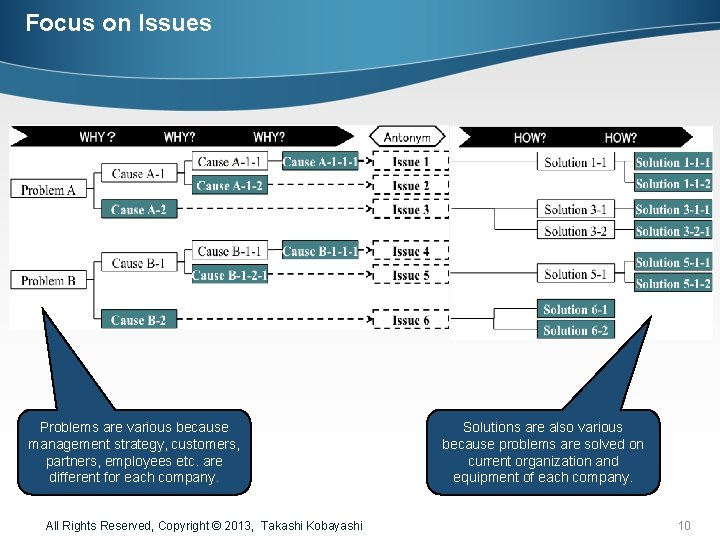
Focus on Issues Problems are various because management strategy, customers, partners, employees etc. are different for each company. All Rights Reserved, Copyright © 2013, Takashi Kobayashi Solutions are also various because problems are solved on current organization and equipment of each company. 10
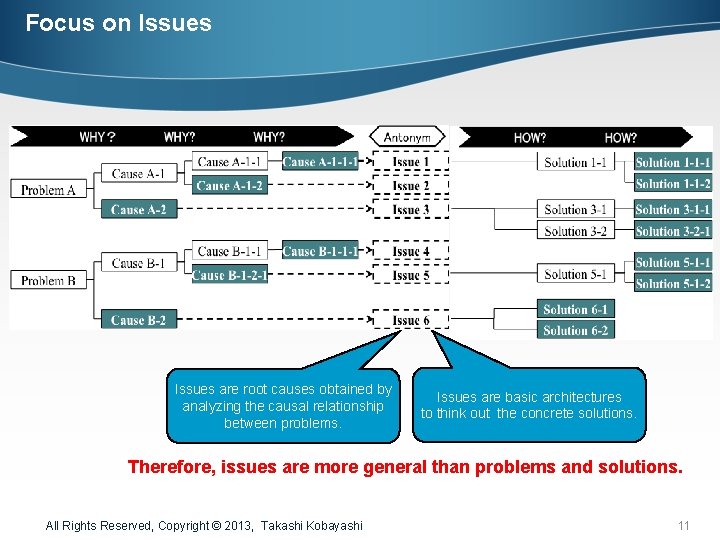
Focus on Issues are root causes obtained by analyzing the causal relationship between problems. Issues are basic architectures to think out the concrete solutions. Therefore, issues are more general than problems and solutions. All Rights Reserved, Copyright © 2013, Takashi Kobayashi 11
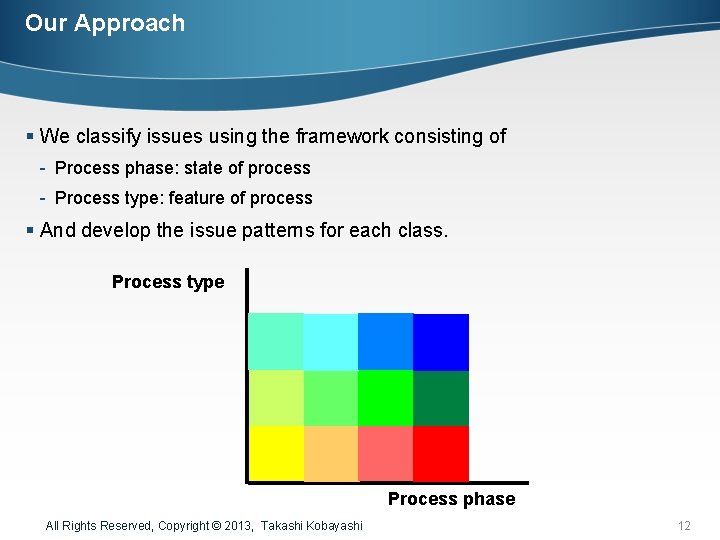
Our Approach § We classify issues using the framework consisting of - Process phase: state of process - Process type: feature of process § And develop the issue patterns for each class. Process type Process phase All Rights Reserved, Copyright © 2013, Takashi Kobayashi 12
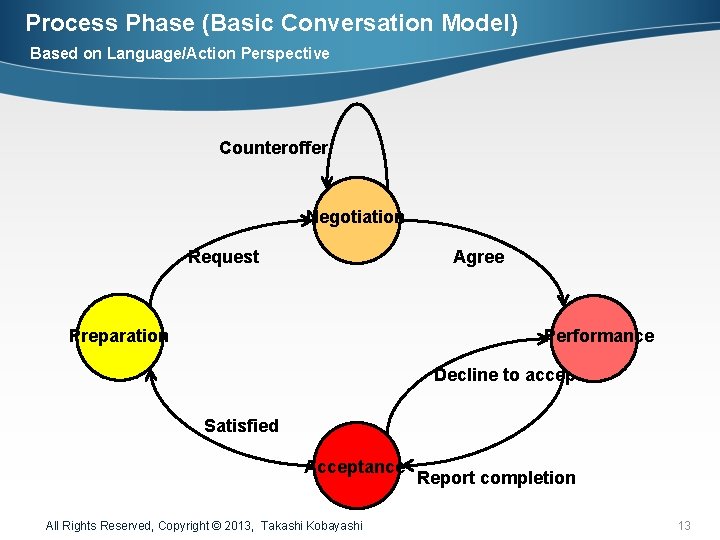
Process Phase (Basic Conversation Model) Based on Language/Action Perspective Counteroffer Negotiation Request Agree Preparation Performance Decline to accept Satisfied Acceptance All Rights Reserved, Copyright © 2013, Takashi Kobayashi Report completion 13
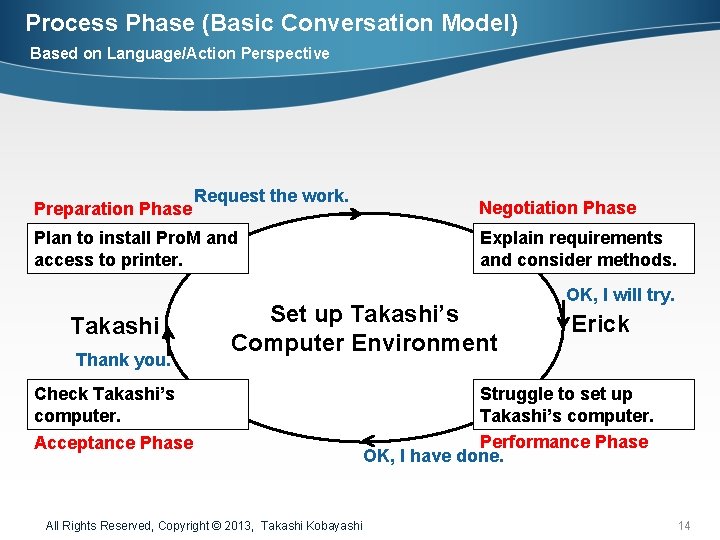
Process Phase (Basic Conversation Model) Based on Language/Action Perspective Preparation Phase Request the work. Plan to install Pro. M and access to printer. Takashi Thank you. Negotiation Phase Explain requirements and consider methods. Set up Takashi’s Computer Environment Check Takashi’s computer. Acceptance Phase All Rights Reserved, Copyright © 2013, Takashi Kobayashi OK, I will try. Erick Struggle to set up Takashi’s computer. Performance Phase OK, I have done. 14
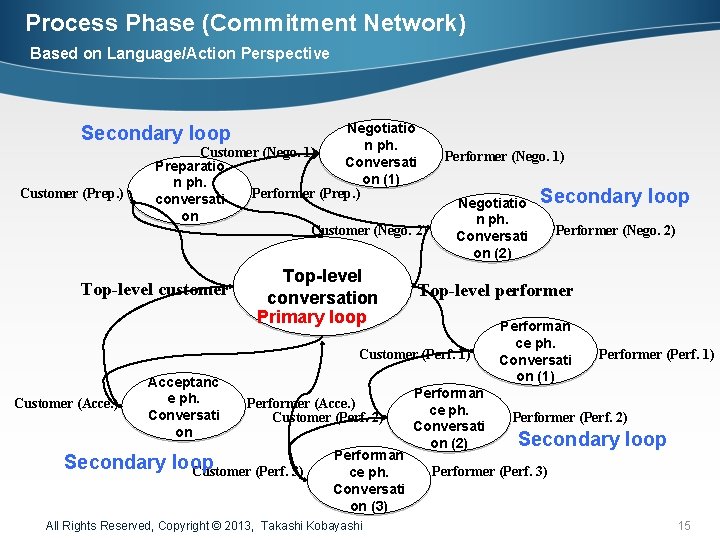
Process Phase (Commitment Network) Based on Language/Action Perspective Negotiatio n ph. Customer (Nego. 1) Conversati Preparatio on (1) n ph. Performer (Prep. ) conversati Secondary loop Customer (Prep. ) on Top-level customer Performer (Nego. 1) Customer (Nego. 2) Top-level conversation Primary loop Negotiatio n ph. Conversati on (2) Customer (Acce. ) Performer (Acce. ) Customer (Perf. 2) Secondary loop Customer (Perf. 3) Performan ce ph. Conversati on (3) All Rights Reserved, Copyright © 2013, Takashi Kobayashi Performer (Nego. 2) Top-level performer Customer (Perf. 1) Acceptanc e ph. Conversati on Secondary loop Performan ce ph. Conversati on (2) Performan ce ph. Conversati on (1) Performer (Perf. 2) Secondary loop Performer (Perf. 3) 15
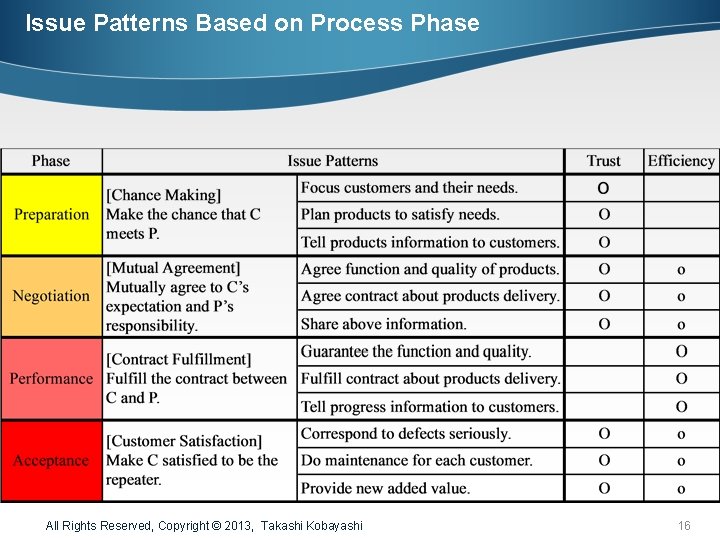
Issue Patterns Based on Process Phase All Rights Reserved, Copyright © 2013, Takashi Kobayashi 16
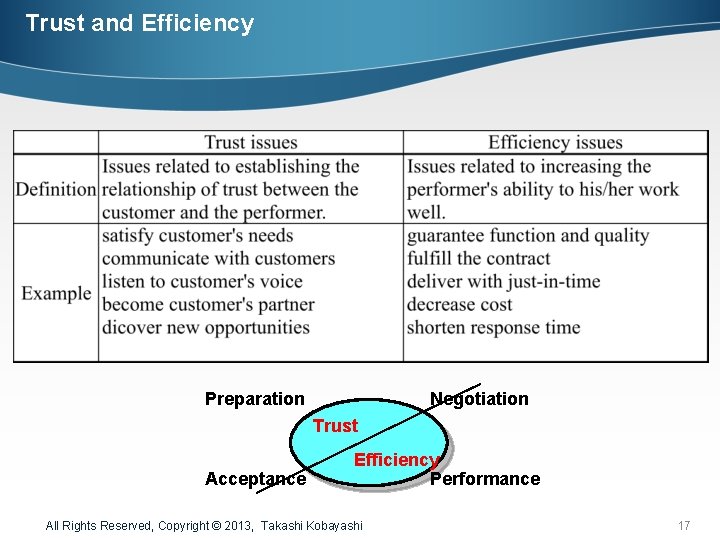
Trust and Efficiency Preparation Negotiation Trust Acceptance Efficiency Performance All Rights Reserved, Copyright © 2013, Takashi Kobayashi 17
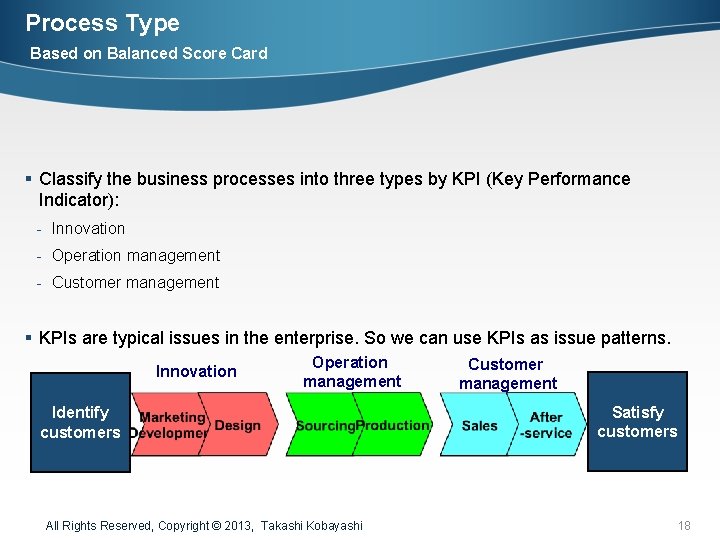
Process Type Based on Balanced Score Card § Classify the business processes into three types by KPI (Key Performance Indicator): - Innovation - Operation management - Customer management § KPIs are typical issues in the enterprise. So we can use KPIs as issue patterns. Innovation Operation management Identify customers All Rights Reserved, Copyright © 2013, Takashi Kobayashi Customer management Satisfy customers 18
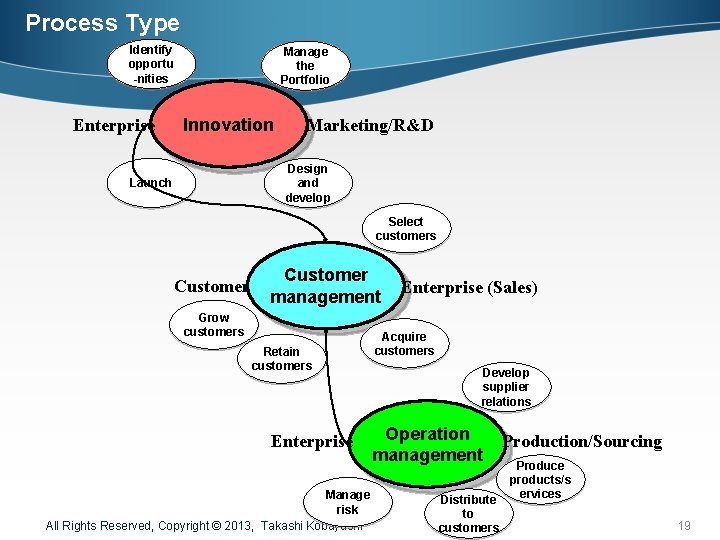
Process Type Identify opportu -nities Enterprise Manage the Portfolio Innovation Marketing/R&D Design and develop Launch Select customers Customer management Grow customers Retain customers Enterprise Manage risk All Rights Reserved, Copyright © 2013, Takashi Kobayashi Enterprise (Sales) Acquire customers Develop supplier relations Operation management Distribute to customers Production/Sourcing Produce products/s ervices 19
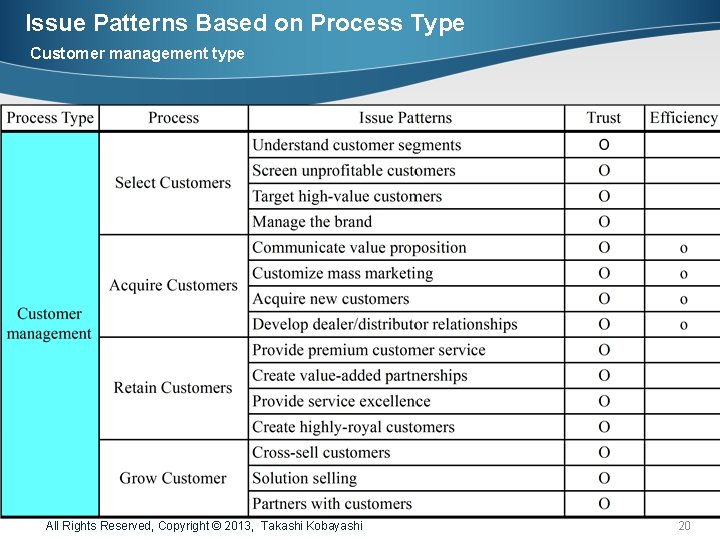
Issue Patterns Based on Process Type Customer management type All Rights Reserved, Copyright © 2013, Takashi Kobayashi 20
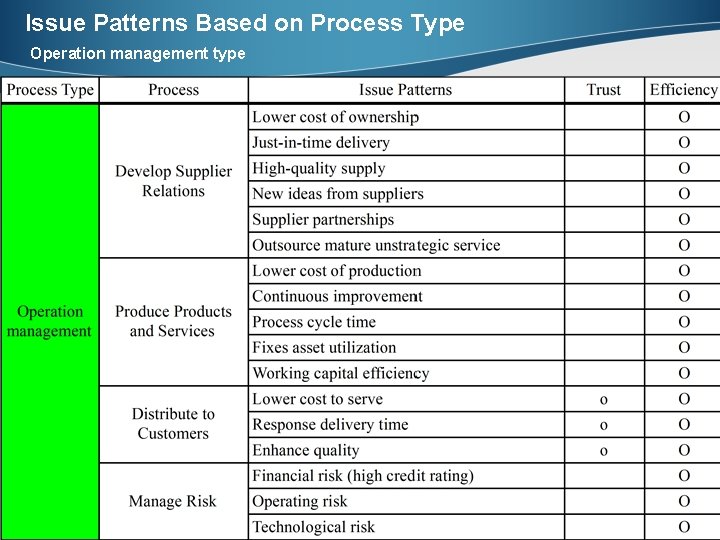
Issue Patterns Based on Process Type Operation management type All Rights Reserved, Copyright © 2013, Takashi Kobayashi 21
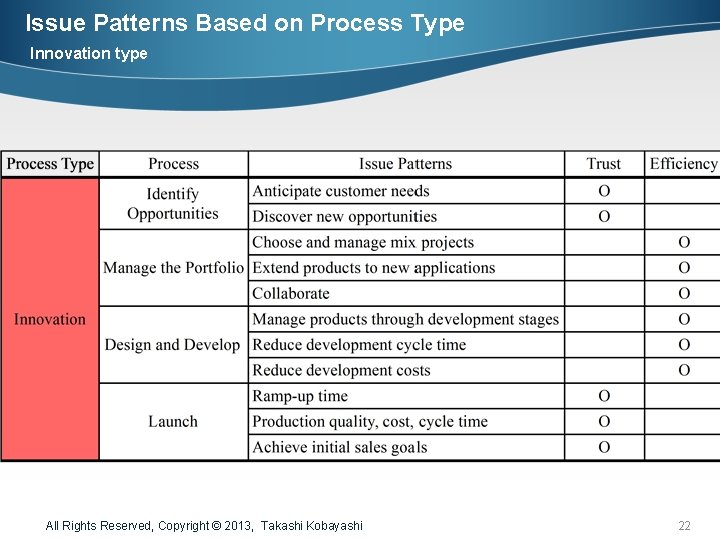
Issue Patterns Based on Process Type Innovation type All Rights Reserved, Copyright © 2013, Takashi Kobayashi 22
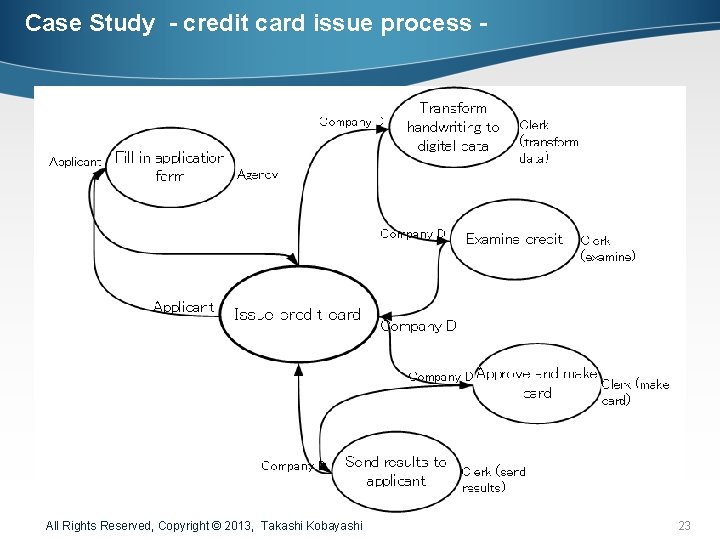
Case Study - credit card issue process - All Rights Reserved, Copyright © 2013, Takashi Kobayashi 23
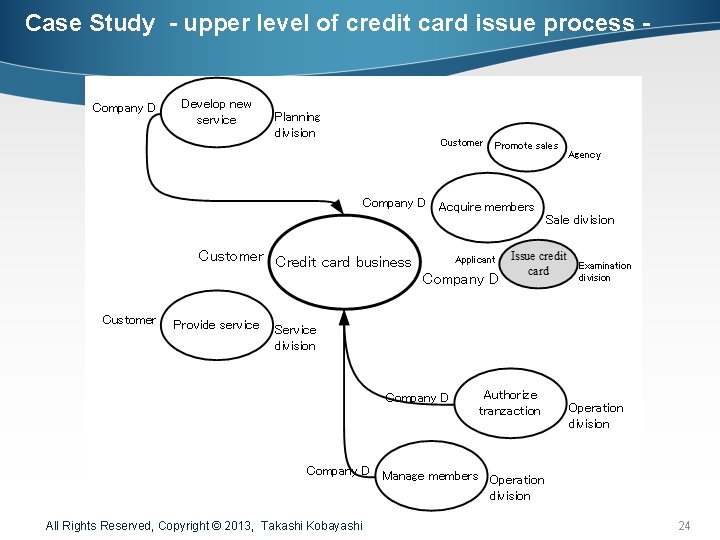
Case Study - upper level of credit card issue process - All Rights Reserved, Copyright © 2013, Takashi Kobayashi 24
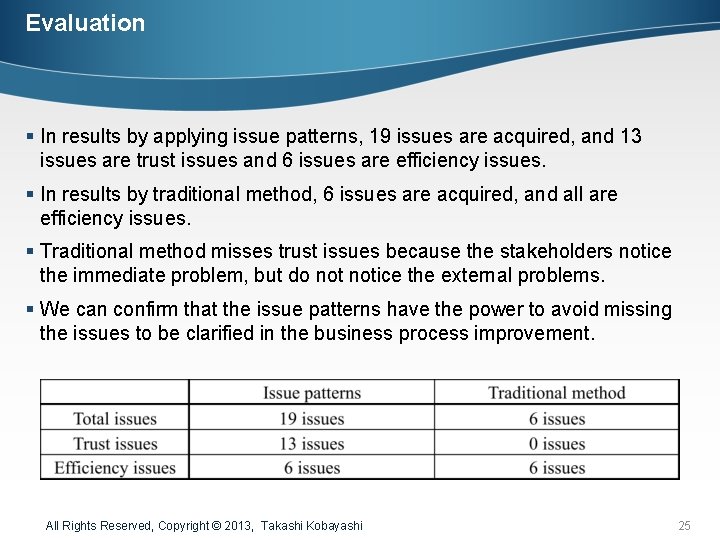
Evaluation § In results by applying issue patterns, 19 issues are acquired, and 13 issues are trust issues and 6 issues are efficiency issues. § In results by traditional method, 6 issues are acquired, and all are efficiency issues. § Traditional method misses trust issues because the stakeholders notice the immediate problem, but do notice the external problems. § We can confirm that the issue patterns have the power to avoid missing the issues to be clarified in the business process improvement. All Rights Reserved, Copyright © 2013, Takashi Kobayashi 25
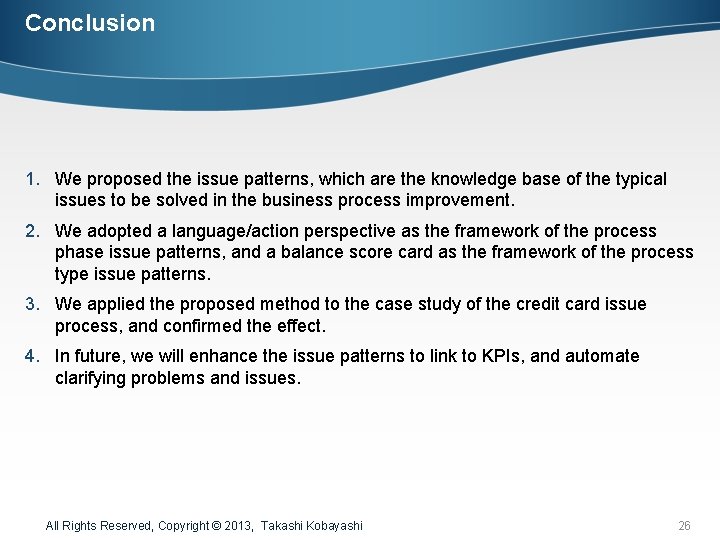
Conclusion 1. We proposed the issue patterns, which are the knowledge base of the typical issues to be solved in the business process improvement. 2. We adopted a language/action perspective as the framework of the process phase issue patterns, and a balance score card as the framework of the process type issue patterns. 3. We applied the proposed method to the case study of the credit card issue process, and confirmed the effect. 4. In future, we will enhance the issue patterns to link to KPIs, and automate clarifying problems and issues. All Rights Reserved, Copyright © 2013, Takashi Kobayashi 26
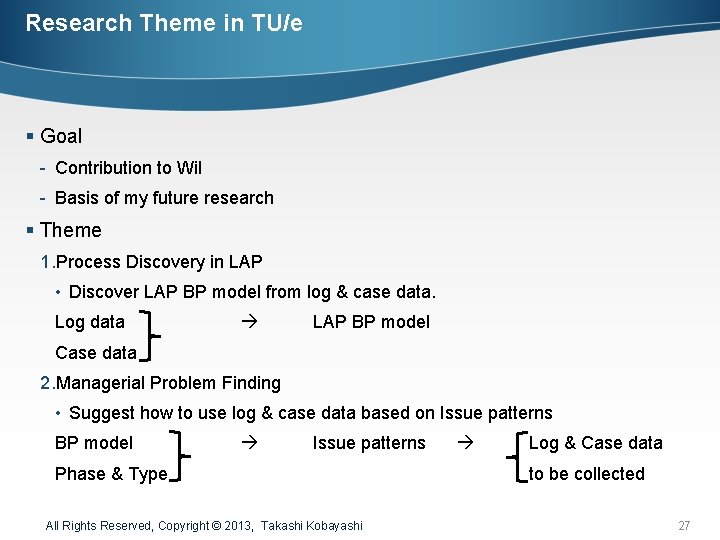
Research Theme in TU/e § Goal - Contribution to Wil - Basis of my future research § Theme 1. Process Discovery in LAP • Discover LAP BP model from log & case data. Log data LAP BP model Case data 2. Managerial Problem Finding • Suggest how to use log & case data based on Issue patterns BP model Issue patterns Phase & Type All Rights Reserved, Copyright © 2013, Takashi Kobayashi Log & Case data to be collected 27
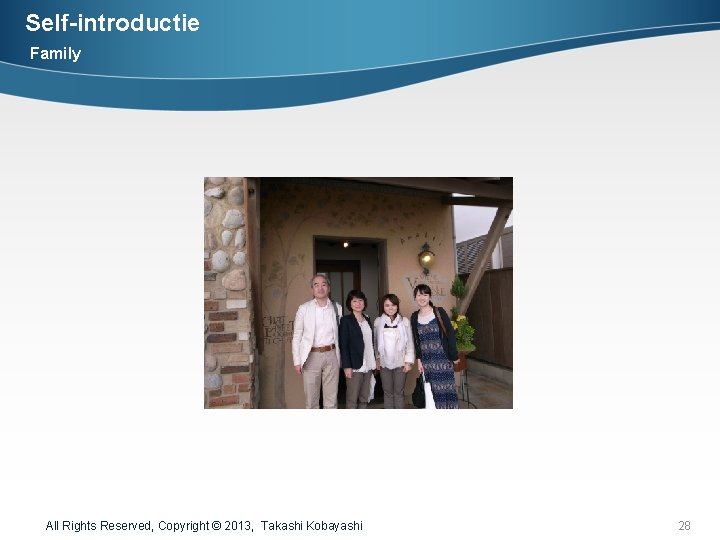
Self-introductie Family All Rights Reserved, Copyright © 2013, Takashi Kobayashi 28
- Slides: 28