
BPLRVS Solar Power Electrical Energy Basics Electric Energy
BPLRVS Solar Power
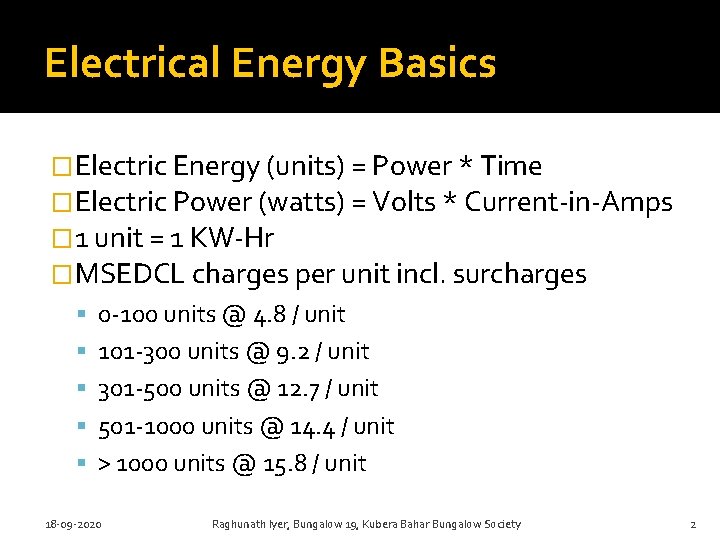
Electrical Energy Basics �Electric Energy (units) = Power * Time �Electric Power (watts) = Volts * Current-in-Amps � 1 unit = 1 KW-Hr �MSEDCL charges per unit incl. surcharges 0 -100 units @ 4. 8 / unit 101 -300 units @ 9. 2 / unit 301 -500 units @ 12. 7 / unit 501 -1000 units @ 14. 4 / unit > 1000 units @ 15. 8 / unit 18 -09 -2020 Raghunath Iyer, Bungalow 19, Kubera Bahar Bungalow Society 2
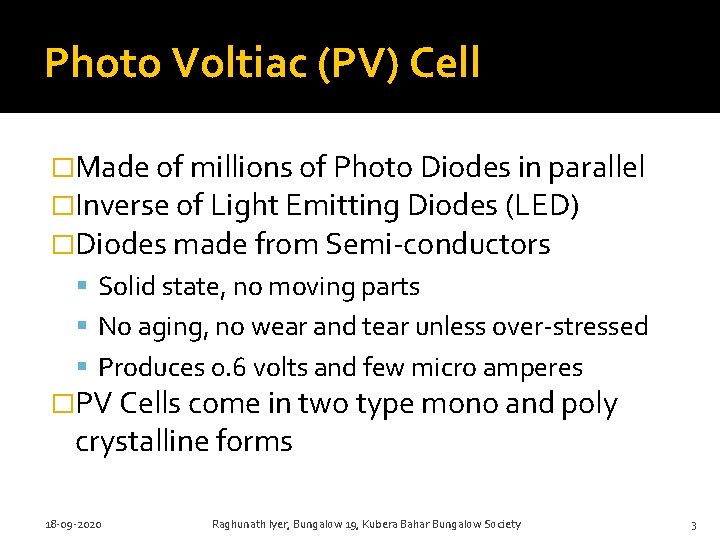
Photo Voltiac (PV) Cell �Made of millions of Photo Diodes in parallel �Inverse of Light Emitting Diodes (LED) �Diodes made from Semi-conductors Solid state, no moving parts No aging, no wear and tear unless over-stressed Produces 0. 6 volts and few micro amperes �PV Cells come in two type mono and poly crystalline forms 18 -09 -2020 Raghunath Iyer, Bungalow 19, Kubera Bahar Bungalow Society 3
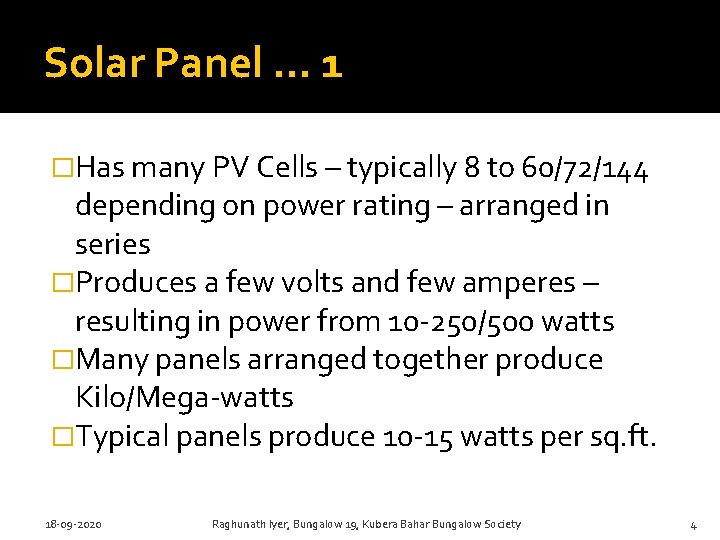
Solar Panel … 1 �Has many PV Cells – typically 8 to 60/72/144 depending on power rating – arranged in series �Produces a few volts and few amperes – resulting in power from 10 -250/500 watts �Many panels arranged together produce Kilo/Mega-watts �Typical panels produce 10 -15 watts per sq. ft. 18 -09 -2020 Raghunath Iyer, Bungalow 19, Kubera Bahar Bungalow Society 4
Solar Panel … 2 �Efficiency varies with angle of sun and power of sunlight and age of panel. Manufacturer specifies Watts-Peak – Wp. �Typically 5 hrs of good power between 8 am and 5 pm. �Power generation drops due to shade and clouds and higher temperature. �Best months – October to June �Need access to south facing sky due to being northern hemisphere and tilt of earth. 18 -09 -2020 Raghunath Iyer, Bungalow 19, Kubera Bahar Bungalow Society 5

Solar Panel construction … 1 18 -09 -2020 Raghunath Iyer, Bungalow 19, Kubera Bahar Bungalow Society 6
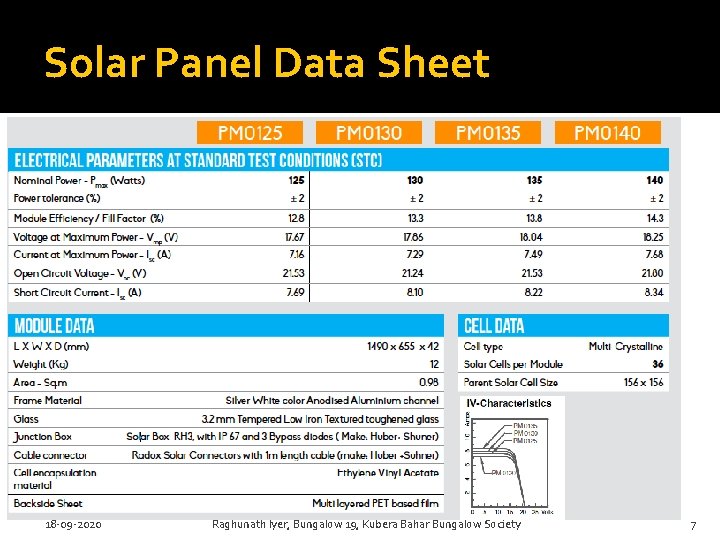
Solar Panel Data Sheet 18 -09 -2020 Raghunath Iyer, Bungalow 19, Kubera Bahar Bungalow Society 7
Panel Power to House Power �Panel produces DC power �Household requires AC power �Panel produces power during daytime �Household requires most power during night. Industries require power full day. �Need an inverter from DC to AC �Need to store excess energy generated for use later – battery or “grid”. 18 -09 -2020 Raghunath Iyer, Bungalow 19, Kubera Bahar Bungalow Society 8
Two Arrangements – Off-Grid �Off-Grid (needs batteries) DC energy from panel used to charge batteries using a Charger which does DC-DC conversion Convert battery power using regular inverter (DC- AC). Recommend sine-wave inverters for motor type equipment – fridge, microwave, fan etc. Battery capacity has to be sized for daily storage and discharge Functions even without MSEDCL input Consumer decides when to consume MSEDCL and Solar power. Excess power charges batteries 18 -09 -2020 Raghunath Iyer, Bungalow 19, Kubera Bahar Bungalow Society 9
Two Arrangements – Grid-Tie � Grid-Tie (no batteries) DC energy from panel directly converted to AC energy using Grid-Tie Inverter (not regular inverter) and attached to the MSEDCL power line. If MSEDCL fails, Solar panel output power generation also stops. Excess power goes back to MSEDCL. ▪ You need reverse power flow measuring meters ▪ Net-Metering announced Sept 2015. Allows such reverse power feed. Much more efficient system compared to Off-Grid due to single stage power conversion DC-AC. (Off-Grid performs DC-DC, then DC-Chemical-DC, then DC-AC. 18 -09 -2020 Raghunath Iyer, Bungalow 19, Kubera Bahar Bungalow Society 10
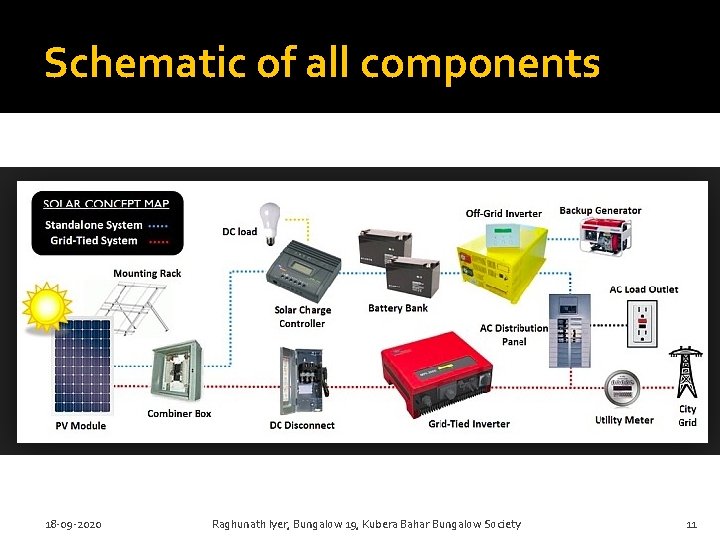
Schematic of all components 18 -09 -2020 Raghunath Iyer, Bungalow 19, Kubera Bahar Bungalow Society 11
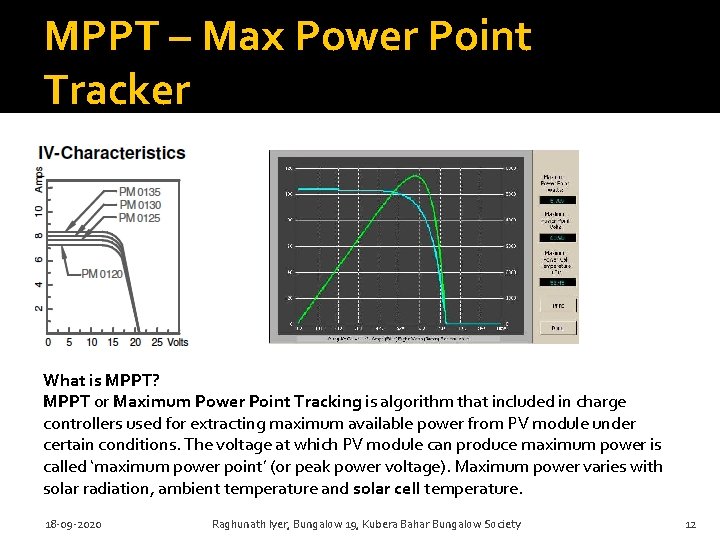
MPPT – Max Power Point Tracker What is MPPT? MPPT or Maximum Power Point Tracking is algorithm that included in charge controllers used for extracting maximum available power from PV module under certain conditions. The voltage at which PV module can produce maximum power is called ‘maximum power point’ (or peak power voltage). Maximum power varies with solar radiation, ambient temperature and solar cell temperature. 18 -09 -2020 Raghunath Iyer, Bungalow 19, Kubera Bahar Bungalow Society 12
Inverter Variations � Central Inverter Large – typically 1 -KW to 100 -s of MW Lower cost Inefficiencies rise due to some panels in shade pulling down power from other panels � Micro Inverter – per panel Very small – typically 100 -250 -400 watts Expensive for > 2 KW VERY EFFICIENT – since each panel has dedicated DC-AC inverter and if one panel has shade ONLY its power output comes down 18 -09 -2020 Raghunath Iyer, Bungalow 19, Kubera Bahar Bungalow Society 13
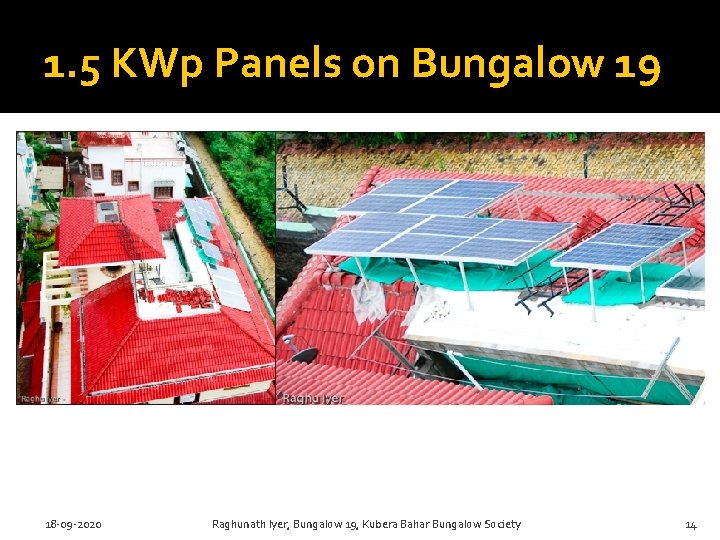
1. 5 KWp Panels on Bungalow 19 18 -09 -2020 Raghunath Iyer, Bungalow 19, Kubera Bahar Bungalow Society 14
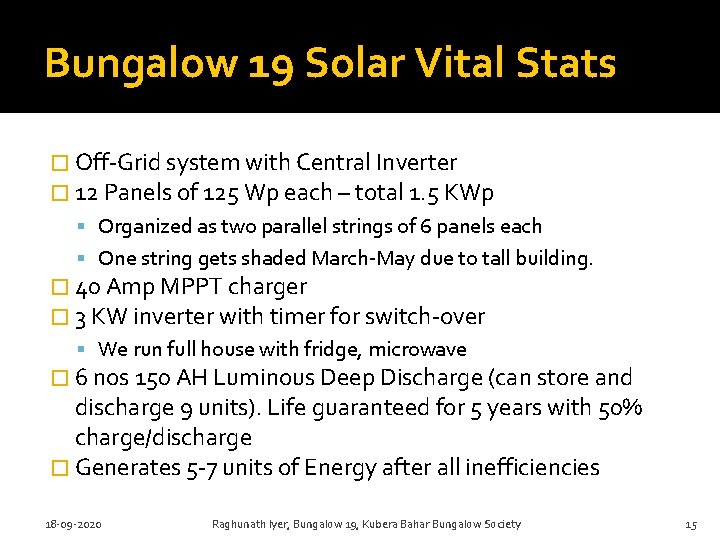
Bungalow 19 Solar Vital Stats � Off-Grid system with Central Inverter � 12 Panels of 125 Wp each – total 1. 5 KWp Organized as two parallel strings of 6 panels each One string gets shaded March-May due to tall building. � 40 Amp MPPT charger � 3 KW inverter with timer for switch-over We run full house with fridge, microwave � 6 nos 150 AH Luminous Deep Discharge (can store and discharge 9 units). Life guaranteed for 5 years with 50% charge/discharge � Generates 5 -7 units of Energy after all inefficiencies 18 -09 -2020 Raghunath Iyer, Bungalow 19, Kubera Bahar Bungalow Society 15
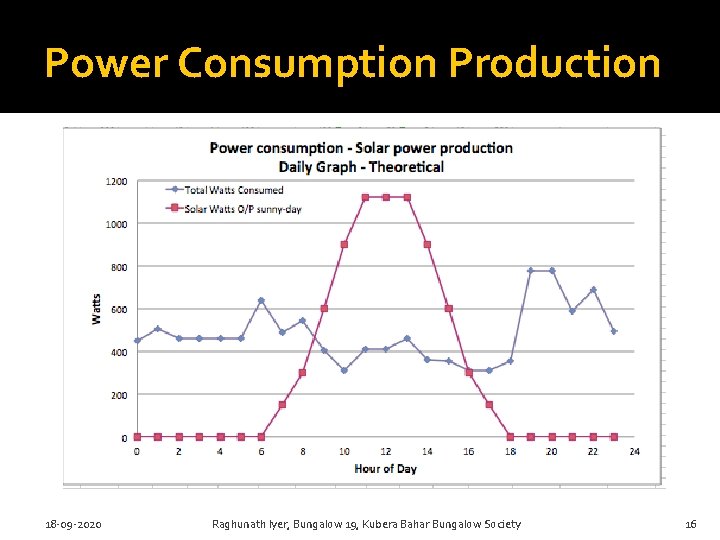
Power Consumption Production 18 -09 -2020 Raghunath Iyer, Bungalow 19, Kubera Bahar Bungalow Society 16
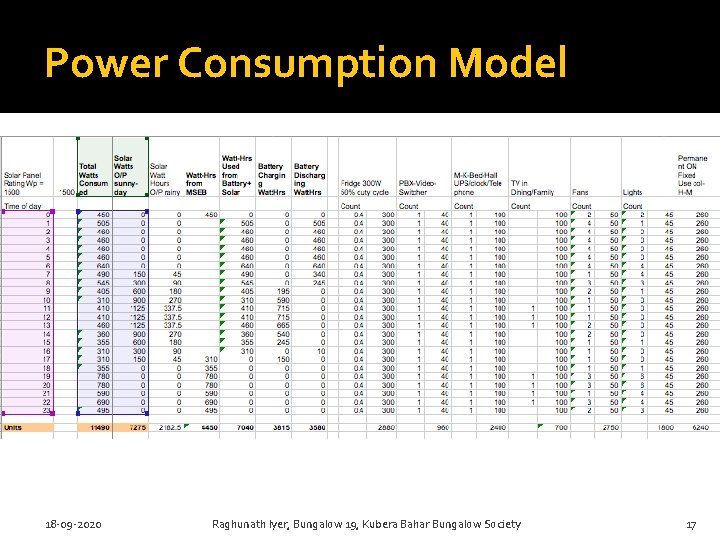
Power Consumption Model 18 -09 -2020 Raghunath Iyer, Bungalow 19, Kubera Bahar Bungalow Society 17
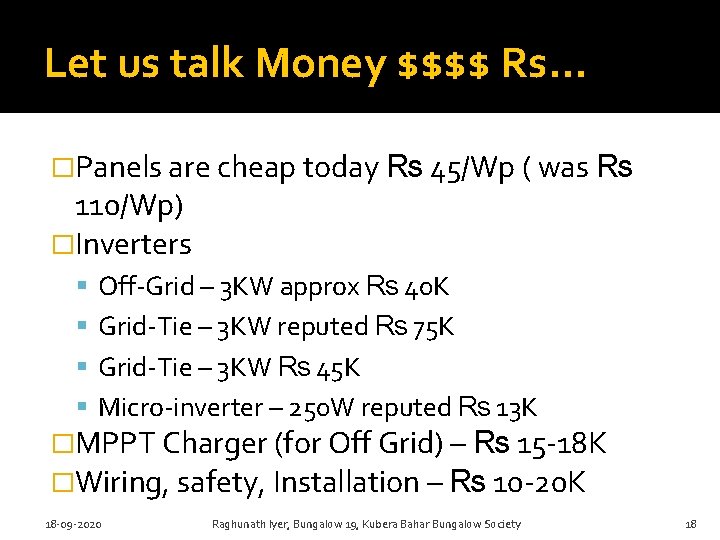
Let us talk Money $$$$ Rs… �Panels are cheap today ₨ 45/Wp ( was ₨ 110/Wp) �Inverters Off-Grid – 3 KW approx ₨ 40 K Grid-Tie – 3 KW reputed ₨ 75 K Grid-Tie – 3 KW ₨ 45 K Micro-inverter – 250 W reputed ₨ 13 K �MPPT Charger (for Off Grid) – ₨ 15 -18 K �Wiring, safety, Installation – ₨ 10 -20 K 18 -09 -2020 Raghunath Iyer, Bungalow 19, Kubera Bahar Bungalow Society 18
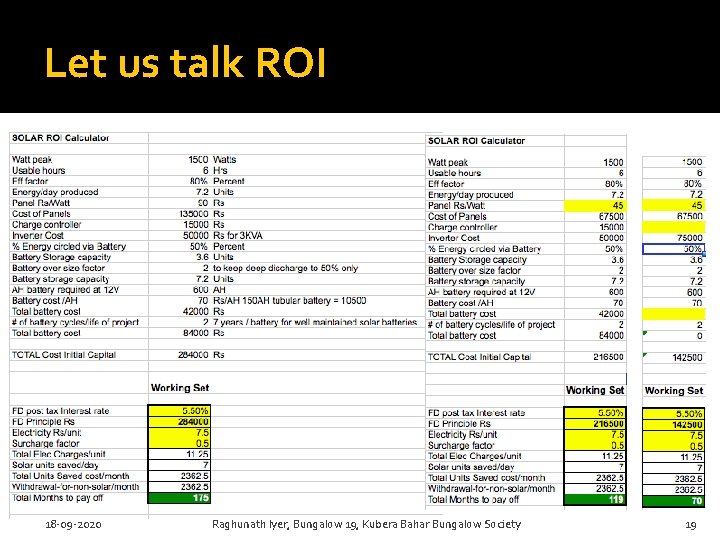
Let us talk ROI 18 -09 -2020 Raghunath Iyer, Bungalow 19, Kubera Bahar Bungalow Society 19
- Slides: 19