
BPF Exploiting Global Dataflow Optimization in a Packet
BPF+ Exploiting Global Data-flow Optimization in a Packet Filter Architecture Andrew Begel, Steven Mc. Canne, Susan L. Graham University of California, Berkeley with acknowledgments to Van Jacobson
The Big Picture With BPF+, we can express packet filters in a high-level language and compile them into efficient code.
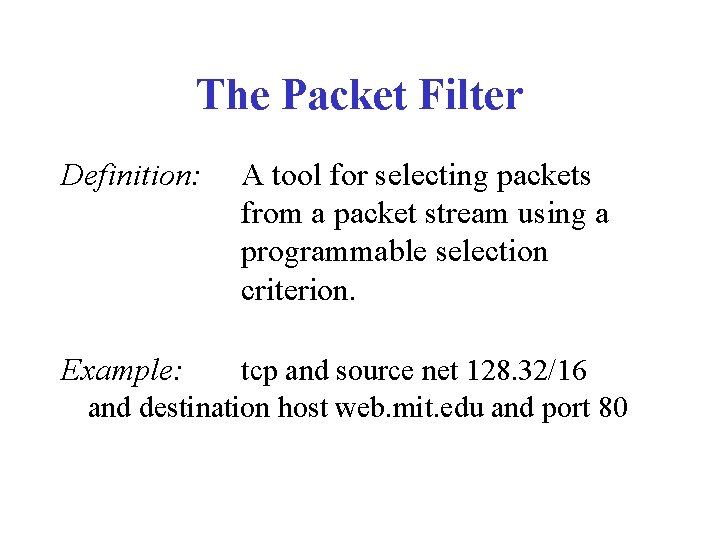
The Packet Filter Definition: Example: A tool for selecting packets from a packet stream using a programmable selection criterion. tcp and source net 128. 32/16 and destination host web. mit. edu and port 80
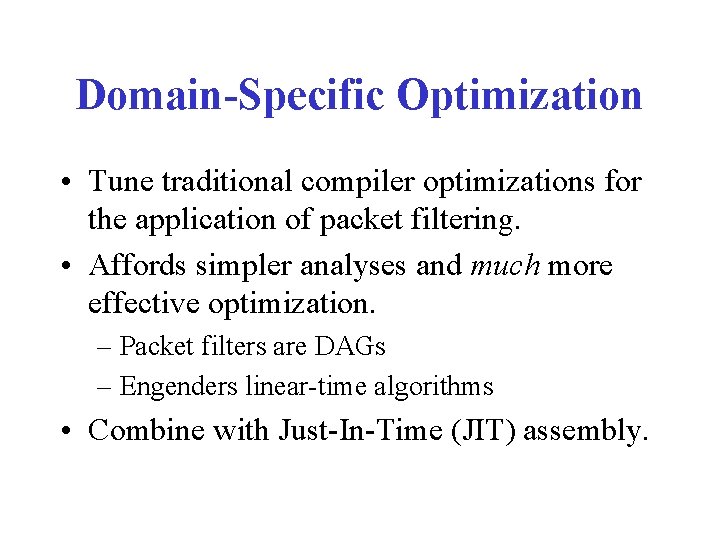
Domain-Specific Optimization • Tune traditional compiler optimizations for the application of packet filtering. • Affords simpler analyses and much more effective optimization. – Packet filters are DAGs – Engenders linear-time algorithms • Combine with Just-In-Time (JIT) assembly.
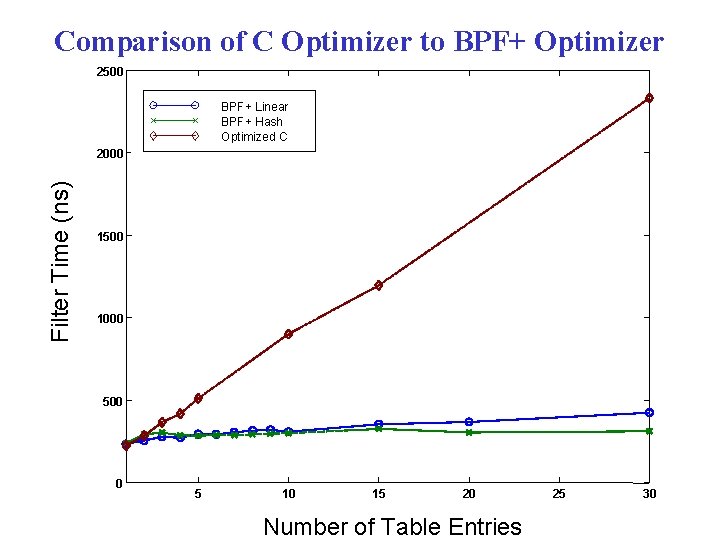
Comparison of C Optimizer to BPF+ Optimizer 2500 BPF+ Linear BPF+ Hash Optimized C Filter Time (ns) 2000 1500 1000 500 0 5 10 15 20 Number of Table Entries 25 30
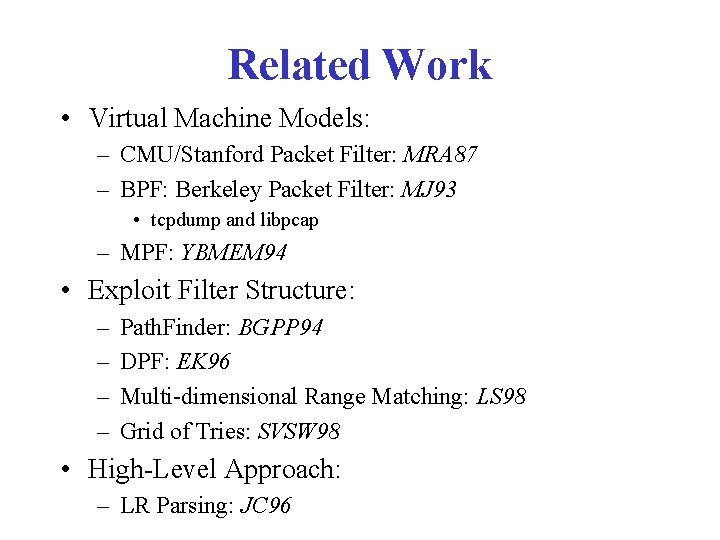
Related Work • Virtual Machine Models: – CMU/Stanford Packet Filter: MRA 87 – BPF: Berkeley Packet Filter: MJ 93 • tcpdump and libpcap – MPF: YBMEM 94 • Exploit Filter Structure: – – Path. Finder: BGPP 94 DPF: EK 96 Multi-dimensional Range Matching: LS 98 Grid of Tries: SVSW 98 • High-Level Approach: – LR Parsing: JC 96


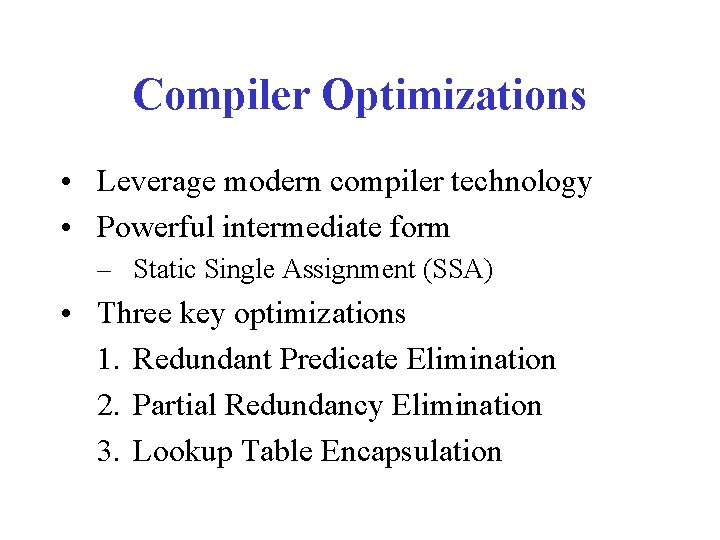
Compiler Optimizations • Leverage modern compiler technology • Powerful intermediate form – Static Single Assignment (SSA) • Three key optimizations 1. Redundant Predicate Elimination 2. Partial Redundancy Elimination 3. Lookup Table Encapsulation
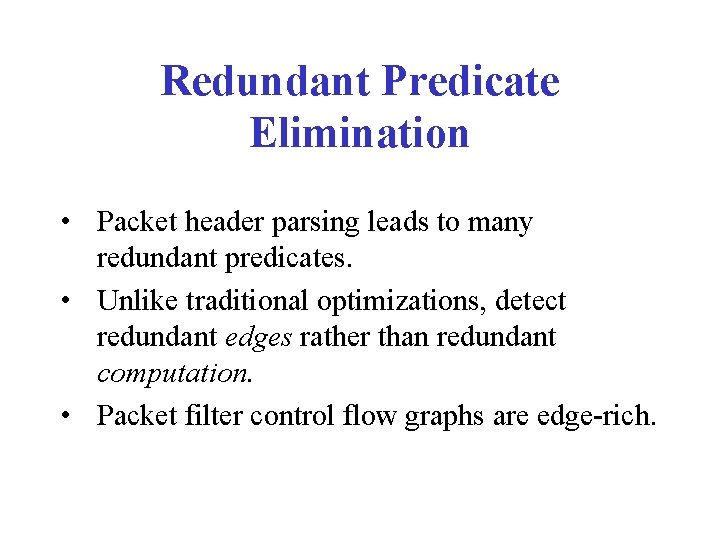
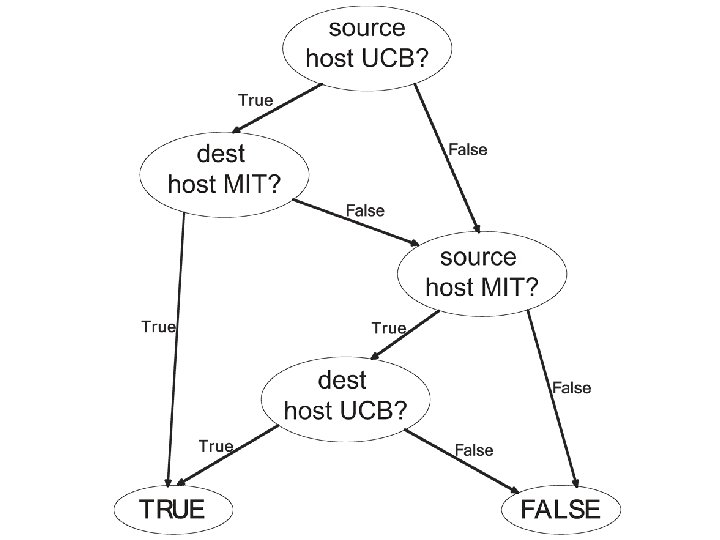
Redundant Predicate Elimination • Packet header parsing leads to many redundant predicates. • Unlike traditional optimizations, detect redundant edges rather than redundant computation. • Packet filter control flow graphs are edge-rich.
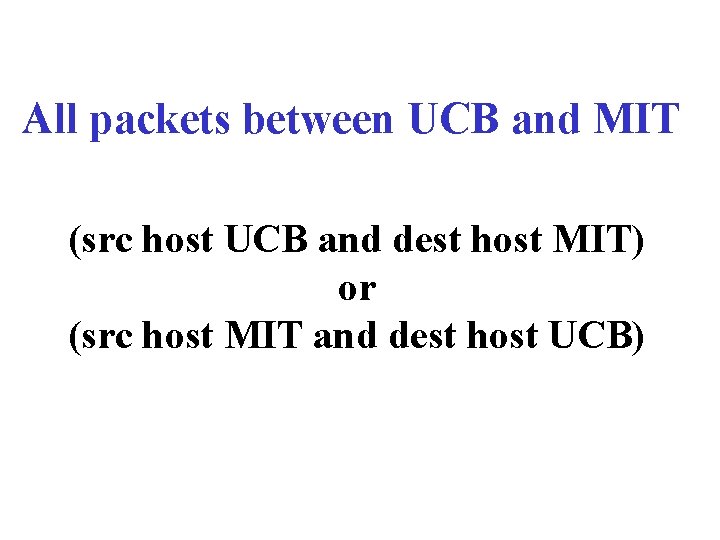
All packets between UCB and MIT (src host UCB and dest host MIT) or (src host MIT and dest host UCB)
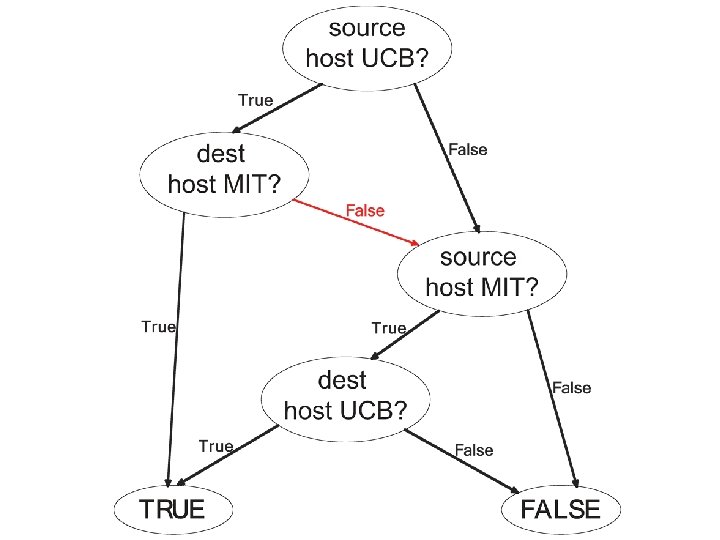
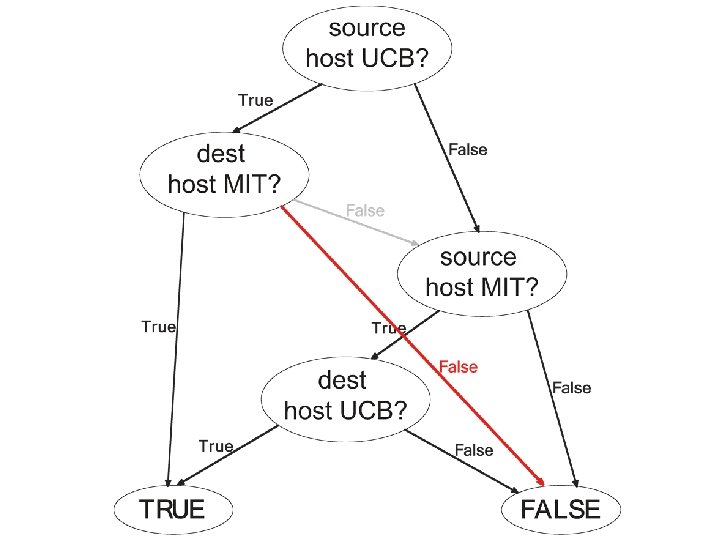
Partial Redundancy Elimination • Packet header parsing also leads to much redundant computation.
All packets that come from either UCB or MIT src host UCB or src host MIT



Putting Them Both Together • Combining partial redundancy elimination with redundant predicate elimination is much more effective than using either alone. (6 steps later. . . )

Lookup Table Encapsulation • After early optimizations, many predicates reduced to simple field comparisons. • Use analysis to discover opportunities for moving into lookup tables. • Implementation may use linear search, binary search, hash lookup or any combination of the three.
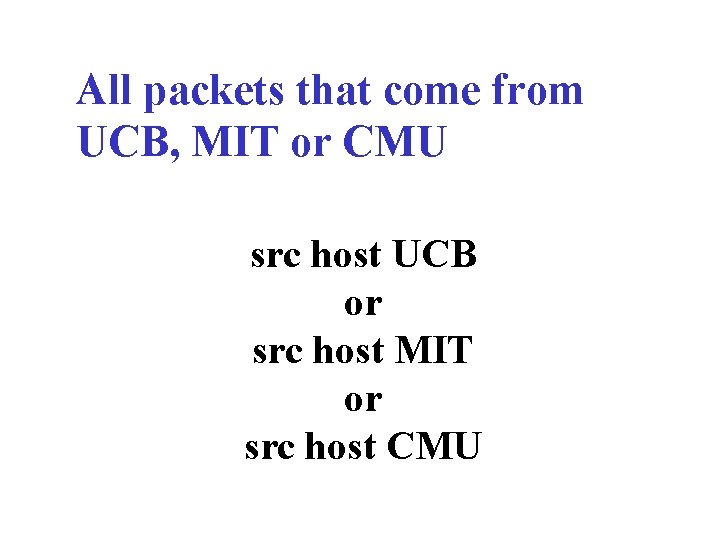
All packets that come from UCB, MIT or CMU src host UCB or src host MIT or src host CMU





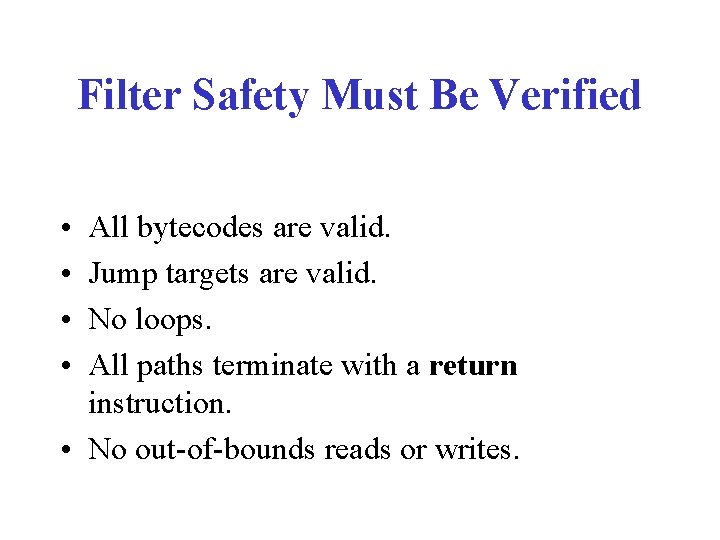
Filter Safety Must Be Verified • • All bytecodes are valid. Jump targets are valid. No loops. All paths terminate with a return instruction. • No out-of-bounds reads or writes.

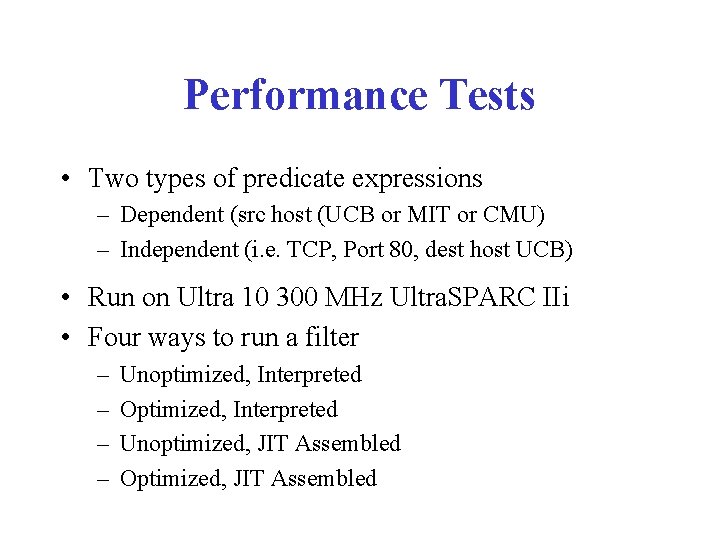
Performance Tests • Two types of predicate expressions – Dependent (src host (UCB or MIT or CMU) – Independent (i. e. TCP, Port 80, dest host UCB) • Run on Ultra 10 300 MHz Ultra. SPARC IIi • Four ways to run a filter – – Unoptimized, Interpreted Optimized, Interpreted Unoptimized, JIT Assembled Optimized, JIT Assembled
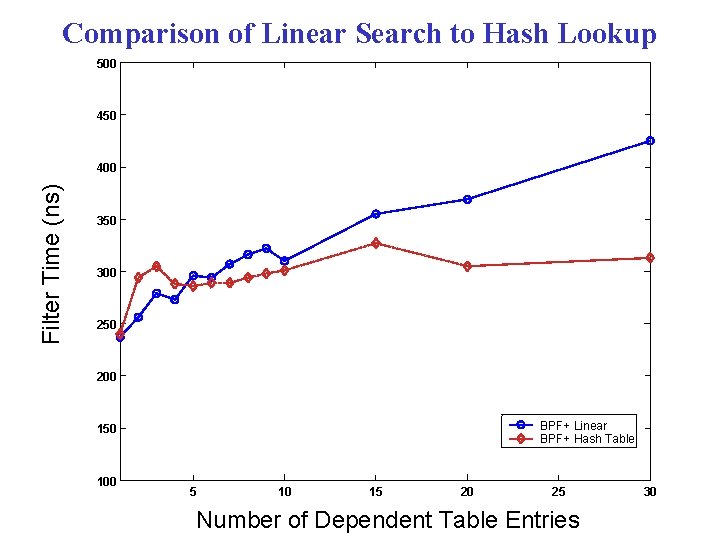
Comparison of Linear Search to Hash Lookup 500 450 Filter Time (ns) 400 350 300 250 200 BPF+ Linear BPF+ Hash Table 150 100 5 10 15 20 25 Number of Dependent Table Entries 30
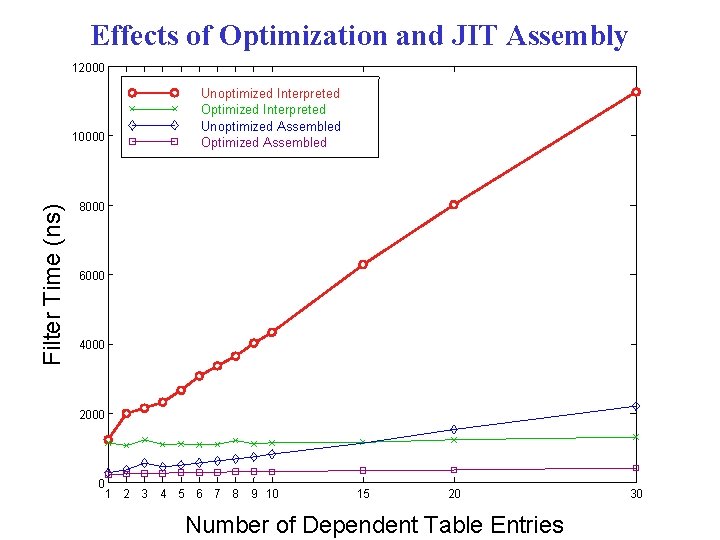
Effects of Optimization and JIT Assembly 12000 Filter Time (ns) 10000 Unoptimized Interpreted Optimized Interpreted Unoptimized Assembled Optimized Assembled 8000 6000 4000 2000 0 1 2 3 4 5 6 7 8 9 10 15 20 Number of Dependent Table Entries 30
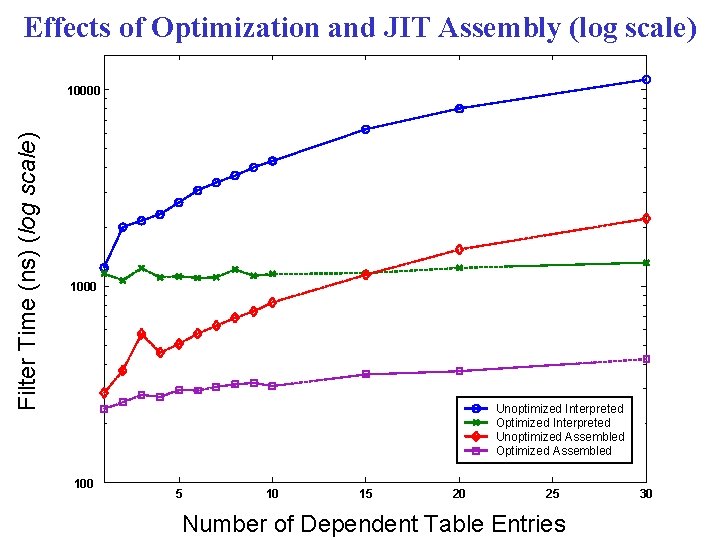
Effects of Optimization and JIT Assembly (log scale) Filter Time (ns) (log scale) 10000 1000 Unoptimized Interpreted Optimized Interpreted Unoptimized Assembled Optimized Assembled 100 5 10 15 20 25 Number of Dependent Table Entries 30
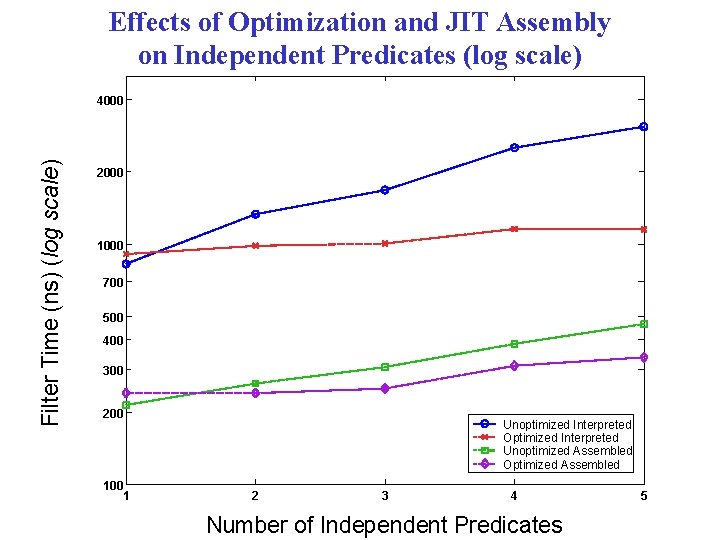
Effects of Optimization and JIT Assembly on Independent Predicates (log scale) Filter Time (ns) (log scale) 4000 2000 1000 700 500 400 300 200 1 Unoptimized Interpreted Optimized Interpreted Unoptimized Assembled Optimized Assembled 2 3 4 Number of Independent Predicates 5
Future Work • More efficient table lookup representations (LS 98, SVSW 98) • Better support for packet classification • Loops – Proof-Carrying Code, Necula 96 • Intrusion detection – Online Updates
Conclusions • Packet filters can be specified at a highlevel and be efficiently executed. • Key idea: Tune familiar global data-flow compiler analyses and optimizations for packet filtering.
- Slides: 37