
BOY TALES OF CHILDHOOD BY ROALD DAHL LO
BOY TALES OF CHILDHOOD BY ROALD DAHL LO: To analyse language used by Dahl to describe Mrs Pratchett. ST: I can identify language choices made by a writer for effect.
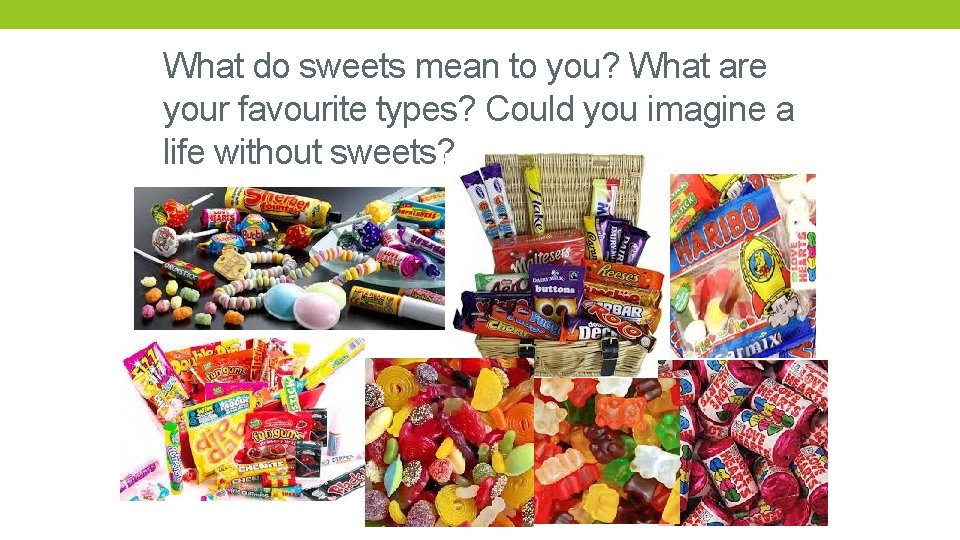
What do sweets mean to you? What are your favourite types? Could you imagine a life without sweets?
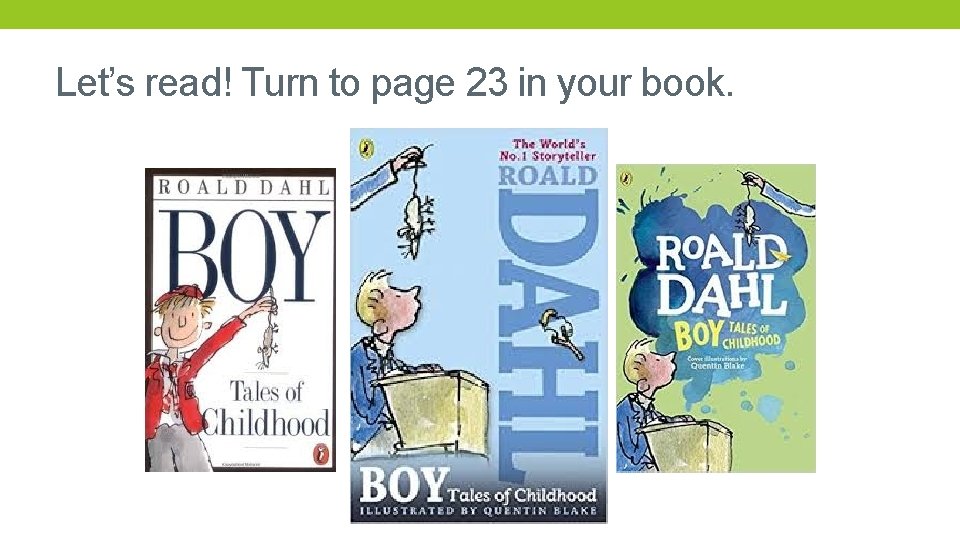
Let’s read! Turn to page 23 in your book.
Task 1: List five things about the boy. Remember to write in full sentences! It was my first term and I was walking home alone across the village green after school when suddenly one of the senior twelve-year-old boys came riding full speed down the road on his bicycle about twenty yards away from me. The road was on a hill and the boy was going down the slope, and as he flashed by he started backpedalling very quickly so that the free-wheeling mechanism of his bike made a loud whirring sound. At the same time, he took his hands off the handlebars and folded them casually across his chest. I stopped dead and stared after him. How wonderful he was! How swift and brave and graceful in his long trousers with bicycle-clips around them and his scarlet school cap at a jaunty angle on his head!
Five things: • We learn the boy was 12 years old • We learn he was riding a bike very fast down a hill. • We learn he back pedalled to make the bike whirr loudly. • We learn he took his hands off the handlebars. • We learn he wore long trousers and bicycle clips. • We learn he wore a red school cap.

Task: Using your Mrs Pratchett image draw on her face/head. Look at page 32 -33 and find some words and phrases that Roald Dahl uses to describe Mrs Pratchett. Label the image.
Task: Read your handout on Mrs Pratchett. How does Roald Dahl use language to describe her? Highlight words and phrases that you think are effective. The sweet- shop in Llandaff in the year 1923 was the very centre of our lives. To us, it was what a bar is to a drunk, or a church is to a Bishop. Without it, there would have been little to live for. But it had one terrible drawback, this sweet-shop. The woman who owned it was a horror. We hated her and we had good reason for doing so. Her name was Mrs Pratchett. She was a small skinny old hag with a moustache on her upper lip and a mouth as sour as a green gooseberry. She never smiled. She never welcomed us when we went in, and the only times she spoke were when she said things like, ‘I’m watchin’ you so keep yer thievin’ fingers off them chocolates!’ Or ‘I don’t want you in ‘ere just to look around! Either you forks out or you gets out!’ But by far the most loathsome thing about Mrs Pratchett was the filth that clung around her. Her apron was grey and greasy. Her blouse had bits of breakfast all over it, toast-crumbs and tea stains and splotches of dried egg-yolk. It was her hands, however, that disturbed us most. They were disgusting. They were black with dirt and grime. They looked as though they had been putting lumps of coal on the fire all day long. And do not forget please that it was these very hands and fingers that plunged into the sweet-jars when we asked for a pennyworth of Treacle Toffee or Wine Gums or Nut Clusters or whatever. There were precious few health laws in those days, and nobody, least of all Mrs Pratchett, ever thought of using a little shovel for getting the sweets as they do today. The mere sight of her grimy right hand with its black fingernails digging an ounce of Chocolate Fudge out of a jar would have caused a starving tramp to go running from the shop. But not us. Sweets were our life-blood. We would have put up with far worse than that to get them. So we simply stood and watched in sullen silence while this disgusting old woman stirred around inside the jars with her foul fingers. The other thing we hated Mrs Pratchett for was her meanness. Unless you spent a whole sixpence all in one go, she wouldn’t give you a bag. Instead you got your sweets twisted in a small piece of newspaper which she tore off a pile of old Daily Mirrors lying on the counter. So you can well understand that we had it in for Mrs Pratchett in a big way, but we didn’t quite know what to do about it. Many schemes were put forward but none of them, that is, until suddenly, one memorable afternoon, we found the dead mouse.
Task: Now write one PEA paragraph answering the question –How does Roald Dahl use language to describe Mrs Pratchett? Roald Dahl describes Mrs Pratchett as … A good example is “………. ” Dahl uses a … to describe her. This shows that Mrs Pratchett is …. It helps a reader to …. . imagine/picture/visualize ….

Plenary: • Questions: • 1. How does Roald Dahl show Mrs Pratchett is unpleasant to the children? • 2. Why do the children keep using the sweet-shop even though Mrs Pratchett is so horrible? • 3. Why do you think the children want to get back at Mrs Pratchett? • 4. Roald Dahl uses a simile to describe her appearance, why is it effective? • 5. Can you spot any use of alliteration in the extract? What effect does it have on the reader?
- Slides: 9