
Boxing Up The Big Launch Why do we
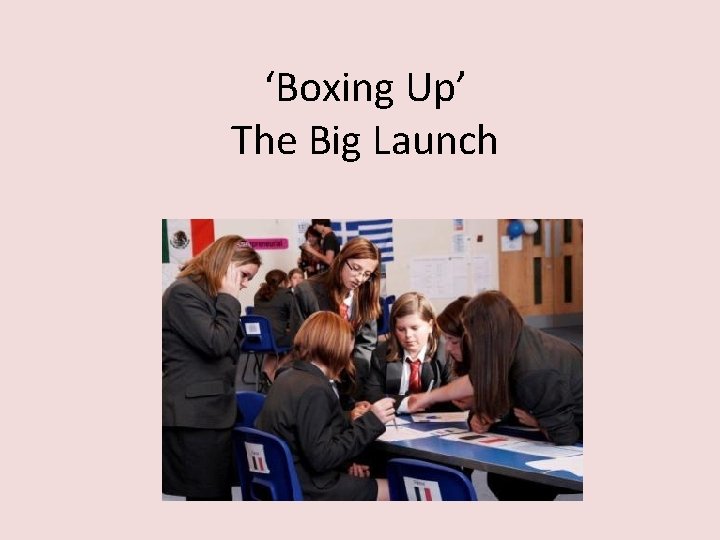
‘Boxing Up’ The Big Launch
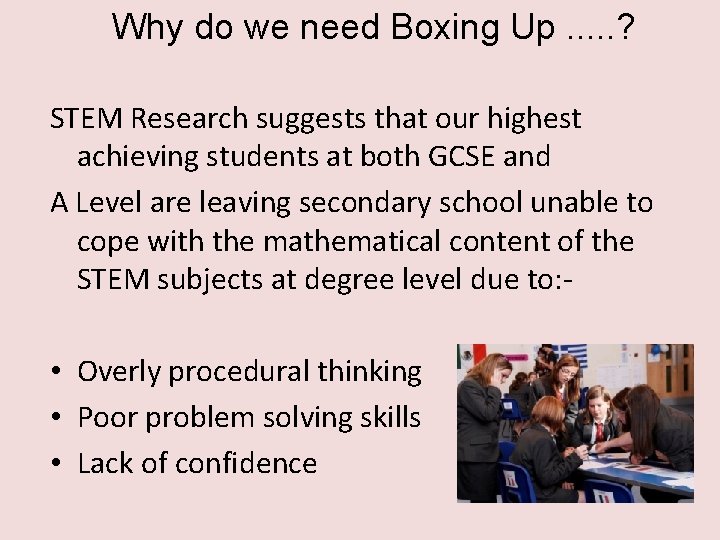
Why do we need Boxing Up. . . ? STEM Research suggests that our highest achieving students at both GCSE and A Level are leaving secondary school unable to cope with the mathematical content of the STEM subjects at degree level due to: - • Overly procedural thinking • Poor problem solving skills • Lack of confidence
‘Boxing Up’ addresses this issue. It removes the emphasis for both students and teachers from arriving at the correct answer to an understanding of the thinking needed to arrive at the solution.
Secondly, we discovered that our students were struggling with the wordy questions in the Functional GCSE and losing out on some of the Quality of Written Communication marks. Boxing Up provides pupils with a strategy for solving these functional questions.
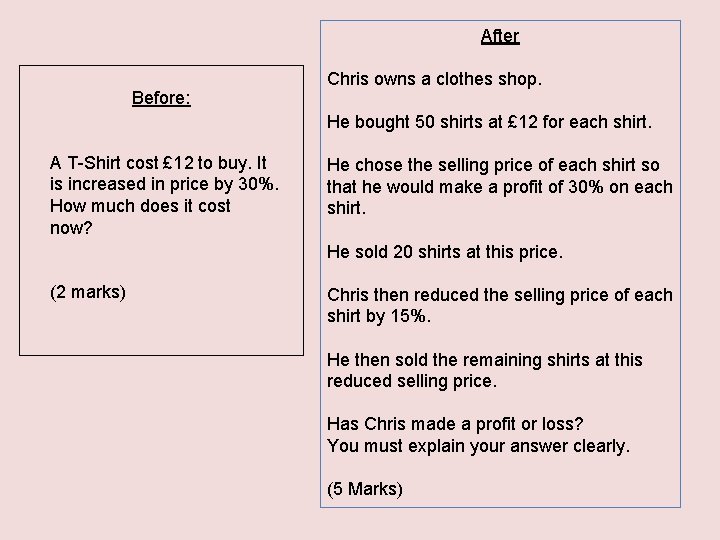
After Before: Chris owns a clothes shop. He bought 50 shirts at £ 12 for each shirt. A T-Shirt cost £ 12 to buy. It is increased in price by 30%. How much does it cost now? He chose the selling price of each shirt so that he would make a profit of 30% on each shirt. He sold 20 shirts at this price. (2 marks) Chris then reduced the selling price of each shirt by 15%. He then sold the remaining shirts at this reduced selling price. Has Chris made a profit or loss? You must explain your answer clearly. (5 Marks)
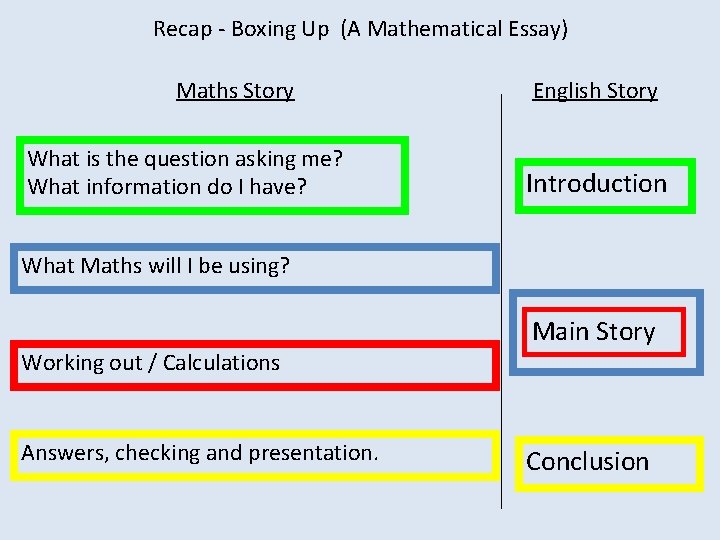
Recap - Boxing Up (A Mathematical Essay) Maths Story What is the question asking me? What information do I have? English Story Introduction What Maths will I be using? Working out / Calculations Answers, checking and presentation. Main Story Conclusion
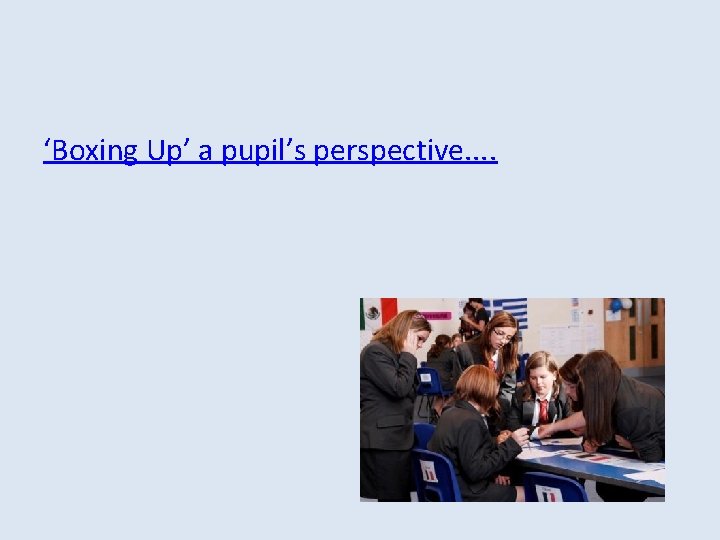
‘Boxing Up’ a pupil’s perspective. .
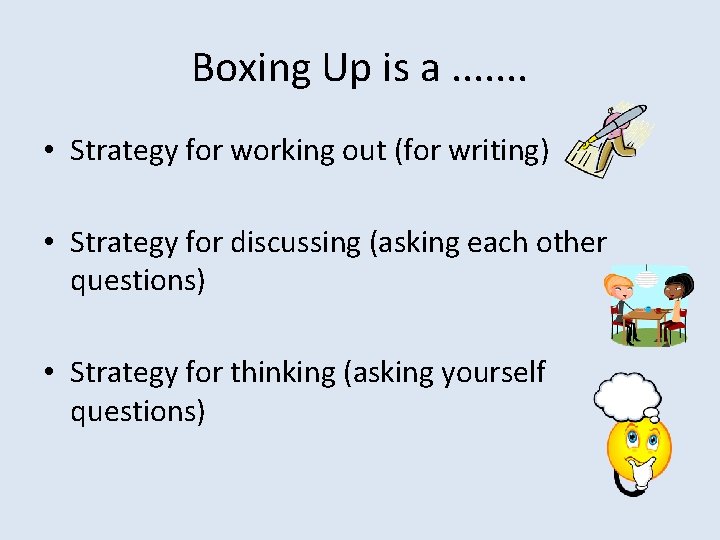
Boxing Up is a. . . . • Strategy for working out (for writing) • Strategy for discussing (asking each other questions) • Strategy for thinking (asking yourself questions)
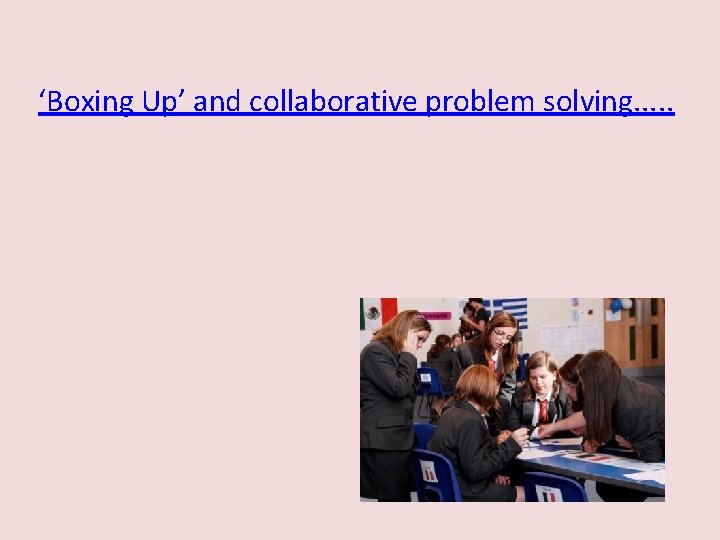
‘Boxing Up’ and collaborative problem solving. . .
Today’s Task On each table there is a wordy exam problem. You will have 5 minutes at each table to work together to solve the problem using boxing up. Think about the problem. Pair up with the person next to you to decide what to write in each box. Share your answer with the pair opposite. When you hear the buzzer move in a clockwise direction to the next table.
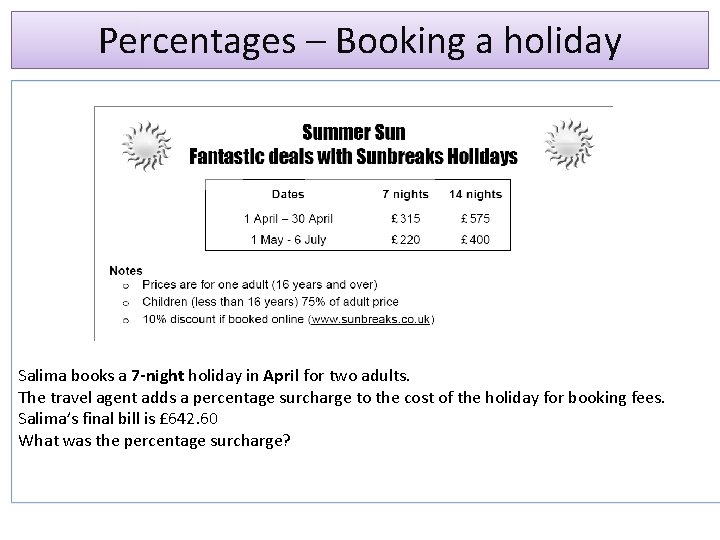
Percentages – Booking a holiday Salima books a 7 -night holiday in April for two adults. The travel agent adds a percentage surcharge to the cost of the holiday for booking fees. Salima’s final bill is £ 642. 60 What was the percentage surcharge?
Ratio & Percentages – Tickets In 2006, the production cost of the Newton School play was £ 370. In 2007, due to the fact that the school had to hire some special costumes the production cost increased by 12%. In 2006, the total number of tickets sold for the play was 732. They sold 1/6 more tickets in 2007 In both years the ratio of adult tickets to student tickets was 42 : 19. In 2006, adult tickets cost £ 3 each and student tickets cost £ 1. 50 each. In 2007 prices were reduced by 10%. Work out the profit or loss made by Newton School in 2006 and 2007.
Percentages – Clothes Chris owns a clothes shop. He bought 50 shirts at £ 12 for each shirt. He chose the selling price of each shirt so that he would make a profit of 30% on each shirt. He sold 20 shirts at this price. Chris then reduced the selling price of each shirt by 15%. He then sold the remaining shirts at this reduced selling price. Has Chris made a profit or loss? You must explain your answer clearly.
Money – Gas Bill Mr Black is looking at cheaper ways of paying for the gas he uses. He has received the following details from two companies. GASCOM Standing charge per month: £ 1. 00 Cost per k. Wh: £ 2. 99 UGAS Standing charge per month: £ 3. 78 Cost per k. Wh: £ 2. 38 Mr Black estimates that he will use 4000 k. Wh in the next 3 months. From which company would his gas bill be cheaper and by how much?
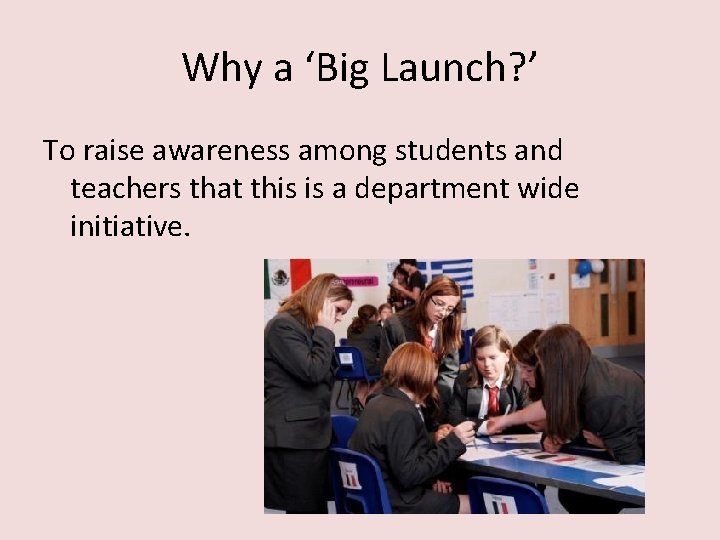
Why a ‘Big Launch? ’ To raise awareness among students and teachers that this is a department wide initiative.
Organising the Launch • All of year 11 took part in an assembly on the morning of the Launch so that we could explain the purpose and structure of the day. • We then split the year group into two halves and held two sessions, one before break and one from break until lunch. • For each session the year 11 s were split into three groups. • The first group into the hall were trained in ‘Boxing Up. ’ • They then trained the second group into the hall. • Both these groups then trained the last group into the hall.
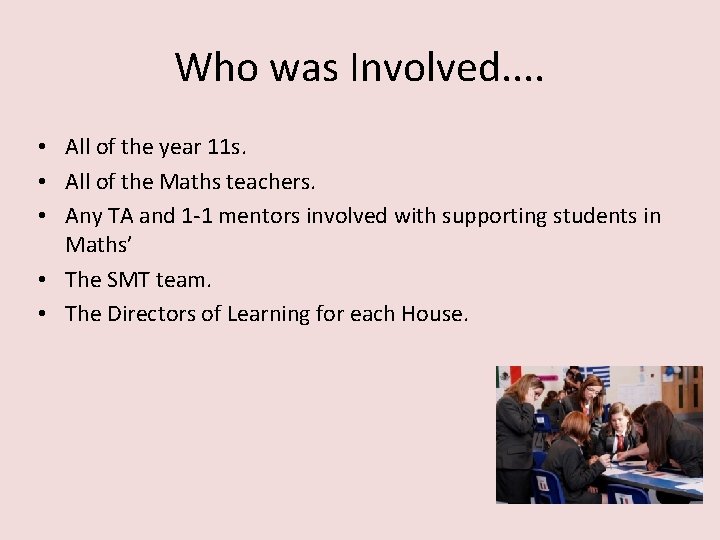
Who was Involved. . • All of the year 11 s. • All of the Maths teachers. • Any TA and 1 -1 mentors involved with supporting students in Maths’ • The SMT team. • The Directors of Learning for each House.
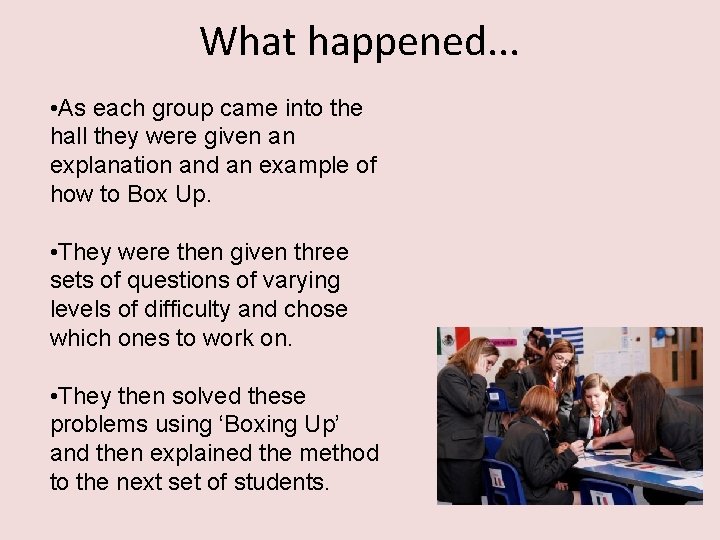
What happened. . . • As each group came into the hall they were given an explanation and an example of how to Box Up. • They were then given three sets of questions of varying levels of difficulty and chose which ones to work on. • They then solved these problems using ‘Boxing Up’ and then explained the method to the next set of students.
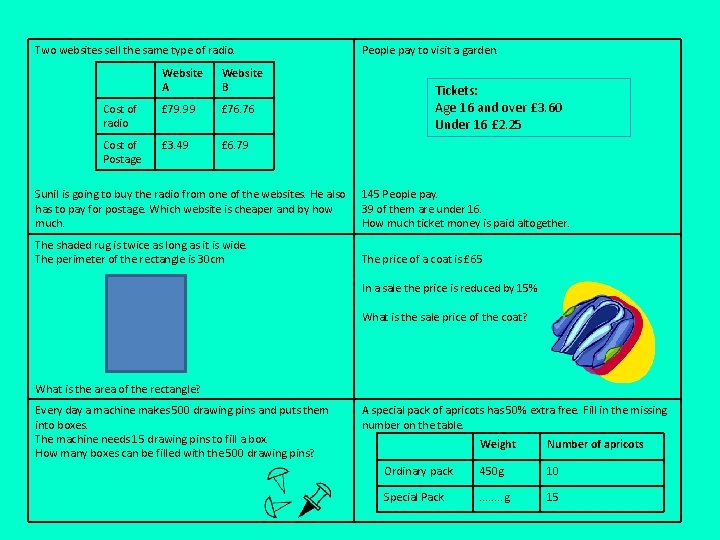
Two websites sell the same type of radio. Website A Website B Cost of radio £ 79. 99 £ 76. 76 Cost of Postage £ 3. 49 £ 6. 79 People pay to visit a garden. Tickets: Age 16 and over £ 3. 60 Under 16 £ 2. 25 Sunil is going to buy the radio from one of the websites. He also has to pay for postage. Which website is cheaper and by how much. 145 People pay. 39 of them are under 16. How much ticket money is paid altogether. The shaded rug is twice as long as it is wide. The perimeter of the rectangle is 30 cm The price of a coat is £ 65 In a sale the price is reduced by 15% What is the sale price of the coat? What is the area of the rectangle? Every day a machine makes 500 drawing pins and puts them into boxes. The machine needs 15 drawing pins to fill a box. How many boxes can be filled with the 500 drawing pins? A special pack of apricots has 50% extra free. Fill in the missing number on the table. Weight Number of apricots Ordinary pack 450 g 10 Special Pack . . . . g 15
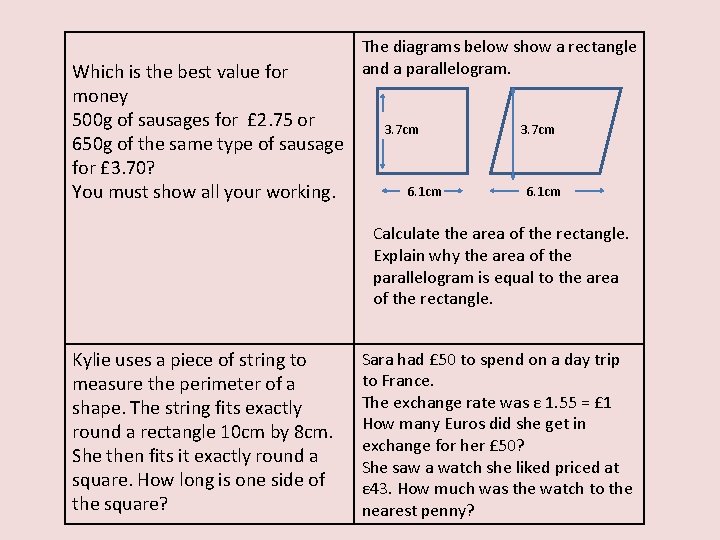
Which is the best value for money 500 g of sausages for £ 2. 75 or 650 g of the same type of sausage for £ 3. 70? You must show all your working. The diagrams below show a rectangle and a parallelogram. 3. 7 cm 6. 1 cm Calculate the area of the rectangle. Explain why the area of the parallelogram is equal to the area of the rectangle. Kylie uses a piece of string to measure the perimeter of a shape. The string fits exactly round a rectangle 10 cm by 8 cm. She then fits it exactly round a square. How long is one side of the square? Sara had £ 50 to spend on a day trip to France. The exchange rate was ε 1. 55 = £ 1 How many Euros did she get in exchange for her £ 50? She saw a watch she liked priced at ε 43. How much was the watch to the nearest penny?
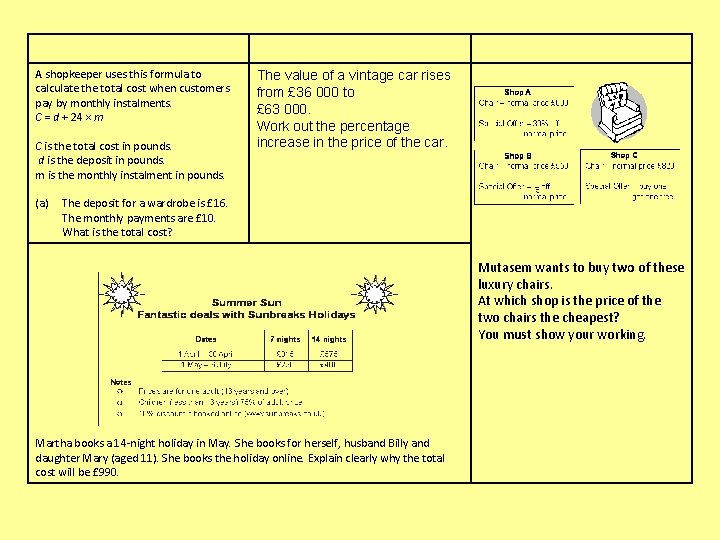
A shopkeeper uses this formula to calculate the total cost when customers pay by monthly instalments. C = d + 24 × m C is the total cost in pounds. d is the deposit in pounds. m is the monthly instalment in pounds. The value of a vintage car rises from £ 36 000 to £ 63 000. Work out the percentage increase in the price of the car. (a) The deposit for a wardrobe is £ 16. The monthly payments are £ 10. What is the total cost? Mutasem wants to buy two of these luxury chairs. At which shop is the price of the two chairs the cheapest? You must show your working. Martha books a 14 -night holiday in May. She books for herself, husband Billy and daughter Mary (aged 11). She books the holiday online. Explain clearly why the total cost will be £ 990.
We have some examples of how pupils’ boxed up these questions.
What happened next. . All Maths teacher are encourage pupils to use ‘Boxing Up’ at every opportunity. The four questions were made into A 2 posters and displayed in each classroom. Maths teachers use the posters and question cards to remind students that they are only allowed to ask for help using one of the four questions.
Next Steps at PACA ‘Boxing Up’ is an initiative that other departments are planning to adopt, it is intended that the method will soon become a whole school approach to problem solving.
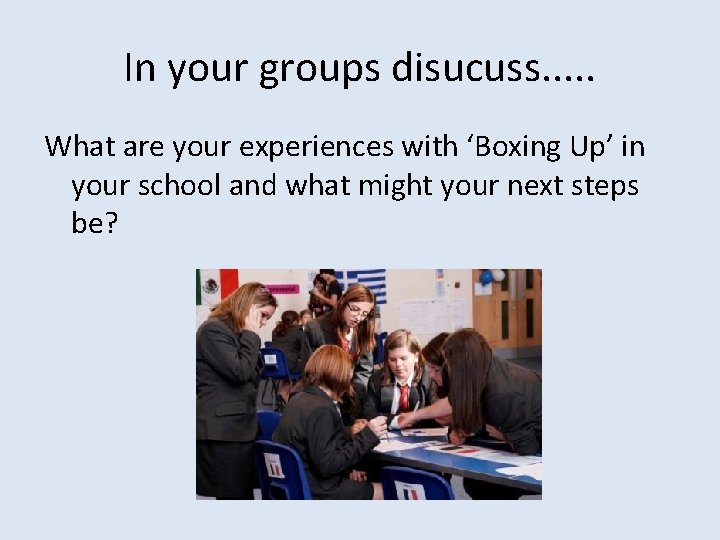
In your groups disucuss. . . What are your experiences with ‘Boxing Up’ in your school and what might your next steps be?
"Good teaching is more a giving of right questions than a giving of right answers. "--Josef Albers What is the question asking me? What information do I already have? What calculations / working out do I need to do? What maths will I be using? How can I check my answer is correct?
‘Learning is making sense, not just remembering’ Geoff Petty Author of Evidence-Based Teaching
- Slides: 27