
Bowel Obstruction Alia Tuqan M D Goals and
Bowel Obstruction Alia Tuqan, M. D.
Goals and Objectives • Understand the pathophysiology of bowel obstruction • Diagnosis of bowel obstruction • Treatment options for bowel obstruction ▫ Medical and surgical options
Introduction • Blockage at some point in the gastrointestinal tract preventing the passage of food and feces ▫ ▫ Partial or complete Mechanical and/or functional Benign or malignant Single or multiple • Common with certain types of cancers ▫ Colorectal ▫ Ovarian ▫ Metastases from other sites • Other causes ▫ ▫ Surgical adhesions Post-radiation fibrosis Fecal impaction Inflammatory bowel disease
Introduction • Morbidity is high and survival is poor in malignant bowel obstruction (MBO) ▫ Chakraborty et al. , 2011 � 35 hospitalized patients were included � 58% were re-admitted �Median survival was 80 days � 17% were alive at 1 year
Pathophysiology • Bowel obstruction ègut hypoxia and bacterial overgrowth ègas production and bowel distension èincreased production of vaso-active peptides and splanchnic vasodilation èincreased production and pooling of secretions ènausea and vomiting and further gas production and bowel distension èincreased gut peristalsis è abdominal pain and increased gas, secretions and distension • A vicious cycle that feeds on itself
Diagnosis • Based on clinical presentation, exam and imaging • Patients often present with abdominal pain, nausea, vomiting and inability to tolerate liquids and solids • Physical exam reveals high-pitched, hypoactive to no bowel sounds and a tender abdomen • Abdominal X-rays show air-fluid levels • Abdominal and pelvic CT-scans show a variety of findings: ▫ An intraluminal mass at the point of obstruction ▫ Peritoneal carcinomatosis diffusely lining the bowel and causing obstruction
Medical Management • When possible, conservative measures are tried first • Mechanical decompression with a nasogastric tube (NGT) • Anti-cholinergic agents (e. g. , scopolamine or glycopyrrolate) to reduce secretions • Pro-motility agents (e. g. , metoclopramide) • Steroids (e. g. , dexamethasone) to reduce inflammation and tumor burden • Manual dis-impaction and bowel regimens to treat fecal impaction • Avoidance of constipating medications (e. g. , opioids, tricyclic antidepressants and iron supplements)
Medical Management • Methylnaltrexone ▫ ▫ ▫ ▫ For opioid-induced constipation Works as mu opioid antagonist 0. 15 mcg/kq SQ or 5 -12 mg SQ x 1 Max dose: 12 mg Renally-dosed; if GFR < 30, reduce dose by 50% May repeat after 48 hrs Contraindicated in complete bowel obstructions
Medical Management • Octreotide ▫ Synthetic somatostatin analog ▫ Decreases secretions, splanchnic blood flow and peristalsis ▫ Provides symptomatic relief ▫ Dosing: �Start 50 -100 mcg q 8 hrs or 100 -200 mcg 2 -4 times per day �If this is not effective, a continuous infusion starting at 10 -20 mcg/hr and at a rate no more than 1200 mcg per day ▫ PO, PR, SQ and IV ▫ Can be efficacious when used in combination with other medications
Interventions: • Venting percutaneous endoscopic gastric (PEG) tube ▫ Typically reserved for patients with poorer functional status and limited life expectancy when medications are ineffective
Interventions • Stenting ▫ Typically reserved for patients with better functional status, life expectancy of weeks to months, and a single obstruction ▫ Covered versus uncovered stents �Risks: stent failure, biliary obstruction, bowel perforation �Tumor regrowth tends to be more common with uncovered stents �Stent migration tends to be more common with covered stents �Fernandez-Esparrach et al, 2011 concluded that surgery over stenting should be considered in patients with good functional status because of stenting complications
Surgery • Typically reserved for patients with better functional status and life expectancy of months • Involves bypassing or resecting the lesion
Surgery • Diverting stoma (DS) ▫ E. g. , ileostomy or colostomy ▫ Least complex surgery ▫ Has lower complication rates in comparison to other surgeries ▫ Better for patients with high-tumor burden and multiple areas of obstruction ▫ Good for distal obstructions in the small or large bowel
Surgery • Internal bypass (IB) ▫ More complex of a surgery than DS, less complex than PR ▫ Better for proximal obstructions in the small bowel
Surgery • Palliative resection (PR) ▫ Most complex surgery ▫ Carries the highest complication and survival rate ▫ Good for patients with low tumor burden, isolated obstruction, and good functional status
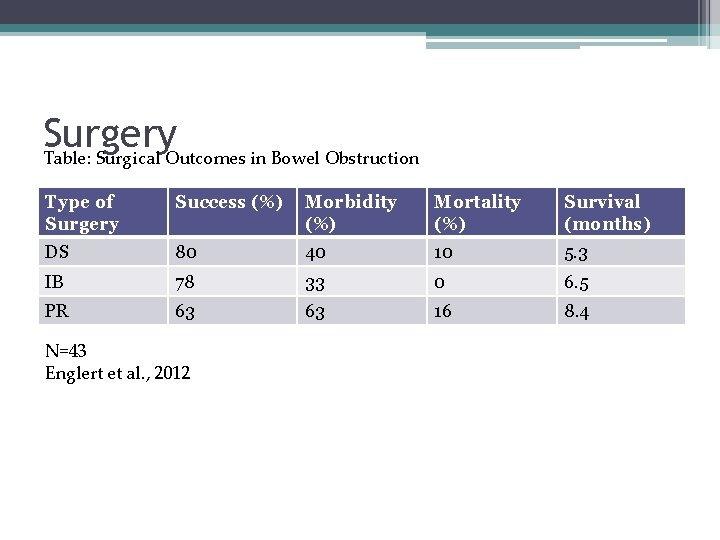
Surgery Table: Surgical Outcomes in Bowel Obstruction Type of Surgery Success (%) Morbidity (%) Mortality (%) Survival (months) DS 80 40 10 5. 3 IB 78 33 0 6. 5 PR 63 63 16 8. 4 N=43 Englert et al. , 2012
Sources • Anita Chakraborty, Debbie Selby, Kate Gardiner, Jeff Myers, Veronika Moravan, Frances Wright. Malignant Bowel Obstruction: Natural History of a Heterogeneous Patient Population Followed Prospectively Over Two Years. Journal of Pain and Symptom Management. 2011; 41(2): 412 -420. • Zachary P. Englert, Michael A. White, Timothy L Fitzgerald, Anusha Vadlamudi, Gus Zervoudakis, and Emmanuel E. Zervos. Surgical Management of Malignant Bowel Obstruction: At What Price Palliative? American Surgeon. 2012; 78: 647 -652. • Gloria Fernandez-Esparrach, J. M. Bordas, M. D. Giraldez, A. Gines, M. Pellise, O. Sendino, G. Martinez-Palli, A. Castells, and J. Llach. Severe Complications Limit Long-Term Clinical Success of Self-Expanding Metal Stents in Patients With Obstructive Colorectal Cancer. American Journal of Gastroenterology. 2010; 105: 1087 -1093. • Robert S. Krause. #119 Invasive Treatment Options for Malignant Bowel Obstruction. Fast Facts and Concepts. End of Life/Palliative Education Resource Center, Medical College of Wisconsin.
Sources • John Manfredonia. Urgent Medical Conditions: Spinal Cord Compression, Hypercalcemia, Seizures, Bowel Obstruction. AAHPM Intensive Board Review Course DVD. 2012. • Gola Tradounsky. Palliation of gastrointestinal obstruction. Canadian Family Physician. 2012; 58(6): 648 -652. • Rodney O. Tucker and Ashley C. Nichols. U 4: Managing Non-Pain Symptoms. American Academy of Hospice and Palliative Medicine. 2012. • Charles von Gunten and J Cameron Muir. #45 Medical Management of Bowel Obstruction, 2 nd edition. Fast Facts and Concepts. End of Life/Palliative Education Resource Center, Medical College of Wisconsin. • Catherine Weber and Gilbert B. Zulian. Malignant Irreversible Intestinal Obstruction: The Powerful Association of Octreotide to Corticosteroids, Antiemetics and Analgesics. American Journal of Hospice and Palliative Medicine. 2009; 26(2): 84 -88.
- Slides: 18