
Bowel and Bladder Management Following Transverse Myelitis Janet
Bowel and Bladder Management Following Transverse Myelitis Janet Dean, MS, RN, CRNP Pediatric Nurse Practitioner International Center for Spinal Cord Injury Department of Physical Medicine and Rehabilitation Johns Hopkins Hospital
Bowel and Bladder • Functions – Store waste – Release waste at the appropriate times • Each system has – Muscular storage area – Outlet valve or sphincter • Control – Voluntary – Involuntary
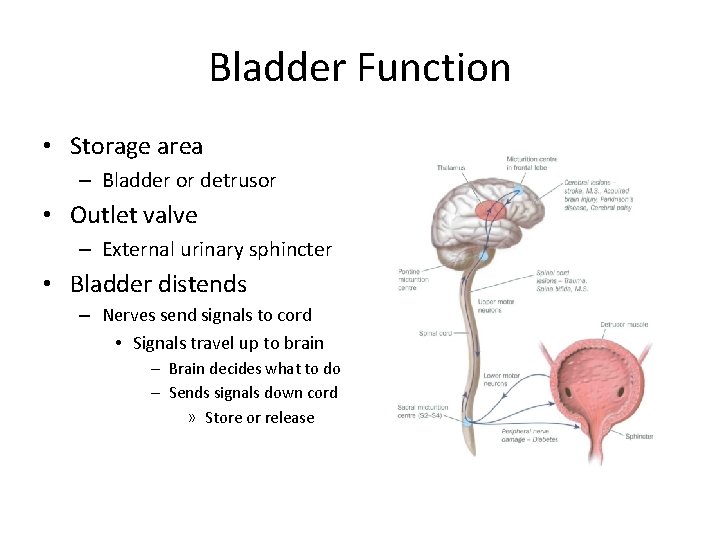
Bladder Function • Storage area – Bladder or detrusor • Outlet valve – External urinary sphincter • Bladder distends – Nerves send signals to cord • Signals travel up to brain – Brain decides what to do – Sends signals down cord » Store or release
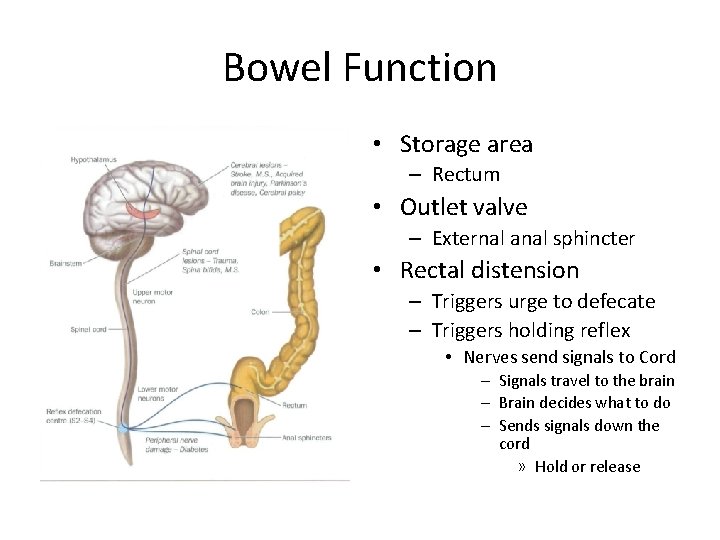
Bowel Function • Storage area – Rectum • Outlet valve – External anal sphincter • Rectal distension – Triggers urge to defecate – Triggers holding reflex • Nerves send signals to Cord – Signals travel to the brain – Brain decides what to do – Sends signals down the cord » Hold or release
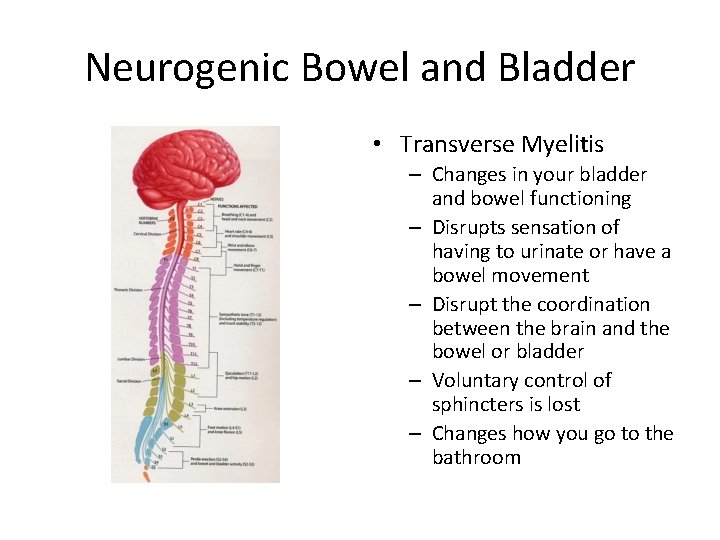
Neurogenic Bowel and Bladder • Transverse Myelitis – Changes in your bladder and bowel functioning – Disrupts sensation of having to urinate or have a bowel movement – Disrupt the coordination between the brain and the bowel or bladder – Voluntary control of sphincters is lost – Changes how you go to the bathroom
Neurogenic Bowel and Bladder Higher level of Injury (T 12 and above ) Spastic or reflexic neurogenic Lower Level of injury (T 12 and below) Flaccid or areflexic neurogenic Bladder • Bladder – Bladder is spastic and irritable – Urinary sphincter is tight and does not relax voluntarily • Difficulty storing and releasing urine • Bowel – Decreased GI motility – Rectum holds stool – Anal sphincter tight and does not relax voluntarily • Difficulty releasing stool – Bladder will not contract when it becomes full – Urinary sphincter is loose and fails to contract • Difficulty storing urine • Bowel – Rectum holds stool – Anal sphincter fails to contract • Difficulty holding stool
Spastic – Reflexic Spastic Bladder • Problems – Bladder tries to distend – Bladder spasms • Urgency • Frequency • Incontinence – Bladder sphincter dyssynergia • Difficulty initiating and maintaining a stream of urine • Vesicoureteral reflux – Kidney damage Spastic Bowel • Problems – Rectal distension – Anal sphincter tightens – Unable to release stool • Constipation • Impaction
Flaccid-Areflexic Flaccid Bladder Flaccid Bowel • Problems – Bladder very relaxed – Does not contract - overfills – Sphincter outlet fails • Incontinence – Urine leaks out • Cough • Sneeze or • Activities that contract abdominal muscles – Rectum dilates – Outlet sphincter fails • Incontinence – Stool leaks out • Cough • Sneeze • Activities that contract abdominal muscles
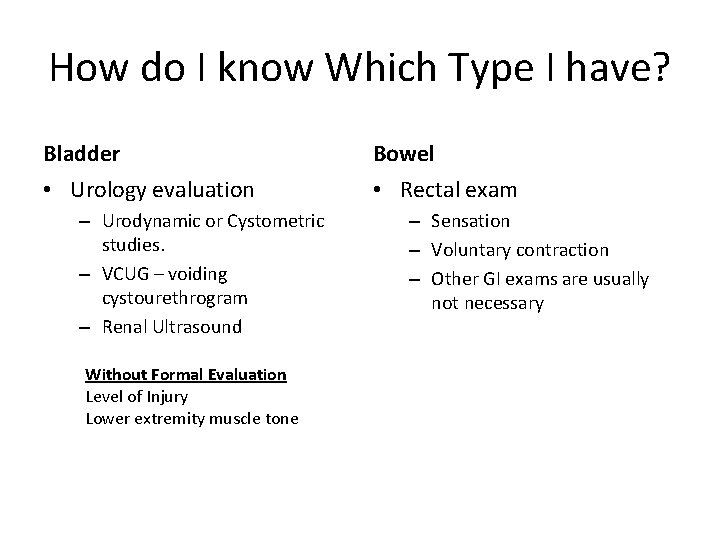
How do I know Which Type I have? Bladder Bowel • Urology evaluation • Rectal exam – Urodynamic or Cystometric studies. – VCUG – voiding cystourethrogram – Renal Ultrasound Without Formal Evaluation Level of Injury Lower extremity muscle tone – Sensation – Voluntary contraction – Other GI exams are usually not necessary
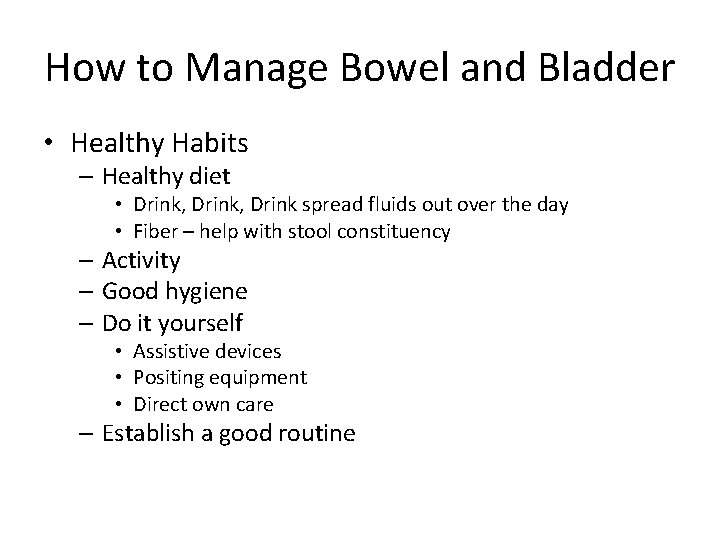
How to Manage Bowel and Bladder • Healthy Habits – Healthy diet • Drink, Drink spread fluids out over the day • Fiber – help with stool constituency – Activity – Good hygiene – Do it yourself • Assistive devices • Positing equipment • Direct own care – Establish a good routine
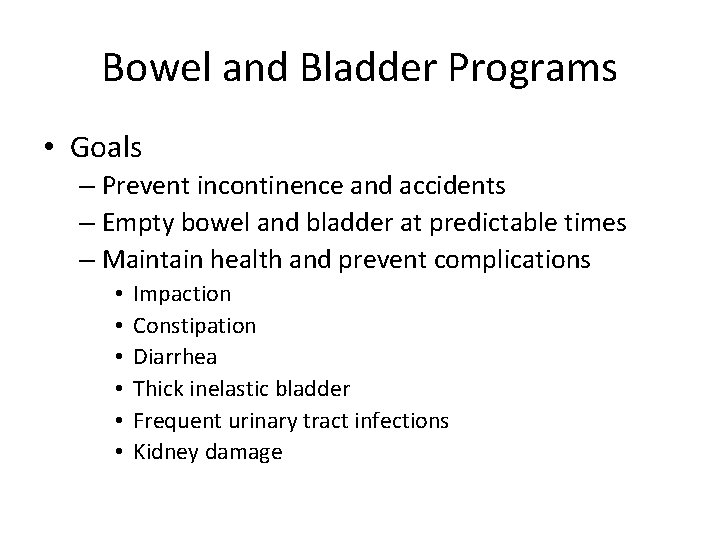
Bowel and Bladder Programs • Goals – Prevent incontinence and accidents – Empty bowel and bladder at predictable times – Maintain health and prevent complications • • • Impaction Constipation Diarrhea Thick inelastic bladder Frequent urinary tract infections Kidney damage
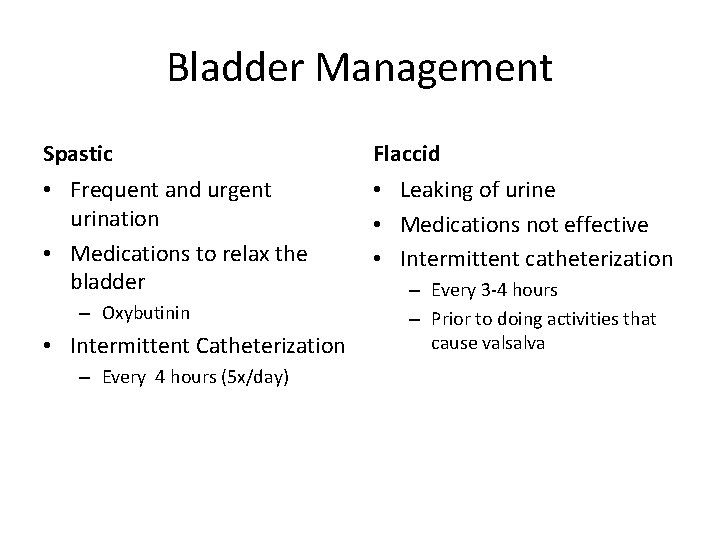
Bladder Management Spastic Flaccid • Frequent and urgent urination • Medications to relax the bladder • Leaking of urine • Medications not effective • Intermittent catheterization – Oxybutinin • Intermittent Catheterization – Every 4 hours (5 x/day) – Every 3 -4 hours – Prior to doing activities that cause valsalva
Other Options for Bladder Management • Men - Condom catheter – overflow • Indwelling Foley catheter – Not recommended • Suprapubic tube – Reversible minor surgery – Increased UTI and bladder bancer • Catheterizable stoma placed in belly button – Permanent, major surgery – less UTI and less bladder Cancer
Bowel Management Spastic Flaccid • Urgency and frequency • May get to the toilet but have difficulty releasing stool • Valsalva or contraction of the abdominal muscles pushing against an closed sphincter • Rectal sphincter will not hold stool • Frequent leaking of small amounts of stool • Activities that cause valsalva will cause leaking of stool
Bowel Management • Bowel Program • Takes planning and routine • Best done every day to every other day – Adults in AM Kids in PM – Should take 15 minutes to 1 hour – Same time (after meal or snack is ideal) • Generally a combination – Medications – Manual disimpaction – Digital stimulation • Work with you health professionals – Guidelines and advice – Customize what works for you
Bowel Management • Manage stool consistency – Diet • Fiber (or supplement) • Fluid – Medications to soften stool • Docusate Sodium • PEG (lower doses) • Promote GI motility • Senna • PEG (higher doses)
Bowel Management • Positioning – Sit up on the toilet or bedside commode – Lay on left side if you can not sit up • Children – Be sure feet are supported on a foot stool and they are comfortable
Bowel Management • Manual disimpaction – Using a gloved, well lubricated finger inserted into the rectum to break up and gently remove stool • Remove stool that will be in the way • Digital stimulation – Inserting a gloved, well lubricated finger into the anal sphincter and gently rotating the finger around the anal sphincter in a circular direction • Trigger reflex evacuation • Rectal Medication – Bisacodyl suppository, Magic Bullet suppository. Enemeez mini enema • Trigger reflex evacuation
Bowel Program Spastic Flaccid • Routine Bowel Program – Every 1 -3 days – Soft formed stool – Trigger reflex evacuation • Digital stimulation • Suppository – 1 -2 x/day – Firm formed stool • Easy to remove but does not leak – Suppositories generally do not work – Manual disimpaction • 1 -2 times per day • prior to activities that cause valsalva
Bowel Program Spastic Bowel Flaccid Bowel • Manually remove stool from rectum • Insert suppository • Digital Stimulation after 515 minutes • Continue digital stimulation every 5 -10 minutes 3 -4 times • Manually remove stool from rectum. • Can try digital stimulation • Valsalva or bearing down push ups, abdominal massage – Use caution cause hemorrhoids
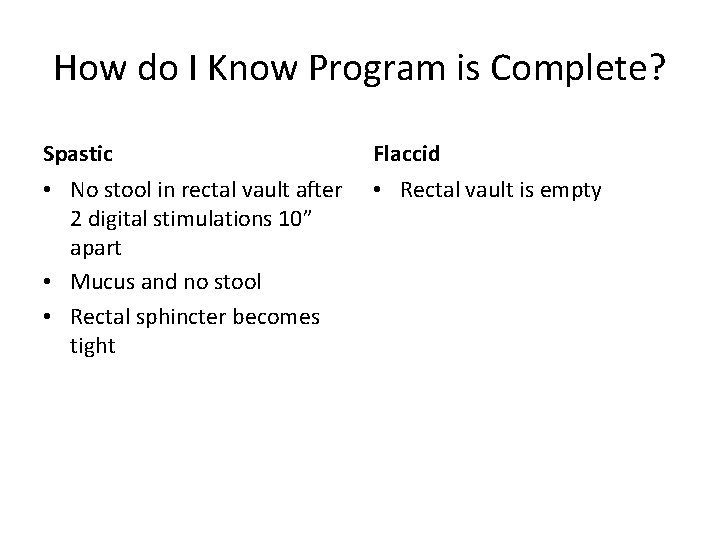
How do I Know Program is Complete? Spastic Flaccid • No stool in rectal vault after 2 digital stimulations 10” apart • Mucus and no stool • Rectal sphincter becomes tight • Rectal vault is empty
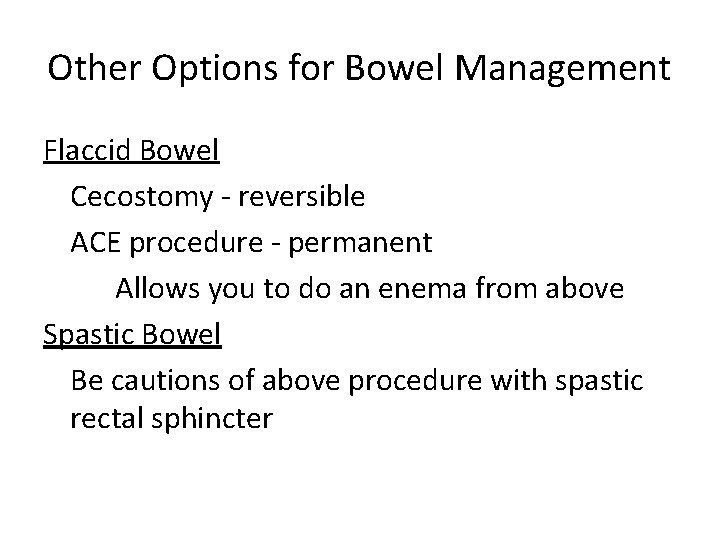
Other Options for Bowel Management Flaccid Bowel Cecostomy - reversible ACE procedure - permanent Allows you to do an enema from above Spastic Bowel Be cautions of above procedure with spastic rectal sphincter
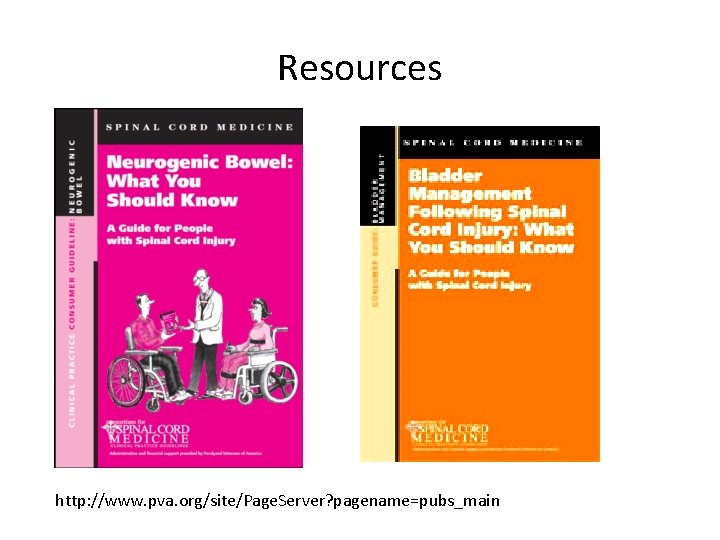
Resources http: //www. pva. org/site/Page. Server? pagename=pubs_main
- Slides: 23