
Boundless Lecture Slides Available on the Boundless Teaching

Boundless Lecture Slides Available on the Boundless Teaching Platform Free to share, print, make copies and changes. Get yours at www. boundless. com
Boundless Teaching Platform Boundless empowers educators to engage their students with affordable, customizable textbooks and intuitive teaching tools. The free Boundless Teaching Platform gives educators the ability to customize textbooks in more than 20 subjects that align to hundreds of popular titles. Get started by using high quality Boundless books, or make switching to our platform easier by building from Boundless content pre-organized to match the assigned textbook. This platform gives educators the tools they need to assign readings and assessments, monitor student activity, and lead their classes with pre-made teaching resources. Using Boundless Presentations The Appendix The appendix is for you to use to add depth and breadth to your lectures. You can simply drag and drop slides from the appendix into the main presentation to make for a richer lecture experience. Get started now at: http: //boundless. com/teaching-platform Free to edit, share, and copy Feel free to edit, share, and make as many copies of the Boundless presentations as you like. We encourage you to take these presentations and make them your own. If you have any questions or problems please email: educators@boundless. com Free to share, print, make copies and changes. Get yours at www. boundless. com

About Boundless is an innovative technology company making education more affordable and accessible for students everywhere. The company creates the world’s best open educational content in 20+ subjects that align to more than 1, 000 popular college textbooks. Boundless integrates learning technology into all its premium books to help students study more efficiently at a fraction of the cost of traditional textbooks. The company also empowers educators to engage their students more effectively through customizable books and intuitive teaching tools as part of the Boundless Teaching Platform. More than 2 million learners access Boundless free and premium content each month across the company’s wide distribution platforms, including its website, i. OS apps, Kindle books, and i. Books. To get started learning or teaching with Boundless, visit boundless. com. Free to share, print, make copies and changes. Get yours at www. boundless. com
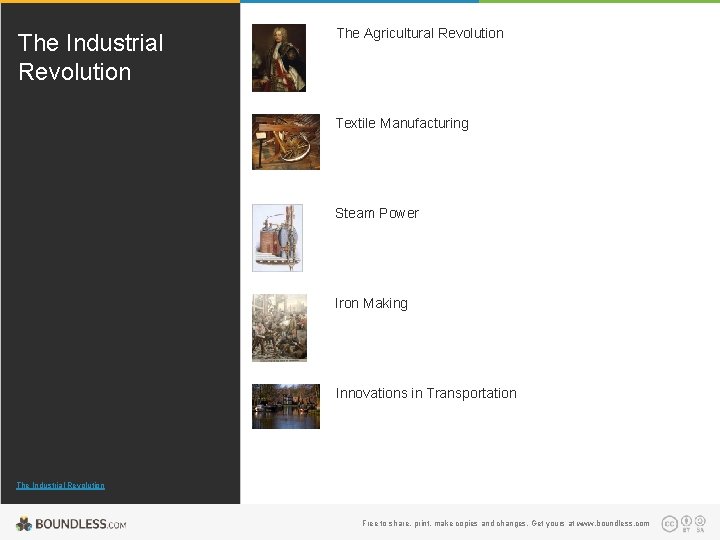
The Industrial Revolution The Agricultural Revolution Textile Manufacturing Steam Power Iron Making Innovations in Transportation The Industrial Revolution Free to share, print, make copies and changes. Get yours at www. boundless. com
The Industrial Revolution (continued) Social Change The Industrial Revolution Free to share, print, make copies and changes. Get yours at www. boundless. com
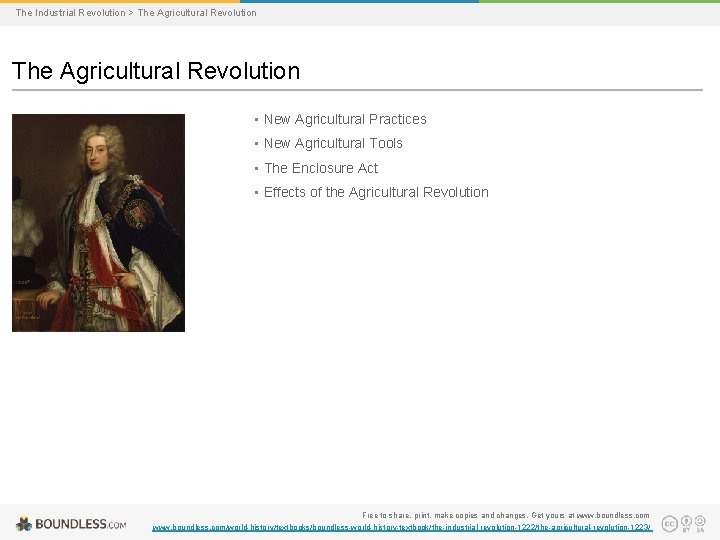
The Industrial Revolution > The Agricultural Revolution • New Agricultural Practices • New Agricultural Tools • The Enclosure Act • Effects of the Agricultural Revolution Free to share, print, make copies and changes. Get yours at www. boundless. com/world-history/textbooks/boundless-world-history-textbook/the-industrial-revolution-1222/the-agricultural-revolution-1223/
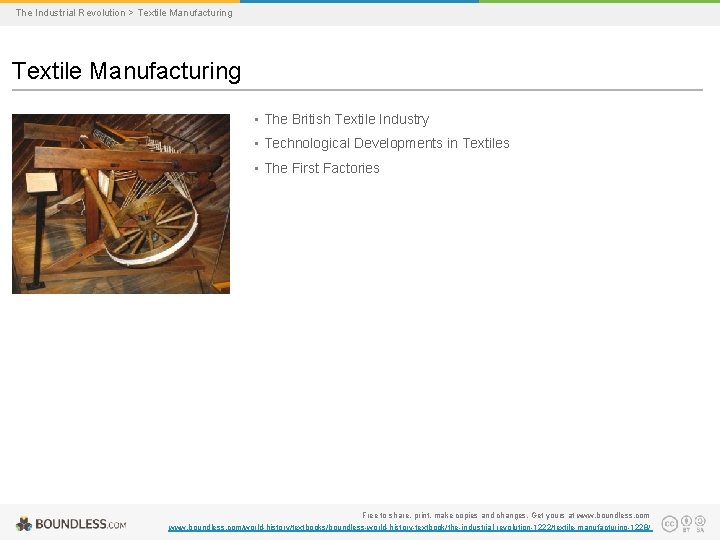
The Industrial Revolution > Textile Manufacturing • The British Textile Industry • Technological Developments in Textiles • The First Factories Free to share, print, make copies and changes. Get yours at www. boundless. com/world-history/textbooks/boundless-world-history-textbook/the-industrial-revolution-1222/textile-manufacturing-1228/
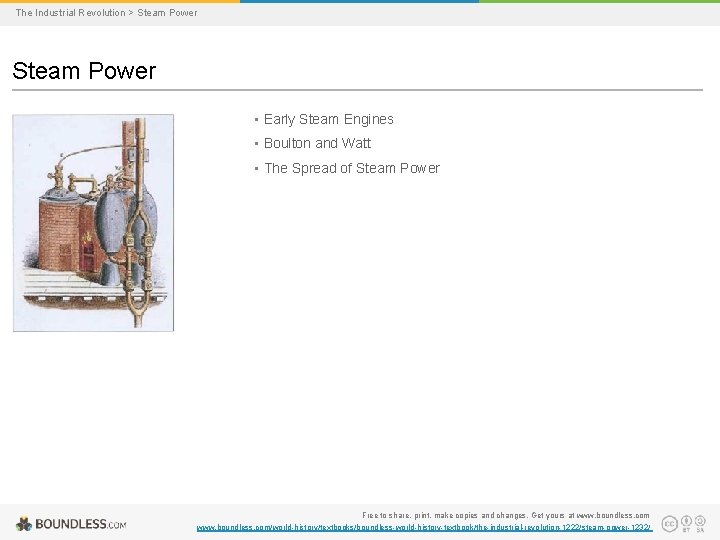
The Industrial Revolution > Steam Power • Early Steam Engines • Boulton and Watt • The Spread of Steam Power Free to share, print, make copies and changes. Get yours at www. boundless. com/world-history/textbooks/boundless-world-history-textbook/the-industrial-revolution-1222/steam-power-1232/
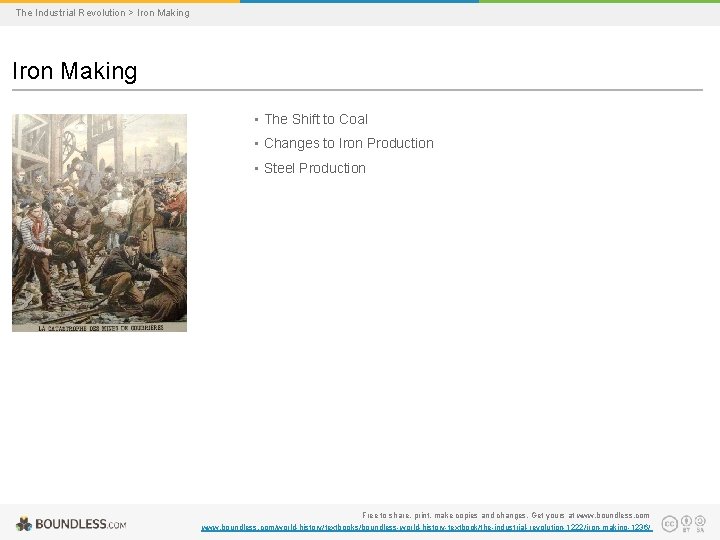
The Industrial Revolution > Iron Making • The Shift to Coal • Changes to Iron Production • Steel Production Free to share, print, make copies and changes. Get yours at www. boundless. com/world-history/textbooks/boundless-world-history-textbook/the-industrial-revolution-1222/iron-making-1236/
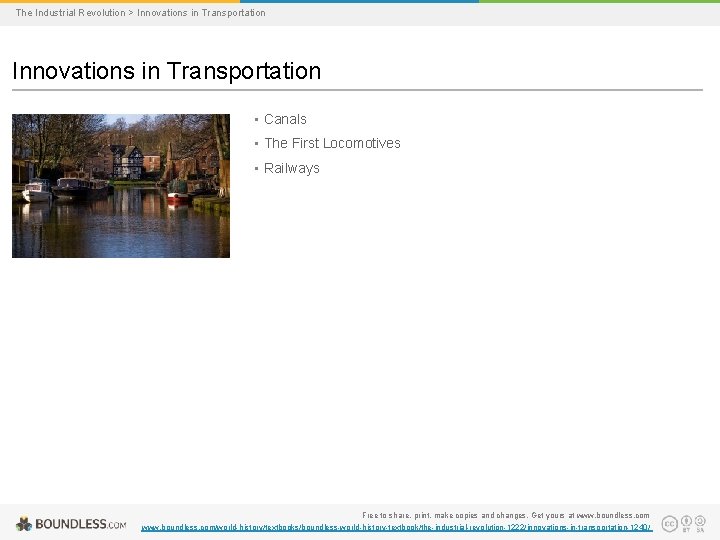
The Industrial Revolution > Innovations in Transportation • Canals • The First Locomotives • Railways Free to share, print, make copies and changes. Get yours at www. boundless. com/world-history/textbooks/boundless-world-history-textbook/the-industrial-revolution-1222/innovations-in-transportation-1240/
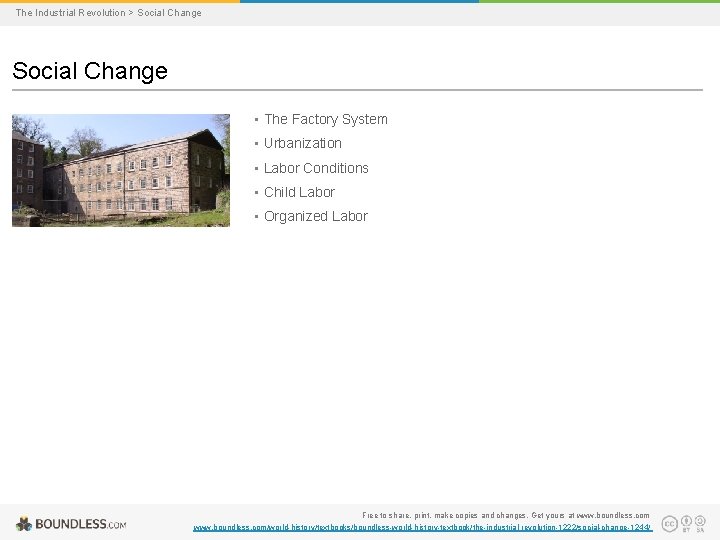
The Industrial Revolution > Social Change • The Factory System • Urbanization • Labor Conditions • Child Labor • Organized Labor Free to share, print, make copies and changes. Get yours at www. boundless. com/world-history/textbooks/boundless-world-history-textbook/the-industrial-revolution-1222/social-change-1244/

Appendix Free to share, print, make copies and changes. Get yours at www. boundless. com
The Industrial Revolution Key terms • aeolipile A simple bladeless radial steam turbine, also known as a Heron's engine, that spins when the central water container is heated. Torque is produced by steam jets exiting the turbine, much like a tip jet or rocket engine. In the 1 st century CE, Hero of Alexandria described the device, and many sources give him the credit for its invention. • Agricultural Revolution The unprecedented increase in agricultural production in Britain due to increases in labor and land productivity between the mid-17 th and late 19 th centuries. Agricultural output grew faster than the population over the century to 1770, and thereafter productivity remained among the highest in the world. This increase in the food supply contributed to the rapid growth of population in England Wales. • Agricultural Revolution The unprecedented increase in agricultural production in Britain due to increases in labor and land productivity between the mid-17 th and late 19 th centuries. Agricultural output grew faster than the population over the century to 1770 and thereafter productivity remained among the highest in the world. • Agricultural Revolution The unprecedented increase inagricultural production in Britain due to increases in labor and landproductivity between the mid-17 th and late 19 th centuries. Agricultural outputgrew faster than the population over the century to 1770 and thereafterproductivity remained among the highest in the world. • atmospheric engine An engine invented by Thomas Newcomen in 1712, often referred to simply as a Newcomen engine. The engine operated by condensing steam drawn into the cylinder, thereby creating a partial vacuum and allowing the atmospheric pressure to push the piston into the cylinder. It was the first practical device to harness steam to produce mechanical work. • beam engine A type of steam engine in which a pivoted overhead beam is used to apply force from a vertical piston to a vertical connecting rod. This configuration, with the engine directly driving a pump, was first used by Thomas Newcomen around 1705 to remove water from mines in Cornwall. • beam engine A type of steam engine where apivoted overhead beam is used to apply the force from a verticalpiston to a Free to share, print, make copies and changes. Get yours at www. boundless. com vertical connecting rod. This configuration, with the enginedirectly driving a pump, was first used by Thomas Newcomen around
The Industrial Revolution • Bridgewater Canal A canal that connects Runcorn, Manchester and Leigh, in North West England. It was commissioned by Francis Egerton, 3 rd Duke of Bridgewater, to transport coal from his mines in Worsley to Manchester. It was opened in 1761 from Worsley to Manchester, and later extended from Manchester to Runcorn, and then from Worsley to Leigh. Its immense economic success triggered the development of a national canal system. • Calico Acts Two legislative acts, one of 1700 and one of 1721, that banned the import of most cotton textiles into England, followed by the restriction of sale of most cotton textiles. • Canal Mania The period of intense canal building in Britain between the 1790 s and 1810 s and the speculative frenzy that accompanied it in the early 1790 s. • carburization A heat treatment process in which iron or steel absorbs carbon while the metal is heated in the presence of a carbon-bearing material, such as charcoal or carbon monoxide. The intent is to make the metal harder. Unlike modern steel making, the process increased the amount of carbon in the iron. • cementation An obsolete technology for making steel by carburization of iron. Unlike modern steel making, it increased the amount of carbon in the iron. It was apparently developed before the 17 th century. Derwentcote Steel Furnace, built in 1720, is the earliest surviving example of a furnace using this technology. • Chartism A working-class movement for political reform in Britain that existed from 1838 to 1857. It took its name from the People's Charter of 1838 and was a national protest movement. The strategy employed was to use the large scale of support for numerous petitions and the accompanying mass meetings to put pressure on politicians to concede manhood suffrage. • coke A fuel with few impurities and ahigh carbon content, usually made from coal. It is the solidcarbonaceous material derived from destructive distillation oflow-ash, low-sulfur bituminous coal. While it can be formed naturally, thecommonly used form is man-made. • coke A fuel with few impurities and a high carbon content, the solid carbonaceous material derived from destructive distillation of low-ash, low-sulfur bituminous coal. While it can form naturally, the common form is man-made. • Combination Act A 1799 Act of Parliament that prohibited trade unions and collective bargaining by British workers. • Combinations of Workmen Act 1825 An 1825 Act of Parliament of the United Kingdom, which prohibited trade unions from attempting to collectively bargain for better terms and conditions at work and suppressed the right to strike. Free to share, print, make copies and changes. Get yours at www. boundless. com • common field system A system of land ownership in which land is owned collectively by a number of persons, or by one person
The Industrial Revolution • common land A system of land ownership, known also as the common field system, in which land is owned collectively by a number of persons, or by one person with others holding certain traditional rights, such as to allow their livestock to graze upon it, collect firewood, or cut turf for fuel. • condenser A device or unit used to condense a substance from its gaseous to its liquid state by cooling it, which transfers the latent heat from the substance to the condenser coolant. These devices are typically heat exchangers, which have various designs and come in many sizes ranging from rather small (hand-held) to very large industrial-scale units used in plant processes. • cottage industry A small-scale industry in which the creation of products and services is home-based rather than factory-based. It was a dominant form of production in prior to industrialization but continues to exist today. While products and services are often unique and distinctive, given that they are usually not mass-produced, producers in this sector often face numerous disadvantages when trying to compete with much larger factory-based companies. • Cotton Mills and Factories Act of 1819 An 1819 Act of Parliament in the United Kingdom that stated that no children under 9 were to be employed and that children aged 9– 16 years were limited to 12 hours' work per day. It applied to the cotton industry only, but covered all children, whether apprentices or not. It was seen through Parliament by Sir Robert Peel but had its origins in a draft prepared by Robert Owen in 1815. The Act that emerged in 1819 was watered down from Owen's draft. • Cottonopolis A metropolis centered on cotton trading servicing the cotton mills in its hinterland. It was originally applied to Manchester, England, because of its status as the international center of the cotton and textile trade during the Industrial Revolution. • crop rotation The practice of growing a series of dissimilar or different types of crops in the same area in sequenced seasons so that the soil of farms is not used to only one type of nutrient. It helps in reducing soil erosion and increases soil fertility and crop yield. • crucible steel A term that applies to steel made by two different methods in the modern era and produced in varying locales throughout history. It is made by melting iron and other materials. It was produced in South and Central Asia during the medieval era but techniques for production of high-quality steel were developed by Benjamin Huntsman in England in the 18 th century. However, Huntsman's process used iron and steel as raw materials rather than direct conversion from cast iron as in the later Bessemer process. The homogeneous crystal structure of this cast steel improved its strength and hardness compared to preceding forms of steel. • enclosure The legal process in England duringthe 18 th century of enclosing a number of small landholdings to create onelarger farm. Once enclosed, use of the land became restricted to the owner andceased to be common land for communal use. In Free to share, print, make copies and changes. Get yours at www. boundless. com England Wales, theterm is also used for the process that ended the ancient system of arablefarming in open fields.
The Industrial Revolution • flyboat A European light vessel, developed primarily as a mercantile cargo carrier, although many served as warships in an auxiliary role, used in the late 16 th and early 17 th century. The name was subsequently applied to a number of disparate vessels, which achieved high speeds or endurance, including those that worked day and night on British canals to compete with the rapidly developing railway. • flying shuttle One of the key developments in the industrialization of weaving during the early Industrial Revolution. It allowed a single weaver to weave much wider fabrics and could be mechanized, allowing for automatic machine looms. It was patented by John Kay in 1733. • Health and Morals of Apprentices Act 1802 An 1802 Act of the Parliament of the United Kingdom, sometimes known as the Factory Act 1802, was designed to improve conditions for apprentices working in cotton mills. The Act was introduced by Sir Robert Peel, who became concerned with the issue after an 1784 outbreak of a "malignant fever" at one of his cotton mills, which he later blamed on "gross mismanagement" by his subordinates. • hurrier A child or woman employed by a collier to transport the coal that they had mined. Women would normally get the children to help them because of the difficulty of carrying the coal. Common particularly in the early 19 th century, they pulled a corf (basket or small wagon) full of coal along roadways as small as 16 inches in height. They would often work 12 -hour shifts, making several runs down to the coal face and back to the surface again. • hurrier A child or woman employed by a collier totransport the coal that they had mined. Women would normally get thechildren to help them because of the difficulty of carrying the coal. Commonparticularly in the early 19 th century, they pulled a corf (basket orsmall wagon) full of coal along roadways as small as 16 inches in height. They would often work 12 -hour shifts, making several runs down to the coal faceand back to the surface again. • Industrial Revolution The transition to new manufacturing processes in the period from about 1760 to sometime between 1820 and 1840. This transition included going from hand production methods to machines, new chemical manufacturing and iron production processes, improved efficiency of water power, the increasing use of steam power, the development of machine tools, and the rise of the factory system. • Industrial Revolution The transition to new manufacturingprocesses in the period from about 1760 to between 1820 and 1840. Thistransition included going from hand production methods to machines, newchemical manufacturing and iron production processes, improved efficiency ofwater power, the increasing use of steam power, the development of machinetools, and the rise of the factory system. • Industrial Revolution The transition to new manufacturingprocesses in the period from about 1760 to between 1820 and 1840. Thistransition included going from hand production methods to machines, newchemical manufacturing and iron production Free to share, print, make copies and changes. Get yours at www. boundless. com processes, improved efficiency ofwater power, the increasing use of steam power, the development of machinetools and the
The Industrial Revolution • Luddites A group of English textileworkers and self-employed weavers in the 19 th century that used the destructionof machinery as a form of protest. The group was protesting the use ofmachinery in a "fraudulent and deceitful manner" to get aroundstandard labor practices. They were fearful that the years they spentlearning the craft would go to waste and unskilled machine operators would robthem of their livelihoods. • Luddites A group of English textileworkers and self-employed weavers in the 19 th century who used the destructionof machinery as a form of protest. The group was protesting the use ofmachinery in a "fraudulent and deceitful manner" to get aroundstandard labor practices. They were fearful that the years they had spentlearning the craft would go to waste and unskilled machine operators would robthem of their livelihood. • Malthusian trap The putative unsustainability of improvements in a society's standard of living because of population growth. It is named for Thomas Robert Malthus, who suggested that while technological advances could increase a society's supply of resources such as food and thereby improve the standard of living, the resource abundance would encourage population growth, which would eventually bring the per capita supply of resources back to its original level. Some economists contend that since the Industrial Revolution, mankind has broken out of the trap. Others argue that the continuation of extreme poverty indicates that the Malthusian trap continues to operate. • mercantilism An economic theory and practice dominant in Western Europe during the 16 th to mid-19 th centuries and a form of economic nationalism. Its goal was to enrich and empower the nation and state to the maximum degree by acquiring and retaining as much economic activity as possible within the nation's borders. Manufacturing and industry, particularly of goods with military applications, was prioritized. • Mines and Collieries Act An 1842 act of the Parliament of the United Kingdom, which prohibited all girls and boys under ten years old from working underground in coal mines. It was a response to the working conditions of children revealed in the Children's Employment Commission (Mines) 1842 report. • Mines and Collieries Act 1842 An 1842 act of the Parliamentof the United Kingdom that prohibited banned) all girls and boys younger than age 10 from working underground in coal mines. It was a response to theworking conditions of children revealed in the Children's Employment Commission(Mines) 1842 report. • parallel motion A mechanical linkage invented by the Scottish engineer James Watt in 1784 for the double-acting Watt steam engine. It allows a rod moving straight up and down to transmit motion to a beam moving in an arc, without putting sideways strain on the rod. • Parliamentary carriages Passenger services required by an Act of Parliament passed in 1844 to allow inexpensive and basic railway travel for less affluent passengers. The legislation required that at least one such service per day be run on every Free to share, print, make copies and changes. Get yours at www. boundless. com railway route in the United Kingdom.
The Industrial Revolution • putting-out system A means of subcontracting work, historically known also as the workshop system and the domestic system. In it, work is contracted by a central agent to subcontractors who complete the work in off-site facilities, either in their own homes or in workshops with multiple craftsmen. • putting-out system A means of subcontracting work, historically known also as the workshop system and the domestic system. Work is contracted by a central agent to subcontractors who complete thework in off-site facilities, either in their own homes or in workshops withmultiple craftsmen. • Race to the North Name given by the press to the phenomenon that occurred during two summers of the late 19 th century, when British passenger trains belonging to different companies would literally race each other from London to Scotland over the two principal rail trunk routes connecting the English capital city to Scotland: the West Coast Main Line and the East Coast Main Line. • rack and pinion railway A steep grade railway with a toothed rack rail, usually between the running rails. The trains are fitted with one or more cog wheels or pinions that mesh with this rack rail. The first railway of this kind was the Middleton Railway between Middleton and Leeds in West Yorkshire, England, UK, where the first commercially successful steam locomotive, Salamanca, ran in 1812. This used a system designed and patented in 1811 by John Blenkinsop. • Radical War A week of strikes and unrest, also known as the Scottish Insurrection of 1820, that was a culmination of Radical demands for reform in the United Kingdom of Great Britain and Ireland which became prominent in the early years of the French Revolution, but were then repressed during the long Napoleonic Wars. • Railway Clearing House An organization set up in 1842 to manage the allocation of revenue collected by pre-grouping railway companies of fares and charges paid for passengers and goods travelling over the lines of other companies. • Railway Mania Speculative frenzy in Britain in the 1840 s caused by the phenomenal profitability of the early railways. • Rainhill Trials An important competition in the early days of steam locomotive railways, run in October 1829 for the nearly completed Liverpool and Manchester Railway. Five engines competed, running back and forth along a mile length of level track at Rainhill in Lancashire (now Merseyside). Stephenson's Rocket was the only locomotive to complete the trials and was declared the winner. The Stephensons were accordingly given the contract to produce locomotives for the railway. • reciprocating engine A heat engine also known as a piston engine that uses one or more reciprocating pistons to convert pressure into a rotating motion. The main types are the internal combustion engine, used extensively in motor vehicles; the steam engine, the mainstay of the Industrial Revolution; and the niche application Stirling engine. • reverberatory furnace A metallurgical or process furnace that isolates the material being processed from contact with the fuel, Free to share, print, make copies and changes. Get yours at www. boundless. com but not from contact with combustion gases. The term reverberation is used here in a generic sense of rebounding or reflecting,
The Industrial Revolution • Salamanca The first commercially successful steam locomotive, built in 1812 by Matthew Murray of Holbeck using John Blenkinsop's patented design for rack propulsion, for the edge-railed Middleton Railway between Middleton and Leeds. It was the first to have two cylinders. It was named after the Duke of Wellington's victory at the battle of Salamanca which was fought that same year. • Second Industrial Revolution A phase of rapid industrialization in the final third of the 19 th century and the beginning of the 20 th, also known as the Technological Revolution. Although a number of its characteristic events can be traced to earlier innovations in manufacturing, such as the establishment of a machine tool industry, the development of methods for manufacturing interchangeable parts, and the invention of the Bessemer Process, it is generally dated between 1870 and 1914 up to the start of World War I. • Second Industrial Revolution A phase of rapid industrialization in the final third of the 19 th century and the beginning of the 20 th. Although a number of its characteristic events can be traced to earlier innovations in manufacturing, such as the establishment of a machine tool industry, the development of methods for manufacturing interchangeable parts, and the invention of the Bessemer Process, it is generally dated between 1870 and 1914. • seed drill A device that sows the seeds for crops by metering out individual seeds, positioning them in the soil, and covering them to a certain average depth. It sows the seeds at equal distances and proper depth, ensuring they get covered with soil and are saved from being eaten by birds. Invented in China in the 2 nd century BCE, it was advanced by Europeans in the 16 th and 17 th centuries, becoming an important development of the Agricultural Revolution. • spinning jenny A multi-spindle spinning frame, one of the key developments in the industrialization of weaving during the early Industrial Revolution. It was invented in 1764 by James Hargreaves in Stanhill, Oswaldtwistle, Lancashire in England. The device reduced the amount of work needed to produce yarn, with a worker able to make eight or more spools at once. • spinning jenny A multi-spindle spinning frame, oneof the key developments in the industrialization of weaving duringthe early Industrial Revolution. It was invented in 1764 by James. Hargreaves in Stanhill, Oswaldtwistle, Lancashire in England. Thedevice reduced the amount of work needed to produce yarn, with a worker able towork eight or more spools at once. • spinning mule A machine used to spin cotton and other fibers in the British mills, used extensively from the late 18 th to the early 20 th century. It was invented between 1775 and 1779 by Samuel Crompton. The machines were worked in pairs by a minder, with the help of two boys: the little piecer and the big or side piecer. The carriage carried up to 1, 320 spindles and could be 150 feet (46 m) long; it could move forward and back a distance of 5 feet (1. 5 m) four times a minute. • Steam engine A heat engine that performs mechanical work using steam as its working fluid. • steam engine A heat engine that performsmechanical work using steam as its working fluid. Free to share, print, make copies and changes. Get yours at www. boundless. com
The Industrial Revolution • Tolpuddle Martyrs A group of 19 th century Dorset agricultural laborers who were convicted of swearing a secret oath as members of the Friendly Society of Agricultural Laborers. At the time, friendly societies had strong elements of what are now considered to be the predominant role of trade unions. The group were subsequently sentenced to penal transportation to Australia. • truck system An arrangement in which employees are paid in commodities or some currency substitute (such as vouchers or token coins, called in some dialects scrip or chit) rather than with standard currency. • water frame An machine to create cotton thread first used in 1768. It was able to spin 128 threads at a time, making it an easier and faster method than ever before. It was developed by Richard Arkwright, who patented the technology in 1767. The design was partly based on a spinning machine built for Thomas Highs by clock maker John Kay, who was hired by Arkwright. Free to share, print, make copies and changes. Get yours at www. boundless. com
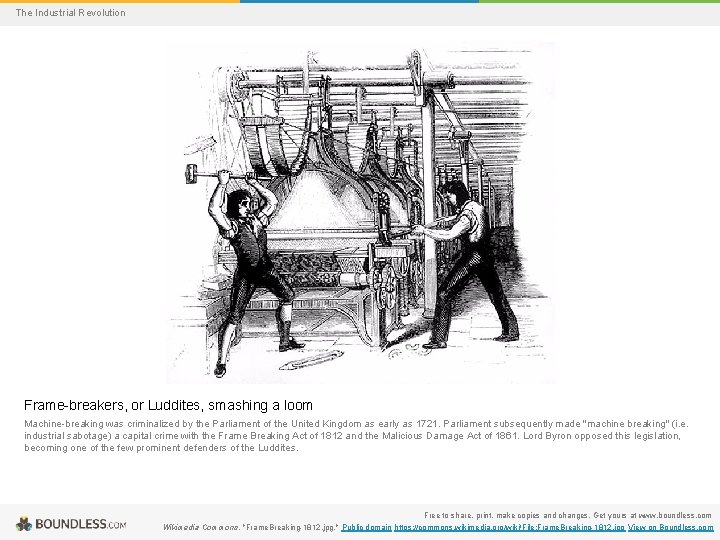
The Industrial Revolution Frame-breakers, or Luddites, smashing a loom Machine-breaking was criminalized by the Parliament of the United Kingdom as early as 1721. Parliament subsequently made "machine breaking" (i. e. industrial sabotage) a capital crime with the Frame Breaking Act of 1812 and the Malicious Damage Act of 1861. Lord Byron opposed this legislation, becoming one of the few prominent defenders of the Luddites. Free to share, print, make copies and changes. Get yours at www. boundless. com Wikimedia Commons. "Frame. Breaking-1812. jpg. " Public domain https: //commons. wikimedia. org/wiki/File: Frame. Breaking-1812. jpg View on Boundless. com
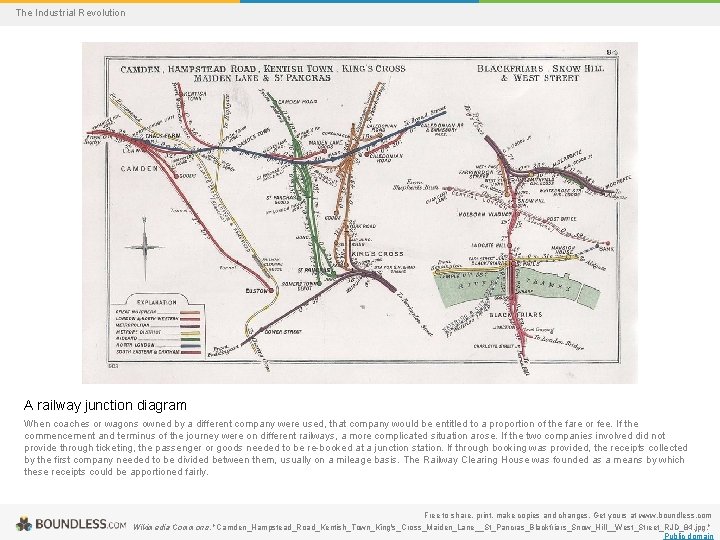
The Industrial Revolution A railway junction diagram When coaches or wagons owned by a different company were used, that company would be entitled to a proportion of the fare or fee. If the commencement and terminus of the journey were on different railways, a more complicated situation arose. If the two companies involved did not provide through ticketing, the passenger or goods needed to be re-booked at a junction station. If through booking was provided, the receipts collected by the first company needed to be divided between them, usually on a mileage basis. The Railway Clearing House was founded as a means by which these receipts could be apportioned fairly. Free to share, print, make copies and changes. Get yours at www. boundless. com Wikimedia Commons. "Camden_Hampstead_Road_Kentish_Town_King's_Cross_Maiden_Lane__St_Pancras_Blackfriars_Snow_Hill__West_Street_RJD_84. jpg. " Public domain
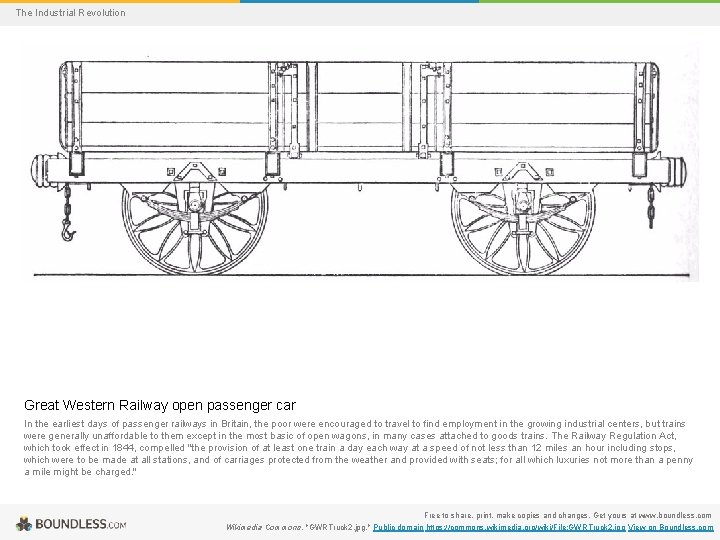
The Industrial Revolution Great Western Railway open passenger car In the earliest days of passenger railways in Britain, the poor were encouraged to travel to find employment in the growing industrial centers, but trains were generally unaffordable to them except in the most basic of open wagons, in many cases attached to goods trains. The Railway Regulation Act, which took effect in 1844, compelled "the provision of at least one train a day each way at a speed of not less than 12 miles an hour including stops, which were to be made at all stations, and of carriages protected from the weather and provided with seats; for all which luxuries not more than a penny a mile might be charged. " Free to share, print, make copies and changes. Get yours at www. boundless. com Wikimedia Commons. "GWRTruck 2. jpg. " Public domain https: //commons. wikimedia. org/wiki/File: GWRTruck 2. jpg View on Boundless. com
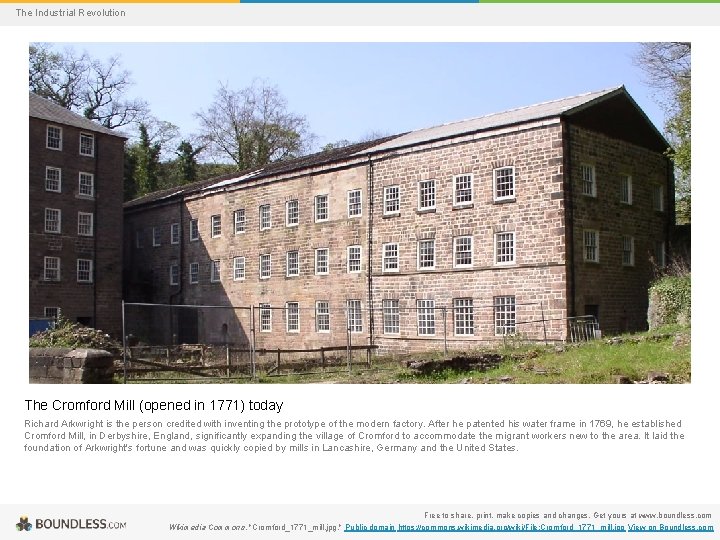
The Industrial Revolution The Cromford Mill (opened in 1771) today Richard Arkwright is the person credited with inventing the prototype of the modern factory. After he patented his water frame in 1769, he established Cromford Mill, in Derbyshire, England, significantly expanding the village of Cromford to accommodate the migrant workers new to the area. It laid the foundation of Arkwright's fortune and was quickly copied by mills in Lancashire, Germany and the United States. Free to share, print, make copies and changes. Get yours at www. boundless. com Wikimedia Commons. "Cromford_1771_mill. jpg. " Public domain https: //commons. wikimedia. org/wiki/File: Cromford_1771_mill. jpg View on Boundless. com
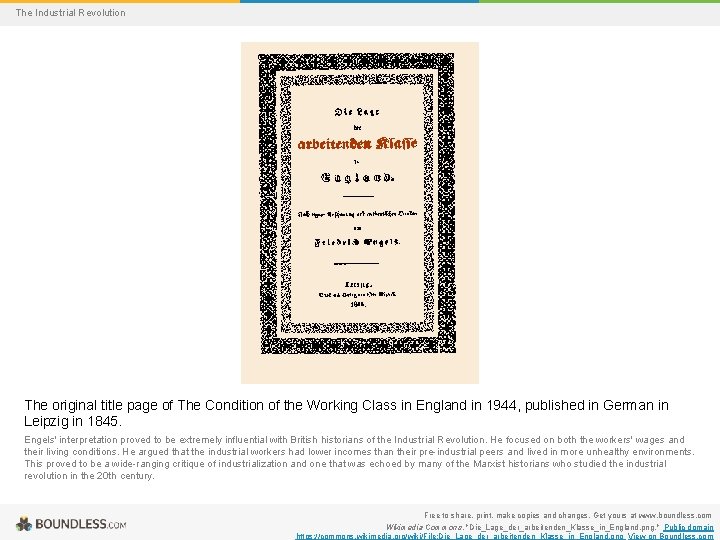
The Industrial Revolution The original title page of The Condition of the Working Class in England in 1944, published in German in Leipzig in 1845. Engels' interpretation proved to be extremely influential with British historians of the Industrial Revolution. He focused on both the workers' wages and their living conditions. He argued that the industrial workers had lower incomes than their pre-industrial peers and lived in more unhealthy environments. This proved to be a wide-ranging critique of industrialization and one that was echoed by many of the Marxist historians who studied the industrial revolution in the 20 th century. Free to share, print, make copies and changes. Get yours at www. boundless. com Wikimedia Commons. "Die_Lage_der_arbeitenden_Klasse_in_England. png. " Public domain https: //commons. wikimedia. org/wiki/File: Die_Lage_der_arbeitenden_Klasse_in_England. png View on Boundless. com
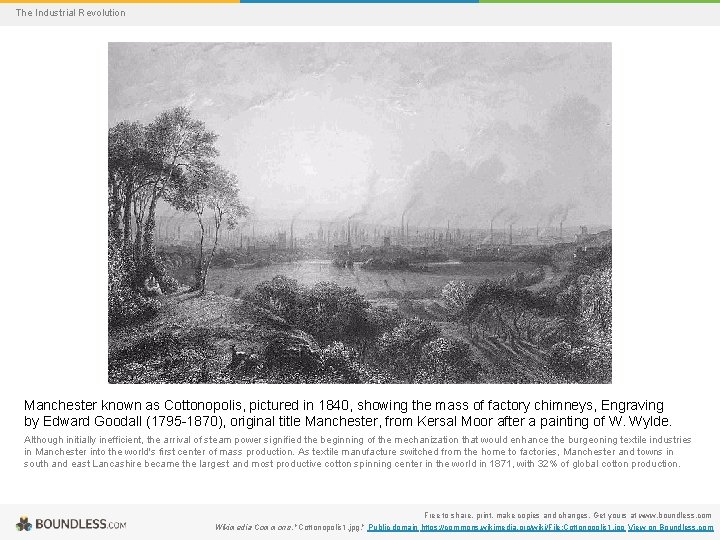
The Industrial Revolution Manchester known as Cottonopolis, pictured in 1840, showing the mass of factory chimneys, Engraving by Edward Goodall (1795 -1870), original title Manchester, from Kersal Moor after a painting of W. Wylde. Although initially inefficient, the arrival of steam power signified the beginning of the mechanization that would enhance the burgeoning textile industries in Manchester into the world's first center of mass production. As textile manufacture switched from the home to factories, Manchester and towns in south and east Lancashire became the largest and most productive cotton spinning center in the world in 1871, with 32% of global cotton production. Free to share, print, make copies and changes. Get yours at www. boundless. com Wikimedia Commons. "Cottonopolis 1. jpg. " Public domain https: //commons. wikimedia. org/wiki/File: Cottonopolis 1. jpg View on Boundless. com
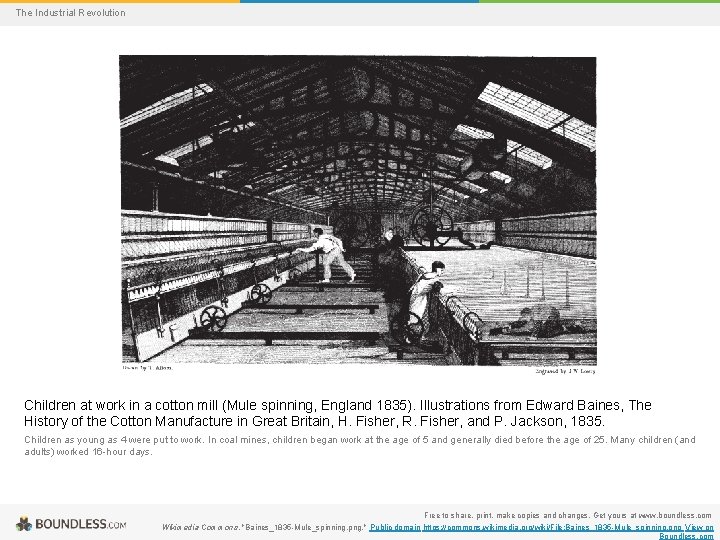
The Industrial Revolution Children at work in a cotton mill (Mule spinning, England 1835). Illustrations from Edward Baines, The History of the Cotton Manufacture in Great Britain, H. Fisher, R. Fisher, and P. Jackson, 1835. Children as young as 4 were put to work. In coal mines, children began work at the age of 5 and generally died before the age of 25. Many children (and adults) worked 16 -hour days. Free to share, print, make copies and changes. Get yours at www. boundless. com Wikimedia Commons. "Baines_1835 -Mule_spinning. png. " Public domain https: //commons. wikimedia. org/wiki/File: Baines_1835 -Mule_spinning. png View on Boundless. com
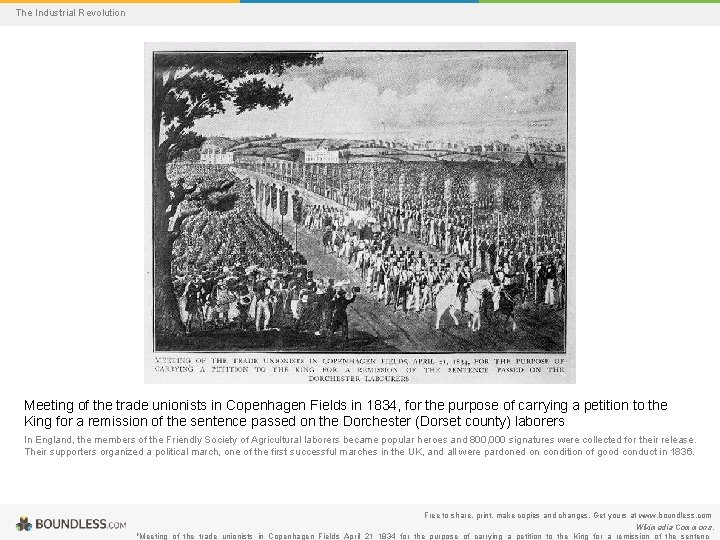
The Industrial Revolution Meeting of the trade unionists in Copenhagen Fields in 1834, for the purpose of carrying a petition to the King for a remission of the sentence passed on the Dorchester (Dorset county) laborers In England, the members of the Friendly Society of Agricultural laborers became popular heroes and 800, 000 signatures were collected for their release. Their supporters organized a political march, one of the first successful marches in the UK, and all were pardoned on condition of good conduct in 1836. Free to share, print, make copies and changes. Get yours at www. boundless. com Wikimedia Commons. "Meeting_of_the_trade_unionists_in_Copenhagen_Fields_April_21_1834_for_the_purpose_of_carrying_a_petition_to_the_King_for_a_remission_of_the_sentenc
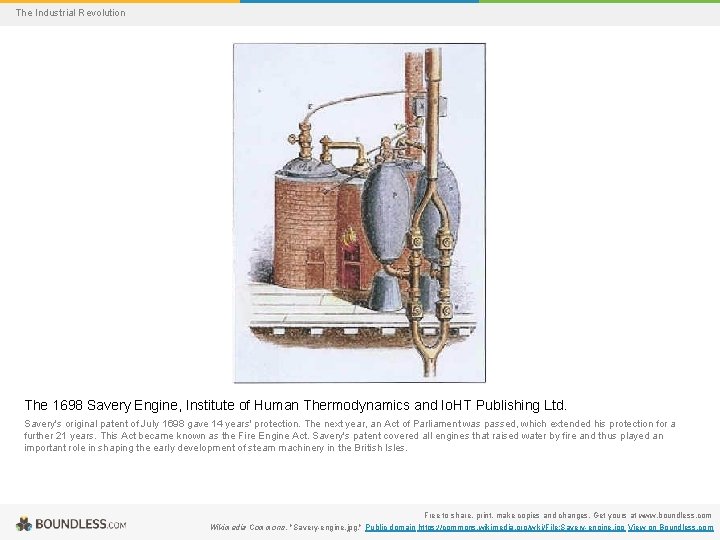
The Industrial Revolution The 1698 Savery Engine, Institute of Human Thermodynamics and Io. HT Publishing Ltd. Savery's original patent of July 1698 gave 14 years' protection. The next year, an Act of Parliament was passed, which extended his protection for a further 21 years. This Act became known as the Fire Engine Act. Savery's patent covered all engines that raised water by fire and thus played an important role in shaping the early development of steam machinery in the British Isles. Free to share, print, make copies and changes. Get yours at www. boundless. com Wikimedia Commons. "Savery-engine. jpg. " Public domain https: //commons. wikimedia. org/wiki/File: Savery-engine. jpg View on Boundless. com
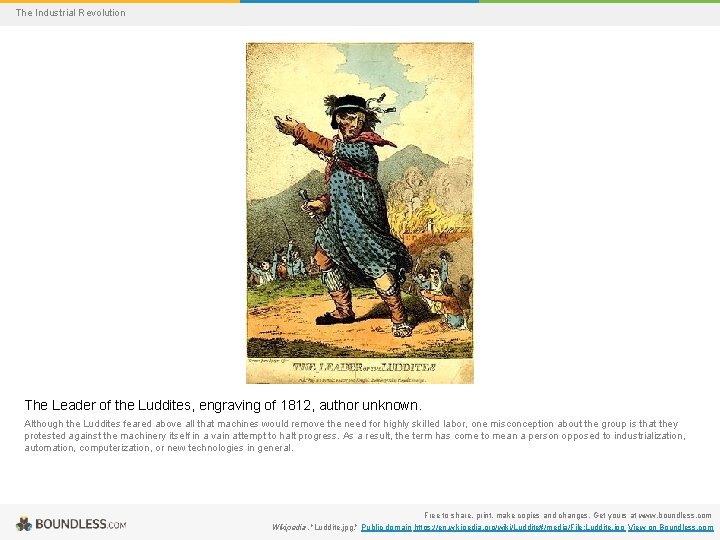
The Industrial Revolution The Leader of the Luddites, engraving of 1812, author unknown. Although the Luddites feared above all that machines would remove the need for highly skilled labor, one misconception about the group is that they protested against the machinery itself in a vain attempt to halt progress. As a result, the term has come to mean a person opposed to industrialization, automation, computerization, or new technologies in general. Free to share, print, make copies and changes. Get yours at www. boundless. com Wikipedia. "Luddite. jpg. " Public domain https: //en. wikipedia. org/wiki/Luddite#/media/File: Luddite. jpg View on Boundless. com
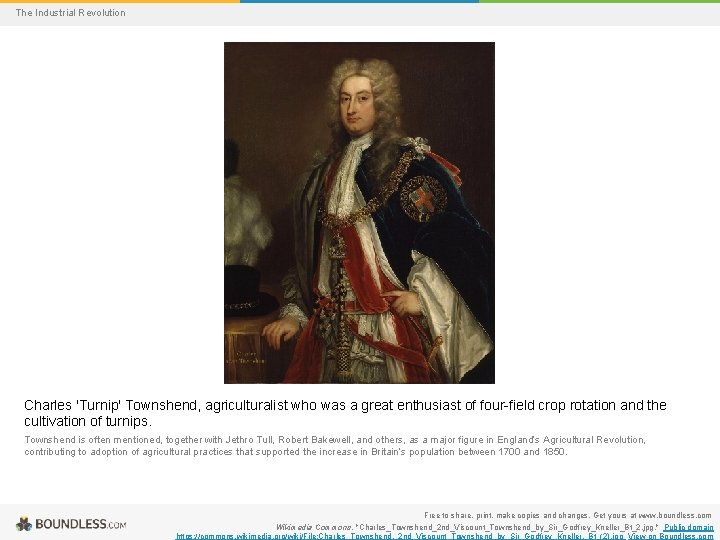
The Industrial Revolution Charles 'Turnip' Townshend, agriculturalist who was a great enthusiast of four-field crop rotation and the cultivation of turnips. Townshend is often mentioned, together with Jethro Tull, Robert Bakewell, and others, as a major figure in England’s Agricultural Revolution, contributing to adoption of agricultural practices that supported the increase in Britain’s population between 1700 and 1850. Free to share, print, make copies and changes. Get yours at www. boundless. com Wikimedia Commons. "Charles_Townshend_2 nd_Viscount_Townshend_by_Sir_Godfrey_Kneller_Bt_2. jpg. " Public domain https: //commons. wikimedia. org/wiki/File: Charles_Townshend, _2 nd_Viscount_Townshend_by_Sir_Godfrey_Kneller, _Bt_(2). jpg View on Boundless. com
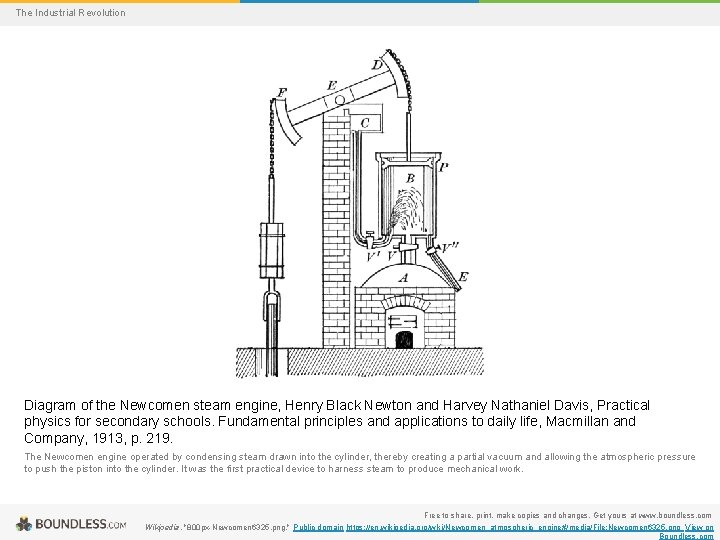
The Industrial Revolution Diagram of the Newcomen steam engine, Henry Black Newton and Harvey Nathaniel Davis, Practical physics for secondary schools. Fundamental principles and applications to daily life, Macmillan and Company, 1913, p. 219. The Newcomen engine operated by condensing steam drawn into the cylinder, thereby creating a partial vacuum and allowing the atmospheric pressure to push the piston into the cylinder. It was the first practical device to harness steam to produce mechanical work. Free to share, print, make copies and changes. Get yours at www. boundless. com Wikipedia. "800 px-Newcomen 6325. png. " Public domain https: //en. wikipedia. org/wiki/Newcomen_atmospheric_engine#/media/File: Newcomen 6325. png View on Boundless. com
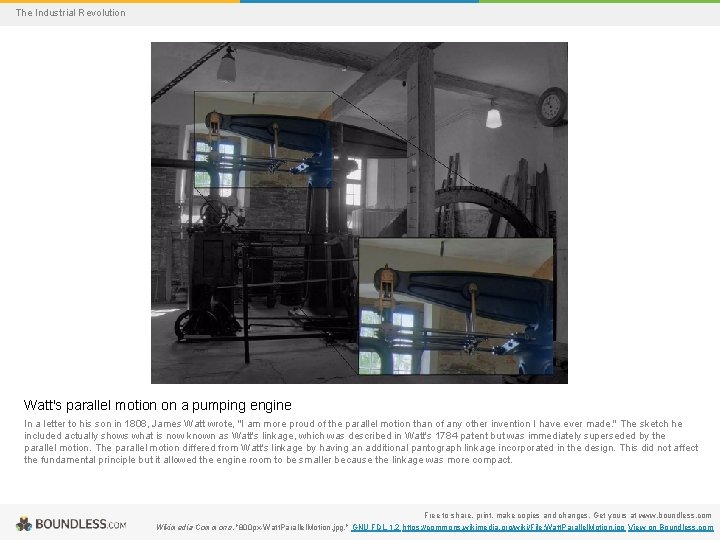
The Industrial Revolution Watt's parallel motion on a pumping engine In a letter to his son in 1808, James Watt wrote, "I am more proud of the parallel motion than of any other invention I have ever made. " The sketch he included actually shows what is now known as Watt's linkage, which was described in Watt's 1784 patent but was immediately superseded by the parallel motion. The parallel motion differed from Watt's linkage by having an additional pantograph linkage incorporated in the design. This did not affect the fundamental principle but it allowed the engine room to be smaller because the linkage was more compact. Free to share, print, make copies and changes. Get yours at www. boundless. com Wikimedia Commons. "800 px-Watt. Parallel. Motion. jpg. " GNU FDL 1. 2 https: //commons. wikimedia. org/wiki/File: Watt. Parallel. Motion. jpg View on Boundless. com
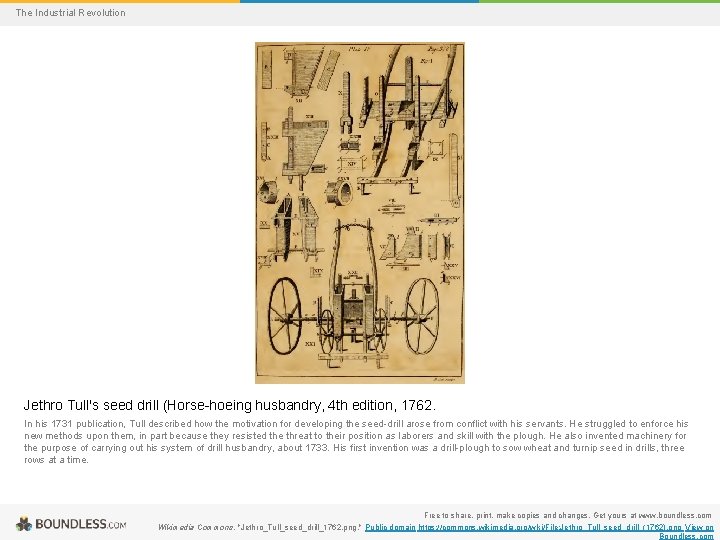
The Industrial Revolution Jethro Tull's seed drill (Horse-hoeing husbandry, 4 th edition, 1762. In his 1731 publication, Tull described how the motivation for developing the seed-drill arose from conflict with his servants. He struggled to enforce his new methods upon them, in part because they resisted the threat to their position as laborers and skill with the plough. He also invented machinery for the purpose of carrying out his system of drill husbandry, about 1733. His first invention was a drill-plough to sow wheat and turnip seed in drills, three rows at a time. Free to share, print, make copies and changes. Get yours at www. boundless. com Wikimedia Commons. "Jethro_Tull_seed_drill_1762. png. " Public domain https: //commons. wikimedia. org/wiki/File: Jethro_Tull_seed_drill_(1762). png View on Boundless. com
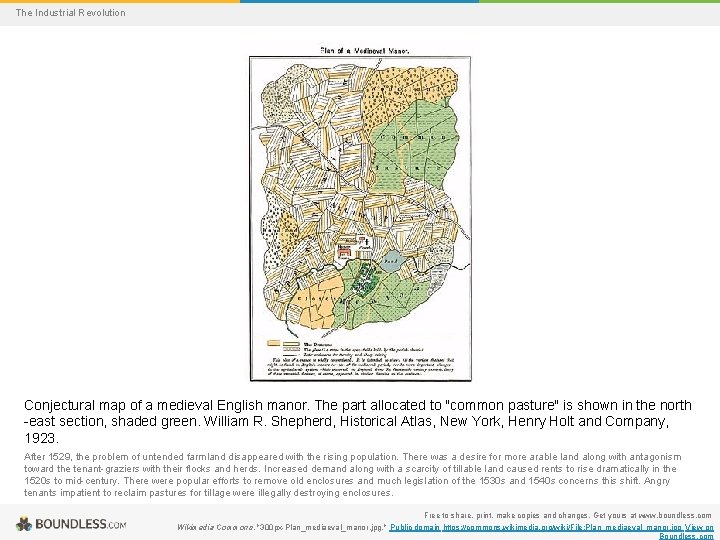
The Industrial Revolution Conjectural map of a medieval English manor. The part allocated to "common pasture" is shown in the north -east section, shaded green. William R. Shepherd, Historical Atlas, New York, Henry Holt and Company, 1923. After 1529, the problem of untended farmland disappeared with the rising population. There was a desire for more arable land along with antagonism toward the tenant-graziers with their flocks and herds. Increased demand along with a scarcity of tillable land caused rents to rise dramatically in the 1520 s to mid-century. There were popular efforts to remove old enclosures and much legislation of the 1530 s and 1540 s concerns this shift. Angry tenants impatient to reclaim pastures for tillage were illegally destroying enclosures. Free to share, print, make copies and changes. Get yours at www. boundless. com Wikimedia Commons. "300 px-Plan_mediaeval_manor. jpg. " Public domain https: //commons. wikimedia. org/wiki/File: Plan_mediaeval_manor. jpg View on Boundless. com
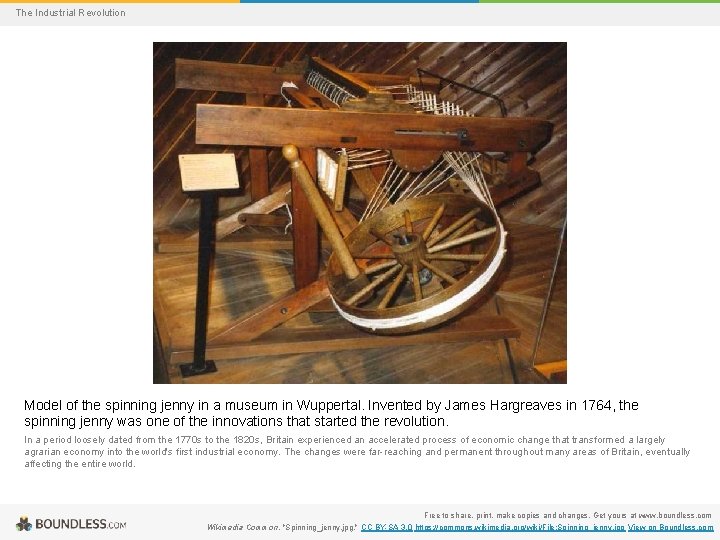
The Industrial Revolution Model of the spinning jenny in a museum in Wuppertal. Invented by James Hargreaves in 1764, the spinning jenny was one of the innovations that started the revolution. In a period loosely dated from the 1770 s to the 1820 s, Britain experienced an accelerated process of economic change that transformed a largely agrarian economy into the world's first industrial economy. The changes were far-reaching and permanent throughout many areas of Britain, eventually affecting the entire world. Free to share, print, make copies and changes. Get yours at www. boundless. com Wikimedia Common. "Spinning_jenny. jpg. " CC BY-SA 3. 0 https: //commons. wikimedia. org/wiki/File: Spinning_jenny. jpg View on Boundless. com
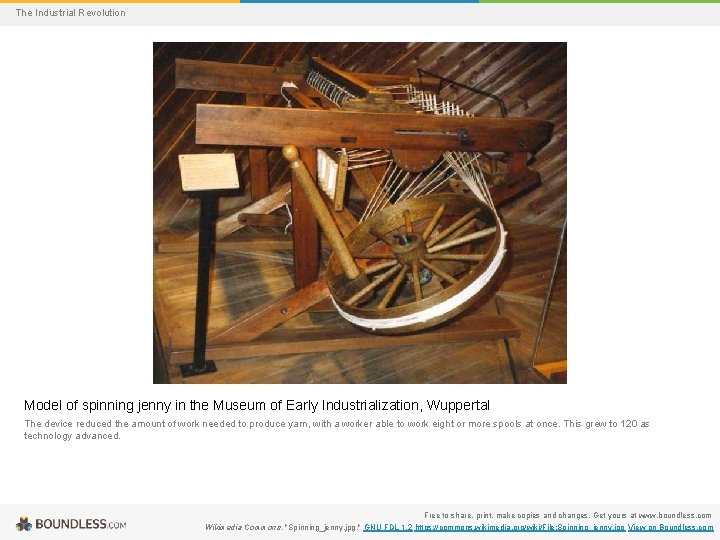
The Industrial Revolution Model of spinning jenny in the Museum of Early Industrialization, Wuppertal The device reduced the amount of work needed to produce yarn, with a worker able to work eight or more spools at once. This grew to 120 as technology advanced. Free to share, print, make copies and changes. Get yours at www. boundless. com Wikimedia Commons. "Spinning_jenny. jpg. " GNU FDL 1. 2 https: //commons. wikimedia. org/wiki/File: Spinning_jenny. jpg View on Boundless. com
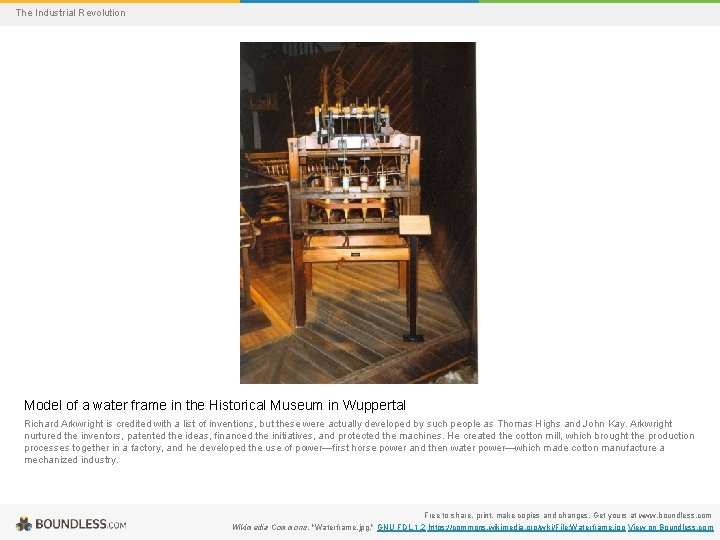
The Industrial Revolution Model of a water frame in the Historical Museum in Wuppertal Richard Arkwright is credited with a list of inventions, but these were actually developed by such people as Thomas Highs and John Kay. Arkwright nurtured the inventors, patented the ideas, financed the initiatives, and protected the machines. He created the cotton mill, which brought the production processes together in a factory, and he developed the use of power—first horse power and then water power—which made cotton manufacture a mechanized industry. Free to share, print, make copies and changes. Get yours at www. boundless. com Wikimedia Commons. "Waterframe. jpg. " GNU FDL 1. 2 https: //commons. wikimedia. org/wiki/File: Waterframe. jpg View on Boundless. com
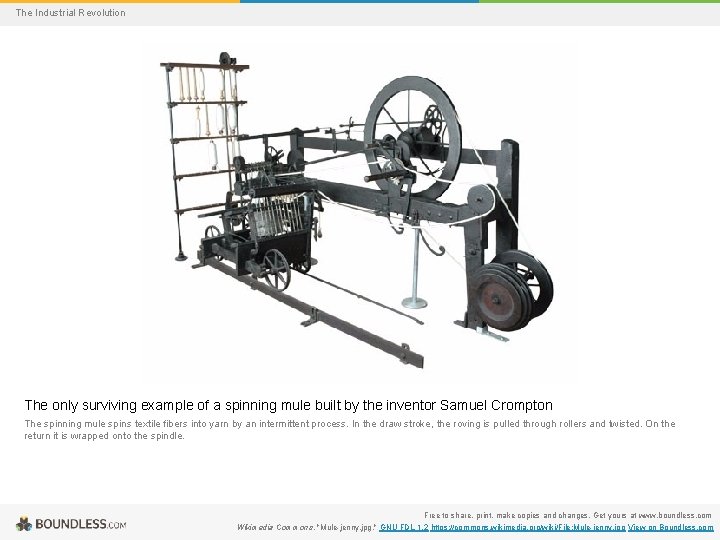
The Industrial Revolution The only surviving example of a spinning mule built by the inventor Samuel Crompton The spinning mule spins textile fibers into yarn by an intermittent process. In the draw stroke, the roving is pulled through rollers and twisted. On the return it is wrapped onto the spindle. Free to share, print, make copies and changes. Get yours at www. boundless. com Wikimedia Commons. "Mule-jenny. jpg. " GNU FDL 1. 2 https: //commons. wikimedia. org/wiki/File: Mule-jenny. jpg View on Boundless. com
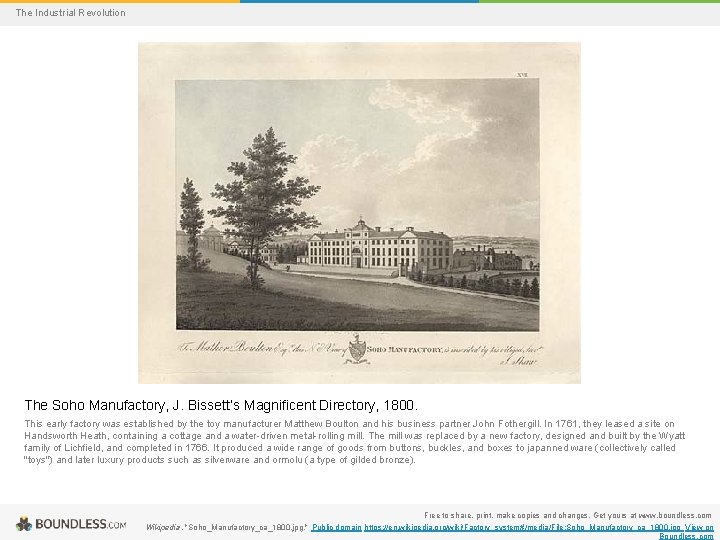
The Industrial Revolution The Soho Manufactory, J. Bissett’s Magnificent Directory, 1800. This early factory was established by the toy manufacturer Matthew Boulton and his business partner John Fothergill. In 1761, they leased a site on Handsworth Heath, containing a cottage and a water-driven metal-rolling mill. The mill was replaced by a new factory, designed and built by the Wyatt family of Lichfield, and completed in 1766. It produced a wide range of goods from buttons, buckles, and boxes to japanned ware (collectively called "toys") and later luxury products such as silverware and ormolu (a type of gilded bronze). Free to share, print, make copies and changes. Get yours at www. boundless. com Wikipedia. "Soho_Manufactory_ca_1800. jpg. " Public domain https: //en. wikipedia. org/wiki/Factory_system#/media/File: Soho_Manufactory_ca_1800. jpg View on Boundless. com
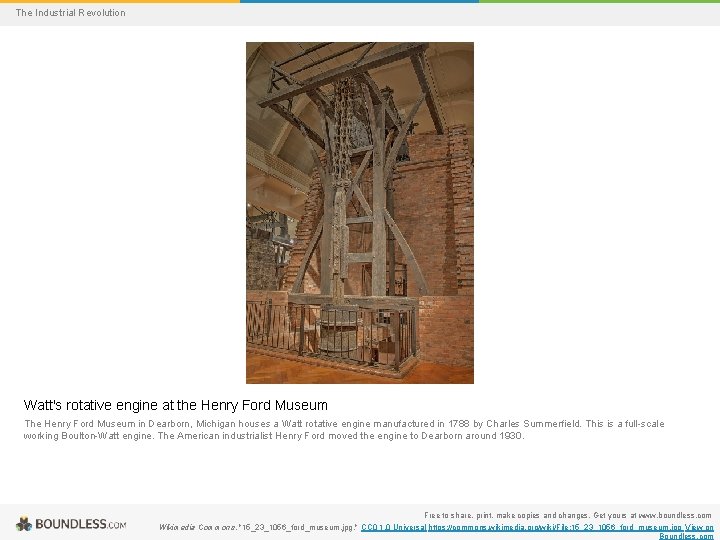
The Industrial Revolution Watt's rotative engine at the Henry Ford Museum The Henry Ford Museum in Dearborn, Michigan houses a Watt rotative engine manufactured in 1788 by Charles Summerfield. This is a full-scale working Boulton-Watt engine. The American industrialist Henry Ford moved the engine to Dearborn around 1930. Free to share, print, make copies and changes. Get yours at www. boundless. com Wikimedia Commons. "15_23_1056_ford_museum. jpg. " CC 0 1. 0 Universal https: //commons. wikimedia. org/wiki/File: 15_23_1056_ford_museum. jpg View on Boundless. com
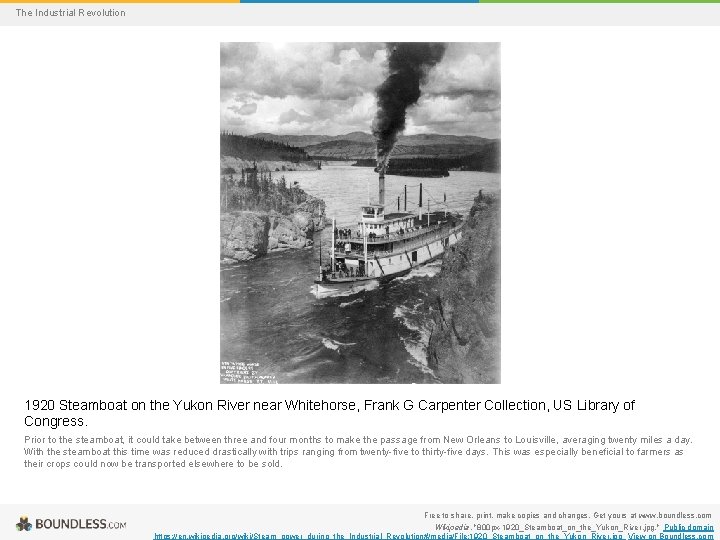
The Industrial Revolution 1920 Steamboat on the Yukon River near Whitehorse, Frank G Carpenter Collection, US Library of Congress. Prior to the steamboat, it could take between three and four months to make the passage from New Orleans to Louisville, averaging twenty miles a day. With the steamboat this time was reduced drastically with trips ranging from twenty-five to thirty-five days. This was especially beneficial to farmers as their crops could now be transported elsewhere to be sold. Free to share, print, make copies and changes. Get yours at www. boundless. com Wikipedia. "800 px-1920_Steamboat_on_the_Yukon_River. jpg. " Public domain https: //en. wikipedia. org/wiki/Steam_power_during_the_Industrial_Revolution#/media/File: 1920_Steamboat_on_the_Yukon_River. jpg View on Boundless. com
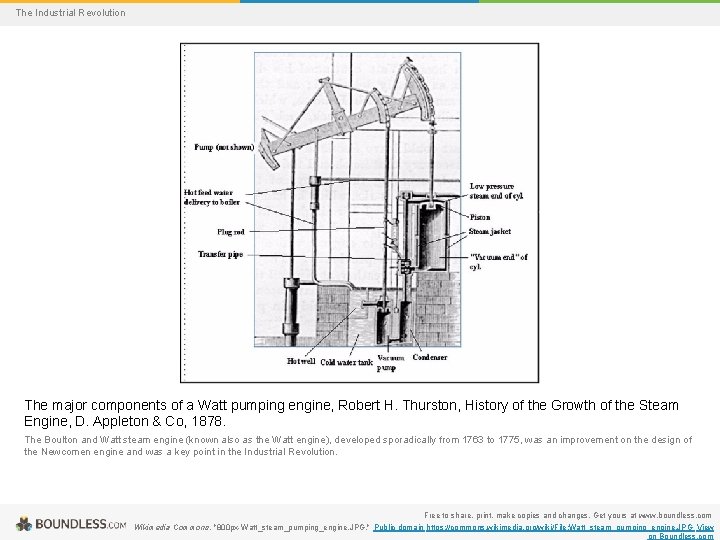
The Industrial Revolution The major components of a Watt pumping engine, Robert H. Thurston, History of the Growth of the Steam Engine, D. Appleton & Co, 1878. The Boulton and Watt steam engine (known also as the Watt engine), developed sporadically from 1763 to 1775, was an improvement on the design of the Newcomen engine and was a key point in the Industrial Revolution. Free to share, print, make copies and changes. Get yours at www. boundless. com Wikimedia Commons. "800 px-Watt_steam_pumping_engine. JPG. " Public domain https: //commons. wikimedia. org/wiki/File: Watt_steam_pumping_engine. JPG View on Boundless. com
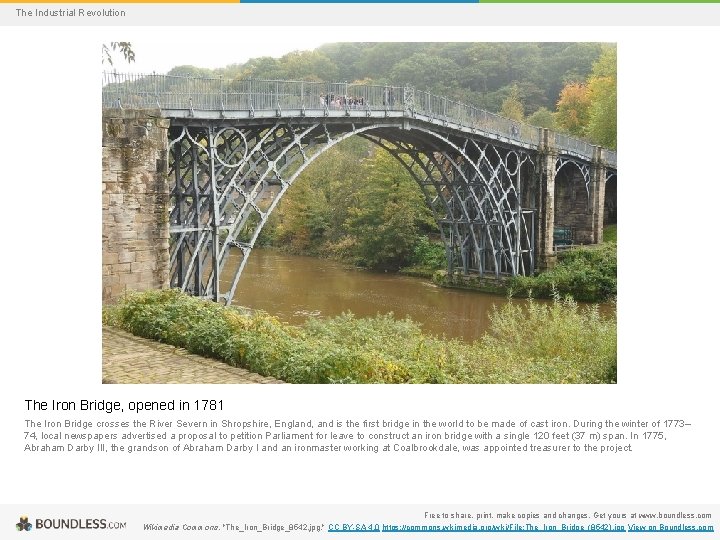
The Industrial Revolution The Iron Bridge, opened in 1781 The Iron Bridge crosses the River Severn in Shropshire, England, and is the first bridge in the world to be made of cast iron. During the winter of 1773– 74, local newspapers advertised a proposal to petition Parliament for leave to construct an iron bridge with a single 120 feet (37 m) span. In 1775, Abraham Darby III, the grandson of Abraham Darby I and an ironmaster working at Coalbrookdale, was appointed treasurer to the project. Free to share, print, make copies and changes. Get yours at www. boundless. com Wikimedia Commons. "The_Iron_Bridge_8542. jpg. " CC BY-SA 4. 0 https: //commons. wikimedia. org/wiki/File: The_Iron_Bridge_(8542). jpg View on Boundless. com
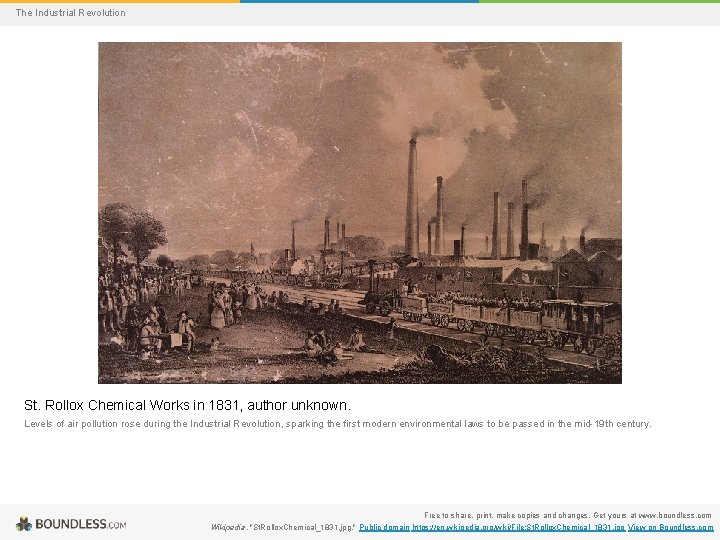
The Industrial Revolution St. Rollox Chemical Works in 1831, author unknown. Levels of air pollution rose during the Industrial Revolution, sparking the first modern environmental laws to be passed in the mid-19 th century. Free to share, print, make copies and changes. Get yours at www. boundless. com Wikipedia. "St. Rollox. Chemical_1831. jpg. " Public domain https: //en. wikipedia. org/wiki/File: St. Rollox. Chemical_1831. jpg View on Boundless. com
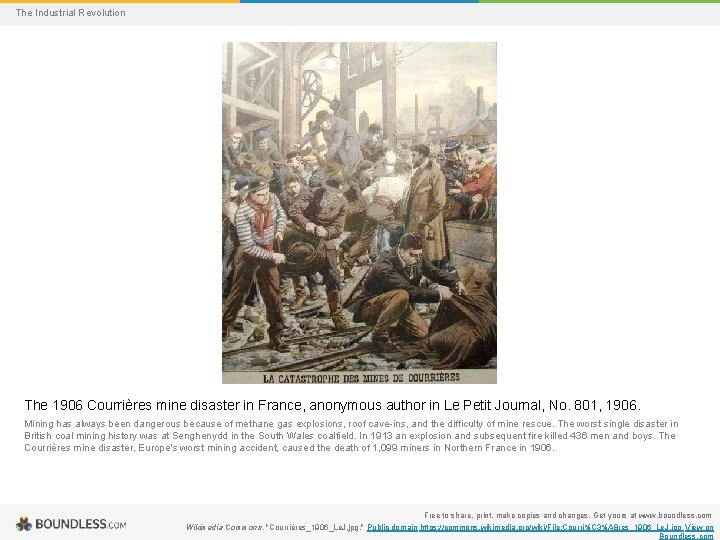
The Industrial Revolution The 1906 Courrières mine disaster in France, anonymous author in Le Petit Journal, No. 801, 1906. Mining has always been dangerous because of methane gas explosions, roof cave-ins, and the difficulty of mine rescue. The worst single disaster in British coal mining history was at Senghenydd in the South Wales coalfield. In 1913 an explosion and subsequent fire killed 436 men and boys. The Courrières mine disaster, Europe's worst mining accident, caused the death of 1, 099 miners in Northern France in 1906. Free to share, print, make copies and changes. Get yours at www. boundless. com Wikimedia Commons. "Courrières_1906_Le. J. jpg. " Public domain https: //commons. wikimedia. org/wiki/File: Courri%C 3%A 8 res_1906_Le. J. jpg View on Boundless. com
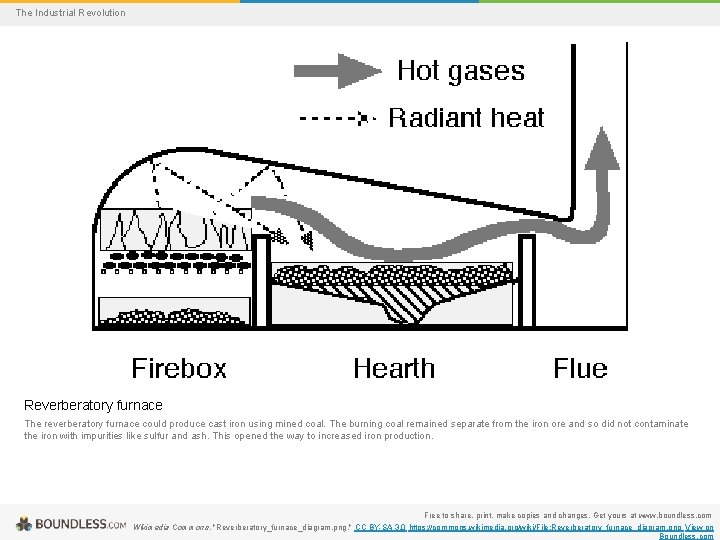
The Industrial Revolution Reverberatory furnace The reverberatory furnace could produce cast iron using mined coal. The burning coal remained separate from the iron ore and so did not contaminate the iron with impurities like sulfur and ash. This opened the way to increased iron production. Free to share, print, make copies and changes. Get yours at www. boundless. com Wikimedia Commons. "Reverberatory_furnace_diagram. png. " CC BY-SA 3. 0 https: //commons. wikimedia. org/wiki/File: Reverberatory_furnace_diagram. png View on Boundless. com
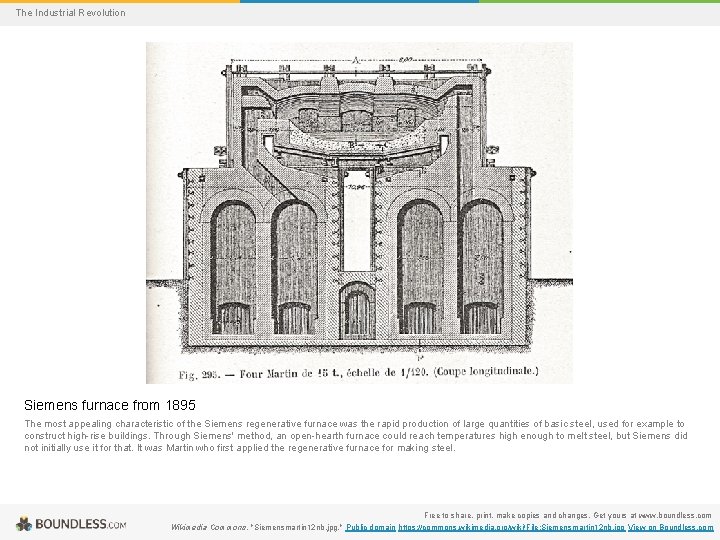
The Industrial Revolution Siemens furnace from 1895 The most appealing characteristic of the Siemens regenerative furnace was the rapid production of large quantities of basic steel, used for example to construct high-rise buildings. Through Siemens' method, an open-hearth furnace could reach temperatures high enough to melt steel, but Siemens did not initially use it for that. It was Martin who first applied the regenerative furnace for making steel. Free to share, print, make copies and changes. Get yours at www. boundless. com Wikimedia Commons. "Siemensmartin 12 nb. jpg. " Public domain https: //commons. wikimedia. org/wiki/File: Siemensmartin 12 nb. jpg View on Boundless. com
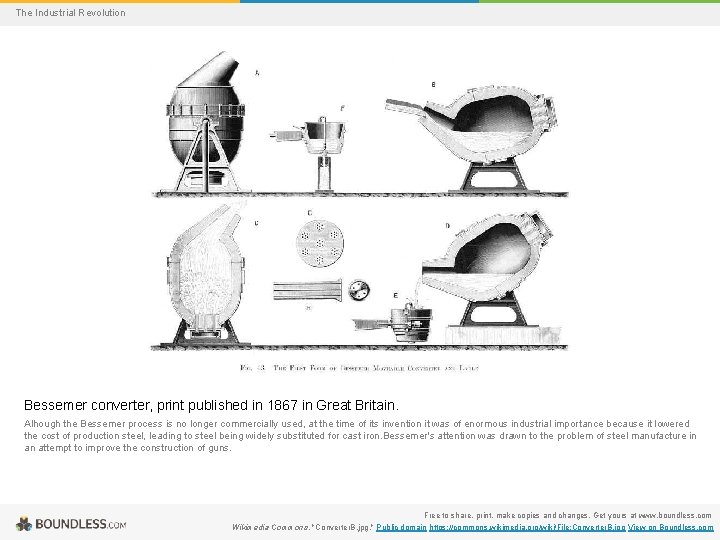
The Industrial Revolution Bessemer converter, print published in 1867 in Great Britain. Alhough the Bessemer process is no longer commercially used, at the time of its invention it was of enormous industrial importance because it lowered the cost of production steel, leading to steel being widely substituted for cast iron. Bessemer's attention was drawn to the problem of steel manufacture in an attempt to improve the construction of guns. Free to share, print, make copies and changes. Get yours at www. boundless. com Wikimedia Commons. "Converter. B. jpg. " Public domain https: //commons. wikimedia. org/wiki/File: Converter. B. jpg View on Boundless. com
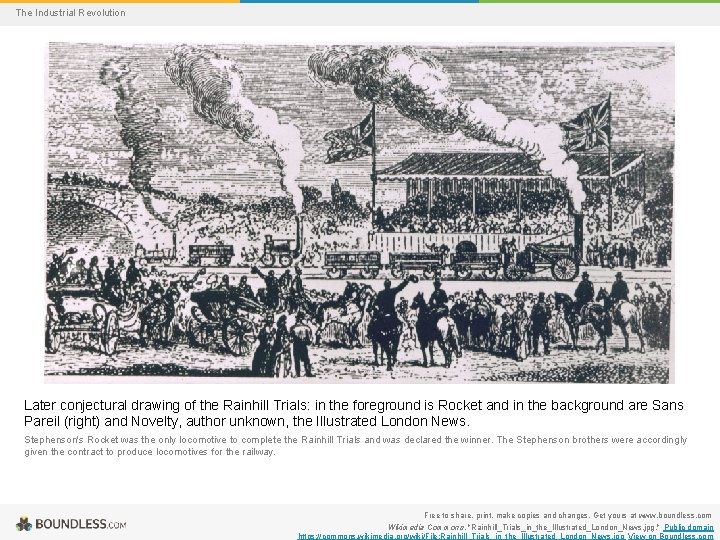
The Industrial Revolution Later conjectural drawing of the Rainhill Trials: in the foreground is Rocket and in the background are Sans Pareil (right) and Novelty, author unknown, the Illustrated London News. Stephenson's Rocket was the only locomotive to complete the Rainhill Trials and was declared the winner. The Stephenson brothers were accordingly given the contract to produce locomotives for the railway. Free to share, print, make copies and changes. Get yours at www. boundless. com Wikimedia Commons. "Rainhill_Trials_in_the_Illustrated_London_News. jpg. " Public domain https: //commons. wikimedia. org/wiki/File: Rainhill_Trials_in_the_Illustrated_London_News. jpg View on Boundless. com
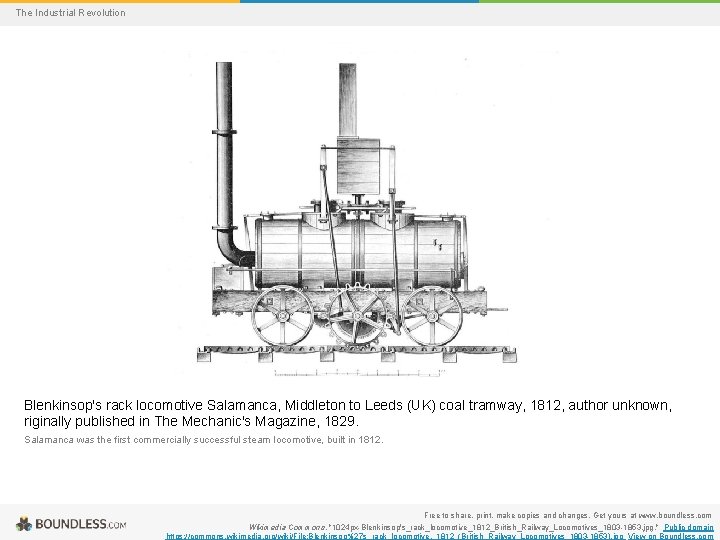
The Industrial Revolution Blenkinsop's rack locomotive Salamanca, Middleton to Leeds (UK) coal tramway, 1812, author unknown, riginally published in The Mechanic's Magazine, 1829. Salamanca was the first commercially successful steam locomotive, built in 1812. Free to share, print, make copies and changes. Get yours at www. boundless. com Wikimedia Commons. "1024 px-Blenkinsop's_rack_locomotive_1812_British_Railway_Locomotives_1803 -1853. jpg. " Public domain https: //commons. wikimedia. org/wiki/File: Blenkinsop%27 s_rack_locomotive, _1812_(British_Railway_Locomotives_1803 -1853). jpg View on Boundless. com
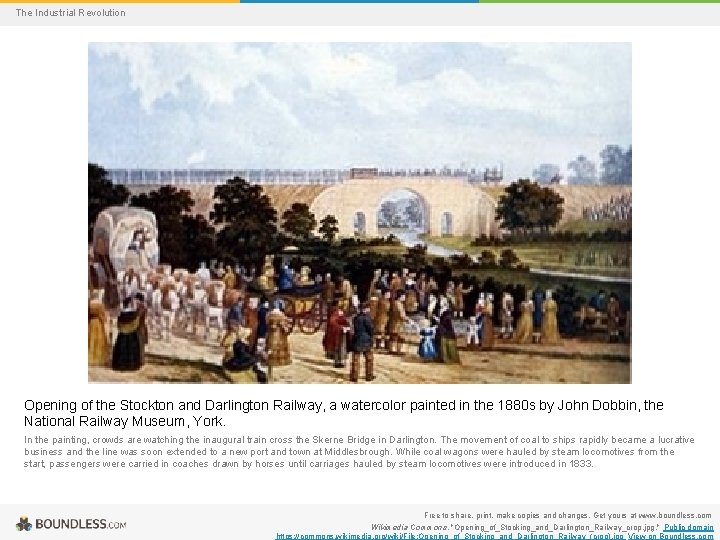
The Industrial Revolution Opening of the Stockton and Darlington Railway, a watercolor painted in the 1880 s by John Dobbin, the National Railway Museum, York. In the painting, crowds are watching the inaugural train cross the Skerne Bridge in Darlington. The movement of coal to ships rapidly became a lucrative business and the line was soon extended to a new port and town at Middlesbrough. While coal wagons were hauled by steam locomotives from the start, passengers were carried in coaches drawn by horses until carriages hauled by steam locomotives were introduced in 1833. Free to share, print, make copies and changes. Get yours at www. boundless. com Wikimedia Commons. "Opening_of_Stocking_and_Darlington_Railway_crop. jpg. " Public domain https: //commons. wikimedia. org/wiki/File: Opening_of_Stocking_and_Darlington_Railway_(crop). jpg View on Boundless. com
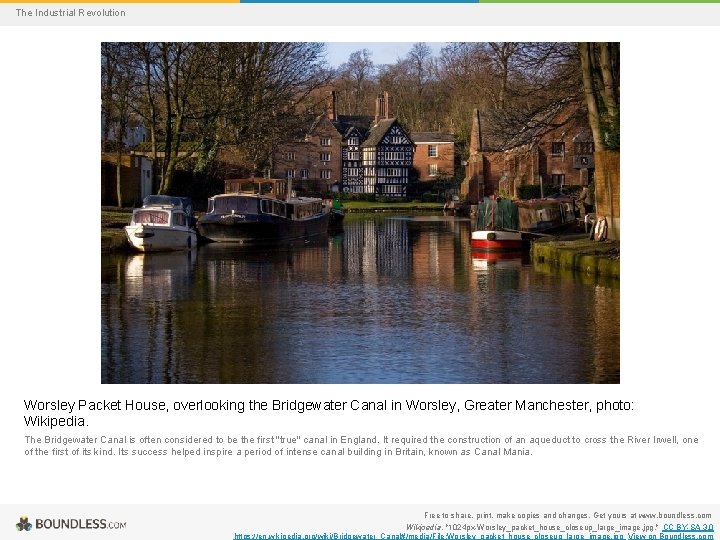
The Industrial Revolution Worsley Packet House, overlooking the Bridgewater Canal in Worsley, Greater Manchester, photo: Wikipedia. The Bridgewater Canal is often considered to be the first "true" canal in England. It required the construction of an aqueduct to cross the River Irwell, one of the first of its kind. Its success helped inspire a period of intense canal building in Britain, known as Canal Mania. Free to share, print, make copies and changes. Get yours at www. boundless. com Wikipedia. "1024 px-Worsley_packet_house_closeup_large_image. jpg. " CC BY-SA 3. 0 https: //en. wikipedia. org/wiki/Bridgewater_Canal#/media/File: Worsley_packet_house_closeup_large_image. jpg View on Boundless. com
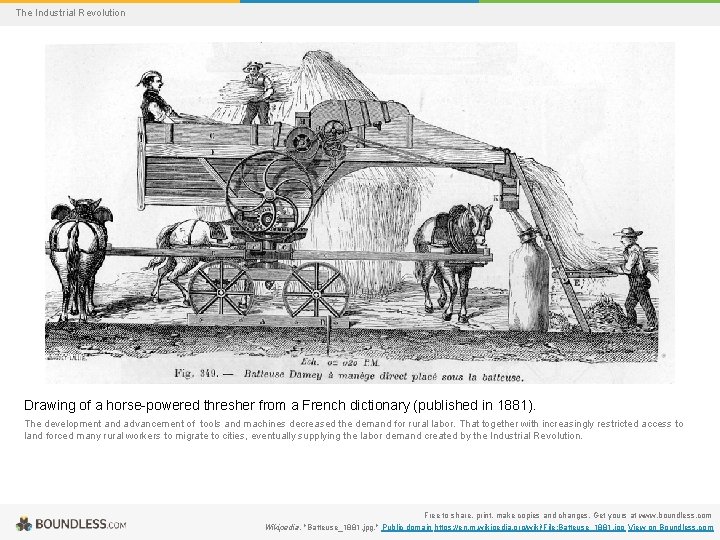
The Industrial Revolution Drawing of a horse-powered thresher from a French dictionary (published in 1881). The development and advancement of tools and machines decreased the demand for rural labor. That together with increasingly restricted access to land forced many rural workers to migrate to cities, eventually supplying the labor demand created by the Industrial Revolution. Free to share, print, make copies and changes. Get yours at www. boundless. com Wikipedia. "Batteuse_1881. jpg. " Public domain https: //en. m. wikipedia. org/wiki/File: Batteuse_1881. jpg View on Boundless. com
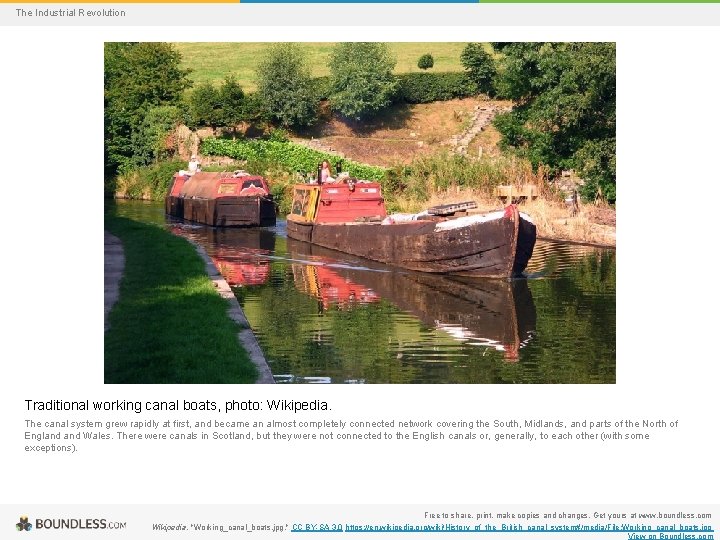
The Industrial Revolution Traditional working canal boats, photo: Wikipedia. The canal system grew rapidly at first, and became an almost completely connected network covering the South, Midlands, and parts of the North of England Wales. There were canals in Scotland, but they were not connected to the English canals or, generally, to each other (with some exceptions). Free to share, print, make copies and changes. Get yours at www. boundless. com Wikipedia. "Working_canal_boats. jpg. " CC BY-SA 3. 0 https: //en. wikipedia. org/wiki/History_of_the_British_canal_system#/media/File: Working_canal_boats. jpg View on Boundless. com
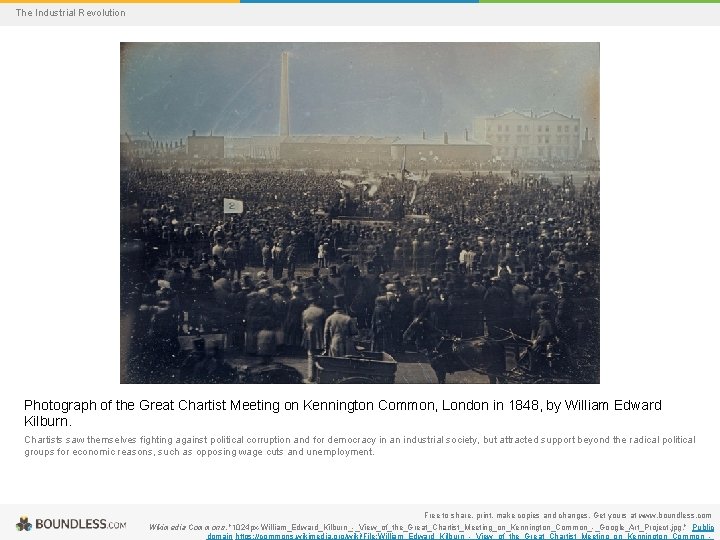
The Industrial Revolution Photograph of the Great Chartist Meeting on Kennington Common, London in 1848, by William Edward Kilburn. Chartists saw themselves fighting against political corruption and for democracy in an industrial society, but attracted support beyond the radical political groups for economic reasons, such as opposing wage cuts and unemployment. Free to share, print, make copies and changes. Get yours at www. boundless. com Wikimedia Commons. "1024 px-William_Edward_Kilburn_-_View_of_the_Great_Chartist_Meeting_on_Kennington_Common_-_Google_Art_Project. jpg. " Public domain https: //commons. wikimedia. org/wiki/File: William_Edward_Kilburn_-_View_of_the_Great_Chartist_Meeting_on_Kennington_Common_-
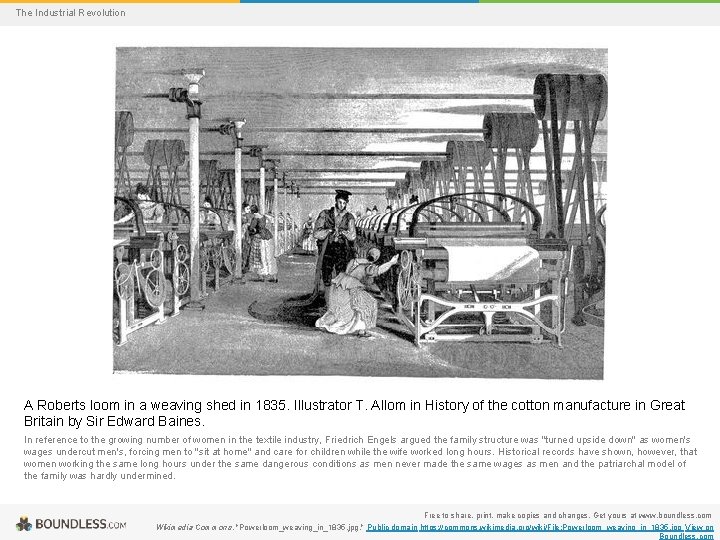
The Industrial Revolution A Roberts loom in a weaving shed in 1835. Illustrator T. Allom in History of the cotton manufacture in Great Britain by Sir Edward Baines. In reference to the growing number of women in the textile industry, Friedrich Engels argued the family structure was "turned upside down" as women's wages undercut men's, forcing men to "sit at home" and care for children while the wife worked long hours. Historical records have shown, however, that women working the same long hours under the same dangerous conditions as men never made the same wages as men and the patriarchal model of the family was hardly undermined. Free to share, print, make copies and changes. Get yours at www. boundless. com Wikimedia Commons. "Powerloom_weaving_in_1835. jpg. " Public domain https: //commons. wikimedia. org/wiki/File: Powerloom_weaving_in_1835. jpg View on Boundless. com
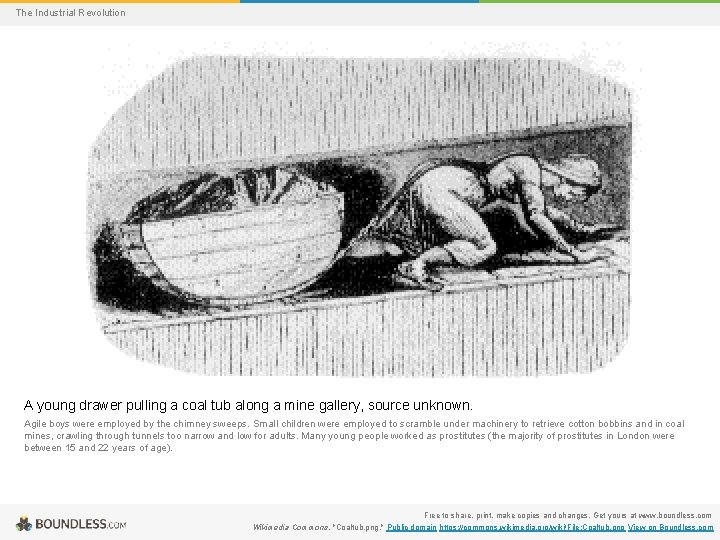
The Industrial Revolution A young drawer pulling a coal tub along a mine gallery, source unknown. Agile boys were employed by the chimney sweeps. Small children were employed to scramble under machinery to retrieve cotton bobbins and in coal mines, crawling through tunnels too narrow and low for adults. Many young people worked as prostitutes (the majority of prostitutes in London were between 15 and 22 years of age). Free to share, print, make copies and changes. Get yours at www. boundless. com Wikimedia Commons. "Coaltub. png. " Public domain https: //commons. wikimedia. org/wiki/File: Coaltub. png View on Boundless. com
The Industrial Revolution Attribution • Wikipedia. "Common land. " CC BY-SA 3. 0 https: //en. wikipedia. org/wiki/Common_land • Wikipedia. "British Agricultural Revolution. " CC BY-SA 3. 0 https: //en. wikipedia. org/wiki/British_Agricultural_Revolution • Wikipedia. "Charles Townshend, 2 nd Viscount Townshend. " CC BY-SA 3. 0 https: //en. wikipedia. org/wiki/Charles_Townshend, _2 nd_Viscount_Townshend • Wikipedia. "Crop rotation. " CC BY-SA 3. 0 https: //en. wikipedia. org/wiki/Crop_rotation • Wikipedia. "Industrial Revolution. " CC BY-SA 3. 0 https: //en. wikipedia. org/wiki/Industrial_Revolution • Wikipedia. "Plough. " CC BY-SA 3. 0 https: //en. wikipedia. org/wiki/Plough • Wikipedia. "History of agriculture. " CC BY-SA 3. 0 https: //en. wikipedia. org/wiki/History_of_agriculture • Wikipedia. "Jethro Tull (agriculturist). " CC BY-SA 3. 0 https: //en. wikipedia. org/wiki/Jethro_Tull_(agriculturist) • Wikipedia. "British Agricultural Revolution. " CC BY-SA 3. 0 https: //en. wikipedia. org/wiki/British_Agricultural_Revolution • Wikipedia. "Seed drill. " CC BY-SA 3. 0 https: //en. wikipedia. org/wiki/Seed_drill • Wikipedia. "Threshing machine. " CC BY-SA 3. 0 https: //en. wikipedia. org/wiki/Threshing_machine • Wikipedia. "History of agriculture. " CC BY-SA 3. 0 https: //en. wikipedia. org/wiki/History_of_agriculture • Wikipedia. "Common land. " CC BY-SA 3. 0 https: //en. wikipedia. org/wiki/Common_land • Wikipedia. "British Agricultural Revolution. " CC BY-SA 3. 0 https: //en. wikipedia. org/wiki/British_Agricultural_Revolution • Wikipedia. "Enclosure. " CC BY-SA 3. 0 https: //en. wikipedia. org/wiki/Enclosure • Wikipedia. "Industrial Revolution. " CC BY-SA 3. 0 https: //en. wikipedia. org/wiki/Industrial_Revolution • Wikipedia. "Inclosure Acts. " CC BY-SA 3. 0 https: //en. wikipedia. org/wiki/Inclosure_Acts Free to share, print, make copies and changes. Get yours at www. boundless. com
The Industrial Revolution • Wikipedia. "British Agricultural Revolution. " CC BY-SA 3. 0 https: //en. wikipedia. org/wiki/British_Agricultural_Revolution • Wikipedia. "Rural flight. " CC BY-SA 3. 0 https: //en. wikipedia. org/wiki/Rural_flight • Wikipedia. "Urbanization. " CC BY-SA 3. 0 https: //en. wikipedia. org/wiki/Urbanization • Wikipedia. "Enclosure. " CC BY-SA 3. 0 https: //en. wikipedia. org/wiki/Enclosure • Wikipedia. "Industrial Revolution. " CC BY-SA 3. 0 https: //en. wikipedia. org/wiki/Industrial_Revolution • Wikipedia. "Economic history of the United Kingdom. " CC BY-SA 3. 0 https: //en. wikipedia. org/wiki/Economic_history_of_the_United_Kingdom • Wikipedia. "Mercantilism. " CC BY-SA 3. 0 https: //en. wikipedia. org/wiki/Mercantilism • Wikipedia. "Calico Acts. " CC BY-SA 3. 0 https: //en. wikipedia. org/wiki/Calico_Acts • Wikipedia. "Textile manufacture during the Industrial Revolution. " CC BY-SA 3. 0 https: //en. wikipedia. org/wiki/Textile_manufacture_during_the_Industrial_Revolution • Wikipedia. "Putting-out system. " CC BY-SA 3. 0 https: //en. wikipedia. org/wiki/Putting-out_system • Wikipedia. "Textile manufacturing by pre-industrial methods. " CC BY-SA 3. 0 https: //en. wikipedia. org/wiki/Textile_manufacturing_by_pre-industrial_methods • Wikipedia. "Industrial Revolution. " CC BY-SA 3. 0 https: //en. wikipedia. org/wiki/Industrial_Revolution • Wikipedia. "Spinning jenny. " CC BY-SA 3. 0 https: //en. wikipedia. org/wiki/Spinning_jenny • Wikipedia. "Water frame. " CC BY-SA 3. 0 https: //en. wikipedia. org/wiki/Water_frame • Wikipedia. "Calico Acts. " CC BY-SA 3. 0 https: //en. wikipedia. org/wiki/Calico_Acts • Wikipedia. "Textile manufacture during the Industrial Revolution. " CC BY-SA 3. 0 https: //en. wikipedia. org/wiki/Textile_manufacture_during_the_Industrial_Revolution • Wikipedia. "Robert Kay (inventor). " CC BY-SA 3. 0 https: //en. wikipedia. org/wiki/Robert_Kay_(inventor) • Wikipedia. "Industrial Revolution. " CC BY-SA 3. 0 https: //en. wikipedia. org/wiki/Industrial_Revolution • Wikipedia. "Flying shuttle. " CC BY-SA 3. 0 https: //en. wikipedia. org/wiki/Flying_shuttle Free to share, print, make copies and changes. Get yours at www. boundless. com
The Industrial Revolution • Wikipedia. "Spinning mule. " CC BY-SA 3. 0 https: //en. wikipedia. org/wiki/Spinning_mule • Wikipedia. "Life in Great Britain during the Industrial Revolution. " CC BY-SA 3. 0 https: //en. wikipedia. org/wiki/Life_in_Great_Britain_during_the_Industrial_Revolution • Wikipedia. "Spinning jenny. " CC BY-SA 3. 0 https: //en. wikipedia. org/wiki/Spinning_jenny • Wikipedia. "Textile manufacture during the Industrial Revolution. " CC BY-SA 3. 0 https: //en. wikipedia. org/wiki/Textile_manufacture_during_the_Industrial_Revolution • Wikipedia. "Putting-out system. " CC BY-SA 3. 0 https: //en. wikipedia. org/wiki/Putting-out_system • Wikipedia. "Factory system. " CC BY-SA 3. 0 https: //en. wikipedia. org/wiki/Factory_system • Wikipedia. "Soho Manufactory. " CC BY-SA 3. 0 https: //en. wikipedia. org/wiki/Soho_Manufactory • Wikipedia. "Luddite. " CC BY-SA 3. 0 https: //en. wikipedia. org/wiki/Luddite • Wikipedia. "Industrial Revolution. " CC BY-SA 3. 0 https: //en. wikipedia. org/wiki/Industrial_Revolution • Wikipedia. "Aeolipile. " CC BY-SA 3. 0 https: //en. wikipedia. org/wiki/Aeolipile • Wikipedia. "Beam engine. " CC BY-SA 3. 0 https: //en. wikipedia. org/wiki/Beam_engine • Wikipedia. "Thomas Savery. " CC BY-SA 3. 0 https: //en. wikipedia. org/wiki/Thomas_Savery • Wikipedia. "Thomas Newcomen. " CC BY-SA 3. 0 https: //en. wikipedia. org/wiki/Thomas_Newcomen • Wikipedia. "Steam power during the Industrial Revolution. " CC BY-SA 3. 0 https: //en. wikipedia. org/wiki/Steam_power_during_the_Industrial_Revolution • Wikipedia. "Newcomen atmospheric engine. " CC BY-SA 3. 0 https: //en. wikipedia. org/wiki/Newcomen_atmospheric_engine • Wikipedia. "Steam engine. " CC BY-SA 3. 0 https: //en. wikipedia. org/wiki/Steam_engine • Wikipedia. "Watt steam engine. " CC BY-SA 3. 0 https: //en. wikipedia. org/wiki/Watt_steam_engine • Wikipedia. "Parallel motion. " CC BY-SA 3. 0 https: //en. wikipedia. org/wiki/Parallel_motion • Wikipedia. "Boulton and Watt. " CC BY-SA 3. 0 https: //en. wikipedia. org/wiki/Boulton_and_Watt Free to share, print, make copies and changes. Get yours at www. boundless. com
The Industrial Revolution • Wikipedia. "Reciprocating engine. " CC BY-SA 3. 0 https: //en. wikipedia. org/wiki/Reciprocating_engine • Wikipedia. "Newcomen atmospheric engine. " CC BY-SA 3. 0 https: //en. wikipedia. org/wiki/Newcomen_atmospheric_engine • Wikipedia. "Steam engine. " CC BY-SA 3. 0 https: //en. wikipedia. org/wiki/Steam_engine • Wikipedia. "Pantograph (transport). " CC BY-SA 3. 0 https: //en. wikipedia. org/wiki/Pantograph_(transport) • Wikipedia. "Condenser (heat transfer). " CC BY-SA 3. 0 https: //en. wikipedia. org/wiki/Condenser_(heat_transfer) • Wikipedia. "Industrial Revolution. " CC BY-SA 3. 0 https: //en. wikipedia. org/wiki/Industrial_Revolution • Wikipedia. "Watt steam engine. " CC BY-SA 3. 0 https: //en. wikipedia. org/wiki/Watt_steam_engine • Wikipedia. "Beam engine. " CC BY-SA 3. 0 https: //en. wikipedia. org/wiki/Beam_engine • Wikipedia. "Steam power during the Industrial Revolution. " CC BY-SA 3. 0 https: //en. wikipedia. org/wiki/Steam_power_during_the_Industrial_Revolution • Wikipedia. "Boulton and Watt. " CC BY-SA 3. 0 https: //en. wikipedia. org/wiki/Boulton_and_Watt • Wikipedia. "Steam engine. " CC BY-SA 3. 0 https: //en. wikipedia. org/wiki/Steam_engine • Wikipedia. "Industrial Revolution. " CC BY-SA 3. 0 https: //en. wikipedia. org/wiki/Industrial_Revolution • Wikipedia. "Coal. " CC BY-SA 3. 0 https: //en. wikipedia. org/wiki/Coal • Wikipedia. "Industrial Revolution. " CC BY-SA 3. 0 https: //en. wikipedia. org/wiki/Industrial_Revolution • Wikipedia. "Coke (fuel). " CC BY-SA 3. 0 https: //en. wikipedia. org/wiki/Coke_(fuel) • Wikipedia. "Coal mining in the United Kingdom. " CC BY-SA 3. 0 https: //en. wikipedia. org/wiki/Coal_mining_in_the_United_Kingdom • Wikipedia. "Reverberatory furnace. " CC BY-SA 3. 0 https: //en. wikipedia. org/wiki/Reverberatory_furnace • Wikipedia. "History of coal mining. " CC BY-SA 3. 0 https: //en. wikipedia. org/wiki/History_of_coal_mining • Wikipedia. "History of coal miners. " CC BY-SA 3. 0 https: //en. wikipedia. org/wiki/History_of_coal_miners Free to share, print, make copies and changes. Get yours at www. boundless. com
The Industrial Revolution • Wikipedia. "Steam engine. " CC BY-SA 3. 0 https: //en. wikipedia. org/wiki/Steam_engine • Wikipedia. "Industrial Revolution. " CC BY-SA 3. 0 https: //en. wikipedia. org/wiki/Industrial_Revolution • Wikipedia. "Ferrous metallurgy. " CC BY-SA 3. 0 https: //en. wikipedia. org/wiki/Ferrous_metallurgy • Wikipedia. "The Iron Bridge. " CC BY-SA 3. 0 https: //en. wikipedia. org/wiki/The_Iron_Bridge • Wikipedia. "Pig iron. " CC BY-SA 3. 0 https: //en. wikipedia. org/wiki/Pig_iron • Wikipedia. "History of the steel industry (1850– 1970). " CC BY-SA 3. 0 https: //en. wikipedia. org/wiki/History_of_the_steel_industry_(1850%E 2%80%931970) • Wikipedia. "Iron. " CC BY-SA 3. 0 https: //en. wikipedia. org/wiki/Iron • Wikipedia. "Coke (fuel). " CC BY-SA 3. 0 https: //en. wikipedia. org/wiki/Coke_(fuel) • Wikipedis. "Reverberatory furnace. " CC BY-SA 3. 0 https: //en. wikipedia. org/wiki/Reverberatory_furnace • Wikipedia. "Carburizing. " CC BY-SA 3. 0 https: //en. wikipedia. org/wiki/Carburizing • Wikipedia. "Industrial Revolution. " CC BY-SA 3. 0 https: //en. wikipedia. org/wiki/Industrial_Revolution • Wikipedia. "Second Industrial Revolution. " CC BY-SA 3. 0 https: //en. wikipedia. org/wiki/Second_Industrial_Revolution • Wikipedia. "Benjamin Huntsman. " CC BY-SA 3. 0 https: //en. wikipedia. org/wiki/Benjamin_Huntsman • Wikipedia. "Crucible steel. " CC BY-SA 3. 0 https: //en. wikipedia. org/wiki/Crucible_steel • Wikipedia. "Open hearth furnace. " CC BY-SA 3. 0 https: //en. wikipedia. org/wiki/Open_hearth_furnace • Wikipedia. "Ferrous metallurgy. " CC BY-SA 3. 0 https: //en. wikipedia. org/wiki/Ferrous_metallurgy • Wikipedia. "History of the steel industry (1850– 1970). " CC BY-SA 3. 0 https: //en. wikipedia. org/wiki/History_of_the_steel_industry_(1850%E 2%80%931970) • Wikipedia. "Cementation process. " CC BY-SA 3. 0 https: //en. wikipedia. org/wiki/Cementation_process • Wikipedia. "Spiegeleisen. " CC BY-SA 3. 0 https: //en. wikipedia. org/wiki/Spiegeleisen Free to share, print, make copies and changes. Get yours at www. boundless. com
The Industrial Revolution • Wikipedia. "Bessemer process. " CC BY-SA 3. 0 https: //en. wikipedia. org/wiki/Bessemer_process • Wikipedia. "Henry Bessemer. " CC BY-SA 3. 0 https: //en. wikipedia. org/wiki/Henry_Bessemer • Wikipedia. "Steel. " CC BY-SA 3. 0 https: //en. wikipedia. org/wiki/Steel • Wikipedia. "Reverberatory furnace. " CC BY-SA 3. 0 https: //en. wikipedia. org/wiki/Reverberatory_furnace • Wikipedia. "Industrial Revolution. " CC BY-SA 3. 0 https: //en. wikipedia. org/wiki/Industrial_Revolution • Wikipedia. "Bridgewater Canal. " CC BY-SA 3. 0 https: //en. wikipedia. org/wiki/Bridgewater_Canal • Wikipedia. "Transport during the British Industrial Revolution. " CC BY-SA 3. 0 https: //en. wikipedia. org/wiki/Transport_during_the_British_Industrial_Revolution • Wikipedia. "History of the British canal system. " CC BY-SA 3. 0 https: //en. wikipedia. org/wiki/History_of_the_British_canal_system • Wikipedia. "Canal Mania. " CC BY-SA 3. 0 https: //en. wikipedia. org/wiki/Canal_Mania • Wikipedia. "Flyboat. " CC BY-SA 3. 0 https: //en. wikipedia. org/wiki/Flyboat • Wikipedia. "Puffing Billy (locomotive). " CC BY-SA 3. 0 https: //en. wikipedia. org/wiki/Puffing_Billy_(locomotive) • Wikipedia. "Rainhill Trials. " CC BY-SA 3. 0 https: //en. wikipedia. org/wiki/Rainhill_Trials • Wikipedia. "Stockton and Darlington Railway. " CC BY-SA 3. 0 https: //en. wikipedia. org/wiki/Stockton_and_Darlington_Railway • Wikipedia. "Rack railway. " CC BY-SA 3. 0 https: //en. wikipedia. org/wiki/Rack_railway • Wikipedia. "Salamanca (locomotive). " CC BY-SA 3. 0 https: //en. wikipedia. org/wiki/Salamanca_(locomotive) • Wikipedia. "Catch Me Who Can. " CC BY-SA 3. 0 https: //en. wikipedia. org/wiki/Catch_Me_Who_Can • Wikipedia. "Plateway. " CC BY-SA 3. 0 https: //en. wikipedia. org/wiki/Plateway • Wikipedia. "History of rail transport in Great Britain to 1830. " CC BY-SA 3. 0 https: //en. wikipedia. org/wiki/History_of_rail_transport_in_Great_Britain_to_1830 • Wikipedia. "Liverpool and Manchester Railway. " CC BY-SA 3. 0 https: //en. wikipedia. org/wiki/Liverpool_and_Manchester_Railway Free to share, print, make copies and changes. Get yours at www. boundless. com
The Industrial Revolution • Wikipedia. "History of rail transport. " CC BY-SA 3. 0 https: //en. wikipedia. org/wiki/History_of_rail_transport • Wikipedia. "History of rail transport in Great Britain. " CC BY-SA 3. 0 https: //en. wikipedia. org/wiki/History_of_rail_transport_in_Great_Britain • Wikipedia. "Parliamentary train. " CC BY-SA 3. 0 https: //en. wikipedia. org/wiki/Parliamentary_train • Wikipedia. "Race to the North. " CC BY-SA 3. 0 https: //en. wikipedia. org/wiki/Race_to_the_North • Wikipedia. "History of rail transport in Great Britain 1830– 1922. " CC BY-SA 3. 0 https: //en. wikipedia. org/wiki/History_of_rail_transport_in_Great_Britain_1830%E 2%80%931922 • Wikipedia. "Railway Mania. " CC BY-SA 3. 0 https: //en. wikipedia. org/wiki/Railway_Mania • Wikipedia. "History of rail transport in Great Britain to 1830. " CC BY-SA 3. 0 https: //en. wikipedia. org/wiki/History_of_rail_transport_in_Great_Britain_to_1830 • Wikipedia. "Railway Clearing House. " CC BY-SA 3. 0 https: //en. wikipedia. org/wiki/Railway_Clearing_House • Wikipedia. "Liverpool and Manchester Railway. " CC BY-SA 3. 0 https: //en. wikipedia. org/wiki/Liverpool_and_Manchester_Railway • Wikipedia. "Truck system. " CC BY-SA 3. 0 https: //en. wikipedia. org/wiki/Truck_system • Wikipedia. "Factory system. " CC BY-SA 3. 0 https: //en. wikipedia. org/wiki/Factory_system • Wikipedia. "Factory. " CC BY-SA 3. 0 https: //en. wikipedia. org/wiki/Factory • Wikipedia. "Etruria Works. " CC BY-SA 3. 0 https: //en. wikipedia. org/wiki/Etruria_Works • Wikipedia. "Putting-out system. " CC BY-SA 3. 0 https: //en. wikipedia. org/wiki/Putting-out_system • Wikipedia. "Soho Manufactory. " CC BY-SA 3. 0 https: //en. wikipedia. org/wiki/Soho_Manufactory • Wikipedia. "Josiah Wedgwood. " CC BY-SA 3. 0 https: //en. wikipedia. org/wiki/Josiah_Wedgwood • Wikipedia. "Cromford Mill. " CC BY-SA 3. 0 https: //en. wikipedia. org/wiki/Cromford_Mill • Wikipedia. "Luddite. " CC BY-SA 3. 0 https: //en. wikipedia. org/wiki/Luddite • Wikipedia. "The Condition of the Working Class in England. " CC BY-SA 3. 0 Free to share, print, make copies and changes. Get yours at www. boundless. com https: //en. wikipedia. org/wiki/The_Condition_of_the_Working_Class_in_England
The Industrial Revolution • Wikipedia. "Industrial Revolution. " CC BY-SA 3. 0 https: //en. wikipedia. org/wiki/Industrial_Revolution • Wikipedia. "History of rail transport. " CC BY-SA 3. 0 https: //en. wikipedia. org/wiki/History_of_rail_transport • Wikipedia. "Malthusian trap. " CC BY-SA 3. 0 https: //en. wikipedia. org/wiki/Malthusian_trap • Wikipedia. "Cottonopolis. " CC BY-SA 3. 0 https: //en. wikipedia. org/wiki/Cottonopolis • Wikipedia. "Factory system. " CC BY-SA 3. 0 https: //en. wikipedia. org/wiki/Factory_system • Wikipedia. "Middle class. " CC BY-SA 3. 0 https: //en. wikipedia. org/wiki/Middle_class • Wikipedia. "Urbanization. " CC BY-SA 3. 0 https: //en. wikipedia. org/wiki/Urbanization • Wikipedia. "British Agricultural Revolution. " CC BY-SA 3. 0 https: //en. wikipedia. org/wiki/British_Agricultural_Revolution • Wikipedia. "Life in Great Britain during the Industrial Revolution. " CC BY-SA 3. 0 https: //en. wikipedia. org/wiki/Life_in_Great_Britain_during_the_Industrial_Revolution • Wikipedia. "Textile manufacture during the Industrial Revolution. " CC BY-SA 3. 0 https: //en. wikipedia. org/wiki/Textile_manufacture_during_the_Industrial_Revolution • Wikipedia. "Mines and Collieries Act 1842. " CC BY-SA 3. 0 https: //en. wikipedia. org/wiki/Mines_and_Collieries_Act_1842 • Wikipedia. "Life in Great Britain during the Industrial Revolution. " CC BY-SA 3. 0 https: //en. wikipedia. org/wiki/Life_in_Great_Britain_during_the_Industrial_Revolution • Wikipedia. "Women in the Victorian era. " CC BY-SA 3. 0 https: //en. wikipedia. org/wiki/Women_in_the_Victorian_era • Wikipedia. "Hurrying. " CC BY-SA 3. 0 https: //en. wikipedia. org/wiki/Hurrying • Wikipedia. "Health and Morals of Apprentices Act 1802. " CC BY-SA 3. 0 https: //en. wikipedia. org/wiki/Health_and_Morals_of_Apprentices_Act_1802 • Wikipedia. "History of coal mining. " CC BY-SA 3. 0 https: //en. wikipedia. org/wiki/History_of_coal_mining • Wikipedia. "Industrial Revolution. " CC BY-SA 3. 0 https: //en. wikipedia. org/wiki/Industrial_Revolution • Wikipedia. "Mines and Collieries Act 1842. " CC BY-SA 3. 0 https: //en. wikipedia. org/wiki/Mines_and_Collieries_Act_1842 • Wikipedia. "Life in Great Britain during the Industrial Revolution. " CC BY-SA 3. 0 Free to share, print, make copies and changes. Get yours at www. boundless. com https: //en. wikipedia. org/wiki/Life_in_Great_Britain_during_the_Industrial_Revolution
The Industrial Revolution • Wikipedia. "Phossy jaw. " CC BY-SA 3. 0 https: //en. wikipedia. org/wiki/Phossy_jaw • Wikipedia. "Hurrying. " CC BY-SA 3. 0 https: //en. wikipedia. org/wiki/Hurrying • Wikipedia. "Victorian era. " CC BY-SA 3. 0 https: //en. wikipedia. org/wiki/Victorian_era • Wikipedia. "Factory Acts. " CC BY-SA 3. 0 https: //en. wikipedia. org/wiki/Factory_Acts • Wikipedia. "Child labour. " CC BY-SA 3. 0 https: //en. wikipedia. org/wiki/Child_labour • Wikipedia. "Health and Morals of Apprentices Act 1802. " CC BY-SA 3. 0 https: //en. wikipedia. org/wiki/Health_and_Morals_of_Apprentices_Act_1802 • Wikipedia. "Factories Act 1847. " CC BY-SA 3. 0 https: //en. wikipedia. org/wiki/Factories_Act_1847 • Wikipedia. "History of coal mining. " CC BY-SA 3. 0 https: //en. wikipedia. org/wiki/History_of_coal_mining • Wikipedia. "Industrial Revolution. " CC BY-SA 3. 0 https: //en. wikipedia. org/wiki/Industrial_Revolution • Wikipedia. "Second Industrial Revolution. " CC BY-SA 3. 0 https: //en. wikipedia. org/wiki/Second_Industrial_Revolution • Wikipedia. "Trade union. " CC BY-SA 3. 0 https: //en. wikipedia. org/wiki/Trade_union • Wikipedia. "Chartism. " CC BY-SA 3. 0 https: //en. wikipedia. org/wiki/Chartism • Wikipedia. "Emma Paterson. " CC BY-SA 3. 0 https: //en. wikipedia. org/wiki/Emma_Paterson • Wikipedia. "History of trade unions in the United Kingdom. " CC BY-SA 3. 0 https: //en. wikipedia. org/wiki/History_of_trade_unions_in_the_United_Kingdom • Wikipedia. "Combination Act 1799. " CC BY-SA 3. 0 https: //en. wikipedia. org/wiki/Combination_Act_1799 • Wikipedia. "Luddite. " CC BY-SA 3. 0 https: //en. wikipedia. org/wiki/Luddite • Wikipedia. "Radical War. " CC BY-SA 3. 0 https: //en. wikipedia. org/wiki/Radical_War • Wikipedia. "Tolpuddle Martyrs. " CC BY-SA 3. 0 https: //en. wikipedia. org/wiki/Tolpuddle_Martyrs • Wikipedia. "Combinations of Workmen Act 1825. " CC BY-SA 3. 0 https: //en. wikipedia. org/wiki/Combinations_of_Workmen_Act_1825 Free to share, print, make copies and changes. Get yours at www. boundless. com

The Industrial Revolution • Wikipedia. "Trade Union Act 1871. " CC BY-SA 3. 0 https: //en. wikipedia. org/wiki/Trade_Union_Act_1871 • Wikipedia. "Industrial Revolution. " CC BY-SA 3. 0 https: //en. wikipedia. org/wiki/Industrial_Revolution Free to share, print, make copies and changes. Get yours at www. boundless. com
- Slides: 68