
Boundless Lecture Slides Available on the Boundless Teaching
Boundless Lecture Slides Available on the Boundless Teaching Platform Free to share, print, make copies and changes. Get yours at www. boundless. com
Boundless Teaching Platform Boundless empowers educators to engage their students with affordable, customizable textbooks and intuitive teaching tools. The free Boundless Teaching Platform gives educators the ability to customize textbooks in more than 20 subjects that align to hundreds of popular titles. Get started by using high quality Boundless books, or make switching to our platform easier by building from Boundless content pre-organized to match the assigned textbook. This platform gives educators the tools they need to assign readings and assessments, monitor student activity, and lead their classes with pre-made teaching resources. Using Boundless Presentations The Appendix The appendix is for you to use to add depth and breadth to your lectures. You can simply drag and drop slides from the appendix into the main presentation to make for a richer lecture experience. Get started now at: http: //boundless. com/teaching-platform Free to edit, share, and copy Feel free to edit, share, and make as many copies of the Boundless presentations as you like. We encourage you to take these presentations and make them your own. If you have any questions or problems please email: educators@boundless. com Free to share, print, make copies and changes. Get yours at www. boundless. com
About Boundless is an innovative technology company making education more affordable and accessible for students everywhere. The company creates the world’s best open educational content in 20+ subjects that align to more than 1, 000 popular college textbooks. Boundless integrates learning technology into all its premium books to help students study more efficiently at a fraction of the cost of traditional textbooks. The company also empowers educators to engage their students more effectively through customizable books and intuitive teaching tools as part of the Boundless Teaching Platform. More than 2 million learners access Boundless free and premium content each month across the company’s wide distribution platforms, including its website, i. OS apps, Kindle books, and i. Books. To get started learning or teaching with Boundless, visit boundless. com. Free to share, print, make copies and changes. Get yours at www. boundless. com
Post-Napoleonic Europe The Congress of Vienna France after 1815 Russia after Napoleon German Unification Post-Napoleonic Europe Free to share, print, make copies and changes. Get yours at www. boundless. com
Post-Napoleonic Europe > The Congress of Vienna • The Balance of Power • Participants of the Congress • Territorial Changes in Europe • Diplomatic Consequences of the Congress of Vienna Free to share, print, make copies and changes. Get yours at www. boundless. com/world-history/textbooks/boundless-world-history-textbook/post-napoleonic-europe-1197/the-congress-of-vienna-1198/
Post-Napoleonic Europe > France after 1815 • Louis XVIII and the Bourbon Restoration • Charles X and the July Revolution • The July Monarchy • The Second French Republic • Napoleon III Free to share, print, make copies and changes. Get yours at www. boundless. com/world-history/textbooks/boundless-world-history-textbook/post-napoleonic-europe-1197/france-after-1815 -1203/
Post-Napoleonic Europe > Russia after Napoleon • Alexander I's Domestic Reforms • Territorial Gains Under Alexander I • The Decembrist Revolt • The Wars of Nicholas I • The Westerners and the Slavophiles • The 1861 Emancipation of the Serfs Free to share, print, make copies and changes. Get yours at www. boundless. com/world-history/textbooks/boundless-world-history-textbook/post-napoleonic-europe-1197/russia-after-napoleon-1209/
Post-Napoleonic Europe > German Unification • The German Confederation • Toward a German Identity • The German Revolutions of 1848 • Otto von Bismarck and the Franco-Prussian War • The German Empire Free to share, print, make copies and changes. Get yours at www. boundless. com/world-history/textbooks/boundless-world-history-textbook/post-napoleonic-europe-1197/german-unification-1216/
Appendix Free to share, print, make copies and changes. Get yours at www. boundless. com
Post-Napoleonic Europe Key terms • "Official Nationality" The dominant ideological doctrine of Russian emperor Nicholas I. It was "the Russian version of a general European ideology of restoration and reaction" that followed the Napoleonic Wars. It was a reactionary policy based on orthodoxy in religion, autocracy in government, and Russian nationalism. • 1848 revolutions A series of political upheavals throughout Europe in 1848 that remains the most widespread revolutionary wave in European history. The revolutions were essentially democratic in nature, with the aim of removing the old feudal structures and creating independent national states. The revolutionary wave began in France in February and immediately spread to most of Europe and parts of Latin America. Over 50 countries were affected, but with no coordination or cooperation between their respective revolutionaries. • Age of Enlightenment An intellectual movement that dominated the world of ideas in Europe in the 18 th century. It centered on reason as the primary source of authority and legitimacy and advanced ideals like liberty, progress, tolerance, fraternity, constitutional government, and separation of church and state. It was marked by an emphasis on the scientific method and reductionism along with increased questioning of religious orthodoxy. • Alexander II The Tsar of Russia from March 2, 1855, until his assassination in 1881. He was also the King of Poland the Grand Duke of Finland. His most significant reform as emperor was emancipation of Russia's serfs in 1861, for which he is known as Alexander the Liberator. • Ancien Régime The monarchic, aristocratic, social, and political system established in the Kingdom of France from approximately the 15 th century until the latter part of the 18 th century ("early modern France") under the late Valois and Bourbon dynasties. • balance of power A theory in international relations that suggests that national security is enhanced when military capability is distributed so that no one state is strong enough to dominate all others. If one state becomes much stronger than others, theory predicts it will take advantage of its strength and attack weaker neighbors, thereby providing an incentive for those threatened to unite in a defensive coalition. • biens nationaux Properties confiscated during the French Revolution from the Catholic Church, the monarchy, émigrés, and suspected counter-revolutionaries for "the good of the nation. " • Burschenschaften One of the traditional student fraternities of Germany. They were founded in the 19 th century as associations of university students inspired by liberal and nationalistic ideas. They were significantly involved in the March Revolution and Free to share, print, make copies and changes. Get yours at www. boundless. com the unification of Germany.
Post-Napoleonic Europe • Crimean War A military conflict fought from October 1853 to March 1856 in which the Russian Empire lost to an alliance of France, Britain, the Ottoman Empire, and Sardinia. The immediate cause involved the rights of Christian minorities in the Holy Land, part of the Ottoman Empire. The French promoted the rights of Roman Catholics while Russia promoted those of the Eastern Orthodox Church. The longer-term causes involved the decline of the Ottoman Empire and the unwillingness of Britain and France to allow Russia to gain territory and power at Ottoman expense. • Duchy A country, territory, fief, or domain ruled by a duke or duchess. The term is used almost exclusively in Europe, where in the present day there is no sovereign duchy (i. e. with the status of a nation state) left. • Eastern Question Refers to the strategic competition and political considerations of the European Great Powers in light of the political and economic instability in the Ottoman Empire from the late 18 th to early 20 th centuries. Characterized as the "sick man of Europe, " the relative weakening of the empire's military strength in the second half of the 18 th century threatened to undermine the fragile balance of power system largely shaped by the Concert of Europe. • enlightened despot A form of absolute monarchy or despotism inspired by the Enlightenment, that embraced rationality, fostered education, and allowed religious tolerance, freedom of speech, and the right to hold private property. • Forty-Eighters Europeans who participated in or supported the revolutions of 1848 that swept Europe. Disappointed at the failure of the revolution to bring about the reform of the system of government in Germany or the Austrian Empire and sometimes on the government's wanted list because of their involvement in the revolution, they gave up their old lives to try again abroad. Many emigrated to the United States, England, and Australia after the revolutions failed. • Franco-Prussian War A conflict between the Second French Empire of Napoleon III and the German states of the North German Confederation led by the Kingdom of Prussia. The conflict was caused by Prussian ambitions to extend German unification and French fears of the shift in the European balance of power that would result if the Prussians succeeded. A series of swift Prussian and German victories in eastern France, culminating in the Siege of Metz and the Battle of Sedan, saw Napoleon III captured and the army of the Second Empire decisively defeated. • Frankfurt Assembly The first freely elected parliament for all of Germany, elected on May 1, 1848. The session was held from May 18, 1848, to May 31, 1849, in the Paulskirche at Frankfurt am Main. Its existence was both part of and the result of the "March Revolution" in the states of the German Confederation. After long and controversial debates, the assembly produced the so-called Frankfurt Constitution. Free to share, print, make copies and changes. Get yours at www. boundless. com • French Revolution of 1848 Sometimes known as the February Revolution, one of a wave of revolutions in 1848 in Europe. In
Post-Napoleonic Europe • haute bourgeoisie A social rank in the bourgeoisie that can only be acquired through time. In France, it is composed of bourgeois families that have existed since the French Revolution. They hold only honorable professions and have experienced many illustrious marriages in their family's history. They have rich cultural and historical heritages, and their financial means are more than secure. These families exude an aura of nobility that prevents them from certain marriages or occupations. They only differ from nobility in that due to circumstances, lack of opportunity, and/or political regime, they have not been ennobled. • Holy Alliance A coalition created by the monarchist great powers of Russia, Austria, and Prussia. It was created with the intention to restrain republicanism and secularism in Europe in the wake of the devastating French Revolutionary Wars. • Holy Roman Empire A multi-ethnic complex of territories in central Europe that developed during the Early Middle Ages and continued until its dissolution in 1806. The largest territory of the empire after 962 was the Kingdom of Germany, though it also came to include the Kingdom of Bohemia, the Kingdom of Burgundy, the Kingdom of Italy, and numerous other territories. • House of Bourbon A European royal house of French origin, a branch of the Capetian dynasty, who first ruled France and Navarre in the 16 th century and by the 18 th century, also held thrones in Spain, Naples, Sicily, and Parma. • Hundred Days The period between Napoleon's return from exile on the island of Elba to Paris on March 20, 1815, and the second restoration of King Louis XVIII on July 8, 1815, (a period of 111 days). Napoleon returned during the Congress of Vienna. On March 13, seven days before Napoleon reached Paris, the powers at the Congress of Vienna declared him an outlaw. On March 25, Austria, Prussia, Russia, and the United Kingdom, members of the Seventh Coalition, bound themselves to put 150, 000 men each into the field to end his rule. This set the stage for the last conflict in the Napoleonic Wars, the defeat of Napoleon at the Battle of Waterloo, the restoration of the French monarchy for the second time, and the permanent exile of Napoleon to the distant island of Saint Helena, where he died in May 1821. • Johann Wolfgang von Goethe A German writer and statesman. His body of work includes epic and lyric poetry written in a variety of meters and styles; prose and verse dramas; memoirs; an autobiography; literary and aesthetic criticism; treatises on botany, anatomy, and color; and four novels. In addition, numerous literary and scientific fragments, more than 10, 000 letters, and nearly 3, 000 drawings by him exist. • July Revolution This uprising of 1830 saw the overthrow of King Charles X, the French Bourbon monarch, and the ascent of his cousin Louis Philippe, Duke of Orléans, who after 18 precarious years on the throne would be overthrown in 1848. It marked the shift from one constitutional monarchy, the Bourbon Restoration, to another, the July Monarchy. Free to share, print, make copies and changes. Get yours at www. boundless. com • Junker A noble honorific, meaning "young nobleman. " The term became popularly used as a reference for the landed nobility
Post-Napoleonic Europe • Louis Philippe I King of the French from 1830 to 1848 as the leader of the Orléanist party. His government, known as the July Monarchy, was dominated by members of a wealthy French elite and numerous former Napoleonic officials. He followed conservative policies, especially under the influence of the French statesman François Guizot from 1840– 48. • mir Peasant village communities, as opposed to individual farmsteads or khutors, in Imperial Russia. The vast majority of Russian peasants held their land in communal ownership within a community, which acted as a village government and a cooperative. Arable land was divided in sections based on soil quality and distance from the village. Each household had the right to claim one or more strips from each section depending on the number of adults in the household. • Napoleon III The only President (1848– 52) of the French Second Republic and, as Napoleon III, the Emperor (1852– 70) of the Second French Empire. He was the nephew and heir of Napoleon I. He was the first President of France to be elected by a direct popular vote. He was blocked by the Constitution and Parliament from running for a second term, so he organized a coup d'état in 1851 and then took the throne as Napoleon III on December 2, 1852, the 48 th anniversary of Napoleon I's coronation. He remains the longest-serving French head of state since the French Revolution. • Napoleonic Code The French civil code established under Napoléon I in 1804. It marked the end of feudalism and the liberation of serfs where it took effect. It recognized the principles of civil liberty, equality before the law, and the secular character of the state. It discarded the old right of primogeniture (where only the eldest son inherited) and required that inheritances be divided equally among all children. The court system was standardized; all judges were appointed by the national government in Paris. • Napoleonic Wars A series of major conflicts pitting the French Empire and its allies, led by Napoleon I, against a fluctuating array of European powers formed into various coalitions, primarily led and financed by the United Kingdom. War broke out as a continuation of the French Revolution, which had plunged the European continent into war since 1792. • Napoleonic Wars A series of major conflicts pitting the French Empire and its allies, led by Napoleon I, against a fluctuating array of European powers formed into various coalitions, primarily led and financed by the United Kingdom. The wars resulted from the unresolved disputes associated with the French Revolution and the Revolutionary Wars, which had raged for years before concluding with the Treaty of Amiens in 1802. The resumption of hostilities the following year paved the way for more than a decade of constant warfare. The wars had profound consequences for global and European history, leading to the spread of nationalism and liberalism, the rise of the British Empire as the world's premier power, the independence movements in Latin America and subsequent collapse of the Spanish Empire, the fundamental reorganization of German and Italian territories into larger states, and the establishment of radically new methods in warfare. • National Workshops Areas of work provided for the unemployed by the French Second Republic after the Revolution of 1848. The political issues that resulted in the abdication of Louis Philippe caused an acute industrial crisis adding to the general agricultural and commercial distress which had prevailed throughout 1847. It greatly exacerbated the problem of unemployment Free to share, print, make copies and changes. Get yours at www. boundless. com in Paris. The provisional government under the influence of one of its members, Louis Blanc, passed a decree (February 25,
Post-Napoleonic Europe • reactionary A person who holds political views that favor a return to the status quo ante, the previous political state of society, which they believe possessed characteristics (discipline, respect for authority, etc. ) that are negatively absent from the contemporary status quo of a society. • realpolitik Politics or diplomacy based primarily on considerations of given circumstances and factors, rather than explicit ideological notions or moral and ethical premises. In this respect, it shares aspects of its philosophical approach with those of realism and pragmatism. The term is sometimes used pejoratively to imply politics that are coercive, amoral, or Machiavellian. • reconstruction of Paris A vast public works program commissioned by Emperor Napoléon III and directed by his prefect of the Seine, Georges-Eugène Haussmann, between 1853 and 1870. It included the demolition of crowded and unhealthy medieval neighborhoods; the building of wide avenues, parks, and squares; the annexation of the suburbs surrounding Paris; and the construction of new sewers, fountains, and aqueducts. Haussmann's work met with fierce opposition and was finally dismissed by Napoleon III in 1870, but work on his projects continued until 1927. The street plan and distinctive appearance of the center of Paris today is largely the result of Haussmann's renovation. • Reichstag The Parliament of Germany from 1871 to 1918. It shared legislative powers with the Bundesrat, the Imperial Council of the reigning princes of the German States. It had no formal right to appoint or dismiss governments, but by contemporary standards it was considered a highly modern and progressive parliament. All German men over 25 years of age were eligible to vote, and members of were elected by general, universal, and secret suffrage. • Rights of Man A book by Thomas Paine, including 31 articles, that posits that popular political revolution is permissible when a government does not safeguard the natural rights of its people. Using these points as a basis, it defends the French Revolution. • Russo-Persian War (1804– 13) One of the many wars between the Persian Empire and Imperial Russia that like many of their wars began as a territorial dispute. The new Persian king, Fath Ali Shah Qajar, wanted to consolidate the northernmost reaches of his kingdom—modern day Georgia—which had been annexed by Tsar Paul I several years after the Russo-Persian War of 1796. Like his Persian counterpart, the Tsar Alexander I was also new to the throne and equally determined to control the disputed territories. The war ended in 1813 with the Treaty of Gulistan, which irrevocably ceded the previously disputed territory of Georgia to Imperial Russia, but added the Iranian territories of Dagestan, most of what is nowadays Azerbaijan, and minor parts of Armenia. • serf The status of many peasants under feudalism, specifically relating to manorialism. It was a condition of bondage, which developed primarily during the High Middle Ages in Europe and lasted in some countries until the mid-19 th century. Those who occupied a plot of land were required to work for the lord of the manor who owned that land, and in return were entitled to protection, justice, and the right to exploit certain fields within the manor for their own subsistence. They were often required not only to work on the lord's fields, but also his mines, forests, and roads. Free to share, print, make copies and changes. Get yours at www. boundless. com
Post-Napoleonic Europe • Zollverein A coalition of German states formed to manage tariffs and economic policies within their territories. It was the first instance in history in which independent states had consummated a full economic union without the simultaneous creation of a political federation or union. • Zollverein A coalition of German states formed to manage tariffs and economic policies within their territories, formed during the German Confederation. Free to share, print, make copies and changes. Get yours at www. boundless. com
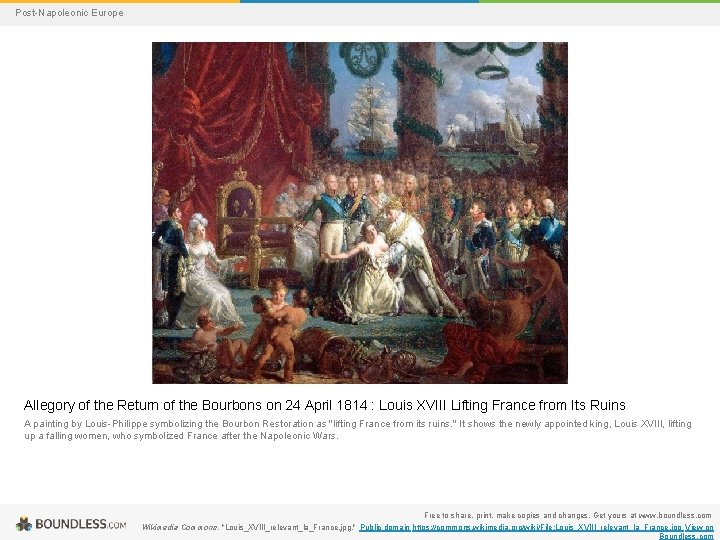
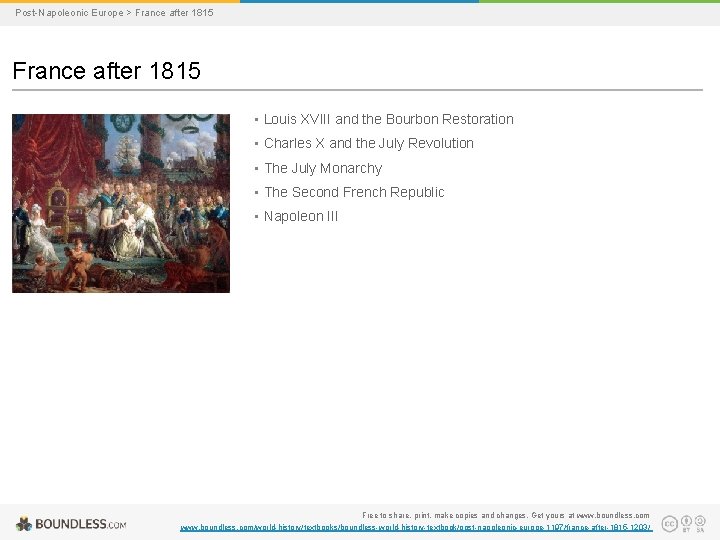
Post-Napoleonic Europe Allegory of the Return of the Bourbons on 24 April 1814 : Louis XVIII Lifting France from Its Ruins A painting by Louis-Philippe symbolizing the Bourbon Restoration as "lifting France from its ruins. " It shows the newly appointed king, Louis XVIII, lifting up a falling women, who symbolized France after the Napoleonic Wars. Free to share, print, make copies and changes. Get yours at www. boundless. com Wikimedia Commons. "Louis_XVIII_relevant_la_France. jpg. " Public domain https: //commons. wikimedia. org/wiki/File: Louis_XVIII_relevant_la_France. jpg View on Boundless. com
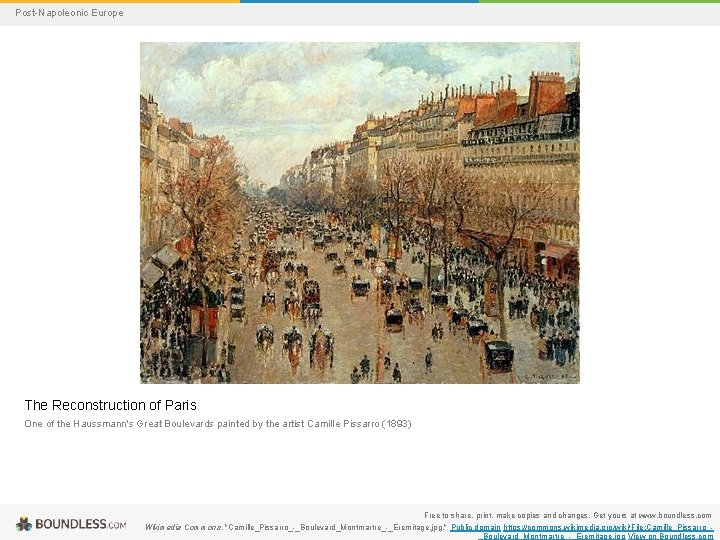
Post-Napoleonic Europe The Reconstruction of Paris One of the Haussmann's Great Boulevards painted by the artist Camille Pissarro (1893) Free to share, print, make copies and changes. Get yours at www. boundless. com Wikimedia Commons. "Camille_Pissarro_-_Boulevard_Montmartre_-_Eremitage. jpg. " Public domain https: //commons. wikimedia. org/wiki/File: Camille_Pissarro__Boulevard_Montmartre_-_Eremitage. jpg View on Boundless. com
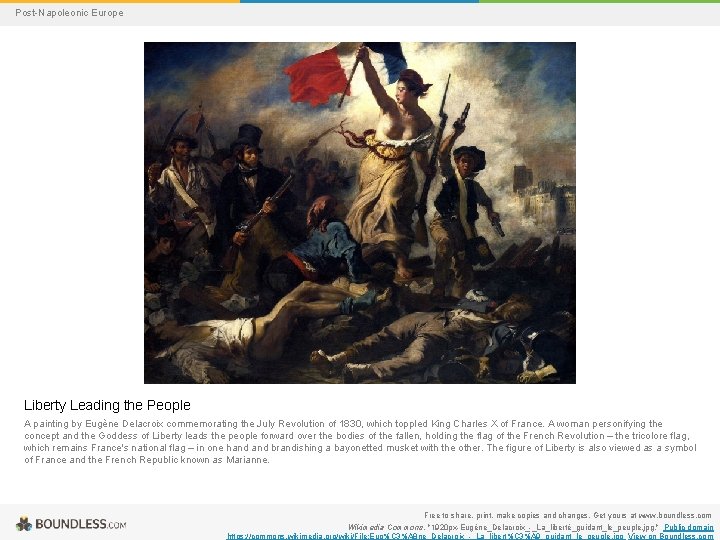
Post-Napoleonic Europe Liberty Leading the People A painting by Eugène Delacroix commemorating the July Revolution of 1830, which toppled King Charles X of France. A woman personifying the concept and the Goddess of Liberty leads the people forward over the bodies of the fallen, holding the flag of the French Revolution – the tricolore flag, which remains France's national flag – in one hand brandishing a bayonetted musket with the other. The figure of Liberty is also viewed as a symbol of France and the French Republic known as Marianne. Free to share, print, make copies and changes. Get yours at www. boundless. com Wikimedia Commons. "1920 px-Eugène_Delacroix_-_La_liberté_guidant_le_peuple. jpg. " Public domain https: //commons. wikimedia. org/wiki/File: Eug%C 3%A 8 ne_Delacroix_-_La_libert%C 3%A 9_guidant_le_peuple. jpg View on Boundless. com
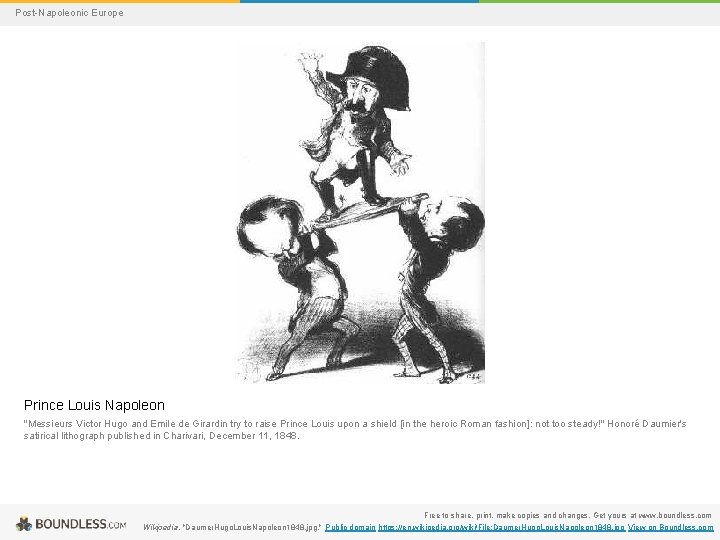
Post-Napoleonic Europe Prince Louis Napoleon "Messieurs Victor Hugo and Emile de Girardin try to raise Prince Louis upon a shield [in the heroic Roman fashion]: not too steady!" Honoré Daumier's satirical lithograph published in Charivari, December 11, 1848. Free to share, print, make copies and changes. Get yours at www. boundless. com Wikipedia. "Daumer. Hugo. Louis. Napoleon 1848. jpg. " Public domain https: //en. wikipedia. org/wiki/File: Daumer. Hugo. Louis. Napoleon 1848. jpg View on Boundless. com
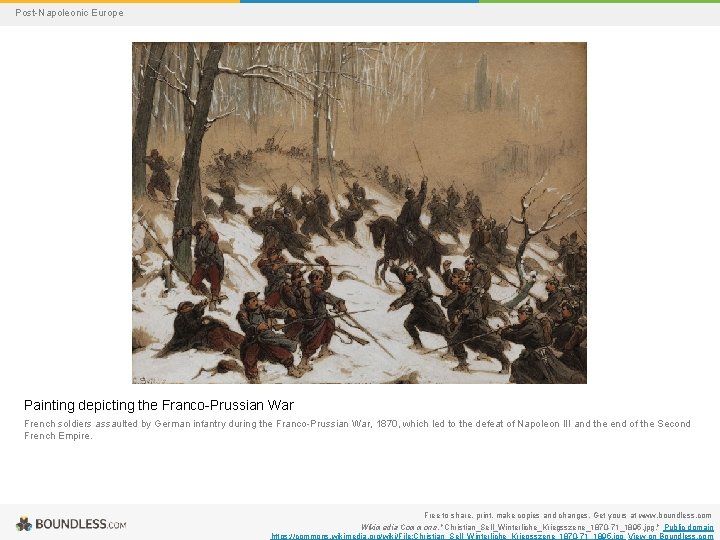
Post-Napoleonic Europe Painting depicting the Franco-Prussian War French soldiers assaulted by German infantry during the Franco-Prussian War, 1870, which led to the defeat of Napoleon III and the end of the Second French Empire. Free to share, print, make copies and changes. Get yours at www. boundless. com Wikimedia Commons. "Christian_Sell_Winterliche_Kriegsszene_1870 -71_1895. jpg. " Public domain https: //commons. wikimedia. org/wiki/File: Christian_Sell_Winterliche_Kriegsszene_1870 -71_1895. jpg View on Boundless. com
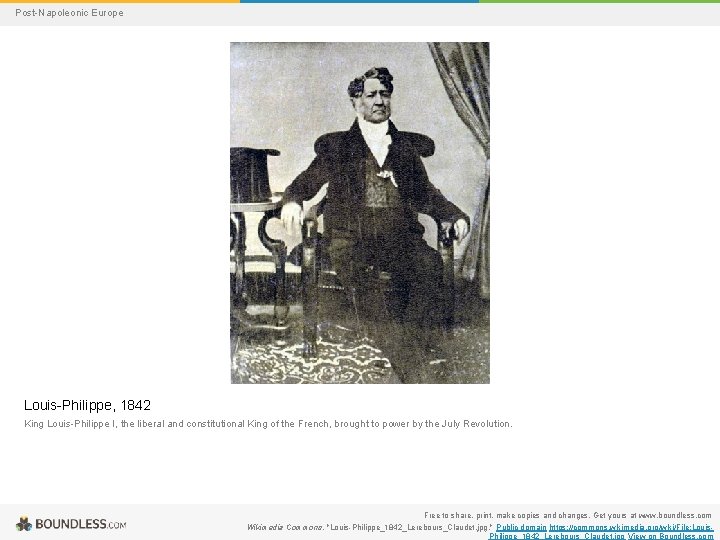
Post-Napoleonic Europe Louis-Philippe, 1842 King Louis-Philippe I, the liberal and constitutional King of the French, brought to power by the July Revolution. Free to share, print, make copies and changes. Get yours at www. boundless. com Wikimedia Commons. "Louis-Philippe_1842_Lerebours_Claudet. jpg. " Public domain https: //commons. wikimedia. org/wiki/File: Louis. Philippe_1842_Lerebours_Claudet. jpg View on Boundless. com
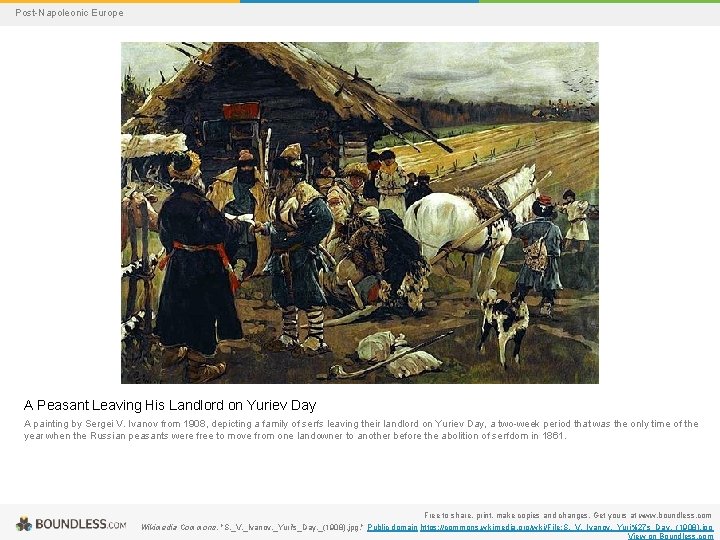
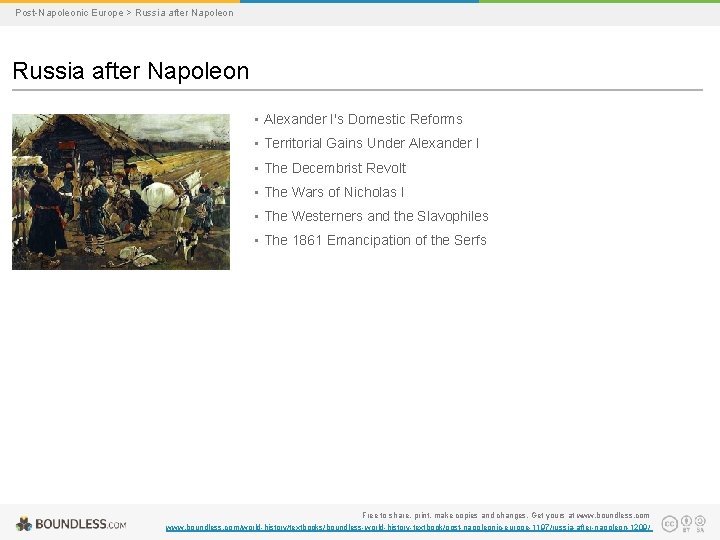
Post-Napoleonic Europe A Peasant Leaving His Landlord on Yuriev Day A painting by Sergei V. Ivanov from 1908, depicting a family of serfs leaving their landlord on Yuriev Day, a two-week period that was the only time of the year when the Russian peasants were free to move from one landowner to another before the abolition of serfdom in 1861. Free to share, print, make copies and changes. Get yours at www. boundless. com Wikimedia Commons. "S. _V. _Ivanov. _Yuri's_Day. _(1908). jpg. " Public domain https: //commons. wikimedia. org/wiki/File: S. _V. _Ivanov. _Yuri%27 s_Day. _(1908). jpg View on Boundless. com
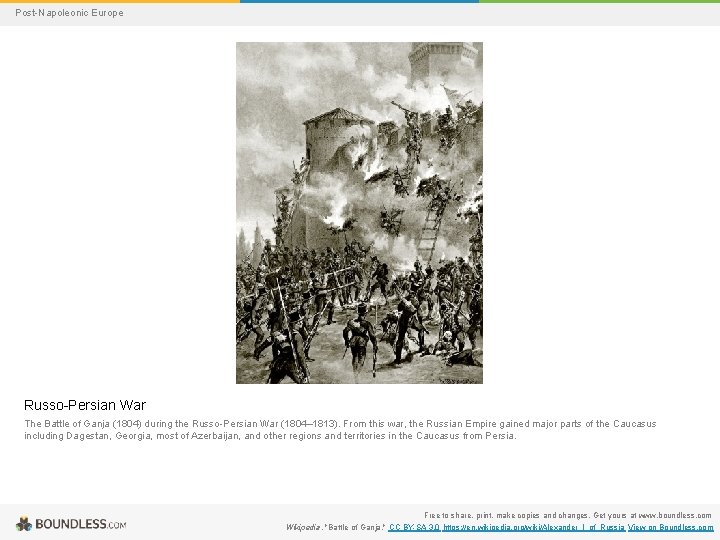
Post-Napoleonic Europe Russo-Persian War The Battle of Ganja (1804) during the Russo-Persian War (1804– 1813). From this war, the Russian Empire gained major parts of the Caucasus including Dagestan, Georgia, most of Azerbaijan, and other regions and territories in the Caucasus from Persia. Free to share, print, make copies and changes. Get yours at www. boundless. com Wikipedia. "Battle of Ganja. " CC BY-SA 3. 0 https: //en. wikipedia. org/wiki/Alexander_I_of_Russia View on Boundless. com
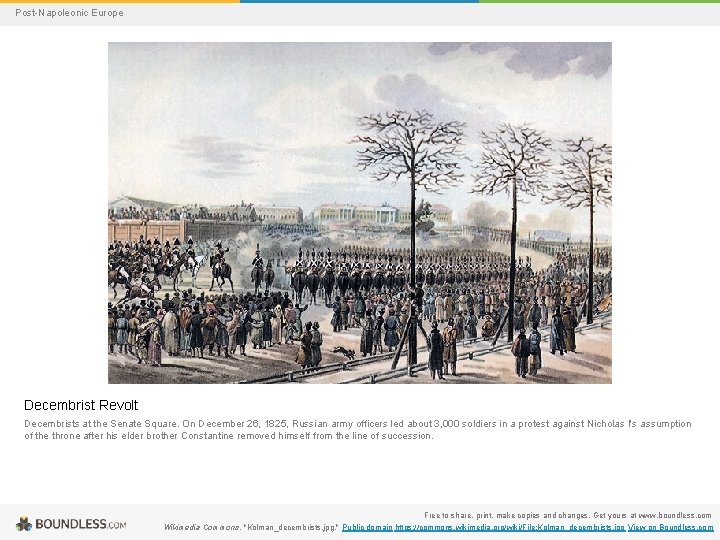
Post-Napoleonic Europe Decembrist Revolt Decembrists at the Senate Square. On December 26, 1825, Russian army officers led about 3, 000 soldiers in a protest against Nicholas I's assumption of the throne after his elder brother Constantine removed himself from the line of succession. Free to share, print, make copies and changes. Get yours at www. boundless. com Wikimedia Commons. "Kolman_decembrists. jpg. " Public domain https: //commons. wikimedia. org/wiki/File: Kolman_decembrists. jpg View on Boundless. com
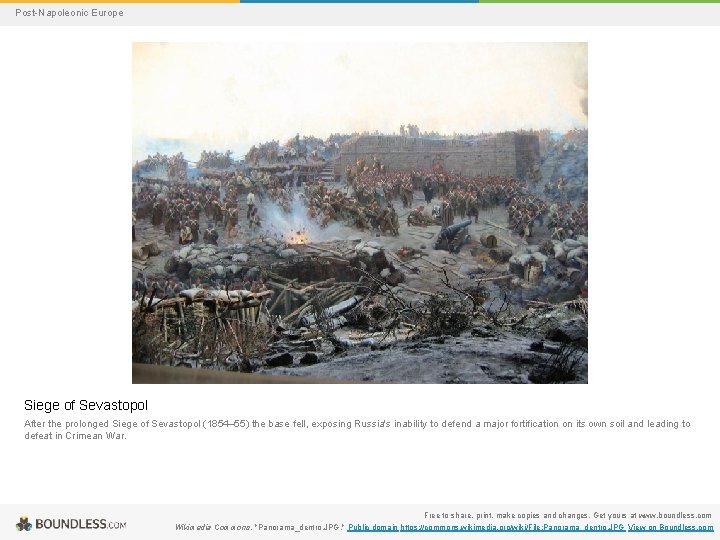
Post-Napoleonic Europe Siege of Sevastopol After the prolonged Siege of Sevastopol (1854– 55) the base fell, exposing Russia's inability to defend a major fortification on its own soil and leading to defeat in Crimean War. Free to share, print, make copies and changes. Get yours at www. boundless. com Wikimedia Commons. "Panorama_dentro. JPG. " Public domain https: //commons. wikimedia. org/wiki/File: Panorama_dentro. JPG View on Boundless. com
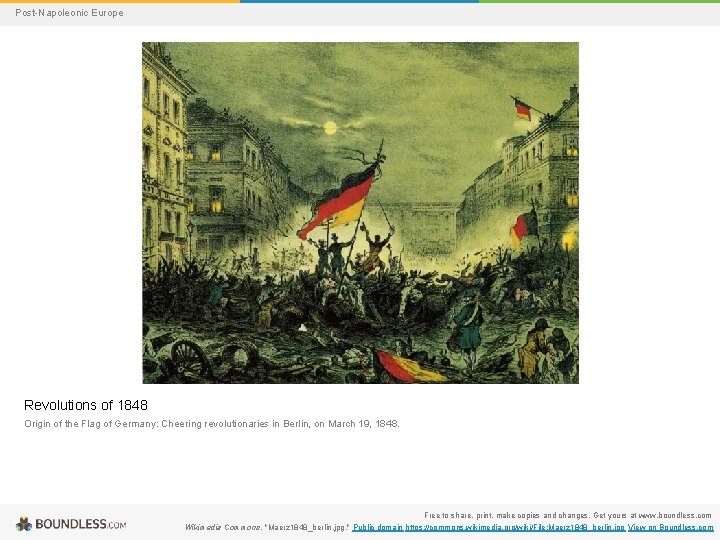
Post-Napoleonic Europe Revolutions of 1848 Origin of the Flag of Germany: Cheering revolutionaries in Berlin, on March 19, 1848. Free to share, print, make copies and changes. Get yours at www. boundless. com Wikimedia Commons. "Maerz 1848_berlin. jpg. " Public domain https: //commons. wikimedia. org/wiki/File: Maerz 1848_berlin. jpg View on Boundless. com
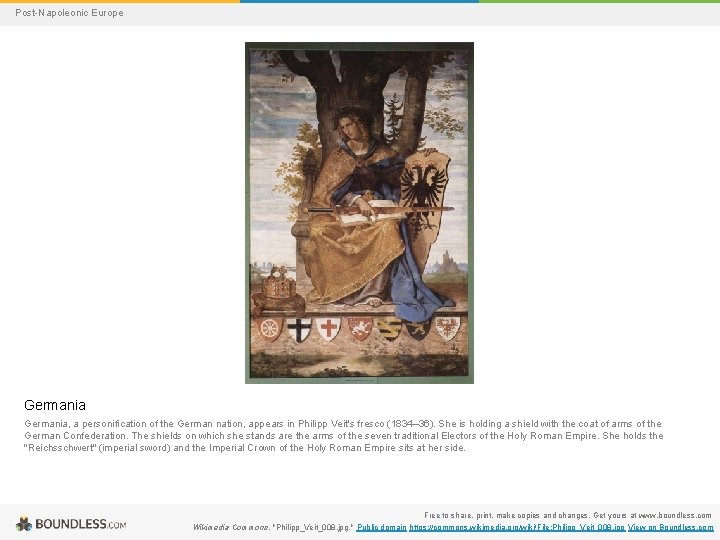
Post-Napoleonic Europe Germania, a personification of the German nation, appears in Philipp Veit's fresco (1834– 36). She is holding a shield with the coat of arms of the German Confederation. The shields on which she stands are the arms of the seven traditional Electors of the Holy Roman Empire. She holds the "Reichsschwert" (imperial sword) and the Imperial Crown of the Holy Roman Empire sits at her side. Free to share, print, make copies and changes. Get yours at www. boundless. com Wikimedia Commons. "Philipp_Veit_008. jpg. " Public domain https: //commons. wikimedia. org/wiki/File: Philipp_Veit_008. jpg View on Boundless. com
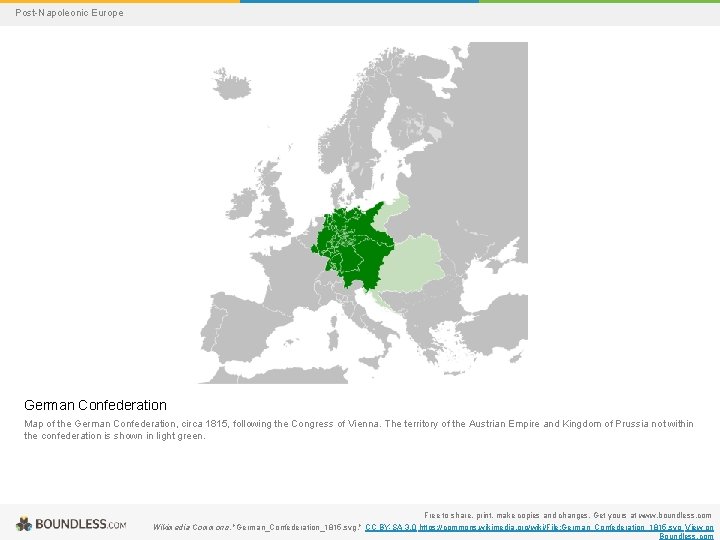
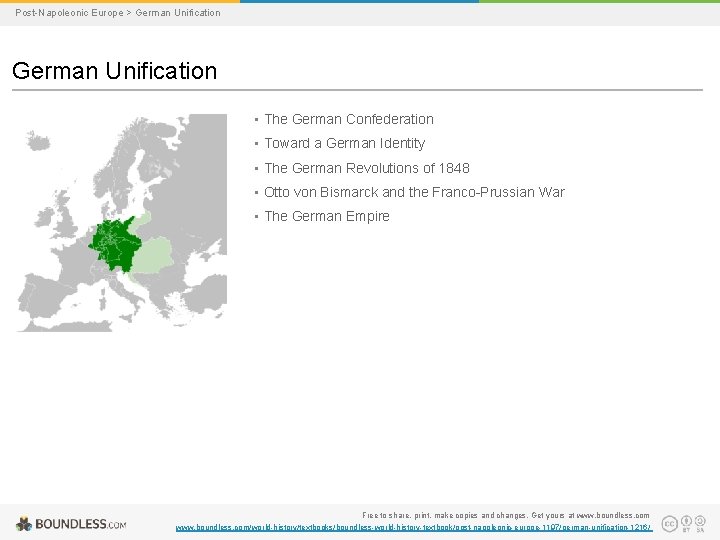
Post-Napoleonic Europe German Confederation Map of the German Confederation, circa 1815, following the Congress of Vienna. The territory of the Austrian Empire and Kingdom of Prussia not within the confederation is shown in light green. Free to share, print, make copies and changes. Get yours at www. boundless. com Wikimedia Commons. "German_Confederation_1815. svg. " CC BY-SA 3. 0 https: //commons. wikimedia. org/wiki/File: German_Confederation_1815. svg View on Boundless. com
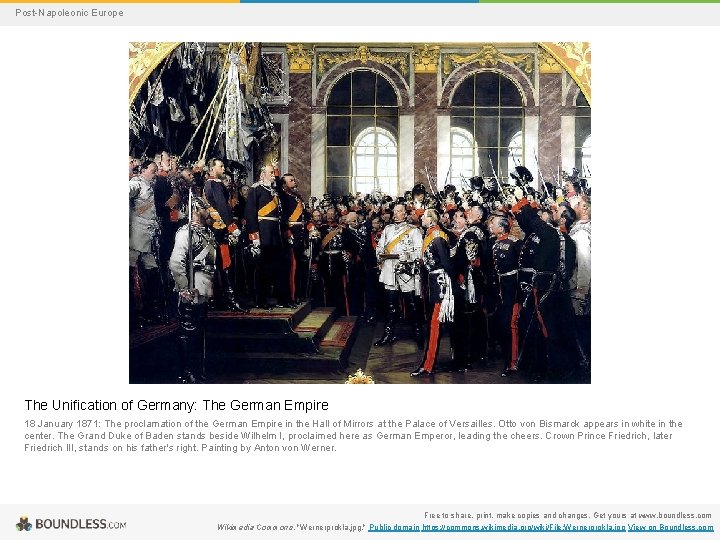
Post-Napoleonic Europe The Unification of Germany: The German Empire 18 January 1871: The proclamation of the German Empire in the Hall of Mirrors at the Palace of Versailles. Otto von Bismarck appears in white in the center. The Grand Duke of Baden stands beside Wilhelm I, proclaimed here as German Emperor, leading the cheers. Crown Prince Friedrich, later Friedrich III, stands on his father's right. Painting by Anton von Werner. Free to share, print, make copies and changes. Get yours at www. boundless. com Wikimedia Commons. "Wernerprokla. jpg. " Public domain https: //commons. wikimedia. org/wiki/File: Wernerprokla. jpg View on Boundless. com
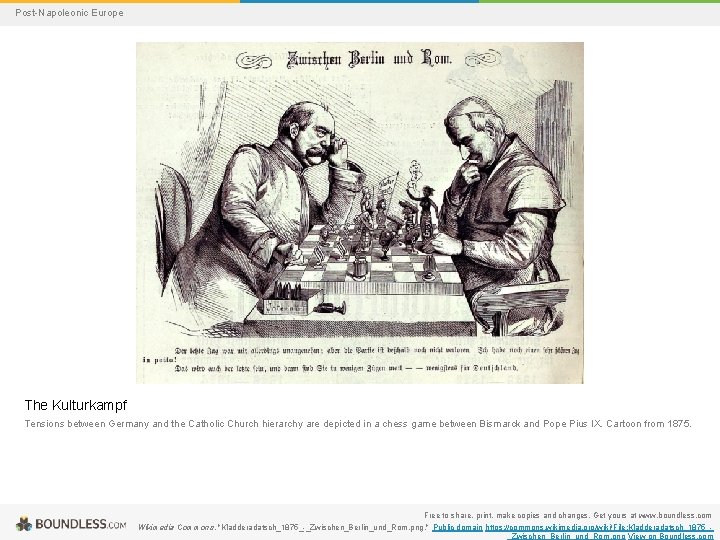
Post-Napoleonic Europe The Kulturkampf Tensions between Germany and the Catholic Church hierarchy are depicted in a chess game between Bismarck and Pope Pius IX. Cartoon from 1875. Free to share, print, make copies and changes. Get yours at www. boundless. com Wikimedia Commons. "Kladderadatsch_1875_-_Zwischen_Berlin_und_Rom. png. " Public domain https: //commons. wikimedia. org/wiki/File: Kladderadatsch_1875__Zwischen_Berlin_und_Rom. png View on Boundless. com
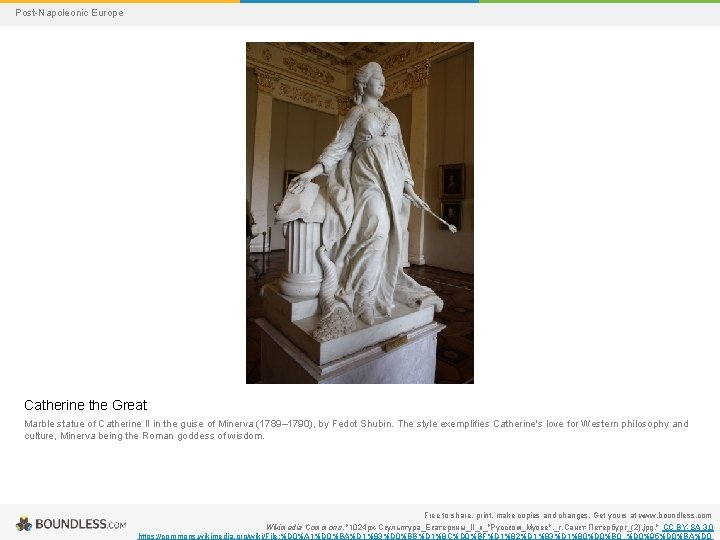
Post-Napoleonic Europe Catherine the Great Marble statue of Catherine II in the guise of Minerva (1789– 1790), by Fedot Shubin. The style exemplifies Catherine's love for Western philosophy and culture, Minerva being the Roman goddess of wisdom. Free to share, print, make copies and changes. Get yours at www. boundless. com Wikimedia Commons. "1024 px-Скульптура_Екатерины_II_в_"Русском_Музее", _г. Санкт-Петербург_(2). jpg. " CC BY-SA 3. 0 https: //commons. wikimedia. org/wiki/File: %D 0%A 1%D 0%BA%D 1%83%D 0%BB%D 1%8 C%D 0%BF%D 1%82%D 1%83%D 1%80%D 0%B 0_%D 0%95%D 0%BA%D 0
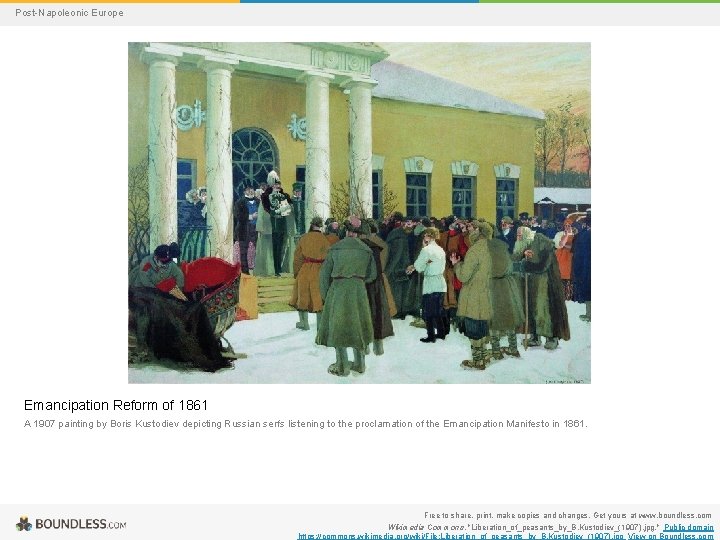
Post-Napoleonic Europe Emancipation Reform of 1861 A 1907 painting by Boris Kustodiev depicting Russian serfs listening to the proclamation of the Emancipation Manifesto in 1861. Free to share, print, make copies and changes. Get yours at www. boundless. com Wikimedia Commons. "Liberation_of_peasants_by_B. Kustodiev_(1907). jpg. " Public domain https: //commons. wikimedia. org/wiki/File: Liberation_of_peasants_by_B. Kustodiev_(1907). jpg View on Boundless. com
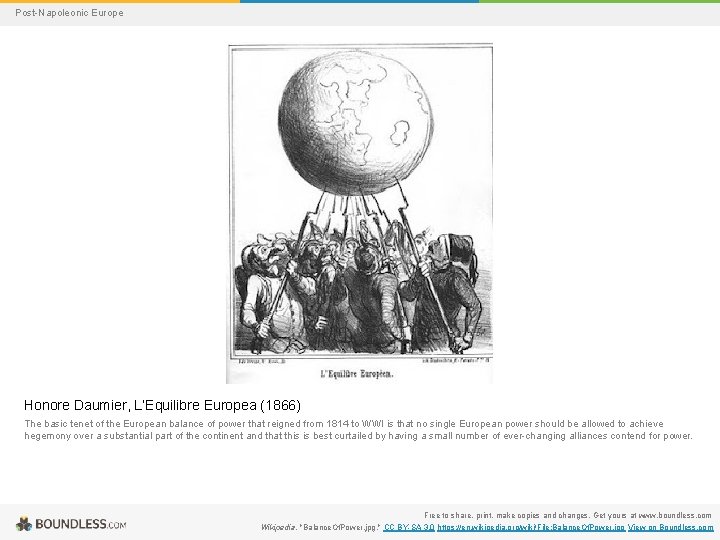
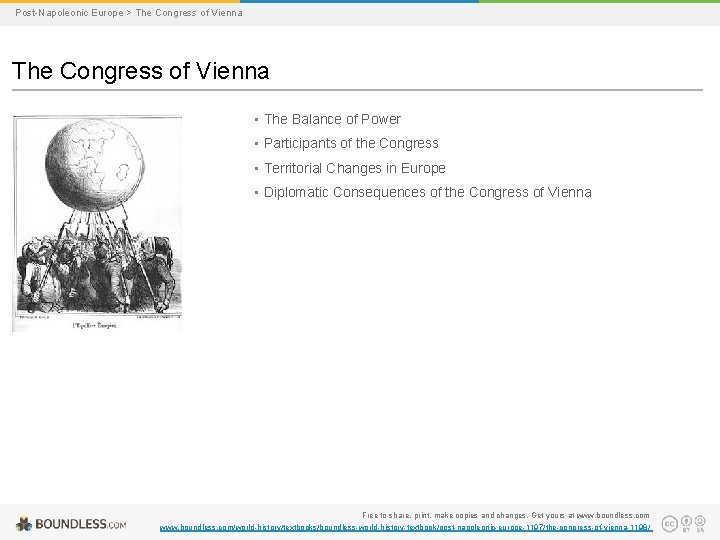
Post-Napoleonic Europe Honore Daumier, L’Equilibre Europea (1866) The basic tenet of the European balance of power that reigned from 1814 to WWI is that no single European power should be allowed to achieve hegemony over a substantial part of the continent and that this is best curtailed by having a small number of ever-changing alliances contend for power. Free to share, print, make copies and changes. Get yours at www. boundless. com Wikipedia. "Balance. Of. Power. jpg. " CC BY-SA 3. 0 https: //en. wikipedia. org/wiki/File: Balance. Of. Power. jpg View on Boundless. com
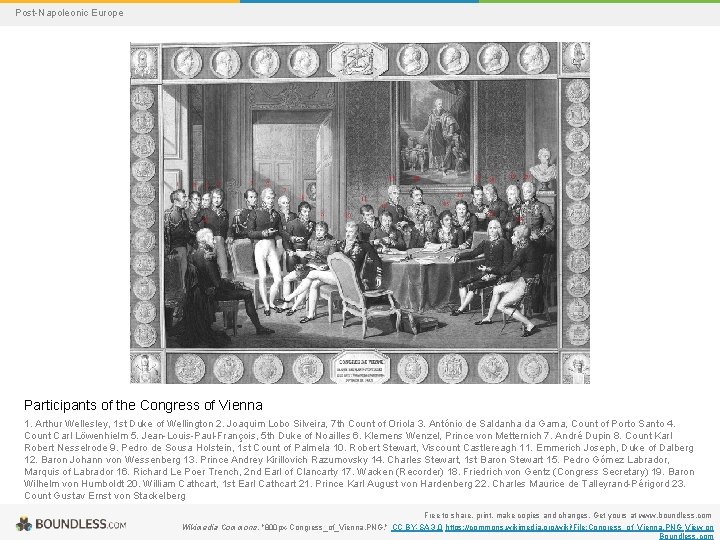
Post-Napoleonic Europe Participants of the Congress of Vienna 1. Arthur Wellesley, 1 st Duke of Wellington 2. Joaquim Lobo Silveira, 7 th Count of Oriola 3. António de Saldanha da Gama, Count of Porto Santo 4. Count Carl Löwenhielm 5. Jean-Louis-Paul-François, 5 th Duke of Noailles 6. Klemens Wenzel, Prince von Metternich 7. André Dupin 8. Count Karl Robert Nesselrode 9. Pedro de Sousa Holstein, 1 st Count of Palmela 10. Robert Stewart, Viscount Castlereagh 11. Emmerich Joseph, Duke of Dalberg 12. Baron Johann von Wessenberg 13. Prince Andrey Kirillovich Razumovsky 14. Charles Stewart, 1 st Baron Stewart 15. Pedro Gómez Labrador, Marquis of Labrador 16. Richard Le Poer Trench, 2 nd Earl of Clancarty 17. Wacken (Recorder) 18. Friedrich von Gentz (Congress Secretary) 19. Baron Wilhelm von Humboldt 20. William Cathcart, 1 st Earl Cathcart 21. Prince Karl August von Hardenberg 22. Charles Maurice de Talleyrand-Périgord 23. Count Gustav Ernst von Stackelberg Free to share, print, make copies and changes. Get yours at www. boundless. com Wikimedia Commons. "800 px-Congress_of_Vienna. PNG. " CC BY-SA 3. 0 https: //commons. wikimedia. org/wiki/File: Congress_of_Vienna. PNG View on Boundless. com
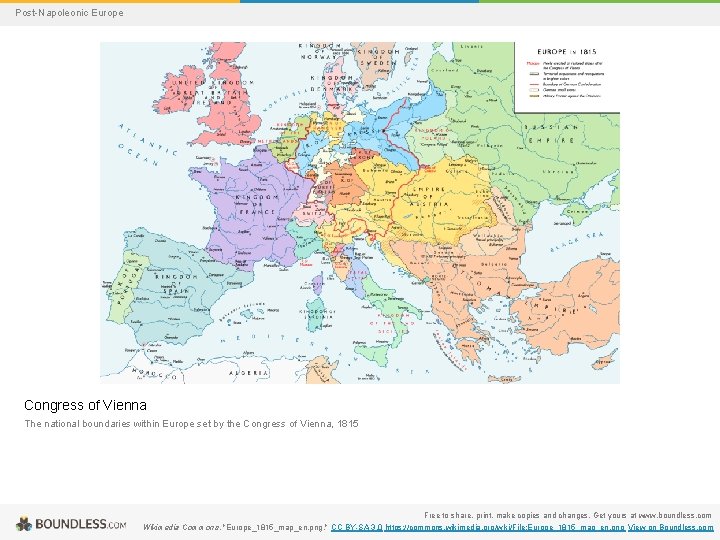
Post-Napoleonic Europe Congress of Vienna The national boundaries within Europe set by the Congress of Vienna, 1815 Free to share, print, make copies and changes. Get yours at www. boundless. com Wikimedia Commons. "Europe_1815_map_en. png. " CC BY-SA 3. 0 https: //commons. wikimedia. org/wiki/File: Europe_1815_map_en. png View on Boundless. com
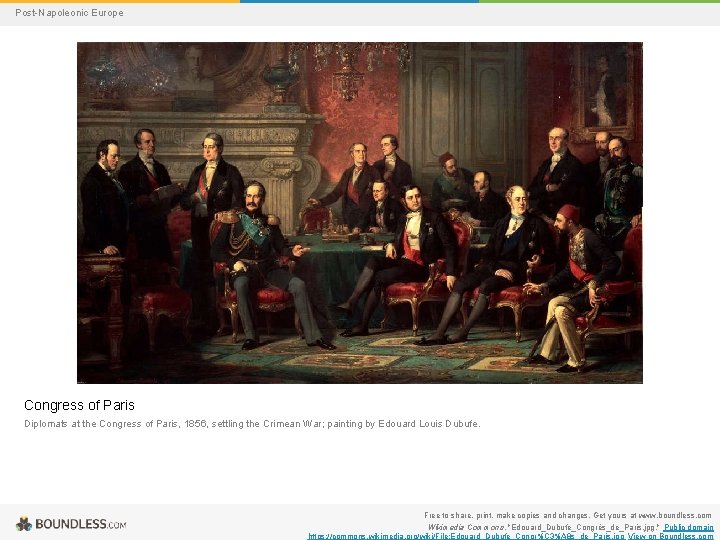
Post-Napoleonic Europe Congress of Paris Diplomats at the Congress of Paris, 1856, settling the Crimean War; painting by Edouard Louis Dubufe. Free to share, print, make copies and changes. Get yours at www. boundless. com Wikimedia Commons. "Edouard_Dubufe_Congrès_de_Paris. jpg. " Public domain https: //commons. wikimedia. org/wiki/File: Edouard_Dubufe_Congr%C 3%A 8 s_de_Paris. jpg View on Boundless. com
Post-Napoleonic Europe Attribution • Wikipedia. "International relations of the Great Powers (1814– 1919). " CC BY-SA 3. 0 https: //en. wikipedia. org/wiki/International_relations_of_the_Great_Powers_(1814 -1919) • Wikipedia. "Conservative Order. " CC BY-SA 3. 0 https: //en. wikipedia. org/wiki/Conservative_Order • Wikipedia. "Concert of Europe. " CC BY-SA 3. 0 https: //en. wikipedia. org/wiki/Concert_of_Europe • Wikipedia. "Congress of Vienna. " CC BY-SA 3. 0 https: //en. wikipedia. org/wiki/Congress_of_Vienna • Wikipedia. "European balance of power. " CC BY-SA 3. 0 https: //en. wikipedia. org/wiki/European_balance_of_power • Wikipedia. "Charles Maurice de Talleyrand-Périgord. " CC BY-SA 3. 0 https: //en. wikipedia. org/wiki/Charles_Maurice_de_Talleyrand-Perigord • Wikipedia. "Robert Stewart, Viscount Castlereagh. " CC BY-SA 3. 0 https: //en. wikipedia. org/wiki/Robert_Stewart, _Viscount_Castlereagh • Wikipedia. "Karl August von Hardenberg. " CC BY-SA 3. 0 https: //en. wikipedia. org/wiki/Karl_August_von_Hardenberg • Wikipedia. "Klemens von Metternich. " CC BY-SA 3. 0 https: //en. wikipedia. org/wiki/Klemens_von_Metternich • Wikipedia. "Congress of Vienna. " CC BY-SA 3. 0 https: //en. wikipedia. org/wiki/Congress_of_Vienna • Wikipedia. "International relations of the Great Powers (1814– 1919). " CC BY-SA 3. 0 https: //en. wikipedia. org/wiki/International_relations_of_the_Great_Powers_(1814 -1919) • Wikipedia. "Holy Alliance. " CC BY-SA 3. 0 https: //en. wikipedia. org/wiki/Holy_Alliance • Wikipedia. "Revolutions of 1848. " CC BY-SA 3. 0 https: //en. wikipedia. org/wiki/Revolutions_of_1848 • Wikipedia. "Concert of Europe. " CC BY-SA 3. 0 https: //en. wikipedia. org/wiki/Concert_of_Europe • Wikipedia. "European balance of power. " CC BY-SA 3. 0 https: //en. wikipedia. org/wiki/European_balance_of_power • Wikipedia. "France in the long nineteenth century. " CC BY-SA 3. 0 Free to share, print, make copies and changes. Get yours at www. boundless. com https: //en. wikipedia. org/wiki/France_in_the_long_nineteenth_century
Post-Napoleonic Europe • Wikipedia. "Louis XVIII of France. " CC BY-SA 3. 0 https: //en. wikipedia. org/wiki/Louis_XVIII_of_France • Wikipedia. "Bourbon Restoration. " CC BY-SA 3. 0 https: //en. wikipedia. org/wiki/Bourbon_Restoration • Wikipedia. "Charles X of France. " CC BY-SA 3. 0 https: //en. wikipedia. org/wiki/Charles_X_of_France • Wikipedia. "France in the long nineteenth century. " CC BY-SA 3. 0 https: //en. wikipedia. org/wiki/France_in_the_long_nineteenth_century • Wikipedia. "Bourbon Restoration. " CC BY-SA 3. 0 https: //en. wikipedia. org/wiki/Bourbon_Restoration • Wikipedia. "July Revolution. " CC BY-SA 3. 0 https: //en. wikipedia. org/wiki/July_Revolution • Wikipedia. "France in the long nineteenth century. " CC BY-SA 3. 0 https: //en. wikipedia. org/wiki/France_in_the_long_nineteenth_century • Wikipedia. "July Monarchy. " CC BY-SA 3. 0 https: //en. wikipedia. org/wiki/July_Monarchy • Wikipedia. "French Revolution of 1848. " CC BY-SA 3. 0 https: //en. wikipedia. org/wiki/French_Revolution_of_1848 • Wikipedia. "France in the long nineteenth century. " CC BY-SA 3. 0 https: //en. wikipedia. org/wiki/France_in_the_long_nineteenth_century • Wikipedia. "French Revolution of 1848. " CC BY-SA 3. 0 https: //en. wikipedia. org/wiki/French_Revolution_of_1848 • Wikipedia. "French Second Republic. " CC BY-SA 3. 0 https: //en. wikipedia. org/wiki/French_Second_Republic • Wikipedia. "History of France. " CC BY-SA 3. 0 https: //en. wikipedia. org/wiki/History_of_France • Wikipedia. "France in the long nineteenth century. " CC BY-SA 3. 0 https: //en. wikipedia. org/wiki/France_in_the_long_nineteenth_century • Wikipedia. "History of France. " CC BY-SA 3. 0 https: //en. wikipedia. org/wiki/History_of_France • Wikipedia. "Second French Empire. " CC BY-SA 3. 0 https: //en. wikipedia. org/wiki/Second_French_Empire • Wikipedia. "Napoleon III. " CC BY-SA 3. 0 https: //en. wikipedia. org/wiki/Napoleon_III • Wikipedia. "History of Russia (1796– 1855). " CC BY-SA 3. 0 https: //en. wikipedia. org/wiki/History_of_Russia_(1796 -1855) • Wikipedia. "Alexander I of Russia. " CC BY-SA 3. 0 https: //en. wikipedia. org/wiki/Alexander_I_of_Russia Free to share, print, make copies and changes. Get yours at www. boundless. com
Post-Napoleonic Europe • Wikipedia. "Serfdom in Russia. " CC BY-SA 3. 0 https: //en. wikipedia. org/wiki/Serfdom_in_Russia • Wikipedia. "Free agriculturalist. " CC BY-SA 3. 0 https: //en. wikipedia. org/wiki/Free_agriculturalist • Wikipedia. "History of Russia (1796 -1855). " CC BY-SA 3. 0 https: //en. wikipedia. org/wiki/History_of_Russia_(1796 -1855) • Wikipedia. "Congress of Vienna. " CC BY-SA 3. 0 https: //en. wikipedia. org/wiki/Congress_of_Vienna • Wikipedia. "Alexander I of Russia. " CC BY-SA 3. 0 https: //en. wikipedia. org/wiki/Alexander_I_of_Russia • Wikipedia. "Congress of Troppau. " CC BY-SA 3. 0 https: //en. wikipedia. org/wiki/Congress_of_Troppau • Wikipedia. "History of Russia (1796– 1855). " CC BY-SA 3. 0 https: //en. wikipedia. org/wiki/History_of_Russia_(1796 -1855) • Wikipedia. "Decembrist revolt. " CC BY-SA 3. 0 https: //en. wikipedia. org/wiki/Decembrist_revolt • Wikipedia. "History of Russia (1796– 1855). " CC BY-SA 3. 0 https: //en. wikipedia. org/wiki/History_of_Russia_(1796 -1855) • Wikipedia. "Nicholas I of Russia. " CC BY-SA 3. 0 https: //en. wikipedia. org/wiki/Nicholas_I_of_Russia • Wikipedia. "Russian Empire. " CC BY-SA 3. 0 https: //en. wikipedia. org/wiki/Russian_Empire • Wikipedia. "Peter the Great. " CC BY-SA 3. 0 https: //en. wikipedia. org/wiki/Peter_the_Great • Wikipedia. "Slavophilia. " CC BY-SA 3. 0 https: //en. wikipedia. org/wiki/Slavophilia • Wikipedia. "Westernizer. " CC BY-SA 3. 0 https: //en. wikipedia. org/wiki/Westernizer • Wikipedia. "History of Russia (1855– 92). " CC BY-SA 3. 0 https: //en. wikipedia. org/wiki/History_of_Russia_(1855 -92) • Wikipedia. "Catherine the Great. " CC BY-SA 3. 0 https: //en. wikipedia. org/wiki/Catherine_the_Great • Wikipedia. "Serfdom in Russia. " CC BY-SA 3. 0 https: //en. wikipedia. org/wiki/Serfdom_in_Russia • Wikipedia. "Russian Empire. " CC BY-SA 3. 0 https: //en. wikipedia. org/wiki/Russian_Empire • Wikipedia. "Emancipation reform of 1861. " CC BY-SA 3. 0 https: //en. wikipedia. org/wiki/Emancipation_reform_of_1861 Free to share, print, make copies and changes. Get yours at www. boundless. com
Post-Napoleonic Europe • Wikipedia. "History of Germany. " CC BY-SA 3. 0 https: //en. wikipedia. org/wiki/History_of_Germany • Wikipedia. "German Confederation. " CC BY-SA 3. 0 https: //en. wikipedia. org/wiki/German_Confederation • Wikipedia. "History of Germany. " CC BY-SA 3. 0 https: //en. wikipedia. org/wiki/History_of_Germany • Wikipedia. "Unification of Germany. " CC BY-SA 3. 0 https: //en. wikipedia. org/wiki/Unification_of_Germany • Wikipedia. "Nationalism. " CC BY-SA 3. 0 https: //en. wikipedia. org/wiki/Nationalism • Wikipedia. "Germany. " CC BY-SA 3. 0 https: //en. wikipedia. org/wiki/Germany • Wikipedia. "Frankfurt Parliament. " CC BY-SA 3. 0 https: //en. wikipedia. org/wiki/Frankfurt_Parliament • Wikipedia. "German revolutions of 1848– 49. " CC BY-SA 3. 0 https: //en. wikipedia. org/wiki/German_revolutions_of_1848 -49 • Wikipedia. "Franco-Prussian War. " CC BY-SA 3. 0 https: //en. wikipedia. org/wiki/Franco-Prussian_War • Wikipedia. "Otto von Bismarck. " CC BY-SA 3. 0 https: //en. wikipedia. org/wiki/Otto_von_Bismarck • Wikipedia. "Unification of Germany. " CC BY-SA 3. 0 https: //en. wikipedia. org/wiki/Unification_of_Germany • Wikipedia. "History of Germany. " CC BY-SA 3. 0 https: //en. wikipedia. org/wiki/History_of_Germany • Wikipedia. "German Empire. " CC BY-SA 3. 0 https: //en. wikipedia. org/wiki/German_Empire • Wikipedia. "Germany. " CC BY-SA 3. 0 https: //en. wikipedia. org/wiki/Germany Free to share, print, make copies and changes. Get yours at www. boundless. com
- Slides: 40