
Bounded Recognition Land use planning the textual mediation
‘Bounded Recognition’: Land use planning & the textual mediation of the rights of Indigenous peoples Janice Barry, University of Sheffield (& Libby Porter, Monash University)
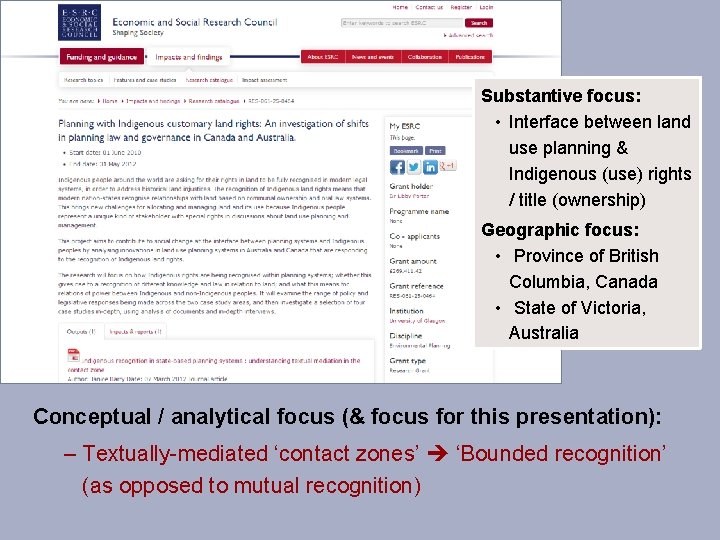
Substantive focus: • Interface between land use planning & Indigenous (use) rights / title (ownership) Geographic focus: • Province of British Columbia, Canada • State of Victoria, Australia Conceptual / analytical focus (& focus for this presentation): – Textually-mediated ‘contact zones’ ‘Bounded recognition’ (as opposed to mutual recognition)
Our Research Context • Colonial histories – Dispossession, aggressive assimilation policies – Ongoing socio-economic deprivation & poor health • Recent shifts in Indigenous-state relationship – National apologies; transformative legal precedent, processes to address unceeded title • But… still persistent conflicts – ‘Material’: over resource harvesting, land allocation – Political: over jurisdiction, voice, representation – Deeper: over meaning of space/place What resonates with conflicts over planning for Gypsies & Travellers? – AND – What theoretical /methodological tool might help unpack these conflicts?
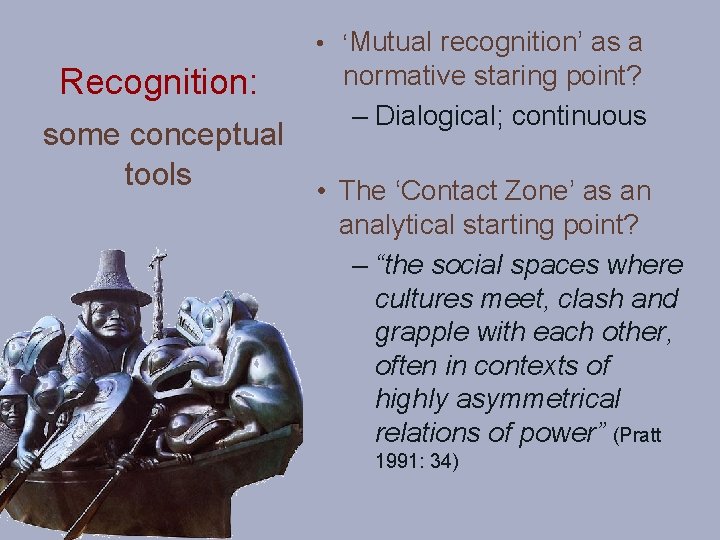
• ‘Mutual recognition’ as a Recognition: normative staring point? – Dialogical; continuous some conceptual tools • The ‘Contact Zone’ as an analytical starting point? – “the social spaces where cultures meet, clash and grapple with each other, often in contexts of highly asymmetrical relations of power” (Pratt 1991: 34)
Textual Analysis & Planning • Planning practice as highly ‘textually mediated’ (Smith 2001; Barry & Porter 2012) – Texts directly and indirectly constitute & legitimate the field of planning by: • assembling the objects of planning • establishing the process for planning • producing/reproducing a spatial and/or temporal order • producing/reproducing social relations
Legal Recognition Planning Approach (Often defines WHY planners work with Indigenous groups) (Often creates expectations for HOW Indigenous groups should be involved) Create boundaries by defining: • What is recognised (not recognised) • Who is recognised as an Indigenous party • Where rights are recognised Create boundaries by articulating: • desired objects of planning • desired process of planning • roles, identities & powers “The Textually. Mediated Contact Zone”
‘Bounded recognition’ • Recognition of rights & title (partially & at least temporarily) unsettles the certainties of: – Property; understandings of space / place – Political authority/jurisdiction = a possibility for new “contact zones” • Only within the controlled boundaries arising out of: – the act of recognition (non-recognition) itself – the existing norms and procedures of the planning system = resettling? a narrowing of the space for ‘contact’? What are the boundaries the define the recognition Gypsies & Travellers’ rights? – AND – What ‘contact zone’ does this give rise to? How does this contact zone open-up/close-down possibilities for conflict resolution?
- Slides: 7