
Boundary matting for view synthesis Samuel W Hasinoff
Boundary matting for view synthesis Samuel W. Hasinoff Sing Bing Kang Richard Szeliski Computer Vision and Image Understanding 103 (2006) 22– 32
Outline • • Introduction Method Result Conclusion
Introduction • New view synthesis has emerged as an important application of 3 D stereo reconstruction. • Even if a perfect depth map were available, current methods for view interpolation share two major limitations: Sampling blur Boundary artifacts • We propose a method called boundary matting, which represents each occlusion boundary as a 3 D curve.
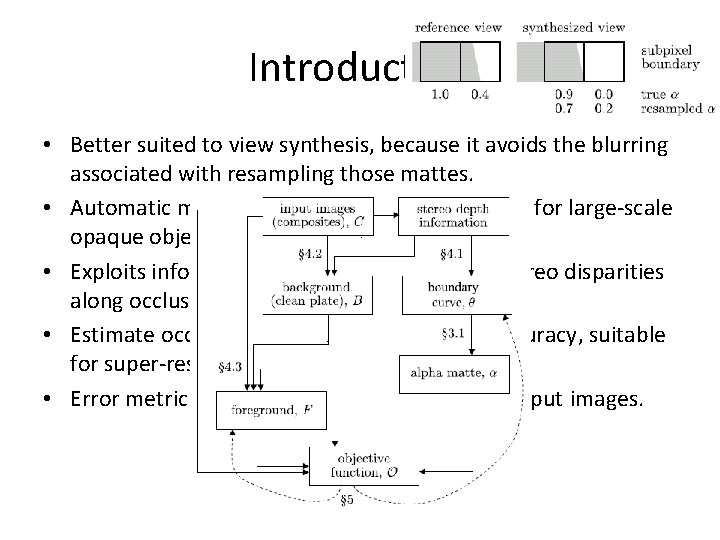
Introduction • Better suited to view synthesis, because it avoids the blurring associated with resampling those mattes. • Automatic matting from imperfect stereo data for large-scale opaque objects. • Exploits information from matting to refine stereo disparities along occlusion boundaries. • Estimate occlusion boundaries to sub-pixel accuracy, suitable for super-resolution or zooming. • Error metric is symmetric with respect to the input images.
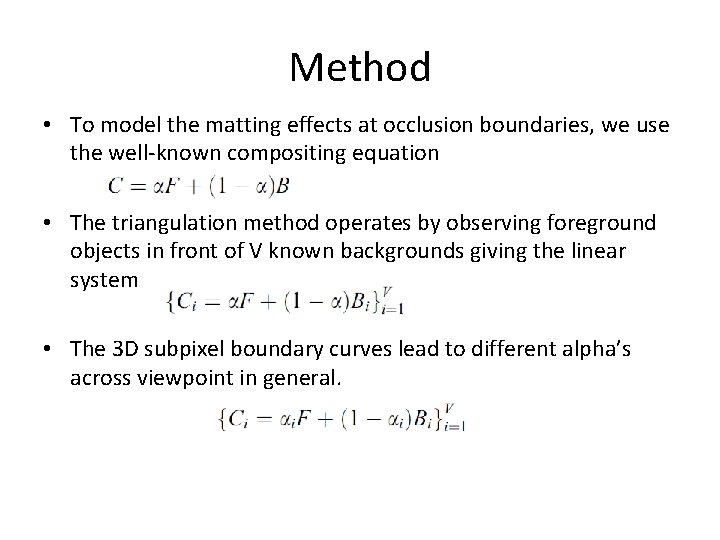
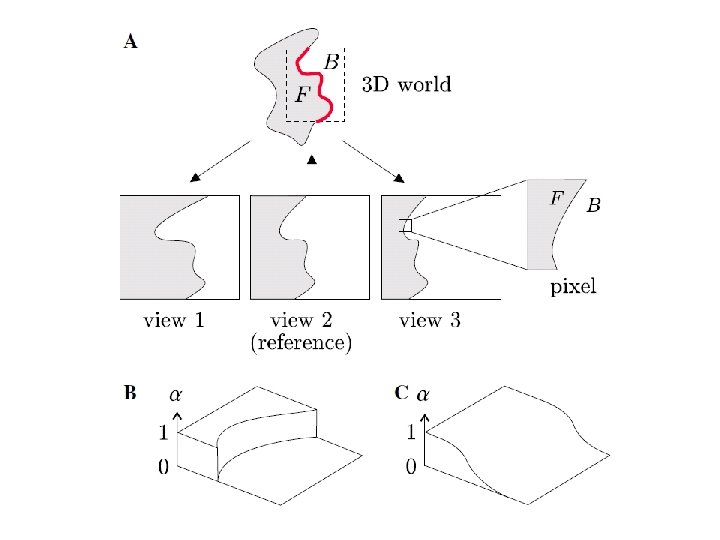
Method • To model the matting effects at occlusion boundaries, we use the well-known compositing equation • The triangulation method operates by observing foreground objects in front of V known backgrounds giving the linear system • The 3 D subpixel boundary curves lead to different alpha’s across viewpoint in general.
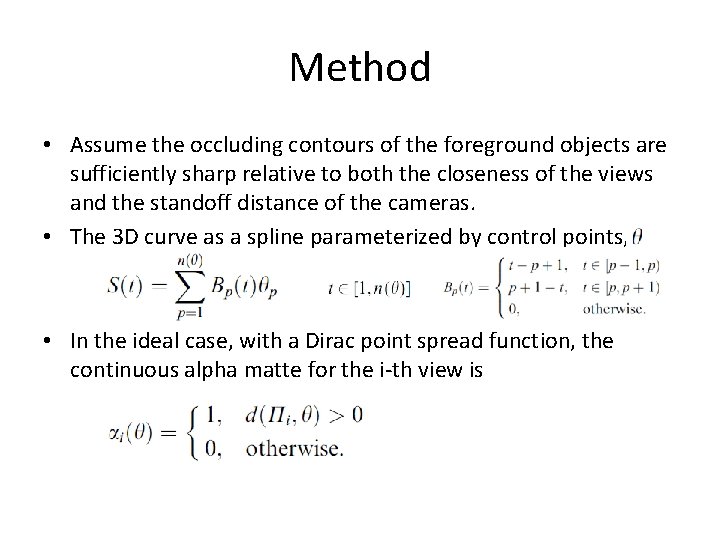
Method • Assume the occluding contours of the foreground objects are sufficiently sharp relative to both the closeness of the views and the standoff distance of the cameras. • The 3 D curve as a spline parameterized by control points, . • In the ideal case, with a Dirac point spread function, the continuous alpha matte for the i-th view is
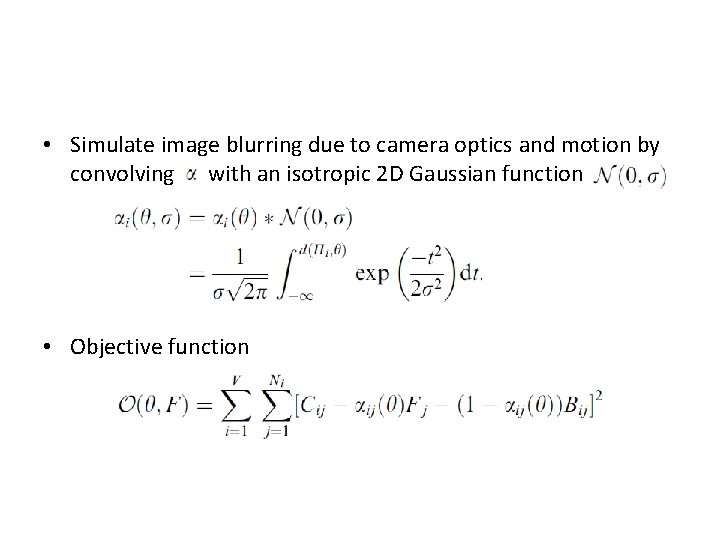
• Simulate image blurring due to camera optics and motion by convolving a with an isotropic 2 D Gaussian function : • Objective function
Method • The starting point for boundary matting is an initialization derived from stereo and the attendant camera calibration. • This method computes stereo by combining shiftable windows for matching with global minimization using graph cuts for visibility reasoning.
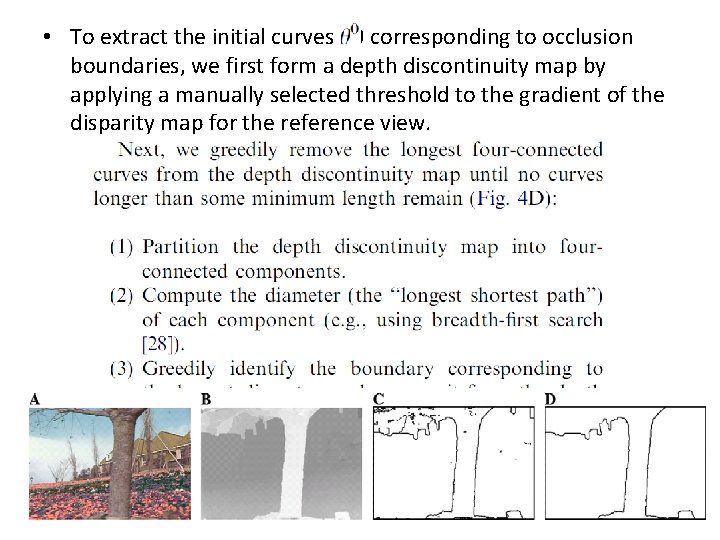
• To extract the initial curves h 0 corresponding to occlusion boundaries, we first form a depth discontinuity map by applying a manually selected threshold to the gradient of the disparity map for the reference view.
Background (clean plate) estimation • For a given boundary pixel, we find potentially corresponding background colors by forward-warping that pixel to all other views. • We use a color inconsistency measure to select the corresponding background pixel most likely to consist of pure background color. • For each candidate background pixel, we compute its ‘‘color inconsistency’’ as the maximum L 2 distance in RGB space between its color and any of its eight-neighbors that are also labeled at background depth.
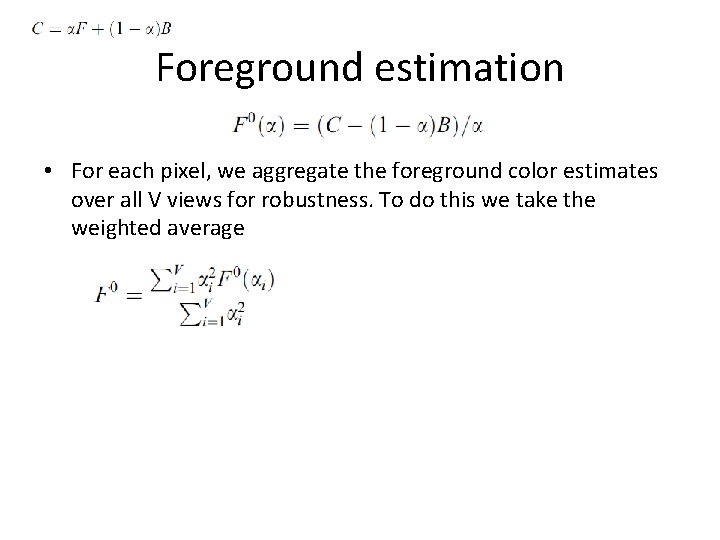
Foreground estimation • For each pixel, we aggregate the foreground color estimates over all V views for robustness. To do this we take the weighted average
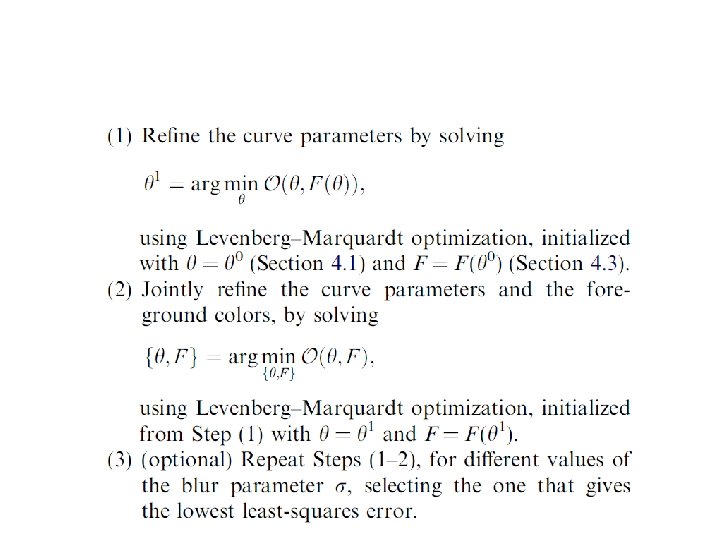
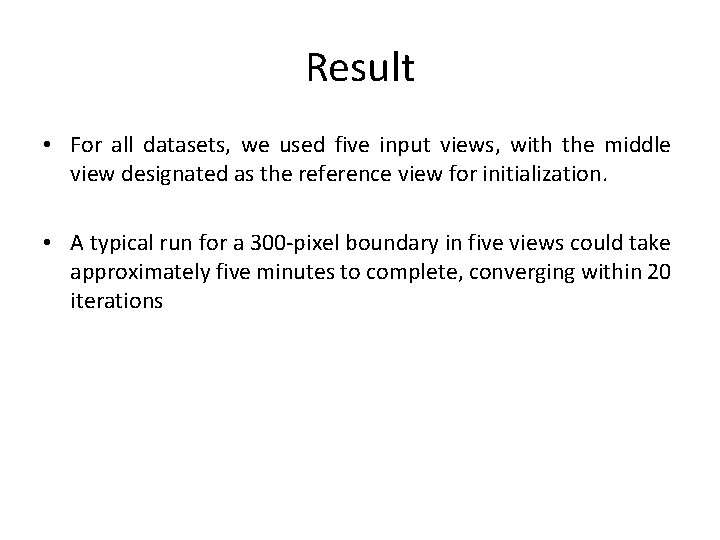
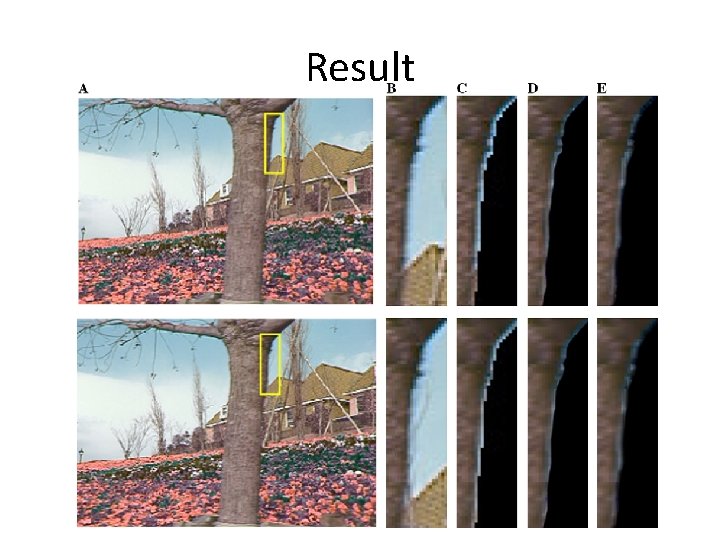
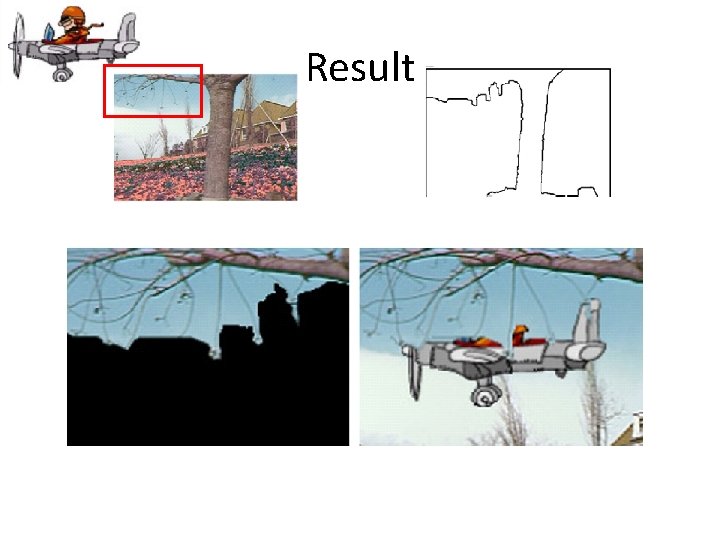
Result • For all datasets, we used five input views, with the middle view designated as the reference view for initialization. • A typical run for a 300 -pixel boundary in five views could take approximately five minutes to complete, converging within 20 iterations
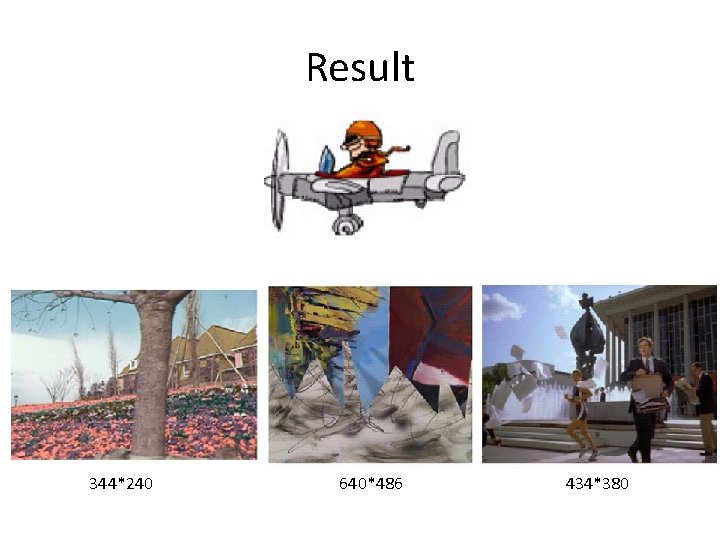
Result 344*240 640*486 434*380
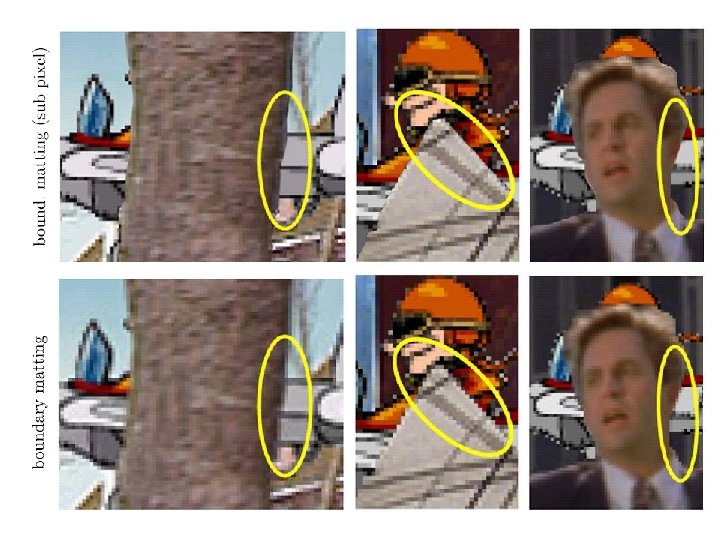
Result
Result
Conclusion • For seamless view interpolation, mixed boundary pixels must be resolved into foreground and background components. Boundary matting appears to be a useful tool for addressing this problem in an automatic way. • Using 3 D curves to model occlusion boundaries is a natural representation that provides several benefits, including the ability to super-resolve the depth maps near occlusion boundaries.
- Slides: 19