
Bottled Water Comparison Science Fair Project Emma Dalley
Bottled Water Comparison Science Fair Project: Emma Dalley Grade 11 - Holy Trinity High, Torbay
INTRODUCTION Purpose: To determine if there any differences in the parameters of various brands of bottled water. Some of these parameters include: p. H, fluoride, mercury, nitrites, zinc, total chlorine, aluminum, etc. . Question: What, if any, are the differences between the various brands of bottled water? Hypothesis: There will be some variation in the levels of each parameter in bottled water, however; all within safe drinking limits.
VARIABLES INDEPENDENT CONTROLLED The brand of bottled water tested. The level of each parameter in each brand of bottled water. Water temperature, the brand of test strips, and the time test strips are in water samples.
MATERIALS LIST OF NEEDED MATERIALS: 1. Multiple different brands of bottled water 2. Water testing strips, which include 16 parameters 3. Thermometer to insure temperature of water 4. Paper Towel 5. Test Tube (Plastic or Glass) 6. Paper to record test results 7. Pen of pencil
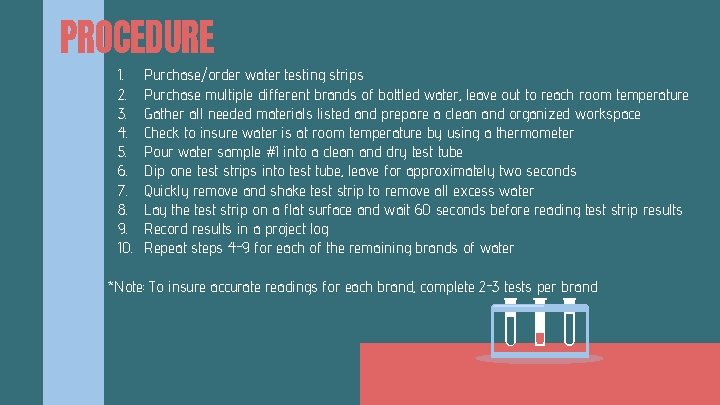
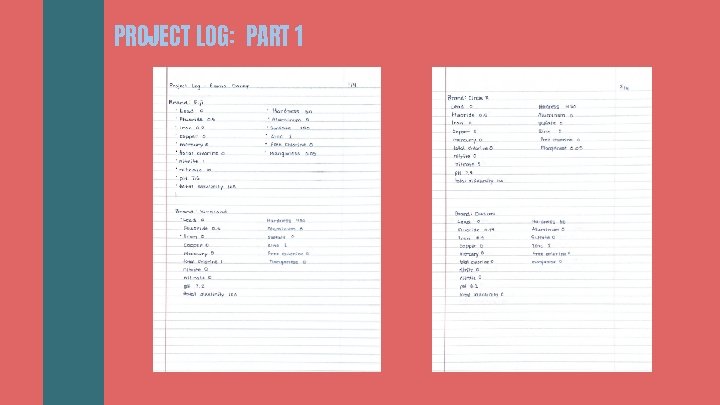
PROCEDURE 1. 2. 3. 4. 5. 6. 7. 8. 9. 10. Purchase/order water testing strips Purchase multiple different brands of bottled water, leave out to reach room temperature Gather all needed materials listed and prepare a clean and organized workspace Check to insure water is at room temperature by using a thermometer Pour water sample #1 into a clean and dry test tube Dip one test strips into test tube, leave for approximately two seconds Quickly remove and shake test strip to remove all excess water Lay the test strip on a flat surface and wait 60 seconds before reading test strip results Record results in a project log Repeat steps 4 -9 for each of the remaining brands of water *Note: To insure accurate readings for each brand, complete 2 -3 tests per brand

RESULTS
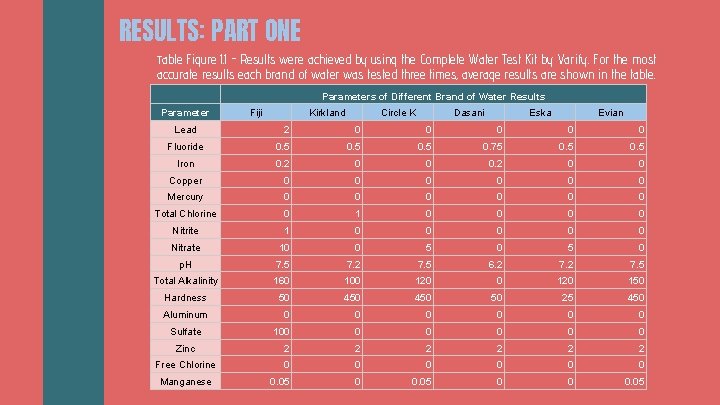
RESULTS: PART ONE Table Figure 1. 1 - Results were achieved by using the Complete Water Test Kit by Varify. For the most accurate results each brand of water was tested three times, average results are shown in the table. Parameters of Different Brand of Water Results Parameter Lead Fiji Kirkland Circle K Dasani Eska Evian 2 0 0 0 Fluoride 0. 5 0. 75 0. 5 Iron 0. 2 0 0 Copper 0 0 0 Mercury 0 0 0 Total Chlorine 0 1 0 0 Nitrite 1 0 0 0 Nitrate 10 0 5 0 p. H 7. 5 7. 2 7. 5 6. 2 7. 5 Total Alkalinity 160 100 120 150 Hardness 50 450 50 25 450 Aluminum 0 0 0 100 0 0 Zinc 2 2 2 Free Chlorine 0 0 0 0. 05 Sulfate Manganese
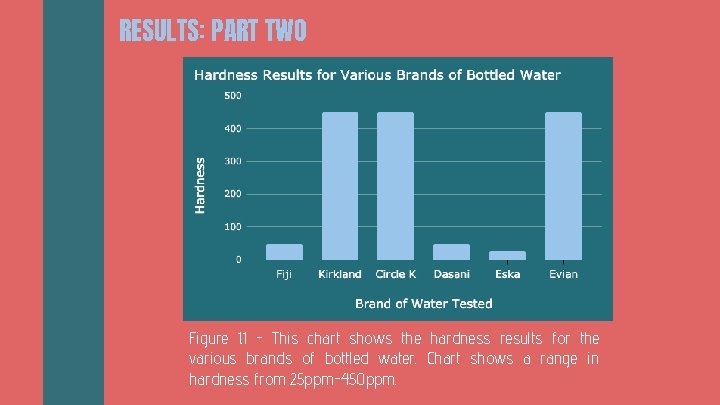
RESULTS: PART TWO Figure 1. 1 - This chart shows the hardness results for the various brands of bottled water. Chart shows a range in hardness from 25 ppm-450 ppm.
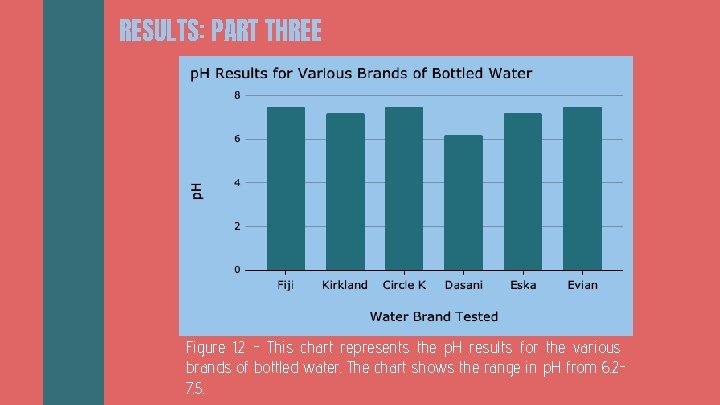
RESULTS: PART THREE Figure 1. 2 - This chart represents the p. H results for the various brands of bottled water. The chart shows the range in p. H from 6. 27. 5.
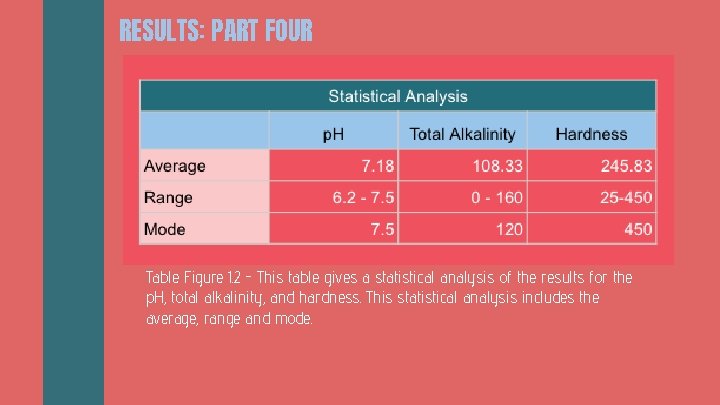
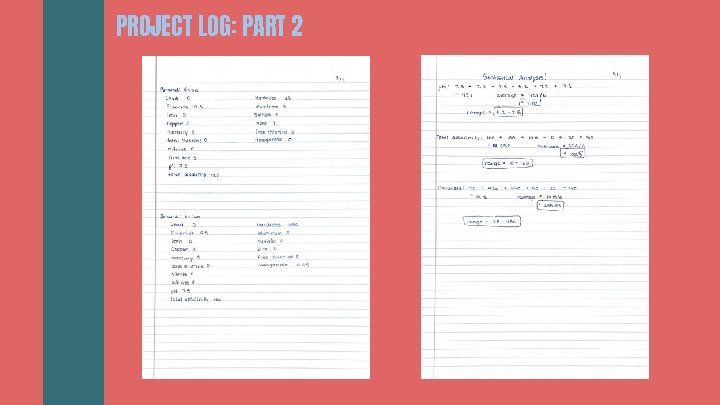
RESULTS: PART FOUR Table Figure 1. 2 - This table gives a statistical analysis of the results for the p. H, total alkalinity, and hardness. This statistical analysis includes the average, range and mode.

DISCUSSION
All results were within the safe limits suggested by the test strip kit, as expected. A detailed analysis of results is to follow. Parameters with no variance: - lead (0. 0 ppm) - copper (0. 0 ppm) - mercury (0. 0 ppm) - aluminum (0. 0 ppm) - free chlorine (0. 0 ppm) - Zinc (2. . 0 ppm) It was expected to have levels of lead, copper, mercury, aluminum and free chlorine at 0. 0 ppm, as these are parameters that consumers do not want to see in their water for safety reasons and any traces would be removed by the company before they were bottled. Parameters with slight variances: - Fluoride (0. 5 ppm-0. 75 ppm) - Iron (0. 0 ppm-0. 2 ppm) - Total Chlorine (0. 0 ppm-1. 0 ppm) - Nitrate (0. 0 ppm-10. 0 ppm) - Nitrite (0. 0 ppm-1. 0 ppm) - Manganese (0. 0 ppm-0. 05 ppm) The parameters above had only slight variances and this may be the result of some of the sources of error (ex, test strips, result reading errors, etc)
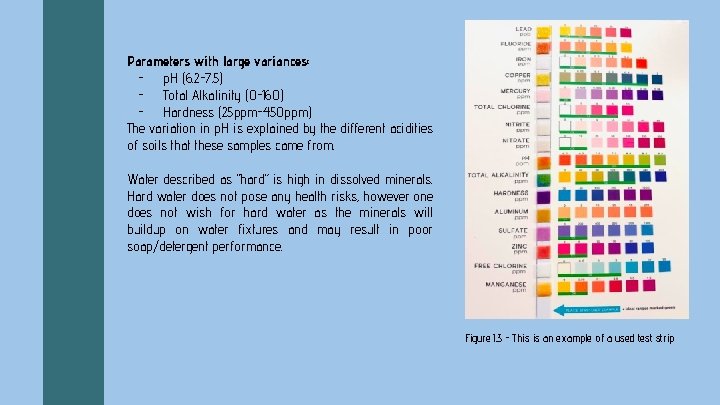
Parameters with large variances: - p. H (6. 2 -7. 5) - Total Alkalinity (0 -160) - Hardness (25 ppm-450 ppm) The variation in p. H is explained by the different acidities of soils that these samples came from. Water described as “hard” is high in dissolved minerals. Hard water does not pose any health risks, however one does not wish for hard water as the minerals will buildup on water fixtures and may result in poor soap/detergent performance. Figure 1. 3 - This is an example of a used test strip
SOURCES OF ERROR Systematic Error 1: It is possible that the test strips were inconsistent with each other or possibly faulty, resulting in some data collected being off and/or incorrect. Systematic Error 2: Everything in this world has some variation. The specific bottled water purchased may not have been good examples of that brand as a whole. Therefore, results are not specific to the brand, rather the sample purchased. Human Error: Results were shown on the test strips as colours, one would have to judge, based on the chart provided, the numerical value associated with that colour. Results may be affected by this.
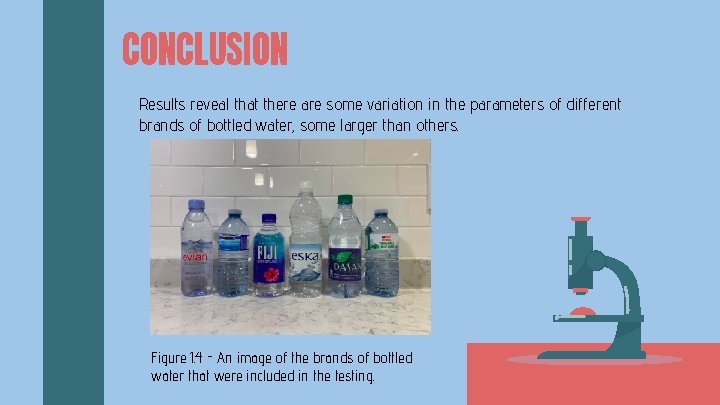
CONCLUSION Results reveal that there are some variation in the parameters of different brands of bottled water, some larger than others. Figure 1. 4 - An image of the brands of bottled water that were included in the testing.
ACKNOWLEDGEMENTS I would like thank the following people: My Chemistry teacher, Ms. Kavanagh, and my Physics teacher, Ms. O'Reilly, who both provided guidance on this project. My parents who assisted with the at home aspect of this project, including the experiment.
REFERENCES Reference 1: Omer, N. H, October 16 th 2019. Retrieved from: Water Quality Parameters Reference 2: Authors name and date of publication is unknown. Retrieved from information booklet provided with the purchase of water testing kit Water testing kit: https: //varifytest. com Reference 3: Ada Mc. Vean B. Sc, January 11 th 2019. Retrieved from: Mc. Gill - Office for Science and Society
PROJECT LOG: PART 1
PROJECT LOG: PART 2

THANK YOU
- Slides: 20