
Bottlebrush Polymer Surfactant Blends for Low IFT Luqing
Bottlebrush Polymer & Surfactant Blends for Low IFT Luqing Qi, Hadi Shamsi. Jazeyi, Xianyu Li, Stacy Pesek, Maura Puerto, Rafael Verduzco, George Hirasaki Department of Chemical and Biomolecular Engineering Rice University, Houston, TX, 77005
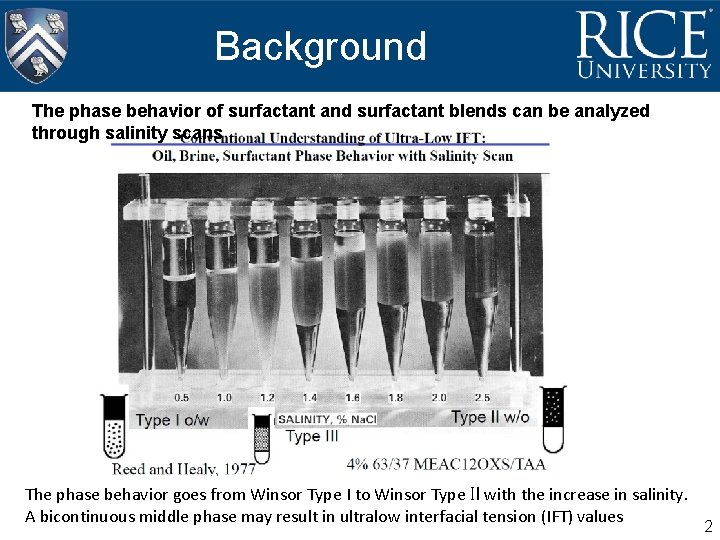
Background The phase behavior of surfactant and surfactant blends can be analyzed through salinity scans The phase behavior goes from Winsor Type I to Winsor TypeⅡwith the increase in salinity. A bicontinuous middle phase may result in ultralow interfacial tension (IFT) values 2
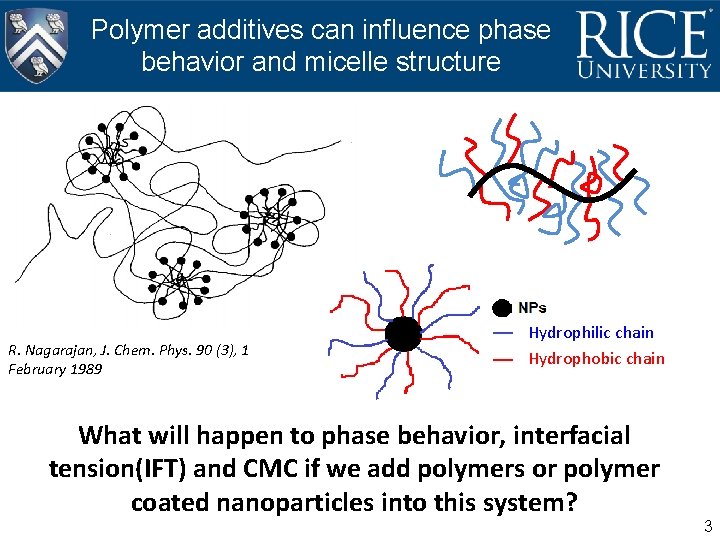
Polymer additives can influence phase behavior and micelle structure R. Nagarajan, J. Chem. Phys. 90 (3), 1 February 1989 Hydrophilic chain Hydrophobic chain What will happen to phase behavior, interfacial tension(IFT) and CMC if we add polymers or polymer coated nanoparticles into this system? 3
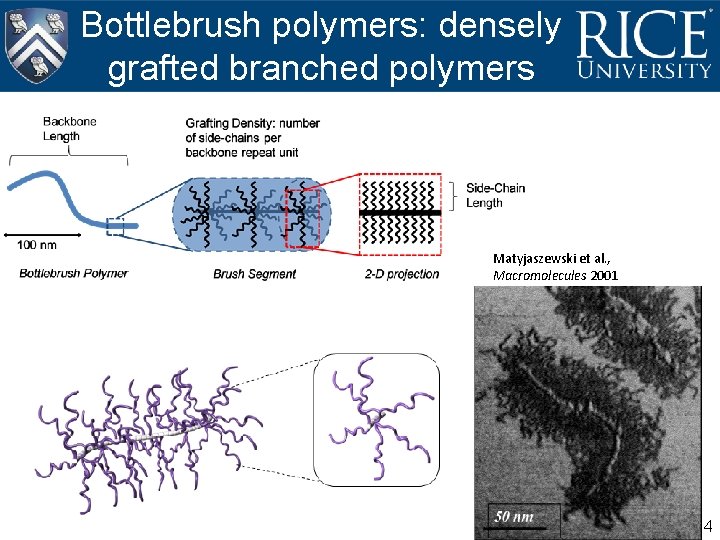
Bottlebrush polymers: densely grafted branched polymers Matyjaszewski et al. , Macromolecules 2001 4
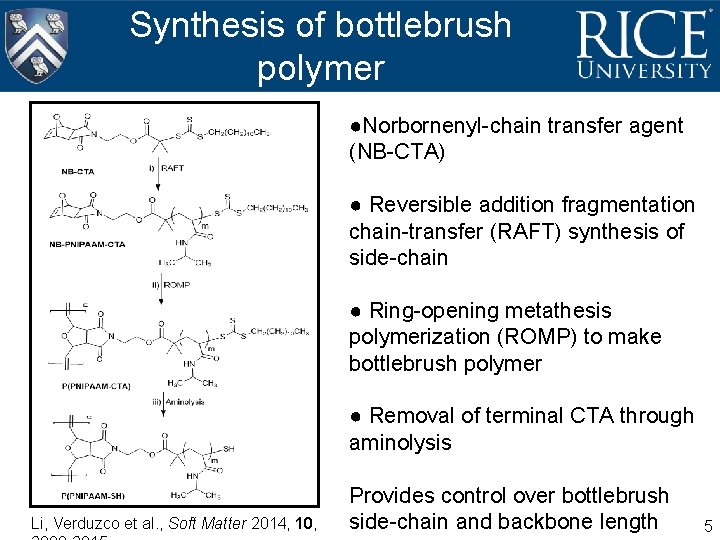
Synthesis of bottlebrush polymer ●Norbornenyl-chain transfer agent (NB-CTA) ● Reversible addition fragmentation chain-transfer (RAFT) synthesis of side-chain ● Ring-opening metathesis polymerization (ROMP) to make bottlebrush polymer ● Removal of terminal CTA through aminolysis Li, Verduzco et al. , Soft Matter 2014, 10, Provides control over bottlebrush side-chain and backbone length 5
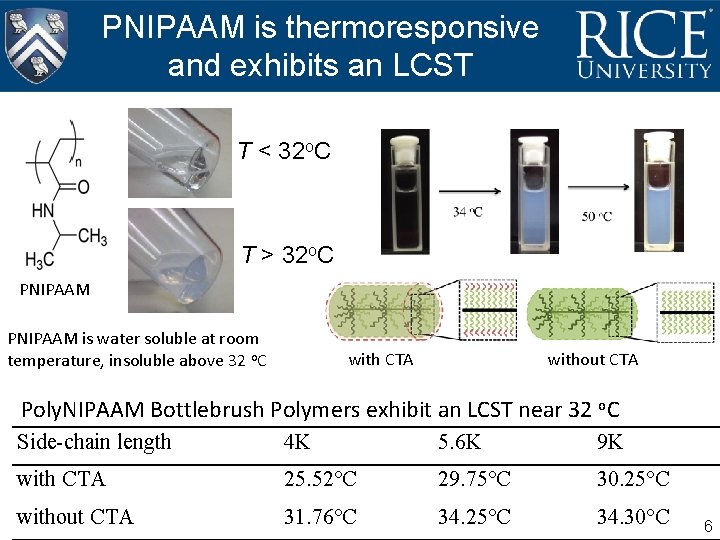
PNIPAAM is thermoresponsive and exhibits an LCST T < 32 o. C T > 32 o. C PNIPAAM is water soluble at room temperature, insoluble above 32 o. C with CTA without CTA Poly. NIPAAM Bottlebrush Polymers exhibit an LCST near 32 o. C Side-chain length 4 K 5. 6 K 9 K with CTA 25. 52°C 29. 75°C 30. 25°C without CTA 31. 76°C 34. 25°C 34. 30°C 6
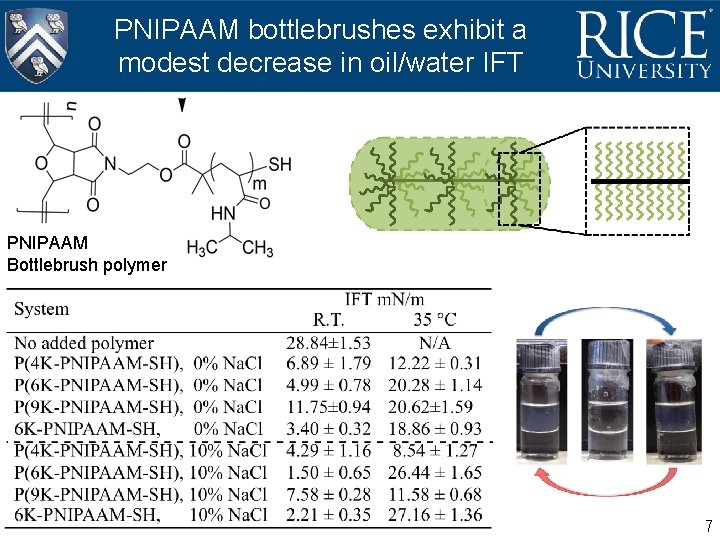
PNIPAAM bottlebrushes exhibit a modest decrease in oil/water IFT PNIPAAM Bottlebrush polymer 7
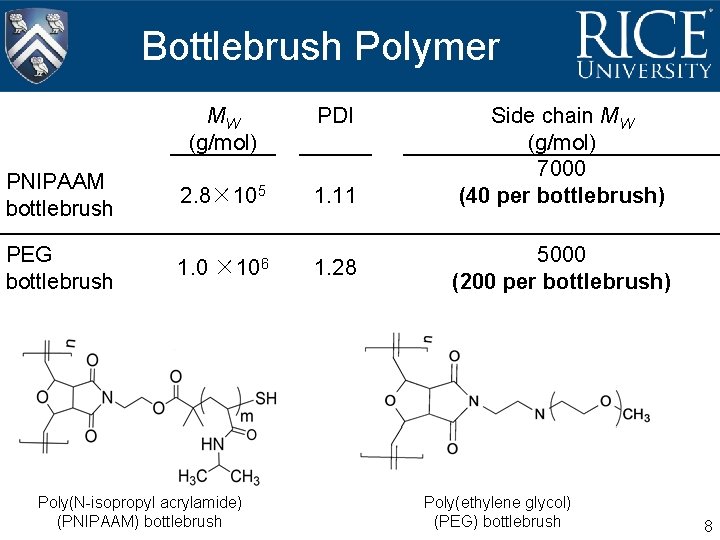
Bottlebrush Polymer MW (g/mol) PDI PNIPAAM bottlebrush 2. 8× 10⁵ 1. 11 PEG bottlebrush 1. 0 × 106 1. 28 Poly(N-isopropyl acrylamide) (PNIPAAM) bottlebrush Side chain MW (g/mol) 7000 (40 per bottlebrush) 5000 (200 per bottlebrush) Poly(ethylene glycol) (PEG) bottlebrush 8
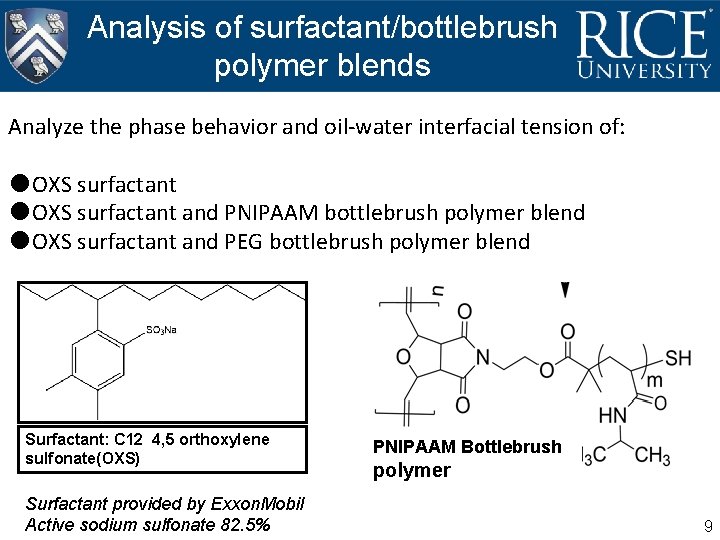
Analysis of surfactant/bottlebrush polymer blends Analyze the phase behavior and oil-water interfacial tension of: ●OXS surfactant and PNIPAAM bottlebrush polymer blend ●OXS surfactant and PEG bottlebrush polymer blend Surfactant: C 12 4, 5 orthoxylene sulfonate(OXS) Surfactant provided by Exxon. Mobil Active sodium sulfonate 82. 5% PNIPAAM Bottlebrush polymer 9
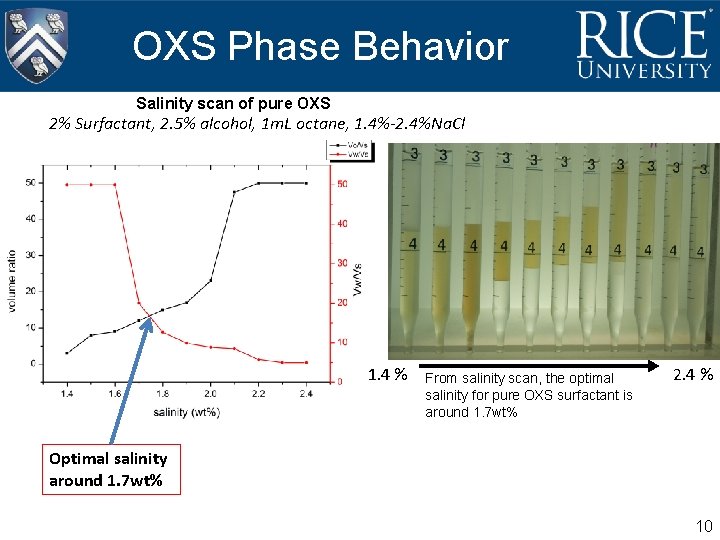
OXS Phase Behavior Salinity scan of pure OXS 2% Surfactant, 2. 5% alcohol, 1 m. L octane, 1. 4%-2. 4%Na. Cl 1. 4 % From salinity scan, the optimal salinity for pure OXS surfactant is around 1. 7 wt% 2. 4 % Optimal salinity around 1. 7 wt% 10
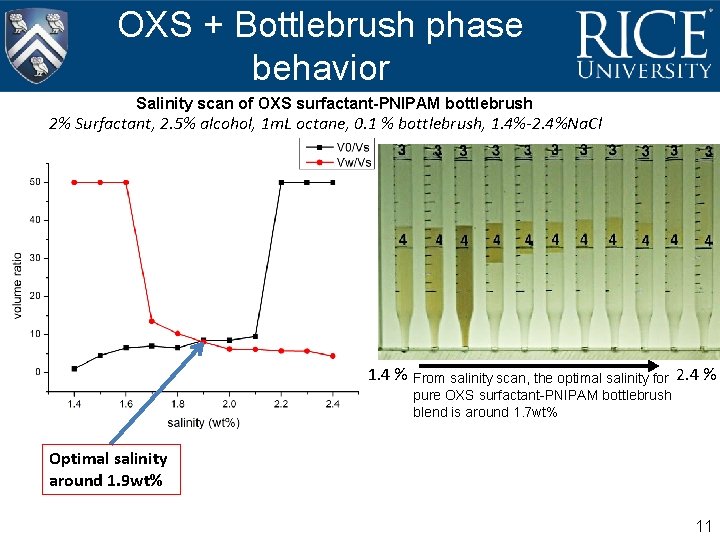
OXS + Bottlebrush phase behavior Salinity scan of OXS surfactant-PNIPAM bottlebrush 2% Surfactant, 2. 5% alcohol, 1 m. L octane, 0. 1 % bottlebrush, 1. 4%-2. 4%Na. Cl 1. 4 % From salinity scan, the optimal salinity for 2. 4 % pure OXS surfactant-PNIPAM bottlebrush blend is around 1. 7 wt% Optimal salinity around 1. 9 wt% 11
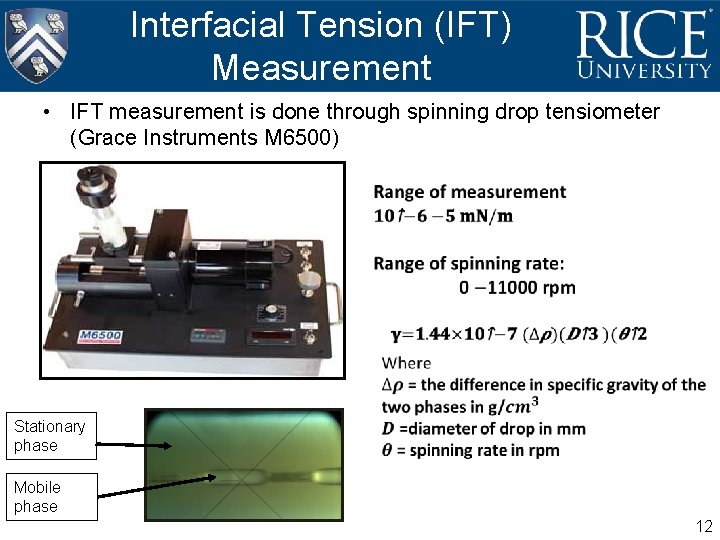
Interfacial Tension (IFT) Measurement • IFT measurement is done through spinning drop tensiometer (Grace Instruments M 6500) Stationary phase Mobile phase 12
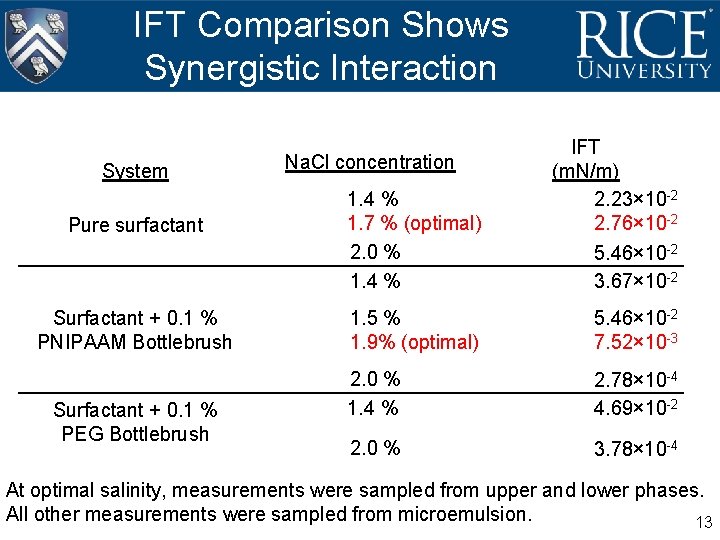
IFT Comparison Shows Synergistic Interaction System Pure surfactant Surfactant + 0. 1 % PNIPAAM Bottlebrush Surfactant + 0. 1 % PEG Bottlebrush Na. Cl concentration 1. 4 % 1. 7 % (optimal) 2. 0 % 1. 4 % IFT (m. N/m) 2. 23× 10 -2 2. 76× 10 -2 5. 46× 10 -2 3. 67× 10 -2 1. 5 % 1. 9% (optimal) 5. 46× 10 -2 7. 52× 10 -3 2. 0 % 1. 4 % 2. 78× 10 -4 4. 69× 10 -2 2. 0 % 3. 78× 10 -4 At optimal salinity, measurements were sampled from upper and lower phases. All other measurements were sampled from microemulsion. 13
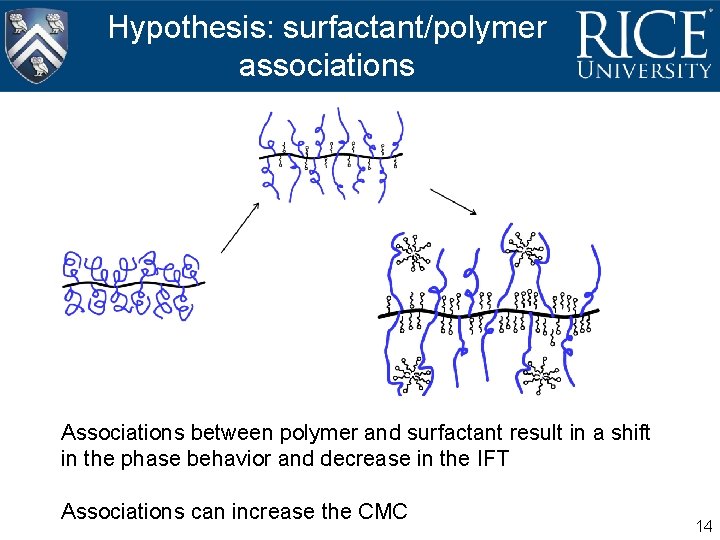
Hypothesis: surfactant/polymer associations Associations between polymer and surfactant result in a shift in the phase behavior and decrease in the IFT Associations can increase the CMC 14
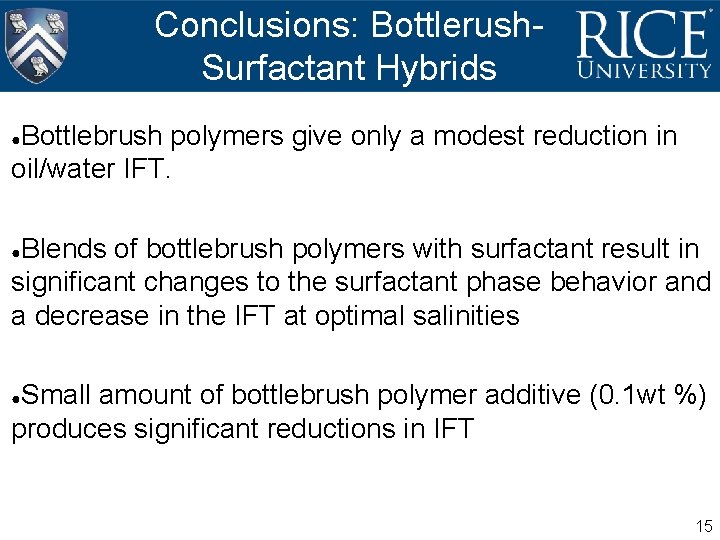
Conclusions: Bottlerush- Surfactant Hybrids Bottlebrush polymers give only a modest reduction in oil/water IFT. ● Blends of bottlebrush polymers with surfactant result in significant changes to the surfactant phase behavior and a decrease in the IFT at optimal salinities ● Small amount of bottlebrush polymer additive (0. 1 wt %) produces significant reductions in IFT ● 15
Future Work • Measure the critical micelle concentration (CMC) of bottlebrush/surfactant blends • Characterize surfactant-bottlebrush associations through dynamic light scattering, X-ray scattering, and electron microscopy • Analyze the rheological properties of bottlebrush polymer/surfactant blends 16
The authors acknowledge the financial support from Rice University Consortium for Processes in Porous Media Thanks for your attention! Question? 17
Backup slides 18
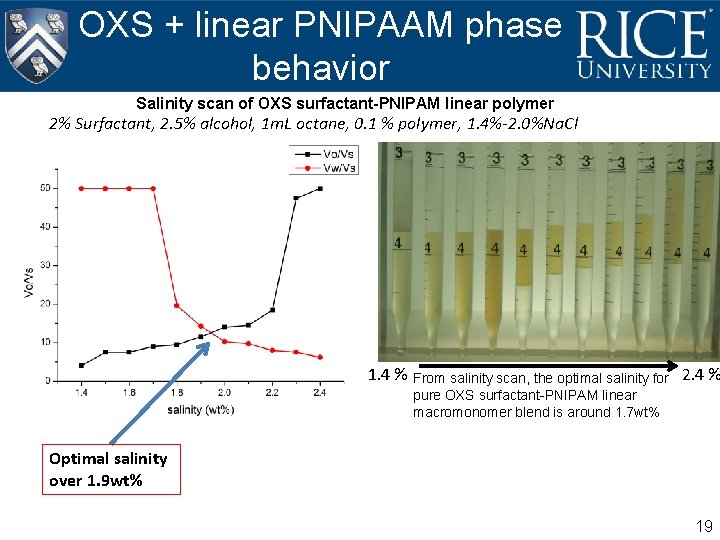
OXS + linear PNIPAAM phase behavior Salinity scan of OXS surfactant-PNIPAM linear polymer 2% Surfactant, 2. 5% alcohol, 1 m. L octane, 0. 1 % polymer, 1. 4%-2. 0%Na. Cl 1. 4 % From salinity scan, the optimal salinity for pure OXS surfactant-PNIPAM linear macromonomer blend is around 1. 7 wt% 2. 4 % Optimal salinity over 1. 9 wt% 19
- Slides: 19