
BOTANY PART I LAND PLANTS 1 Four Groups
BOTANY PART I LAND PLANTS 1
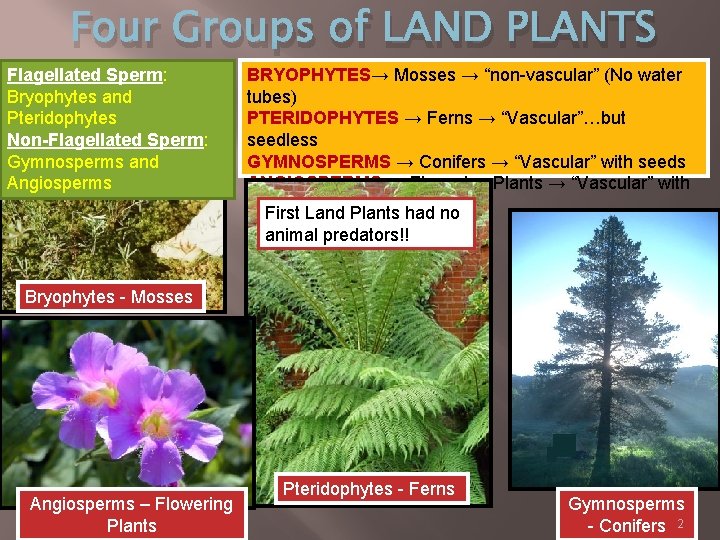
Four Groups of LAND PLANTS Flagellated Sperm: Bryophytes and Pteridophytes Non-Flagellated Sperm: Gymnosperms and Angiosperms BRYOPHYTES→ Mosses → “non-vascular” (No water tubes) PTERIDOPHYTES → Ferns → “Vascular”…but seedless GYMNOSPERMS → Conifers → “Vascular” with seeds ANGIOSPERMS → Flowering Plants → “Vascular” with seeds flowers Firstand Land Plants had no animal predators!! Bryophytes - Mosses Angiosperms – Flowering Plants Pteridophytes - Ferns Gymnosperms - Conifers 2
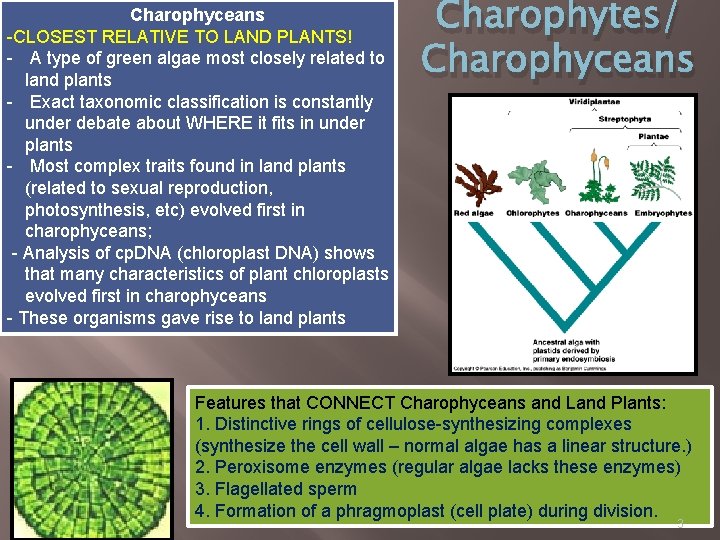
Charophyceans -CLOSEST RELATIVE TO LAND PLANTS! - A type of green algae most closely related to land plants - Exact taxonomic classification is constantly under debate about WHERE it fits in under plants - Most complex traits found in land plants (related to sexual reproduction, photosynthesis, etc) evolved first in charophyceans; - Analysis of cp. DNA (chloroplast DNA) shows that many characteristics of plant chloroplasts evolved first in charophyceans - These organisms gave rise to land plants Charophytes/ Charophyceans Features that CONNECT Charophyceans and Land Plants: 1. Distinctive rings of cellulose-synthesizing complexes (synthesize the cell wall – normal algae has a linear structure. ) 2. Peroxisome enzymes (regular algae lacks these enzymes) 3. Flagellated sperm 4. Formation of a phragmoplast (cell plate) during division. 3
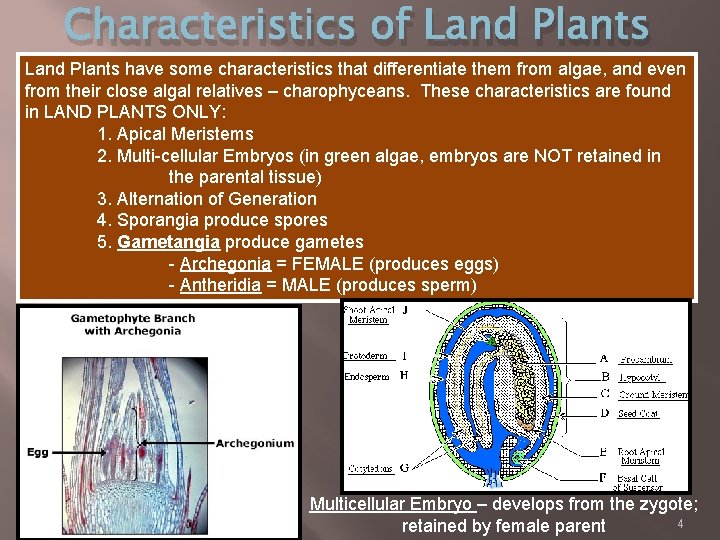
Characteristics of Land Plants have some characteristics that differentiate them from algae, and even from their close algal relatives – charophyceans. These characteristics are found in LAND PLANTS ONLY: 1. Apical Meristems 2. Multi-cellular Embryos (in green algae, embryos are NOT retained in the parental tissue) 3. Alternation of Generation 4. Sporangia produce spores 5. Gametangia produce gametes - Archegonia = FEMALE (produces eggs) - Antheridia = MALE (produces sperm) Multicellular Embryo – develops from the zygote; 4 retained by female parent
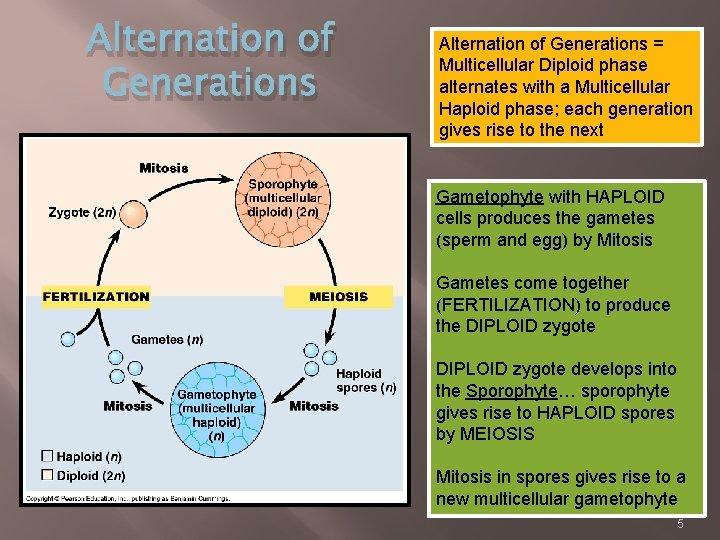
Alternation of Generations = Multicellular Diploid phase alternates with a Multicellular Haploid phase; each generation gives rise to the next Gametophyte with HAPLOID cells produces the gametes (sperm and egg) by Mitosis Gametes come together (FERTILIZATION) to produce the DIPLOID zygote develops into the Sporophyte… sporophyte gives rise to HAPLOID spores by MEIOSIS Mitosis in spores gives rise to a new multicellular gametophyte 5
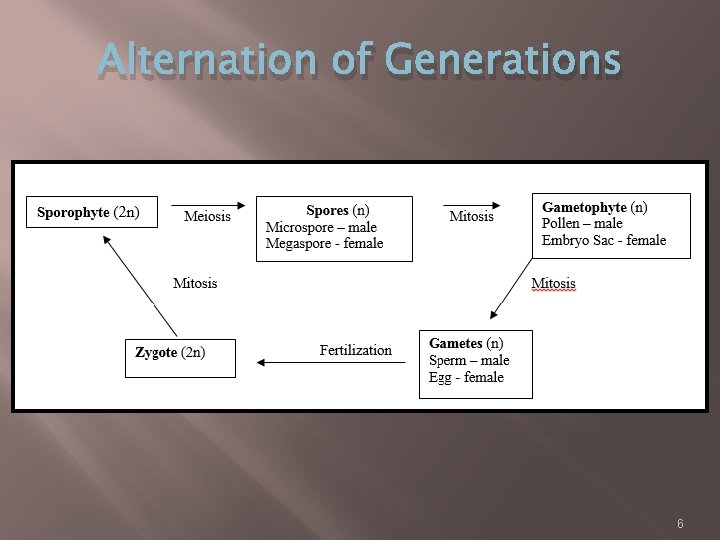
Alternation of Generations 6
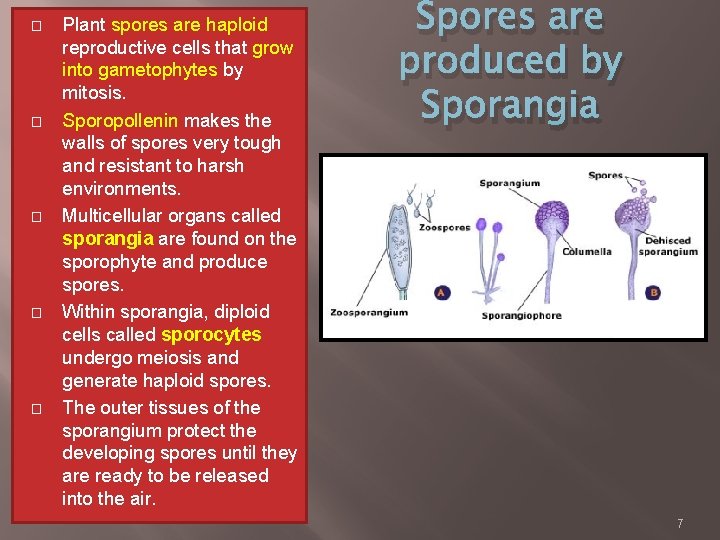
� � � Plant spores are haploid reproductive cells that grow into gametophytes by mitosis. Sporopollenin makes the walls of spores very tough and resistant to harsh environments. Multicellular organs called sporangia are found on the sporophyte and produce spores. Within sporangia, diploid cells called sporocytes undergo meiosis and generate haploid spores. The outer tissues of the sporangium protect the developing spores until they are ready to be released into the air. Spores are produced by Sporangia 7
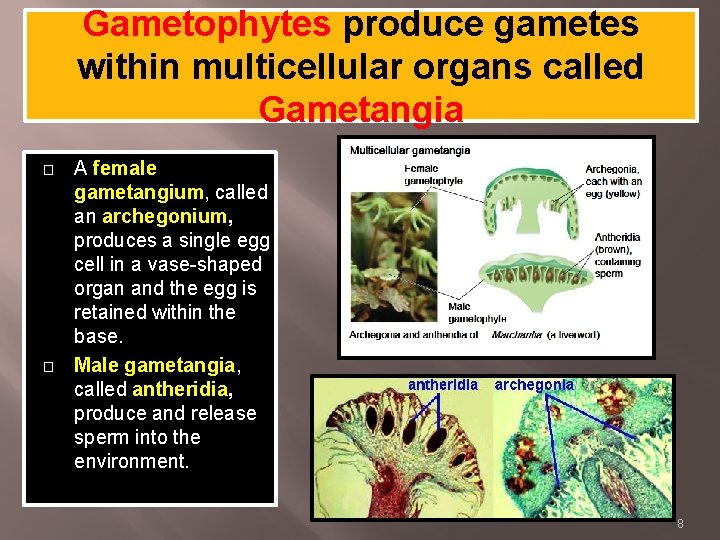
Gametophytes produce gametes within multicellular organs called Gametangia � � A female gametangium, called an archegonium, produces a single egg cell in a vase-shaped organ and the egg is retained within the base. Male gametangia, called antheridia, produce and release sperm into the environment. 8
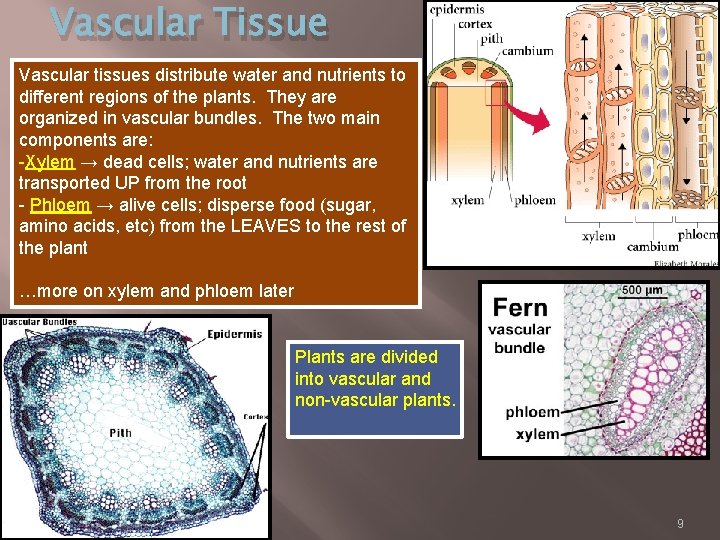
Vascular Tissue Vascular tissues distribute water and nutrients to different regions of the plants. They are organized in vascular bundles. The two main components are: -Xylem → dead cells; water and nutrients are transported UP from the root - Phloem → alive cells; disperse food (sugar, amino acids, etc) from the LEAVES to the rest of the plant …more on xylem and phloem later Plants are divided into vascular and non-vascular plants. 9
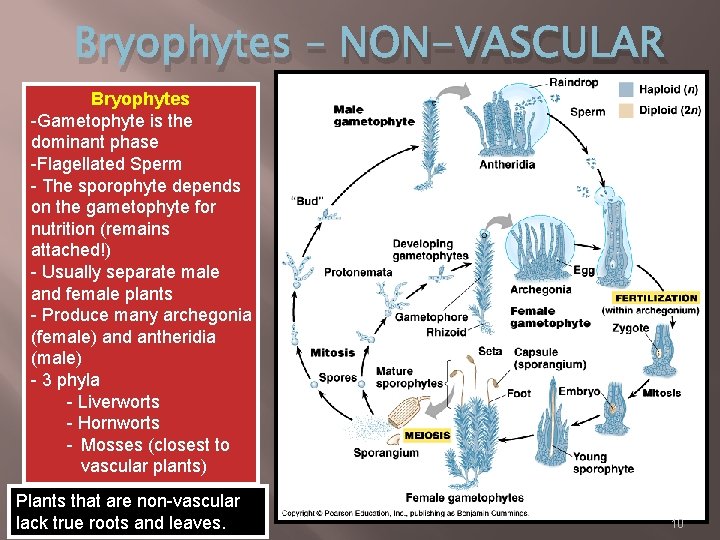
Bryophytes – NON-VASCULAR Bryophytes -Gametophyte is the dominant phase -Flagellated Sperm - The sporophyte depends on the gametophyte for nutrition (remains attached!) - Usually separate male and female plants - Produce many archegonia (female) and antheridia (male) - 3 phyla - Liverworts - Hornworts - Mosses (closest to vascular plants) Plants that are non-vascular lack true roots and leaves. 10
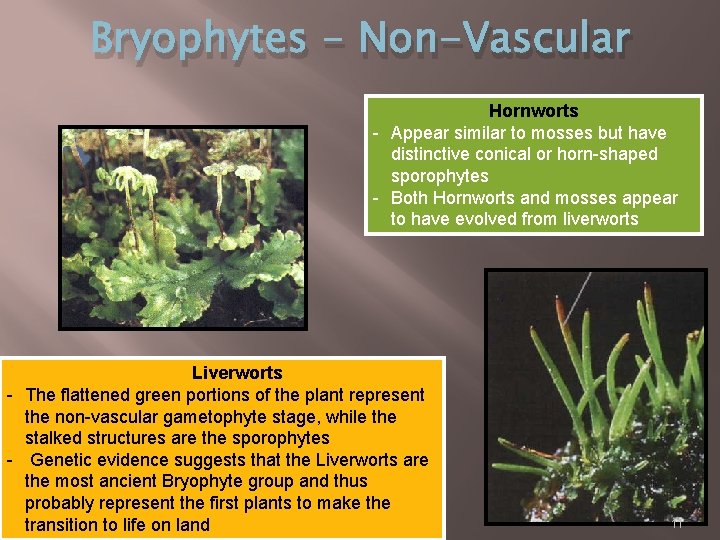
Bryophytes - Non-Vascular Hornworts - Appear similar to mosses but have distinctive conical or horn-shaped sporophytes - Both Hornworts and mosses appear to have evolved from liverworts Liverworts - The flattened green portions of the plant represent the non-vascular gametophyte stage, while the stalked structures are the sporophytes - Genetic evidence suggests that the Liverworts are the most ancient Bryophyte group and thus probably represent the first plants to make the transition to life on land 11
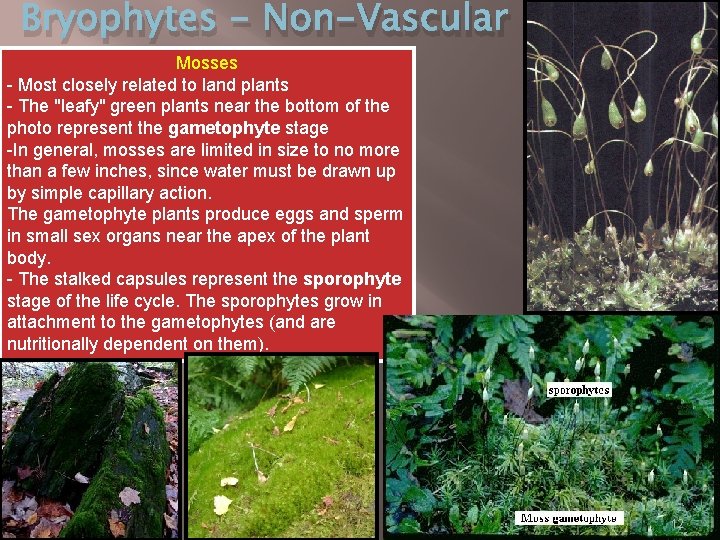
Bryophytes - Non-Vascular Mosses - Most closely related to land plants - The "leafy" green plants near the bottom of the photo represent the gametophyte stage -In general, mosses are limited in size to no more than a few inches, since water must be drawn up by simple capillary action. The gametophyte plants produce eggs and sperm in small sex organs near the apex of the plant body. - The stalked capsules represent the sporophyte stage of the life cycle. The sporophytes grow in attachment to the gametophytes (and are nutritionally dependent on them). 12
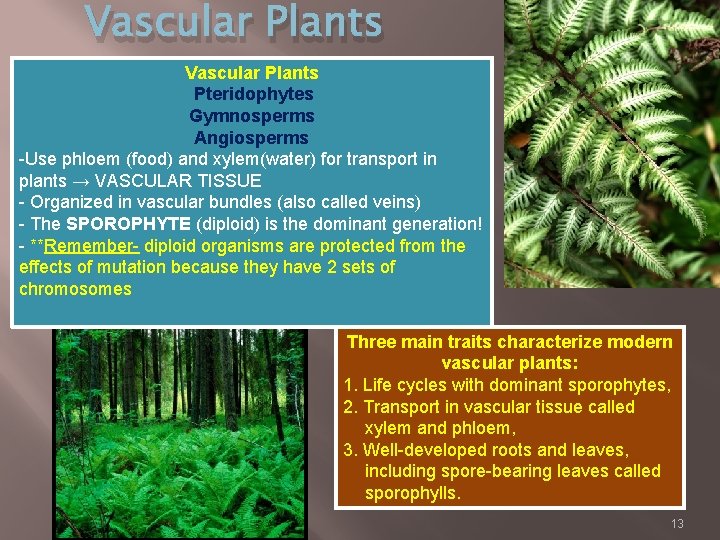
Vascular Plants Pteridophytes Gymnosperms Angiosperms -Use phloem (food) and xylem(water) for transport in plants → VASCULAR TISSUE - Organized in vascular bundles (also called veins) - The SPOROPHYTE (diploid) is the dominant generation! - **Remember- diploid organisms are protected from the effects of mutation because they have 2 sets of chromosomes Three main traits characterize modern vascular plants: 1. Life cycles with dominant sporophytes, 2. Transport in vascular tissue called xylem and phloem, 3. Well-developed roots and leaves, including spore-bearing leaves called sporophylls. 13
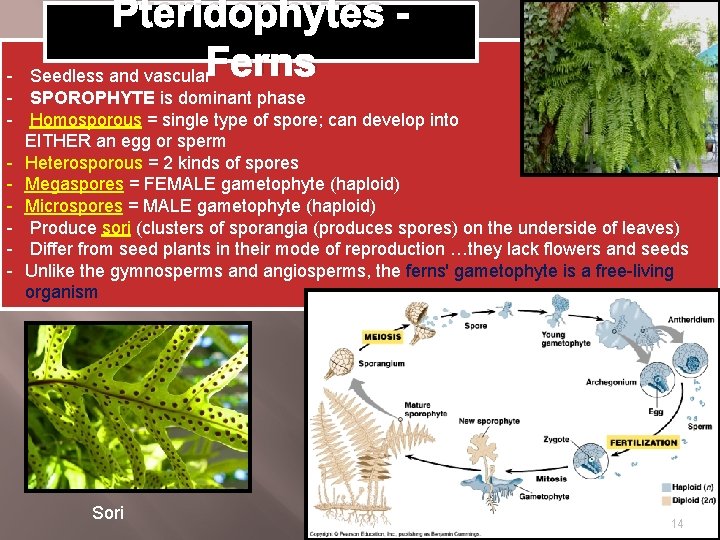
Pteridophytes Seedless and vascular. Ferns - SPOROPHYTE is dominant phase - Homosporous = single type of spore; can develop into EITHER an egg or sperm - Heterosporous = 2 kinds of spores - Megaspores = FEMALE gametophyte (haploid) - Microspores = MALE gametophyte (haploid) - Produce sori (clusters of sporangia (produces spores) on the underside of leaves) - Differ from seed plants in their mode of reproduction …they lack flowers and seeds - Unlike the gymnosperms and angiosperms, the ferns' gametophyte is a free-living organism Sori 14
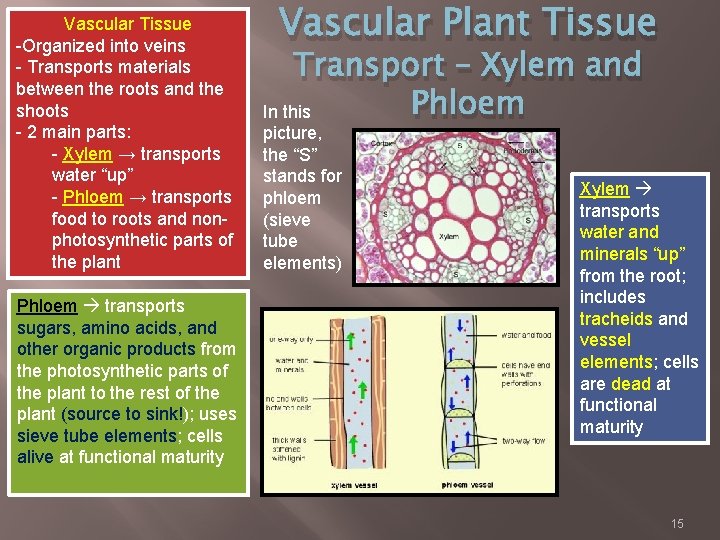
Vascular Tissue -Organized into veins - Transports materials between the roots and the shoots - 2 main parts: - Xylem → transports water “up” - Phloem → transports food to roots and nonphotosynthetic parts of the plant Phloem transports sugars, amino acids, and other organic products from the photosynthetic parts of the plant to the rest of the plant (source to sink!); uses sieve tube elements; cells alive at functional maturity Vascular Plant Tissue Transport – Xylem and In this Phloem picture, the “S” stands for phloem (sieve tube elements) Xylem transports water and minerals “up” from the root; includes tracheids and vessel elements; cells are dead at functional maturity 15
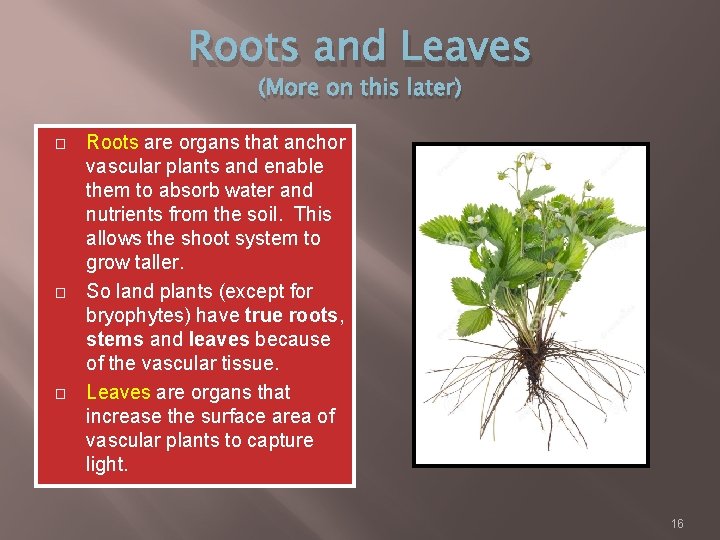
Roots and Leaves (More on this later) � � � Roots are organs that anchor vascular plants and enable them to absorb water and nutrients from the soil. This allows the shoot system to grow taller. So land plants (except for bryophytes) have true roots, stems and leaves because of the vascular tissue. Leaves are organs that increase the surface area of vascular plants to capture light. 16
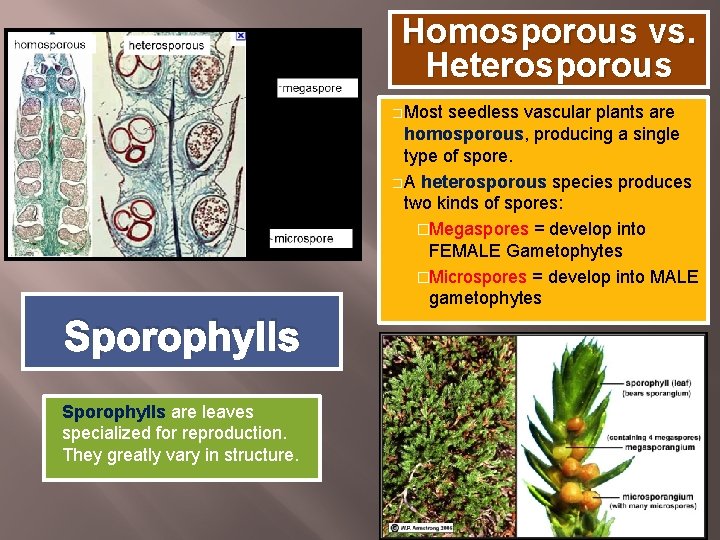
Homosporous vs. Heterosporous � Most seedless vascular plants are homosporous, producing a single type of spore. � A heterosporous species produces two kinds of spores: �Megaspores = develop into FEMALE Gametophytes �Microspores = develop into MALE gametophytes Sporophylls are leaves specialized for reproduction. They greatly vary in structure. 17
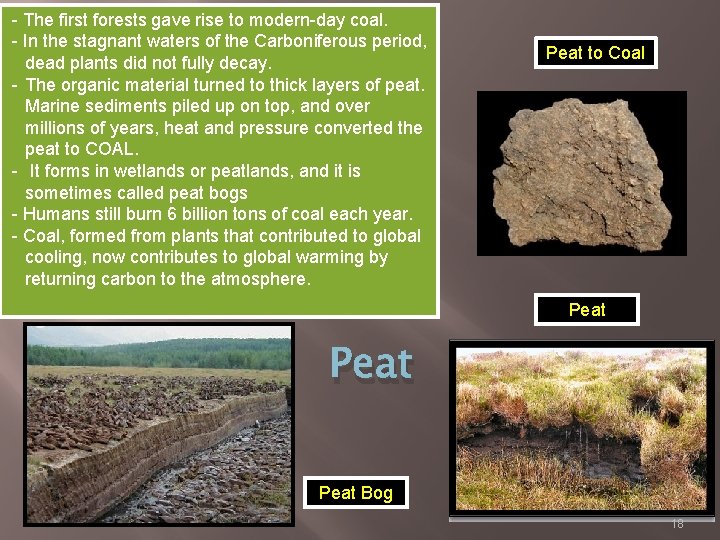
- The first forests gave rise to modern-day coal. - In the stagnant waters of the Carboniferous period, dead plants did not fully decay. - The organic material turned to thick layers of peat. Marine sediments piled up on top, and over millions of years, heat and pressure converted the peat to COAL. - It forms in wetlands or peatlands, and it is sometimes called peat bogs - Humans still burn 6 billion tons of coal each year. - Coal, formed from plants that contributed to global cooling, now contributes to global warming by returning carbon to the atmosphere. Peat to Coal Peat Bog 18
Adaptations for existence on land � � � Stomata (gas exchange) Waxy cuticle (prevents water loss) Vascular tissue (xylem and phloem) Seeds Flowers In dry environments, larger leaf surfaces are NOT beneficial because they can lose too much water through the stomata 19
Other Important Notes: � Water conservation was an issue when plants came out of the water to colonize land, so they had the following structures to try to prevent dessication (drying out) and help adapt : Waxy cuticles prevent water loss Stomata pores on the surface of leaves that function in gas exchange; controlled by guard cells � Vascular Tissue xylem and phloem for transport � � � Other adaptations for land existence in addition to vascular tissue were apical meristems, seeds, and flowers. If leaves wilt because there isn’t enough water, the stomata close so there is a decrease in gas exchange and therefore there is a decrease in photosynthesis The first land plants didn’t have to deal with animal predators 20
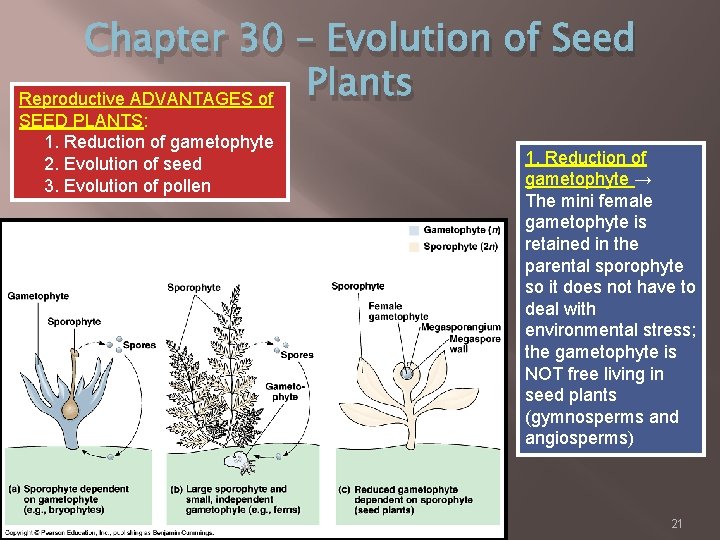
Chapter 30 – Evolution of Seed Plants Reproductive ADVANTAGES of SEED PLANTS: 1. Reduction of gametophyte 2. Evolution of seed 3. Evolution of pollen 1. Reduction of gametophyte → The mini female gametophyte is retained in the parental sporophyte so it does not have to deal with environmental stress; the gametophyte is NOT free living in seed plants (gymnosperms and angiosperms) 21
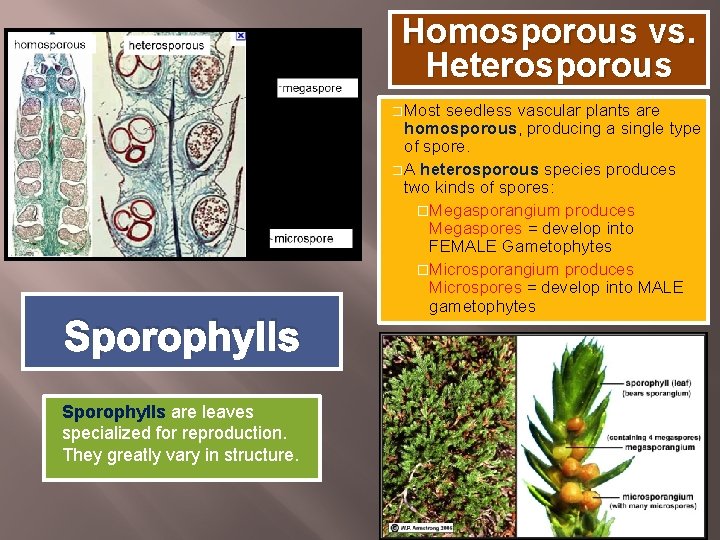
Homosporous vs. Heterosporous � Most Sporophylls seedless vascular plants are homosporous, producing a single type of spore. � A heterosporous species produces two kinds of spores: �Megasporangium produces Megaspores = develop into FEMALE Gametophytes �Microsporangium produces Microspores = develop into MALE gametophytes Sporophylls are leaves specialized for reproduction. They greatly vary in structure. 22
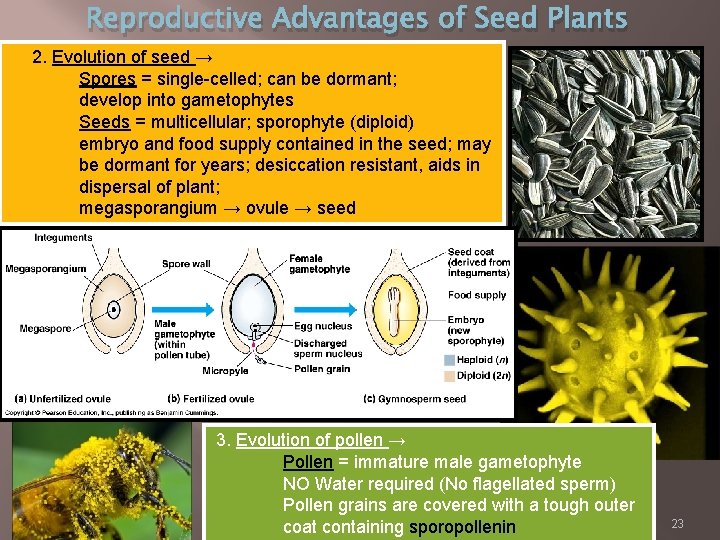
Reproductive Advantages of Seed Plants 2. Evolution of seed → Spores = single-celled; can be dormant; develop into gametophytes Seeds = multicellular; sporophyte (diploid) embryo and food supply contained in the seed; may be dormant for years; desiccation resistant, aids in dispersal of plant; megasporangium → ovule → seed 3. Evolution of pollen → Pollen = immature male gametophyte NO Water required (No flagellated sperm) Pollen grains are covered with a tough outer coat containing sporopollenin 23
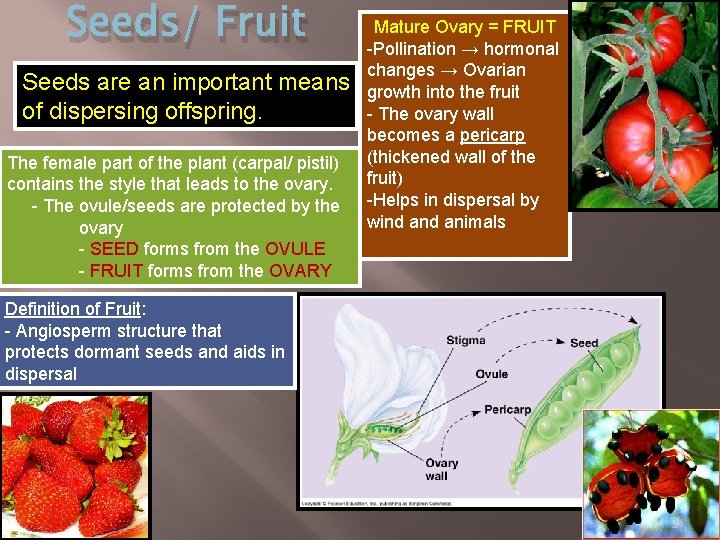
Seeds/ Fruit Seeds are an important means of dispersing offspring. The female part of the plant (carpal/ pistil) contains the style that leads to the ovary. - The ovule/seeds are protected by the ovary - SEED forms from the OVULE - FRUIT forms from the OVARY Mature Ovary = FRUIT -Pollination → hormonal changes → Ovarian growth into the fruit - The ovary wall becomes a pericarp (thickened wall of the fruit) -Helps in dispersal by wind animals Definition of Fruit: - Angiosperm structure that protects dormant seeds and aids in dispersal 24
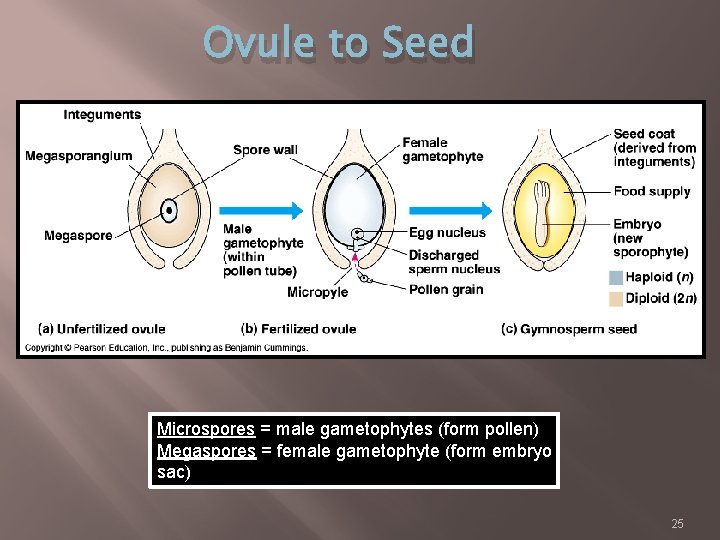
Ovule to Seed Microspores = male gametophytes (form pollen) Megaspores = female gametophyte (form embryo sac) 25
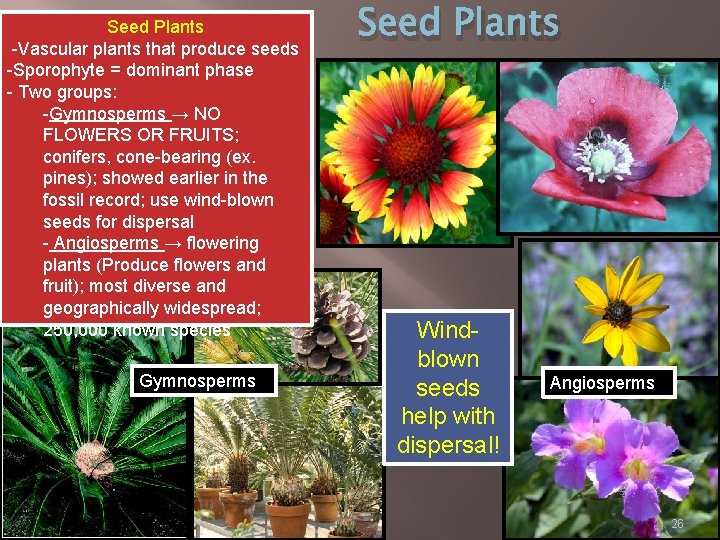
Seed Plants -Vascular plants that produce seeds -Sporophyte = dominant phase - Two groups: -Gymnosperms → NO FLOWERS OR FRUITS; conifers, cone-bearing (ex. pines); showed earlier in the fossil record; use wind-blown seeds for dispersal - Angiosperms → flowering plants (Produce flowers and fruit); most diverse and geographically widespread; 250, 000 known species Gymnosperms Seed Plants Windblown seeds help with dispersal! Angiosperms 26
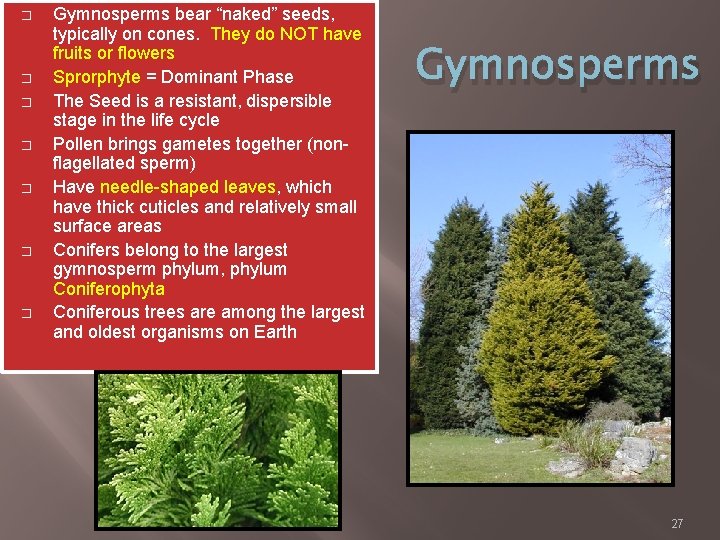
� � � � Gymnosperms bear “naked” seeds, typically on cones. They do NOT have fruits or flowers Sprorphyte = Dominant Phase The Seed is a resistant, dispersible stage in the life cycle Pollen brings gametes together (nonflagellated sperm) Have needle-shaped leaves, which have thick cuticles and relatively small surface areas Conifers belong to the largest gymnosperm phylum, phylum Coniferophyta Coniferous trees are among the largest and oldest organisms on Earth Gymnosperms 27
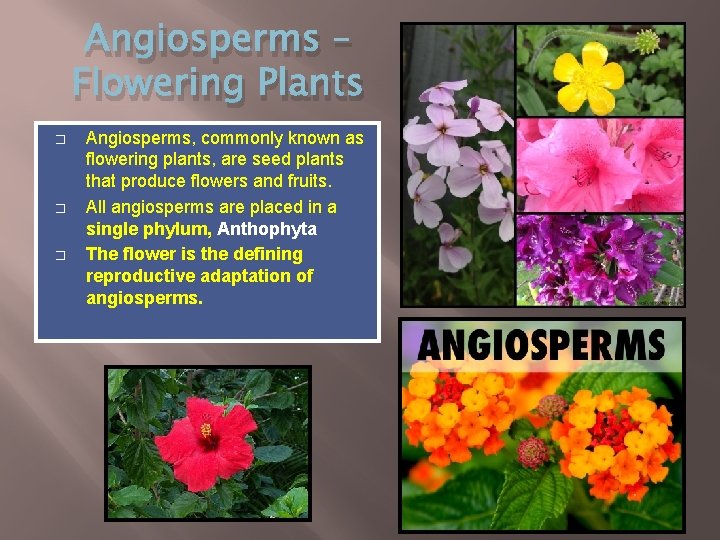
Angiosperms – Flowering Plants � � � Angiosperms, commonly known as flowering plants, are seed plants that produce flowers and fruits. All angiosperms are placed in a single phylum, Anthophyta The flower is the defining reproductive adaptation of angiosperms. 28
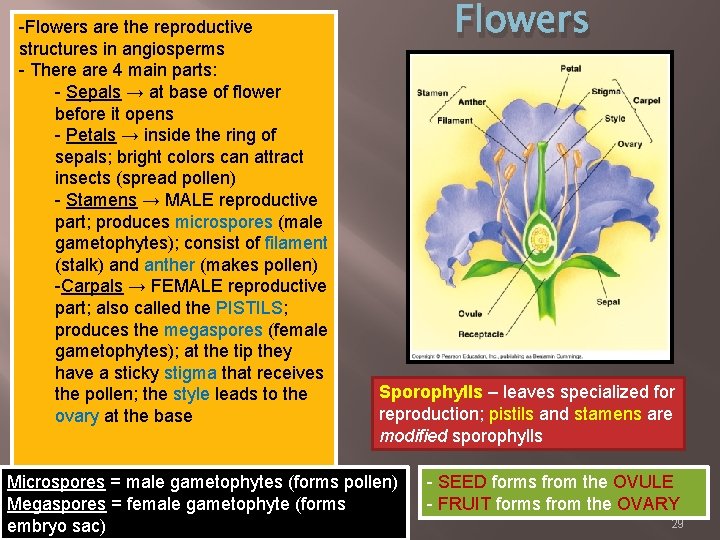
-Flowers are the reproductive structures in angiosperms - There are 4 main parts: - Sepals → at base of flower before it opens - Petals → inside the ring of sepals; bright colors can attract insects (spread pollen) - Stamens → MALE reproductive part; produces microspores (male gametophytes); consist of filament (stalk) and anther (makes pollen) -Carpals → FEMALE reproductive part; also called the PISTILS; produces the megaspores (female gametophytes); at the tip they have a sticky stigma that receives the pollen; the style leads to the ovary at the base Flowers Sporophylls – leaves specialized for reproduction; pistils and stamens are modified sporophylls Microspores = male gametophytes (forms pollen) Megaspores = female gametophyte (forms embryo sac) - SEED forms from the OVULE - FRUIT forms from the OVARY 29
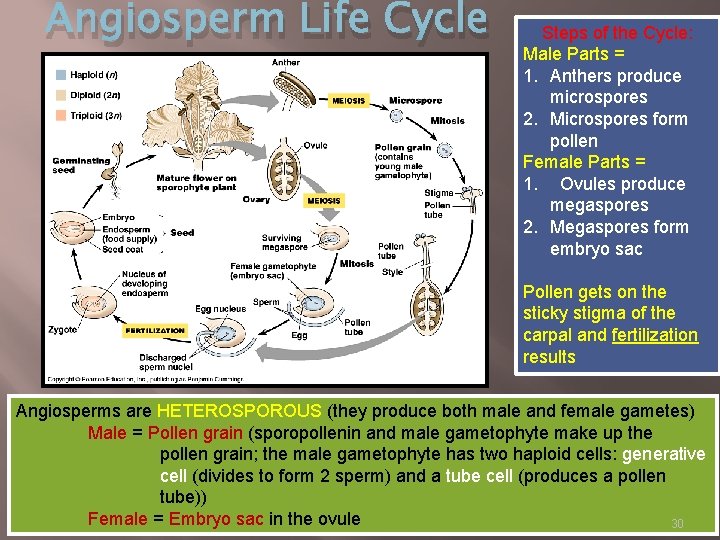
Angiosperm Life Cycle Steps of the Cycle: Male Parts = 1. Anthers produce microspores 2. Microspores form pollen Female Parts = 1. Ovules produce megaspores 2. Megaspores form embryo sac Pollen gets on the sticky stigma of the carpal and fertilization results Angiosperms are HETEROSPOROUS (they produce both male and female gametes) Male = Pollen grain (sporopollenin and male gametophyte make up the pollen grain; the male gametophyte has two haploid cells: generative cell (divides to form 2 sperm) and a tube cell (produces a pollen tube)) Female = Embryo sac in the ovule 30
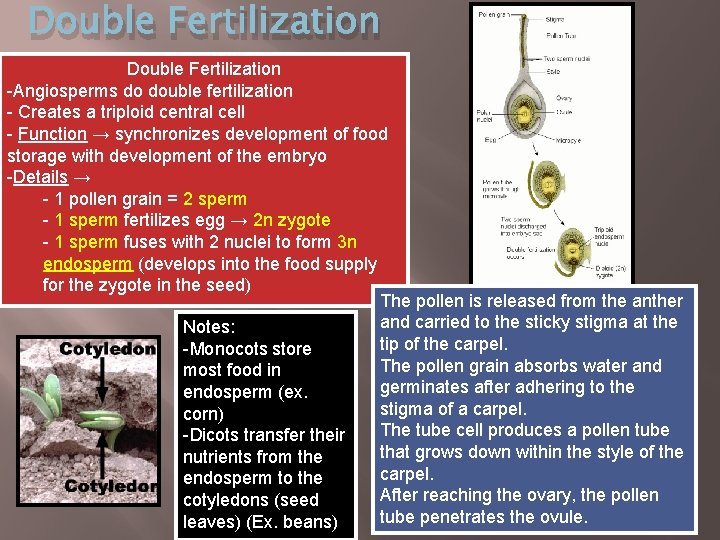
Double Fertilization -Angiosperms do double fertilization - Creates a triploid central cell - Function → synchronizes development of food storage with development of the embryo -Details → - 1 pollen grain = 2 sperm - 1 sperm fertilizes egg → 2 n zygote - 1 sperm fuses with 2 nuclei to form 3 n endosperm (develops into the food supply for the zygote in the seed) The pollen is released from the anther and carried to the sticky stigma at the Notes: tip of the carpel. -Monocots store The pollen grain absorbs water and most food in germinates after adhering to the endosperm (ex. stigma of a carpel. corn) The tube cell produces a pollen tube -Dicots transfer their that grows down within the style of the nutrients from the carpel. endosperm to the After reaching the ovary, the pollen cotyledons (seed tube penetrates the ovule. leaves) (Ex. beans) 31
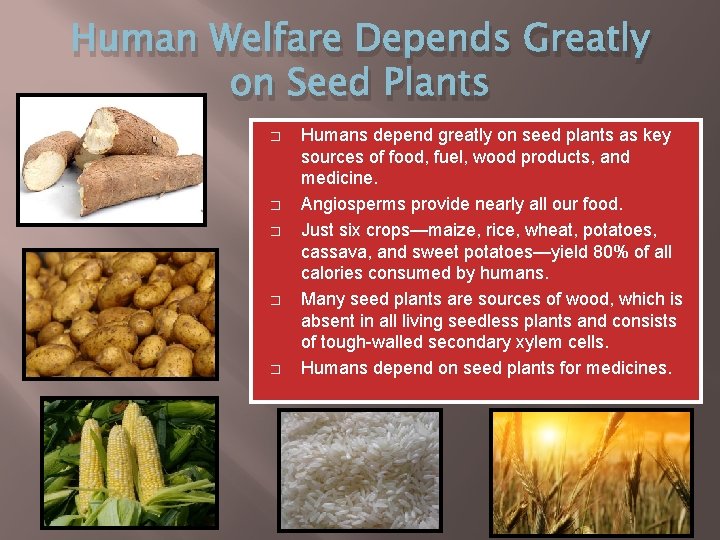
Human Welfare Depends Greatly on Seed Plants � � � Humans depend greatly on seed plants as key sources of food, fuel, wood products, and medicine. Angiosperms provide nearly all our food. Just six crops—maize, rice, wheat, potatoes, cassava, and sweet potatoes—yield 80% of all calories consumed by humans. Many seed plants are sources of wood, which is absent in all living seedless plants and consists of tough-walled secondary xylem cells. Humans depend on seed plants for medicines. 32
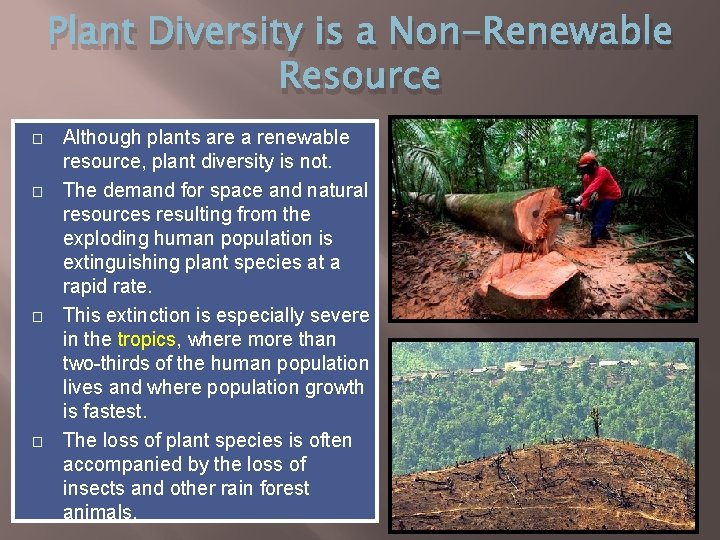
Plant Diversity is a Non-Renewable Resource � � Although plants are a renewable resource, plant diversity is not. The demand for space and natural resources resulting from the exploding human population is extinguishing plant species at a rapid rate. This extinction is especially severe in the tropics, where more than two-thirds of the human population lives and where population growth is fastest. The loss of plant species is often accompanied by the loss of insects and other rain forest animals. 33
Co. Evolution and Fossil Record � Relationship between angiosperms and animals was a mutualistic one – animals got food and plants got dispersed! COEVOLUTION!! Fossil Record: Single celled Green Algae Charophyceans Bryophytes Pteridophytes Gymnosperms Angiosperms � 34
- Slides: 34