
Botany Chapter 3 Cell Structure Objectives Understand the
Botany Chapter 3 Cell Structure Objectives: Ø Understand the structure and function of cells Ø Understand the function of Organelles Ø Identify and name important Organelles Ø Understand the Cell Cycle Suggested reading: pp. 33 -44 (Eukaryotic/Prokaryotic Cells to Cell Reproduction)
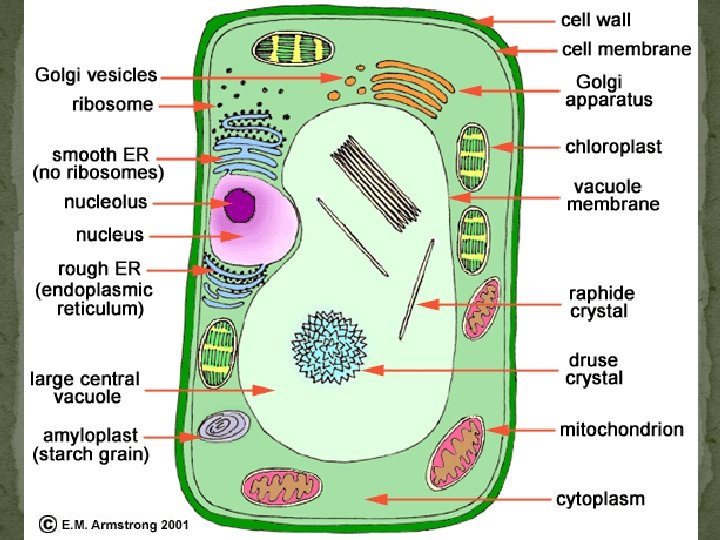
Plant Cells �Although diverse in appearance, all cells are basically similar in composition. �The presence (or absence) of organelles is related to the cell’s function � Cells needing color will contain chromoplasts � Cells used in photosynthesis will contain chloroplasts �Protoplasm—the mass of proteins, lipids, nucleic acids and water within the cell. � Protoplasm includes all organelles but the cell wall. �Cell Wall—made of cellulose. � Provides support and protection for the cell.
Organelles 1. Plasma Membrane � Also called the plasmalemma � Outermost surface of the protoplast � Is selectively permeable 2. Nucleus � Storage for genetic information (DNA) � Surrounded by the nuclear envelope made of an inner and outer membrane � Nuclear envelope filled with nucleoplasm
Organelles 3. Vacuole (central vacuole) � Surrounded by single membrane called tonoplast � Can swell with water to aid in cell growth � Used for permanent storage of waste and other material (Plants don’t poop) � Can break down old organelles for recycling 4. Cytoplasm—all protoplasm except vacuole and nucleus
Organelles 5. Mitochondria � Provides energy for cell through respiration � Inner membranes are folded into sheets called cristae � Selectively permeable � Contains many molecular pumps � Out membrane gives strength and shape � Contains DNA (Mitochondrial DNA) that is structurally different than nuclear DNA
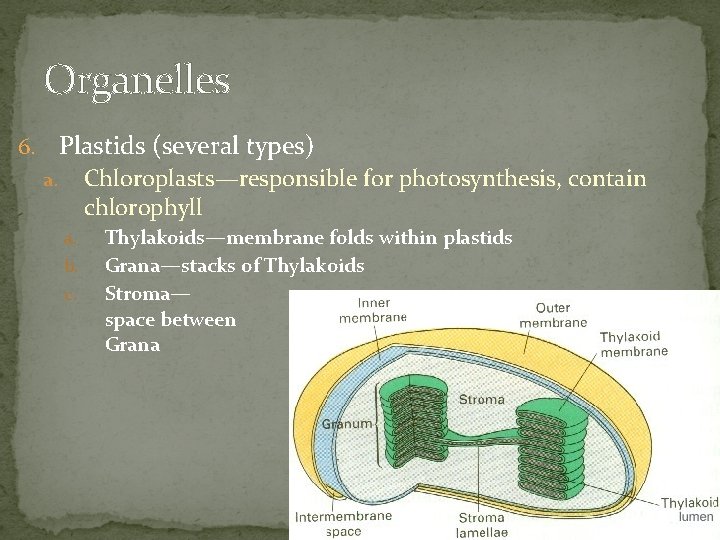
Organelles 6. Plastids (several types) Chloroplasts—responsible for photosynthesis, contain chlorophyll a. a. b. c. Thylakoids—membrane folds within plastids Grana—stacks of Thylakoids Stroma— space between Grana
Organelles 6. PLASTIDS (cont’d) b. Amyloplasts—stores starch, found in non-photosynthetic tissue c. Chromoplasts—contain colored lipids—(flowers and fruit) d. Leucoplasts—all other white plastids ( have various functions) 7. Ribosomes—contain RNA and make protiens 8. Endoplasmic Reticulum (ER)—allows for the movement of substances through the protoplasm a. Rough ER—has ribosomes b. Smooth ER—does not has ribosomes
Organelles 9. Dictyosomes (known as Golgi bodies in animals) � Flattened discs that look like stacks of pancakes � Works in conjunction with the E. R. � Functions: � Modify carbohydrates � Assemble complex polysaccharides � Modify proteins � Modify enzymes
Homework �Read Cellular Reproduction pp. 44 -51.
- Slides: 10