
Botany 251 Y Part II Powerpoint Animations for
Botany 251 Y Part II Powerpoint Animations for the Photosynthesis lectures Directions: Play the Powerpoint show, and click enter to move to the next step in the animation, or the next slide.
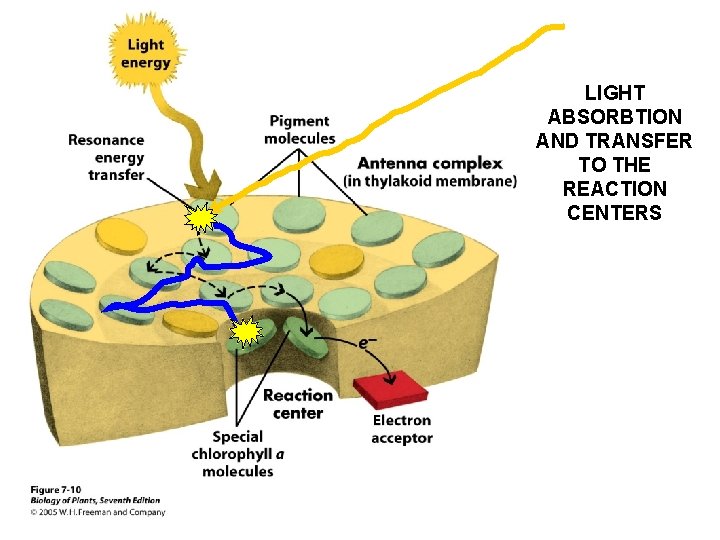
LIGHT ABSORBTION AND TRANSFER TO THE REACTION CENTERS
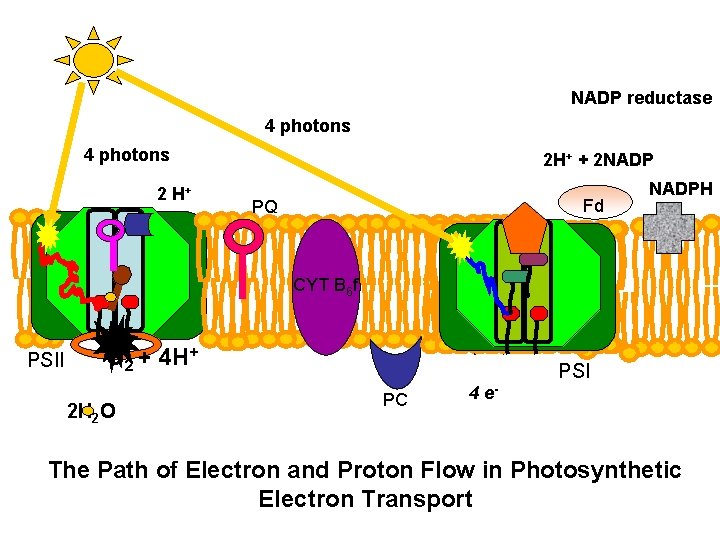
NADP reductase 4 photons 2 H+ 2 H+ + 2 NADP Fd PQ NADPH CYT B 6 f PSII O 2 + 4 H+ 2 H 2 O PSI PC 4 e- The Path of Electron and Proton Flow in Photosynthetic Electron Transport
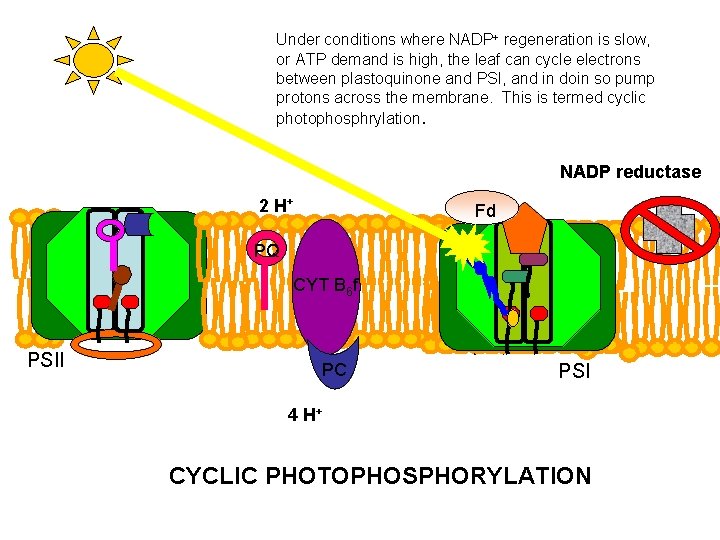
Under conditions where NADP+ regeneration is slow, or ATP demand is high, the leaf can cycle electrons between plastoquinone and PSI, and in doin so pump protons across the membrane. This is termed cyclic photophosphrylation. NADP reductase 2 H+ Fd PQ CYT B 6 f PSII PC PSI 4 H+ CYCLIC PHOTOPHOSPHORYLATION
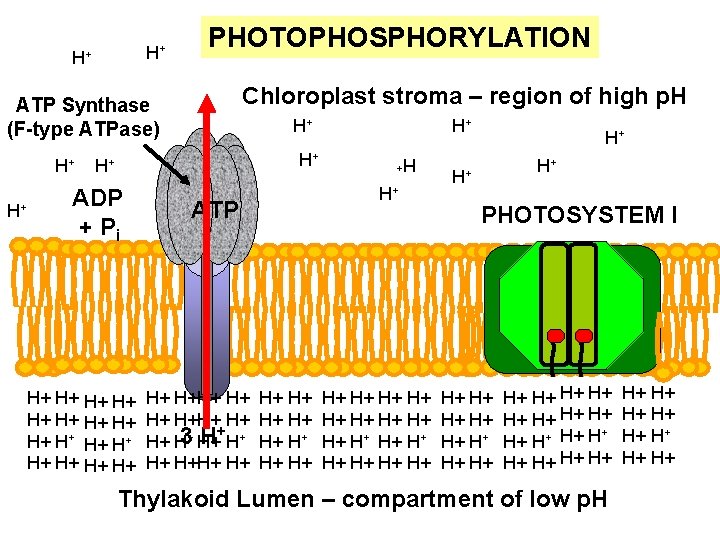
PHOTOPHOSPHORYLATION Chloroplast stroma – region of high p. H ATP Synthase (F-type ATPase) H+ H+ H+ ADP + Pi H+ H+ H+ H+ H+ ATP H+ H+H+ H+ H 3+ H+ H+ H+ H+ H+ H+ H+ H+ H+ PHOTOSYSTEM I H+ H+ H+ H+ + H+ H+ Thylakoid Lumen – compartment of low p. H H+ H+
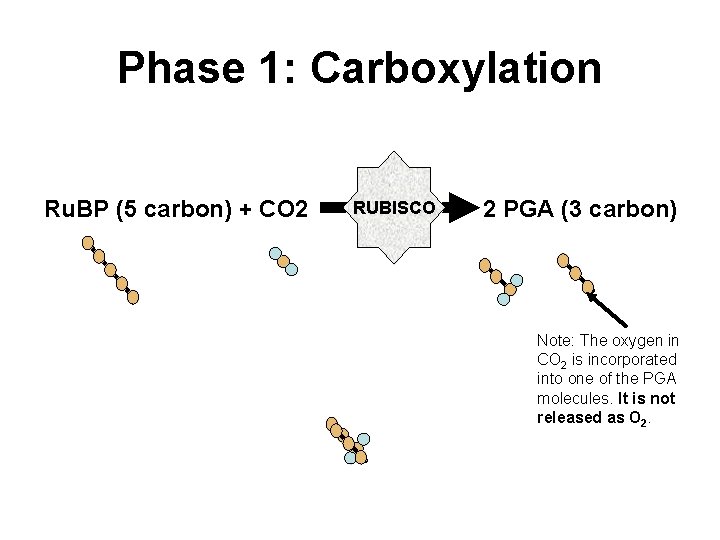
Phase 1: Carboxylation Ru. BP (5 carbon) + CO 2 RUBISCO 2 PGA (3 carbon) Note: The oxygen in CO 2 is incorporated into one of the PGA molecules. It is not released as O 2.
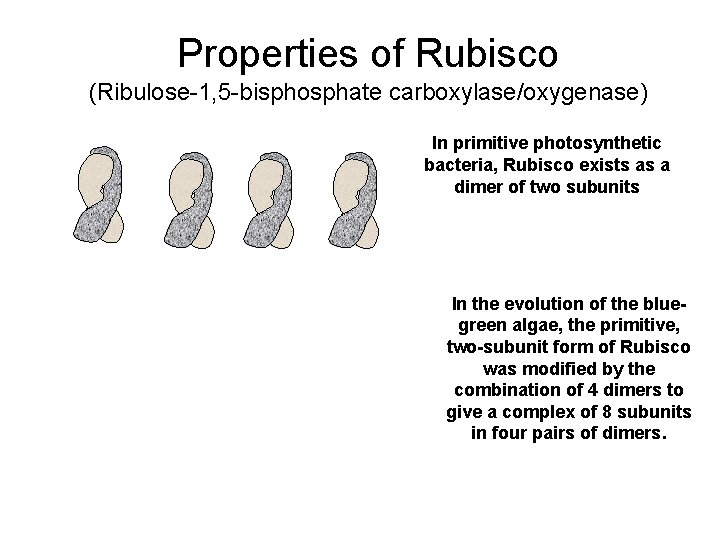
Properties of Rubisco (Ribulose-1, 5 -bisphosphate carboxylase/oxygenase) In primitive photosynthetic bacteria, Rubisco exists as a dimer of two subunits In the evolution of the bluegreen algae, the primitive, two-subunit form of Rubisco was modified by the combination of 4 dimers to give a complex of 8 subunits in four pairs of dimers.
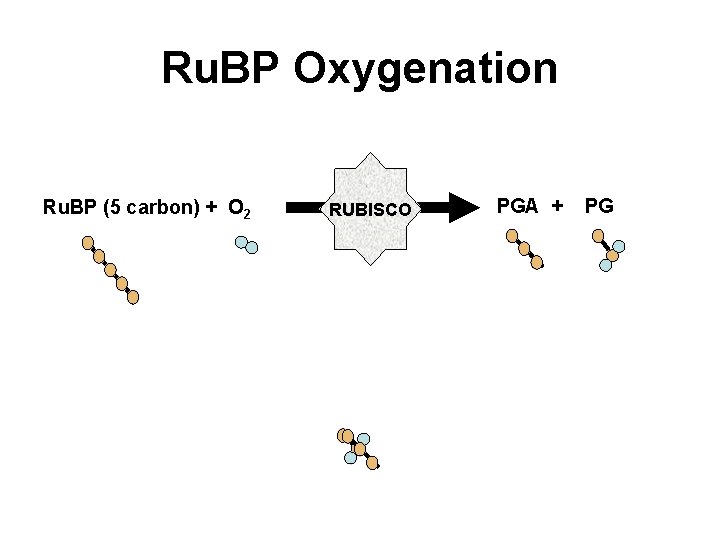
Ru. BP Oxygenation Ru. BP (5 carbon) + O 2 RUBISCO PGA + PG
- Slides: 8