
BOT 3015 L Biology of Flowering Plants Reproduction

BOT 3015 L Biology of Flowering Plants: Reproduction Flowers and Pollination Presentation created by Danielle Sherdan All photos from Raven et al. Biology of Plants except when otherwise noted
Today • Introducing angiosperms, flower structure and function • Pollination • Evolutionary trends in floral structure • Inflorescences • Monocots and dicots
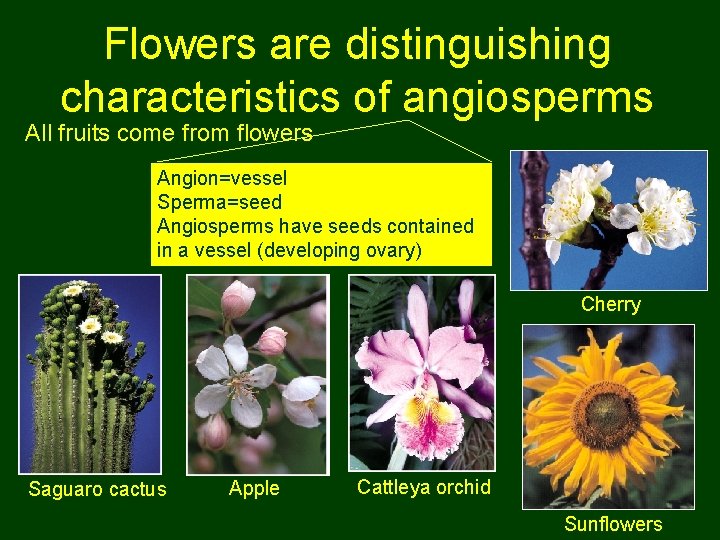
Flowers are distinguishing characteristics of angiosperms All fruits come from flowers Angion=vessel Sperma=seed Angiosperms have seeds contained in a vessel (developing ovary) Cherry Saguaro cactus Apple Cattleya orchid Sunflowers
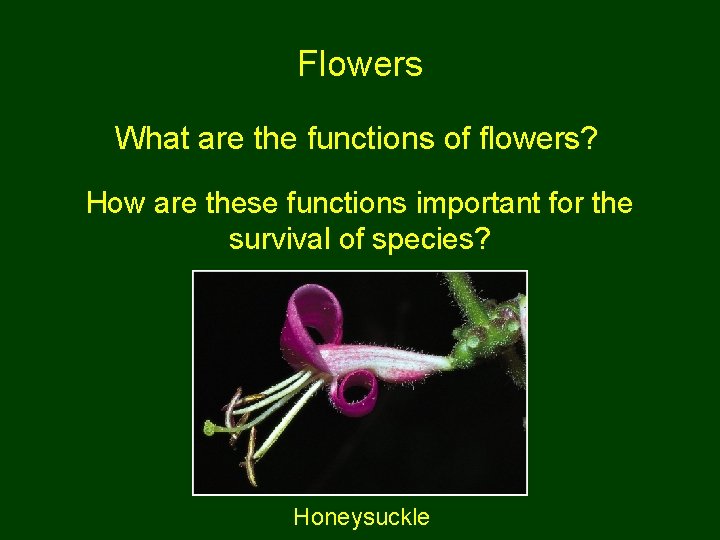
Flowers What are the functions of flowers? How are these functions important for the survival of species? Honeysuckle
Alternation of Generations generalized plant life cycle In angiosperms, gametophytes are borne within the reproductive structures of the flower; thus flowers are important when discussing evolution of angiosperms
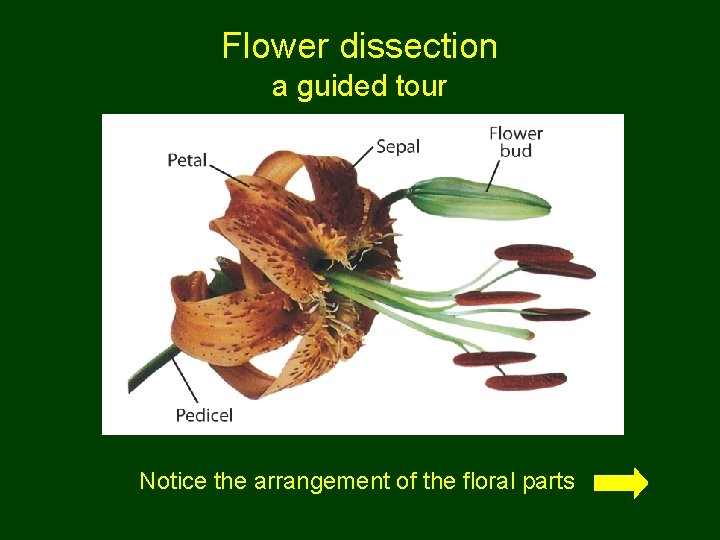
Flower dissection a guided tour Notice the arrangement of the floral parts
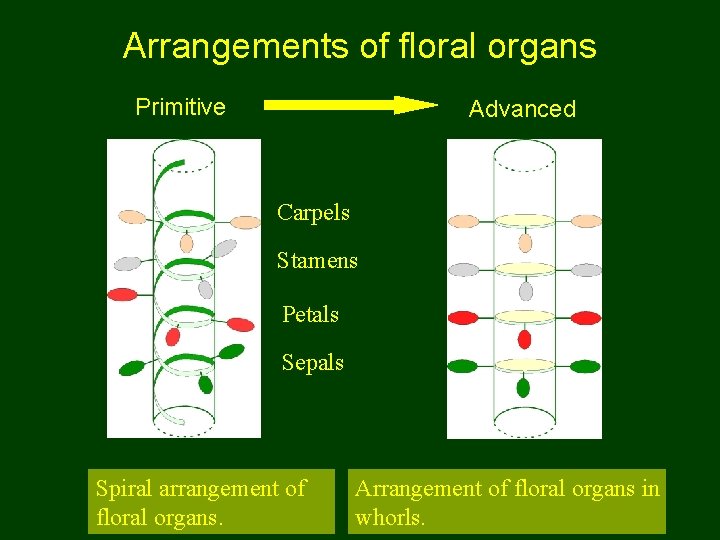
Arrangements of floral organs Primitive Advanced Carpels Stamens Petals Sepals Spiral arrangement of floral organs. Arrangement of floral organs in whorls.
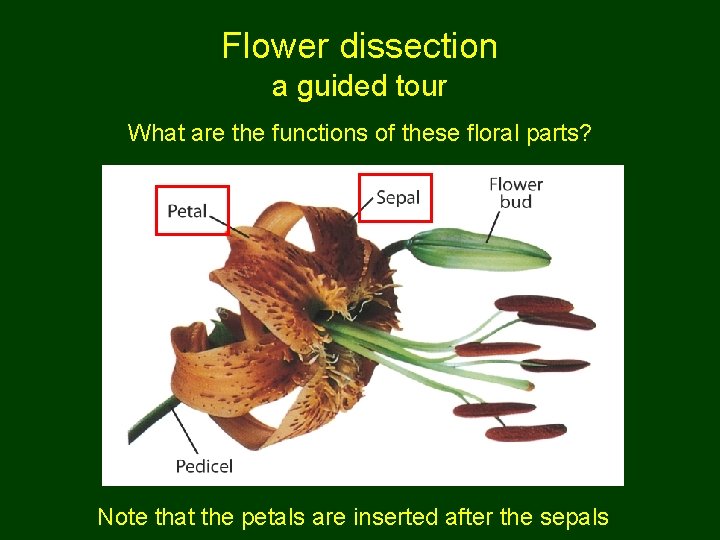
Flower dissection a guided tour What are the functions of these floral parts? Note that the petals are inserted after the sepals
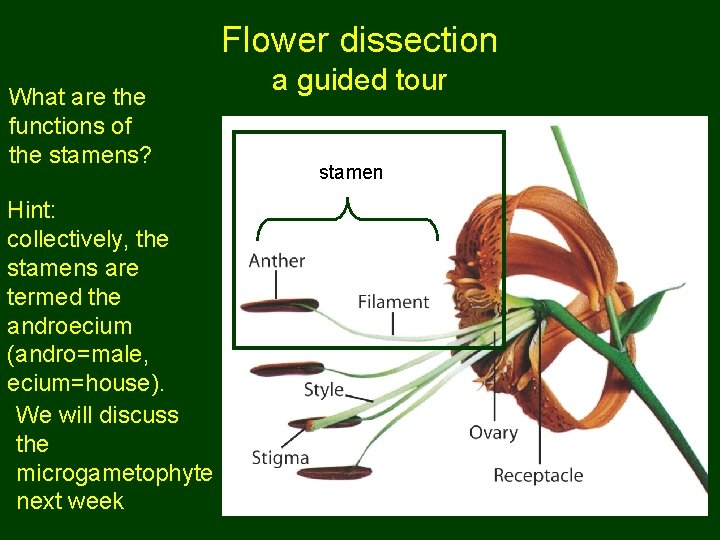
Flower dissection What are the functions of the stamens? Hint: collectively, the stamens are termed the androecium (andro=male, ecium=house). We will discuss the microgametophyte next week a guided tour stamen
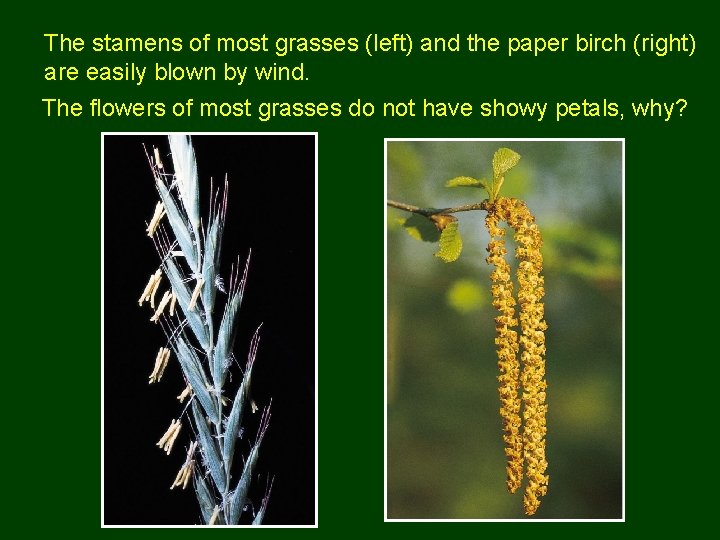
The stamens of most grasses (left) and the paper birch (right) are easily blown by wind. The flowers of most grasses do not have showy petals, why?
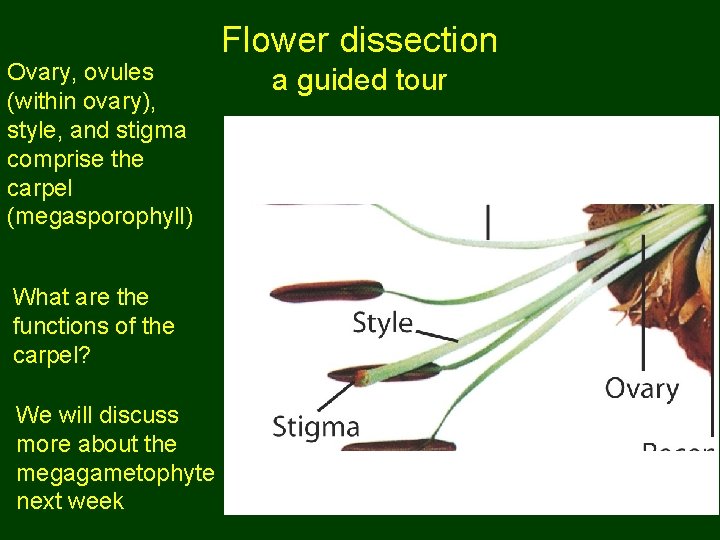
Ovary, ovules (within ovary), style, and stigma comprise the carpel (megasporophyll) What are the functions of the carpel? We will discuss more about the megagametophyte next week Flower dissection a guided tour stamen
Alternation of Generations generalized plant life cycle Requires pollination In angiosperms, gametophytes are born within the reproductive structures of the flower; thus flowers are important when discussing evolution of angiosperms
Today • Introducing angiosperms, flower structure and function • Pollination • Evolutionary trends in floral structure • Inflorescences • Monocots and dicots
Pollination In angiosperms, movement of the microgametophyte (pollen grain) to the megagametophyte in the ovule of the carpel How does a sessile organism, the microgametophyte in the case of angiosperms move? Vectors In the following discussion, notice the co-evolution of flowers and their biotic vectors
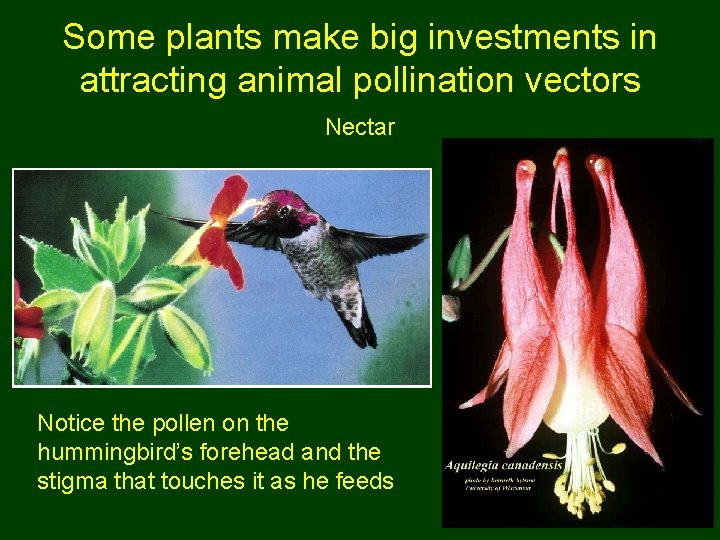
Some plants make big investments in attracting animal pollination vectors Nectar Notice the pollen on the hummingbird’s forehead and the stigma that touches it as he feeds
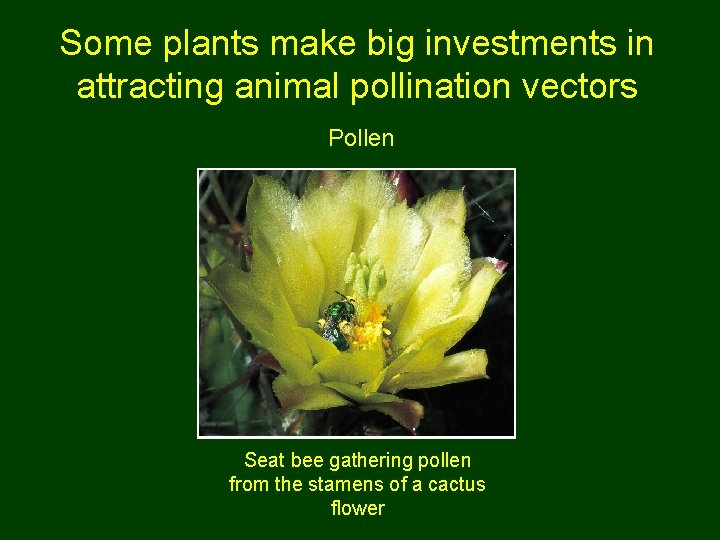
Some plants make big investments in attracting animal pollination vectors Pollen Seat bee gathering pollen from the stamens of a cactus flower
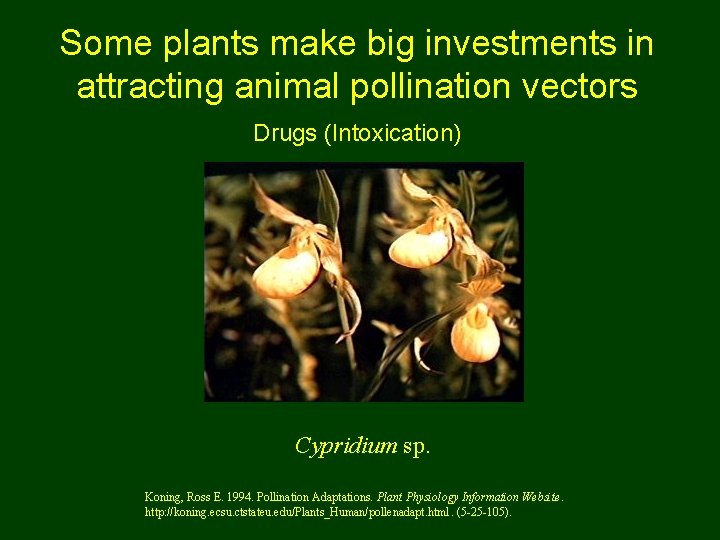
Some plants make big investments in attracting animal pollination vectors Drugs (Intoxication) Cypridium sp. Koning, Ross E. 1994. Pollination Adaptations. Plant Physiology Information Website. http: //koning. ecsu. ctstateu. edu/Plants_Human/pollenadapt. html. (5 -25 -105).
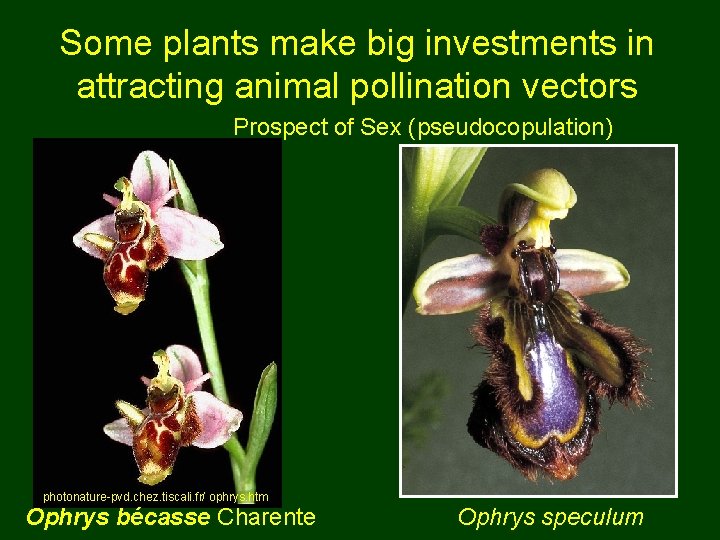
Some plants make big investments in attracting animal pollination vectors Prospect of Sex (pseudocopulation) photonature-pvd. chez. tiscali. fr/ ophrys. htm Ophrys bécasse Charente Ophrys speculum
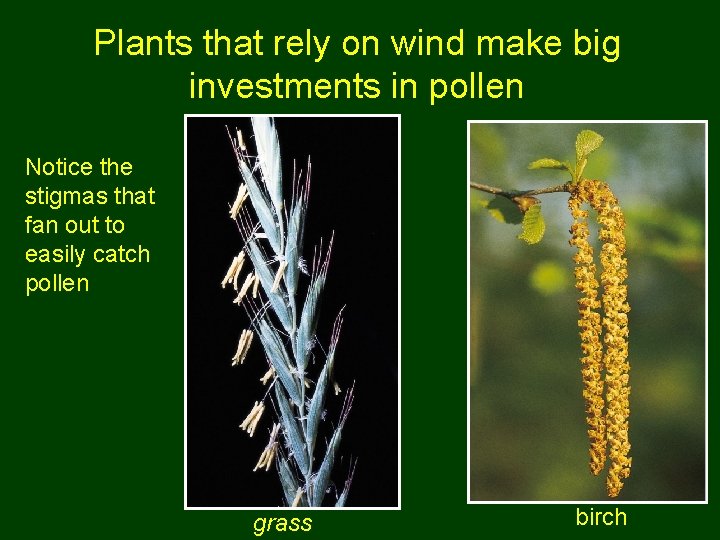
Plants that rely on wind make big investments in pollen Notice the stigmas that fan out to easily catch pollen grass birch
Pollination Biology movie
Today • Introducing angiosperms, flower structure and function • Pollination • Evolutionary trends in floral structure • Inflorescences • Monocots and dicots
Evolutionary Trends in Floral Structure 1. Reduction in number of parts
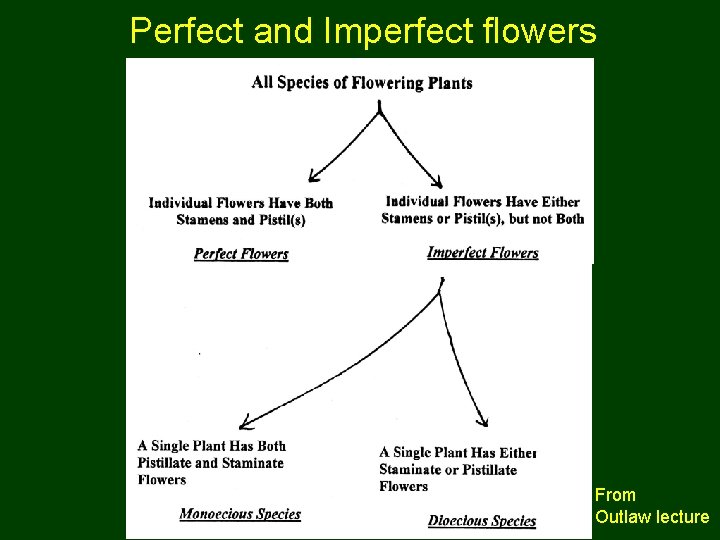
Perfect and Imperfect flowers From Outlaw lecture
Evolutionary Trends in Floral Structure 1. Reduction in number of parts 2. Cyclic arrangement (vs. spiral) 3. Fusion of organs
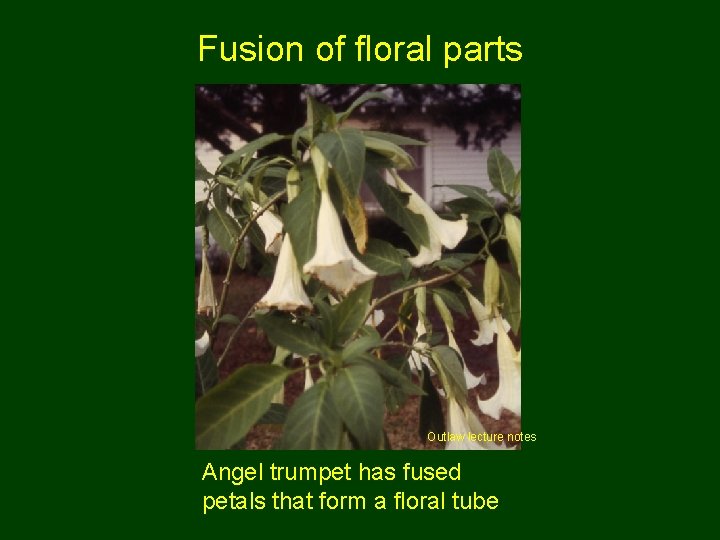
Fusion of floral parts Outlaw lecture notes Angel trumpet has fused petals that form a floral tube
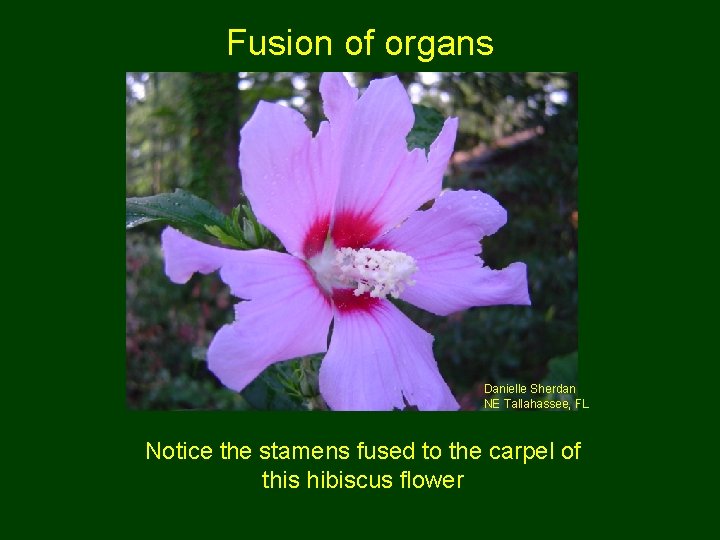
Fusion of organs Danielle Sherdan NE Tallahassee, FL Notice the stamens fused to the carpel of this hibiscus flower
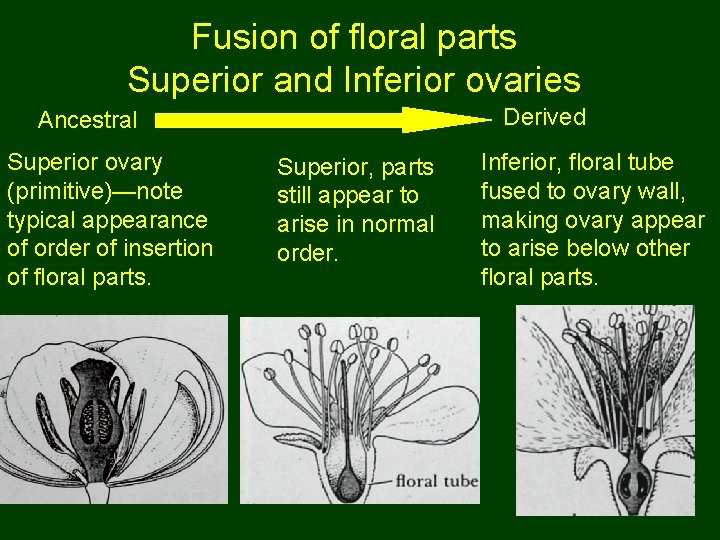
Fusion of floral parts Superior and Inferior ovaries Derived Ancestral Superior ovary (primitive)—note typical appearance of order of insertion of floral parts. Superior, parts still appear to arise in normal order. Inferior, floral tube fused to ovary wall, making ovary appear to arise below other floral parts.
Evolutionary Trends in Floral Structure 1. Reduction in number of parts 2. Cyclic arrangement (vs. spiral) 3. Fusion of organs 4. Away from marginal placentation
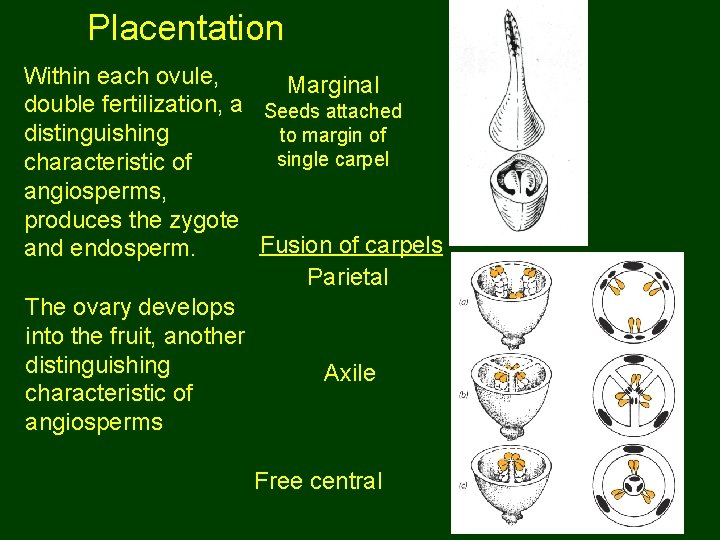
Placentation Within each ovule, Marginal double fertilization, a Seeds attached Primitive distinguishing to margin of single carpel characteristic of angiosperms, produces the zygote Fusion of carpels and endosperm. Parietal The ovary develops into the fruit, another distinguishing Axile characteristic Advanced of angiosperms Free central
Evolutionary Trends in Floral Structure 1. Reduction in number of parts 2. Cyclic arrangement (vs. spiral) 3. Fusion of organs 4. Away from marginal placentation 5. Away from regularity e. g. toward bilateral symmetry over radial symmetry
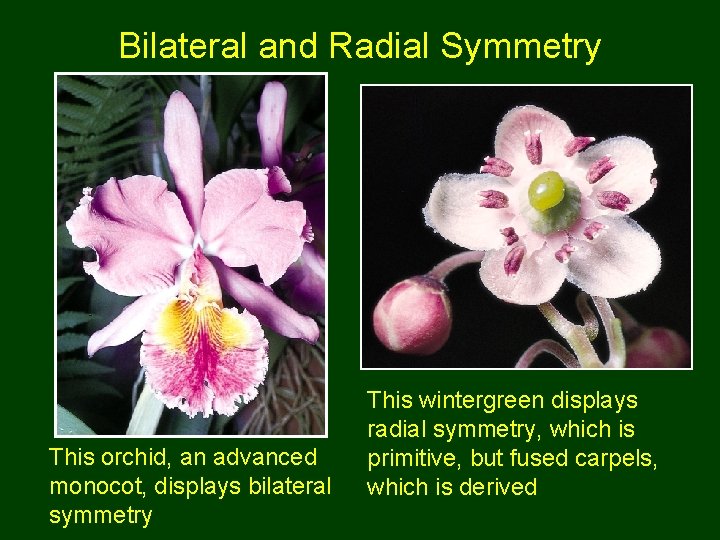
Bilateral and Radial Symmetry This orchid, an advanced monocot, displays bilateral symmetry This wintergreen displays radial symmetry, which is primitive, but fused carpels, which is derived
Today • Introducing angiosperms, flower structure and function • Pollination • Evolutionary trends in floral structure • Inflorescences • Monocots and dicots
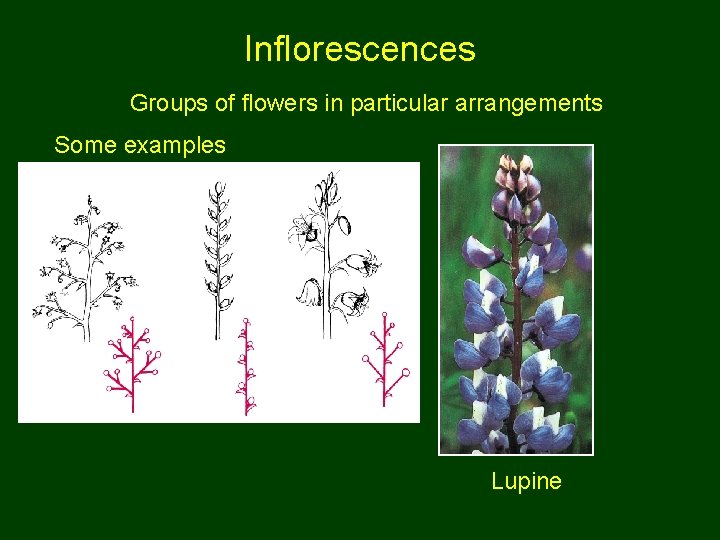
Inflorescences Groups of flowers in particular arrangements Some examples Lupine
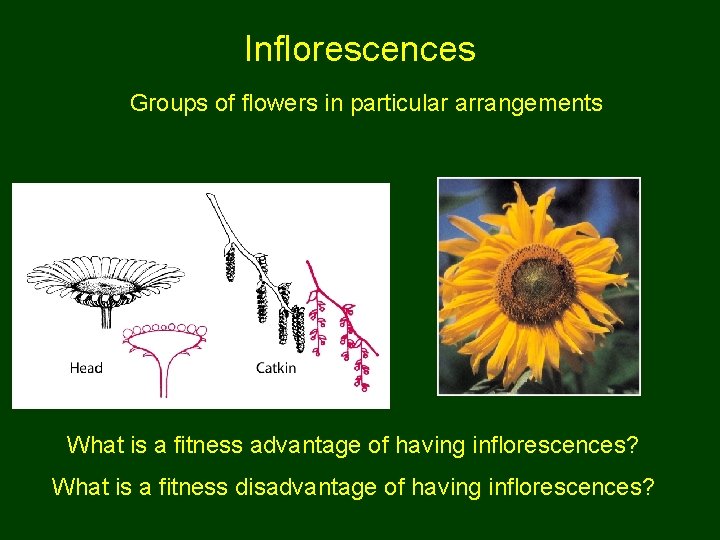
Inflorescences Groups of flowers in particular arrangements What is a fitness advantage of having inflorescences? What is a fitness disadvantage of having inflorescences?
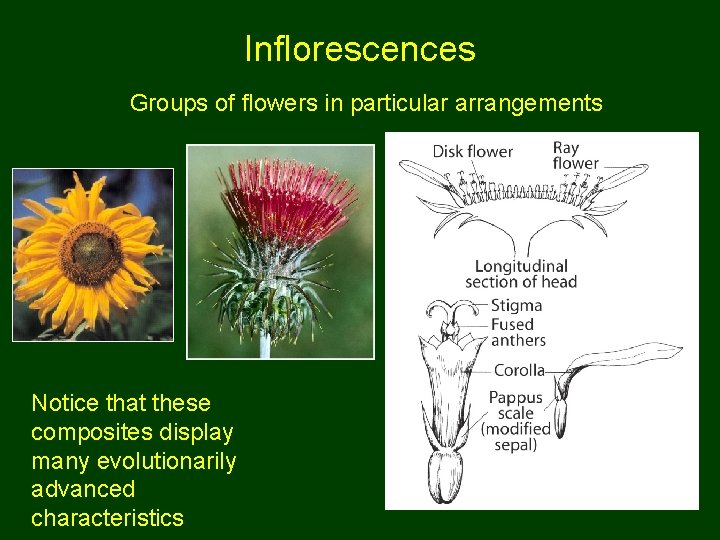
Inflorescences Groups of flowers in particular arrangements Notice that these composites display many evolutionarily advanced characteristics
Today • Introducing angiosperms, flower structure and function • Pollination • Evolutionary trends in floral structure • Inflorescences • Monocots and dicots
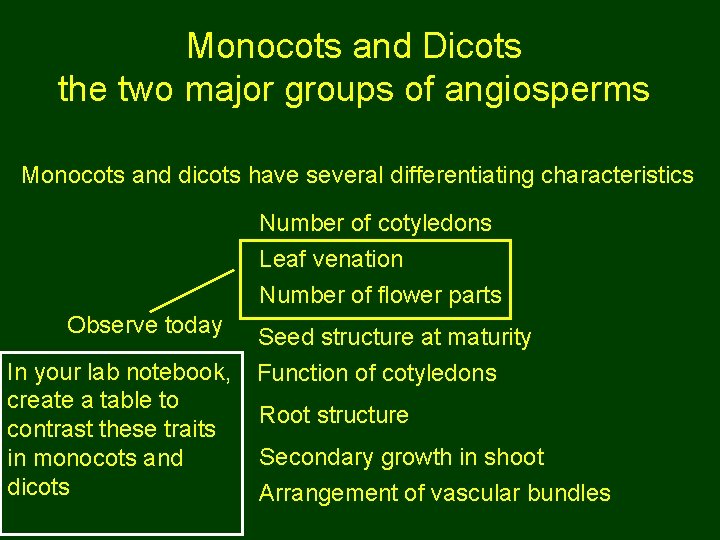
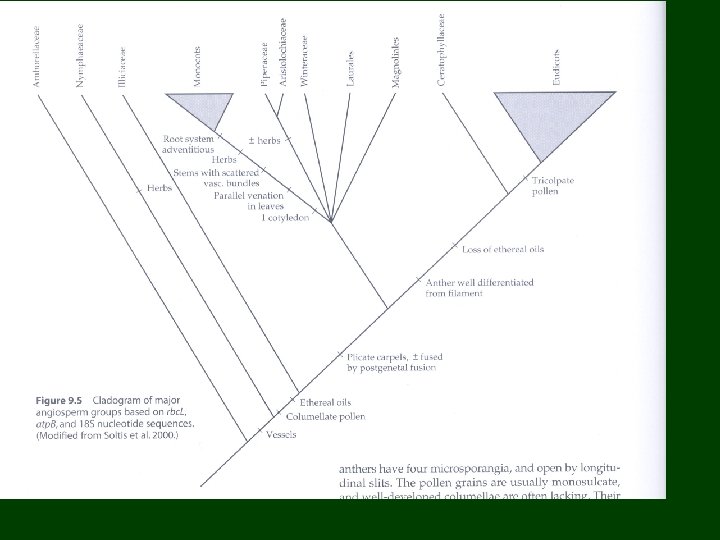
Monocots and Dicots the two major groups of angiosperms Monocots and dicots have several differentiating characteristics Number of cotyledons Leaf venation Number of flower parts Observe today In your lab notebook, create a table to contrast these traits in monocots and dicots Seed structure at maturity Function of cotyledons Root structure Secondary growth in shoot Arrangement of vascular bundles
- Slides: 38