
Boston University Daniel Taylor R Terry Black Nima
Boston University Daniel Taylor R. Terry Black Nima Badizadegan Pantelis Thomadis
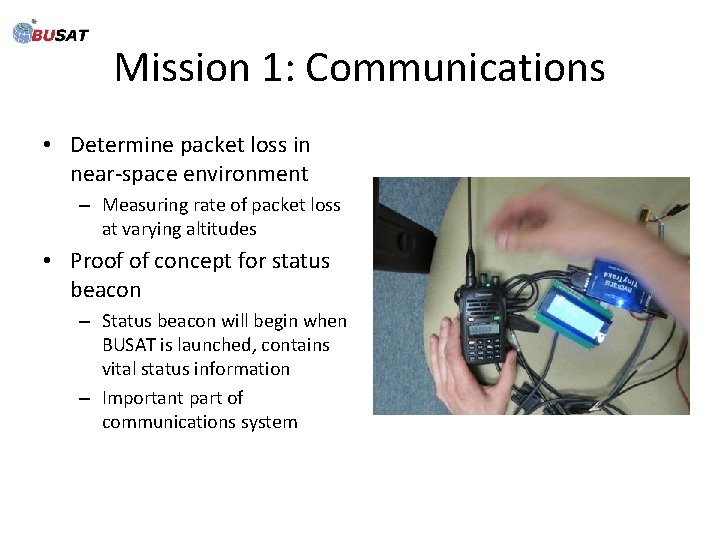
Mission 1: Communications • Determine packet loss in near-space environment – Measuring rate of packet loss at varying altitudes • Proof of concept for status beacon – Status beacon will begin when BUSAT is launched, contains vital status information – Important part of communications system
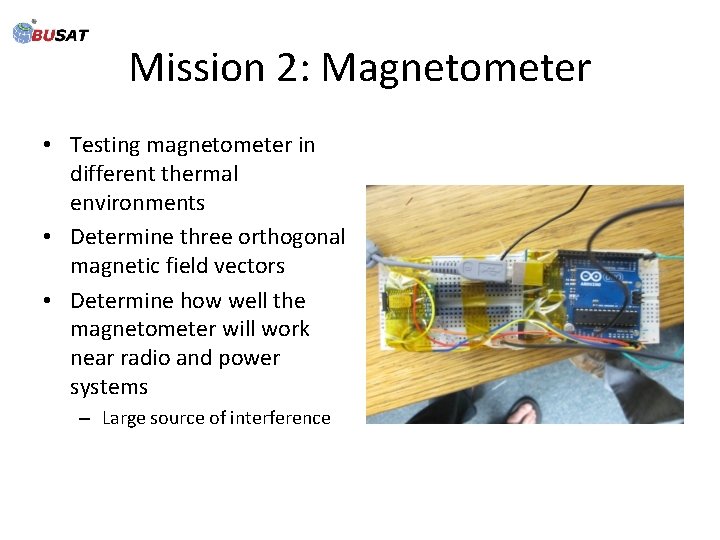
Mission 2: Magnetometer • Testing magnetometer in different thermal environments • Determine three orthogonal magnetic field vectors • Determine how well the magnetometer will work near radio and power systems – Large source of interference
SHOT II / UN-7 Connection • Communications system test – Packet loss – Near space environment – Proof of concept for beacon • Magnetometer – Thermal testing – Stored data can be used for calibration in the future – Same setup as on BUSAT
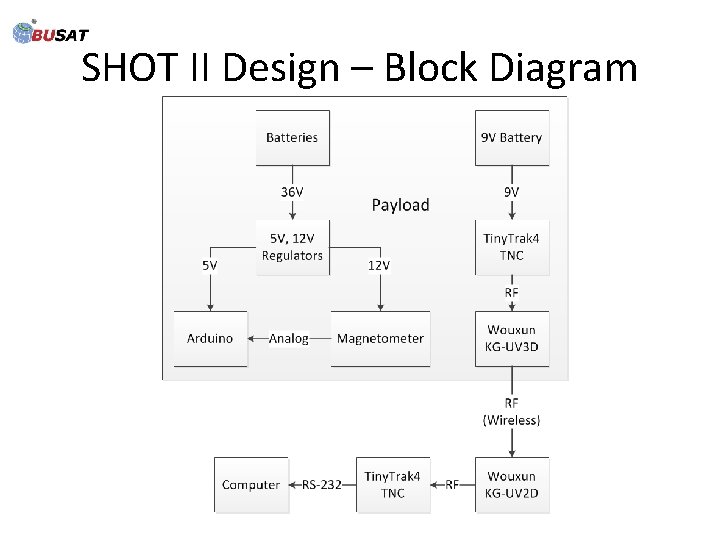
SHOT II Design – Block Diagram
SHOT II Design – Software • No software needed for radio – Beacon set up automatically • Microcontroller software: – Read data from Magnetometer every 42 seconds – Data stored in EEPROM (512 bytes total) – 113 data points per axis
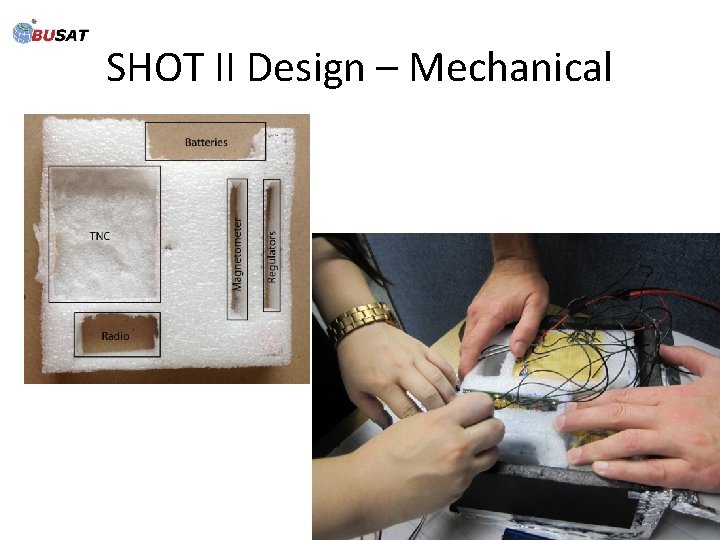
SHOT II Design – Mechanical
SHOT II Test Procedure • Chase balloon around with handheld Yagi antenna – Receive and record any packets received from the beacon, can be checked for error rate • Magnetometer records data automatically – One sample every 62 sec – EEPROM can be read when the payload is recovered
Expected Data • Magnetometer: 113 data points for each axis – Data comparable to IGRF data – Should indicate that magnetometer correctly reads magnetic field (with error) over large temperature range • Communications: packet loss data – Able to decode and read packets on the ground – Low packet loss (75% received)
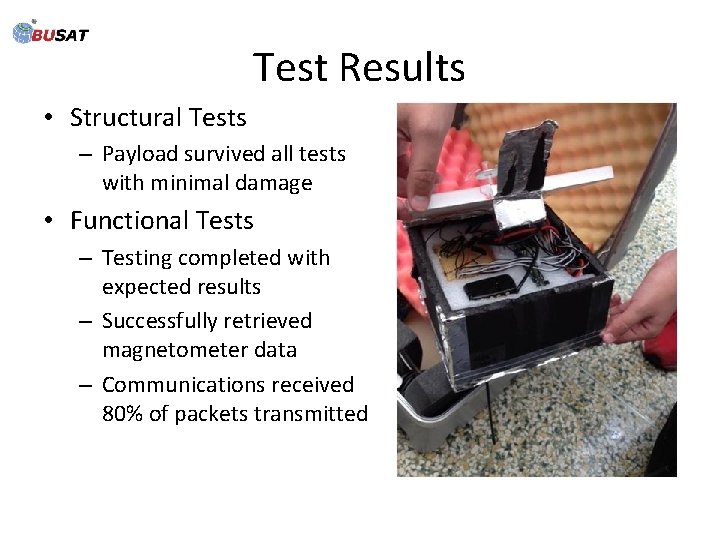
Test Results • Structural Tests – Payload survived all tests with minimal damage • Functional Tests – Testing completed with expected results – Successfully retrieved magnetometer data – Communications received 80% of packets transmitted
- Slides: 10