
Boron film deposition by electron beam technique Giuseppe
Boron film deposition by electron beam technique Giuseppe Celentano, Fabio Fabbri, Angelo Vannozzi Superconductivity Laboratory – ENEA, Frascati Research Centre Frascati, December 3 rd 2013 Outline - Intro: why B films - B film by e-beam deposition technique; - GEM detector; - Conclusions
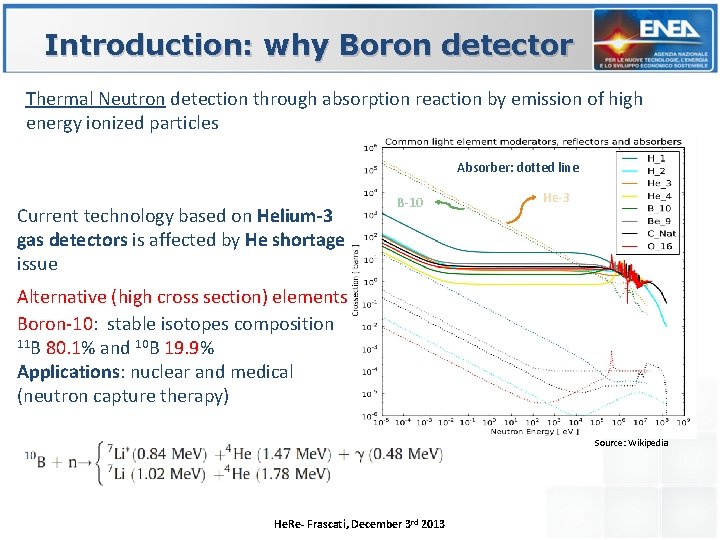
Introduction: why Boron detector Thermal Neutron detection through absorption reaction by emission of high energy ionized particles Absorber: dotted line Current technology based on Helium-3 gas detectors is affected by He shortage issue B-10 He-3 Alternative (high cross section) elements Boron-10: stable isotopes composition 11 B 80. 1% and 10 B 19. 9% Applications: nuclear and medical (neutron capture therapy) Source: Wikipedia He. Re- Frascati, December 3 rd 2013
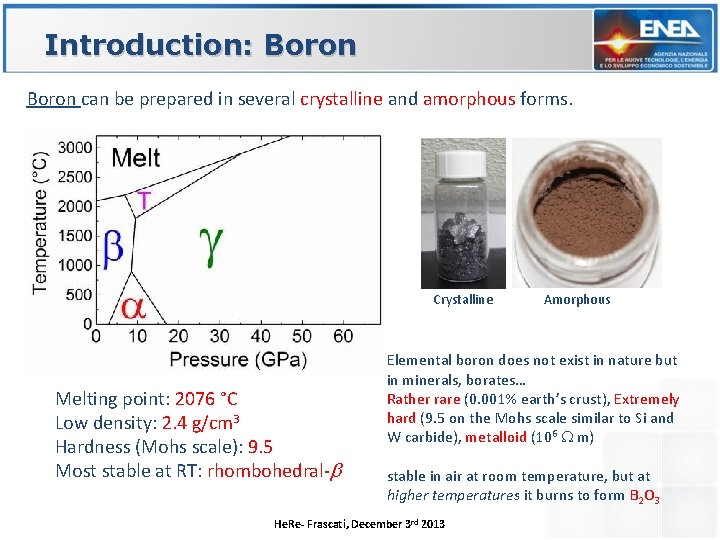
Introduction: Boron can be prepared in several crystalline and amorphous forms. Crystalline Melting point: 2076 °C Low density: 2. 4 g/cm 3 Hardness (Mohs scale): 9. 5 Most stable at RT: rhombohedral- Amorphous Elemental boron does not exist in nature but in minerals, borates… Rather rare (0. 001% earth’s crust), Extremely hard (9. 5 on the Mohs scale similar to Si and W carbide), metalloid (106 m) stable in air at room temperature, but at higher temperatures it burns to form B 2 O 3 He. Re- Frascati, December 3 rd 2013
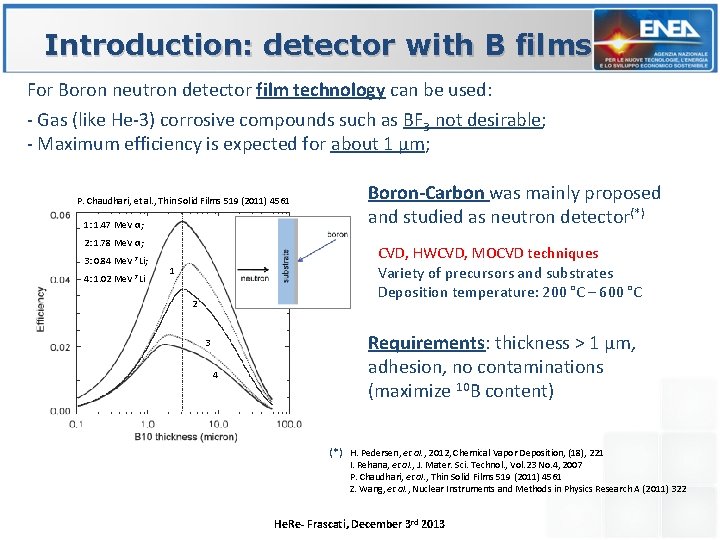
Introduction: detector with B films For Boron neutron detector film technology can be used: - Gas (like He-3) corrosive compounds such as BF 3 not desirable; - Maximum efficiency is expected for about 1 μm; P. Chaudhari, et al. , Thin Solid Films 519 (2011) 4561 1: 1. 47 Me. V α; 2: 1. 78 Me. V α; 3: 0. 84 Me. V 7 Li; 4: 1. 02 Me. V 7 Li Boron-Carbon was mainly proposed and studied as neutron detector(*) CVD, HWCVD, MOCVD techniques Variety of precursors and substrates Deposition temperature: 200 °C – 600 °C 1 2 3 4 Requirements: thickness > 1 μm, adhesion, no contaminations (maximize 10 B content) (*) H. Pedersen, et al. , 2012, Chemical Vapor Deposition, (18), 221 I. Rehana, et al. , J. Mater. Sci. Technol. , Vol. 23 No. 4, 2007 P. Chaudhari, et al. , Thin Solid Films 519 (2011) 4561 Z. Wang, et al. , Nuclear Instruments and Methods in Physics Research A (2011) 322 He. Re- Frascati, December 3 rd 2013
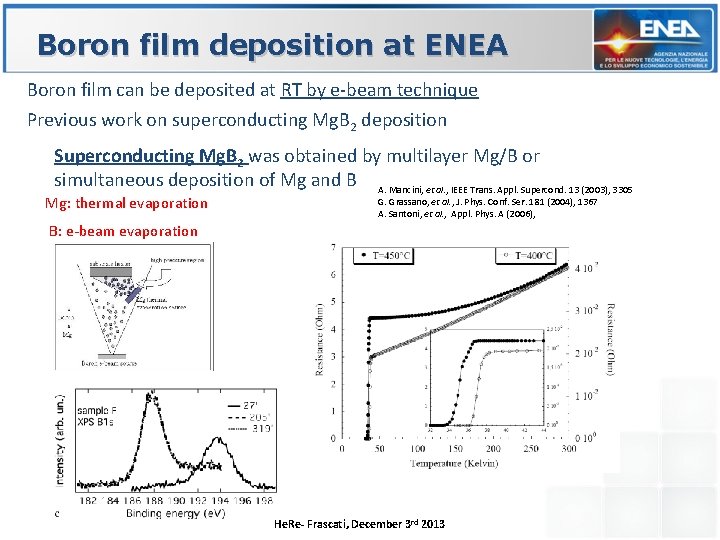
Boron film deposition at ENEA Boron film can be deposited at RT by e-beam technique Previous work on superconducting Mg. B 2 deposition Superconducting Mg. B 2 was obtained by multilayer Mg/B or simultaneous deposition of Mg and B A. Mancini, et al. , IEEE Trans. Appl. Supercond. 13 (2003), 3305 Mg: thermal evaporation G. Grassano, et al. , J. Phys. Conf. Ser. 181 (2004), 1367 A. Santoni, et al. , Appl. Phys. A (2006), B: e-beam evaporation He. Re- Frascati, December 3 rd 2013
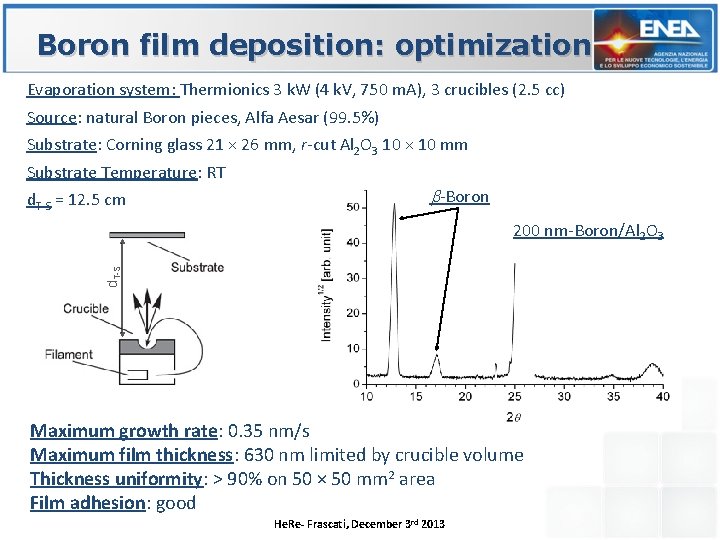
Boron film deposition: optimization Evaporation system: Thermionics 3 k. W (4 k. V, 750 m. A), 3 crucibles (2. 5 cc) Source: natural Boron pieces, Alfa Aesar (99. 5%) Substrate: Corning glass 21 × 26 mm, r-cut Al 2 O 3 10 × 10 mm Substrate Temperature: RT d. T-S = 12. 5 cm -Boron d. T-S 200 nm-Boron/Al 2 O 3 Maximum growth rate: 0. 35 nm/s Maximum film thickness: 630 nm limited by crucible volume Thickness uniformity: > 90% on 50 × 50 mm 2 area Film adhesion: good He. Re- Frascati, December 3 rd 2013
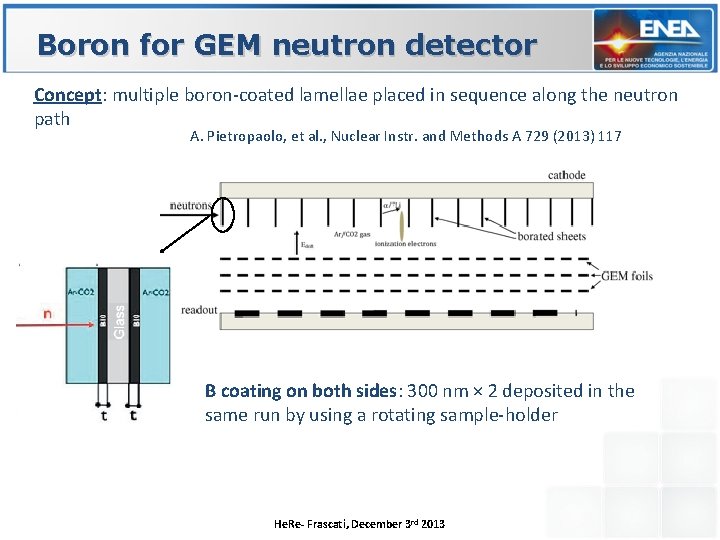
Boron for GEM neutron detector Concept: multiple boron-coated lamellae placed in sequence along the neutron path A. Pietropaolo, et al. , Nuclear Instr. and Methods A 729 (2013) 117 B coating on both sides: 300 nm × 2 deposited in the same run by using a rotating sample-holder He. Re- Frascati, December 3 rd 2013
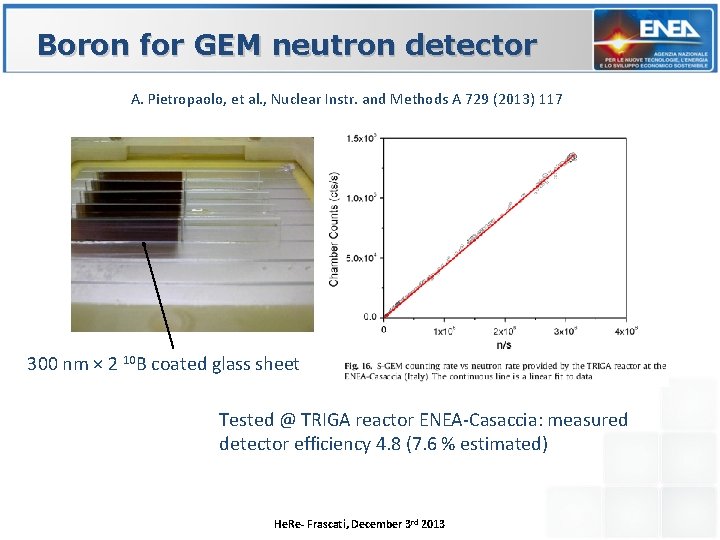
Boron for GEM neutron detector A. Pietropaolo, et al. , Nuclear Instr. and Methods A 729 (2013) 117 300 nm × 2 10 B coated glass sheet Tested @ TRIGA reactor ENEA-Casaccia: measured detector efficiency 4. 8 (7. 6 % estimated) He. Re- Frascati, December 3 rd 2013
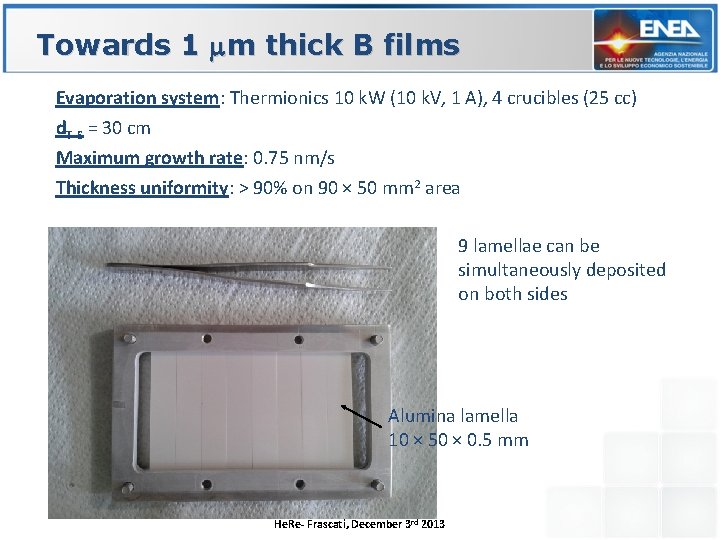
Towards 1 m thick B films Evaporation system: Thermionics 10 k. W (10 k. V, 1 A), 4 crucibles (25 cc) d. T-S = 30 cm Maximum growth rate: 0. 75 nm/s Thickness uniformity: > 90% on 90 × 50 mm 2 area 9 lamellae can be simultaneously deposited on both sides Alumina lamella 10 × 50 × 0. 5 mm He. Re- Frascati, December 3 rd 2013
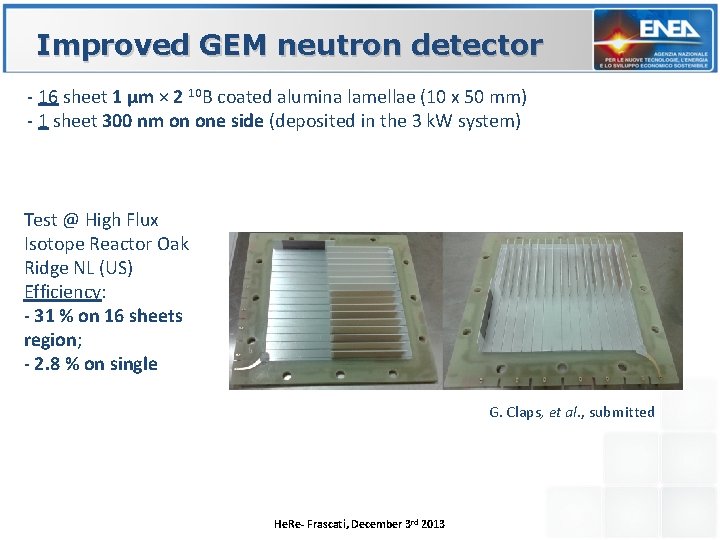
Improved GEM neutron detector - 16 sheet 1 μm × 2 10 B coated alumina lamellae (10 x 50 mm) - 1 sheet 300 nm on one side (deposited in the 3 k. W system) Test @ High Flux Isotope Reactor Oak Ridge NL (US) Efficiency: - 31 % on 16 sheets region; - 2. 8 % on single G. Claps, et al. , submitted He. Re- Frascati, December 3 rd 2013
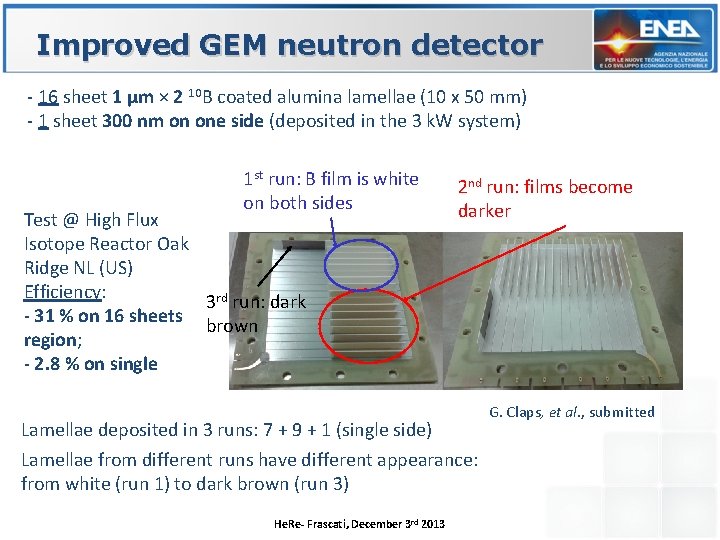
Improved GEM neutron detector - 16 sheet 1 μm × 2 10 B coated alumina lamellae (10 x 50 mm) - 1 sheet 300 nm on one side (deposited in the 3 k. W system) 1 st run: B film is white on both sides Test @ High Flux Isotope Reactor Oak Ridge NL (US) Efficiency: 3 rd run: dark - 31 % on 16 sheets brown region; - 2. 8 % on single 2 nd run: films become darker Lamellae deposited in 3 runs: 7 + 9 + 1 (single side) Lamellae from different runs have different appearance: from white (run 1) to dark brown (run 3) He. Re- Frascati, December 3 rd 2013 G. Claps, et al. , submitted
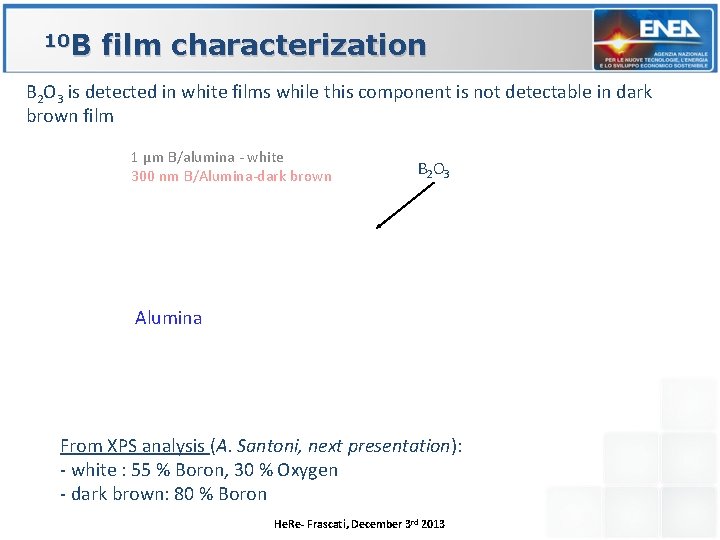
10 B film characterization B 2 O 3 is detected in white films while this component is not detectable in dark brown film 1 μm B/alumina - white 300 nm B/Alumina-dark brown B 2 O 3 Alumina From XPS analysis (A. Santoni, next presentation): - white : 55 % Boron, 30 % Oxygen - dark brown: 80 % Boron He. Re- Frascati, December 3 rd 2013
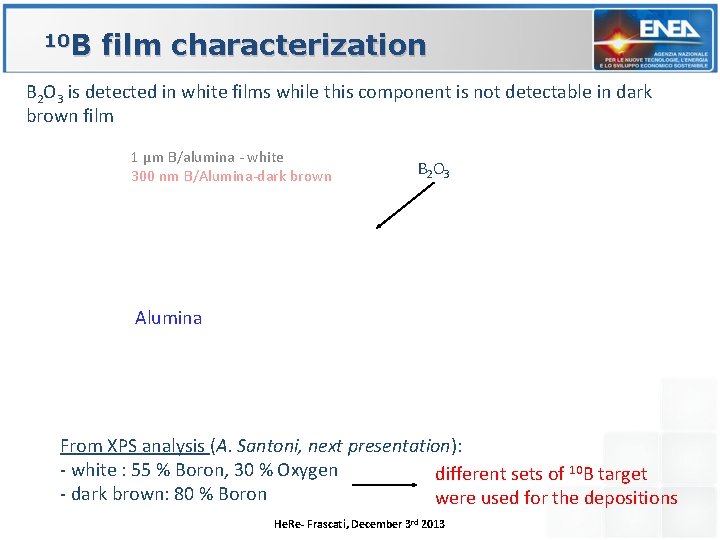
10 B film characterization B 2 O 3 is detected in white films while this component is not detectable in dark brown film 1 μm B/alumina - white 300 nm B/Alumina-dark brown B 2 O 3 Alumina From XPS analysis (A. Santoni, next presentation): - white : 55 % Boron, 30 % Oxygen different sets of 10 B target - dark brown: 80 % Boron were used for the depositions He. Re- Frascati, December 3 rd 2013
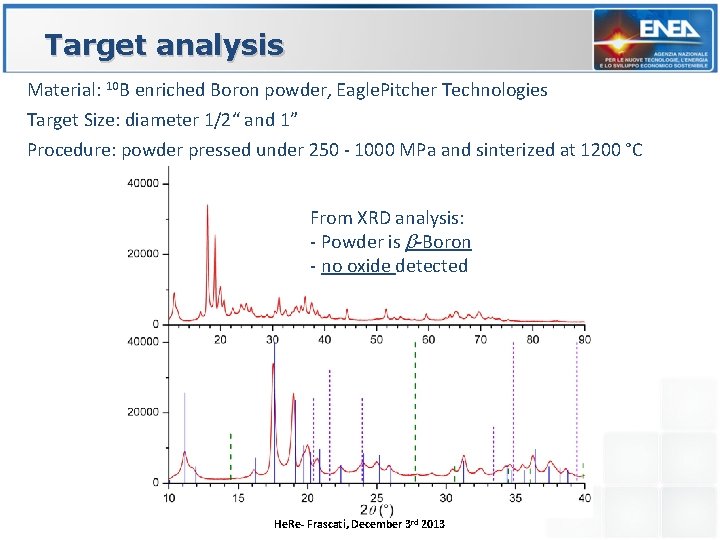
Target analysis Material: 10 B enriched Boron powder, Eagle. Pitcher Technologies Target Size: diameter 1/2“ and 1” Procedure: powder pressed under 250 - 1000 MPa and sinterized at 1200 °C From XRD analysis: - Powder is -Boron - no oxide detected He. Re- Frascati, December 3 rd 2013
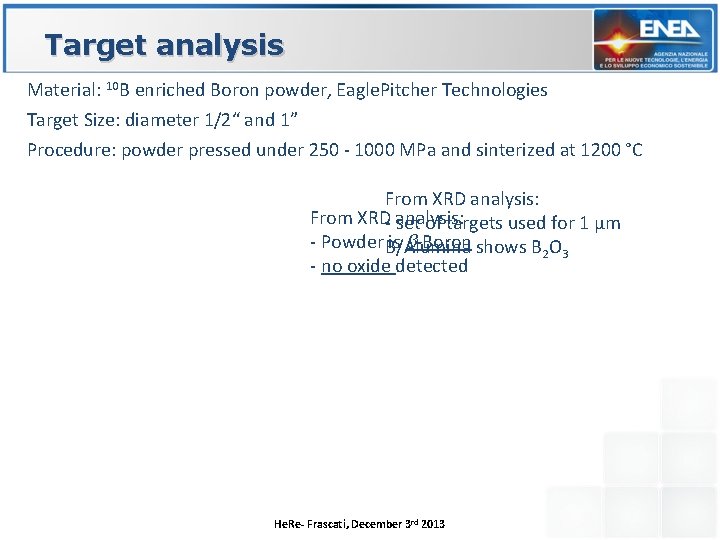
Target analysis Material: 10 B enriched Boron powder, Eagle. Pitcher Technologies Target Size: diameter 1/2“ and 1” Procedure: powder pressed under 250 - 1000 MPa and sinterized at 1200 °C From XRD analysis: From XRD- analysis: set of targets used for 1 μm - Powder B/Alumina is -Boron shows B 2 O 3 - no oxide detected He. Re- Frascati, December 3 rd 2013
Conclusions & Perspectives • B film suitable for GEM neutron detector have been deposited on technical substrates (glass, Alumina) by e-beam technique; • due to target contamination Boron content in the film was remarkably lower than expected; • as soon as target preparation will be optimized, neutron detection efficiency higher than 30 % (current detector) can be reasonably achieved (70 %? ) He. Re- Frascati, December 3 rd 2013
Conclusions & Perspectives • B film suitable for GEM neutron detector have been deposited on technical substrates (glass, Alumina) by e-beam technique; • due to target contamination Boron content in the film was remarkably lower than expected; • as soon as target preparation will be optimized, neutron detection efficiency higher than 30 % (current detector) can be reasonably achieved (70 %? ) Thank you for your attention Special thanks to A. Pietropaolo and F. Murtas: the whole activity is inspired by them He. Re- Frascati, December 3 rd 2013
- Slides: 17