
Borehole drilling and completion repository design Presenter Name
Borehole drilling and completion, repository design Presenter Name School of Drafting Regulations for Borehole Disposal of DSRS 2016 Vienna, Austria IAEA International Atomic Energy Agency

Outline/ Contents • Main components of the BDC design and their safety functions • Adapting the generic design to a specific site • Drilling and completing a disposal borehole IAEA 2
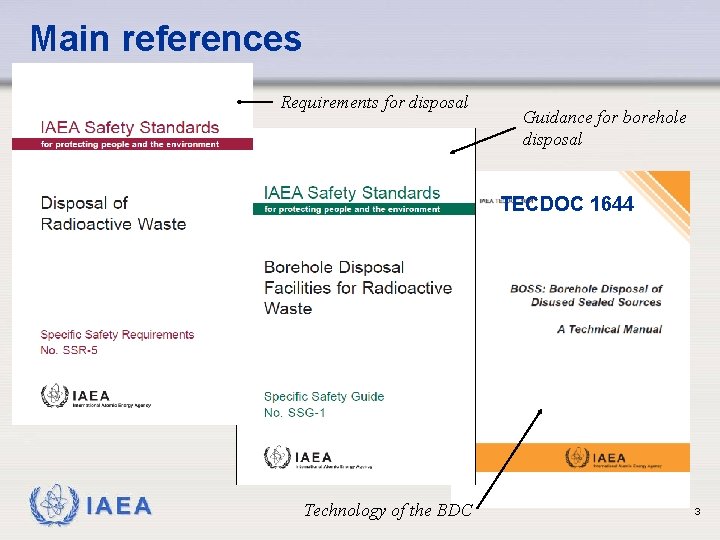
Main references Requirements for disposal Guidance for borehole disposal TECDOC 1644 IAEA Technology of the BDC 3

Main components of the BDC and their safety functions IAEA 4

Borehole Design 1 102 IAEA

Ground surface Casing removed over top two metres Backfill with native soil Closure zone, minimum 30 metres Anti-intrusion plate Concrete closure seal GEOSPHERE IAEA Disposal zone 1 m
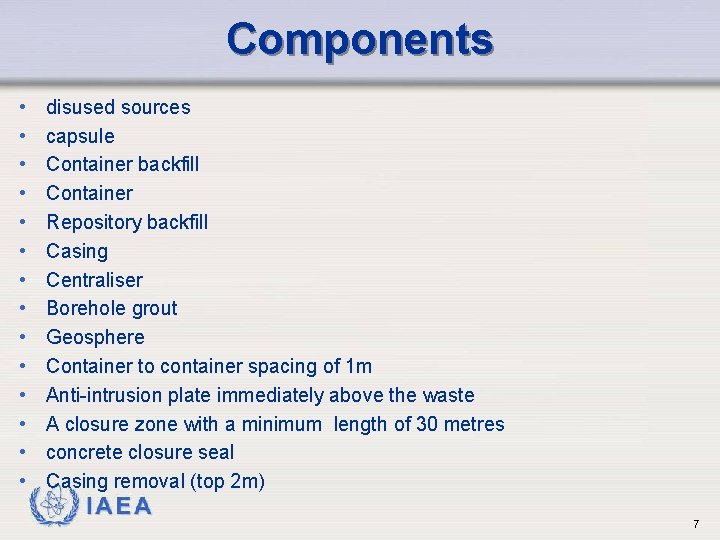
Components • • • • disused sources capsule Container backfill Container Repository backfill Casing Centraliser Borehole grout Geosphere Container to container spacing of 1 m Anti-intrusion plate immediately above the waste A closure zone with a minimum length of 30 metres concrete closure seal Casing removal (top 2 m) IAEA 7
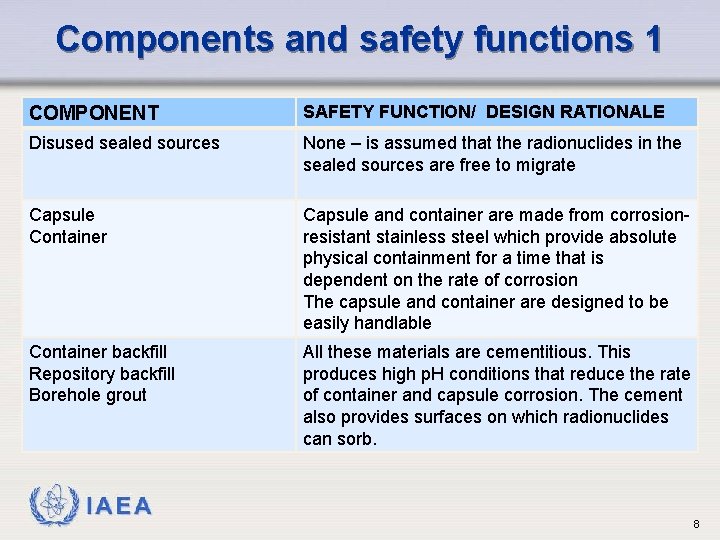
Components and safety functions 1 COMPONENT SAFETY FUNCTION/ DESIGN RATIONALE Disused sealed sources None – is assumed that the radionuclides in the sealed sources are free to migrate Capsule Container Capsule and container are made from corrosionresistant stainless steel which provide absolute physical containment for a time that is dependent on the rate of corrosion The capsule and container are designed to be easily handlable Container backfill Repository backfill Borehole grout All these materials are cementitious. This produces high p. H conditions that reduce the rate of container and capsule corrosion. The cement also provides surfaces on which radionuclides can sorb. IAEA 8

Components and safety functions 2 COMPONENT SAFETY FUNCTION/ DESIGN RATIONALE Casing Facilitates operation by supporting the borehole wall, excluding groundwater, providing a smooth surface to prevent snagging when emplacing waste packages It has no long-term safety function Casing centraliser Facilitates operation by ensuring that the borehole is close to vertical Container to container spacing Provides adequate concrete to provide p. H buffering; provides dilution by spreading out any contaminant plume Anti-intrusion plate Prevents inadvertent drilling into the disposal zone Closure zone minimum 30 m Provides isolation of the waste by placing it out of reach of normal deep excavation activities eg roads, foundations of buildings IAEA 9
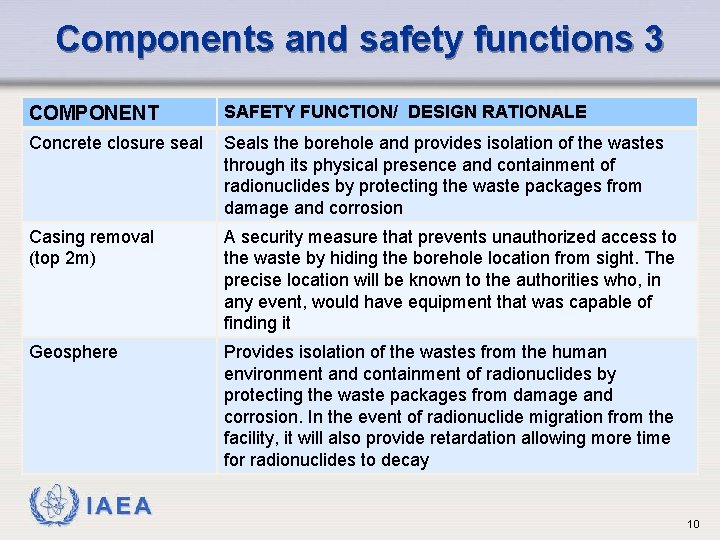
Components and safety functions 3 COMPONENT SAFETY FUNCTION/ DESIGN RATIONALE Concrete closure seal Seals the borehole and provides isolation of the wastes through its physical presence and containment of radionuclides by protecting the waste packages from damage and corrosion Casing removal (top 2 m) A security measure that prevents unauthorized access to the waste by hiding the borehole location from sight. The precise location will be known to the authorities who, in any event, would have equipment that was capable of finding it Geosphere Provides isolation of the wastes from the human environment and containment of radionuclides by protecting the waste packages from damage and corrosion. In the event of radionuclide migration from the facility, it will also provide retardation allowing more time for radionuclides to decay IAEA 10
Influences on the site-specific design IAEA 11
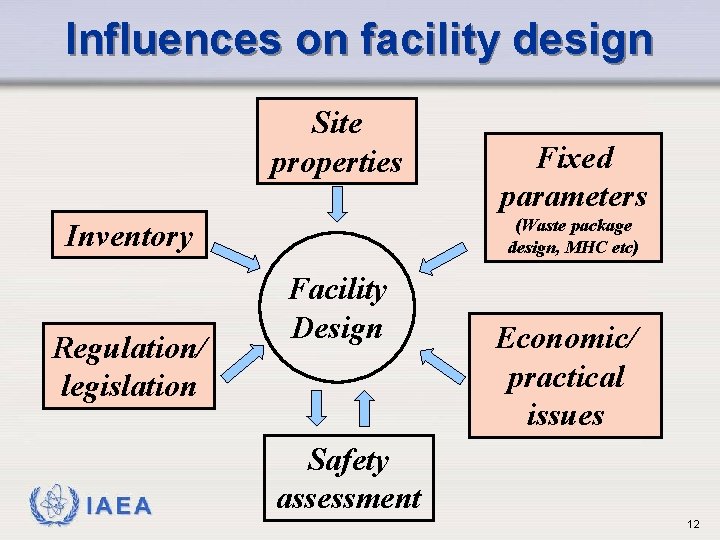
Influences on facility design Site properties (Waste package design, MHC etc) Inventory Regulation/ legislation IAEA Fixed parameters Facility Design Economic/ practical issues Safety assessment 12
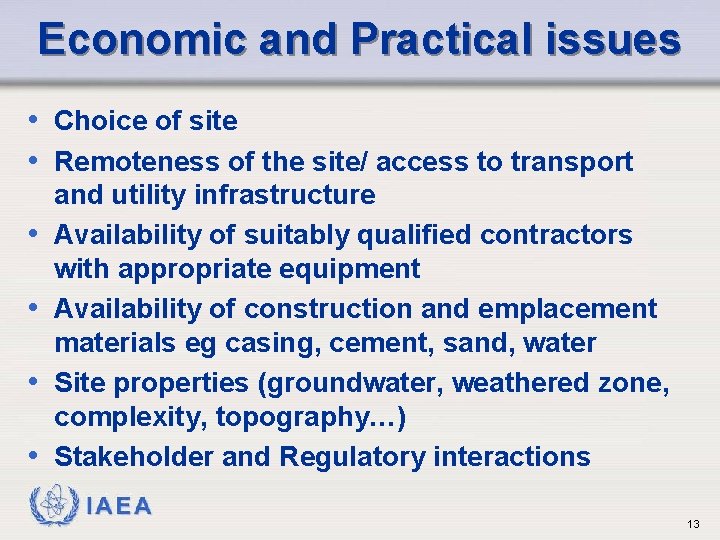
Economic and Practical issues • Choice of site • Remoteness of the site/ access to transport • • and utility infrastructure Availability of suitably qualified contractors with appropriate equipment Availability of construction and emplacement materials eg casing, cement, sand, water Site properties (groundwater, weathered zone, complexity, topography…) Stakeholder and Regulatory interactions IAEA 13
Regulation/ legislation • Determines the safety standards to be met • May also prescribe other issues eg • Format of the safety case or safety assessment • Who is permitted to design the facility • The need (or not) for retrievability • Use of the Model Regulations will anticipate many of the questions to be answered • Licensee will need to have a very good understanding of how regulations will impact on what is planned IAEA 14
Inventory • Compared to (say) disposal of NPP wastes, inventory characterization of disused sealed sources is straightforward • Key parameters to be determined for each source: • Identification of radionuclide/ nuclear reaction/ emissions • Activity at specified date • Physical size of source to be disposed • Current storage and handling arrangements / means of retrieval from store / weight • Means of removal of bare source from operating shield • Need for shielding during conditioning/ containerization • HENCE relevant to design: • Number of waste packages -> number of boreholes • Need (or not) for MHC and remote handling, lifting equipment etc IAEA 15
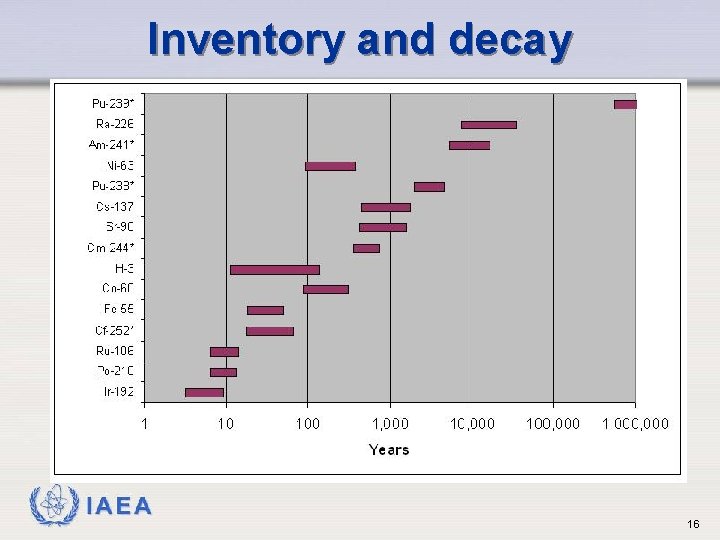
Inventory and decay IAEA 16
Important Site properties • Depth to water table • Existence of near-surface weathered rocks • Separation of near-surface and deep water bodies • Rate of surface erosion/ geomorphology • Properties of potential host geology • Structural • Geomechanical • Geochemical • Etc –see previous lecture IAEA 17
Adapting the generic design to a specific site IAEA 18
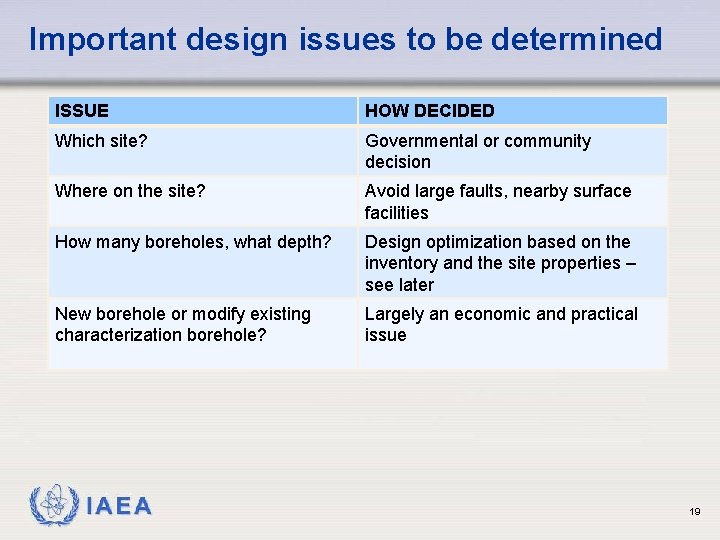
Important design issues to be determined ISSUE HOW DECIDED Which site? Governmental or community decision Where on the site? Avoid large faults, nearby surface facilities How many boreholes, what depth? Design optimization based on the inventory and the site properties – see later New borehole or modify existing characterization borehole? Largely an economic and practical issue IAEA 19
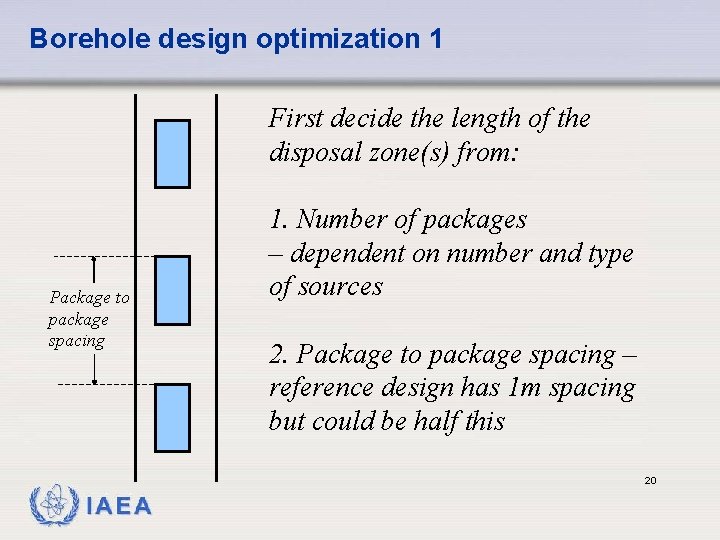
Borehole design optimization 1 First decide the length of the disposal zone(s) from: Package to package spacing 1. Number of packages – dependent on number and type of sources 2. Package to package spacing – reference design has 1 m spacing but could be half this 20 IAEA
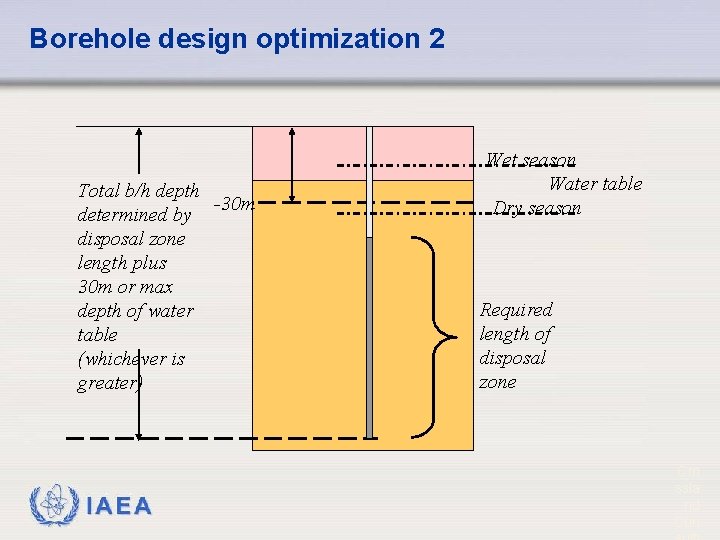
Borehole design optimization 2 Total b/h depth -30 m determined by disposal zone length plus 30 m or max depth of water table (whichever is greater) IAEA Wet season Water table Dry season Required length of disposal zone Cro ssla nd Con
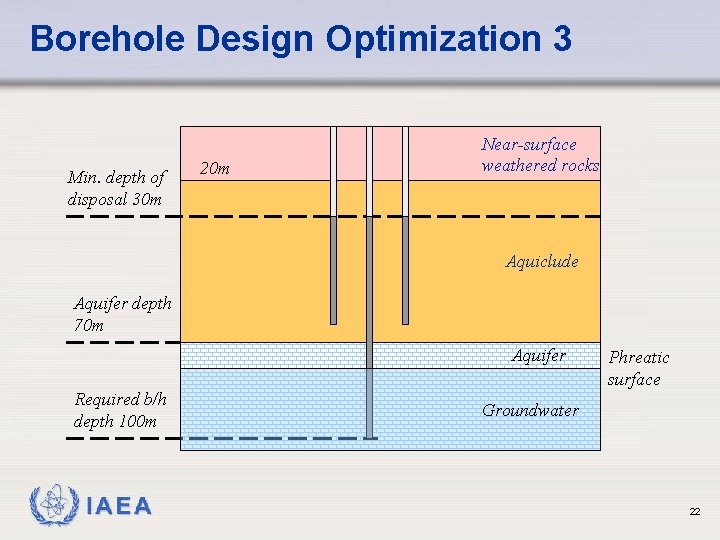
Borehole Design Optimization 3 Min. depth of disposal 30 m 20 m Near-surface weathered rocks Aquiclude Aquifer depth 70 m Aquifer Required b/h depth 100 m IAEA Phreatic surface Groundwater 22
Drilling and completing a disposal borehole IAEA 23
Drilling • BDC designed to use techniques that are widely available • Borehole diameter 0. 26 m minimum – is typical of boreholes used for groundwater abstraction • Would normally used rotary air percussion drill • Not necessary to core the disposal borehole but retain samples of chippings for every metre of borehole IAEA 24
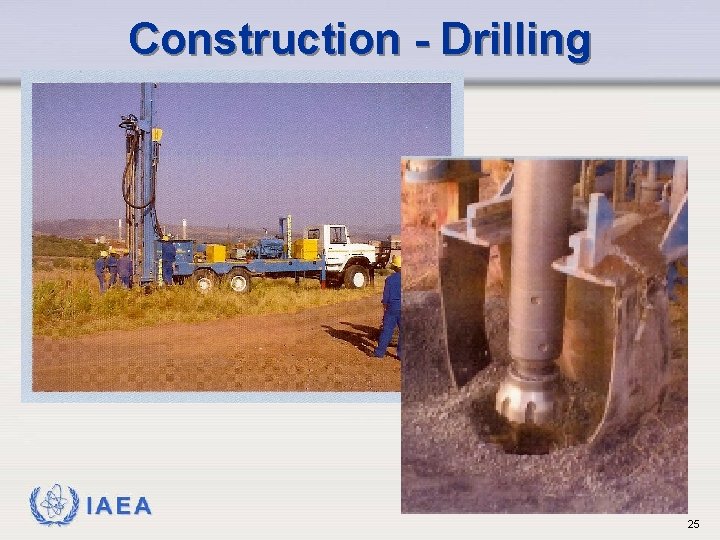
Construction - Drilling IAEA 25
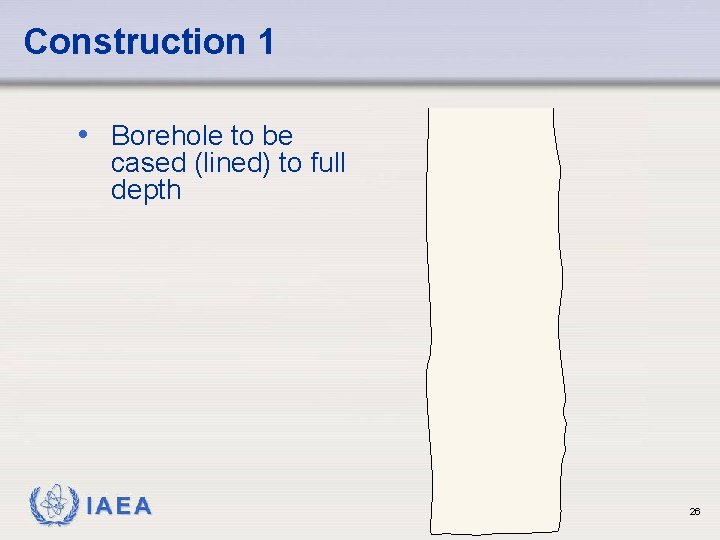
Construction 1 • Borehole to be cased (lined) to full depth IAEA 26
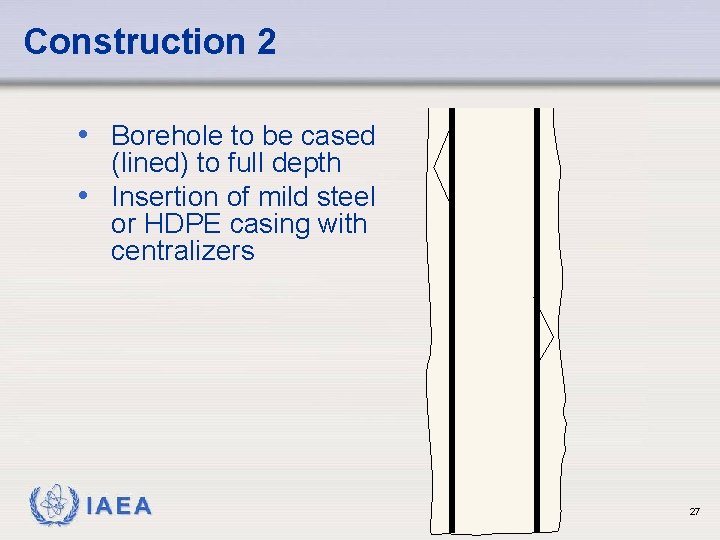
Construction 2 • Borehole to be cased (lined) to full depth • Insertion of mild steel or HDPE casing with centralizers IAEA 27
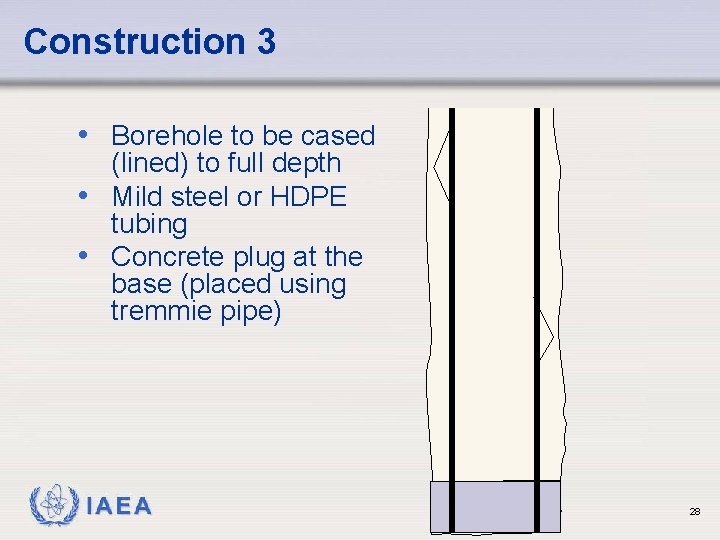
Construction 3 • Borehole to be cased (lined) to full depth • Mild steel or HDPE tubing • Concrete plug at the base (placed using tremmie pipe) IAEA 28
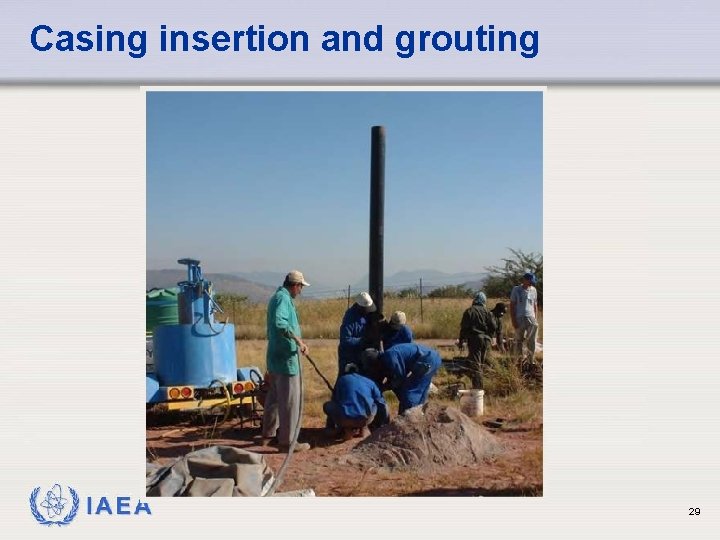
Casing insertion and grouting IAEA 29
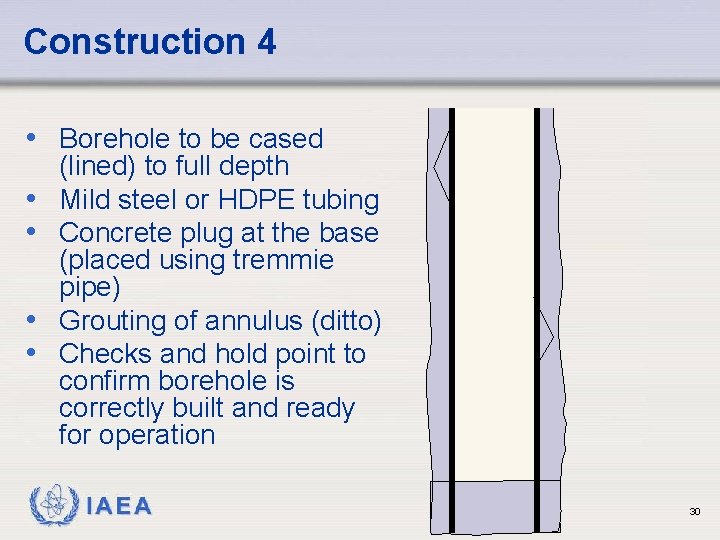
Construction 4 • Borehole to be cased • • (lined) to full depth Mild steel or HDPE tubing Concrete plug at the base (placed using tremmie pipe) Grouting of annulus (ditto) Checks and hold point to confirm borehole is correctly built and ready for operation IAEA 30
Summary • Main components of the BDC design and their safety functions • Containers and capsule, backfill, casing etc • Influences on the site-specific design • Practical/ regulatory/ inventory/ site properties • Adapting (optimizing) the generic design for a specific site • Two examples given – one leads to one borehole, the other, two • Steps in the construction of a disposal borehole IAEA 31

IAEA Thank you! 32
- Slides: 32