
Booths Algorithm Points to remember n When using
Booth's Algorithm
Points to remember n When using Booth's Algorithm: n n You will need twice as many bits in your product as you have in your original two operands. The leftmost bit of your operands (both your multiplicand multiplier) is a SIGN bit, and cannot be used as part of the value.
To begin n Decide which operand will be the multiplier and which will be the multiplicand Convert both operands to two's complement representation using X bits n X must be at least one more bit than is required for the binary representation of the numerically larger operand Begin with a product that consists of the multiplier with an additional X leading zero bits
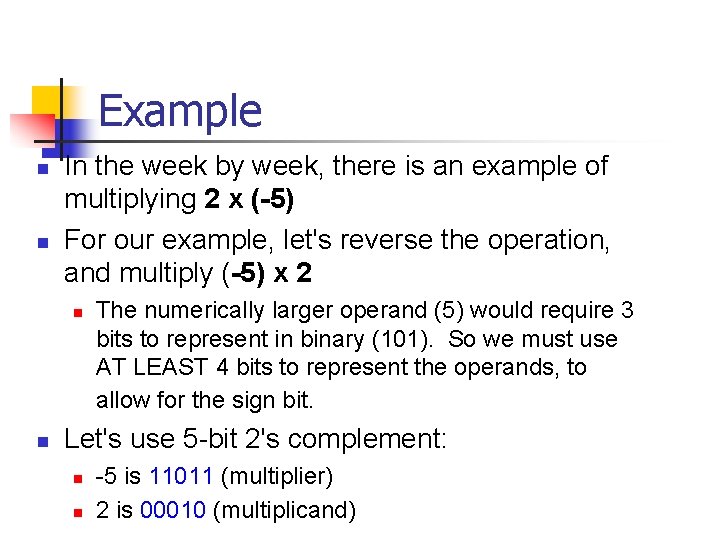
Example n n In the week by week, there is an example of multiplying 2 x (-5) For our example, let's reverse the operation, and multiply (-5) x 2 n n The numerically larger operand (5) would require 3 bits to represent in binary (101). So we must use AT LEAST 4 bits to represent the operands, to allow for the sign bit. Let's use 5 -bit 2's complement: n n -5 is 11011 (multiplier) 2 is 00010 (multiplicand)
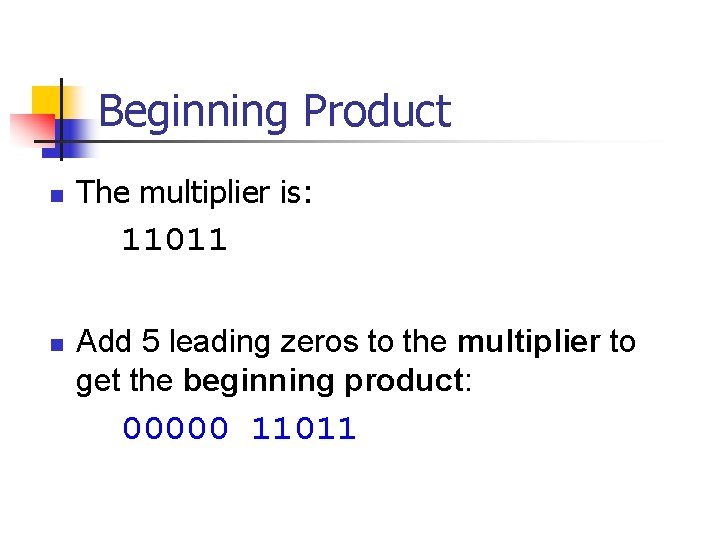
Beginning Product n The multiplier is: 11011 n Add 5 leading zeros to the multiplier to get the beginning product: 00000 11011

Step 1 for each pass n Use the LSB (least significant bit) and the previous LSB to determine the arithmetic action. n n If it is the FIRST pass, use 0 as the previous LSB. Possible arithmetic actions: 00 n 01 n 10 n 11 n no arithmetic operation add multiplicand to left half of product subtract multiplicand from left half of product no arithmetic operation
Step 2 for each pass n n Perform an arithmetic right shift (ASR) on the entire product. NOTE: For X-bit operands, Booth's algorithm requires X passes.
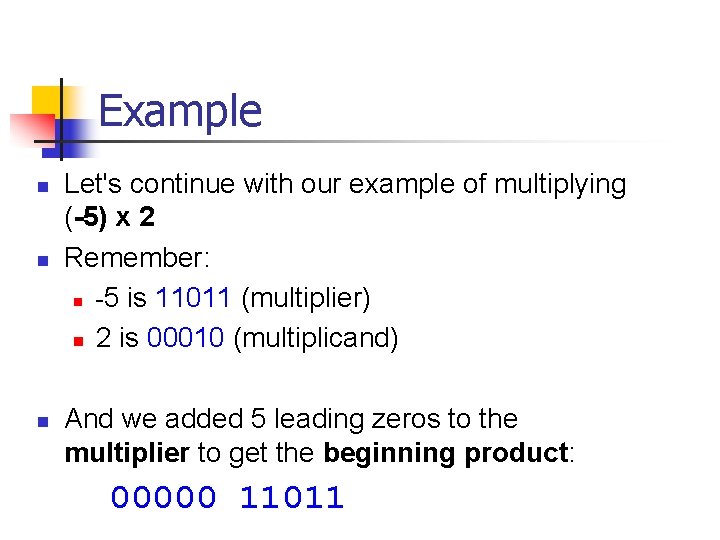
Example n n n Let's continue with our example of multiplying (-5) x 2 Remember: n -5 is 11011 (multiplier) n 2 is 00010 (multiplicand) And we added 5 leading zeros to the multiplier to get the beginning product: 00000 11011
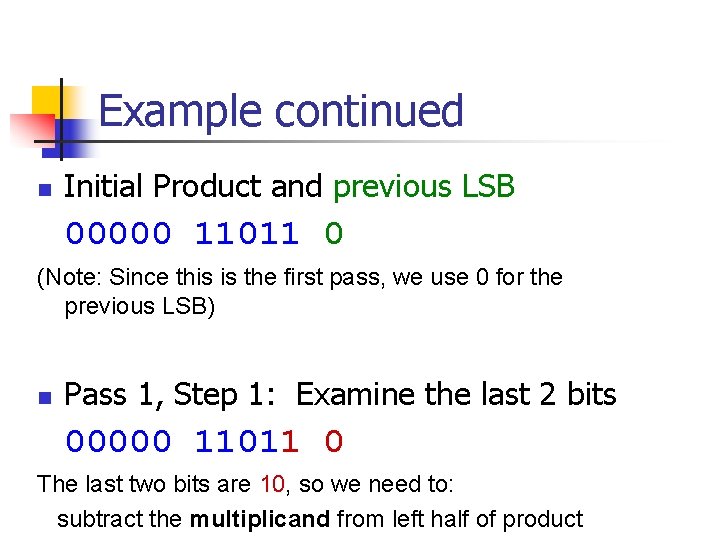
Example continued n Initial Product and previous LSB 00000 11011 0 (Note: Since this is the first pass, we use 0 for the previous LSB) n Pass 1, Step 1: Examine the last 2 bits 00000 11011 0 The last two bits are 10, so we need to: subtract the multiplicand from left half of product
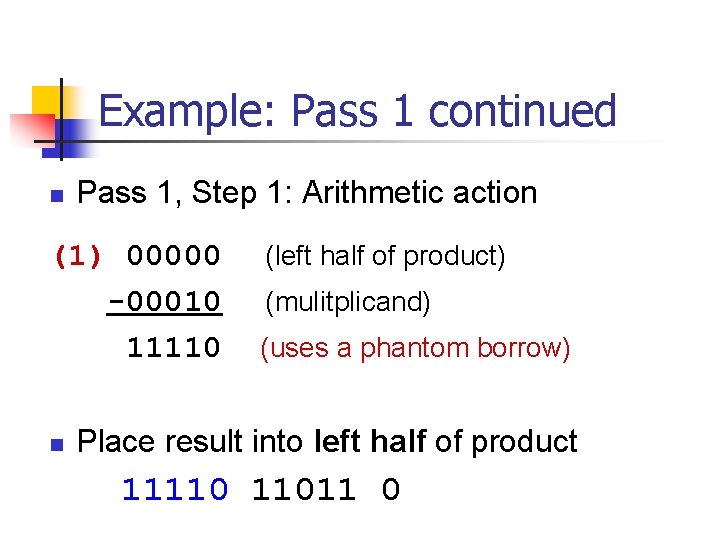
Example: Pass 1 continued n Pass 1, Step 1: Arithmetic action (1) 00000 -00010 11110 n (left half of product) (mulitplicand) (uses a phantom borrow) Place result into left half of product 11110 11011 0

Example: Pass 1 continued n Pass 1, Step 2: ASR (arithmetic shift right) n Before ASR 11110 11011 0 n After ASR 11111 01101 1 (left-most bit was 1, so a 1 was shifted in on the left) n Pass 1 is complete.
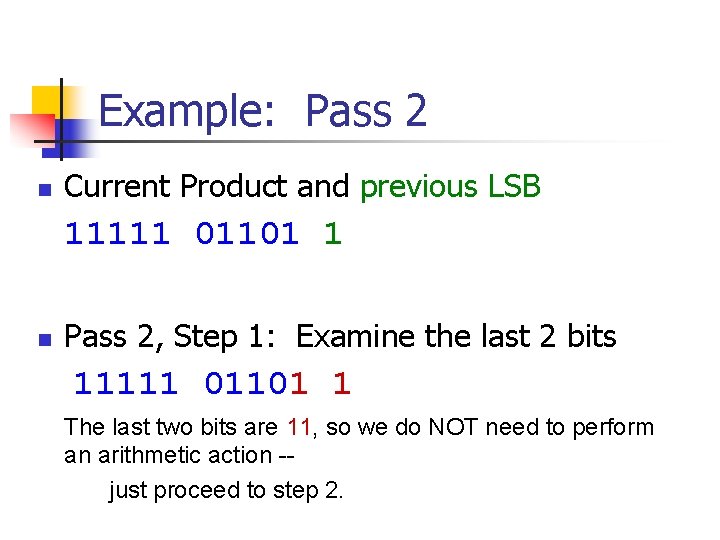
Example: Pass 2 n Current Product and previous LSB 11111 01101 1 n Pass 2, Step 1: Examine the last 2 bits 11111 01101 1 The last two bits are 11, so we do NOT need to perform an arithmetic action -just proceed to step 2.
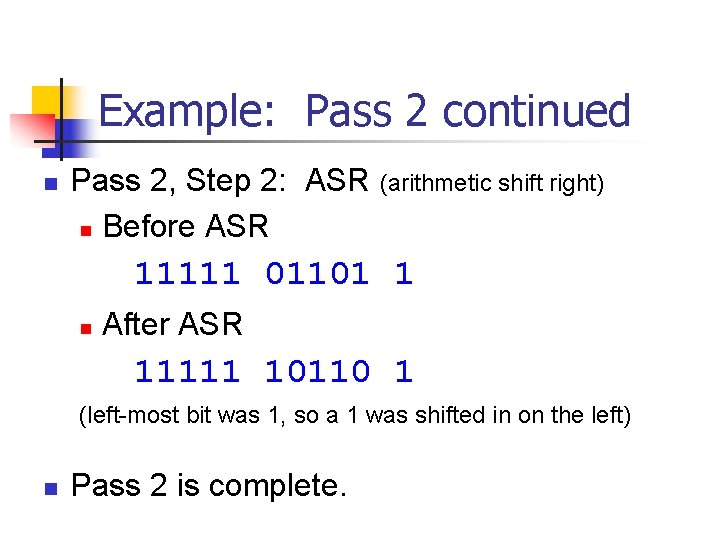
Example: Pass 2 continued n Pass 2, Step 2: ASR (arithmetic shift right) n Before ASR 11111 01101 1 n After ASR 11111 10110 1 (left-most bit was 1, so a 1 was shifted in on the left) n Pass 2 is complete.
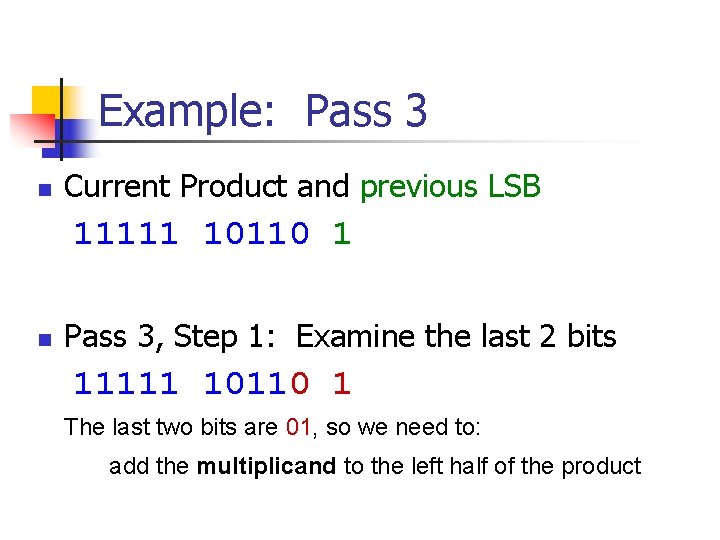
Example: Pass 3 n Current Product and previous LSB 11111 10110 1 n Pass 3, Step 1: Examine the last 2 bits 11111 10110 1 The last two bits are 01, so we need to: add the multiplicand to the left half of the product
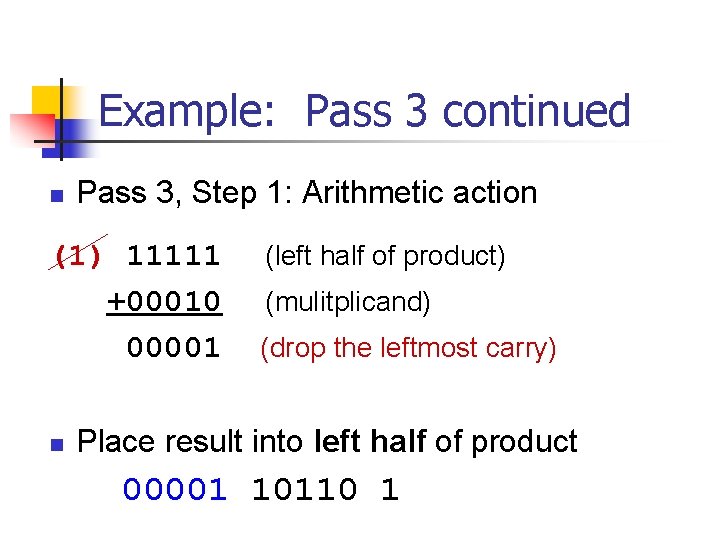
Example: Pass 3 continued n Pass 3, Step 1: Arithmetic action (1) 11111 +00010 00001 n (left half of product) (mulitplicand) (drop the leftmost carry) Place result into left half of product 00001 10110 1
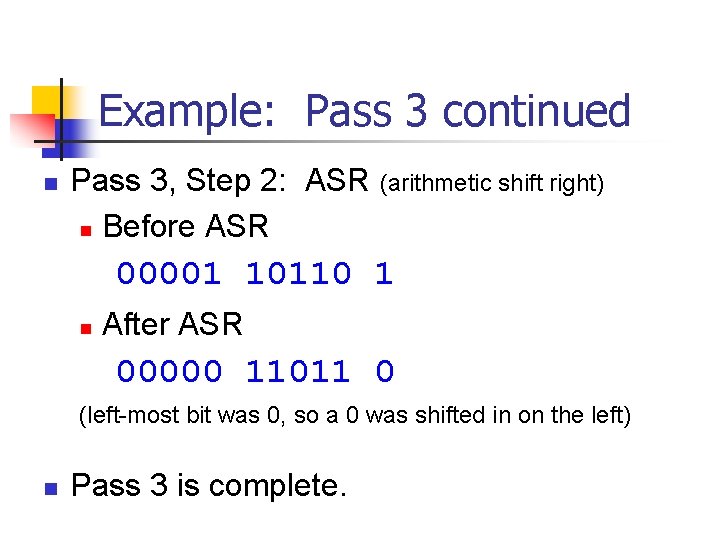
Example: Pass 3 continued n Pass 3, Step 2: ASR (arithmetic shift right) n Before ASR 00001 10110 1 n After ASR 00000 11011 0 (left-most bit was 0, so a 0 was shifted in on the left) n Pass 3 is complete.
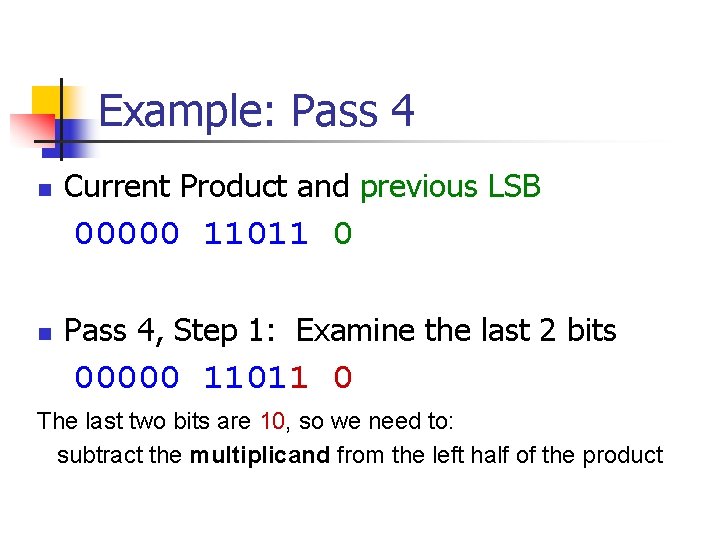
Example: Pass 4 n Current Product and previous LSB 00000 11011 0 n Pass 4, Step 1: Examine the last 2 bits 00000 11011 0 The last two bits are 10, so we need to: subtract the multiplicand from the left half of the product
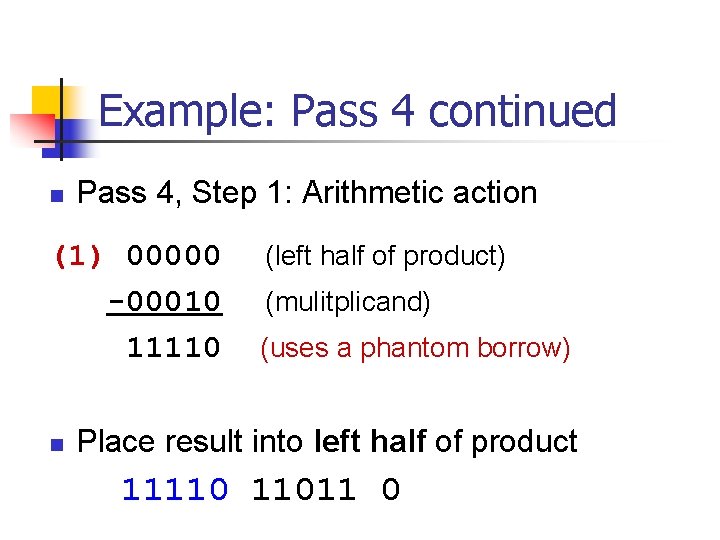
Example: Pass 4 continued n Pass 4, Step 1: Arithmetic action (1) 00000 -00010 11110 n (left half of product) (mulitplicand) (uses a phantom borrow) Place result into left half of product 11110 11011 0
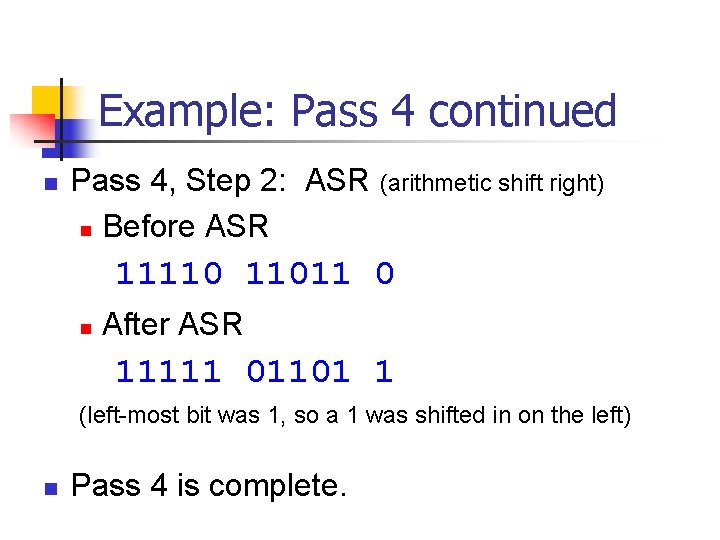
Example: Pass 4 continued n Pass 4, Step 2: ASR (arithmetic shift right) n Before ASR 11110 11011 0 n After ASR 11111 01101 1 (left-most bit was 1, so a 1 was shifted in on the left) n Pass 4 is complete.
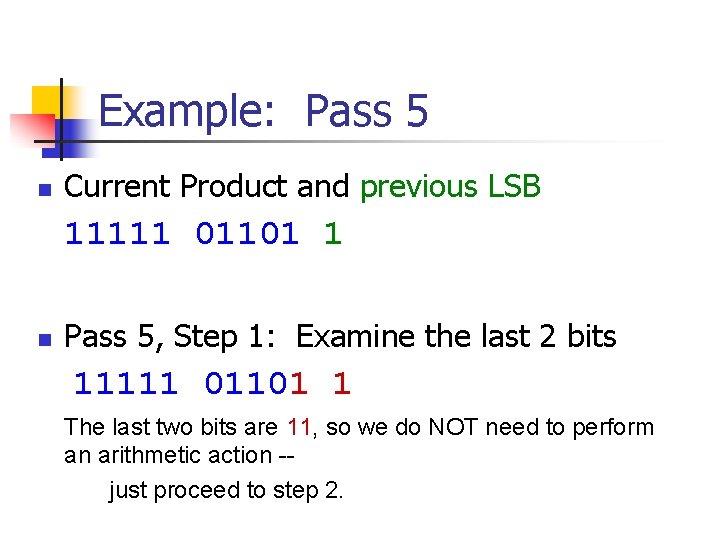
Example: Pass 5 n Current Product and previous LSB 11111 01101 1 n Pass 5, Step 1: Examine the last 2 bits 11111 01101 1 The last two bits are 11, so we do NOT need to perform an arithmetic action -just proceed to step 2.
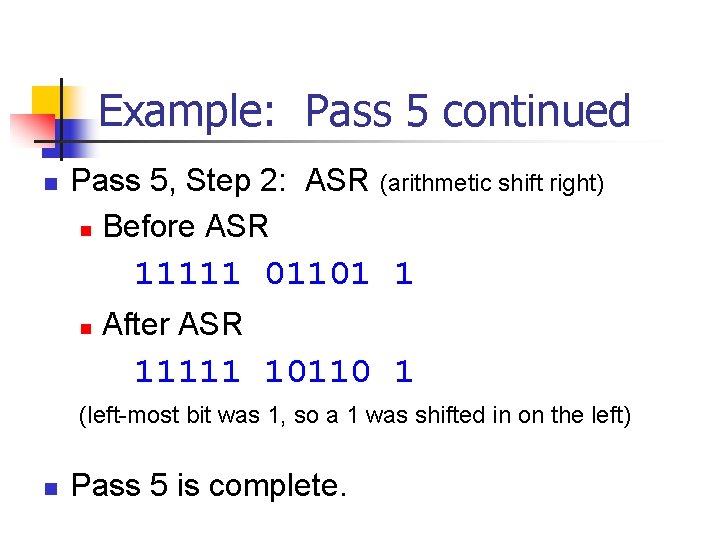
Example: Pass 5 continued n Pass 5, Step 2: ASR (arithmetic shift right) n Before ASR 11111 01101 1 n After ASR 11111 10110 1 (left-most bit was 1, so a 1 was shifted in on the left) n Pass 5 is complete.
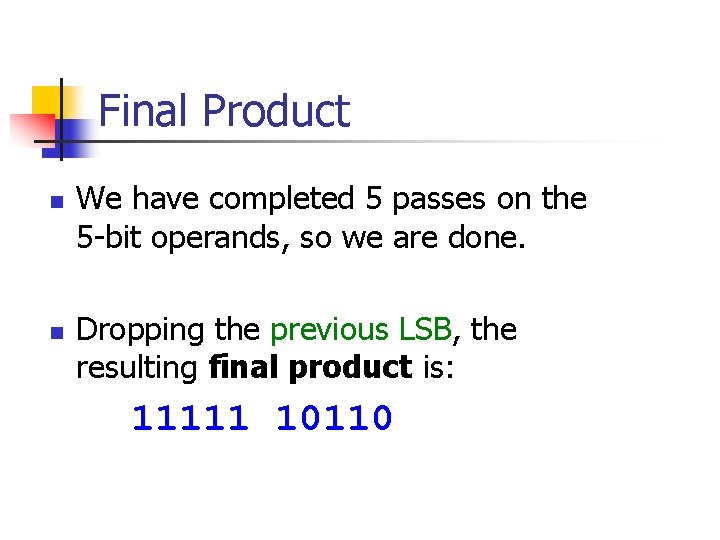
Final Product n n We have completed 5 passes on the 5 -bit operands, so we are done. Dropping the previous LSB, the resulting final product is: 11111 10110
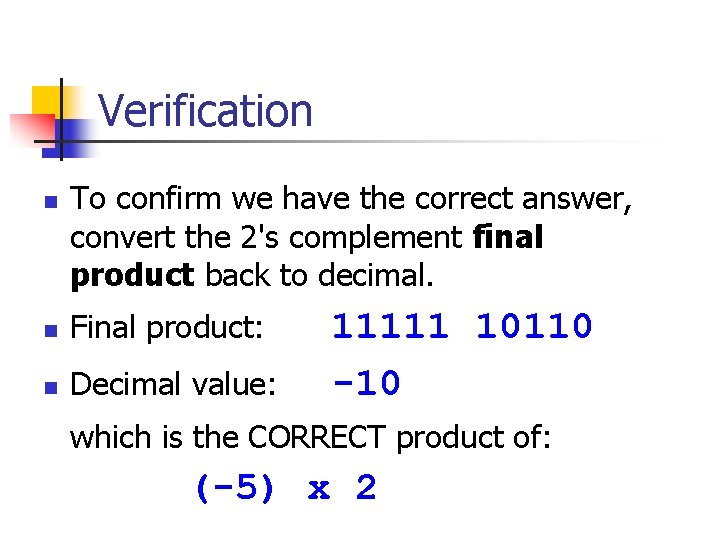
Verification n To confirm we have the correct answer, convert the 2's complement final product back to decimal. n Final product: n Decimal value: 11111 10110 -10 which is the CORRECT product of: (-5) x 2

Thanks…
- Slides: 24