
Booster Collimation Upgrade Plans Valery Kapin PIPI Booster

Booster Collimation Upgrade Plans Valery Kapin PIP-I+ Booster collimator and Shielding Assessment 15 November 2017
Relevant reports & talks 1) V. Kapin et al, “Study of Two-Stage Collimation System in Fermilab Booster”, June 12, 2017, Beams-Docs-5519 -v 1 (The final write up for study of existing 2 SC in Boo) 2) V. Kapin, “A proposal for upgrade of Booster collimation system”, PIP meeting 22 -Feb -2017, Beams-doc-5340 -v 1 3) V. Kapin et al. , “Collimation in Booster: Experimental Results for Horizontal Plane”, PIP Meeting, April 19, 2017, Beams-doc-5371 -v 1 4) V. Kapin, “Booster Collimation: 2 -stage vs 1 -stage”, PIP meeting 24 -Aug-2016, Beams -doc-5222 -v 2 (incl. Exp. Results for Vertical Plane) 5) V. V. Kapin et al, “Numerical Simulations of Collimation Efficiency for Beam Collimation System in the Fermilab Booster”, NAPAC-2016, Chicago, paper WEPOA 20. (approach for collimation efficiency simulation) 6) V. Kapin et al “Experimental Studies of Beam Collimation System in the Fermilab Booster”, NAPAC-16, paper WEPOA 18 (incl. Exp. Results for Vertical Plane) Co-authors: S. J. Chaurize 1, 3, 6, V. A. Lebedev 1, 5, N. M. Mokhov 1, 5, 6, W. A. Pelico 1, 6, T. M. Sullivan 1, 3, 6, S. I. Striganov 1, 5, R. J. Tesarek 1, 3, 6, A. K. Triplett 1, 3, 6, I. S. Tropin 1, 5 2

Booster Layout 400 Me. V -> 8 Ge. V 33 ms (20, 000 turns) 24 periods (L=19. 8 m) S=474. 2 m 3
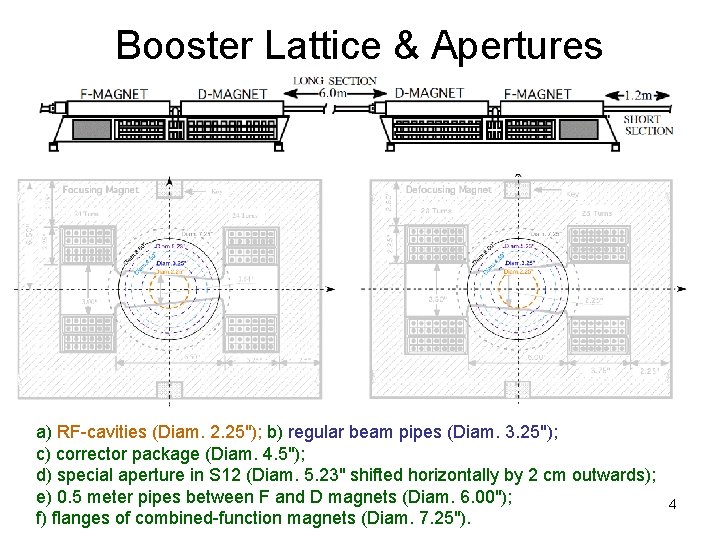
Booster Lattice & Apertures a) RF-cavities (Diam. 2. 25"); b) regular beam pipes (Diam. 3. 25"); c) corrector package (Diam. 4. 5"); d) special aperture in S 12 (Diam. 5. 23" shifted horizontally by 2 cm outwards); e) 0. 5 meter pipes between F and D magnets (Diam. 6. 00"); f) flanges of combined-function magnets (Diam. 7. 25"). 4
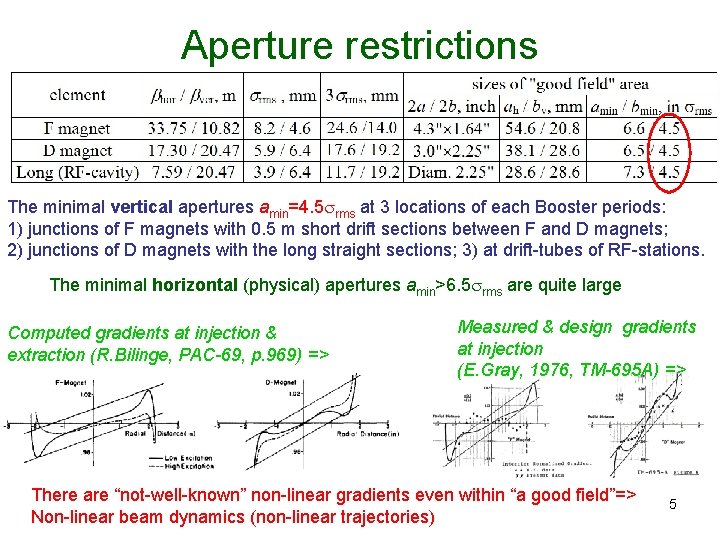
Aperture restrictions The minimal vertical apertures amin=4. 5 srms at 3 locations of each Booster periods: 1) junctions of F magnets with 0. 5 m short drift sections between F and D magnets; 2) junctions of D magnets with the long straight sections; 3) at drift-tubes of RF-stations. The minimal horizontal (physical) apertures amin>6. 5 srms are quite large Computed gradients at injection & extraction (R. Bilinge, PAC-69, p. 969) => Measured & design gradients at injection (E. Gray, 1976, TM-695 A) => There are “not-well-known” non-linear gradients even within “a good field”=> Non-linear beam dynamics (non-linear trajectories) 5
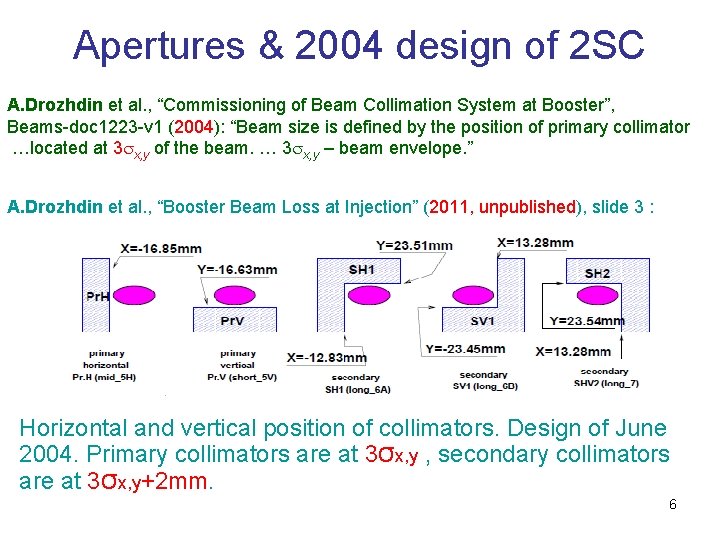
Apertures & 2004 design of 2 SC A. Drozhdin et al. , “Commissioning of Beam Collimation System at Booster”, Beams-doc 1223 -v 1 (2004): “Beam size is defined by the position of primary collimator …located at 3 sx, y of the beam. … 3 sx, y – beam envelope. ” A. Drozhdin et al. , “Booster Beam Loss at Injection” (2011, unpublished), slide 3 : Horizontal and vertical position of collimators. Design of June 2004. Primary collimators are at 3σx, y , secondary collimators are at 3σx, y+2 mm. 6
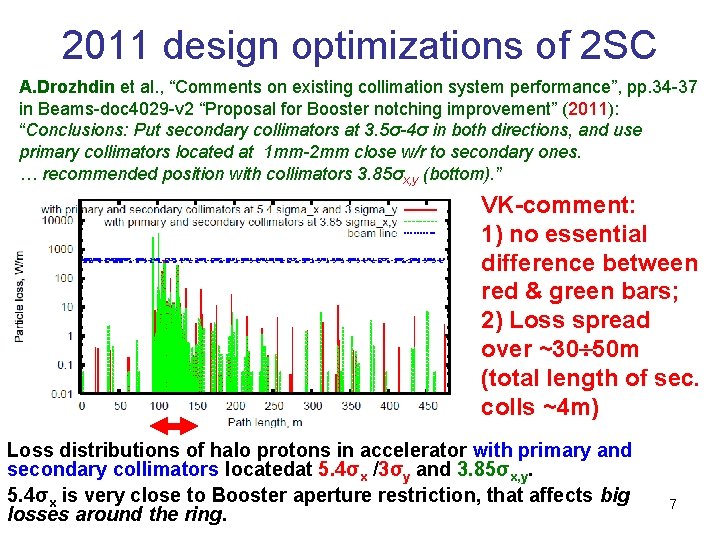
2011 design optimizations of 2 SC A. Drozhdin et al. , “Comments on existing collimation system performance”, pp. 34 -37 in Beams-doc 4029 -v 2 “Proposal for Booster notching improvement” (2011): “Conclusions: Put secondary collimators at 3. 5σ-4σ in both directions, and use primary collimators located at 1 mm-2 mm close w/r to secondary ones. … recommended position with collimators 3. 85σx, y (bottom). ” VK-comment: 1) no essential difference between red & green bars; 2) Loss spread over ~30 50 m (total length of sec. colls ~4 m) Loss distributions of halo protons in accelerator with primary and secondary collimators locatedat 5. 4σx /3σy and 3. 85σx, y. 5. 4σx is very close to Booster aperture restriction, that affects big losses around the ring. 7
Reasons for a Low Efficiency of 2 SC [3. 4. 1. 4 in ref. 1] 1) Small apertures of gradient magnets and RF-cavities do not allow a usage a rather thick foil (e. g. 400 mm Cu >60% lost on apertures). A forced solution: usage of thinner foil However, portion of escaped protons (through 2 mm gap) is in a range from 50% for 50 mm Cu foil till 90% for 10 mm. Escaped protons are out of control (Uncontrollable multi-turn losses) and have a small impact parameter => out-scattering effect is not reduced and should be almost the same as for 1 SC. Then, optimal 50 mm Cu foil with collimation efficiency ~50%, which is close to a single stage collimation. 2) Non-optimal phase locations of the secondary collimators. It be compensated after many turns (is it a Booster case ? ) 3) Variable 3 s-trajectories sitting on c. o in Booster (time-variable parameters, mismatching, not measured&controlled at all !). 4) Experimental beam studies did not show any advantages of 2 SC in comparison to 1 SC. 8
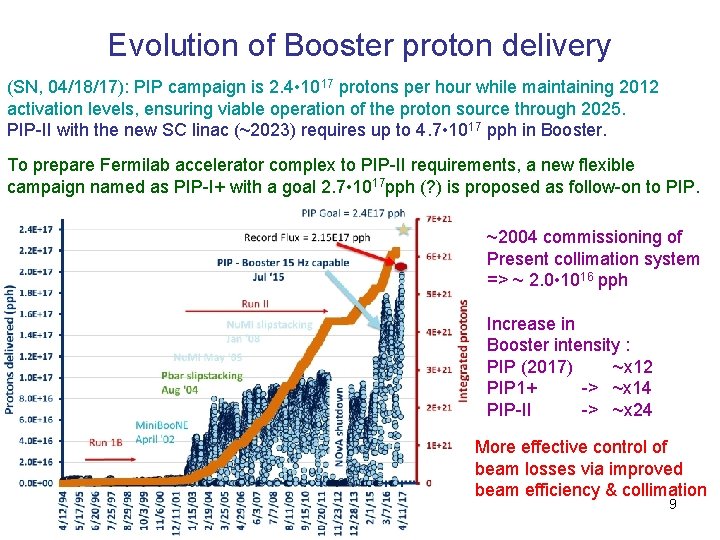
Evolution of Booster proton delivery (SN, 04/18/17): PIP campaign is 2. 4 • 1017 protons per hour while maintaining 2012 activation levels, ensuring viable operation of the proton source through 2025. PIP-II with the new SC linac (~2023) requires up to 4. 7 • 1017 pph in Booster. To prepare Fermilab accelerator complex to PIP-II requirements, a new flexible campaign named as PIP-I+ with a goal 2. 7 • 1017 pph (? ) is proposed as follow-on to PIP. ~2004 commissioning of Present collimation system => ~ 2. 0 • 1016 pph Increase in Booster intensity : PIP (2017) ~x 12 PIP 1+ -> ~x 14 PIP-II -> ~x 24 More effective control of beam losses via improved beam efficiency & collimation 9
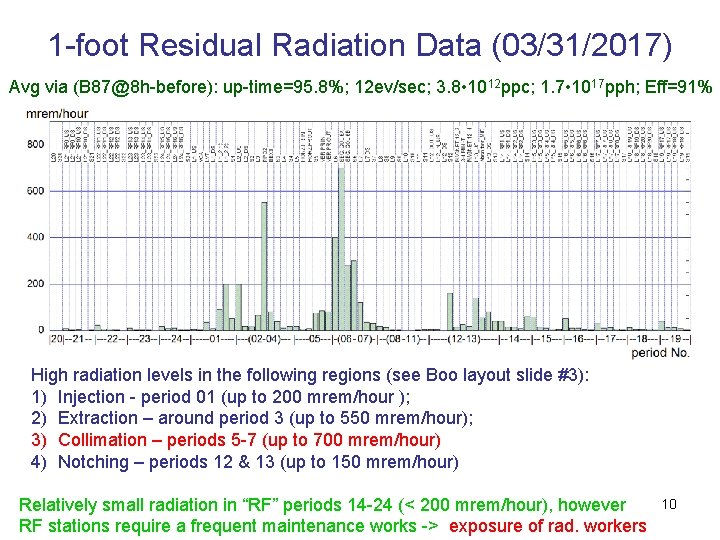
1 -foot Residual Radiation Data (03/31/2017) Avg via (B 87@8 h-before): up-time=95. 8%; 12 ev/sec; 3. 8 • 1012 ppc; 1. 7 • 1017 pph; Eff=91% High radiation levels in the following regions (see Boo layout slide #3): 1) Injection - period 01 (up to 200 mrem/hour ); 2) Extraction – around period 3 (up to 550 mrem/hour); 3) Collimation – periods 5 -7 (up to 700 mrem/hour) 4) Notching – periods 12 & 13 (up to 150 mrem/hour) Relatively small radiation in “RF” periods 14 -24 (< 200 mrem/hour), however RF stations require a frequent maintenance works -> exposure of rad. workers 10
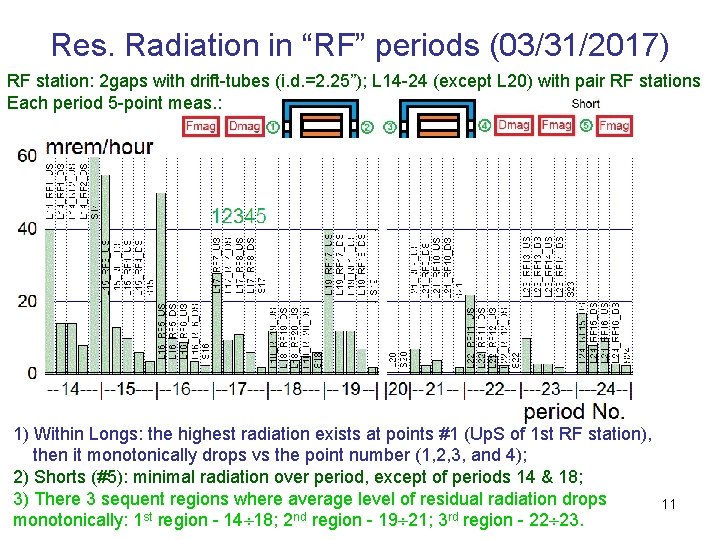
Res. Radiation in “RF” periods (03/31/2017) RF station: 2 gaps with drift-tubes (i. d. =2. 25”); L 14 -24 (except L 20) with pair RF stations Each period 5 -point meas. : 1) Within Longs: the highest radiation exists at points #1 (Up. S of 1 st RF station), then it monotonically drops vs the point number (1, 2, 3, and 4); 2) Shorts (#5): minimal radiation over period, except of periods 14 & 18; 3) There 3 sequent regions where average level of residual radiation drops monotonically: 1 st region - 14 18; 2 nd region - 19 21; 3 rd region - 22 23. 11
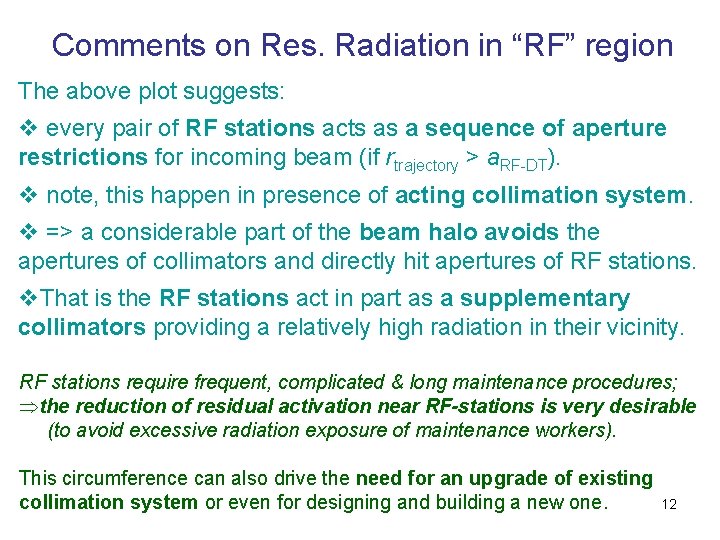
Comments on Res. Radiation in “RF” region The above plot suggests: v every pair of RF stations acts as a sequence of aperture restrictions for incoming beam (if rtrajectory > a. RF-DT). v note, this happen in presence of acting collimation system. v => a considerable part of the beam halo avoids the apertures of collimators and directly hit apertures of RF stations. v. That is the RF stations act in part as a supplementary collimators providing a relatively high radiation in their vicinity. RF stations require frequent, complicated & long maintenance procedures; Þthe reduction of residual activation near RF-stations is very desirable (to avoid excessive radiation exposure of maintenance workers). This circumference can also drive the need for an upgrade of existing collimation system or even for designing and building a new one. 12
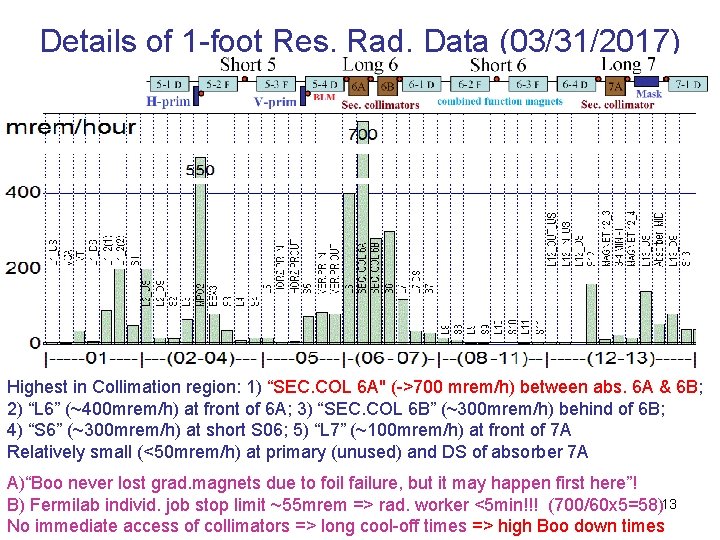
Details of 1 -foot Res. Rad. Data (03/31/2017) Highest in Collimation region: 1) “SEC. COL 6 A" (->700 mrem/h) between abs. 6 A & 6 B; 2) “L 6” (~400 mrem/h) at front of 6 A; 3) “SEC. COL 6 B” (~300 mrem/h) behind of 6 B; 4) “S 6” (~300 mrem/h) at short S 06; 5) “L 7” (~100 mrem/h) at front of 7 A Relatively small (<50 mrem/h) at primary (unused) and DS of absorber 7 A A)“Boo never lost grad. magnets due to foil failure, but it may happen first here”! B) Fermilab individ. job stop limit ~55 mrem => rad. worker <5 min!!! (700/60 x 5=58)13 No immediate access of collimators => long cool-off times => high Boo down times
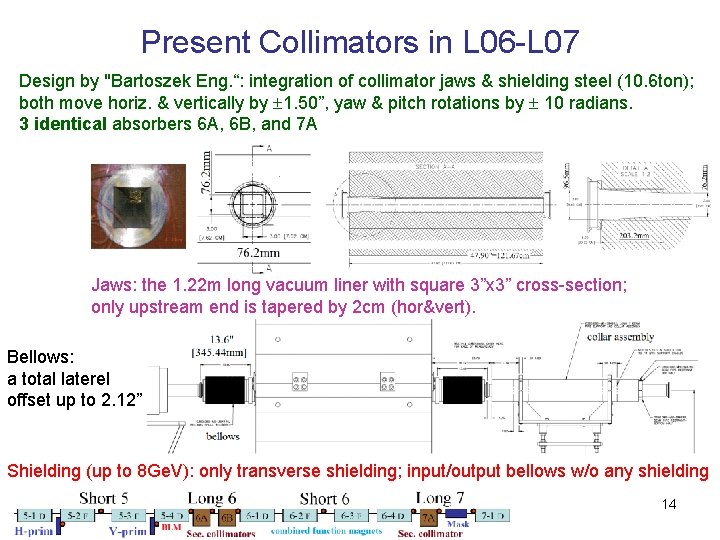
Present Collimators in L 06 -L 07 Design by "Bartoszek Eng. “: integration of collimator jaws & shielding steel (10. 6 ton); both move horiz. & vertically by 1. 50”, yaw & pitch rotations by 10 radians. 3 identical absorbers 6 A, 6 B, and 7 A Jaws: the 1. 22 m long vacuum liner with square 3”x 3” cross-section; only upstream end is tapered by 2 cm (hor&vert). Bellows: a total laterel offset up to 2. 12” Shielding (up to 8 Ge. V): only transverse shielding; input/output bellows w/o any shielding 14
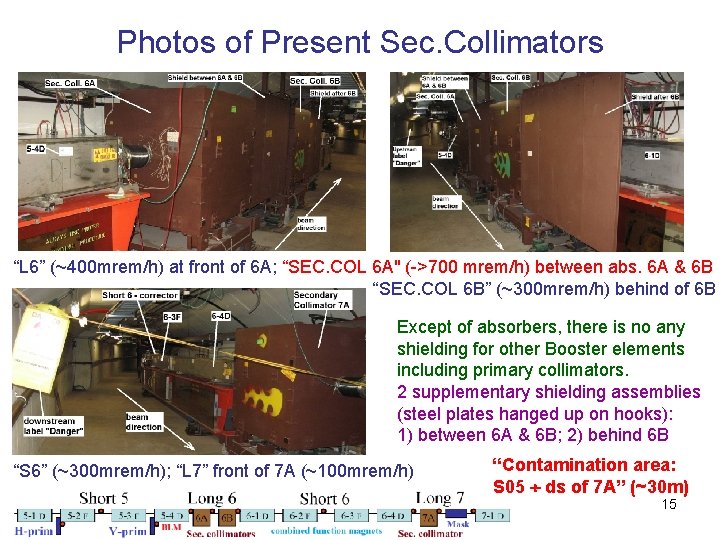
Photos of Present Sec. Collimators “L 6” (~400 mrem/h) at front of 6 A; “SEC. COL 6 A" (->700 mrem/h) between abs. 6 A & 6 B “SEC. COL 6 B” (~300 mrem/h) behind of 6 B Except of absorbers, there is no any shielding for other Booster elements including primary collimators. 2 supplementary shielding assemblies (steel plates hanged up on hooks): 1) between 6 A & 6 B; 2) behind 6 B “S 6” (~300 mrem/h); “L 7” front of 7 A (~100 mrem/h) “Contamination area: S 05 ds of 7 A” (~30 m) 15
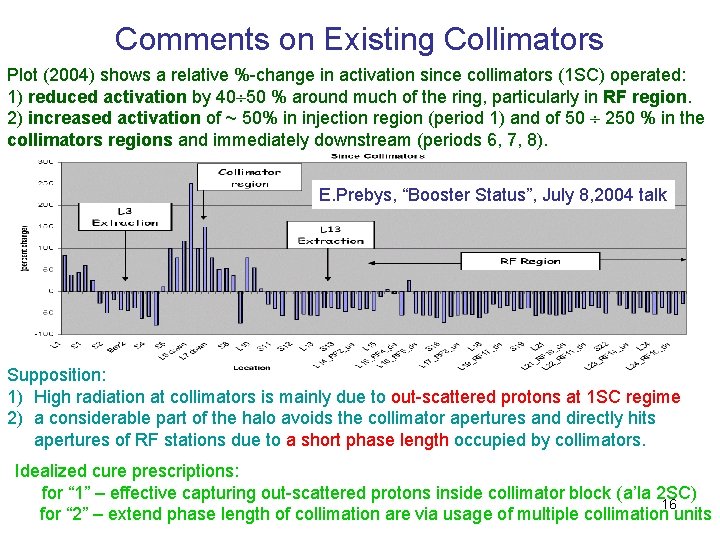
Comments on Existing Collimators Plot (2004) shows a relative %-change in activation since collimators (1 SC) operated: 1) reduced activation by 40 50 % around much of the ring, particularly in RF region. 2) increased activation of ~ 50% in injection region (period 1) and of 50 250 % in the collimators regions and immediately downstream (periods 6, 7, 8). E. Prebys, “Booster Status”, July 8, 2004 talk Supposition: 1) High radiation at collimators is mainly due to out-scattered protons at 1 SC regime 2) a considerable part of the halo avoids the collimator apertures and directly hits apertures of RF stations due to a short phase length occupied by collimators. Idealized cure prescriptions: for “ 1” – effective capturing out-scattered protons inside collimator block (a’la 2 SC) 16 for “ 2” – extend phase length of collimation are via usage of multiple collimation units
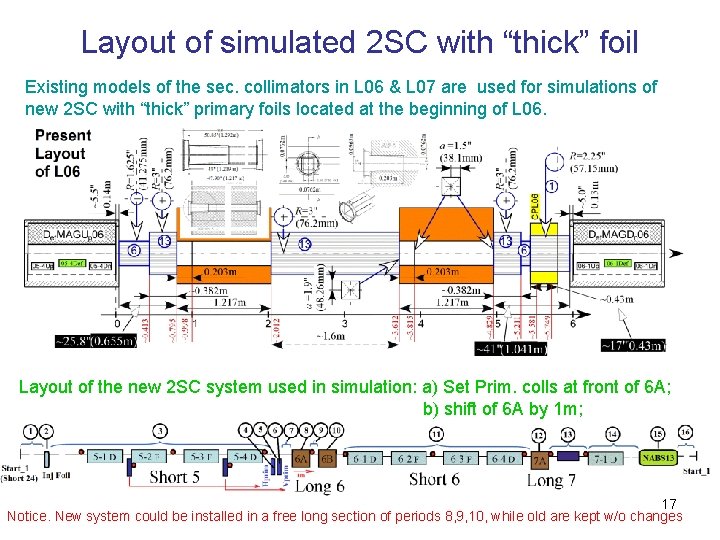
Layout of simulated 2 SC with “thick” foil Existing models of the sec. collimators in L 06 & L 07 are used for simulations of new 2 SC with “thick” primary foils located at the beginning of L 06. Layout of the new 2 SC system used in simulation: a) Set Prim. colls at front of 6 A; b) shift of 6 A by 1 m; 17 Notice. New system could be installed in a free long section of periods 8, 9, 10, while old are kept w/o changes
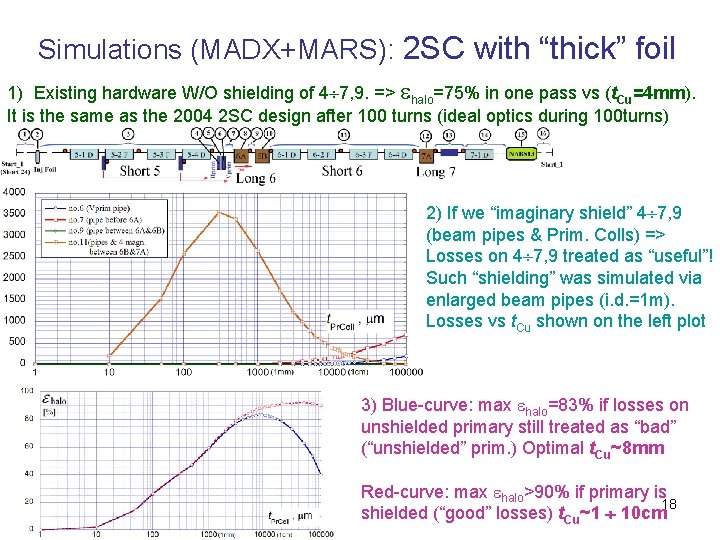
Simulations (MADX+MARS): 2 SC with “thick” foil 1) Existing hardware W/O shielding of 4 7, 9. => ehalo=75% in one pass vs (t. Cu=4 mm). It is the same as the 2004 2 SC design after 100 turns (ideal optics during 100 turns) 2) If we “imaginary shield” 4 7, 9 (beam pipes & Prim. Colls) => Losses on 4 7, 9 treated as “useful”! Such “shielding” was simulated via enlarged beam pipes (i. d. =1 m). Losses vs t. Cu shown on the left plot 3) Blue-curve: max ehalo=83% if losses on unshielded primary still treated as “bad” (“unshielded” prim. ) Optimal t. Cu~8 mm Red-curve: max ehalo>90% if primary is 18 shielded (“good” losses) t. Cu~1 10 cm
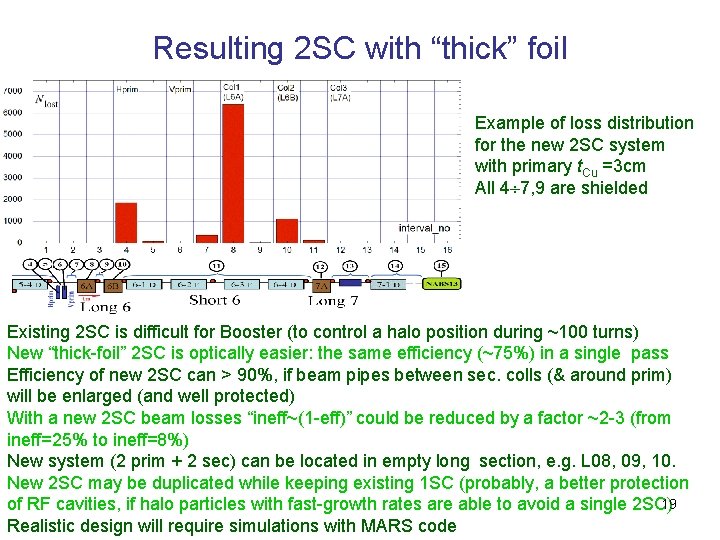
Resulting 2 SC with “thick” foil Example of loss distribution for the new 2 SC system with primary t. Cu =3 cm All 4 7, 9 are shielded Existing 2 SC is difficult for Booster (to control a halo position during ~100 turns) New “thick-foil” 2 SC is optically easier: the same efficiency (~75%) in a single pass Efficiency of new 2 SC can > 90%, if beam pipes between sec. colls (& around prim) will be enlarged (and well protected) With a new 2 SC beam losses “ineff~(1 -eff)” could be reduced by a factor ~2 -3 (from ineff=25% to ineff=8%) New system (2 prim + 2 sec) can be located in empty long section, e. g. L 08, 09, 10. New 2 SC may be duplicated while keeping existing 1 SC (probably, a better protection 19 of RF cavities, if halo particles with fast-growth rates are able to avoid a single 2 SC) Realistic design will require simulations with MARS code
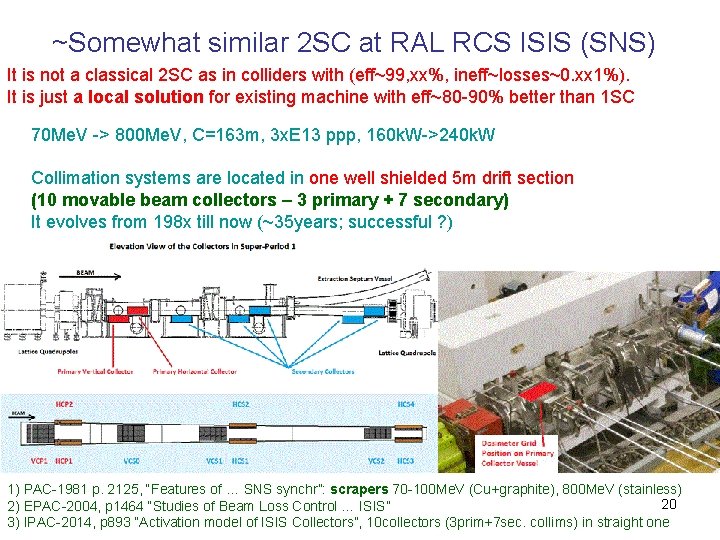
~Somewhat similar 2 SC at RAL RCS ISIS (SNS) It is not a classical 2 SC as in colliders with (eff~99, xx%, ineff~losses~0. xx 1%). It is just a local solution for existing machine with eff~80 -90% better than 1 SC 70 Me. V -> 800 Me. V, C=163 m, 3 x. E 13 ppp, 160 k. W->240 k. W Collimation systems are located in one well shielded 5 m drift section (10 movable beam collectors – 3 primary + 7 secondary) It evolves from 198 x till now (~35 years; successful ? ) 1) PAC-1981 p. 2125, “Features of … SNS synchr”: scrapers 70 -100 Me. V (Cu+graphite), 800 Me. V (stainless) 20 2) EPAC-2004, p 1464 “Studies of Beam Loss Control … ISIS” 3) IPAC-2014, p 893 “Activation model of ISIS Collectors”, 10 collectors (3 prim+7 sec. collims) in straight one
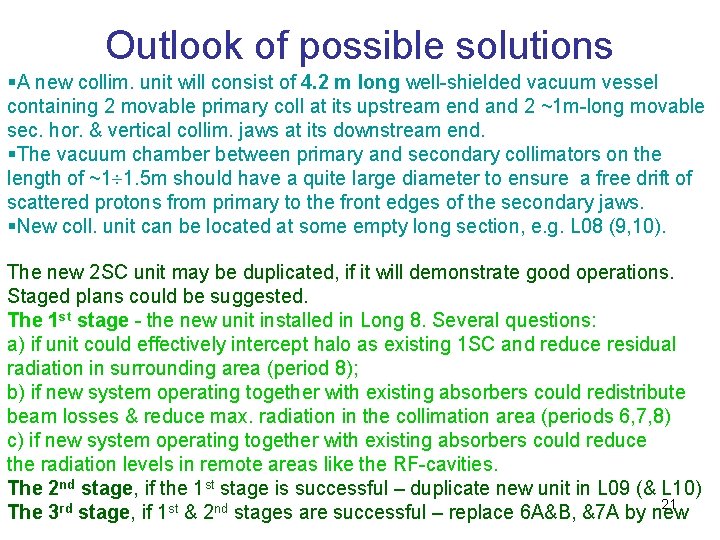
Outlook of possible solutions §A new collim. unit will consist of 4. 2 m long well-shielded vacuum vessel containing 2 movable primary coll at its upstream end and 2 ~1 m-long movable sec. hor. & vertical collim. jaws at its downstream end. §The vacuum chamber between primary and secondary collimators on the length of ~1 1. 5 m should have a quite large diameter to ensure a free drift of scattered protons from primary to the front edges of the secondary jaws. §New coll. unit can be located at some empty long section, e. g. L 08 (9, 10). The new 2 SC unit may be duplicated, if it will demonstrate good operations. Staged plans could be suggested. The 1 st stage - the new unit installed in Long 8. Several questions: a) if unit could effectively intercept halo as existing 1 SC and reduce residual radiation in surrounding area (period 8); b) if new system operating together with existing absorbers could redistribute beam losses & reduce max. radiation in the collimation area (periods 6, 7, 8) c) if new system operating together with existing absorbers could reduce the radiation levels in remote areas like the RF-cavities. The 2 nd stage, if the 1 st stage is successful – duplicate new unit in L 09 (& L 10) 21 The 3 rd stage, if 1 st & 2 nd stages are successful – replace 6 A&B, &7 A by new
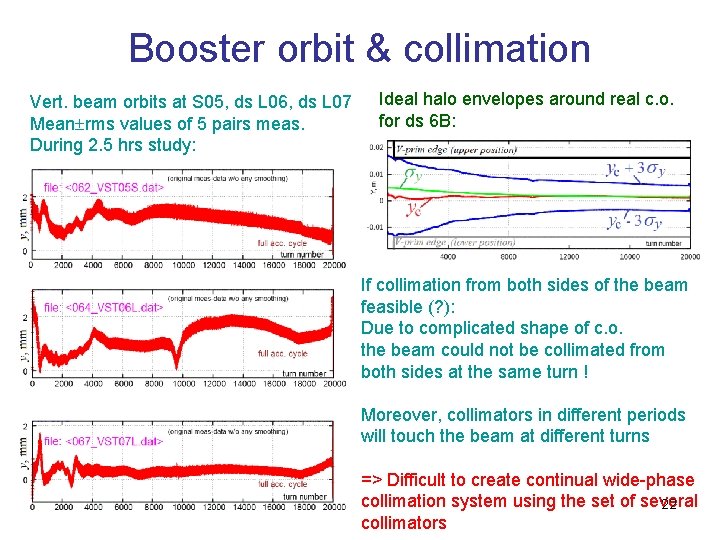
Booster orbit & collimation Vert. beam orbits at S 05, ds L 06, ds L 07 Mean rms values of 5 pairs meas. During 2. 5 hrs study: Ideal halo envelopes around real c. o. for ds 6 B: If collimation from both sides of the beam feasible (? ): Due to complicated shape of c. o. the beam could not be collimated from both sides at the same turn ! Moreover, collimators in different periods will touch the beam at different turns => Difficult to create continual wide-phase collimation system using the set of several 22 collimators
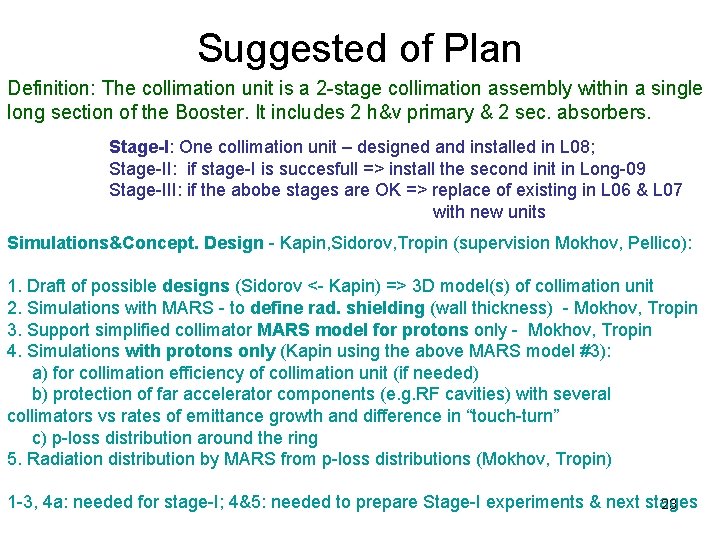
Suggested of Plan Definition: The collimation unit is a 2 -stage collimation assembly within a single long section of the Booster. It includes 2 h&v primary & 2 sec. absorbers. Stage-I: One collimation unit – designed and installed in L 08; Stage-II: if stage-I is succesfull => install the second init in Long-09 Stage-III: if the abobe stages are OK => replace of existing in L 06 & L 07 with new units Simulations&Concept. Design - Kapin, Sidorov, Tropin (supervision Mokhov, Pellico): 1. Draft of possible designs (Sidorov <- Kapin) => 3 D model(s) of collimation unit 2. Simulations with MARS - to define rad. shielding (wall thickness) - Mokhov, Tropin 3. Support simplified collimator MARS model for protons only - Mokhov, Tropin 4. Simulations with protons only (Kapin using the above MARS model #3): a) for collimation efficiency of collimation unit (if needed) b) protection of far accelerator components (e. g. RF cavities) with several collimators vs rates of emittance growth and difference in “touch-turn” c) p-loss distribution around the ring 5. Radiation distribution by MARS from p-loss distributions (Mokhov, Tropin) 1 -3, 4 a: needed for stage-I; 4&5: needed to prepare Stage-I experiments & next stages 23
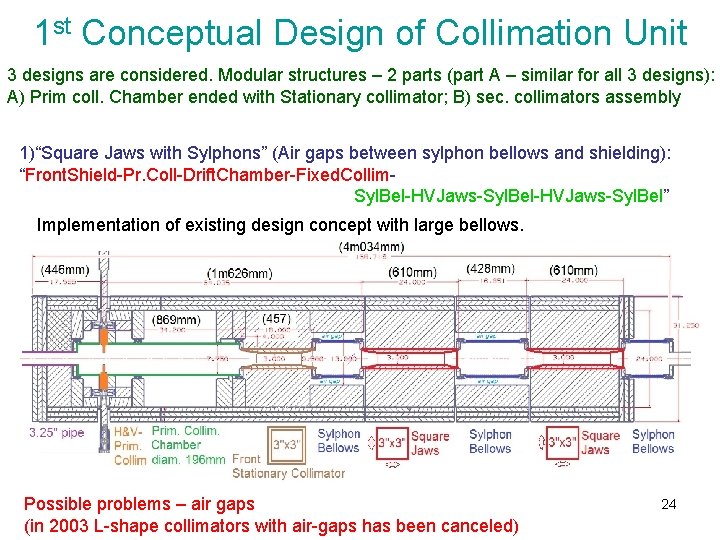
1 st Conceptual Design of Collimation Unit 3 designs are considered. Modular structures – 2 parts (part A – similar for all 3 designs): A) Prim coll. Chamber ended with Stationary collimator; B) sec. collimators assembly 1)“Square Jaws with Sylphons” (Air gaps between sylphon bellows and shielding): “Front. Shield-Pr. Coll-Drift. Chamber-Fixed. Collim. Syl. Bel-HVJaws-Syl. Bel” Implementation of existing design concept with large bellows. Possible problems – air gaps (in 2003 L-shape collimators with air-gaps has been canceled) 24
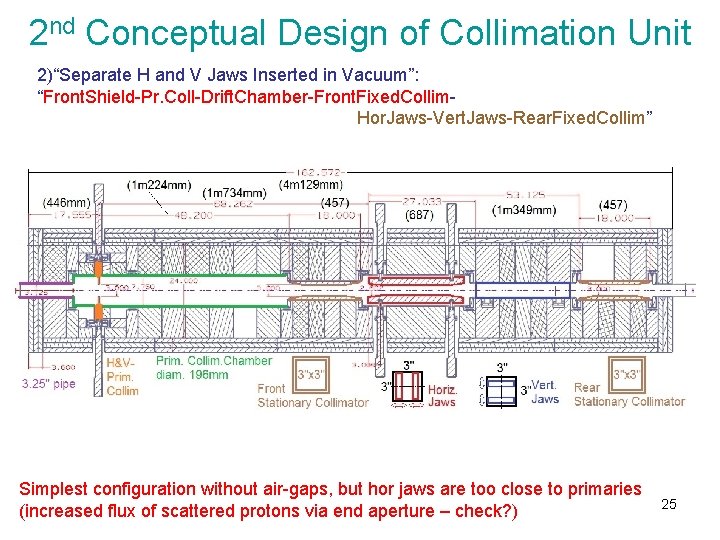
2 nd Conceptual Design of Collimation Unit 2)“Separate H and V Jaws Inserted in Vacuum”: “Front. Shield-Pr. Coll-Drift. Chamber-Front. Fixed. Collim. Hor. Jaws-Vert. Jaws-Rear. Fixed. Collim” Simplest configuration without air-gaps, but hor jaws are too close to primaries (increased flux of scattered protons via end aperture – check? ) 25
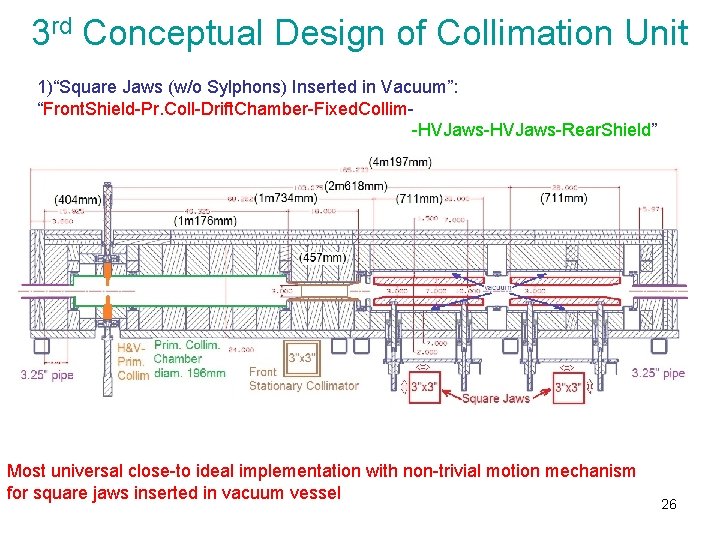
3 rd Conceptual Design of Collimation Unit 1)“Square Jaws (w/o Sylphons) Inserted in Vacuum”: “Front. Shield-Pr. Coll-Drift. Chamber-Fixed. Collim-HVJaws-Rear. Shield” Most universal close-to ideal implementation with non-trivial motion mechanism for square jaws inserted in vacuum vessel 26
- Slides: 26