
Boolean Network Models of Collective Dynamics of Open
Boolean Network Models of Collective Dynamics of Open and Closed Large. Scale Multi-agent Systems Predrag Tosic Carlos Ordonez (presenter) Washington State University USA University of Houston USA
Talk Outline • Introduction: Agents and Their Environments • Boolean Network Automata • Open & Closed Systems of Simple Reactive Agents • Complexity Results for BNA models (open, closed) • Implications & interpretations of our results • Conclusions 2
![AI View of the World: An Agent Embedded in An Environment • [AIMA] by](http://slidetodoc.com/presentation_image_h2/f42f6844cf0dca513847c87f0ec4f5c8/image-3.jpg "AI View of the World: An Agent Embedded in An Environment • [AIMA] by")
AI View of the World: An Agent Embedded in An Environment • [AIMA] by S. Russell and P. Norvig: the problem of AI is, given a problem and an environment, to design an “intelligent agent” that solves problem via dynamic interaction with its environment -- sensing -- decision making -- acting The Environment affects the Agent, and vice versa -- we can control agent’s behavior, but not the environment’s 3
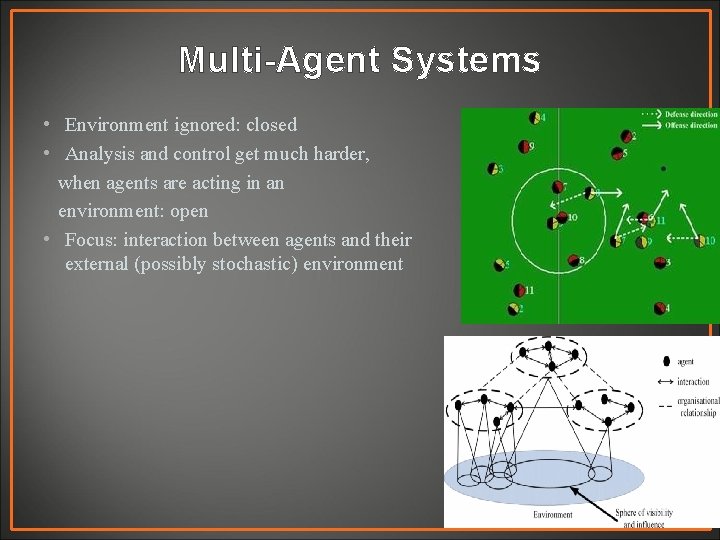
Multi-Agent Systems • Environment ignored: closed • Analysis and control get much harder, when agents are acting in an environment: open • Focus: interaction between agents and their external (possibly stochastic) environment 4
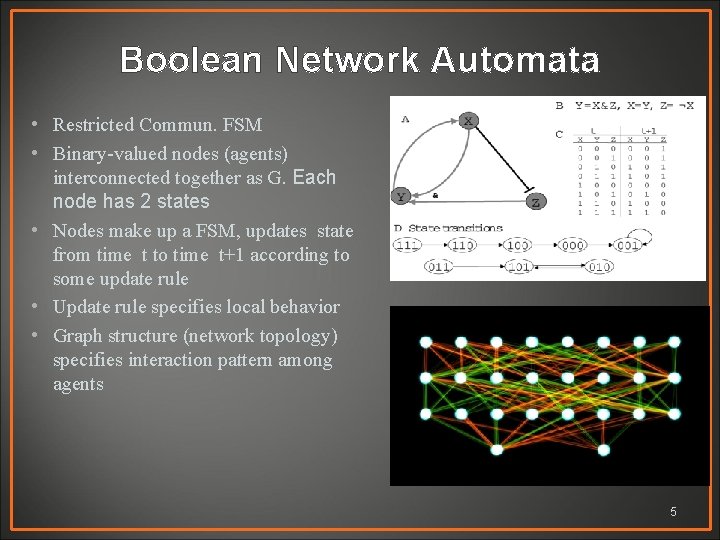
Boolean Network Automata • Restricted Commun. FSM • Binary-valued nodes (agents) interconnected together as G. Each node has 2 states • Nodes make up a FSM, updates state from time t to time t+1 according to some update rule • Update rule specifies local behavior • Graph structure (network topology) specifies interaction pattern among agents 5
Examples • • Soccer robot teams (closed) Unmanned vehicles (military/surveillance, open) Traffic controller network (open) Epidemics propagation (generally assumed closed/small vs open/large/dynamic)
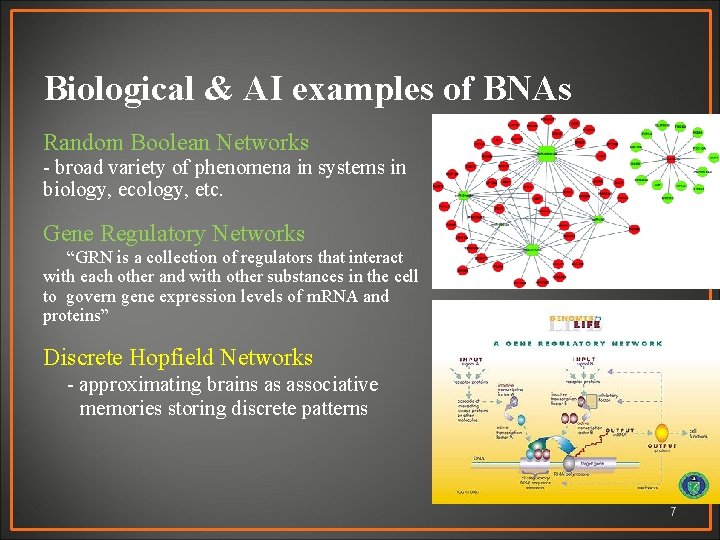
Biological & AI examples of BNAs Random Boolean Networks - broad variety of phenomena in systems in biology, ecology, etc. Gene Regulatory Networks “GRN is a collection of regulators that interact with each other and with other substances in the cell to govern gene expression levels of m. RNA and proteins” Discrete Hopfield Networks - approximating brains as associative memories storing discrete patterns 7
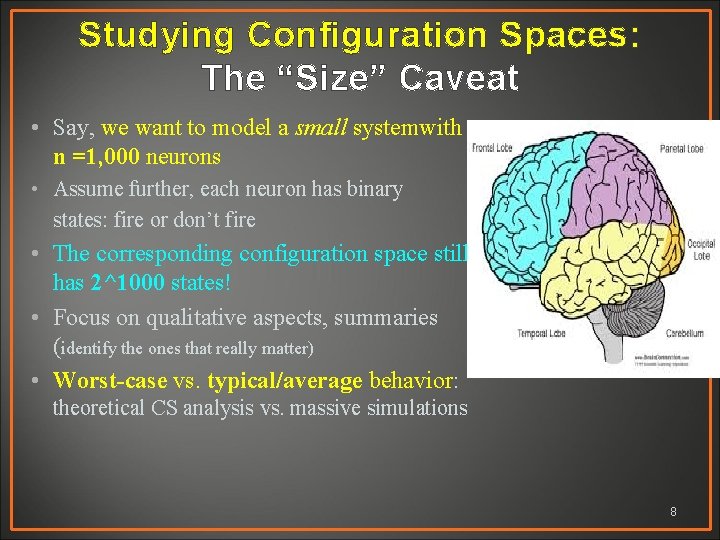
Studying Configuration Spaces: The “Size” Caveat • Say, we want to model a small systemwith n =1, 000 neurons • Assume further, each neuron has binary states: fire or don’t fire • The corresponding configuration space still has 2^1000 states! • Focus on qualitative aspects, summaries (identify the ones that really matter) • Worst-case vs. typical/average behavior: theoretical CS analysis vs. massive simulations 8
Some Classes of Problems About BNA Configuration Space Properties Problems about forward (esp. asymptotic) dynamics: o Reachability of stable states, cycle states, particular subset of states o Speed of convergence to a stable state, find cyclical/periodic states, … Problems about backward dynamics: o Existence/number of predecessors; size/depth of “basin of attraction” o Is dynamics reversible, is global map a bijection on the set of configurations? Existence of various configuration types: o Does a given BNA have a “fixed point”? Temporal cycles? Long transients? o Does a given configuration have a predecessor? A big basin of attraction? Enumeration of particular types of configurations o How many FPs? How many temporal cycles? o Given an arbitrary or specific state, how many predecessors / ancestors? 9
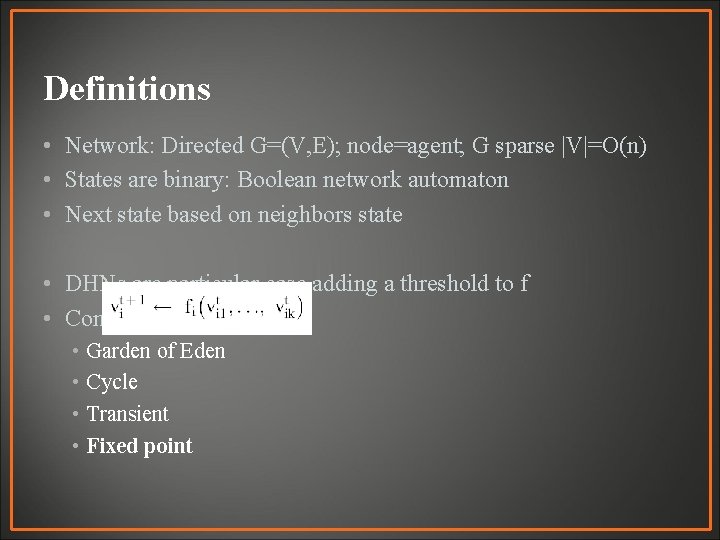
Definitions • Network: Directed G=(V, E); node=agent; G sparse |V|=O(n) • States are binary: Boolean network automaton • Next state based on neighbors state • DHNs are particular case adding a threshold to f • Configurations: • Garden of Eden • Cycle • Transient • Fixed point
Goals • • • Existence of stable configurations Counting stable configurations Finding reachable configurations Filtering out rare/transient configurations Invertible dynamics (going back)
Complexity of counting vs deciding The problems of computing the permanent and counting the # of (perfect) matchings in bipartite graphs [L. Valiant 1979] Class #P: those counting problems accepted by poly-time bounded Nondeterministic Turing Machine s. t. the # of accepting computations equals the # of problem’s solutions #P-complete problems: the hardest in #P NP-complete decision problems have their counting versions #P-complete … but so do several problems (whose decision versions are in) P (e. g. , bipartite matchings, 2 CNF SAT, MON-2 CNF SAT) 12
Theoretical Computer Science 201: How to Prove #P-Completeness • We need efficient (polynomial-time) reductions that preserve the # of solutions • Strongly parsimonious Reductions : poly- time transformations that exactly preserve the # of solutions: # (f(I)) = # (I) • Weakly Parsimonious Reductions : poly-time transformations f that allow the # of solutions of (I) to be efficiently recovered from # (f(I)) Note: weakly parsimonious reductions are, in general, much easier to design than the strongly parsimonious ones (… yet suffice for establishing #P-completeness) 13
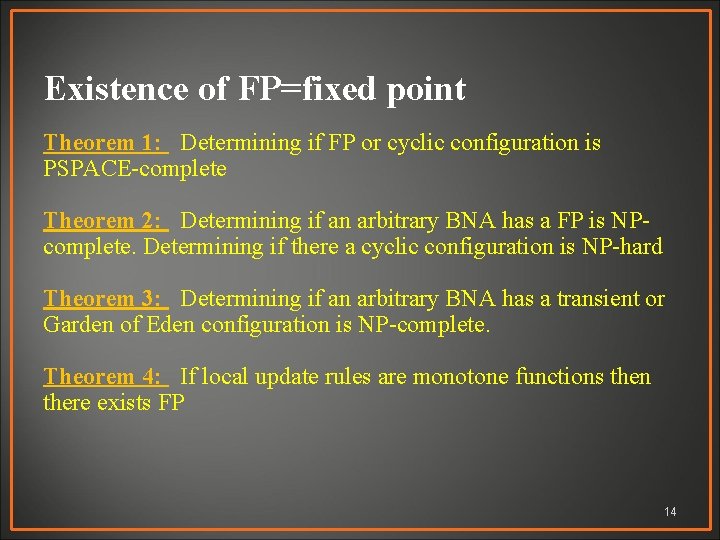
Existence of FP=fixed point Theorem 1: Determining if FP or cyclic configuration is PSPACE-complete Theorem 2: Determining if an arbitrary BNA has a FP is NPcomplete. Determining if there a cyclic configuration is NP-hard Theorem 3: Determining if an arbitrary BNA has a transient or Garden of Eden configuration is NP-complete. Theorem 4: If local update rules are monotone functions then there exists FP 14
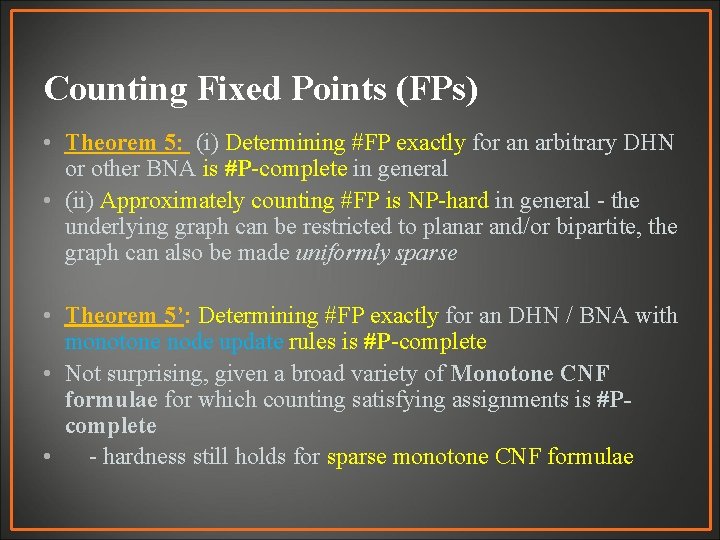
Counting Fixed Points (FPs) • Theorem 5: (i) Determining #FP exactly for an arbitrary DHN or other BNA is #P-complete in general • (ii) Approximately counting #FP is NP-hard in general - the underlying graph can be restricted to planar and/or bipartite, the graph can also be made uniformly sparse • Theorem 5’: Determining #FP exactly for an DHN / BNA with monotone node update rules is #P-complete • Not surprising, given a broad variety of Monotone CNF formulae for which counting satisfying assignments is #Pcomplete • - hardness still holds for sparse monotone CNF formulae
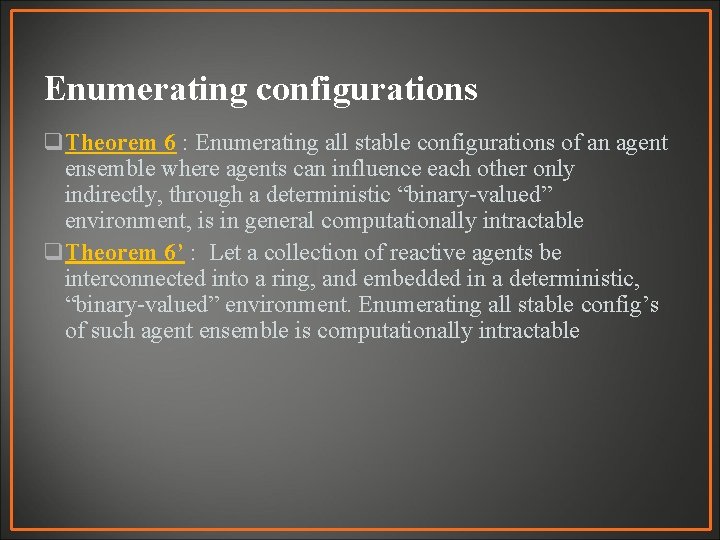
Enumerating configurations q. Theorem 6 : Enumerating all stable configurations of an agent ensemble where agents can influence each other only indirectly, through a deterministic “binary-valued” environment, is in general computationally intractable q. Theorem 6’ : Let a collection of reactive agents be interconnected into a ring, and embedded in a deterministic, “binary-valued” environment. Enumerating all stable config’s of such agent ensemble is computationally intractable
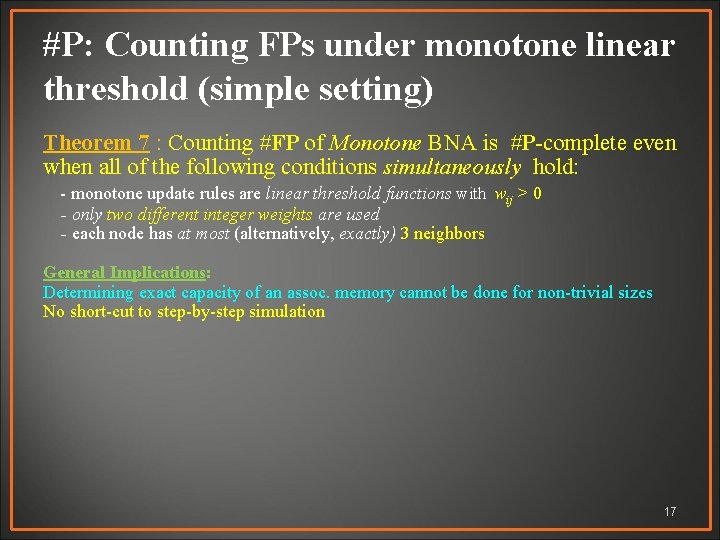
#P: Counting FPs under monotone linear threshold (simple setting) Theorem 7 : Counting #FP of Monotone BNA is #P-complete even when all of the following conditions simultaneously hold: - monotone update rules are linear threshold functions with wij > 0 - only two different integer weights are used - each node has at most (alternatively, exactly) 3 neighbors General Implications: Determining exact capacity of an assoc. memory cannot be done for non-trivial sizes No short-cut to step-by-step simulation 17
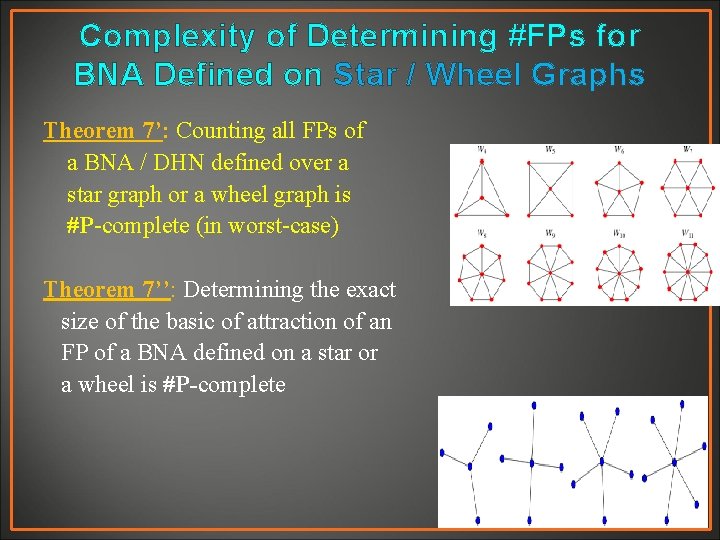
Complexity of Determining #FPs for BNA Defined on Star / Wheel Graphs Theorem 7’: Counting all FPs of a BNA / DHN defined over a star graph or a wheel graph is #P-complete (in worst-case) Theorem 7’’: Determining the exact size of the basic of attraction of an FP of a BNA defined on a star or a wheel is #P-complete 18
Understanding configurations Theorem 7: Given a current configuration of a BNA in a simple deterministic environment, determining in how many ways could that configuration have been reached is intractable Theorem 8: Determining if stable of cyclic behavior are reached is PSPACE-complete Theorem 9: Determining if here are FPs, unreachable configurations, transient configurations is NP-hard. If behavior can be modeled as biunary function these problems are NPcomplete in worst case Theorem 10: Counting FPs, TCs, GEs, # predecessors is #Pcomplete 19
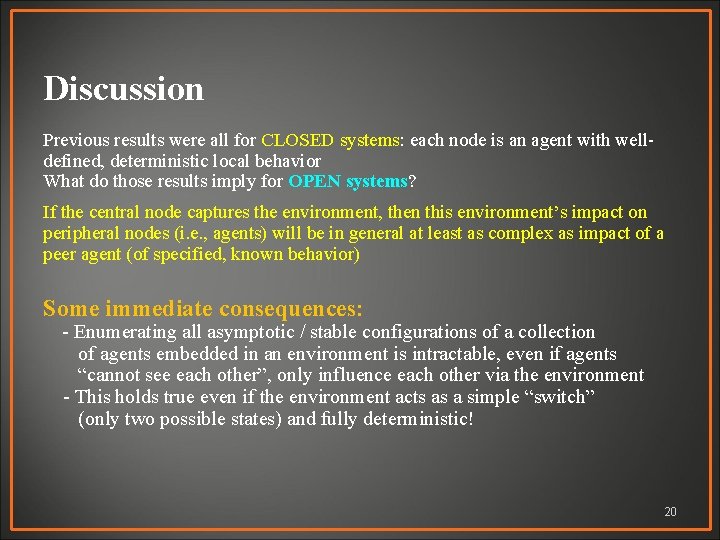
Discussion Previous results were all for CLOSED systems: each node is an agent with welldefined, deterministic local behavior What do those results imply for OPEN systems? If the central node captures the environment, then this environment’s impact on peripheral nodes (i. e. , agents) will be in general at least as complex as impact of a peer agent (of specified, known behavior) Some immediate consequences: - Enumerating all asymptotic / stable configurations of a collection of agents embedded in an environment is intractable, even if agents “cannot see each other”, only influence each other via the environment - This holds true even if the environment acts as a simple “switch” (only two possible states) and fully deterministic! 20
Conclusions We studied dynamics of Boolean Networks by formally investigating their configuration spaces Among various config. space properties, we focused on enumeration problems (how many fixed point configurations, predecessors, possible dynamics? ) These enumeration problems are provably intractable in BNA modeling closed multi-agent systems (no “environment”) Those enumeration problems are at least as hard in open systems setting – even when interaction patterns & environment behavior are fully deterministic and simple 21
Future Work • Identify practical cases where monotone functions can be applied uniformly on every node • Approximate counts via randomized algorithms • Simulations starting from as small set of GEs • Higher probability for one state in each FSM • Small n allows brute force search of stable configurations • Focus on sparse graphs, perhaps with local cliques, instead of dense graphs; remove edges
- Slides: 22