
Boolean Logic CS 202 Spring 2007 Epp sections
Boolean Logic CS 202, Spring 2007 Epp, sections 1. 1 and 1. 2 Aaron Bloomfield 1
Administratrivia • HW 1: due next Friday – Section 1. 1 # 49, 52 – Section 1. 2 # 34, 46 • Today’s lecture will be somewhat of a review • Next week we will see applications of logic 2
Applications of Boolean logic • • Computer programs And computer addition Logic problems Sudoku 3
Boolean propositions • A proposition is a statement that can be either true or false – “The sky is blue” – “I is a Engineering major” – “x == y” • Not propositions: – “Are you Bob? ” – “x : = 7” 4
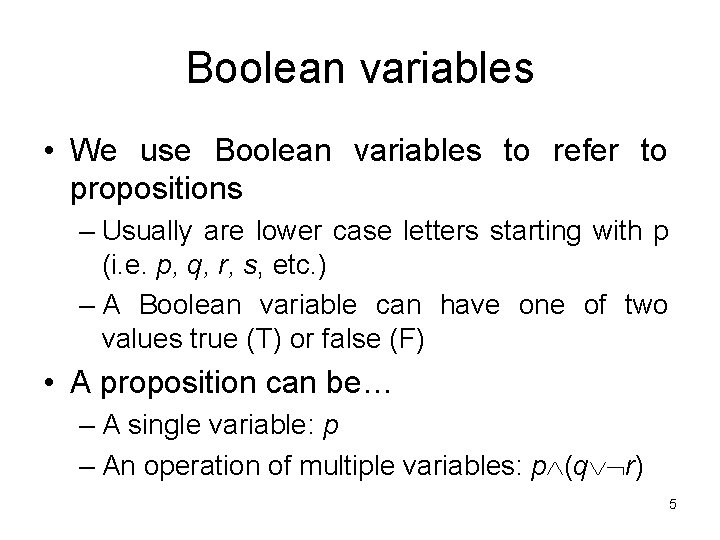
Boolean variables • We use Boolean variables to refer to propositions – Usually are lower case letters starting with p (i. e. p, q, r, s, etc. ) – A Boolean variable can have one of two values true (T) or false (F) • A proposition can be… – A single variable: p – An operation of multiple variables: p (q r) 5
Introduction to Logical Operators • About a dozen logical operators – Similar to algebraic operators + * - / • In the following examples, – p = “Today is Friday” – q = “Today is my birthday” 6
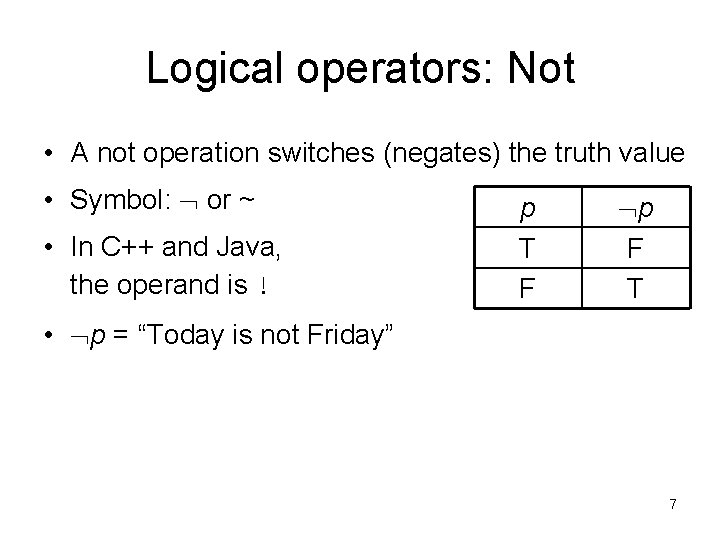
Logical operators: Not • A not operation switches (negates) the truth value • Symbol: or ~ • In C++ and Java, the operand is ! p T F p F T • p = “Today is not Friday” 7
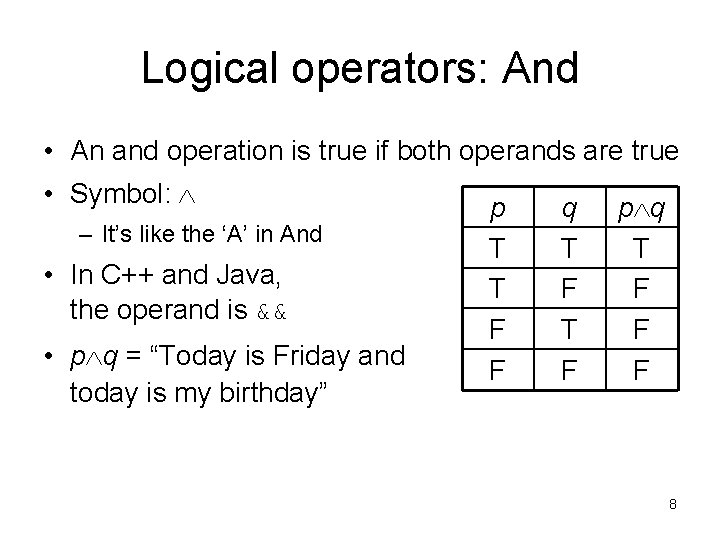
Logical operators: And • An and operation is true if both operands are true • Symbol: – It’s like the ‘A’ in And • In C++ and Java, the operand is && • p q = “Today is Friday and today is my birthday” p T T F F q T F p q T F F F 8
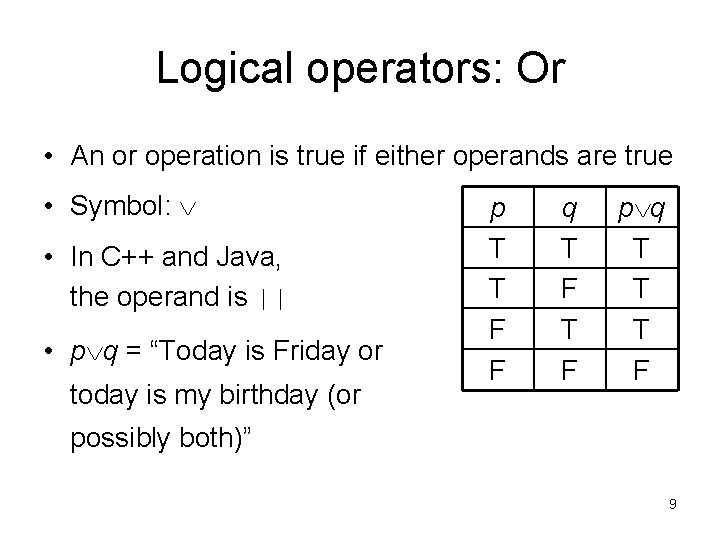
Logical operators: Or • An or operation is true if either operands are true • Symbol: • In C++ and Java, the operand is || • p q = “Today is Friday or today is my birthday (or p T T F F q T F p q T T T F possibly both)” 9
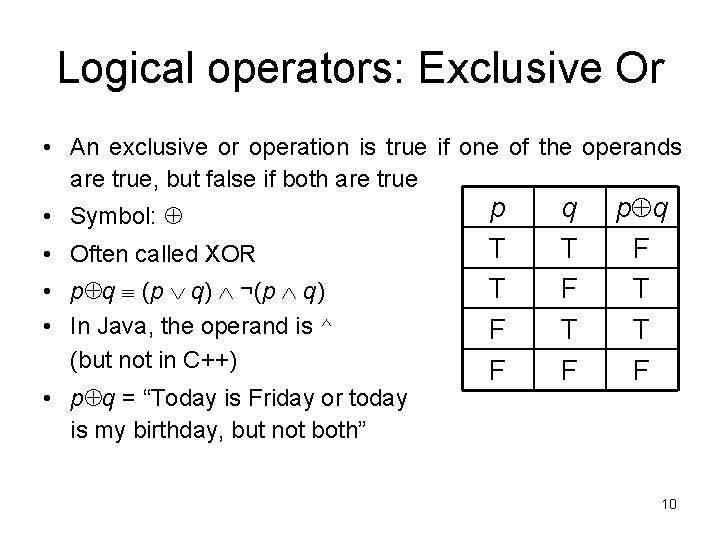
Logical operators: Exclusive Or • An exclusive or operation is true if one of the operands are true, but false if both are true • Symbol: • Often called XOR • p q (p q) ¬(p q) • In Java, the operand is ^ (but not in C++) • p q = “Today is Friday or today is my birthday, but not both” p T T F F q T F p q F T T F 10
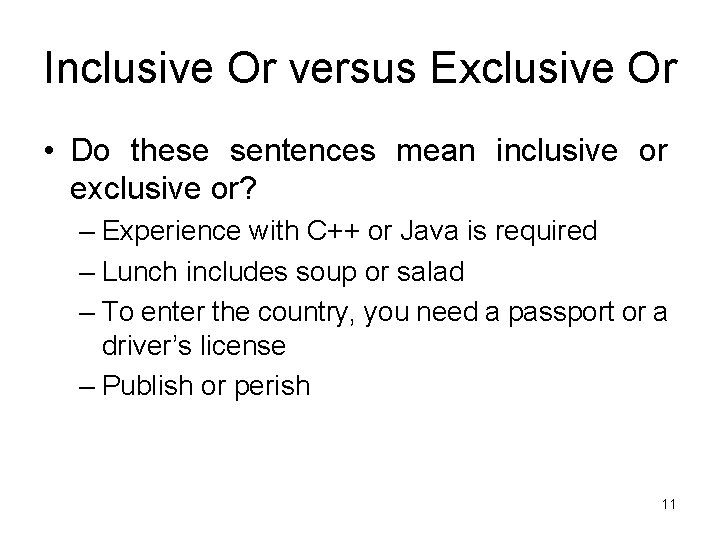
Inclusive Or versus Exclusive Or • Do these sentences mean inclusive or exclusive or? – Experience with C++ or Java is required – Lunch includes soup or salad – To enter the country, you need a passport or a driver’s license – Publish or perish 11
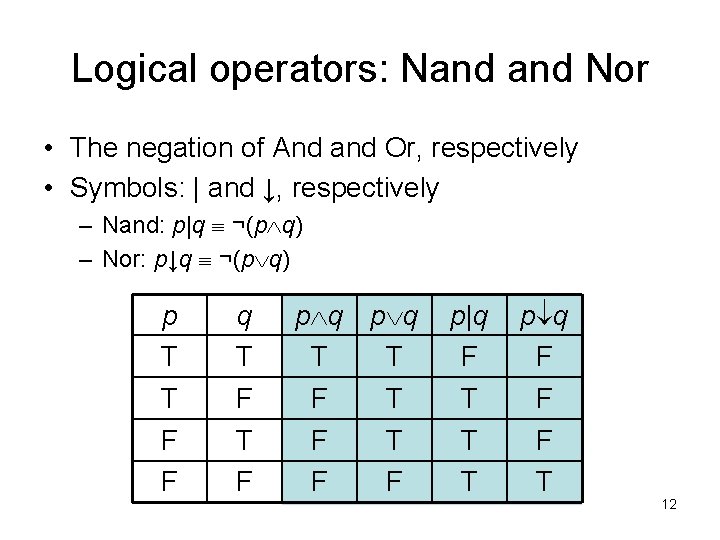
Logical operators: Nand Nor • The negation of And and Or, respectively • Symbols: | and ↓, respectively – Nand: p|q ¬(p q) – Nor: p↓q ¬(p q) p T T F F q T F p q T T F T F F p|q F T T T p q F F F T 12
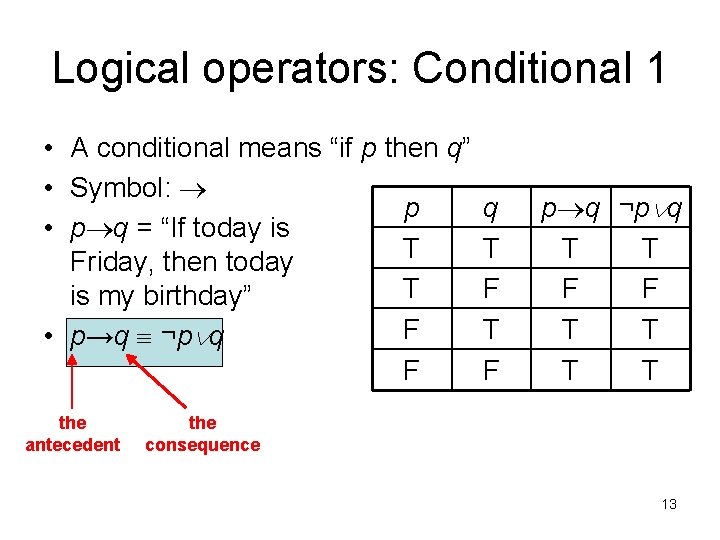
Logical operators: Conditional 1 • A conditional means “if p then q” • Symbol: p • p q = “If today is T Friday, then today T is my birthday” F • p→q ¬p q F the antecedent q T F p q ¬p q T T F F T T the consequence 13
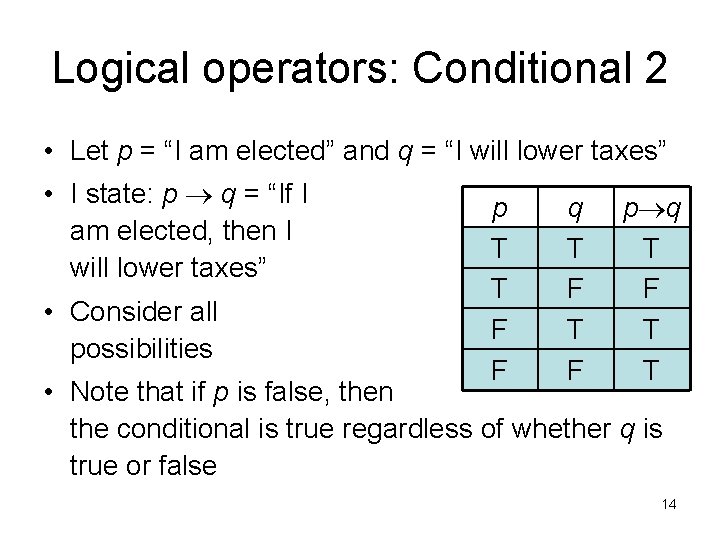
Logical operators: Conditional 2 • Let p = “I am elected” and q = “I will lower taxes” • I state: p q = “If I am elected, then I will lower taxes” • Consider all possibilities p T T F F q T F p q T F T T • Note that if p is false, then the conditional is true regardless of whether q is true or false 14
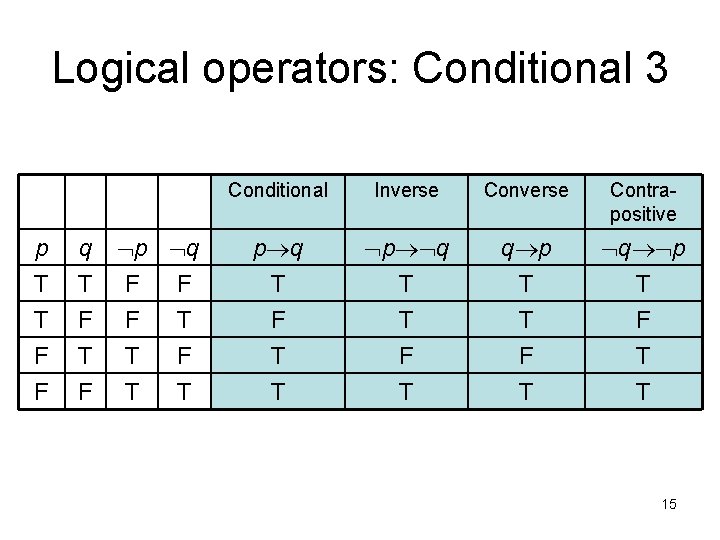
Logical operators: Conditional 3 p T T F F q T F p q F F F T T Conditional Inverse Contrapositive p q T F T T p q T T F T q p T T F T q p T F T T 15
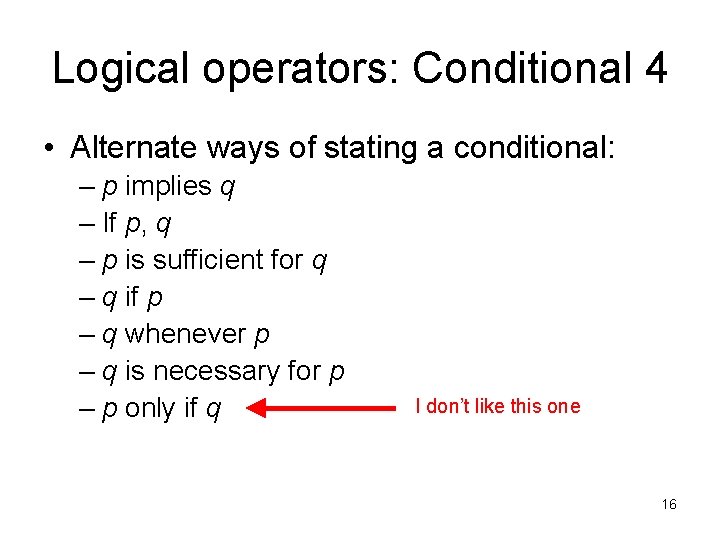
Logical operators: Conditional 4 • Alternate ways of stating a conditional: – p implies q – If p, q – p is sufficient for q – q if p – q whenever p – q is necessary for p – p only if q I don’t like this one 16
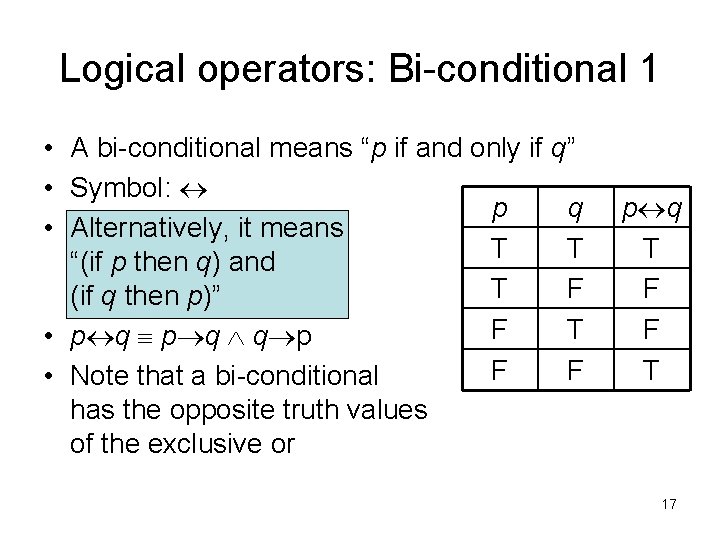
Logical operators: Bi-conditional 1 • A bi-conditional means “p if and only if q” • Symbol: p q • Alternatively, it means T T “(if p then q) and T F (if q then p)” F T • p q q p F F • Note that a bi-conditional has the opposite truth values of the exclusive or p q T F F T 17
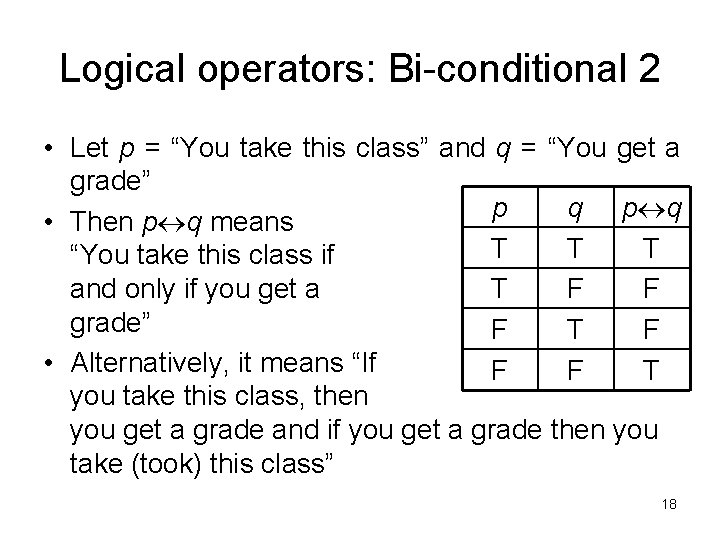
Logical operators: Bi-conditional 2 • Let p = “You take this class” and q = “You get a grade” p q • Then p q means T T T “You take this class if and only if you get a T F F grade” F T F • Alternatively, it means “If F F T you take this class, then you get a grade and if you get a grade then you take (took) this class” 18
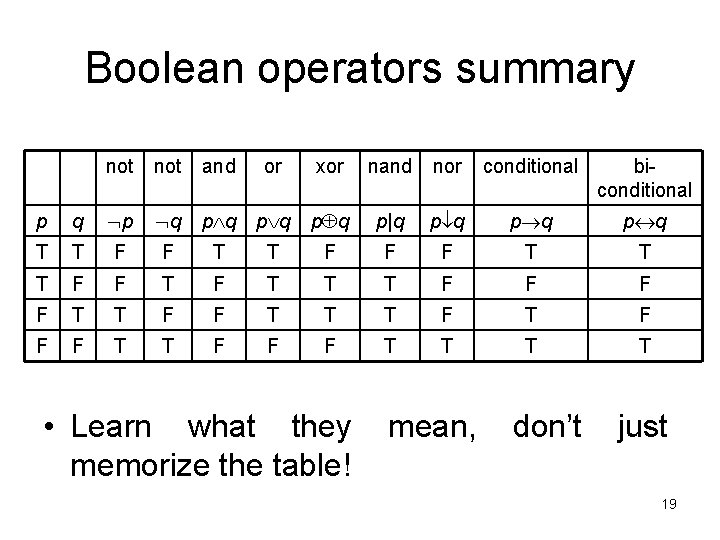
Boolean operators summary not and or p q xor nand nor conditional biconditional p q p|q p q p q p q T T F F F T T T F F T T T F F F T T • Learn what they memorize the table! mean, don’t just 19
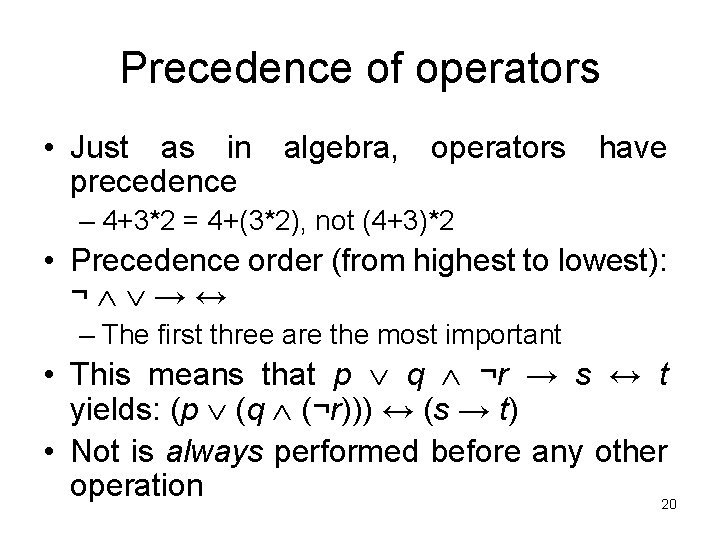
Precedence of operators • Just as in algebra, operators have precedence – 4+3*2 = 4+(3*2), not (4+3)*2 • Precedence order (from highest to lowest): ¬ →↔ – The first three are the most important • This means that p q ¬r → s ↔ t yields: (p (q (¬r))) ↔ (s → t) • Not is always performed before any other operation 20
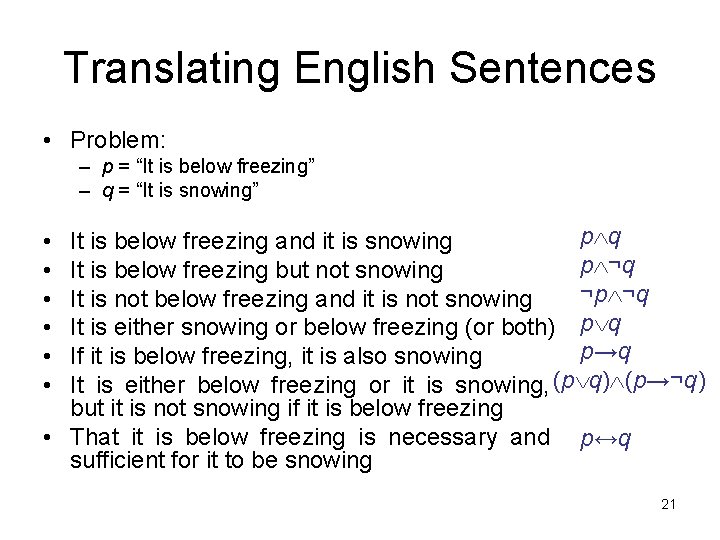
Translating English Sentences • Problem: – p = “It is below freezing” – q = “It is snowing” p q It is below freezing and it is snowing p ¬q It is below freezing but not snowing ¬p ¬q It is not below freezing and it is not snowing It is either snowing or below freezing (or both) p q p→q If it is below freezing, it is also snowing It is either below freezing or it is snowing, (p q) (p→¬q) but it is not snowing if it is below freezing • That it is below freezing is necessary and p↔q sufficient for it to be snowing • • • 21
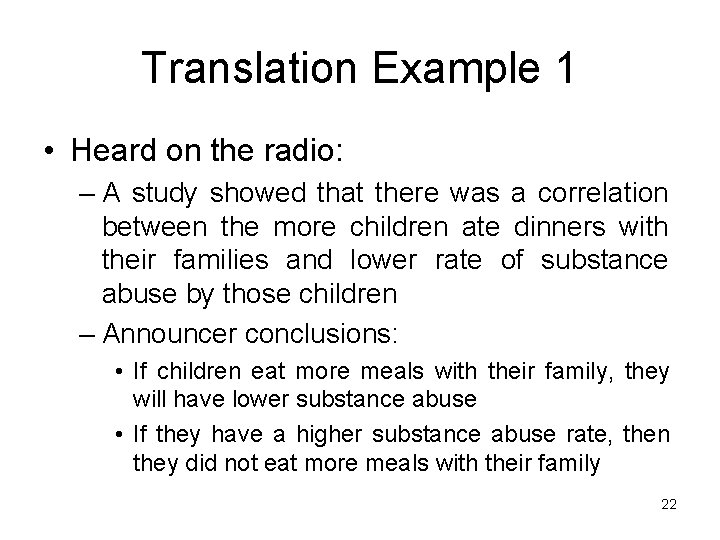
Translation Example 1 • Heard on the radio: – A study showed that there was a correlation between the more children ate dinners with their families and lower rate of substance abuse by those children – Announcer conclusions: • If children eat more meals with their family, they will have lower substance abuse • If they have a higher substance abuse rate, then they did not eat more meals with their family 22
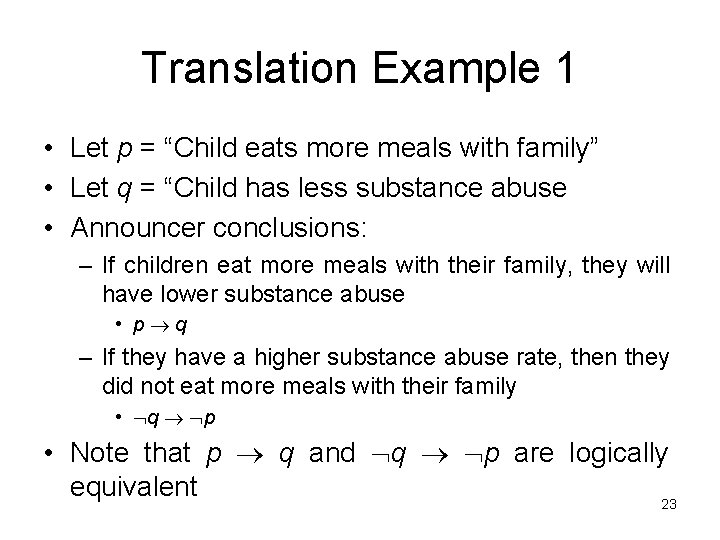
Translation Example 1 • Let p = “Child eats more meals with family” • Let q = “Child has less substance abuse • Announcer conclusions: – If children eat more meals with their family, they will have lower substance abuse • p q – If they have a higher substance abuse rate, then they did not eat more meals with their family • q p • Note that p q and q p are logically equivalent 23
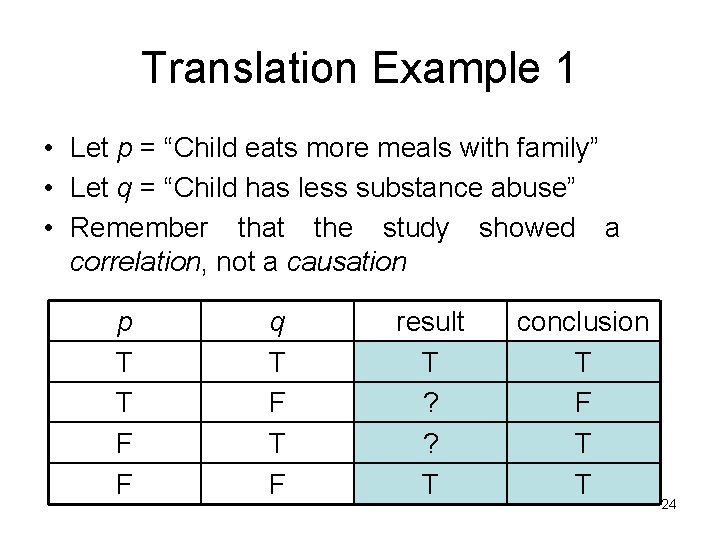
Translation Example 1 • Let p = “Child eats more meals with family” • Let q = “Child has less substance abuse” • Remember that the study showed a correlation, not a causation p T T F F q T F result T ? ? T conclusion T F T T 24
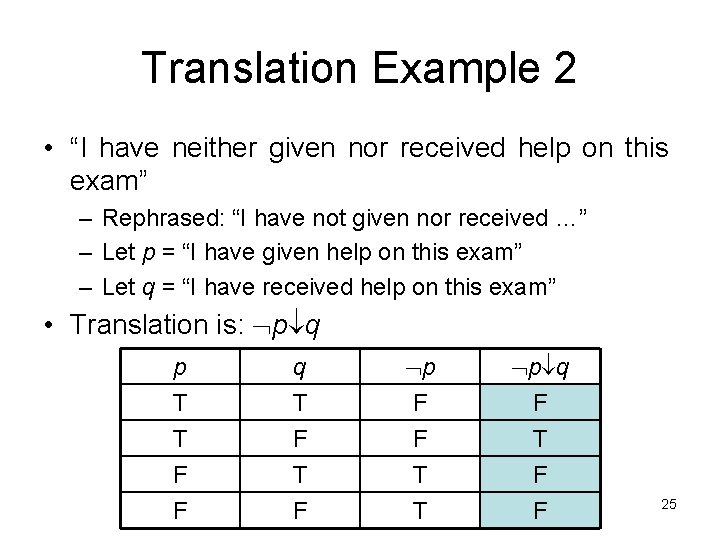
Translation Example 2 • “I have neither given nor received help on this exam” – Rephrased: “I have not given nor received …” – Let p = “I have given help on this exam” – Let q = “I have received help on this exam” • Translation is: p q p T q T p F p q F T F T T F F F T F 25
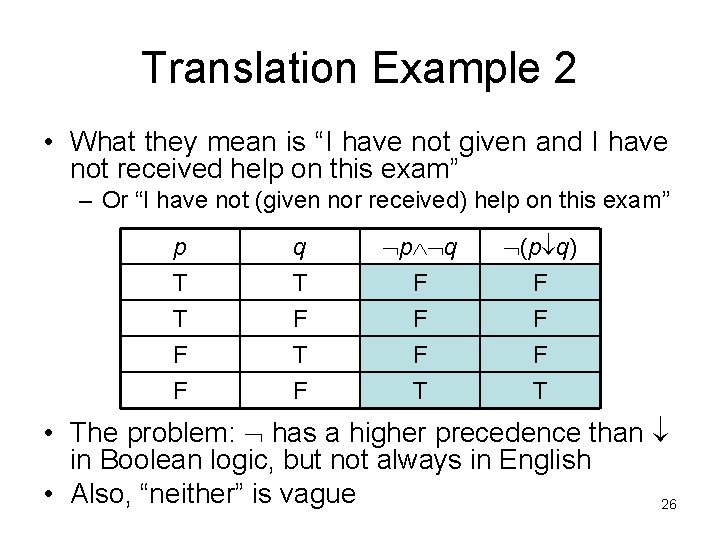
Translation Example 2 • What they mean is “I have not given and I have not received help on this exam” – Or “I have not (given nor received) help on this exam” p T T F q T F T p q F F F (p q) F F F T T • The problem: has a higher precedence than in Boolean logic, but not always in English • Also, “neither” is vague 26
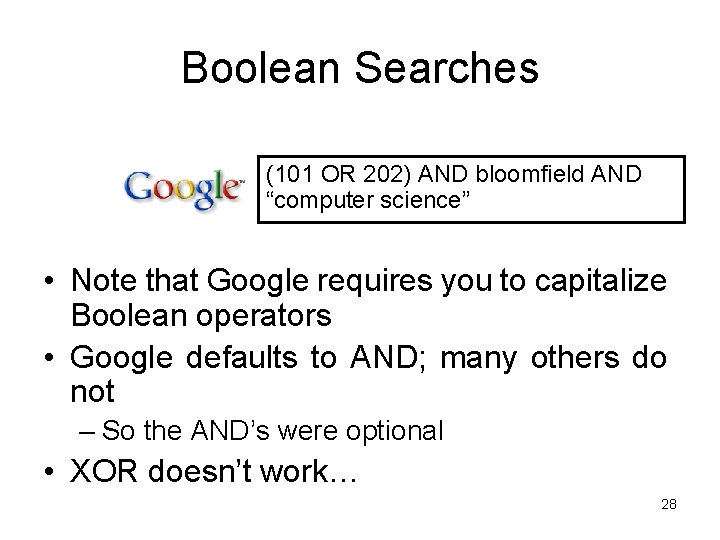
Boolean Searches (101 OR 202) AND bloomfield AND “computer science” • Note that Google requires you to capitalize Boolean operators • Google defaults to AND; many others do not – So the AND’s were optional • XOR doesn’t work… 28
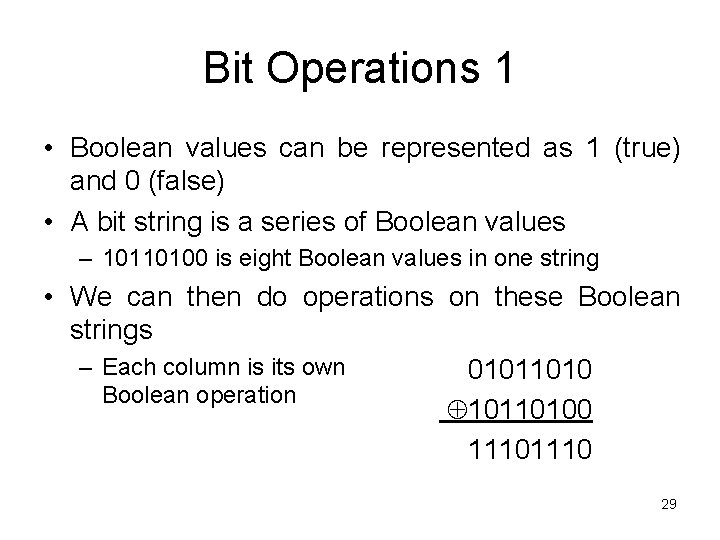
Bit Operations 1 • Boolean values can be represented as 1 (true) and 0 (false) • A bit string is a series of Boolean values – 10110100 is eight Boolean values in one string • We can then do operations on these Boolean strings – Each column is its own 01011010 Boolean operation 10110100 1110 29
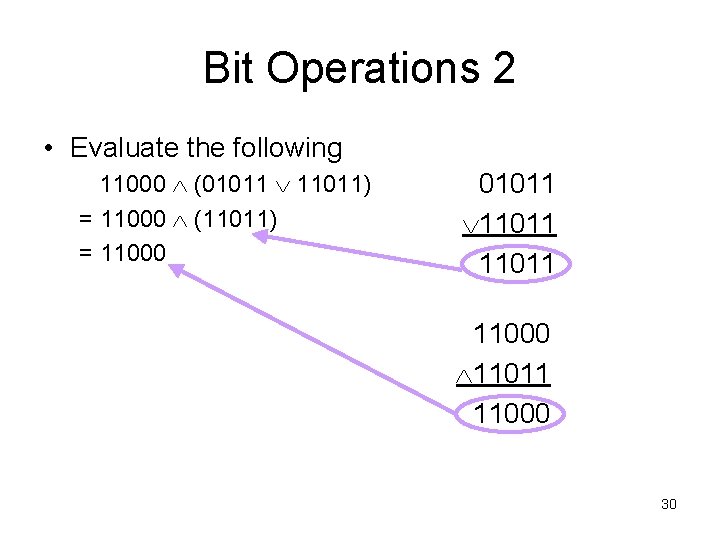
Bit Operations 2 • Evaluate the following 11000 (01011 11011) = 11000 (11011) = 11000 01011 11011 11000 30
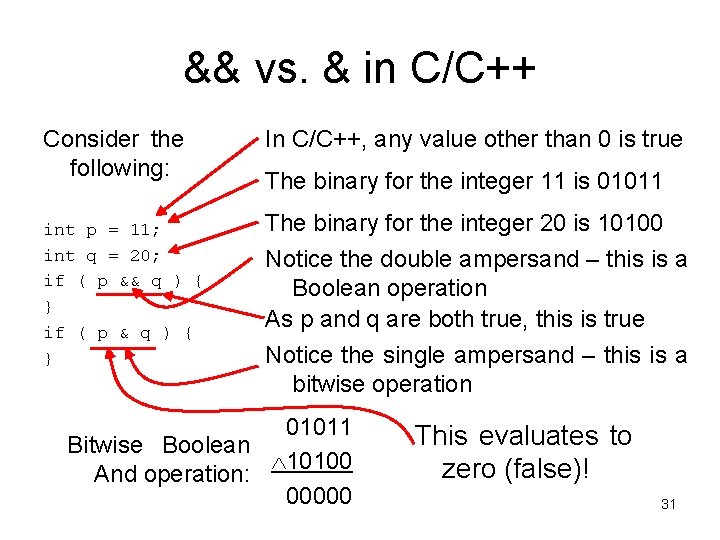
&& vs. & in C/C++ Consider the following: int p = 11; int q = 20; if ( p && q ) { } if ( p & q ) { } In C/C++, any value other than 0 is true The binary for the integer 11 is 01011 The binary for the integer 20 is 10100 Notice the double ampersand – this is a Boolean operation As p and q are both true, this is true Notice the single ampersand – this is a bitwise operation 01011 Bitwise Boolean 10100 And operation: 00000 This evaluates to zero (false)! 31
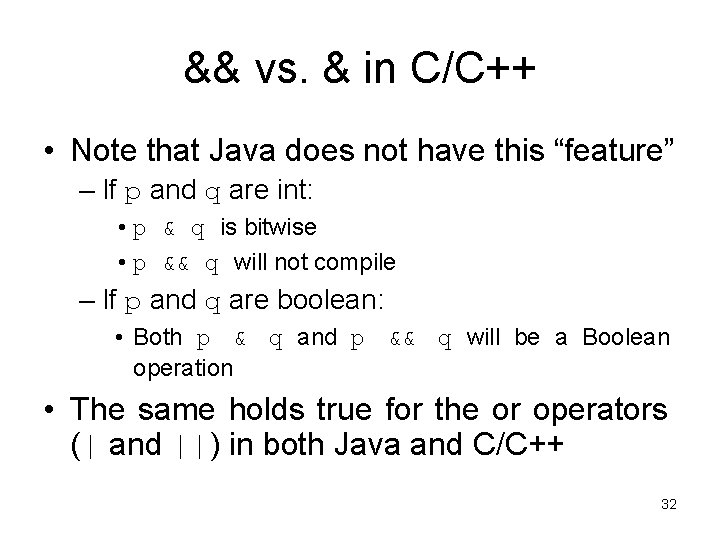
&& vs. & in C/C++ • Note that Java does not have this “feature” – If p and q are int: • p & q is bitwise • p && q will not compile – If p and q are boolean: • Both p & q and p && q will be a Boolean operation • The same holds true for the or operators (| and ||) in both Java and C/C++ 32
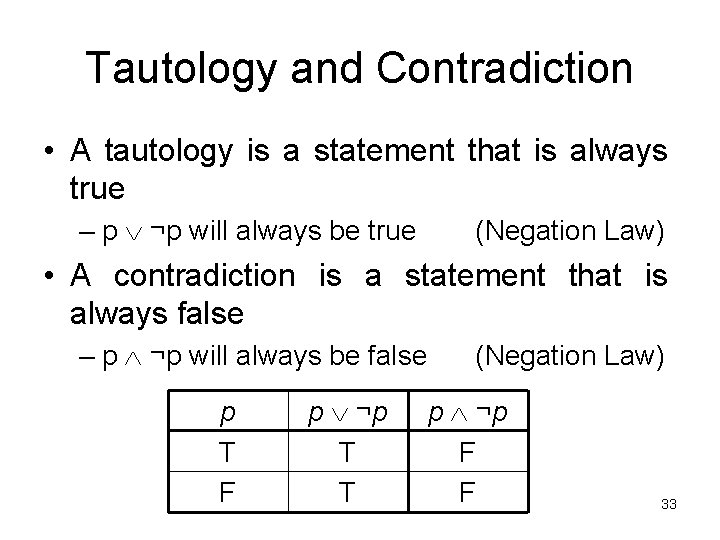
Tautology and Contradiction • A tautology is a statement that is always true – p ¬p will always be true (Negation Law) • A contradiction is a statement that is always false – p ¬p will always be false p T F p ¬p T T (Negation Law) p ¬p F F 33
Logical Equivalence • A logical equivalence means that the two sides always have the same truth values – Symbol is ≡ or • We’ll use ≡, so as not to confuse it with the biconditional 34
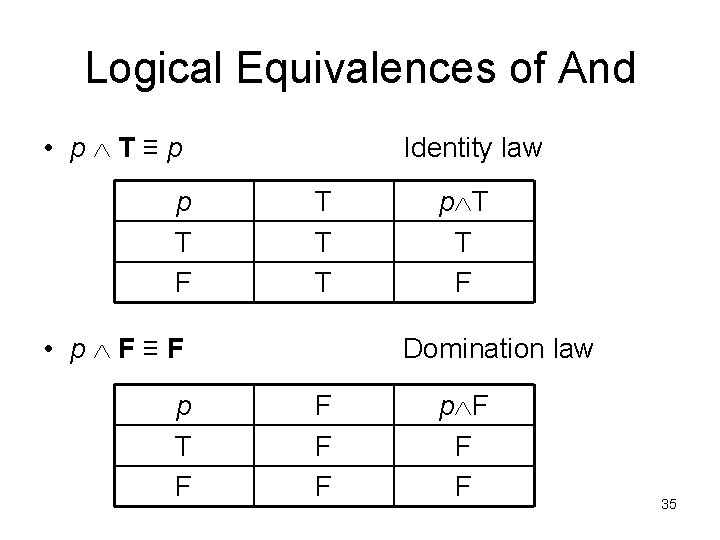
Logical Equivalences of And • p T≡p p T F Identity law T T T • p F≡F p T T F Domination law F F F p F F F 35
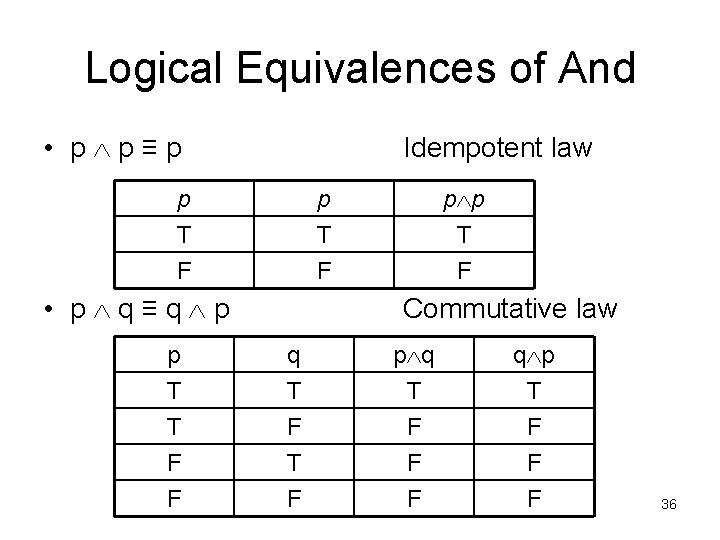
Logical Equivalences of And • p p≡p Idempotent law p T F • p q≡q p p p T F Commutative law p T T F q T F T p q T F F q p T F F F 36
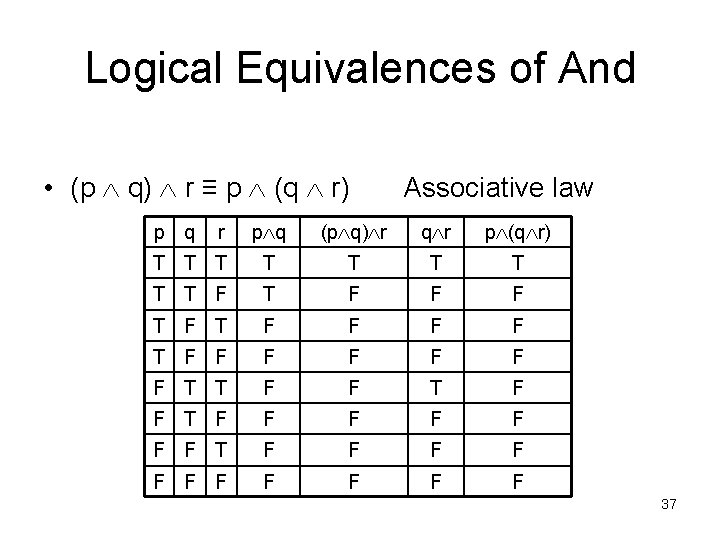
Logical Equivalences of And • (p q) r ≡ p (q r) p q r Associative law p q (p q) r q r p (q r) T T T T T F T F F F F T T F F F F F F 37
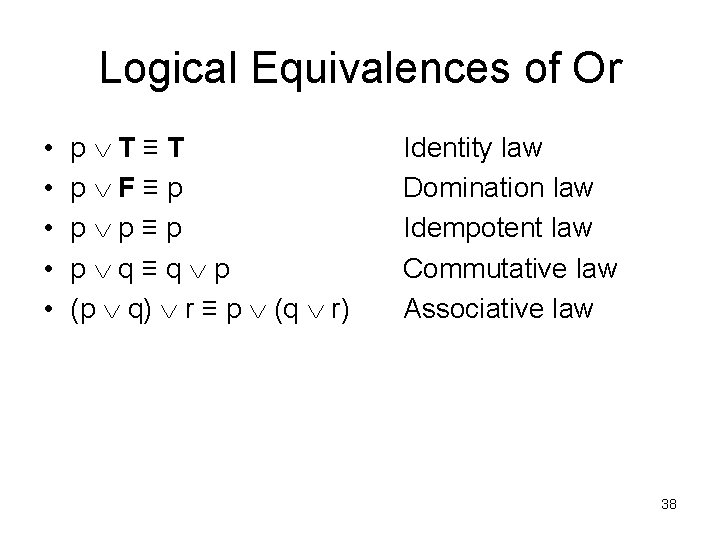
Logical Equivalences of Or • • • p T≡T p F≡p p p≡p p q≡q p (p q) r ≡ p (q r) Identity law Domination law Idempotent law Commutative law Associative law 38
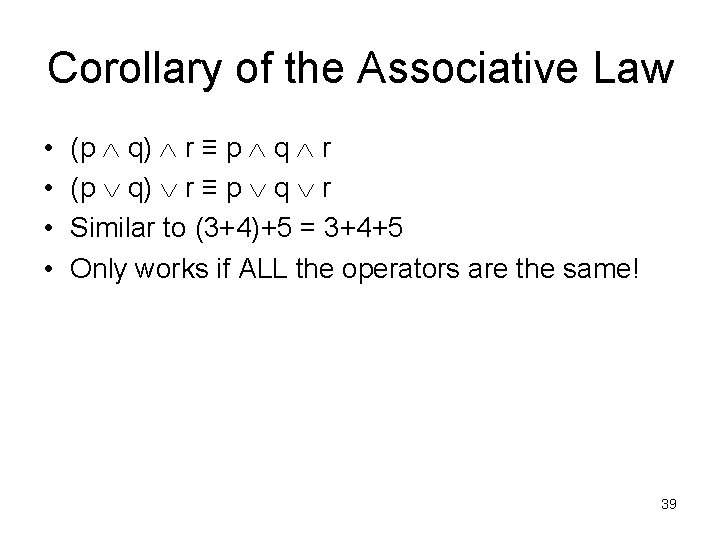
Corollary of the Associative Law • • (p q) r ≡ p q r Similar to (3+4)+5 = 3+4+5 Only works if ALL the operators are the same! 39
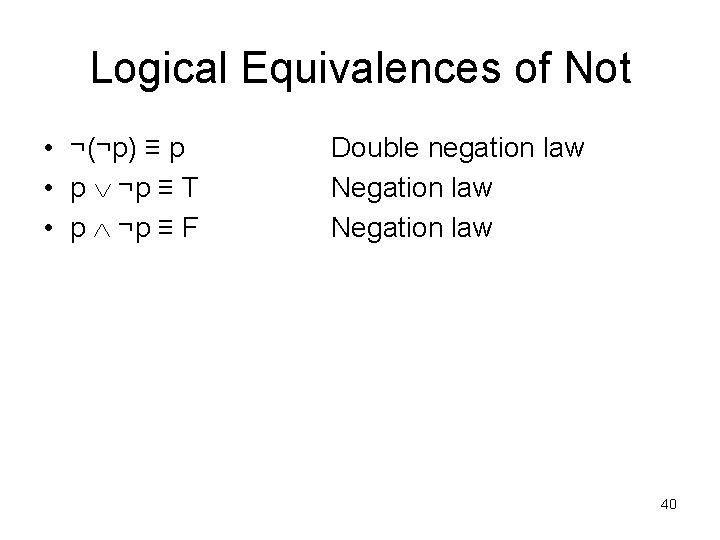
Logical Equivalences of Not • ¬(¬p) ≡ p • p ¬p ≡ T • p ¬p ≡ F Double negation law Negation law 40
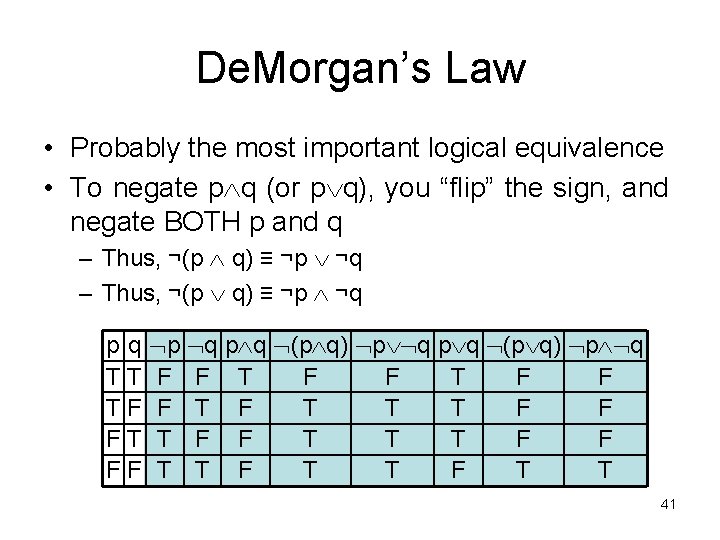
De. Morgan’s Law • Probably the most important logical equivalence • To negate p q (or p q), you “flip” the sign, and negate BOTH p and q – Thus, ¬(p q) ≡ ¬p ¬q p T T F F q T F p F F T T q F T p q (p q) p q T F F F T T 41
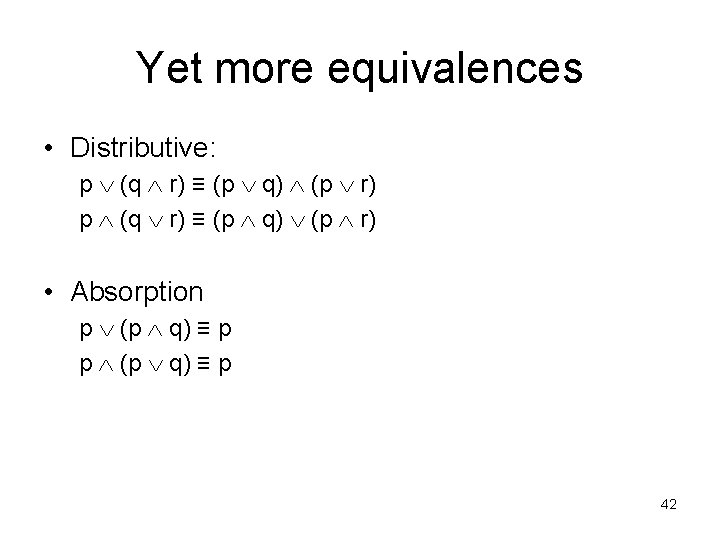
Yet more equivalences • Distributive: p (q r) ≡ (p q) (p r) • Absorption p (p q) ≡ p 42
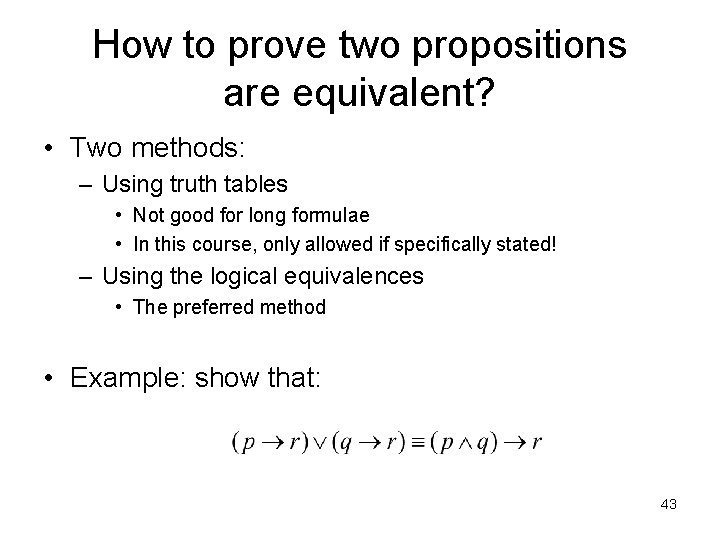
How to prove two propositions are equivalent? • Two methods: – Using truth tables • Not good for long formulae • In this course, only allowed if specifically stated! – Using the logical equivalences • The preferred method • Example: show that: 43
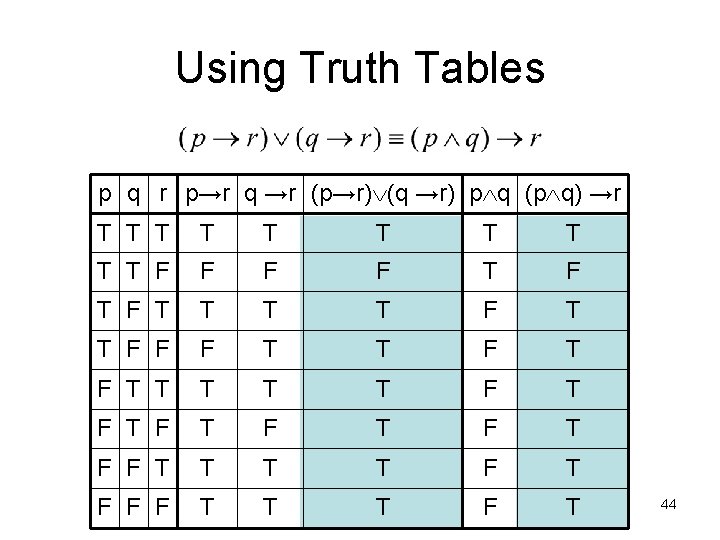
Using Truth Tables p q r p→r q →r (p→r) (q →r) p q (p q) →r T T T T T F F T F T T F F F T T T F T F T F F T T F T F F F T T T F T 44
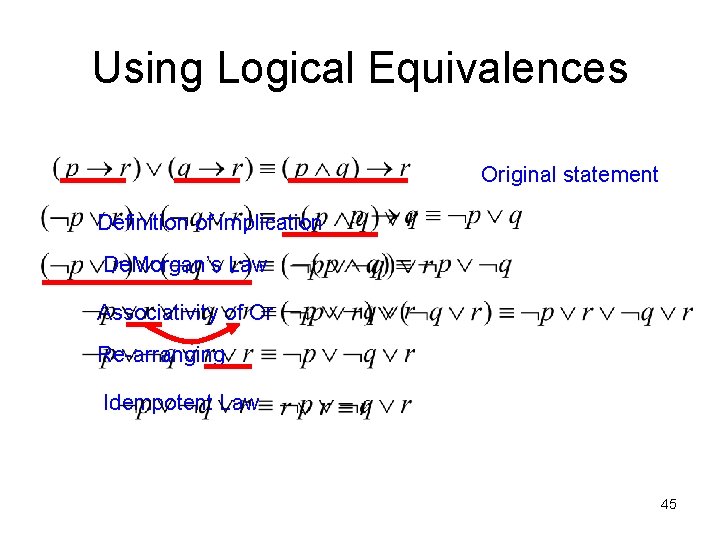
Using Logical Equivalences Original statement Definition of implication De. Morgan’s Law Associativity of Or Re-arranging Idempotent Law 45
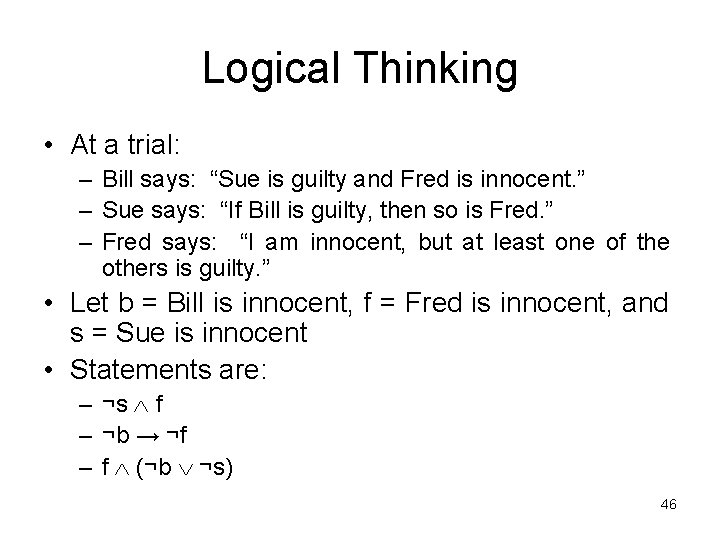
Logical Thinking • At a trial: – Bill says: “Sue is guilty and Fred is innocent. ” – Sue says: “If Bill is guilty, then so is Fred. ” – Fred says: “I am innocent, but at least one of the others is guilty. ” • Let b = Bill is innocent, f = Fred is innocent, and s = Sue is innocent • Statements are: – ¬s f – ¬b → ¬f – f (¬b ¬s) 46
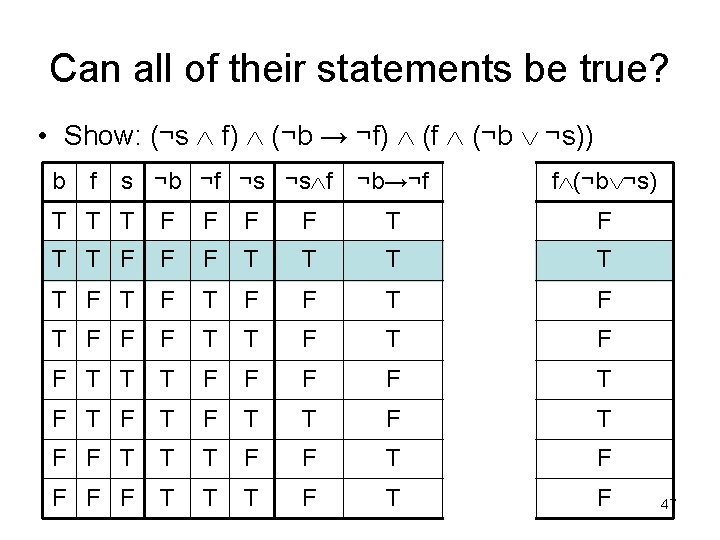
Can all of their statements be true? • Show: (¬s f) (¬b → ¬f) (f (¬b ¬s)) b f s ¬b ¬f ¬s ¬s f ¬b→¬f ¬b ¬s f (¬b ¬s) T T T F F T T F F F T T T F T F F F T T T F F T T F T F T T F F T T T F 47
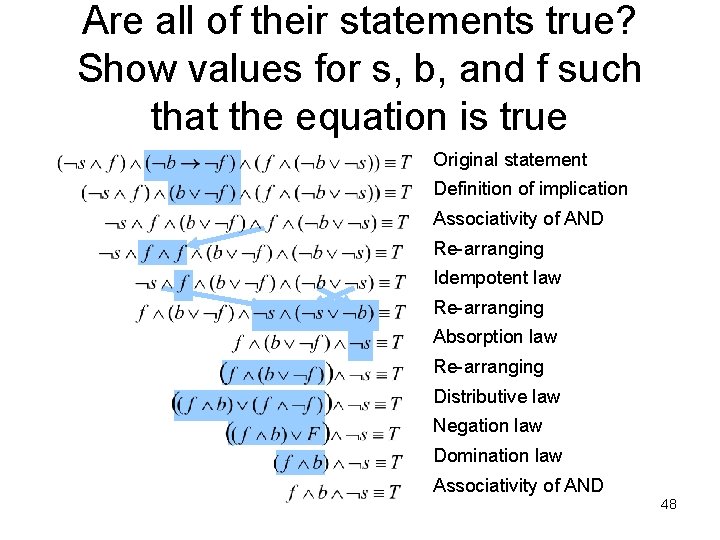
Are all of their statements true? Show values for s, b, and f such that the equation is true Original statement Definition of implication Associativity of AND Re-arranging Idempotent law Re-arranging Absorption law Re-arranging Distributive law Negation law Domination law Associativity of AND 48
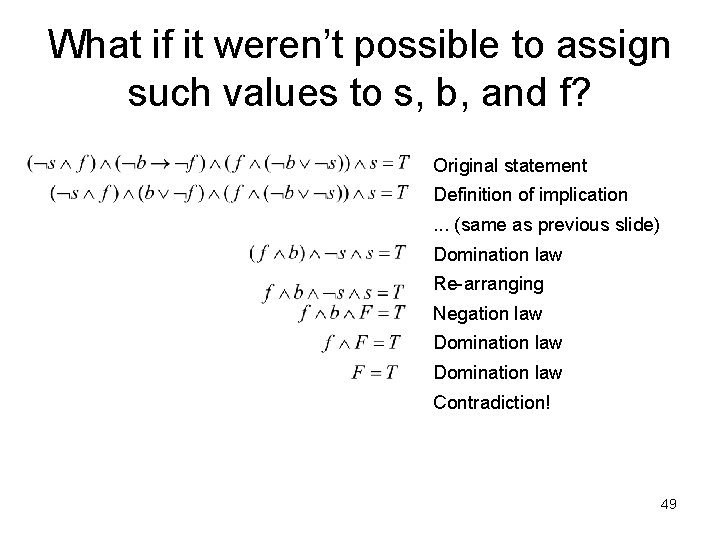
What if it weren’t possible to assign such values to s, b, and f? Original statement Definition of implication. . . (same as previous slide) Domination law Re-arranging Negation law Domination law Contradiction! 49
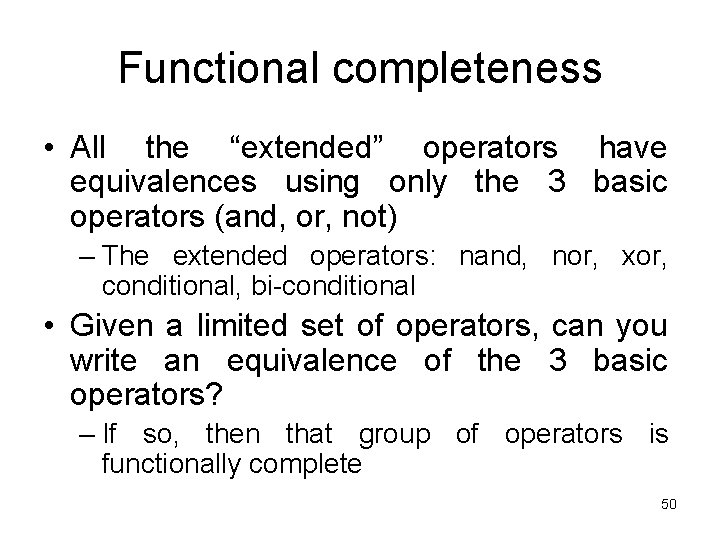
Functional completeness • All the “extended” operators have equivalences using only the 3 basic operators (and, or, not) – The extended operators: nand, nor, xor, conditional, bi-conditional • Given a limited set of operators, can you write an equivalence of the 3 basic operators? – If so, then that group of operators is functionally complete 50
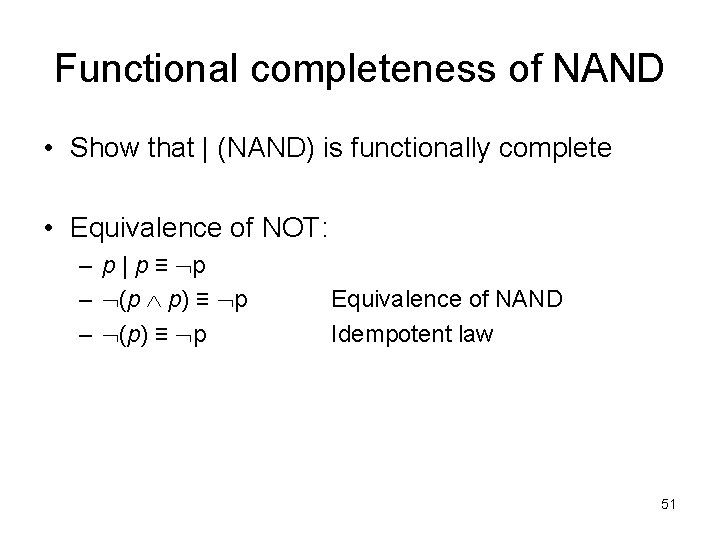
Functional completeness of NAND • Show that | (NAND) is functionally complete • Equivalence of NOT: – p | p ≡ p – (p p) ≡ p – (p) ≡ p Equivalence of NAND Idempotent law 51
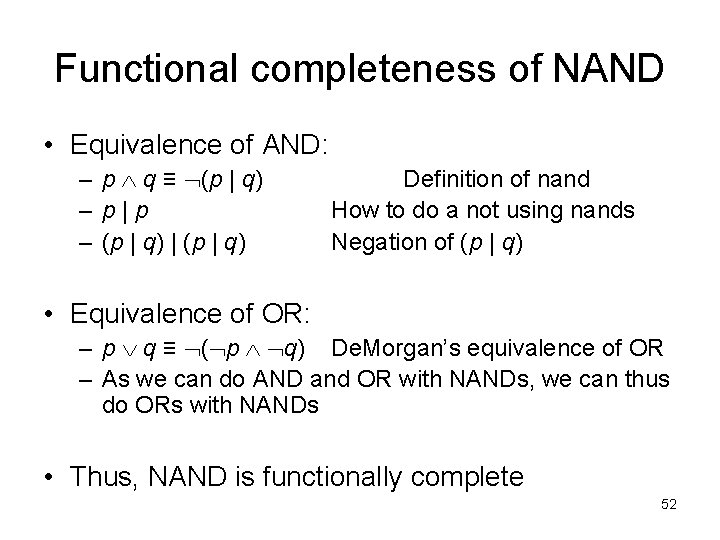
Functional completeness of NAND • Equivalence of AND: – p q ≡ (p | q) – p|p – (p | q) | (p | q) Definition of nand How to do a not using nands Negation of (p | q) • Equivalence of OR: – p q ≡ ( p q) De. Morgan’s equivalence of OR – As we can do AND and OR with NANDs, we can thus do ORs with NANDs • Thus, NAND is functionally complete 52
- Slides: 51