
Boolean and Vector Space Retrieval Models Sampath Jayarathna

Boolean and Vector Space Retrieval Models Sampath Jayarathna Cal Poly Pomona Credit for some of the slides in this lecture goes to Prof. Ray Mooney at UT Austin
Retrieval Models • A retrieval model specifies the details of: • Document representation • Query representation • Retrieval function • Determines a notion of relevance. • Notion of relevance can be binary or continuous (i. e. ranked retrieval). 2
Classes of Retrieval Models • Boolean models • Vector space models (statistical/algebraic) • Latent Semantic Indexing • Probabilistic models • Basic probabilistic model • Bayesian inference networks • Language models 3
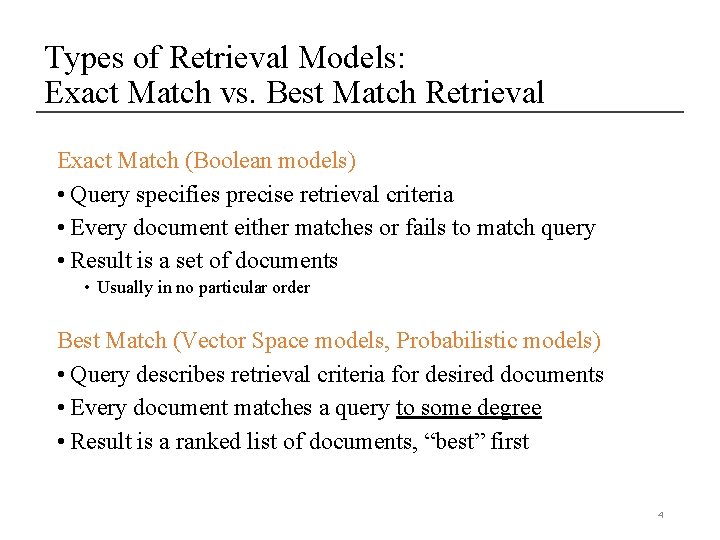
Types of Retrieval Models: Exact Match vs. Best Match Retrieval Exact Match (Boolean models) • Query specifies precise retrieval criteria • Every document either matches or fails to match query • Result is a set of documents • Usually in no particular order Best Match (Vector Space models, Probabilistic models) • Query describes retrieval criteria for desired documents • Every document matches a query to some degree • Result is a ranked list of documents, “best” first 4

Exact Match vs. Best Match Retrieval • Best-match models are usually more accurate / effective • Good documents appear at the top of the rankings • Good documents often don’t exactly match the query • Query was too strict • “Multimedia AND NOT (Apple OR IBM OR Microsoft)” • Document didn’t match user expectations • “multi database retrieval” vs “multi db retrieval” • Exact match still prevalent in some markets • • Large installed base that doesn’t want to migrate to new software Efficiency: Exact match is very fast, good for high volume tasks Sufficient for some tasks Web “advanced search” 5
Common Preprocessing Steps • Strip unwanted characters/markup (e. g. HTML tags, punctuation, numbers, etc. ). • Break into tokens (keywords) on whitespace. • Stem tokens to “root” words • computational comput • Remove common stopwords (e. g. a, the, it, etc. ). • Detect common phrases (possibly using a domain specific dictionary). • Build inverted index (keyword list of docs containing it). 6
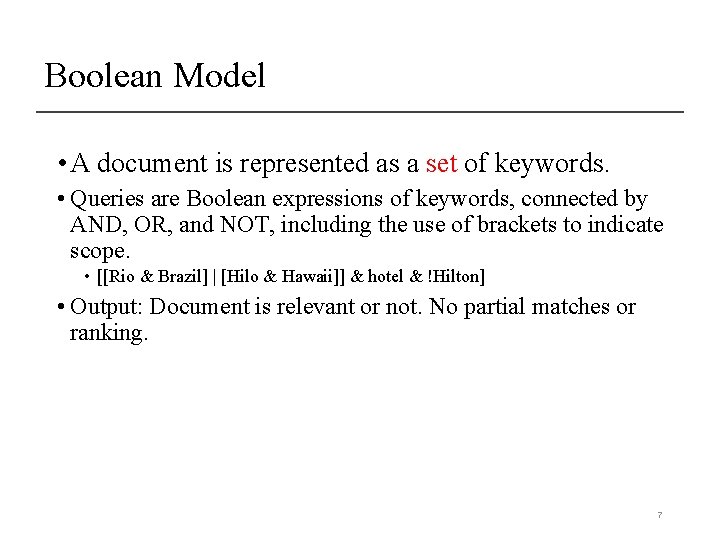
Boolean Model • A document is represented as a set of keywords. • Queries are Boolean expressions of keywords, connected by AND, OR, and NOT, including the use of brackets to indicate scope. • [[Rio & Brazil] | [Hilo & Hawaii]] & hotel & !Hilton] • Output: Document is relevant or not. No partial matches or ranking. 7
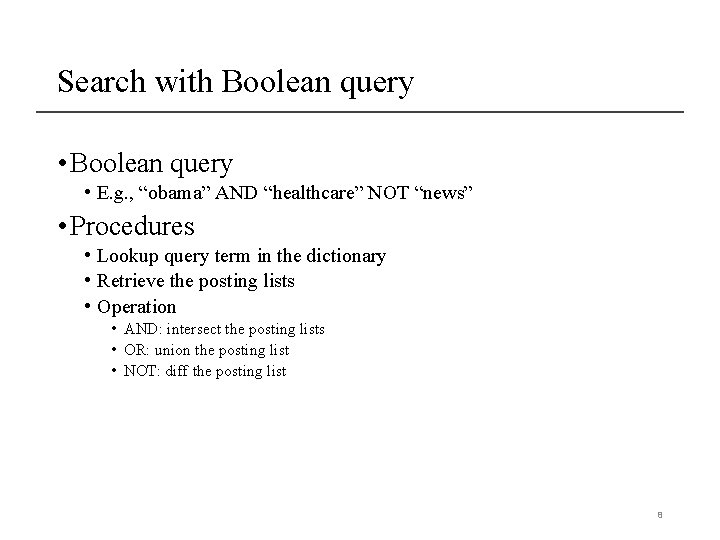
Search with Boolean query • E. g. , “obama” AND “healthcare” NOT “news” • Procedures • Lookup query term in the dictionary • Retrieve the posting lists • Operation • AND: intersect the posting lists • OR: union the posting list • NOT: diff the posting list 8
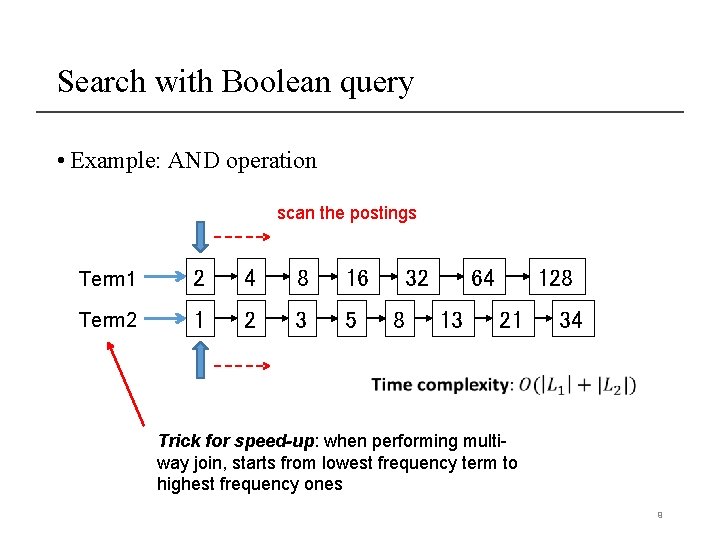
Search with Boolean query • Example: AND operation scan the postings Term 1 2 4 8 16 Term 2 1 2 3 5 32 8 64 13 128 21 34 Trick for speed-up: when performing multiway join, starts from lowest frequency term to highest frequency ones 9

Boolean Retrieval Model • Popular retrieval model because: • Easy to understand for simple queries. • Clean formalism. • Boolean models can be extended to include ranking. • Reasonably efficient implementations possible for normal queries. 10

Boolean Models Problems • The query is unlikely precise. Studies show that people are not good at creating Boolean queries • • People overestimate the quality of the queries they create Queries are too strict: Few relevant documents found Queries are too loose: Too many documents found (few relevant) It is hard to find the right position between these two extremes (hard for users to specify constraints) • Even if it is accurate • Not all users would like to use such queries • All relevant documents are not equally important • No one would go through all the matched results • Difficult to perform relevance feedback. • If a document is identified by the user as relevant or irrelevant, how should the query be modified? 11
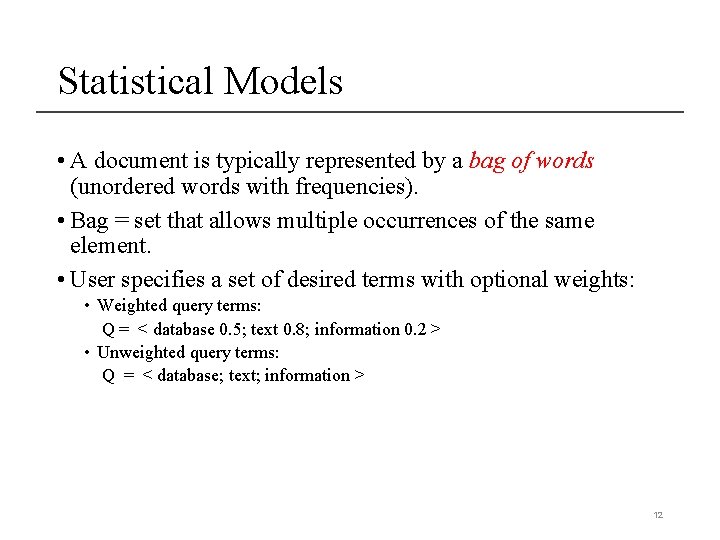
Statistical Models • A document is typically represented by a bag of words (unordered words with frequencies). • Bag = set that allows multiple occurrences of the same element. • User specifies a set of desired terms with optional weights: • Weighted query terms: Q = < database 0. 5; text 0. 8; information 0. 2 > • Unweighted query terms: Q = < database; text; information > 12
Statistical Retrieval • Retrieval based on similarity between query and documents. • Output documents are ranked according to similarity to query. • Similarity based on occurrence frequencies of keywords in query and document. • Automatic relevance feedback can be supported: • Relevant documents “added” to query. • Irrelevant documents “subtracted” from query. • Assumptions • Query and documents are represented in the same form • A query can be regarded as a “document” • Relevance(d, q) similarity(d, q) 13
Vector space model • Represent both doc and query by concept vectors • Each concept defines one dimension • K concepts define a high-dimensional space • Element of vector corresponds to concept weight • E. g. , d=(x 1, …, xk), xi is “importance” of concept i • Measure relevance • Distance between the query vector and document vector in this concept space 14
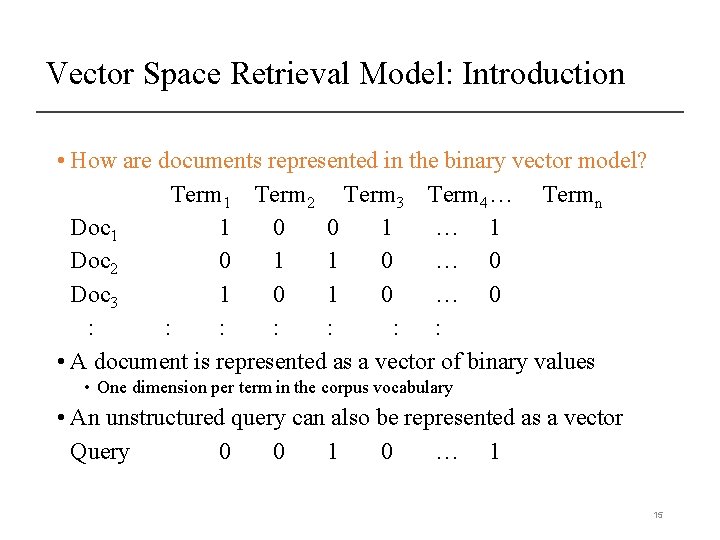
Vector Space Retrieval Model: Introduction • How are documents represented in the binary vector model? Term 1 Term 2 Term 3 Term 4… Termn Doc 1 1 0 0 1 … 1 Doc 2 0 1 1 0 … 0 Doc 3 1 0 … 0 : : : : • A document is represented as a vector of binary values • One dimension per term in the corpus vocabulary • An unstructured query can also be represented as a vector Query 0 0 1 0 … 1 15
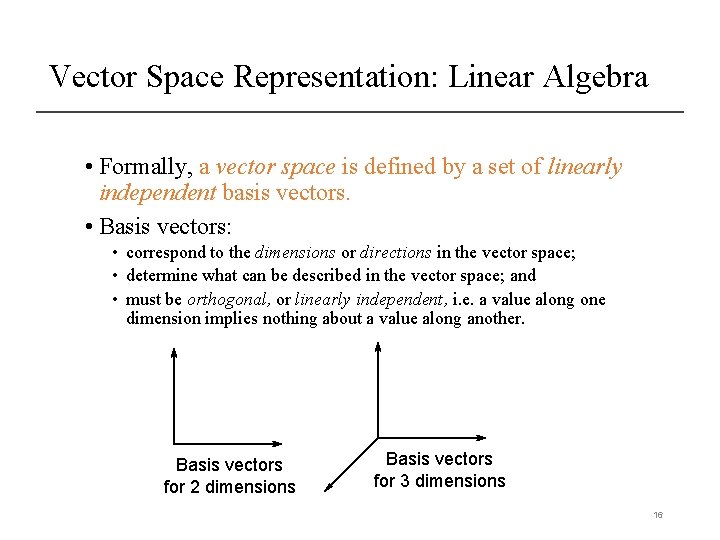
Vector Space Representation: Linear Algebra • Formally, a vector space is defined by a set of linearly independent basis vectors. • Basis vectors: • correspond to the dimensions or directions in the vector space; • determine what can be described in the vector space; and • must be orthogonal, or linearly independent, i. e. a value along one dimension implies nothing about a value along another. Basis vectors for 2 dimensions Basis vectors for 3 dimensions 16
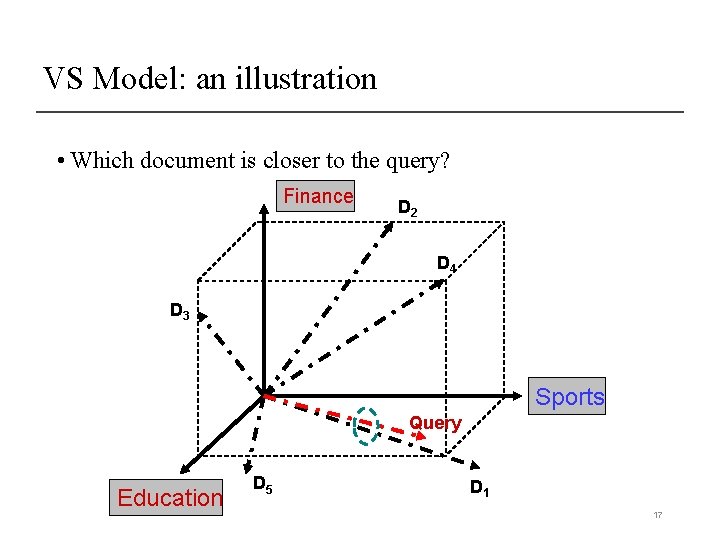
VS Model: an illustration • Which document is closer to the query? Finance D 2 D 4 D 3 Sports Query Education D 5 D 1 17
What the VS model doesn’t say • How to define/select the “basic concept” • Concepts are assumed to be orthogonal • How to assign weights • Weight in query indicates importance of the concept • Weight in doc indicates how well the concept characterizes the doc • How to define the similarity/distance measure 18
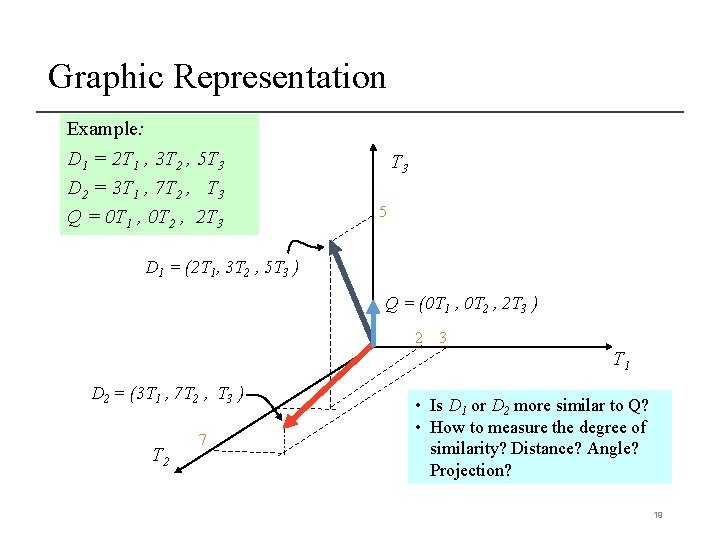
Graphic Representation Example: D 1 = 2 T 1 , 3 T 2 , 5 T 3 D 2 = 3 T 1 , 7 T 2 , T 3 Q = 0 T 1 , 0 T 2 , 2 T 3 5 D 1 = (2 T 1, 3 T 2 , 5 T 3 ) Q = (0 T 1 , 0 T 2 , 2 T 3 ) 2 3 T 1 D 2 = (3 T 1 , 7 T 2 , T 3 ) T 2 7 • Is D 1 or D 2 more similar to Q? • How to measure the degree of similarity? Distance? Angle? Projection? 19
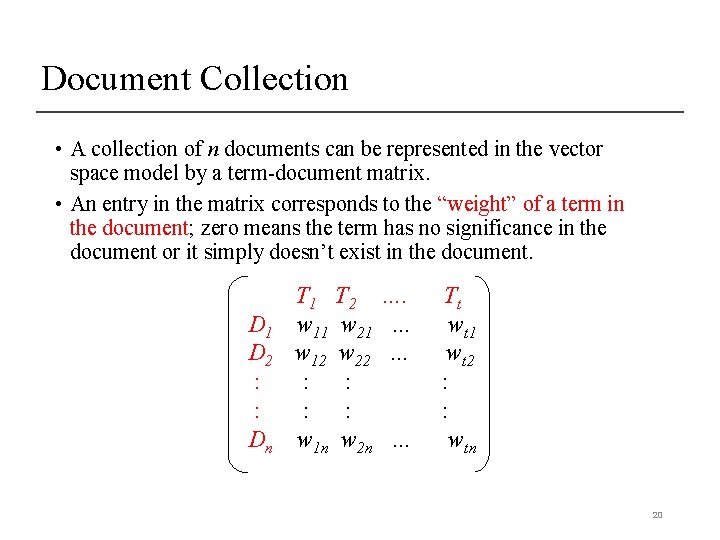
Document Collection • A collection of n documents can be represented in the vector space model by a term-document matrix. • An entry in the matrix corresponds to the “weight” of a term in the document; zero means the term has no significance in the document or it simply doesn’t exist in the document. D 1 D 2 : : Dn T 1 T 2 w 11 w 21 w 12 w 22 : : w 1 n w 2 n …. … … … Tt wt 1 wt 2 : : wtn 20
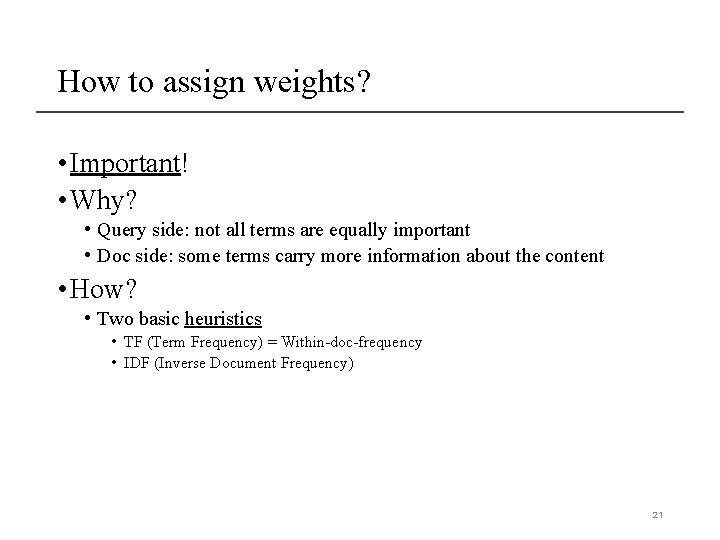
How to assign weights? • Important! • Why? • Query side: not all terms are equally important • Doc side: some terms carry more information about the content • How? • Two basic heuristics • TF (Term Frequency) = Within-doc-frequency • IDF (Inverse Document Frequency) 21
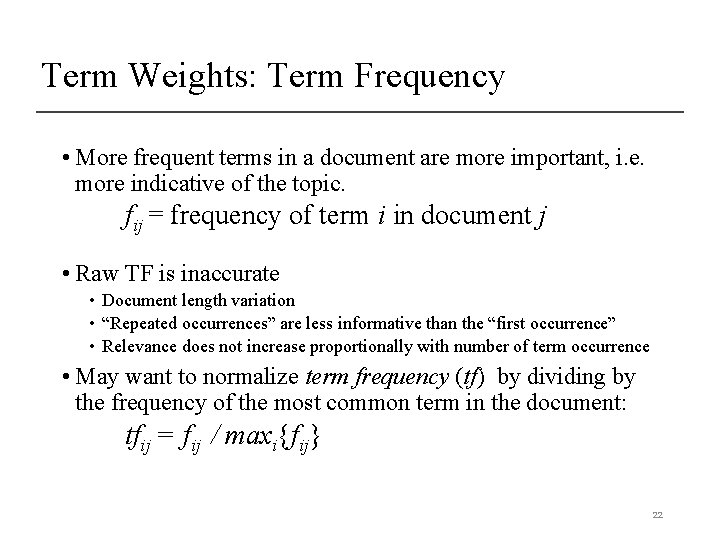
Term Weights: Term Frequency • More frequent terms in a document are more important, i. e. more indicative of the topic. fij = frequency of term i in document j • Raw TF is inaccurate • Document length variation • “Repeated occurrences” are less informative than the “first occurrence” • Relevance does not increase proportionally with number of term occurrence • May want to normalize term frequency (tf) by dividing by the frequency of the most common term in the document: tfij = fij / maxi{fij} 22
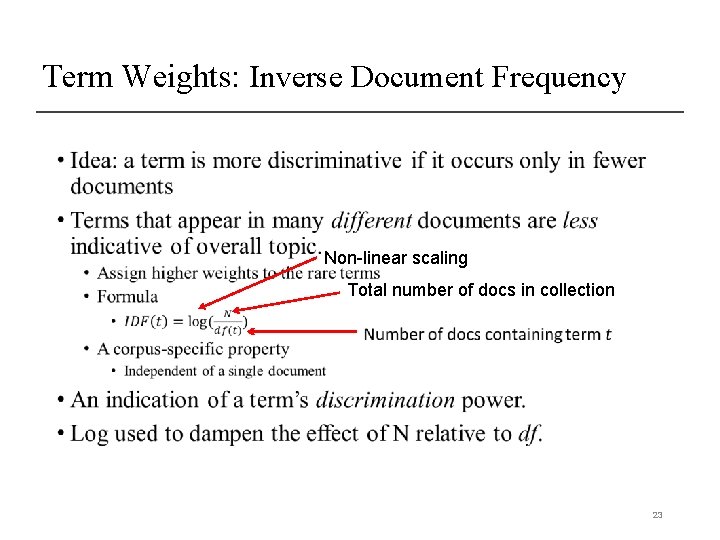
Term Weights: Inverse Document Frequency • Non-linear scaling Total number of docs in collection 23
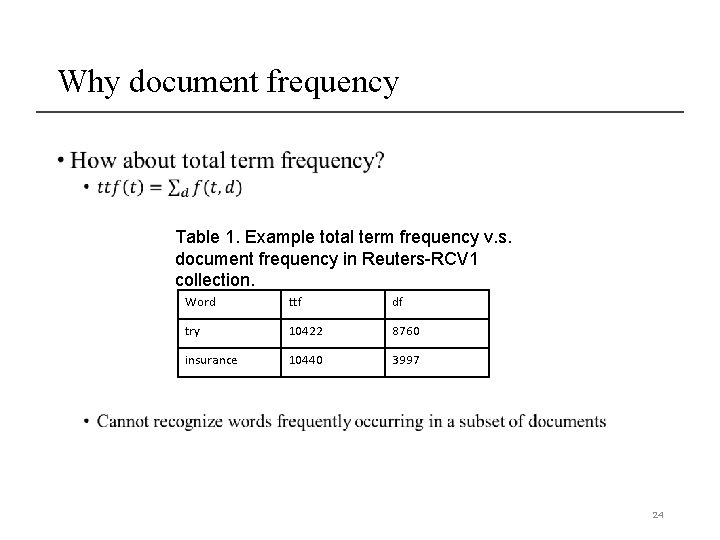
Why document frequency • Table 1. Example total term frequency v. s. document frequency in Reuters-RCV 1 collection. Word ttf df try 10422 8760 insurance 10440 3997 24
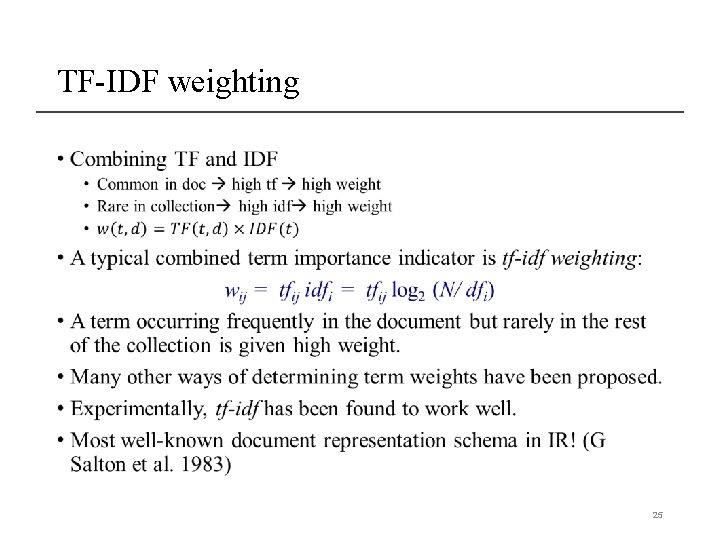
TF-IDF weighting • 25
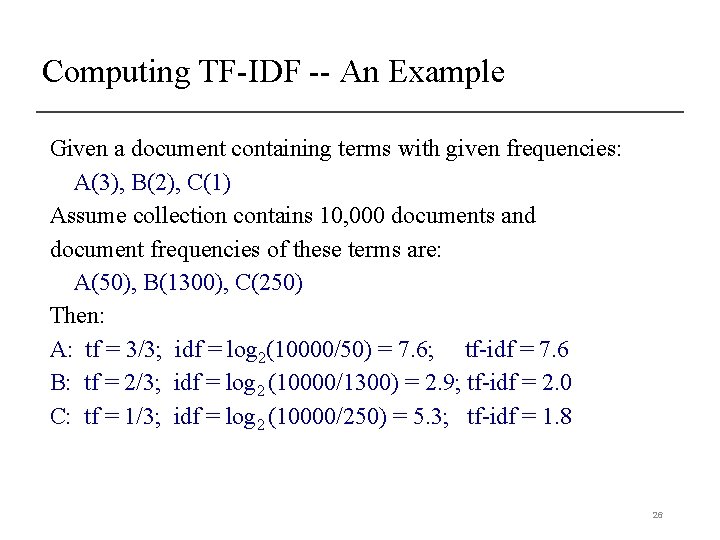
Computing TF-IDF -- An Example Given a document containing terms with given frequencies: A(3), B(2), C(1) Assume collection contains 10, 000 documents and document frequencies of these terms are: A(50), B(1300), C(250) Then: A: tf = 3/3; idf = log 2(10000/50) = 7. 6; tf-idf = 7. 6 B: tf = 2/3; idf = log 2 (10000/1300) = 2. 9; tf-idf = 2. 0 C: tf = 1/3; idf = log 2 (10000/250) = 5. 3; tf-idf = 1. 8 26
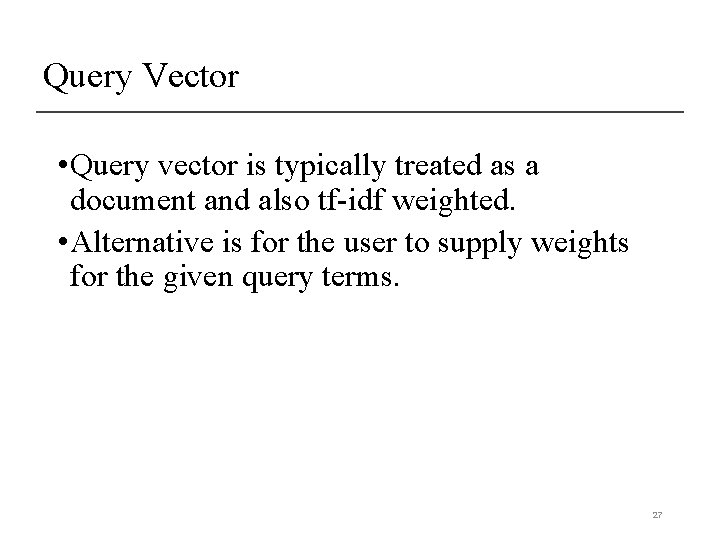
Query Vector • Query vector is typically treated as a document and also tf-idf weighted. • Alternative is for the user to supply weights for the given query terms. 27
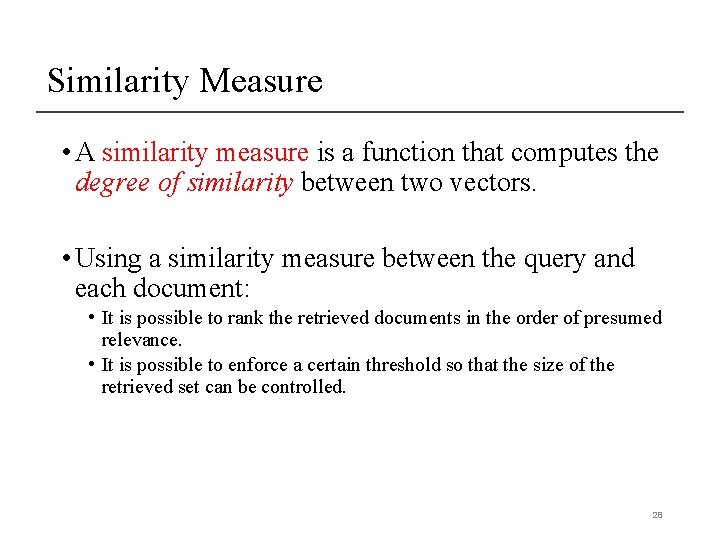
Similarity Measure • A similarity measure is a function that computes the degree of similarity between two vectors. • Using a similarity measure between the query and each document: • It is possible to rank the retrieved documents in the order of presumed relevance. • It is possible to enforce a certain threshold so that the size of the retrieved set can be controlled. 28
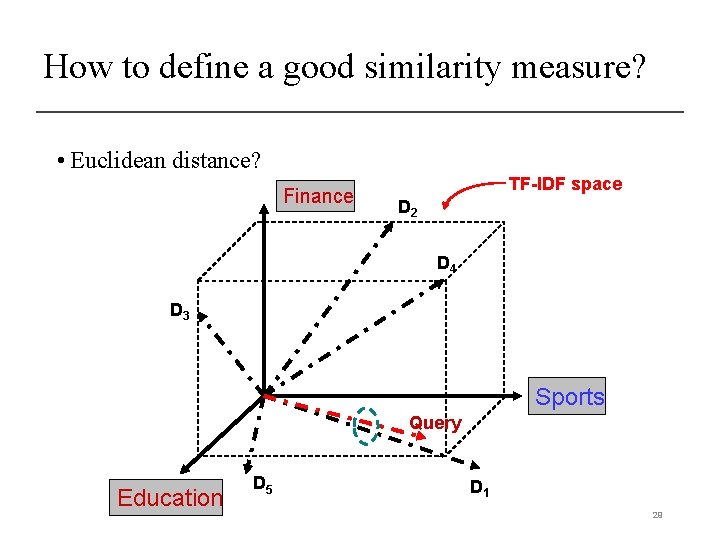
How to define a good similarity measure? • Euclidean distance? Finance TF-IDF space D 2 D 4 D 3 Sports Query Education D 5 D 1 29
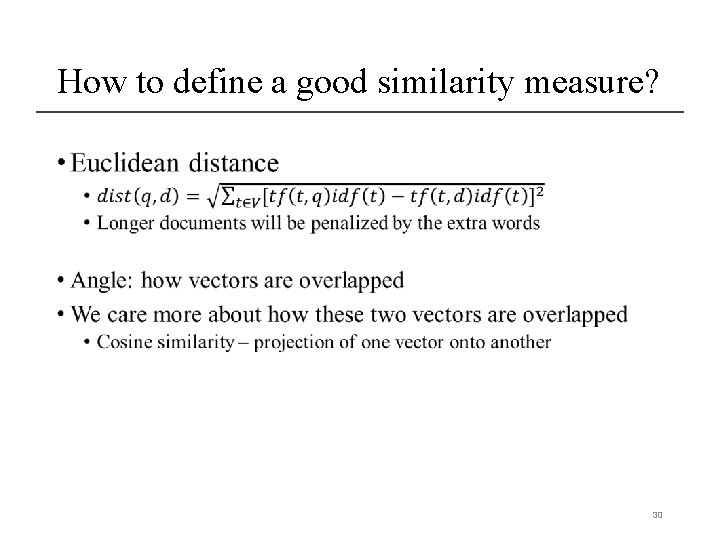
How to define a good similarity measure? • 30
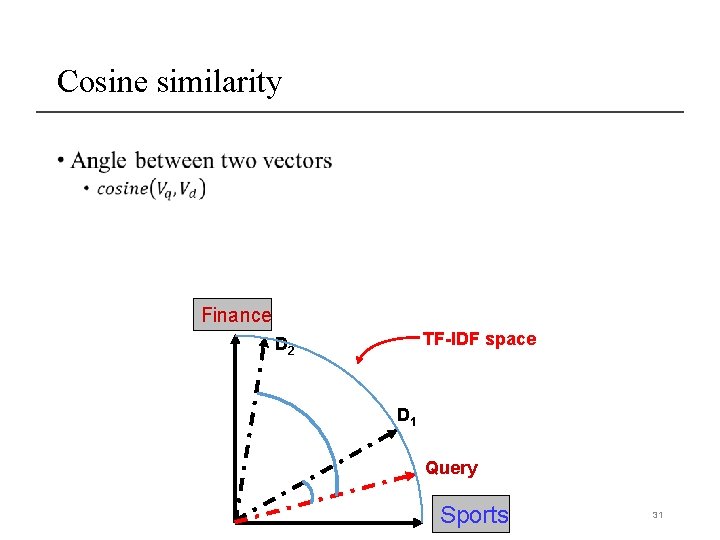
Cosine similarity • Finance TF-IDF space D 2 D 1 Query Sports 31
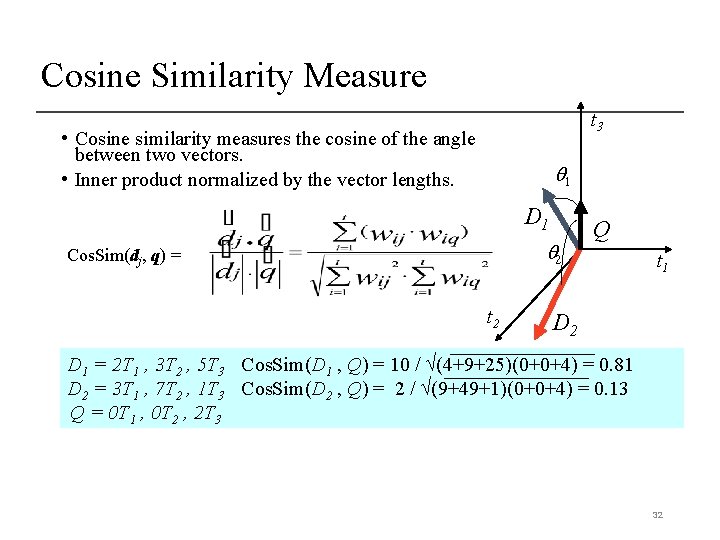
Cosine Similarity Measure t 3 • Cosine similarity measures the cosine of the angle between two vectors. • Inner product normalized by the vector lengths. 1 D 1 2 Cos. Sim(dj, q) = t 2 Q t 1 D 2 D 1 = 2 T 1 , 3 T 2 , 5 T 3 Cos. Sim(D 1 , Q) = 10 / (4+9+25)(0+0+4) = 0. 81 D 2 = 3 T 1 , 7 T 2 , 1 T 3 Cos. Sim(D 2 , Q) = 2 / (9+49+1)(0+0+4) = 0. 13 Q = 0 T 1 , 0 T 2 , 2 T 3 32
Comments on Vector Space Models • Empirically effective! (Top TREC performance) • Intuitive • Easy to implement • Well-studied/Mostly evaluated • The Smart system • Developed at Cornell: 1960 -1999 • Still widely used • Warning: Many variants of TF-IDF! 33
Problems with Vector Space Model • Missing semantic information (e. g. word sense). • Missing syntactic information (e. g. phrase structure, word order, proximity information). • Assumption of term independence (e. g. ignores synonomy). • Lacks the control of a Boolean model (e. g. , requiring a term to appear in a document). • Given a two-term query “A B”, may prefer a document containing A frequently but not B, over a document that contains both A and B, but both less frequently. • Assume query and document to be the same • Lack of “predictive adequacy” • Arbitrary term weighting • Arbitrary similarity measure • Lots of parameter tuning! 34
- Slides: 34