
Books Using reading materials in the EFL classroom
Books! Using reading materials in the EFL classroom Presented by: Aj. Jennifer Lund E-mail address: Lundjen 1@gmail. com Cell phone: 096 -087 -1444 (until July 7) English Language Fellow American Corner-Nakhon Si Thammarat Rajabhat 24 June 2008
Presentation Focus n n Extensive and Intensive reading Suggestions for using graded readers and storybooks Creating and maintaining a library of English reading materials Resources for further information
What is extensive reading? n n n Reading for general overall meaning Reading for information and enjoyment Reading easy material (less than 3 unknown words per page) Reading is individual and silent Learners are not given comprehension questions about their reading Dictionary use is discouraged
What is intensive reading? n Teaching and learning specific reading skills such as skimming, scanning, prereading, post-reading, guessing the main idea, looking for rhetorical patterns, vocabulary study, etc…
Benefits of extensive reading in a second language n n n Reading fluency is gained, a skill that may be retained and used longer than speaking, listening or writing skills L 2 Vocabulary increases Writing in the L 2 improves Cultural awareness increases Intrinsic motivation to study the L 2 because students can choose the material
Activity: I think/I don’t think n n n Reading English is difficult. I should usually look up new words in the dictionary. Reading out loud is a good idea. It is easier to read about sports than science. If I read fast, it’s hard to understand meaning. Reading English is boring.
Choosing a graded reader n n Graded readers are “graded”, meaning that they are written at different levels of vocabulary knowledge (number of headwords). Ex. Easystarts (200 words) You need to consider level, genre, and variety of English. There is also a summary (blurb) outlining the setting, characters, and storyline of the book. Penguin Readers give all of this information on the back cover of each book.
Introducing reading material 1. 2. 3. 4. Students may scan for information about the readers in small groups. Teacher can pass out different books to groups of students and then give clues about a mystery book. Students have to guess if the mystery book is theirs. Match blurbs with titles. Introduce the title, author, genre of the book, then play 5 minutes of a CD recording of the book. Sts. can guess about the story.
Interactive Storybook Reading n n n Teacher reads a story and students are each assigned a word or character from the story. When the students hear their word or character, they have to give some kind of signal. To continue, students can act out their own version of the story or create a new ending.
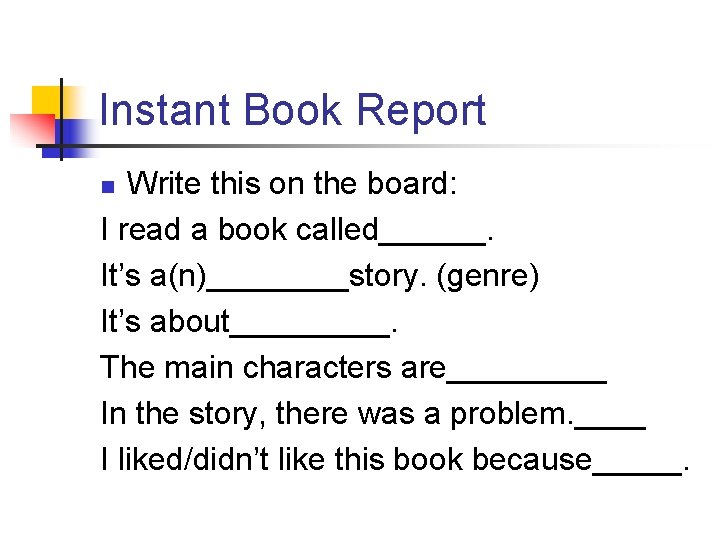
Instant Book Report Write this on the board: I read a book called______. It’s a(n)____story. (genre) It’s about_____. The main characters are_____ In the story, there was a problem. ____ I liked/didn’t like this book because_____. n
Instant Book Report continued n n Give students 2 -3 minutes to think first before speaking. Students work in pairs and tell their reports to their partner. Students can change partners if they finish early. Partners can be required to ask at least two questions about the story.
Suggestions for creating and maintaining an “English Corner” at your school n n n Add a bookshelf to an already existing library Ask one teacher or librarian to be in charge of the book collection Create a system so that many teachers and students can have access to the books Start a Book Club (all members read the same or different books and discuss together) Do a “Reading Marathon” in your school or class (students earn km. for reading a certain number of words)
Building your library: Travel grants to Bangkok available Books for Thailand Foundation (Donated books) Siam Commercial Bank, Saphakachat Thai Branch, 2 nd Floor 1873 Henry Dunant Road, Pathumwan Bangkok 10330 Tel: 02 -652 -3301 Fax: 02 -652 -3302 Email: booksforthailandfoundation@hotmail. com Contact Person: Khun (Ms. ) Amorn Saiyoi Office Hours: Mondays-Fridays, 08: 00 -16: 30
Further resources n n n n Bamford, J. & Day, Richard R. (2004). Extensive Reading Activities for Teaching Language. Cambridge University Press. Day, Richard R. (ed. ). New Ways in Teaching Reading. Alexandria, VA: TESOL. www. student-weekly. com www. extensivereading. net www. erfoundation. org www. squidoo. com/extensivereading www. ipl. org (Internet Public Library)
Recommended reading n n Habibi (a novel) / by Naomi Shihab Nye The Flag of Childhood: Poems from the Middle East / by Naomi Shihab Nye Ayat Jamilah: Beautiful Signs: A Treasury of Islamic Wisdom for Children and Parents / collected & adapted by Sarah Conover and Freda Crane The Best Eid Ever / by Asma Mobin-Uddin
Some Final Thoughts “He who reads widely has a gifted pen. ” ~ Unknown ~ “Children are made readers on the laps of their parents (or teachers). ” ~ Emilie Buchwald ~ “Reading makes immigrants of us all. It takes us away from home, but more important, it finds homes for us everywhere. ” ~ Hazel Rochman ~
- Slides: 16