
Book Club The Model Millionaire Short story by
Book Club – “The Model Millionaire” Short story by Oscar Wilde
Before we dive into the story… • To what extent are appearances important in today’s society? • Do appearances determine our first impression of somebody? Why/How? • Have you witnessed/experienced situations in which somebody turned out to be different from what you initially expected? • To what factors could we attribute this “cult of appearances”? Is it something we are born with or, rather, something we are conditioned to learn as we grow up?
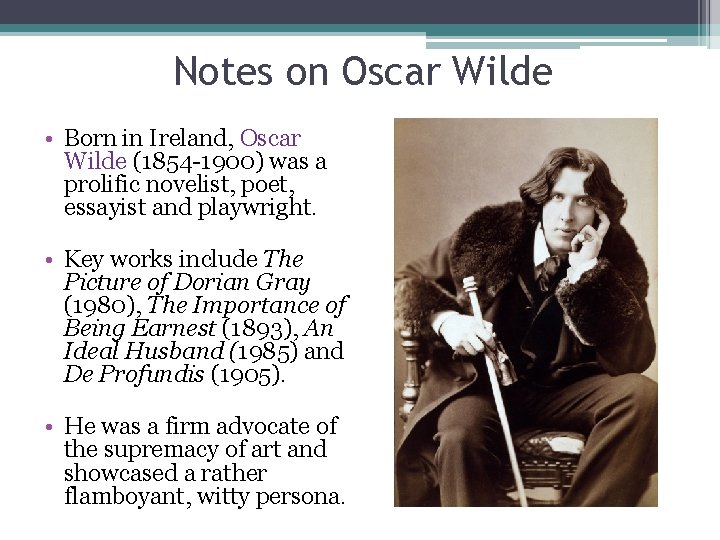
Notes on Oscar Wilde • Born in Ireland, Oscar Wilde (1854 -1900) was a prolific novelist, poet, essayist and playwright. • Key works include The Picture of Dorian Gray (1980), The Importance of Being Earnest (1893), An Ideal Husband (1985) and De Profundis (1905). • He was a firm advocate of the supremacy of art and showcased a rather flamboyant, witty persona.
“A Model Millionaire” (1887) • “Unless one is wealthy there is no use in being a charming fellow. Romance is the privilege of the rich, not the profession of the unemployed. The poor should be practical and prosaic. It is better to have a permanent income than to be fascinating. These are the great truths of modern life which Hughie Erskine never realised. Poor Hughie! Intellectually, we must admit, he was not of much importance. He never said a brilliant or even an ill-natured thing in his life. ”
• “He had tried everything. He had gone on the Stock Exchange for six months; but what was a butterfly to do among bulls and bears? He had been a tea-merchant for a little longer, but had soon tired of pekoe and souchong. Then he had tried selling dry sherry. That did not answer; the sherry was a little too dry. Ultimately he became nothing, a delightful, ineffectual young man with a perfect profile and no profession. ”
• “To make matters worse, he was in love. The girl he loved was Laura Merton, the daughter of a retired Colonel who had lost his temper and his digestion in India, and had never found either of them again. Laura adored him, and he was ready to kiss her shoe-strings. They were the handsomest couple in London, and had not a penny-piece between them. ”
• “One morning, as he was on his way to Holland Park, where the Mertons lived, he dropped in to see a great friend of his, Alan Trevor was a painter. Indeed, few people escape that nowadays. But he was also an artist, and artists are rather rare. ”
• “When Hughie came in he found Trevor putting the finishing touches to a wonderful life-size picture of a beggar-man. The beggar himself was standing on a raised platform in a corner of the studio. He was a wizened old man, with a face like wrinkled parchment, and a most piteous expression. Over his shoulders was flung a coarse brown cloak, all tears and tatters; his thick boots were patched and cobbled, and with one hand he leant on a rough stick, while with the other he held out his battered hat for alms. ”
• ‘An amazing model? ’ shouted Trevor at the top of his voice; ‘I should think so! Such beggars as he are not to be met with every day. A trouvaille, mon cher; a living Velasquez! My stars! what an etching Rembrandt would have made of him!’ • ‘Poor old chap!’ said Hughie, ‘how miserable he looks! But I suppose, to you painters, his face is his fortune? ’ • ‘Certainly, ’ replied Trevor, ‘you don’t want a beggar to look happy, do you? ’
• “The old beggar-man took advantage of Trevor’s absence to rest for a moment on a wooden bench that was behind him. He looked so forlorn and wretched that Hughie could not help pitying him, and felt in his pockets to see what money he had. All he could find was a sovereign and some coppers. ‘Poor old fellow, ’ he thought to himself, ‘he wants it more than I do, but it means no hansoms for a fortnight’; and he walked across the studio and slipped the sovereign into the beggar’s hand. ”
• ‘My dear boy, ’ said Trevor, smiling, ‘that old beggar, as you call him, is one of the richest men in Europe. He could buy all London tomorrow without overdrawing his account. He has a house in every capital, dines off gold plate, and can prevent Russia going to war when he chooses. ’ • ‘What I say, ’ said Trevor. ‘The old man you saw today in the studio was Baron Hausberg. He is a great friend of mine, buys all my pictures and that sort of thing, and gave me a commission a month ago to paint him as a beggar. Que voulez-vous? La fantaisie d’un millionnaire! And I must say he made a magnificent figure in his rags, or perhaps I should say in my rags; they are an old suit I got in Spain. ’
• The next morning, as he was at breakfast, the servant brought him up a card on which was written, ‘Monsieur Gustave Naudin, de la part de M. le Baron Hausberg. ’ ‘I suppose he has come for an apology, ’ said Hughie to himself; and he told the servant to show the visitor up. • ‘Millionaire models, ’ remarked Alan, ‘are rare enough; but, by Jove, model millionaires are rarer still!’
Discuss the following questions: • What genre would you classify this story into?
• Wilde is fairly popular for his particular writing. What kinds of rhetorical and stylistic devices do you think characterise the story?
• Is there a moral to the story? Do you think Hughie’s reward was well-deserved? Why?
• According to Oscar Wilde, what makes a person a “model millionaire”? Do you agree?
• Do you think this story is still relevant in our society? Why/Why not?

Great job everyone!
- Slides: 18