
Book Chat What is a Literature Circle A
Book Chat
What is a Literature Circle? A literature circle is a students' equivalent of an adult book club, but with greater structure, expectation and rigor. The aim is to encourage thoughtful discussion and a love of reading in young people. The true intent of literature circles is "to allow students to practice and develop the skills and strategies of good readers" (Da. Lie, 2001).
The Books Preview the following books and decide which one interests you, challenges you, and you can imagine talking (and writing!) about.
The Girls Lori Lansens Summary: Rose and Ruby Darlen are closer than most twin sisters. Indeed, they have spent their twenty-nine years on earth joined at the head. Given that they share a web of essential veins, there is no possibility that they can be separated in their lifetime. On the eve of their thirtieth birthday, Rose sets out to write her autobiography. But because their lives have been so closely shared, Ruby insists on contributing the occasional chapter. And so, as Rose types away on her laptop, the technophobic Ruby scribbles longhand on a yellow legal pad. They’ve established one rule for their cowriting venture: neither is allowed to see what the other has written. Together, they tell the story of their lives as the world’s oldest surviving craniopagus twins – the literary Rose and straight-talking Ruby often seeing the same event in wildly different ways. Despite their extreme medical condition, the sisters express emotional truths: on losing a loved one, the hard lessons of compromise, the first stirrings of sexual desire, the pain of abandonment, and the transcendent power of love.
The Girls Lori Lansens Themes: - Normalcy - Unconditional Love - Truth, Secrets - The intense bond between the sisters “I have never looked into my sister's eyes. I have never bathed alone. I have never stood in the grass at night and raised my arms to the beguiling moon. I’ve never used an airplane bathroom. Or worn a hat. Or been kissed like that. I’ve never driven a car. Or slept through the night. Never a private talk. Or a solo walk. I’ve never climbed a tree. Or faded into a crowd. So many things I’ve never done, but oh, how I’ve been loved. And, if such things were to be, I’d live a thousand lives as me, to be loved so exponentially” (1).

Flowers for Algernon Daniel Keyes Summary: Flowers for Algernon is a character study of one man, Charlie Gordon. Charlie is a 32 -year-old developmentally disabled man who has the opportunity to undergo a surgical procedure that will dramatically increase his mental capabilities. This procedure had already been performed on a laboratory mouse, Algernon, with remarkable results. Charlie will be the first human subject. In a series of progress reports, Charlie documents everything that happens to him. As Charlie's intelligence increases to a genius level, the reader not only reads about the changes from Charlie's viewpoint, but also sees the change evidenced in Charlie's writing ability. This jump in intelligence is not necessarily a good thing, however. Charlie is now able to recall past events that shaped his life and analyze past friendships for what they were, or weren't. He also has difficulty making new friendships and establishing new relationships due to a lack of social intelligence that the surgery could neither correct nor anticipate. And, finally, because of his increased intelligence, Charlie is able to discover the experiment's "fatal flaw" and is reduced to watching the end for both Algernon and himself, hoping to salvage something for the future from his brief bout with genius.
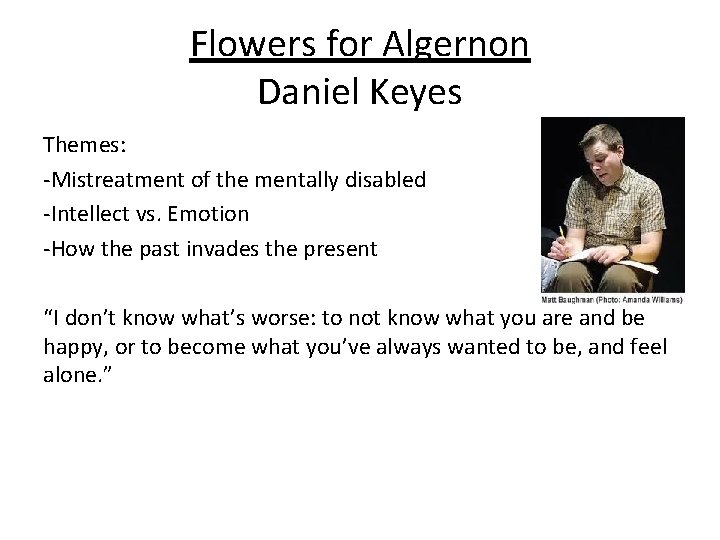
Flowers for Algernon Daniel Keyes Themes: -Mistreatment of the mentally disabled -Intellect vs. Emotion -How the past invades the present “I don’t know what’s worse: to not know what you are and be happy, or to become what you’ve always wanted to be, and feel alone. ”
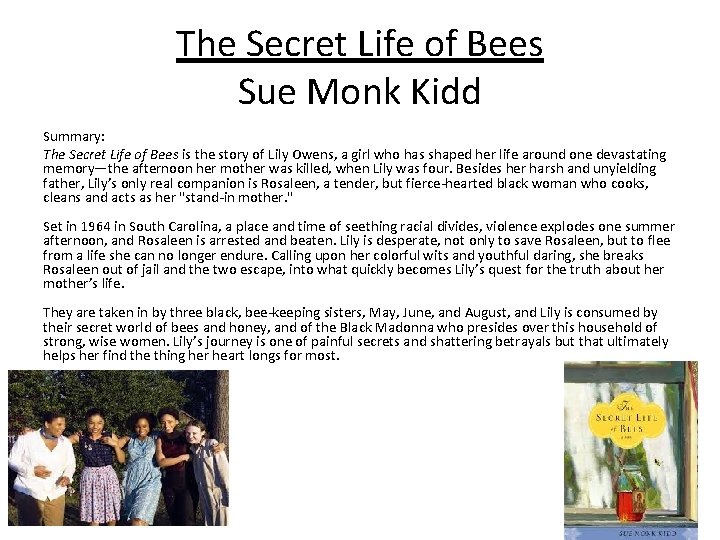
The Secret Life of Bees Sue Monk Kidd Summary: The Secret Life of Bees is the story of Lily Owens, a girl who has shaped her life around one devastating memory—the afternoon her mother was killed, when Lily was four. Besides her harsh and unyielding father, Lily’s only real companion is Rosaleen, a tender, but fierce-hearted black woman who cooks, cleans and acts as her "stand-in mother. " Set in 1964 in South Carolina, a place and time of seething racial divides, violence explodes one summer afternoon, and Rosaleen is arrested and beaten. Lily is desperate, not only to save Rosaleen, but to flee from a life she can no longer endure. Calling upon her colorful wits and youthful daring, she breaks Rosaleen out of jail and the two escape, into what quickly becomes Lily’s quest for the truth about her mother’s life. They are taken in by three black, bee-keeping sisters, May, June, and August, and Lily is consumed by their secret world of bees and honey, and of the Black Madonna who presides over this household of strong, wise women. Lily’s journey is one of painful secrets and shattering betrayals but that ultimately helps her find the thing her heart longs for most.
The Secret Life of Bees Sue Monk Kidd Themes: -Racism -The power of the female community - Coming of Age - The search for identity “When it's time to die, go ahead and die, and when it's time to live, live. Don't sort-of-maybe live, but live like you're going all out, like you're not afraid. ”

The Curious Incident of the Dog in the Night. Time Mark Haddon Summary: Christopher John Francis Boone knows all the countries of the world and their capitals and every prime number up to 7, 057. He relates well to animals but has no understanding of human emotions. He cannot stand to be touched. And he detests the color yellow. This is the improbable story of Christopher's quest to investigate the suspicious death of a neighborhood dog.
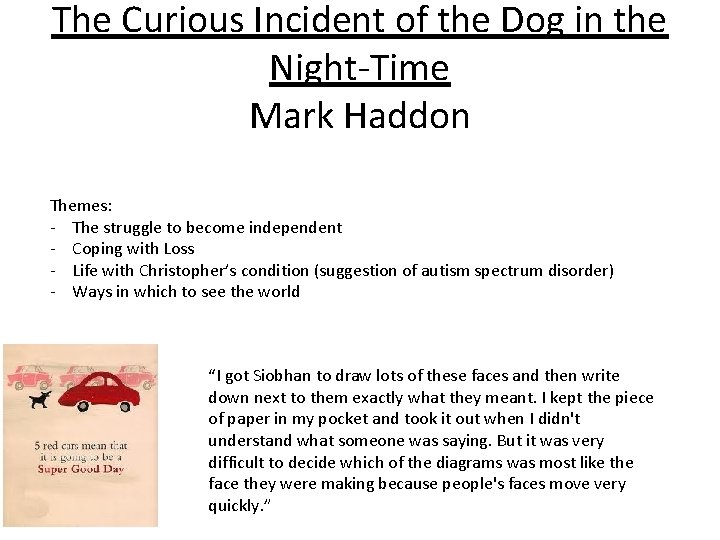
The Curious Incident of the Dog in the Night-Time Mark Haddon Themes: - The struggle to become independent - Coping with Loss - Life with Christopher’s condition (suggestion of autism spectrum disorder) - Ways in which to see the world “I got Siobhan to draw lots of these faces and then write down next to them exactly what they meant. I kept the piece of paper in my pocket and took it out when I didn't understand what someone was saying. But it was very difficult to decide which of the diagrams was most like the face they were making because people's faces move very quickly. ”
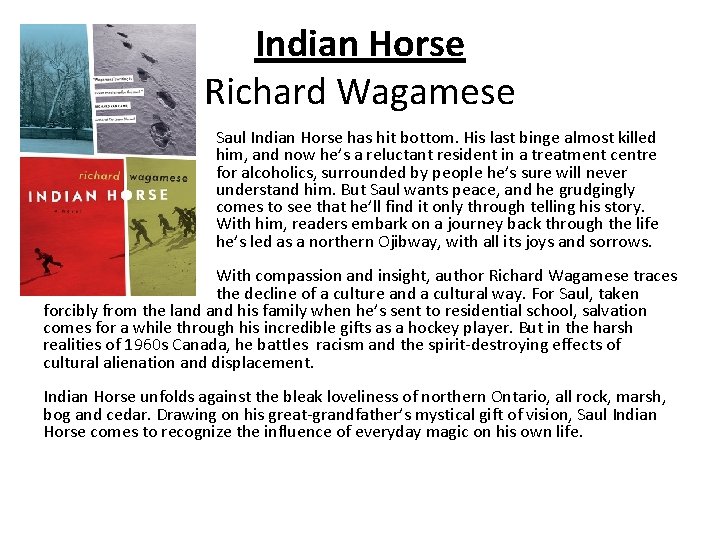
Indian Horse Richard Wagamese Summary: Saul Indian Horse has hit bottom. His last binge almost killed him, and now he’s a reluctant resident in a treatment centre for alcoholics, surrounded by people he’s sure will never understand him. But Saul wants peace, and he grudgingly comes to see that he’ll find it only through telling his story. With him, readers embark on a journey back through the life he’s led as a northern Ojibway, with all its joys and sorrows. With compassion and insight, author Richard Wagamese traces the decline of a culture and a cultural way. For Saul, taken forcibly from the land his family when he’s sent to residential school, salvation comes for a while through his incredible gifts as a hockey player. But in the harsh realities of 1960 s Canada, he battles racism and the spirit-destroying effects of cultural alienation and displacement. Indian Horse unfolds against the bleak loveliness of northern Ontario, all rock, marsh, bog and cedar. Drawing on his great-grandfather’s mystical gift of vision, Saul Indian Horse comes to recognize the influence of everyday magic on his own life.
Indian Horse Richard Wagamese Themes: -Racism -Cultural alienation -Alcoholism -Physical and Sexual abuse -The healing power of sports -The importance of personal history -The role of spirituality -The role of magic “We were hockey gypsies, heading down another gravel road every weekend, plowing into the heart of that magnificent northern landscape. We never gave a thought to being deprived as we travelled, to being shut of the regular league system…We were a league of nomads, mad for the game, mad for the road, mad for ice and snow, an Arctic wind on our faces and a frozen puck on the blade of our sticks. ” Richard Wagamese, Indian Horse
- Slides: 13