
Book Cataloging Presented by Illinois Heartland Library System

Book Cataloging Presented by Illinois Heartland Library System
Cataloging n Three types of cataloging u Classification u Subject -- Assigning a call number analysis -- Determining the subject of a work u Descriptive cataloging -- Describing an item in a unique way F Discussed in detail today
What is Descriptive Cataloging? n The process of: u Describing an item in a cataloging record and u Identifying and formatting access points u Based on: F F Anglo-American Cataloguing Rules (AACR) or Resource Description and Access (RDA)
AACR and RDA n n Instructions for entering descriptive elements and name-and-title access points in a catalog record Records look different depending on which set of rules is used to create the record AACR—Available in print format RDA—Available as print or online subscription (www. rdatoolkit. org) – annual fee for online
Structure of AACR n Divided into two parts u Part 1. Deals with the description of the item (Title, publisher, physical characteristics, etc. ) F Chapter for each format u Part 2. Deals with the access points which will be used to search for the item n Appendices give instructions for capitalization, abbreviation, etc.
Structure of RDA n Divided into sections with instructions that apply to all formats u No n separate chapters for type of material Appendices with instructions on capitalization, abbreviations and symbols, initial articles, etc.
Sources of Information n The first areas to examine when cataloging an item Provide: u Title u Author/creator and/or others responsible for content u Publication information such as name of publisher, place of publication, and date u Edition information, when present u Series statement, when present
Sources of Information-Books n n n Title page If there’s no title page: cover, spine, other preliminary pages, colophon, container, etc. Terminology note: u AACR: Chief source of information u RDA: Preferred source
Definitions n n Preliminary pages: title page, title page verso, any pages before title page, and cover Colophon: statement at the end of the item with title, publisher, printer, or date, information about the author
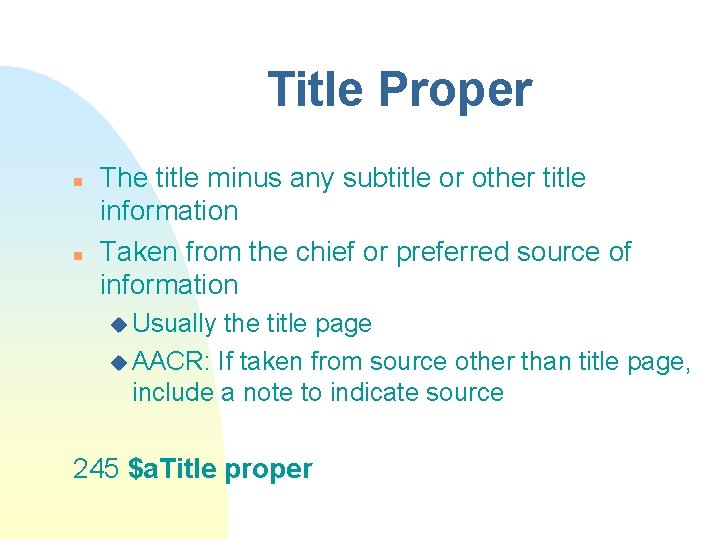
Title Proper n n The title minus any subtitle or other title information Taken from the chief or preferred source of information u Usually the title page u AACR: If taken from source other than title page, include a note to indicate source 245 $a. Title proper
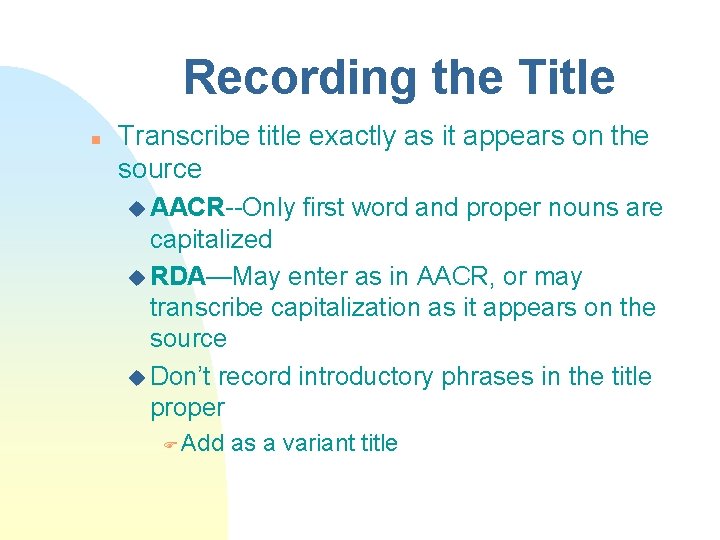
Recording the Title n Transcribe title exactly as it appears on the source u AACR--Only first word and proper nouns are capitalized u RDA—May enter as in AACR, or may transcribe capitalization as it appears on the source u Don’t record introductory phrases in the title proper F Add as a variant title
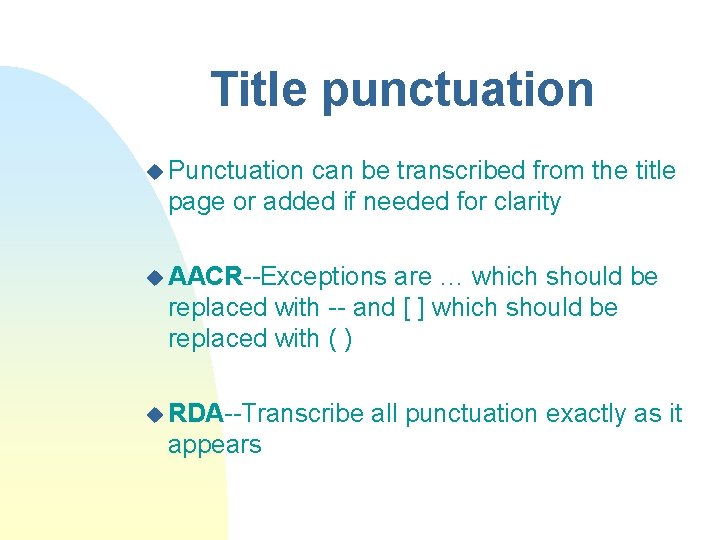
Title punctuation u Punctuation can be transcribed from the title page or added if needed for clarity u AACR--Exceptions are … which should be replaced with -- and [ ] which should be replaced with ( ) u RDA--Transcribe appears all punctuation exactly as it
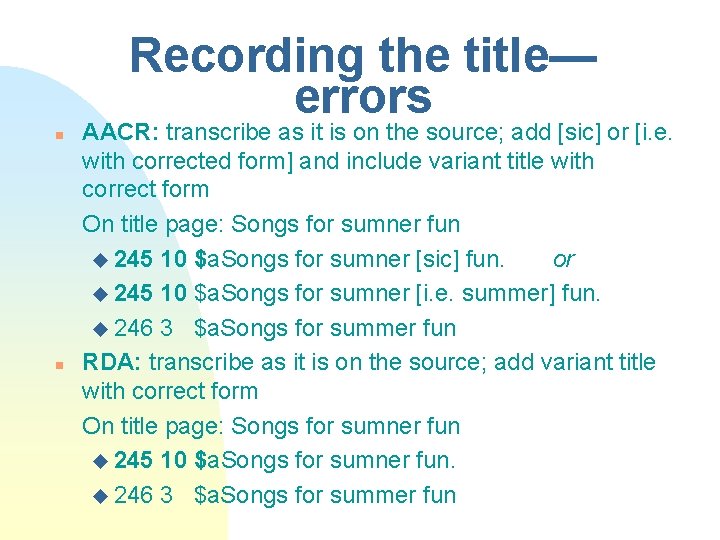
Recording the title— errors n n AACR: transcribe as it is on the source; add [sic] or [i. e. with corrected form] and include variant title with correct form On title page: Songs for sumner fun u 245 10 $a. Songs for sumner [sic] fun. or u 245 10 $a. Songs for sumner [i. e. summer] fun. u 246 3 $a. Songs for summer fun RDA: transcribe as it is on the source; add variant title with correct form On title page: Songs for sumner fun u 245 10 $a. Songs for sumner fun. u 246 3 $a. Songs for summer fun
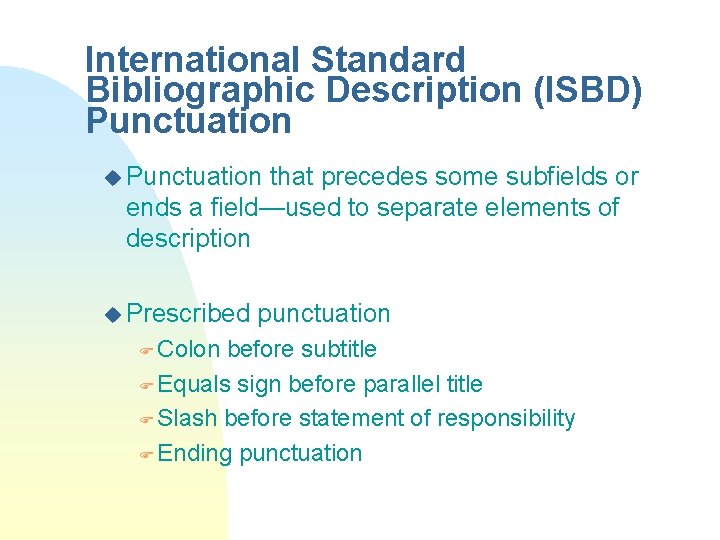
International Standard Bibliographic Description (ISBD) Punctuation u Punctuation that precedes some subfields or ends a field—used to separate elements of description u Prescribed F Colon punctuation before subtitle F Equals sign before parallel title F Slash before statement of responsibility F Ending punctuation
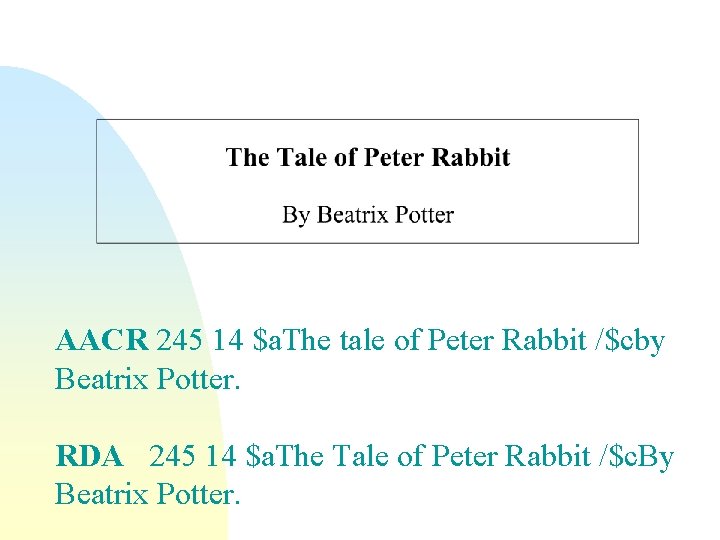
AACR 245 14 $a. The tale of Peter Rabbit /$cby Beatrix Potter. RDA 245 14 $a. The Tale of Peter Rabbit /$c. By Beatrix Potter.
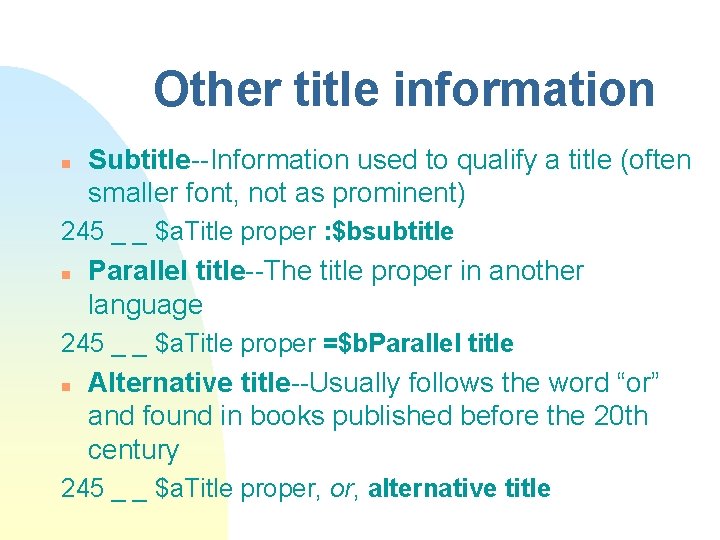
Other title information n Subtitle--Information used to qualify a title (often smaller font, not as prominent) 245 _ _ $a. Title proper : $bsubtitle n Parallel title--The title proper in another language 245 _ _ $a. Title proper =$b. Parallel title n Alternative title--Usually follows the word “or” and found in books published before the 20 th century 245 _ _ $a. Title proper, or, alternative title
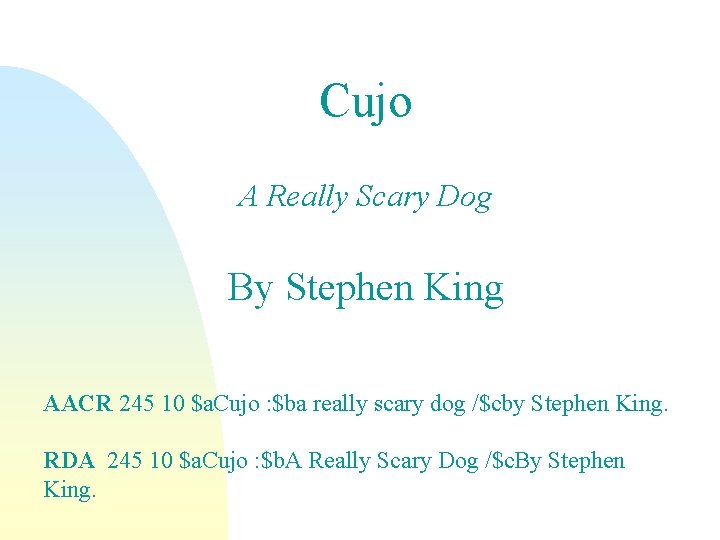
Cujo A Really Scary Dog By Stephen King AACR 245 10 $a. Cujo : $ba really scary dog /$cby Stephen King. RDA 245 10 $a. Cujo : $b. A Really Scary Dog /$c. By Stephen King.
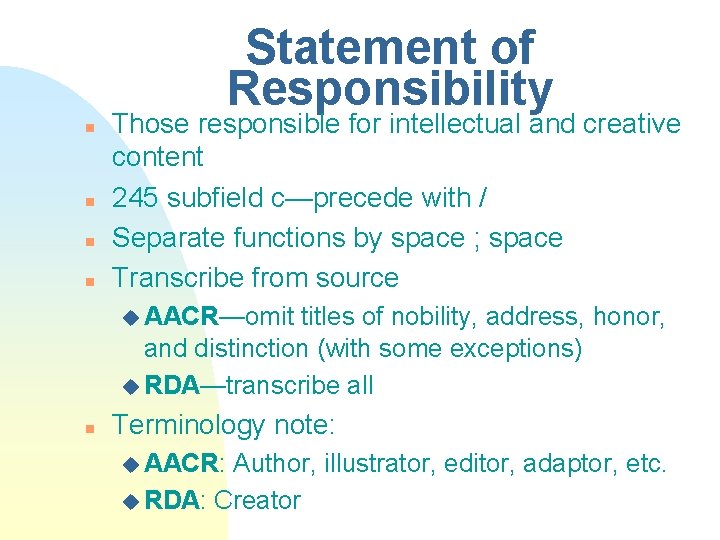
Statement of Responsibility n n Those responsible for intellectual and creative content 245 subfield c—precede with / Separate functions by space ; space Transcribe from source u AACR—omit titles of nobility, address, honor, and distinction (with some exceptions) u RDA—transcribe all n Terminology note: u AACR: Author, illustrator, editor, adaptor, etc. u RDA: Creator
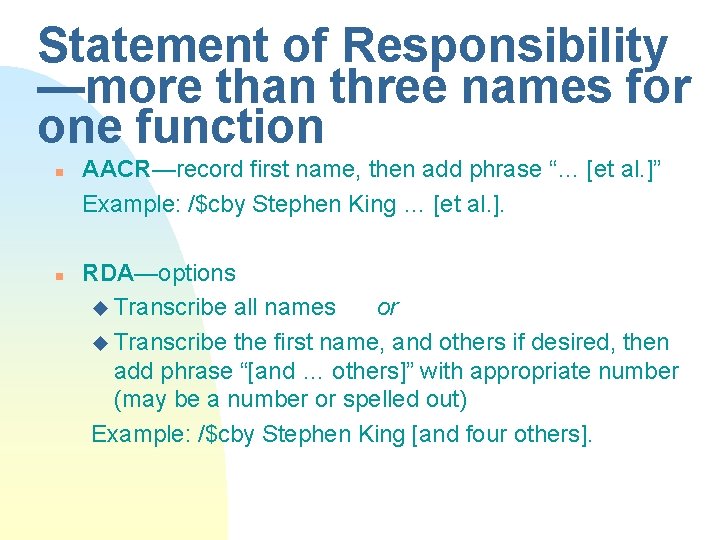
Statement of Responsibility —more than three names for one function n n AACR—record first name, then add phrase “… [et al. ]” Example: /$cby Stephen King … [et al. ]. RDA—options u Transcribe all names or u Transcribe the first name, and others if desired, then add phrase “[and … others]” with appropriate number (may be a number or spelled out) Example: /$cby Stephen King [and four others].
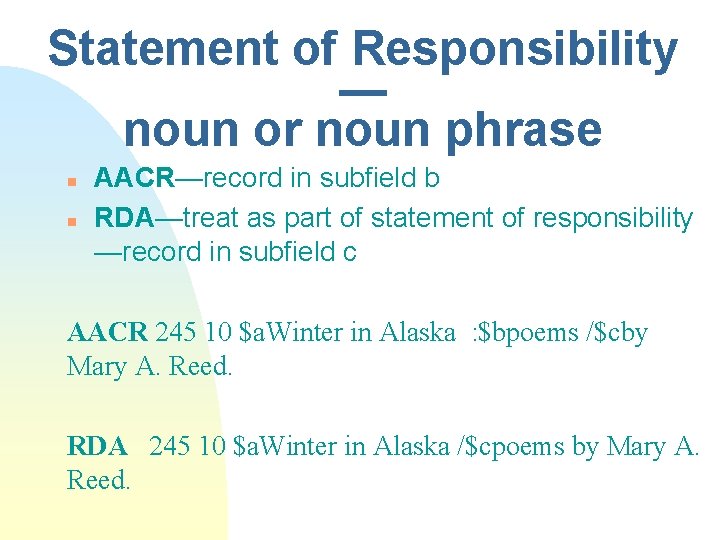
Statement of Responsibility — noun or noun phrase n n AACR—record in subfield b RDA—treat as part of statement of responsibility —record in subfield c AACR 245 10 $a. Winter in Alaska : $bpoems /$cby Mary A. Reed. RDA 245 10 $a. Winter in Alaska /$cpoems by Mary A. Reed.
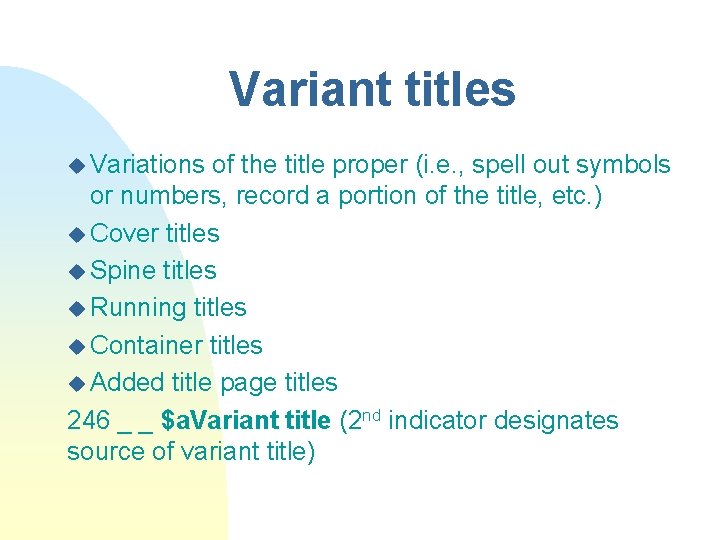
Variant titles u Variations of the title proper (i. e. , spell out symbols or numbers, record a portion of the title, etc. ) u Cover titles u Spine titles u Running titles u Container titles u Added title page titles 246 _ _ $a. Variant title (2 nd indicator designates source of variant title)
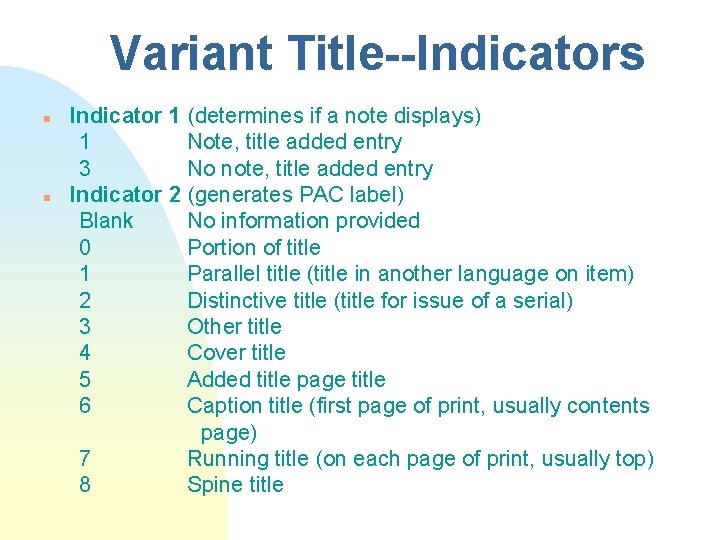
Variant Title--Indicators n n Indicator 1 (determines if a note displays) 1 Note, title added entry 3 No note, title added entry Indicator 2 (generates PAC label) Blank No information provided 0 Portion of title 1 Parallel title (title in another language on item) 2 Distinctive title (title for issue of a serial) 3 Other title 4 Cover title 5 Added title page title 6 Caption title (first page of print, usually contents page) 7 Running title (on each page of print, usually top) 8 Spine title
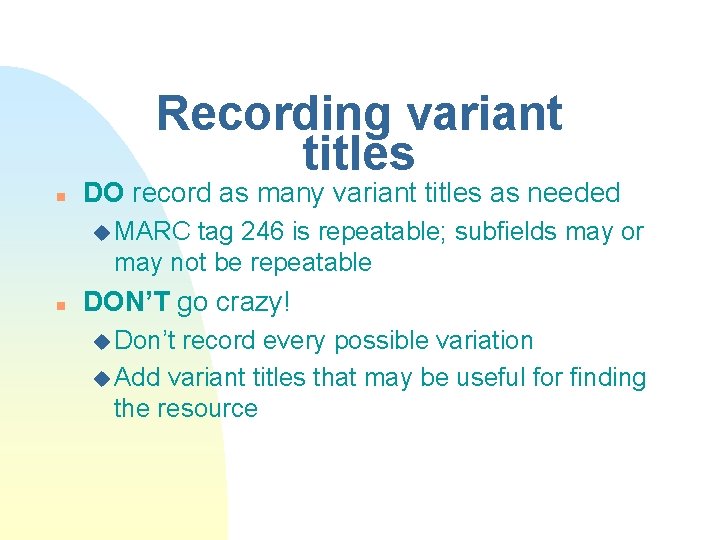
Recording variant titles n DO record as many variant titles as needed u MARC tag 246 is repeatable; subfields may or may not be repeatable n DON’T go crazy! u Don’t record every possible variation u Add variant titles that may be useful for finding the resource
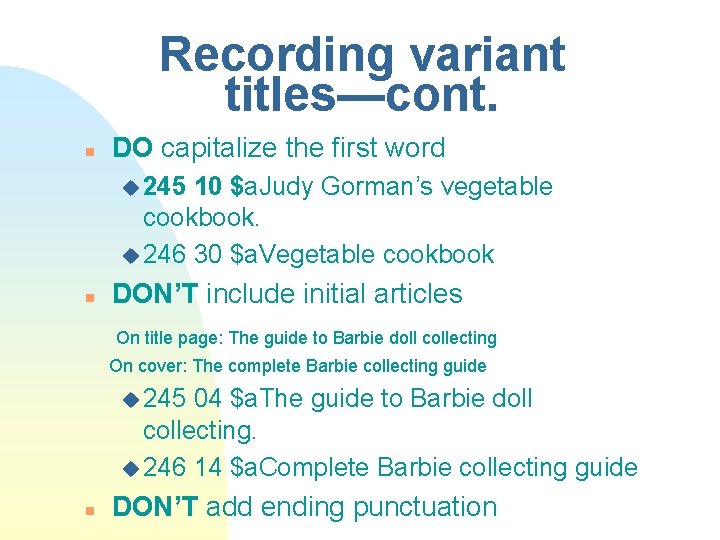
Recording variant titles—cont. n DO capitalize the first word u 245 10 $a. Judy Gorman’s vegetable cookbook. u 246 30 $a. Vegetable cookbook n DON’T include initial articles On title page: The guide to Barbie doll collecting On cover: The complete Barbie collecting guide u 245 04 $a. The guide to Barbie doll collecting. u 246 14 $a. Complete Barbie collecting guide n DON’T add ending punctuation
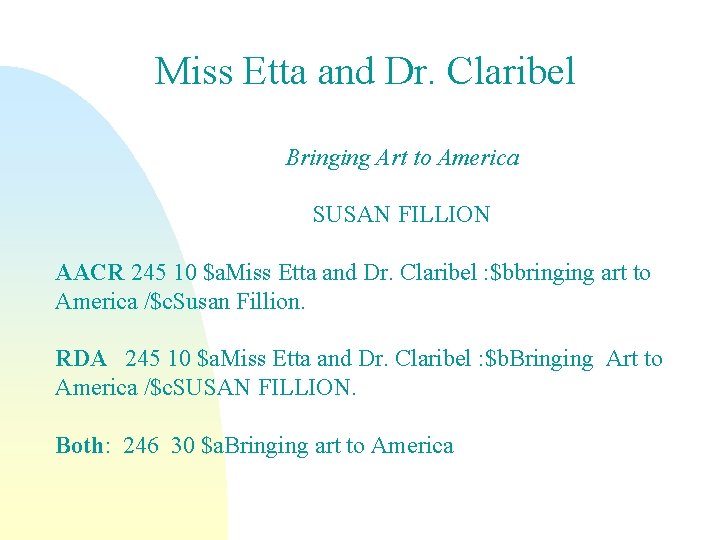
Miss Etta and Dr. Claribel Bringing Art to America SUSAN FILLION AACR 245 10 $a. Miss Etta and Dr. Claribel : $bbringing art to America /$c. Susan Fillion. RDA 245 10 $a. Miss Etta and Dr. Claribel : $b. Bringing Art to America /$c. SUSAN FILLION. Both: 246 30 $a. Bringing art to America
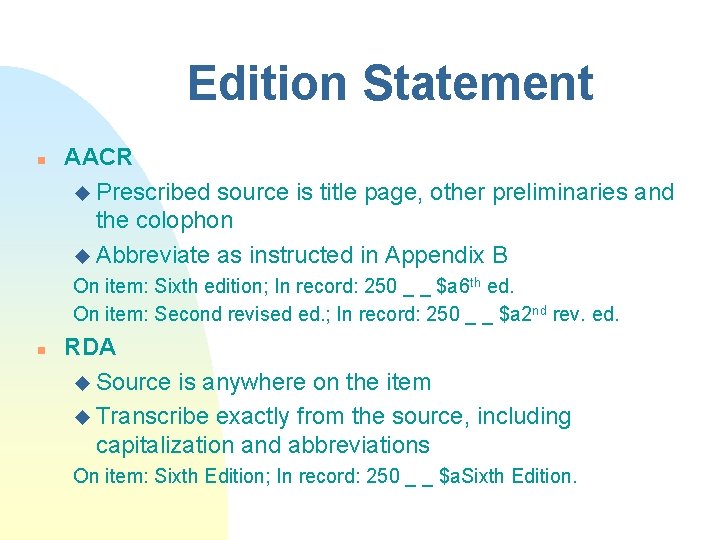
Edition Statement n AACR u Prescribed source is title page, other preliminaries and the colophon u Abbreviate as instructed in Appendix B On item: Sixth edition; In record: 250 _ _ $a 6 th ed. On item: Second revised ed. ; In record: 250 _ _ $a 2 nd rev. ed. n RDA u Source is anywhere on the item u Transcribe exactly from the source, including capitalization and abbreviations On item: Sixth Edition; In record: 250 _ _ $a. Sixth Edition.
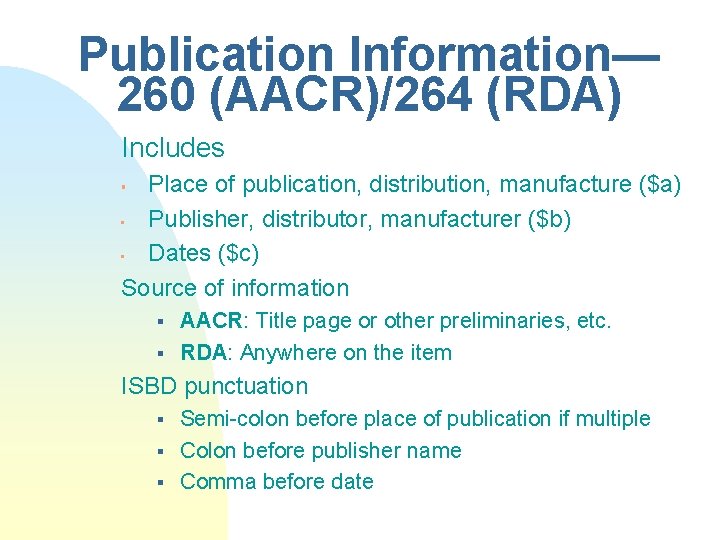
Publication Information— 260 (AACR)/264 (RDA) Includes Place of publication, distribution, manufacture ($a) • Publisher, distributor, manufacturer ($b) • Dates ($c) Source of information § § § AACR: Title page or other preliminaries, etc. RDA: Anywhere on the item ISBD punctuation § § § Semi-colon before place of publication if multiple Colon before publisher name Comma before date
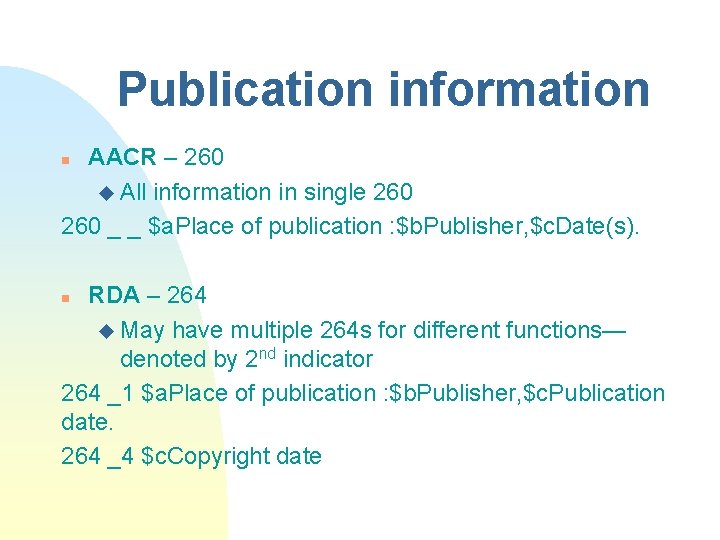
Publication information AACR – 260 u All information in single 260 _ _ $a. Place of publication : $b. Publisher, $c. Date(s). n RDA – 264 u May have multiple 264 s for different functions— denoted by 2 nd indicator 264 _1 $a. Place of publication : $b. Publisher, $c. Publication date. 264 _4 $c. Copyright date n
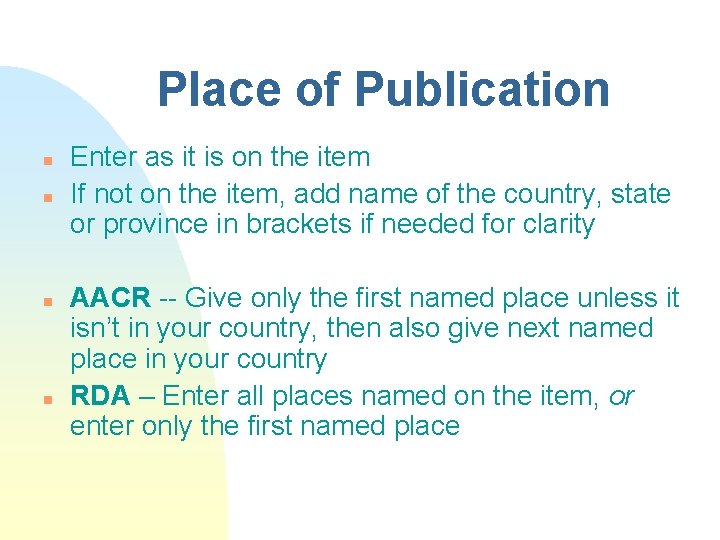
Place of Publication n n Enter as it is on the item If not on the item, add name of the country, state or province in brackets if needed for clarity AACR -- Give only the first named place unless it isn’t in your country, then also give next named place in your country RDA – Enter all places named on the item, or enter only the first named place
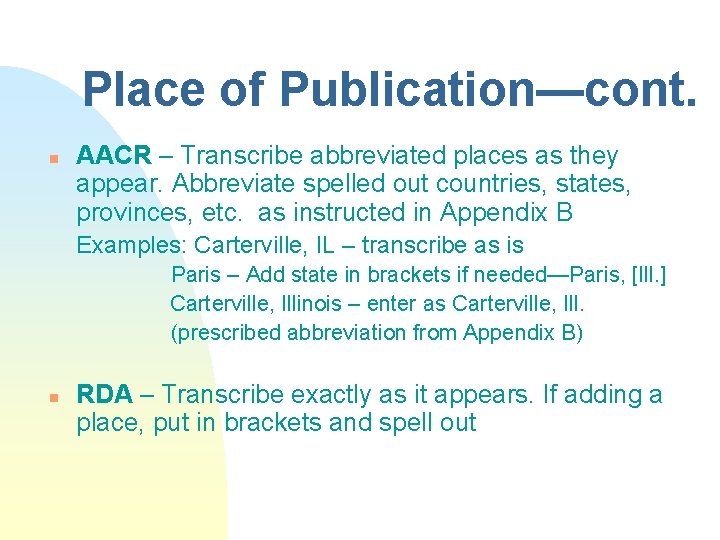
Place of Publication—cont. n AACR – Transcribe abbreviated places as they appear. Abbreviate spelled out countries, states, provinces, etc. as instructed in Appendix B Examples: Carterville, IL – transcribe as is Paris – Add state in brackets if needed—Paris, [Ill. ] Carterville, Illinois – enter as Carterville, Ill. (prescribed abbreviation from Appendix B) n RDA – Transcribe exactly as it appears. If adding a place, put in brackets and spell out
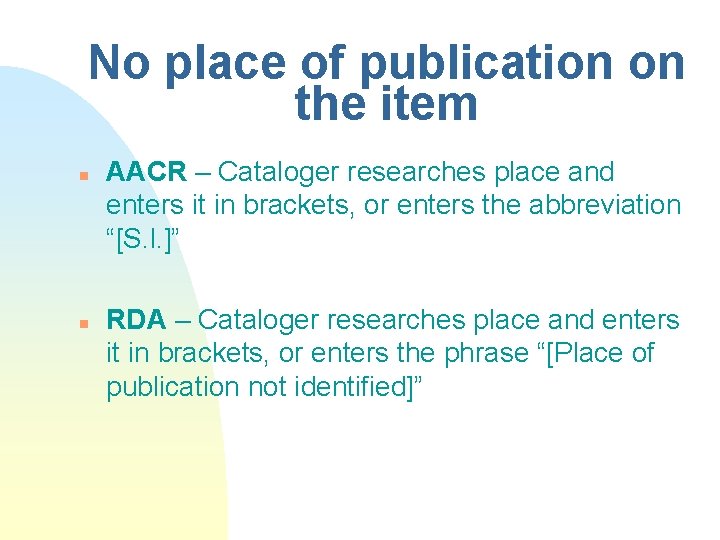
No place of publication on the item n n AACR – Cataloger researches place and enters it in brackets, or enters the abbreviation “[S. l. ]” RDA – Cataloger researches place and enters it in brackets, or enters the phrase “[Place of publication not identified]”
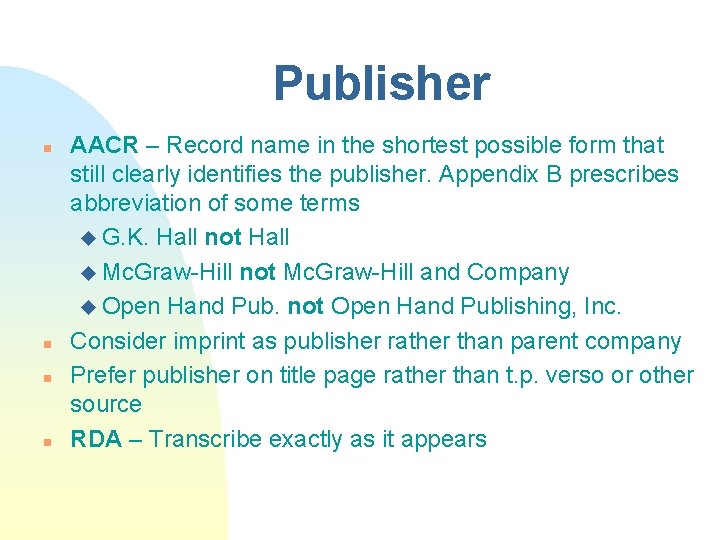
Publisher n n AACR – Record name in the shortest possible form that still clearly identifies the publisher. Appendix B prescribes abbreviation of some terms u G. K. Hall not Hall u Mc. Graw-Hill not Mc. Graw-Hill and Company u Open Hand Pub. not Open Hand Publishing, Inc. Consider imprint as publisher rather than parent company Prefer publisher on title page rather than t. p. verso or other source RDA – Transcribe exactly as it appears
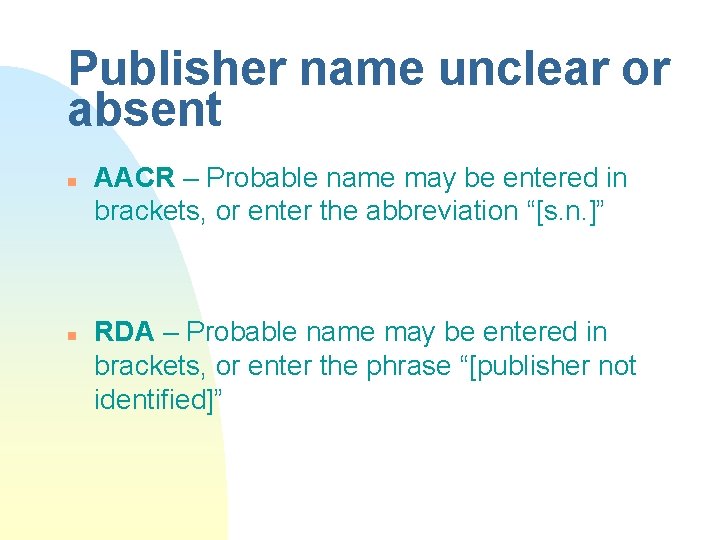
Publisher name unclear or absent n n AACR – Probable name may be entered in brackets, or enter the abbreviation “[s. n. ]” RDA – Probable name may be entered in brackets, or enter the phrase “[publisher not identified]”
Dates n n n Publication date -- most important – use the most recent publication date Copyright date -- may be added along with the publication date but not required AACR: If no pub. date, use the copyright date instead On item: no pub. date, copyright 2012. In record: $cc 2012. n RDA: Requires a pub. date. If no pub. date, use the copyright date as an implied pub. date, in brackets On item: no pub. date, copyright 2012. In record: $c[2012] n n Printing dates do not matter unless it is “first” printing Preceded by comma
Multiple Copyright Dates n When a copyright renewal date is present: u If the 1 st copyright date is before 1978, use the earliest and ignore renewals u If the 1 st copyright date is after 1977, use the latest copyright date n If multiple copyright dates with no renewal date, use the latest date
No date available on item n AACR – cataloger estimates a publication date u Entered in brackets Examples: [2010] [199 -? ]—probable decade [19 --? ]—probable century n RDA – cataloger estimates a date or enters the phrase “[date of publication not identified]”
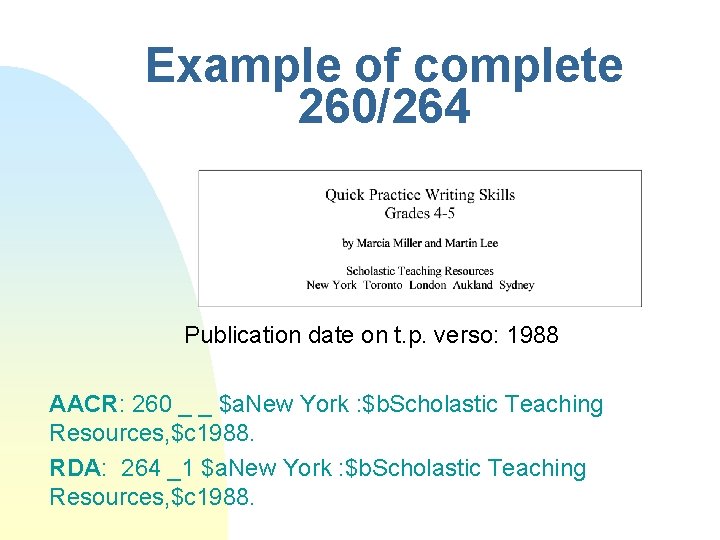
Example of complete 260/264 Publication date on t. p. verso: 1988 AACR: 260 _ _ $a. New York : $b. Scholastic Teaching Resources, $c 1988. RDA: 264 _1 $a. New York : $b. Scholastic Teaching Resources, $c 1988.
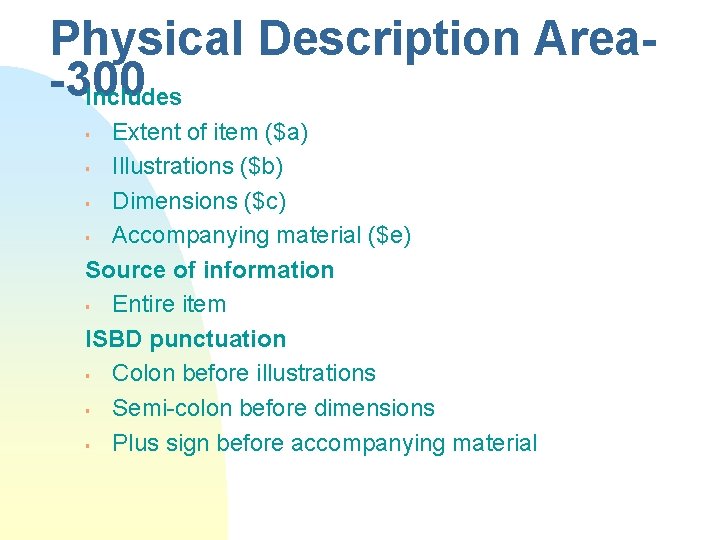
Physical Description Area-300 Includes Extent of item ($a) § Illustrations ($b) § Dimensions ($c) § Accompanying material ($e) Source of information § Entire item ISBD punctuation § Colon before illustrations § Semi-colon before dimensions § Plus sign before accompanying material §
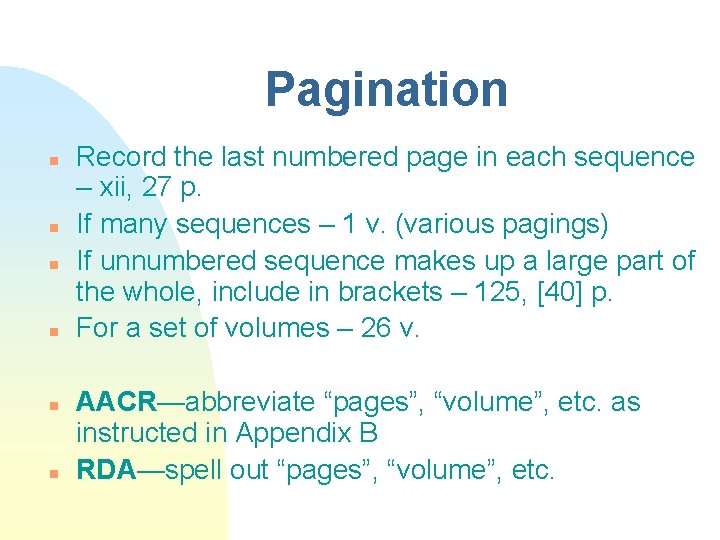
Pagination n n n Record the last numbered page in each sequence – xii, 27 p. If many sequences – 1 v. (various pagings) If unnumbered sequence makes up a large part of the whole, include in brackets – 125, [40] p. For a set of volumes – 26 v. AACR—abbreviate “pages”, “volume”, etc. as instructed in Appendix B RDA—spell out “pages”, “volume”, etc.
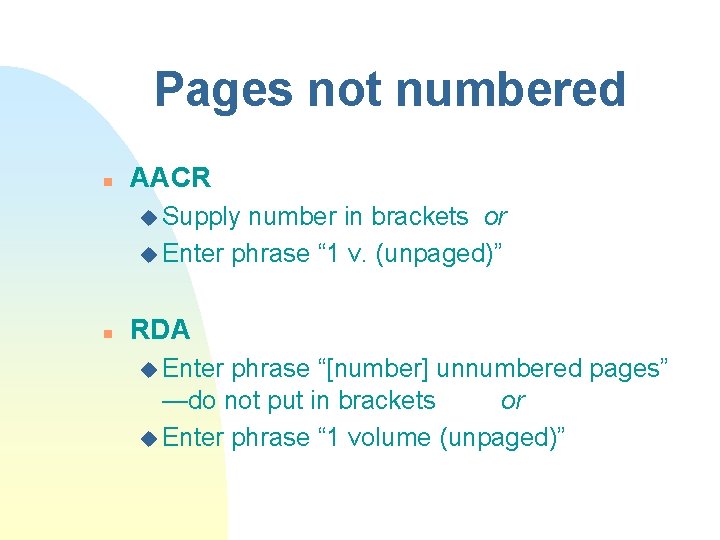
Pages not numbered n AACR u Supply number in brackets or u Enter phrase “ 1 v. (unpaged)” n RDA u Enter phrase “[number] unnumbered pages” —do not put in brackets or u Enter phrase “ 1 volume (unpaged)”
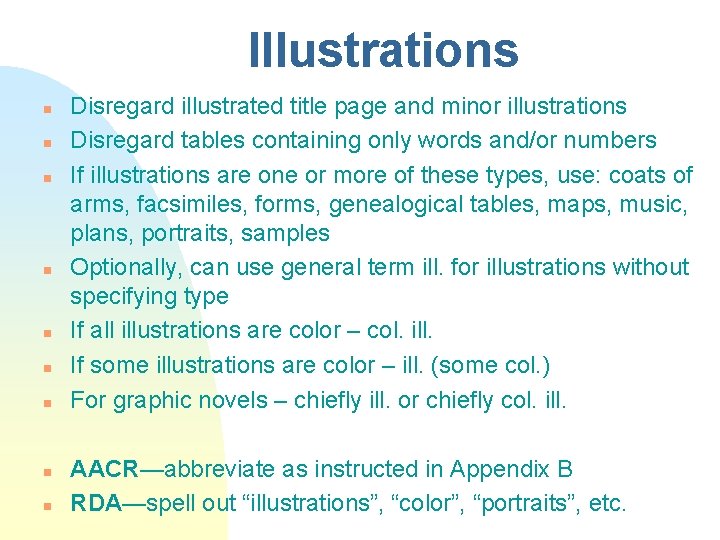
Illustrations n n n n n Disregard illustrated title page and minor illustrations Disregard tables containing only words and/or numbers If illustrations are one or more of these types, use: coats of arms, facsimiles, forms, genealogical tables, maps, music, plans, portraits, samples Optionally, can use general term ill. for illustrations without specifying type If all illustrations are color – col. ill. If some illustrations are color – ill. (some col. ) For graphic novels – chiefly ill. or chiefly col. ill. AACR—abbreviate as instructed in Appendix B RDA—spell out “illustrations”, “color”, “portraits”, etc.
Dimensions n n n Give height in centimeters Always round up If width is greater than height, give both height and width – 18 x 30 cm. If width is less than half the height, give both height and width – 24 x 11 cm. AACR—period follows cm—considered an abbreviation RDA—cm considered a symbol, not abbreviation u Period after cm only if 300 is followed by 490
Accompanying Material n Give details as you would describe the item in an individual record u 300 _ _ $a 450 p. : $bcol. ill. ; $c 28 cm. +$e 1 videodisc (32 min. : sd. , col. ; 4 ¾ in. ) u 300 _ _ $a 50 p. : $bill. , maps, ports. ; $c 30 cm. +$e 1 teacher’s guide (10 p. : ill. ; 18 cm. )
MARC tags 3 XX—RDA only 336 337 338 344 346 347 380 Content type Media type Carrier type Sound characteristics Video characteristics Digital file characteristics Form of work
Series— 490/8 XX Includes Series statement ($a) • Series numbering ($v) Source of information § § Title page Series title page The rest of the publication—cover, etc. ISBD punctuation § Semi-colon before series numbering
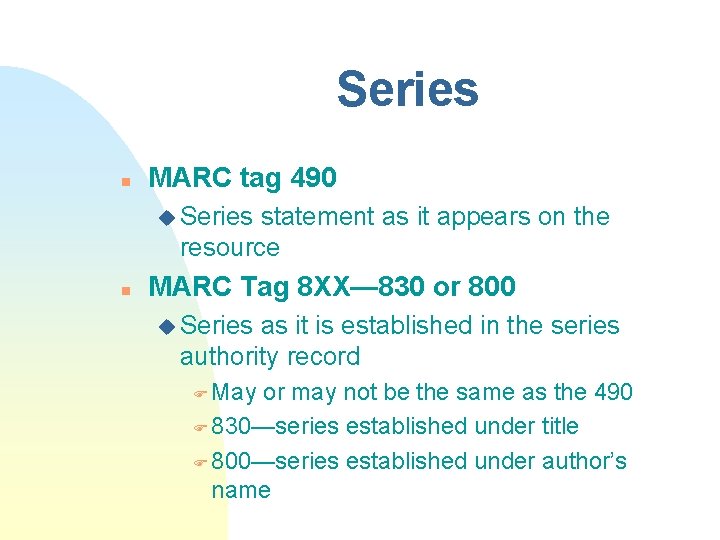
Series n MARC tag 490 u Series statement as it appears on the resource n MARC Tag 8 XX— 830 or 800 u Series as it is established in the series authority record F May or may not be the same as the 490 F 830—series established under title F 800—series established under author’s name
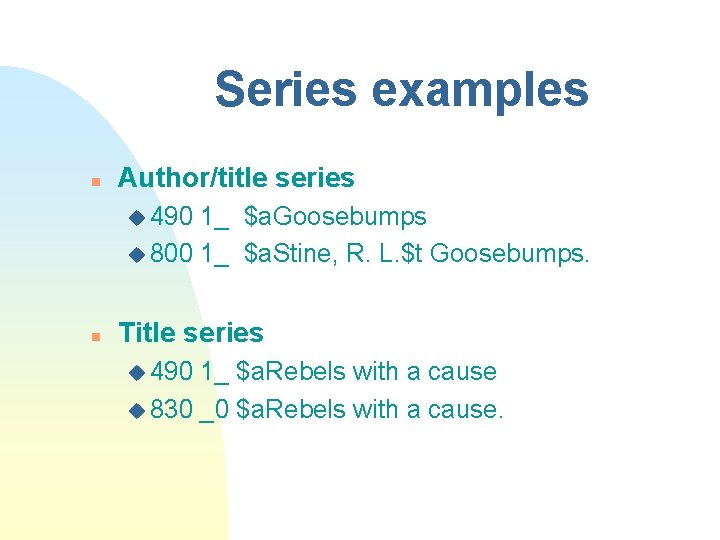
Series examples n Author/title series u 490 1_ $a. Goosebumps u 800 1_ $a. Stine, R. L. $t Goosebumps. n Title series u 490 1_ $a. Rebels with a cause u 830 _0 $a. Rebels with a cause.
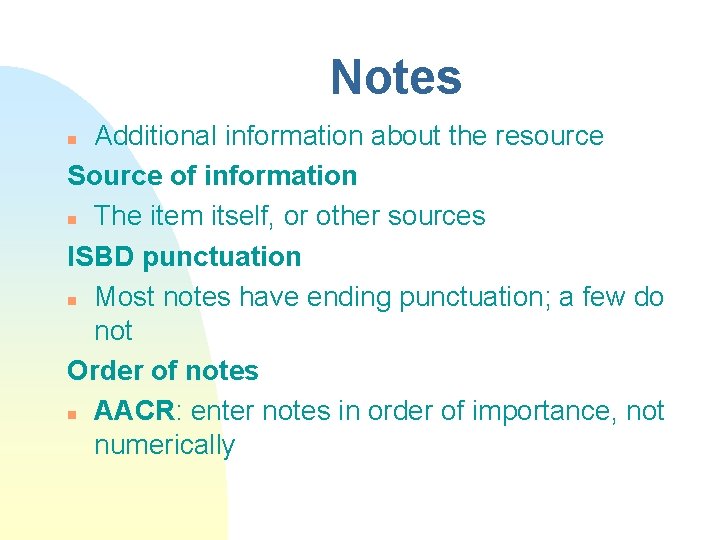
Notes Additional information about the resource Source of information n The item itself, or other sources ISBD punctuation n Most notes have ending punctuation; a few do not Order of notes n AACR: enter notes in order of importance, not numerically n
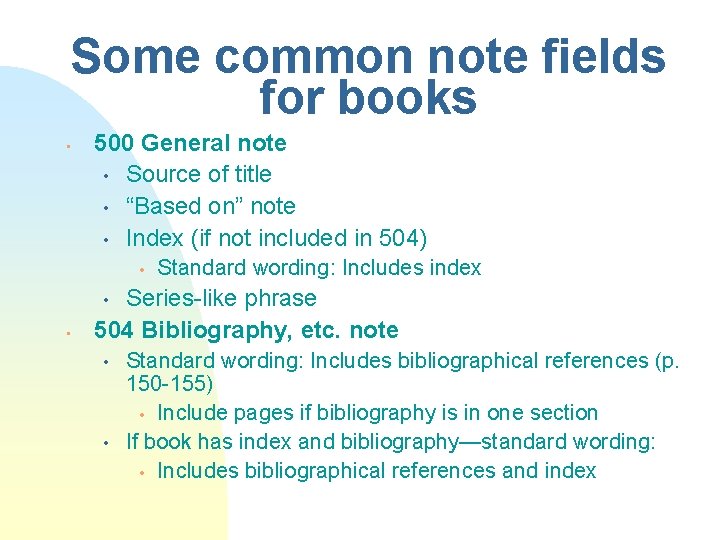
Some common note fields for books • 500 General note • Source of title • “Based on” note • Index (if not included in 504) • Standard wording: Includes index Series-like phrase 504 Bibliography, etc. note • • Standard wording: Includes bibliographical references (p. 150 -155) • Include pages if bibliography is in one section If book has index and bibliography—standard wording: • Includes bibliographical references and index
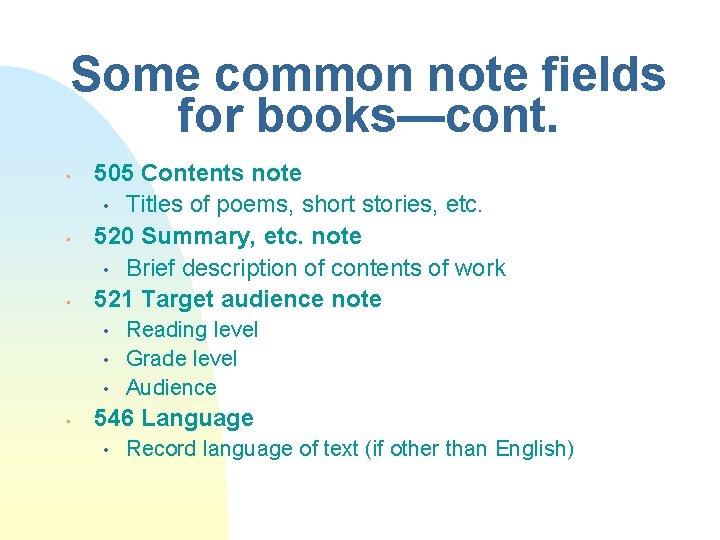
Some common note fields for books—cont. • • • 505 Contents note • Titles of poems, short stories, etc. 520 Summary, etc. note • Brief description of contents of work 521 Target audience note • • Reading level Grade level Audience 546 Language • Record language of text (if other than English)

Quoted notes--500 n n Direct quote from item If taken from title page, end with period inside closing quotation mark u “A n Borzoi book. ” If taken from elsewhere on item, give source, end with period u “Based on a true story”—Cover.
Subject headings n Terms that describe what the work is about u Topical u Geographic u Names u Genre n MARC tags that start with 6
Standard Numbers n n n 010 -Library of Congress Control Number (LCCN) 020 -International Standard Book Number (ISBN) 050, 090, 082, 092 Call numbers
Other MARC tags n 041 – Language code u Coded n information on languages noted in 546 043 – Geographic area code u Coded information on geographic areas noted in subject headings
Fixed Fields n n n Will always be present in the record, but may or may not contain data Will only accept data that is valid for that field Different formats of material have different fixed fields Data can be used to limit searches Some are system-supplied; some are coded from data in the variable fields
Access Points n Names or terms used to locate the resource u. Main entry u. Added entries u. Title (title proper & variants) u. Series u. Subjects u. Standard numbers u. Keyword
Choosing the Main Entry n n n The first author should be recorded as the main entry Other authors get added entries unless more than three authors Adapters are given main entry Illustrators, compilers, editors and translators can also get added entries If no author is given, use title main entry. Compilers and editors aren’t given main entry; record in added entry RDA records access points, but doesn’t have equivalent terminology for main and added entry
Form of Name Access Points n n Form of name is entered in access point as established in an authority record or using guidelines in AACR 2 or RDA if no authority record exists. We look at OCLC or LC Authority File for correct form Standard format: Last name, first name, possible middle name or initial, dates associated with the name
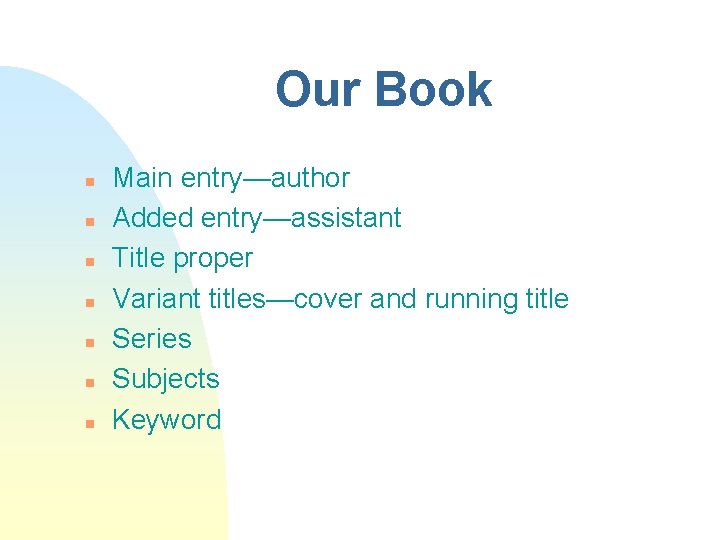
Our Book n n n n Main entry—author Added entry—assistant Title proper Variant titles—cover and running title Series Subjects Keyword
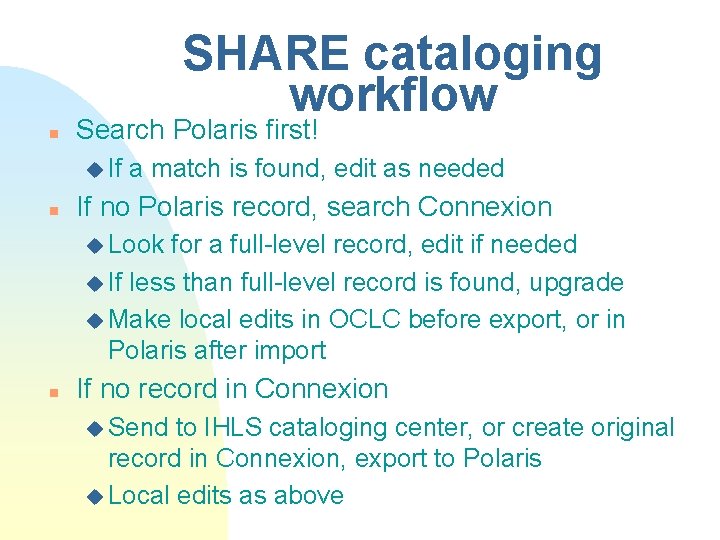
SHARE cataloging workflow n Search Polaris first! u If n a match is found, edit as needed If no Polaris record, search Connexion u Look for a full-level record, edit if needed u If less than full-level record is found, upgrade u Make local edits in OCLC before export, or in Polaris after import n If no record in Connexion u Send to IHLS cataloging center, or create original record in Connexion, export to Polaris u Local edits as above
- Slides: 60