
Bony Fish Internal Body Anatomy S Internal Parts
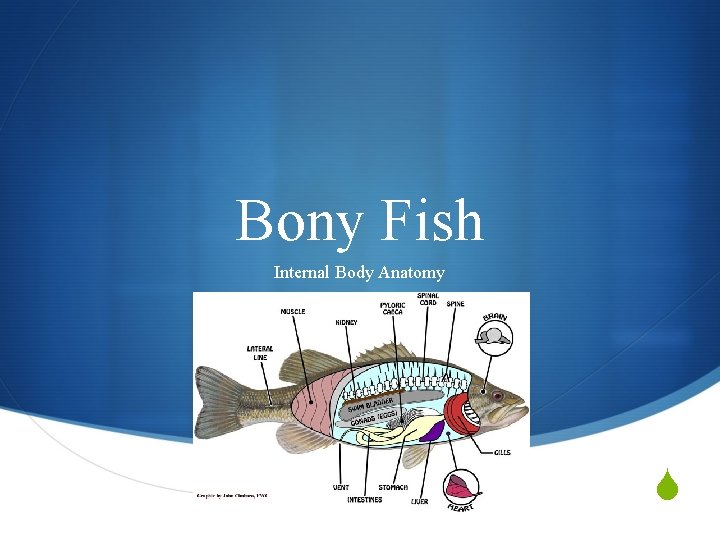
Bony Fish Internal Body Anatomy S

Internal Parts of Fish S Spine S Stomach S Spinal Cord S Intestines S Brain S Pyloric Caeca S Swim/Air Bladder S Vent S Gills S Liver S Kidney S Heart S Gonads S Muscles

Spine S The primary structural framework upon which the fish's body is built S connects to the skull at the front of the fish and to the tail at the rear. S The spine is made up of numerous vertebrae S which are hollow and house and protect the delicate spinal cord.
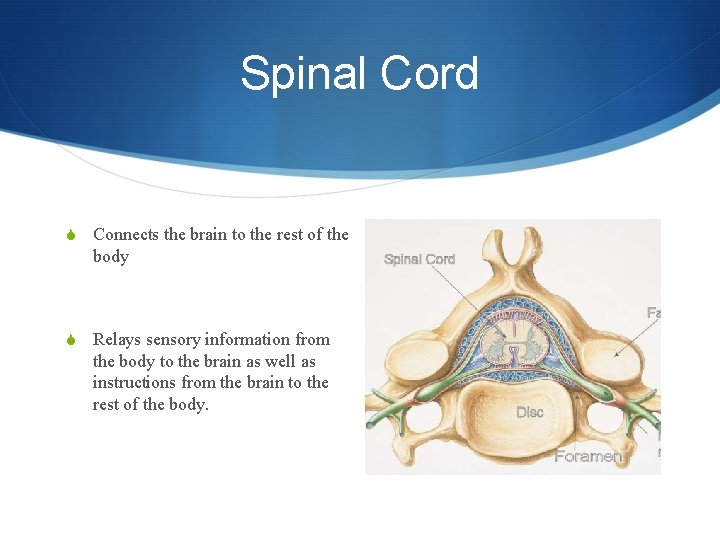
Spinal Cord S Connects the brain to the rest of the body S Relays sensory information from the body to the brain as well as instructions from the brain to the rest of the body.
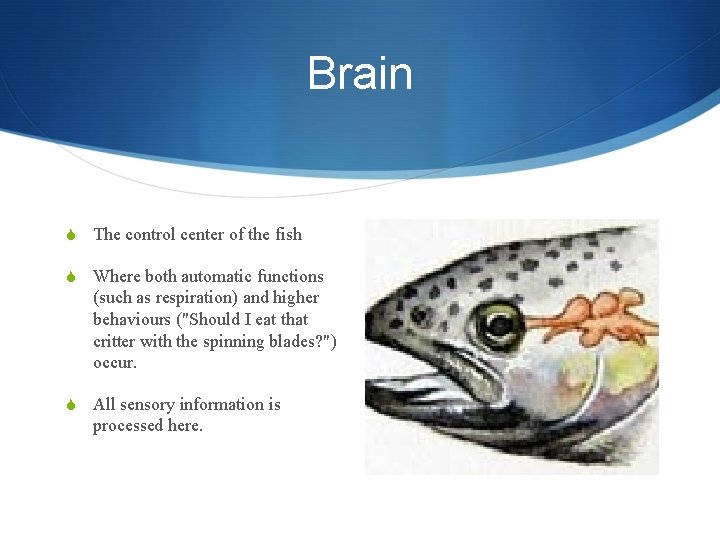
Brain S The control center of the fish S Where both automatic functions (such as respiration) and higher behaviours ("Should I eat that critter with the spinning blades? ") occur. S All sensory information is processed here.

Lateral Line S One of the fish's primary sense organs S Detects underwater vibrations and is capable of determining the direction of their source.

Air/Swim Bladder S A hollow, gas-filled balance organ that allows a fish to conserve energy by maintaining neutral buoyancy (suspending) in water. S Fish caught from very deep water sometimes need to have air released from their swim bladder before they can be released and return to deep water, due to the difference in atmospheric pressure at the water's surface. S Species of fish that do not possess a swim bladder sink to the bottom if they stop swimming.

Gills S Allow a fish to breathe underwater. These are very delicate structures and should not be touched by hand.
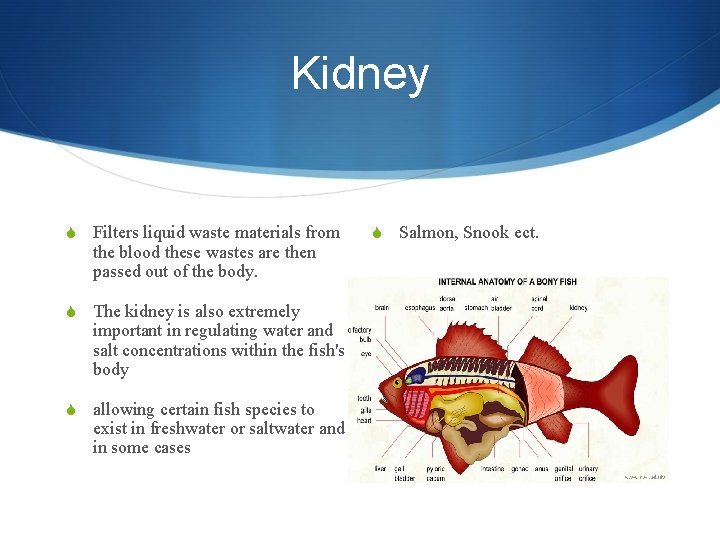
Kidney S Filters liquid waste materials from the blood these wastes are then passed out of the body. S The kidney is also extremely important in regulating water and salt concentrations within the fish's body S allowing certain fish species to exist in freshwater or saltwater and in some cases S Salmon, Snook ect.
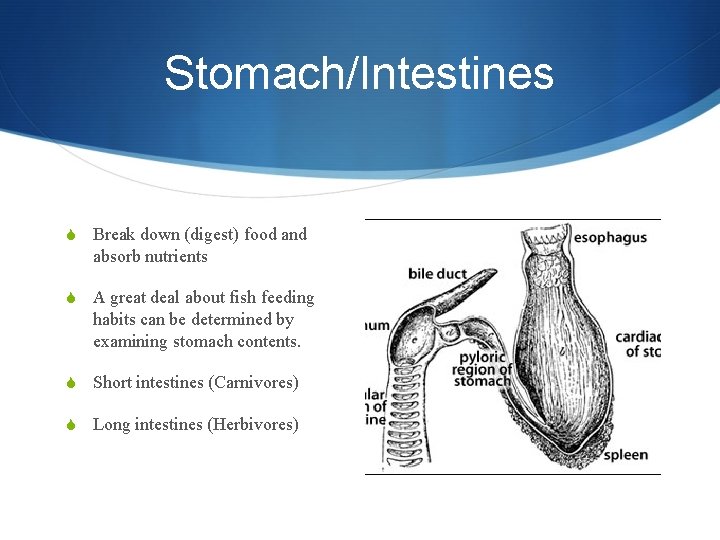
Stomach/Intestines S Break down (digest) food and absorb nutrients S A great deal about fish feeding habits can be determined by examining stomach contents. S Short intestines (Carnivores) S Long intestines (Herbivores)

Pyloric Caeca S This organ with finger like projections is located near the junction of the stomach and the intestines. S Its function is not entirely understood, but it is known to secrete enzymes that aid in digestion, may function to absorb digested food, or do both.

Vent S The site of waste elimination from the fish's body. S Also known as the Anal Vent
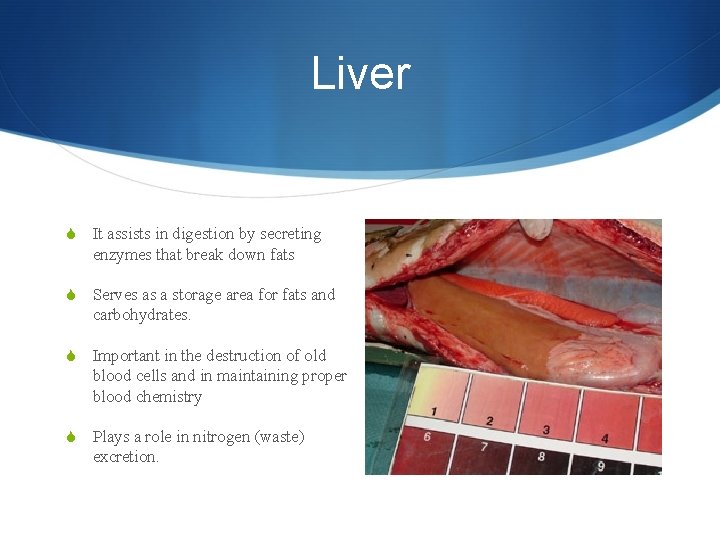
Liver S It assists in digestion by secreting enzymes that break down fats S Serves as a storage area for fats and carbohydrates. S Important in the destruction of old blood cells and in maintaining proper blood chemistry S Plays a role in nitrogen (waste) excretion.
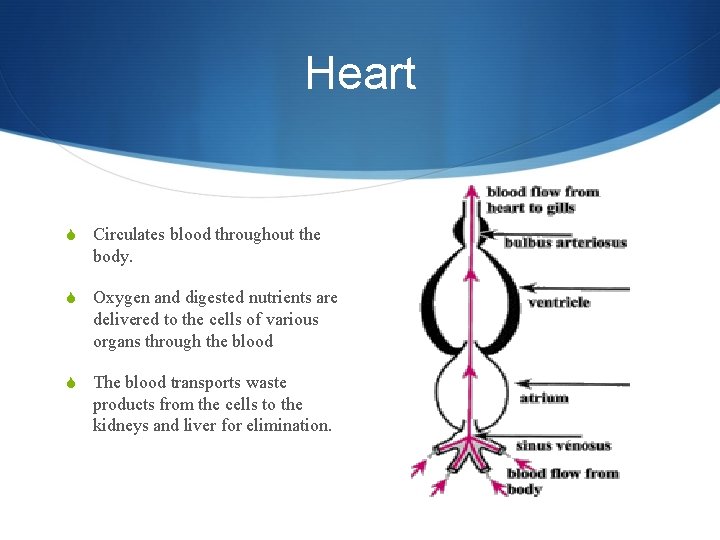
Heart S Circulates blood throughout the body. S Oxygen and digested nutrients are delivered to the cells of various organs through the blood S The blood transports waste products from the cells to the kidneys and liver for elimination.
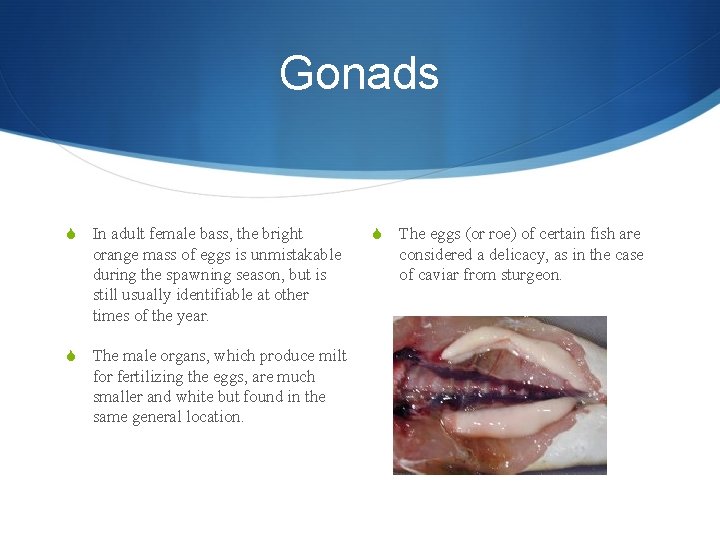
Gonads S In adult female bass, the bright orange mass of eggs is unmistakable during the spawning season, but is still usually identifiable at other times of the year. S The male organs, which produce milt for fertilizing the eggs, are much smaller and white but found in the same general location. S The eggs (or roe) of certain fish are considered a delicacy, as in the case of caviar from sturgeon.
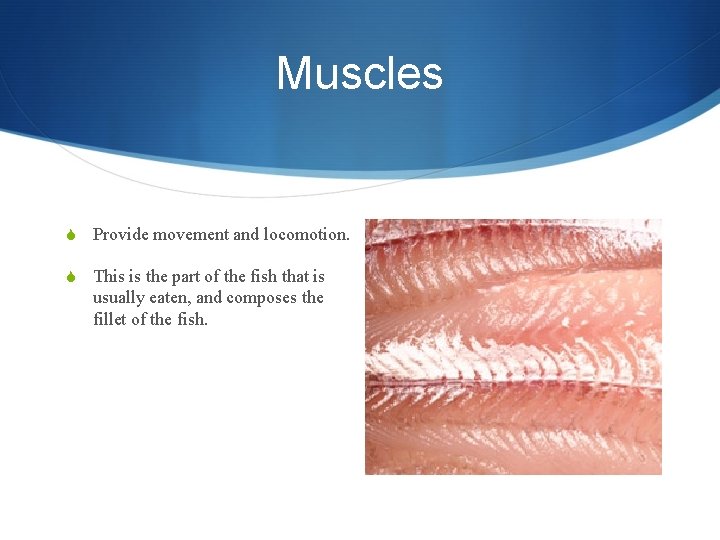
Muscles S Provide movement and locomotion. S This is the part of the fish that is usually eaten, and composes the fillet of the fish.
- Slides: 16