
Bonham chapter 8 Knowledge Management 1 Knowledge Management
Bonham, chapter 8 Knowledge Management 1
Knowledge Management p p 8. 1 8. 2 8. 3 8. 4 n n p Success Levels Externally Focused KM Internally Focused KM PMO-Supported KM 8. 4. 1 8. 4. 2 8. 4. 3 8. 4. 4 Personal KM Project KM The KM Team Organizational Support and Rollout 8. 5 Summary 2
Knowledge Management p In this age of information, knowledge is one of the most powerful tools for success p Companies that know how to n n n p get it, manipulate it, and use it the fastest stand to win their market races. Not only is it important to manage to the highest level of KM success, it is also important to leverage the forms of KM that best fit your company. 3
Knowledge Management (KM) p PATH: How firm: n n n Gathers its knowledge Learns from this knowledge Implements business initiatives from this knowledge p DEFINITION depends on industry, situation, strategy. p PROCESS: n n Identify business competencies enhanced by KM Develop knowledge strategies to fit them 4
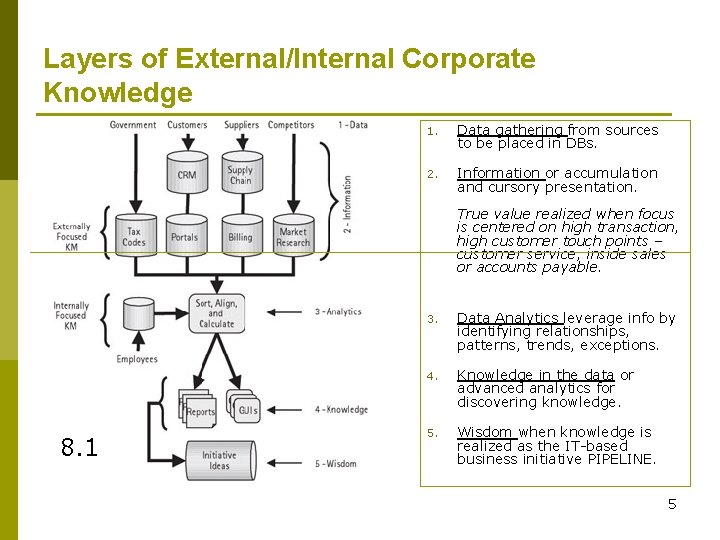
Layers of External/Internal Corporate Knowledge 1. Data gathering from sources to be placed in DBs. 2. Information or accumulation and cursory presentation. True value realized when focus is centered on high transaction, high customer touch points – customer service, inside sales or accounts payable. 8. 1 3. Data Analytics leverage info by identifying relationships, patterns, trends, exceptions. 4. Knowledge in the data or advanced analytics for discovering knowledge. 5. Wisdom when knowledge is realized as the IT-based business initiative PIPELINE. 5
PMO-Supported Knowledge Management Provides structure and organization to the unending flow of knowledge between projects p Two areas in which an IT PMO can apply KM to support the project portfolio are project knowledge bases and personal training: n n Personal training p (is ultimately the responsibility of the individual employees) p PMOs can provide training options geared towards projects p PMOs can provide direction for all project-specific training Project knowledge bases on all projects and on each ongoing projects – p repository of knowledge about: § § § n Technology Business relationships Corporate needs Best practices Sources of expertise. Must code to make metadata of all input to project/central Knowledge Bases 6
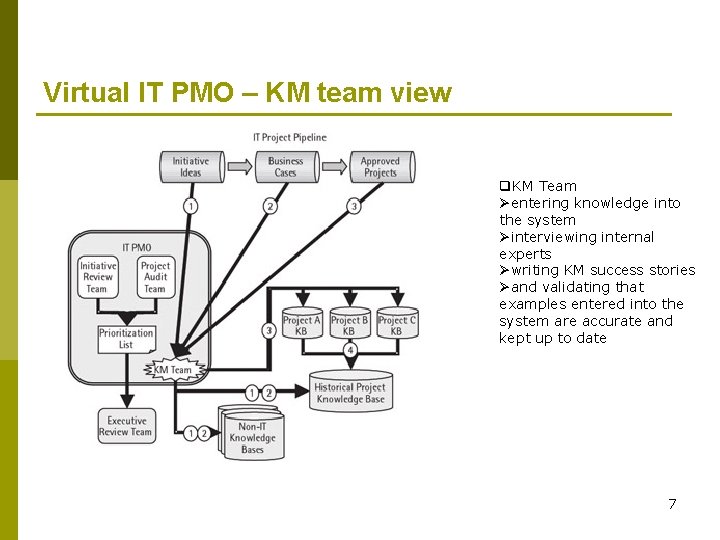
Virtual IT PMO – KM team view q. KM Team Øentering knowledge into the system Øinterviewing internal experts Øwriting KM success stories Øand validating that examples entered into the system are accurate and kept up to date 7
KM Organizational Support and Rollout p KM must have clear n n p executive support & end-user buy in. Requirements for KM Success 1. Money Trail. Keep track of what K data is used to support which projects. 2. More out than in. User must use it more than feed it. 3. Recognition. Users who feed it must get recognition for work done. 4. Reliability. All audit type data, time line data must be: 1. 2. Accurate Dependable 8
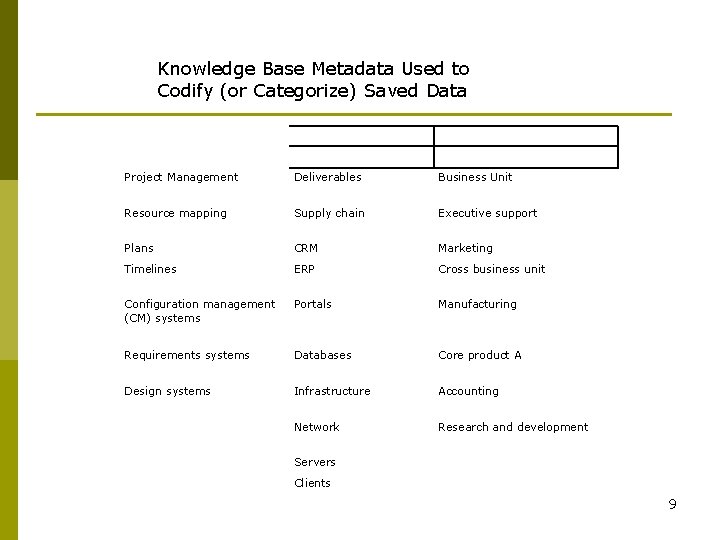
Knowledge Base Metadata Used to Codify (or Categorize) Saved Data Project Management Deliverables Business Unit Resource mapping Supply chain Executive support Plans CRM Marketing Timelines ERP Cross business unit Configuration management (CM) systems Portals Manufacturing Requirements systems Databases Core product A Design systems Infrastructure Accounting Network Research and development Servers Clients 9
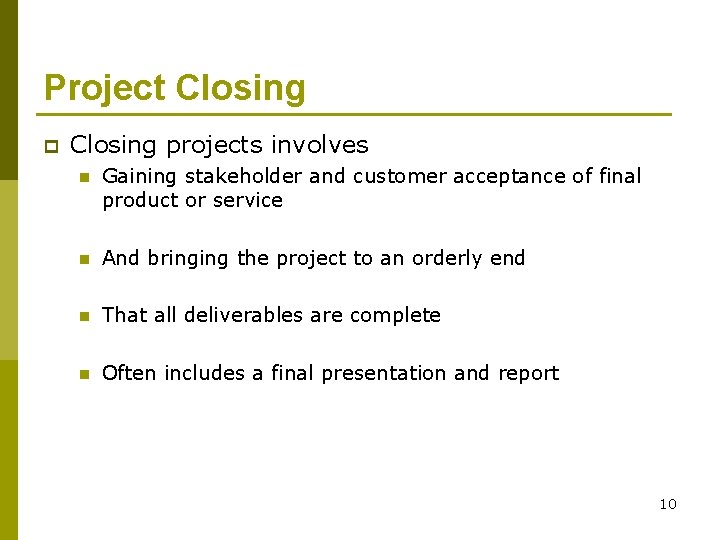
Project Closing projects involves n Gaining stakeholder and customer acceptance of final product or service n And bringing the project to an orderly end n That all deliverables are complete n Often includes a final presentation and report 10
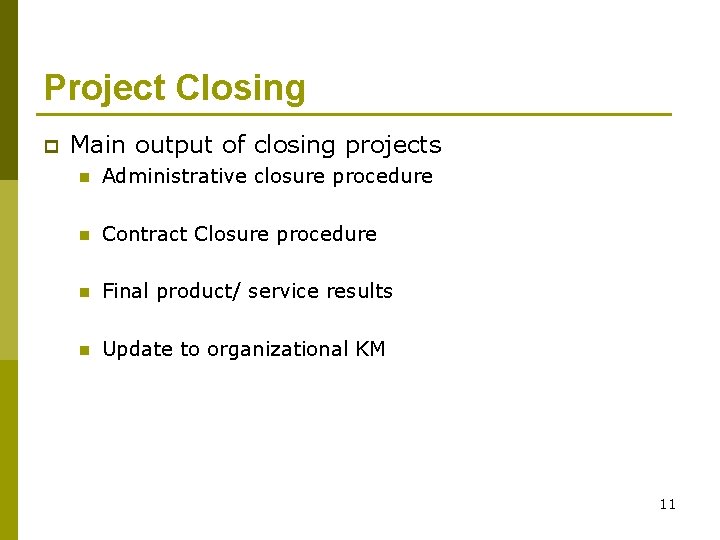
Project Closing p Main output of closing projects n Administrative closure procedure n Contract Closure procedure n Final product/ service results n Update to organizational KM 11
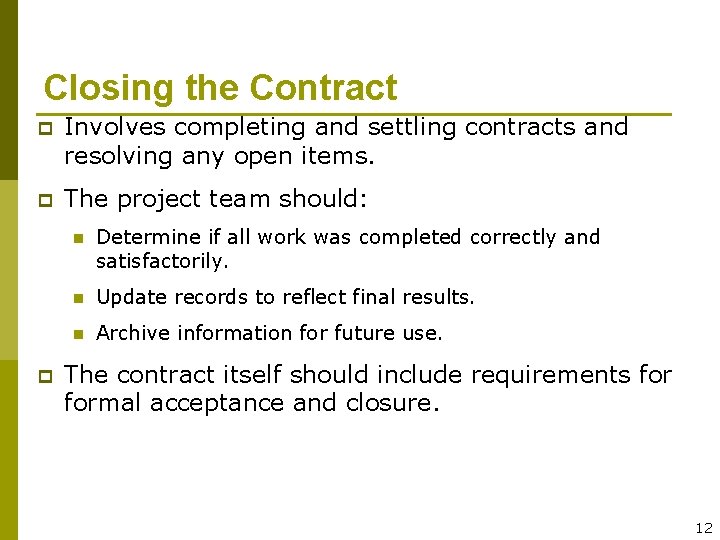
Closing the Contract p Involves completing and settling contracts and resolving any open items. p The project team should: p n Determine if all work was completed correctly and satisfactorily. n Update records to reflect final results. n Archive information for future use. The contract itself should include requirements formal acceptance and closure. 12
PM Summary 13
Project Initiation p Initiating a project includes recognizing and starting a new project or project phase. p Some organizations use a pre-initiation phase, while others include items such as developing a business case as part of the initiation. p The main goal is to formally select and start off projects. p Key outputs include: n n Assigning the project manager. Identifying key stakeholders. Completing a business case. Completing a project charter and getting signatures on it. 14
Project Planning p The main purpose of project planning is to guide execution. n p Every knowledge area includes planning information Key outputs include: n n n A team contract. A scope statement. A work breakdown structure (WBS). A project schedule, in the form of a Gantt chart with all dependencies and resources entered. A list of prioritized risks (part of a risk register). 15
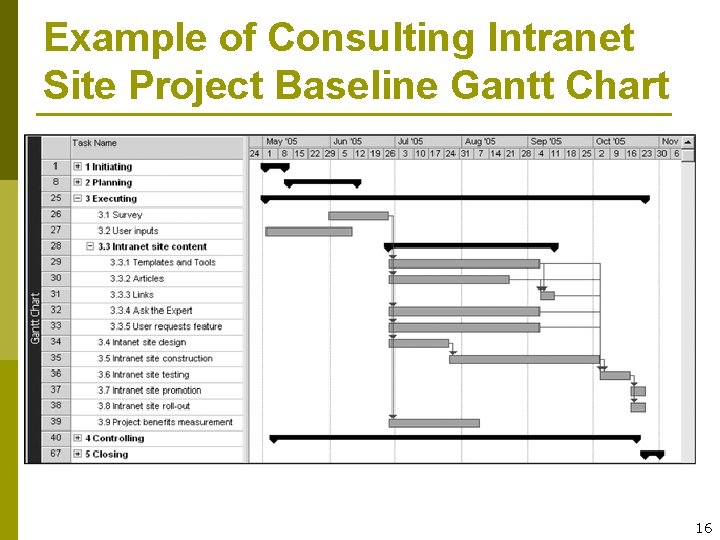
Example of Consulting Intranet Site Project Baseline Gantt Chart 16
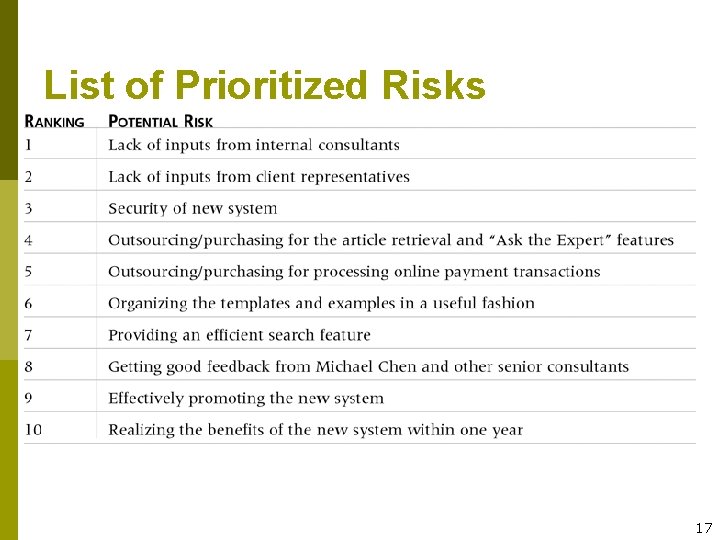
List of Prioritized Risks 17
Project Executing p Project execution usually takes the most time and resources. p Project managers must use their leadership skills to handle the many challenges that occur during project execution. p lists the executing processes and outputs. Many project sponsors and customers focus on deliverables related to providing the products, services, or results desired from the project. p A milestone report (see example on page 100) can keep the focus on completing major milestones. 18
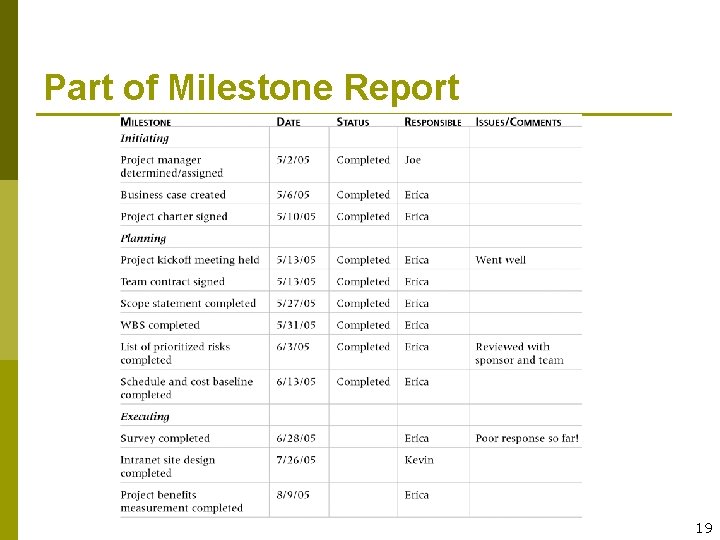
Part of Milestone Report 19
Project Monitoring and Controlling p Involves measuring progress toward project objectives, monitoring deviation from the plan, and taking corrective action to match progress with the plan. p Affects all other process groups and occurs during all phases of the project life cycle. p Outputs include performance reports, requested changes, and updates to various plans. 20
Project Closing p Involves gaining stakeholder and customer acceptance of the final products and services. p Even if projects are not completed, they should be formally closed in order to reflect on what can be learned to improve future projects. p Outputs include project archives and lessons learned, which are part of organizational process assets. p Most projects also include a final report and presentation to the sponsor or senior management. 21
Summary p The five project management process groups are initiating, planning, executing, monitoring and controlling, and closing. p You can map the main activities of each process group to the nine knowledge areas. p Some organizations develop their own information technology project management methodologies. p It is important to have records of project documents. 22
- Slides: 22